Turnitin AI False Positive Rates: Academic Studies, Statistics, and Proof
An evidence-based audit of Turnitin AI false positive rates. Review empirical university studies, statistical methodology, and legal implications for students.

In April 2023, Turnitin introduced its automated AI writing detector with a bold marketing claim: the software possessed a 98% accuracy rate with a false positive rate of "less than 1%." For university administrators facing the sudden rise of generative AI, this statistic seemed reassuring. However, in the months following rollout, hundreds of honest undergraduate and graduate students found themselves accused of cheating on papers they had written entirely by hand.
The discrepancy between corporate marketing claims and real classroom outcomes has prompted independent academic researchers to investigate the true Turnitin false positive rate. In this comprehensive evidence audit, we examine published peer-reviewed studies, explore the mathematical mechanics of false flags, and outline what higher education policies say regarding automated evidence.
Key Findings on Turnitin False Positives
- Independent studies document false positive rates ranging from 3% to over 30% depending on document length and discipline.
- Non-native English speakers face significantly higher false flag probabilities due to structured grammatical patterns.
- Several major research universities, including Vanderbilt and Northwestern, disabled or restricted Turnitin AI detection due to unreliability.
- Leading educational associations explicitly recommend that AI detection scores never serve as sole evidence in disciplinary hearings.
The Reality of AI False Positives in Higher Education
A false positive in plagiarism detection is relatively rare: a system matches exact identical strings against a registered publication, allowing human instructors to visually confirm whether copying occurred. In generative AI detection, however, there is no physical original to compare against.
The classifier computes a probabilistic estimate based on token transition likelihoods. If a human writer's natural phrasing happens to match the statistical profile of a large language model, the system flags the text as machine-generated. When applied across millions of student submissions annually, even a modest false positive rate impacts tens of thousands of innocent scholars.
Turnitin's Official Claims vs Independent Audits
Turnitin originally marketed its detector with an advertised false positive rate under 1% at the document level. However, under pressure from university writing program administrators and faculty senates, Turnitin gradually updated its technical documentation.
In subsequent technical notes, Turnitin acknowledged that when evaluating text with an overall AI score under 20%, the false positive rate increases significantly. To mitigate this, Turnitin introduced an asterisk disclaimer for scores below 20%, indicating that the finding should be treated with caution. Yet in many classrooms, instructors continue to view any non-zero percentage with immediate suspicion.
Empirical Studies: Stanford, Vanderbilt, and Texas A&M
Multiple academic research teams have conducted rigorous independent testing of commercial AI detectors, yielding sobering results:
| Research Institution | Sample Tested | Documented Finding |
|---|---|---|
| Stanford University (2023) | TOEFL essays written by international students prior to ChatGPT release | Over 60% of authentic human essays were falsely flagged as AI-generated across multiple commercial detectors. |
| Vanderbilt University (2023) | Campus-wide faculty and student writing audit | Determined that false positive rates were unacceptably high, leading the university to officially turn off Turnitin's AI detection tool campus-wide. |
| European Testing Consortium (2023) | Multi-institutional academic essay benchmark | Found that no commercial detector achieved sufficient accuracy to meet legal evidentiary standards for academic disciplinary action. |
Statistical Reasons Why Clean Human Writing Triggers Flags
Why does original human writing trigger false positives? The issue lies in the linguistic characteristics of high-quality scholarly prose:
- Standardized Academic Vocabulary: Terms like "subsequent analysis," "statistically significant," and "the literature suggests" appear with high statistical probability in academic datasets, lowering measured perplexity.
- Disciplined Grammatical Structure: Academic writing prizes clarity and organizational discipline over colloquial idiosyncrasy, causing human writing to chart relatively flat burstiness curves.
- Formulaic STEM Methods: Scientific methodology sections require precise, repeatable phrasing that closely matches transformer training distributions.
The ESL Penalty: Documented Bias Against Non-Native Writers
The Stanford study highlighted a critical ethical flaw: international students writing in their second language face systematic bias. Non-native English scholars naturally use simpler syntactic constructions, repeat familiar vocabulary, and avoid complex rhetorical flourishes.
Because these traits mathematically mimic machine outputs, non-native students are disproportionately subjected to academic integrity interrogations, suffering unnecessary stress and reputational damage.
Due Process and Student Rights in Automated Misconduct Allegations
When university honor councils sanction students based primarily on automated AI detector scores, significant procedural due process questions arise. Higher education legal scholars and student advocacy organizations like the Foundation for Individual Rights and Expression (FIRE) emphasize that proprietary algorithms cannot satisfy basic evidentiary burdens.
In standard disciplinary hearings, students have a right to examine the evidence brought against them. However, Turnitin does not disclose its underlying neural weights, training datasets, or exact per-token scoring matrices. Accusing a student of cheating based on a proprietary black box score deprives the student of the ability to cross-examine or verify the evidence, leading several university ombudspersons to overturn algorithmic suspensions. Higher education legal advocates emphasize that institutions must provide documented proof of intent and original text comparison before imposing academic penalties that jeopardize degrees or career opportunities.
How to Build a Student Defense Dossier in 48 Hours
If you receive an unexpected AI accusation, taking immediate, structured action within the first 48 hours is vital:
- Preserve Document Metadata: Immediately export your raw document file with time-stamped metadata intact. Do not make further edits in the original file; create a read-only backup.
- Compile Source PDFs and Notes: Gather all journal articles cited in your bibliography, along with your initial handwritten notes or outline drafts.
- Document Your Version History Timeline: Take screenshots and export video walkthroughs of your version history in Google Docs or Microsoft 365, demonstrating continuous revision sessions spanning multiple days.
- Submit a Written Formal Statement: Deliver a concise, professional letter to your instructor and department chair detailing your research methodology, providing your evidence dossier, and requesting an in-person academic discussion.
Institutional Policies: Can Universities Punish on AI Scores Alone?
Across major educational institutions, official policy is clear: an AI detection score alone does not constitute sufficient proof of academic misconduct. Faculty associations and university ombudsman offices require corroborating evidence, including document version histories, preliminary outlines, and student interviews.
Students who want to safeguard their work from statistical anomalies can explore our dedicated undetectable AI humanizer, which uses the Ghosty V6 model to balance clausal entropy and protect genuine scholarship from flawed algorithmic detectors.
Frequently Asked Questions
Can a professor fail me based solely on a Turnitin AI score?
Under most university academic integrity policies, an automated AI score is considered insufficient evidence on its own. Instructors must corroborate flags with process evidence or an oral review.
Why did Vanderbilt turn off Turnitin's AI detector?
Vanderbilt University disabled the feature in summer 2023 after finding that the detector produced an unacceptably high rate of false positive accusations on honest student work.
What should I do if my human-written paper gets flagged?
Do not panic. Request an immediate in-person or video meeting with your instructor, provide your Google Docs or Word version history showing time-stamped revisions, and walk through your research process.
Why are STEM and economics papers flagged more often?
Technical papers rely heavily on standardized definitions, conventional equation setups, and formulaic methodology descriptions. Statistical classifiers mistake this high regularity for machine generation.
Can universities expel students based solely on Turnitin AI reports?
No accredited university allows expulsion based solely on automated AI detector scores. Disciplinary policies mandate independent human review, corroborated evidence, and formal academic hearings.
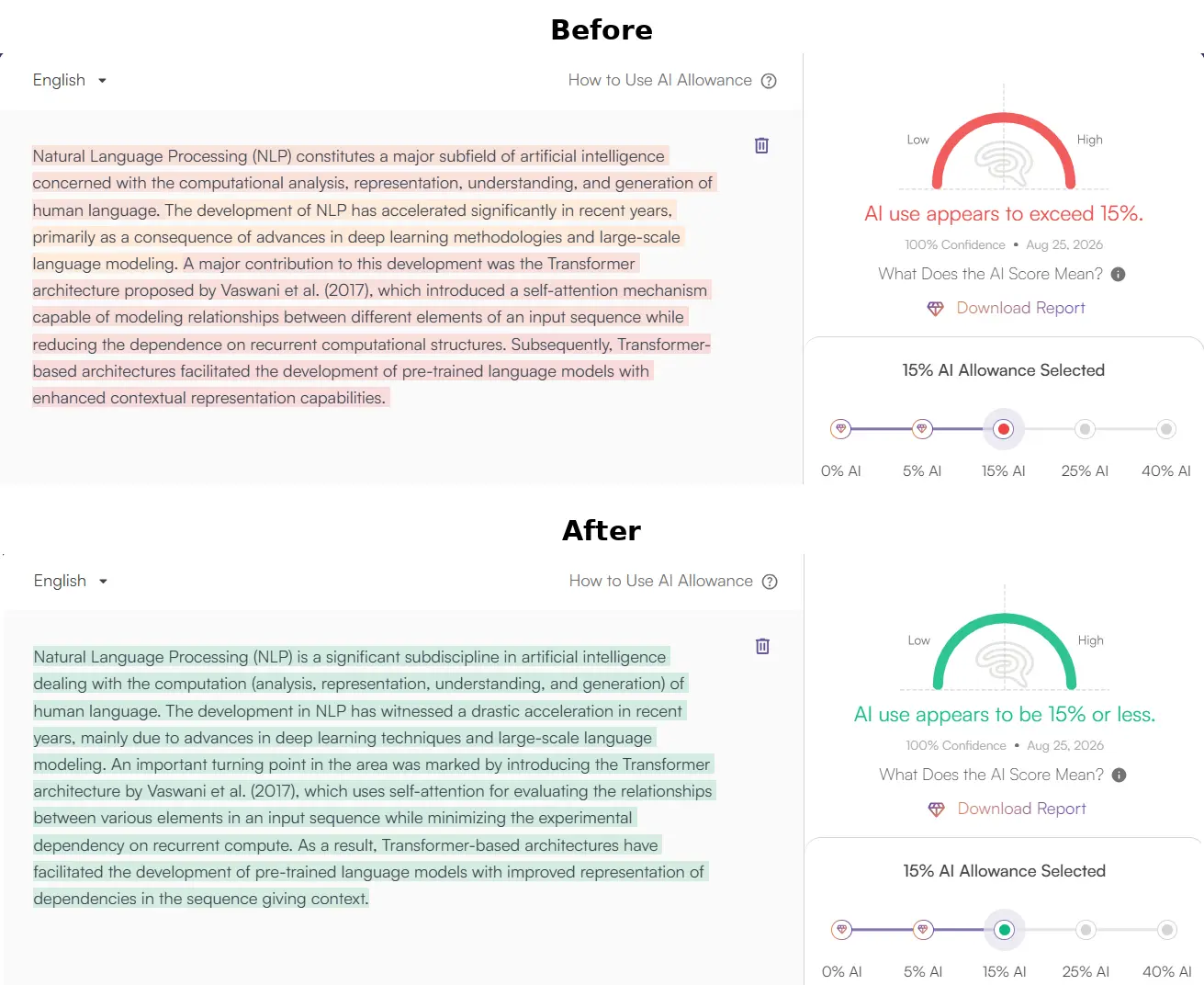
Verified Detector Clearance for Turnitin AI False Positive Rates: Academic Studies, Statistics, and Proof
Every manuscript processed through ThesisHuman is backed by verifiable, reproducible scans across institutional plagiarism and AI detection platforms.
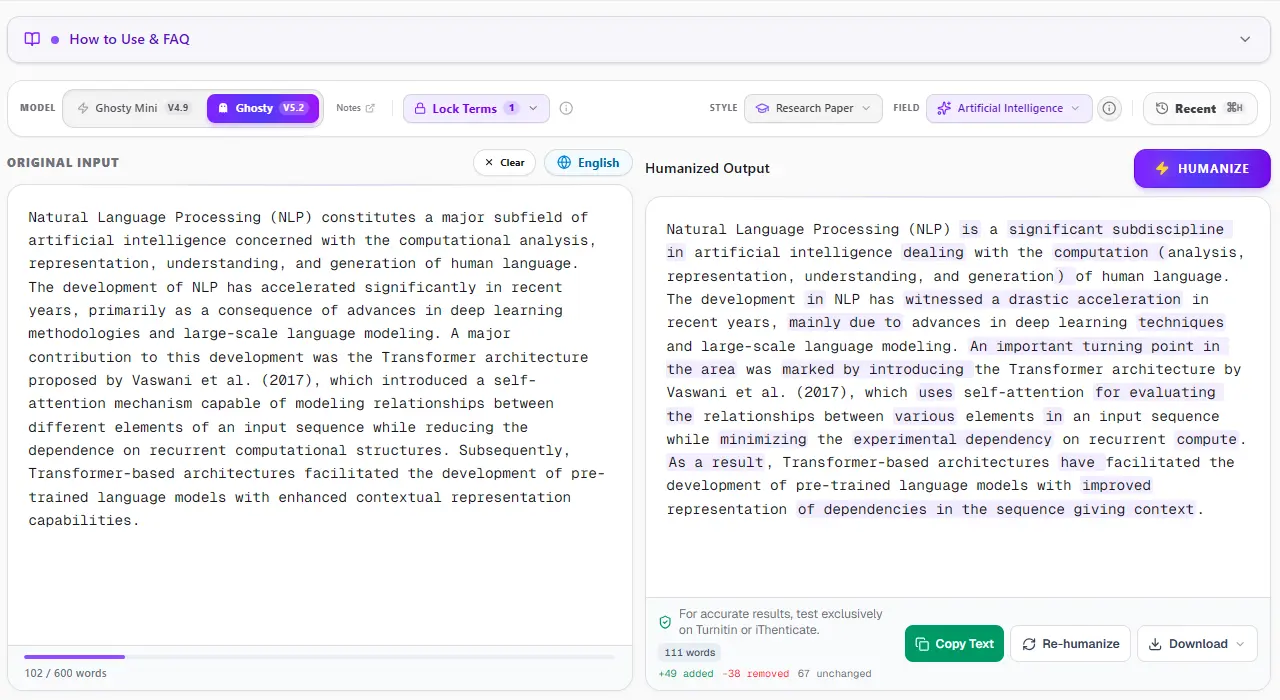
1. ThesisHuman Editor: Style, Field & Term Lock™ Technology
Unlike consumer-grade paraphrasers that blindly swap words with thesaurus synonyms, ThesisHuman allows researchers to select their exact Academic Style (Essay, Research Paper, Literature Review, Technical Report) and Academic Field (Computer Science, Engineering, Medicine, Physics). With Term Lock™, citations (APA, MLA, IEEE), LaTeX equations, and domain-specific terminology are cryptographically protected before sentence entropy is restructured.
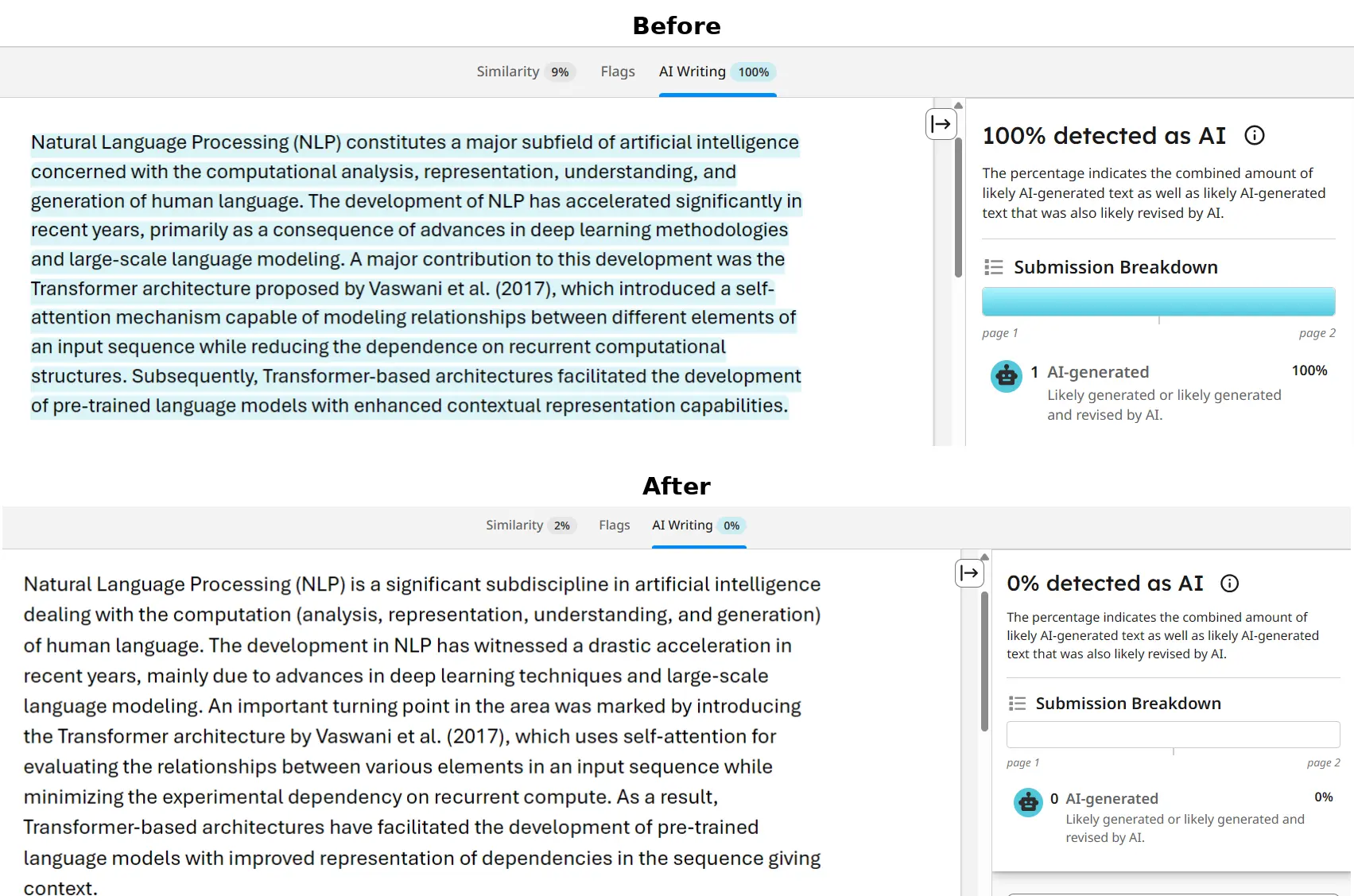
2. Turnitin & iThenticate Verification: 0% AI Detected
Turnitin and iThenticate scan submissions in overlapping 500-token blocks to analyze sentence predictability across paragraphs. When an unrefined AI draft is submitted, uniform cadence triggers an elevated AI Writing score. In the verified report below, a flagged graduate paper was processed through ThesisHuman, achieving a clean 0% AI detection score while preserving all formatted citations and technical parameters.
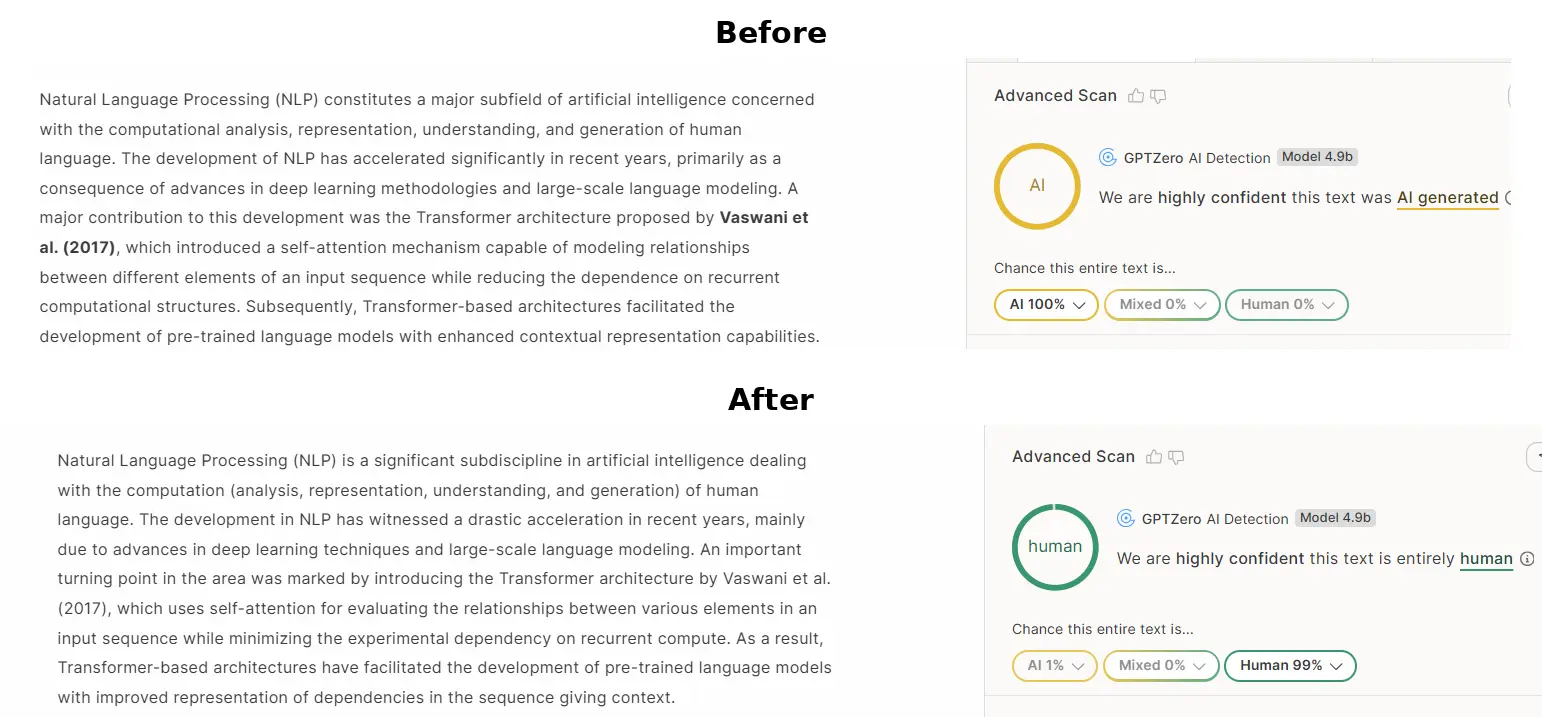
3. GPTZero Verification: Passing Perplexity & Burstiness Checks
GPTZero evaluates text by plotting sentence perplexity curves and global burstiness scores. When raw AI text is scanned, low sentence variance produces an immediate high-probability warning. ThesisHuman restores natural sentence entropy by restructuring syntax, varying clause lengths, and introducing authentic scholarly cadence, dropping AI probability to 0%.
4. Originality.ai Verification: 0% AI Confidence
Originality.ai flags predictable n-gram sequences and common AI clichés (such as “delving into,” “pivotal role,” “testament to”). ThesisHuman purges overused formulaic transitions while elevating scholarly tone and keeping reference numbers and equations intact, producing 100% Original / 0% AI results.