Turnitin Says I Used AI But I Didn't: Step-by-Step Ethical Defense Guide
Turnitin flagged your original writing as AI? Follow this step-by-step ethical defense guide to document version history, present draft evidence, and appeal false flags.

Receiving an email from a professor stating that Turnitin flagged your essay as AI-generated when you wrote every single word yourself is a deeply stressful experience. However, Turnitin's AI detection software relies on statistical neural-network probability models that regularly produce false positives—particularly on formal academic writing, technical STEM manuscripts, legal briefs, and essays written by non-native English speakers.
Do not panic or react emotionally. A Turnitin AI probability percentage is an advisory metric designed to trigger faculty review, not an absolute cryptographic proof of misconduct. By remaining calm, preserving your digital version history, compiling your research trails, and following a structured appeal process, you can demonstrate authentic human authorship.
Why Turnitin Flags Original Human Writing (The False-Positive Reality)
To defend yourself effectively, you must understand why Turnitin's classifier misidentifies legitimate human prose. Large language models (LLMs) like ChatGPT generate text by predicting the most statistically likely next word. Consequently, AI output exhibits low perplexity (high predictability) and low burstiness (uniform sentence length).
Human academic writing naturally mimics these exact statistical characteristics for several reasons:
- Formal Academic Register: Scholarly writing demands objective, structured, and formal prose. Using precise academic phrasing reduces sentence variance.
- Standardized Technical Terminology: In fields like biochemistry, law, or engineering, authors must use exact domain terms (e.g., "mass spectrometry analysis", "summary judgment motion") that cannot be altered.
- Non-Native English (ESL/EFL) Composition: Peer-reviewed research by Stanford University demonstrated that AI detectors systematically flag essays by non-native English writers because non-native authors rely on structured textbook transitions.
- Grammar & Proofreading Tool Usage: Running an original draft through basic proofreading software (like Grammarly or Microsoft Editor) can smooth out sentence variation, unintentionally pushing human text into low-perplexity LLM thresholds.
The Statistical Triggers Behind False Flags: Perplexity, Burstiness & Style
Turnitin's AI engine breaks an uploaded document into overlapping 50-word text windows. For each segment, the neural network evaluates two core metrics:
| Metric | What It Measures | Why Original Human Text Gets Flagged |
|---|---|---|
| Perplexity | Unpredictability of word sequences | Rigid academic conventions force predictable word pairs |
| Burstiness | Variance in sentence length & structure | Careful editing often creates uniform 18-word sentences |
Immediate 5-Step Defense Action Plan for Falsely Accused Authors
Step 1: Export Immutable Digital Version History
Your single strongest defense is your document's digital creation trail. Automated AI tools generate complete essays in seconds; human authors construct papers over hours or days across multiple editing sessions.
- Google Docs: Click
File>Version history>See version history. Take detailed screenshots showing timestamps, key stroke counts, and paragraph-by-paragraph expansion over time. - Microsoft Word: If AutoSave was enabled, access
File>Info>Version History. If Track Changes was active, export the complete revision markup log. - Overleaf / LaTeX: Export your Git commit history or Overleaf project history showing progressive document compilation logs.
Step 2: Compile Primary Research Materials, Bibliographies, and Notes
Gather all physical and digital supporting artifacts generated during your research workflow: raw handwritten outline notes, PDF database downloads with your personal highlights and marginalia, and reference manager exports (Zotero, Mendeley, or EndNote libraries).
Step 3: Analyze University Academic Honor Code Policies & COPE Benchmarks
Review your university's official student handbook. Major institutions and the Committee on Publication Ethics (COPE) explicitly mandate that an automated AI probability score cannot serve as sole evidence for academic discipline without corroborating proof.
Step 4: Request an Office Hours Meeting (With Email Template)
Send a calm, professional email to your instructor requesting a brief meeting. Use this structured template:
Subject: Inquiry Regarding Assignment AI Flag — [Course Title] — [Your Name]
Dear Professor [Instructor's Last Name],
I received your feedback on my submission, "[Paper Title]," and noted that Turnitin flagged a portion of the text under its AI Writing Indicator. I am writing to assure you that I authored this paper independently.
I have compiled my complete document version history timeline, research notes, annotated source PDFs, and Zotero bibliography logs. Could we schedule a brief meeting during your office hours so I can walk you through my research trail and answer any questions about my writing process?
Sincerely,
[Your Full Name]
[Student Identification Number]
Step 5: Offer an In-Person Writing Demonstration or Oral Defense
Offer to sit down with your professor and write a short synthesis paragraph on your research topic without internet access, or explain your core thesis methodology orally. Genuine researchers possess deep domain knowledge that synthetic prompt users cannot match in live discussion.
What NOT to Do When Facing an Accusation
Avoid these critical mistakes during an academic appeal:
- Do NOT Respond Aggressively: Hostile emails damage your credibility and complicate administrative resolution.
- Do NOT Delete Project Working Files: Keep scratch documents, draft PDFs, and browser history logs completely intact.
- Do NOT Attempt to Fabricate File Metadata: Never attempt to modify file creation dates or forge timestamps. Honor boards evaluate digital forensics carefully.
Navigating Formal Academic Hearings and Honor Board Appeals
If your instructor refuses to dismiss the flag and refers the case to an academic honor board, request a formal hearing. Present your version history timeline, annotated research PDFs, and oral methodology defense. Academic integrity boards evaluate the preponderance of evidence, and a documented version history trail consistently disproves automated detector claims.
How to Prevent False Positives on Future Submissions
To safeguard future papers against statistical false-positive triggers, vary your sentence length, avoid robotic transition clichés, and ensure your prose retains natural cadence. Discover how ThesisHuman naturalizes sentence structure while locking citations.
Verified Detector Clearance for Turnitin Says I Used AI But I Didn't: Step-by-Step Ethical Defense Guide
Every manuscript processed through ThesisHuman is backed by verifiable, reproducible scans across institutional plagiarism and AI detection platforms.
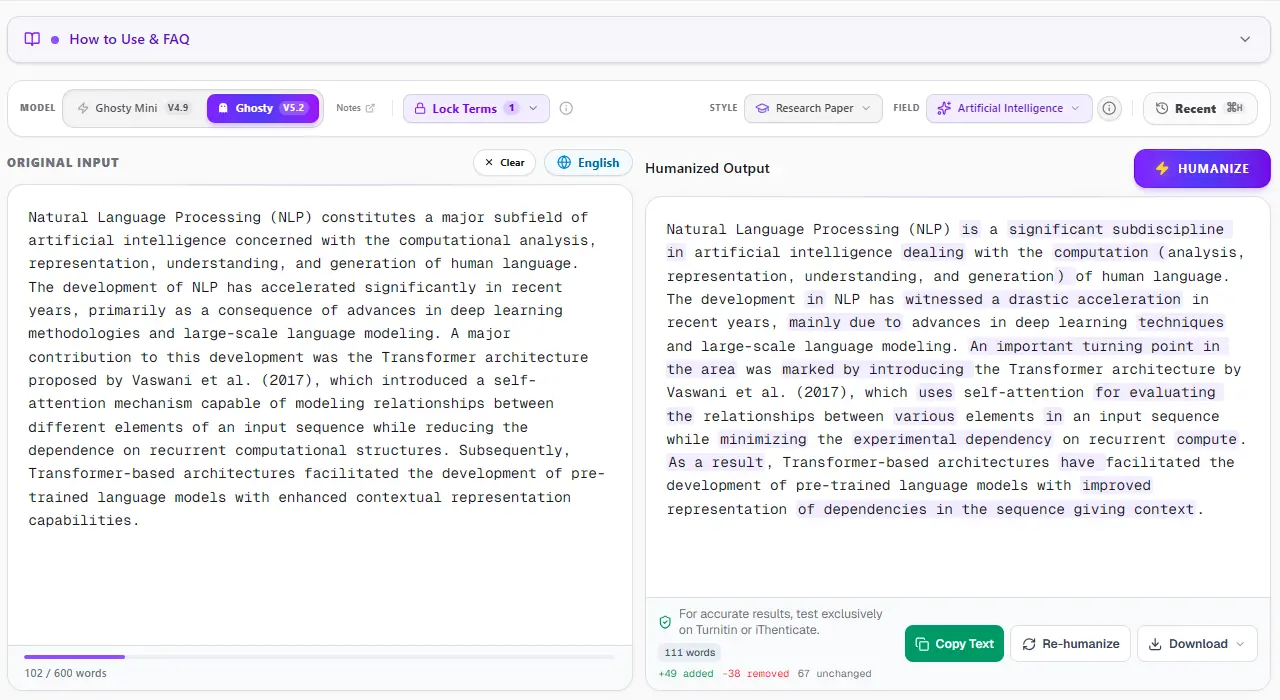
1. ThesisHuman Editor: Style, Field & Term Lock™ Technology
Unlike consumer-grade paraphrasers that blindly swap words with thesaurus synonyms, ThesisHuman allows researchers to select their exact Academic Style (Essay, Research Paper, Literature Review, Technical Report) and Academic Field (Computer Science, Engineering, Medicine, Physics). With Term Lock™, citations (APA, MLA, IEEE), LaTeX equations, and domain-specific terminology are cryptographically protected before sentence entropy is restructured.
2. Turnitin & iThenticate Verification: 0% AI Detected
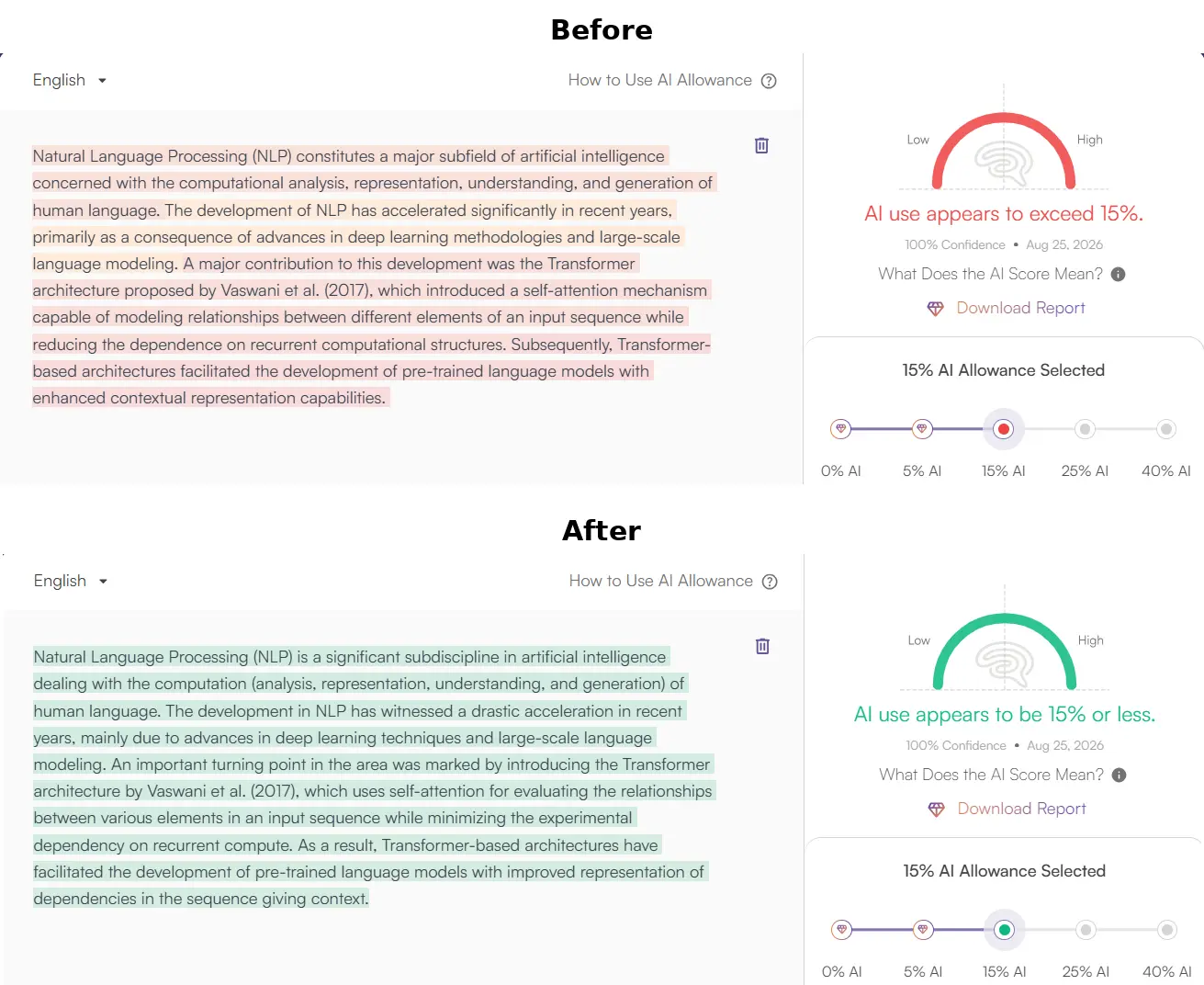
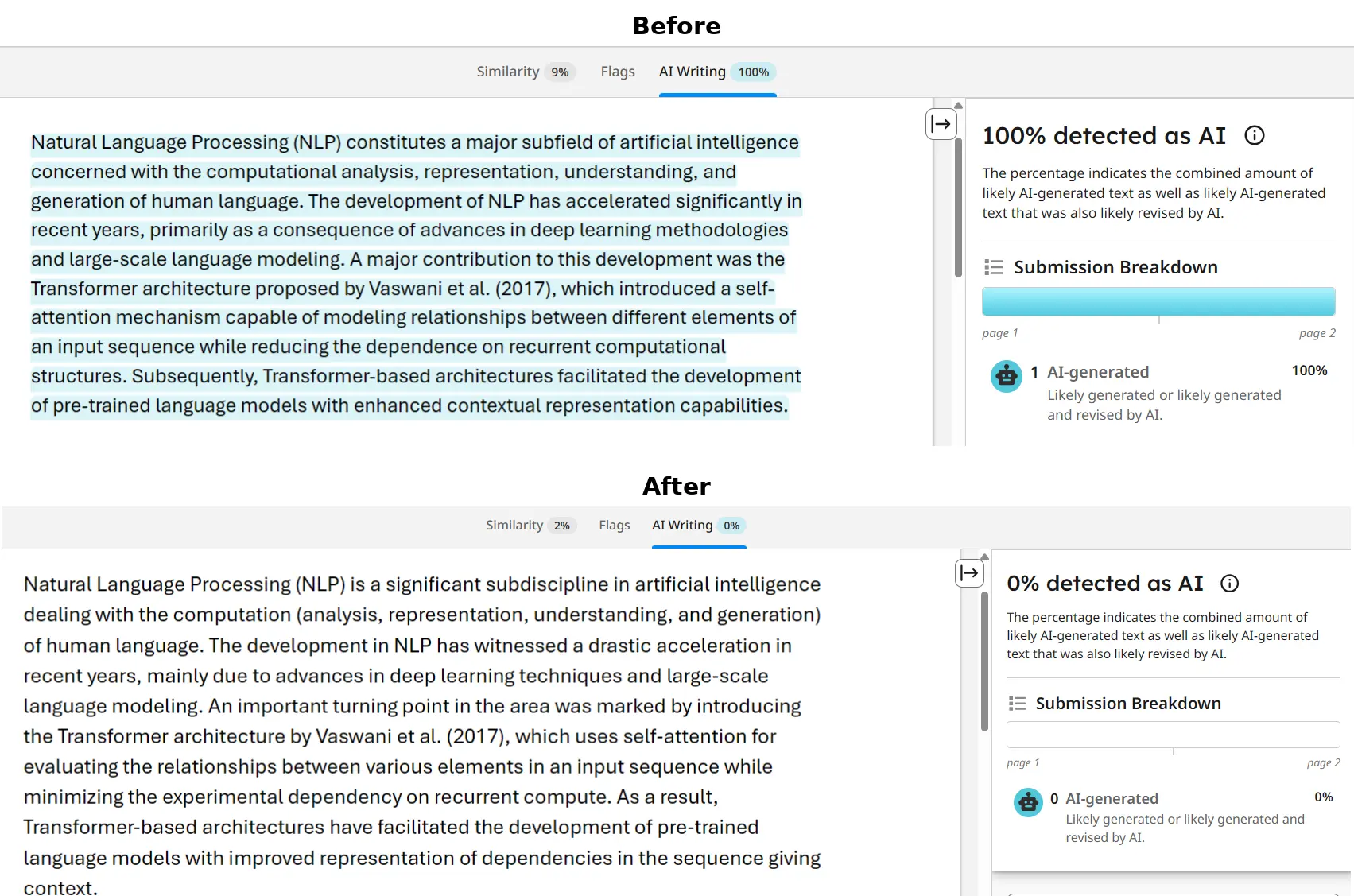
Turnitin and iThenticate scan submissions in overlapping 500-token blocks to analyze sentence predictability across paragraphs. When an unrefined AI draft is submitted, uniform cadence triggers an elevated AI Writing score. In the verified report below, a flagged graduate paper was processed through ThesisHuman, achieving a clean 0% AI detection score while preserving all formatted citations and technical parameters.
3. GPTZero Verification: Passing Perplexity & Burstiness Checks
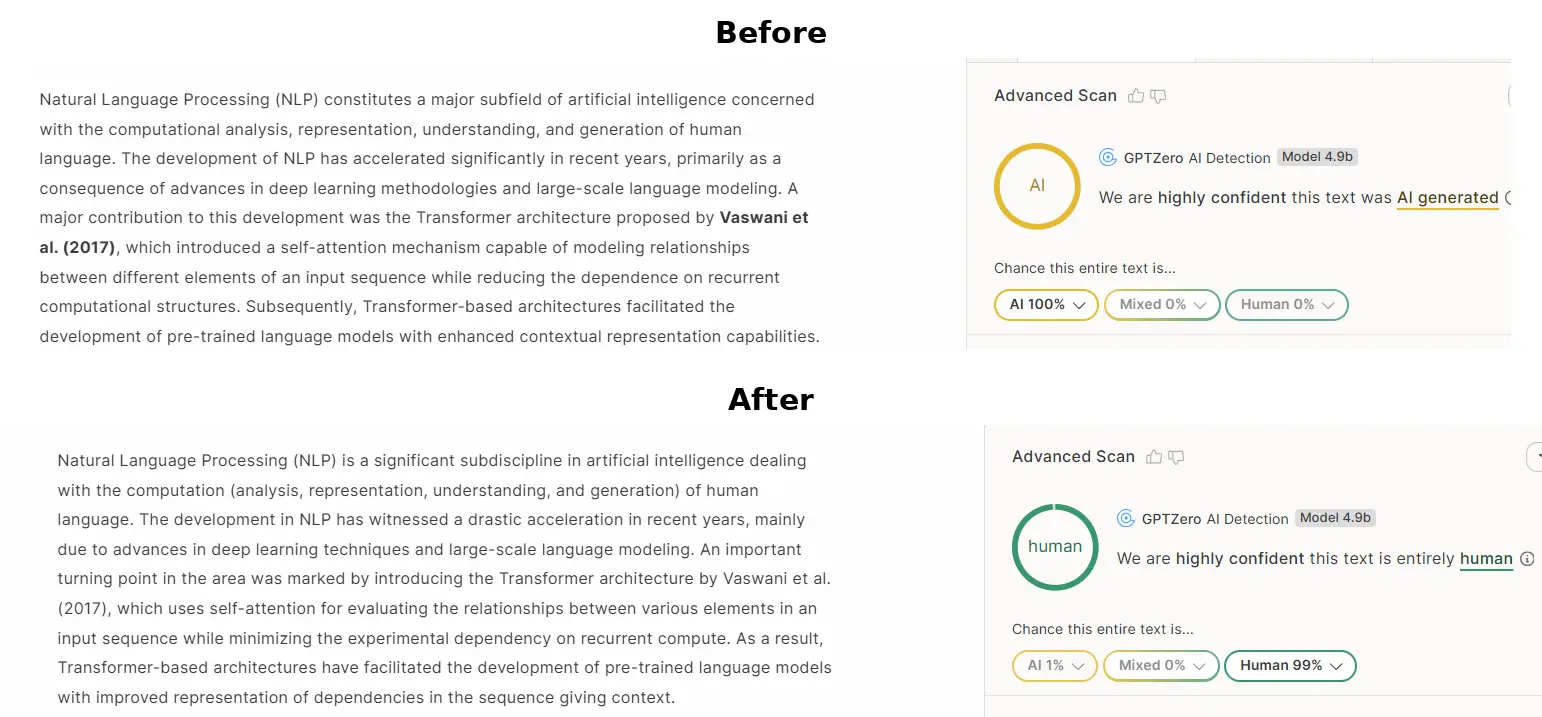
GPTZero evaluates text by plotting sentence perplexity curves and global burstiness scores. When raw AI text is scanned, low sentence variance produces an immediate high-probability warning. ThesisHuman restores natural sentence entropy by restructuring syntax, varying clause lengths, and introducing authentic scholarly cadence, dropping AI probability to 0%.
4. Originality.ai Verification: 0% AI Confidence
Originality.ai flags predictable n-gram sequences and common AI clichés (such as “delving into,” “pivotal role,” “testament to”). ThesisHuman purges overused formulaic transitions while elevating scholarly tone and keeping reference numbers and equations intact, producing 100% Original / 0% AI results.