What Is a Possessive Pronoun? Definition, Rules, and Examples
Master possessive pronouns (mine, yours, his, hers, ours, theirs) vs possessive determiners (my, your, its, their). Learn apostrophe traps, whose vs who's, formal academic usage, and practice drills.

1. Direct Answer: What Is a Possessive Pronoun?
A possessive pronoun is a pronoun (mine, yours, his, hers, ours, theirs, and interrogative/relative whose) that replaces an entire noun phrase to show ownership, authorship, attribution, or close association without needing a noun directly after it.
Compare these two ordinary sentences:
- "Their data table matched ours." (ours stands alone as an independent possessive pronoun, replacing "our data table".)
- "Their data table matched our baseline notes." (our modifies the noun phrase baseline notes, acting as a possessive determiner or possessive adjective.)
In both classroom grammar and academic proofreading, separating independent possessive pronouns from possessive determiners prevents three recurring errors: misusing apostrophes (it's vs its, your's vs yours), mismatching singular/plural antecedents, and writing ambiguous references inside multi-study comparisons.
2. Independent Possessive Pronouns vs Possessive Determiners
Many grammar references group both columns under the umbrella label "possessive forms," yet their grammatical slots inside a clause work differently:
- Independent Possessive Pronouns occupy full noun slots (subject, direct object, subject complement, or prepositional object) by themselves. No noun follows them.
- Possessive Determiners (often called possessive adjectives) sit before a noun phrase just like the or this, requiring a head noun afterward.
| Person / Number | Possessive Determiner (Precedes Noun) | Independent Possessive Pronoun (Stands Alone) | Example Comparison |
|---|---|---|---|
| 1st Person Singular | my | mine | Is that my notebook? Yes, that folder is mine. |
| 2nd Person (Sg./Pl.) | your | yours | Please upload your slide deck before editing yours. |
| 3rd Person Masc. | his | his | Both his model and the rival team's failed; only his recovered quickly. |
| 3rd Person Fem. | her | hers | I reviewed her appendix after checking hers for missing tables. |
| 3rd Person Neuter | its | (rarely used alone) | The sensor lost its baseline signal. (Avoid standalone its.) |
| 1st Person Plural | our | ours | Compare our regression slope with ours from last spring. |
| 3rd Person Plural / Neutral Sg. | their | theirs | One lab shared their protocol, whereas the second retained theirs. |
| Interrogative / Relative | whose | whose | Whose dataset failed check 2? / Whose is this USB drive? |
Why *Its* Rarely Functions as an Independent Possessive Pronoun
Notice its behaves as a possessive determiner ("The battery lost its charge"), not as a standalone pronoun. Standard English almost never says "The charging cable is its"; instead, writers repeat the noun ("the battery's cable").
3. Why Possessive Pronouns Never Take Apostrophes
Here is one of the cleanest, exception-free punctuation rules in English: no possessive pronoun or possessive determiner ever uses an apostrophe. Apostrophes mark possession exclusively on nouns (the researcher's hypothesis, the students' lockers) and indefinite pronouns (anyone's guess, someone's key), or mark missing letters in contractions.
Every high-frequency proofreading slip in this category comes from confusing an unpunctuated possessive form with an apostrophe contraction:
| Pair | Possessive Form (NO Apostrophe) | Contraction (WITH Apostrophe) | Verification Substitution Test |
|---|---|---|---|
| its / it's | its (belonging to it) | it's (it is or it has) | Replace with "it is": if the sentence breaks, remove the apostrophe ("The system calibrated its clock"). |
| whose / who's | whose (belonging to whom/which) | who's (who is or who has) | Replace with "who is": "The analyst whose code ran fastest..." fails with who is, so whose is right. |
| theirs / there's | theirs (belonging to them) | there's (there is or there has) | Test "there is": "That experimental setup is theirs" cannot mean there is. |
| your / you're | your (belonging to you) | you're (you are) | Test "you are": "Your citations require page locators." |
| hers / ours / yours | hers, ours, yours | (None; her's, our's, your's do not exist) | Never insert "'s" before -s on possessive pronouns. |
Remembering the "expand the contraction" check catches virtually every its/it's and whose/who's slip during final manuscript review.
4. Grammatical Roles Inside Clauses (Subjects, Objects, and Double Possessives)
Because independent possessive pronouns replace complete noun phrases, they can sit in every standard noun position checked in our guide on what a subject in a sentence is:
- Grammatical Subject: "Theirs outperformed all earlier prototypes in cold trials." (Replaces "their prototype" as singular or plural subject depending on context.)
- Subject Complement After Linking Verbs: "The fault was entirely ours, not the supplier's."
- Direct Object: "We submitted our ethics addendum on Monday, and Dr. Park uploaded hers Tuesday morning."
- Object of a Preposition (Double Possessives): English idioms regularly pair of with an independent possessive pronoun: "a colleague of mine", "an earlier paper of theirs", "that habit of hers". Because mine/theirs/hers already carries possessive meaning after of, this construction is called a double genitive (or double possessive) and is completely standard in formal prose.
5. Academic Style Rules: Singular Their/Theirs and Formal Whose
Research and style manuals address two nuanced usage questions around possessives in scholarly writing:
1. Singular *They*, *Their*, and *Theirs*
Major style guides including APA 7th Edition and MLA 9th Edition endorse singular they / them / their / theirs both when referring to an individual whose pronouns are they/them and as an inclusive generic pronoun referring to any unnamed single person (avoiding awkward "his or her" repetition):
- Formal Example: "Every reviewer returned their rubric within five business days, and theirs remained the strictest assessment in the panel."
- Notice verb agreement: even when they/their refers to a single person, the personal pronoun itself continues to take plural verb morphology ("they write", "were they advised").
2. Using *Whose* With Non-Human Nouns vs *Of Which*
Some writers worry erroneously that whose belongs only to people. In standard English style guides, whose serves comfortably for both animate actors and inanimate concepts, instruments, or systems when "of which" produces clumsy syntax:
- Natural Formal Prose: "We inspected a filtration membrane whose pore diameter varied across batches."
- Awkward Alternative: "We inspected a filtration membrane, the pore diameter of which varied across batches." Both are grammatical, and formal scholarly editors routinely favor whose whenever of which slows sentence rhythm.
6. Eliminating Vague Reference and Agreement Errors in Academic Writing
While possessives prevent tedious noun repetition, dropping a standalone possessive pronoun when two earlier nouns compete for the antecedent creates reader confusion:
- Ambiguous: "Between the 2021 protocol and the 2025 baseline, theirs required fewer reagents." (Which group or document does theirs refer to?)
- Explicit: "Between the 2021 cohort and the 2025 cohort, the 2025 protocol required fewer reagents than theirs." (Or repeat the exact noun: "...the 2025 team's protocol required fewer reagents.")
Also watch possessive determiner agreement when an indefinite singular pronoun precedes the noun:
- "Each department manages its own archive." (Department is singular, so its matches cleanly, not their.)
- "Any student submitting late must attach their advisor's sign-off." (Singular generic their aligns with current inclusive style rules.)
Check how prepositional modifiers and subject heads interact cleanly in our guides on what a prepositional phrase is and how to improve clarity in academic writing.
7. Five Weak vs Revised Possessive Pronoun Examples
Review these five invented proofreading pairs illustrating how fixing apostrophe slips, determiner confusion, and vague antecedents clarifies formal drafts:
| Weak / Incorrect Draft | Underlying Grammar Error | Corrected Revision |
|---|---|---|
| "The instrument lost it's calibration after transit." | Used contraction it's (it is) instead of possessive determiner its | "The instrument lost its calibration after transit." |
| "Our laboratory tested ten compounds; your's tested twelve." | Added nonexistent apostrophe 's to possessive pronoun yours | "Our laboratory tested ten compounds; yours tested twelve." |
| "The committee disagreed over who's method ran faster." | Used contraction who's (who is) instead of possessive whose | "The committee disagreed over whose method ran faster." |
| "Between the control and treatment arms, theirs remained steady." | Standalone theirs has no named human plural antecedent in the sentence | "Between the two study teams, the comparison group's baseline remained steady while theirs declined." (Or specify directly: "...the treatment arm's baseline remained steady.") |
| "Neither team shared their raw sensor logs until April." | With singular neither team acting individually, specify clear determiner matching | "Neither lab team shared its raw sensor logs until April." (Or pluralize: "Neither the engineers nor the chemists shared their raw logs...") |
8. Four-Check Proofreading Method for Possessives and Contractions
Run this quick four-step sweep before turning in any essay, thesis chapter, or technical memo:
- Search Document-Wide for Apostrophe Traps: Run Find (Ctrl+F) for it's, who's, they're, and there's. Expand each mentally (it is, who is, they are, there is). Note that formal academic papers generally replace contractions anyway, making stray it's occurrences immediately obvious.
- Audit Every -s Ending on Pronouns: Confirm hers, ours, yours, theirs, its, whose never carry an apostrophe anywhere in running prose or footnotes.
- Check What Follows the Word: If a noun comes immediately after (my paper, our study, their data), verify you chose a determiner; if nothing follows (mine, ours, theirs), verify it is an independent possessive pronoun.
- Trace Back One Sentence for Antecedents: Whenever theirs, hers, his, or ours starts a clause, verify an explicit matching owner appears clearly in the preceding clause.
9. Ten Short Practice Sentences With Answers
Identify the possessive form in each sentence, classify whether it is an independent possessive pronoun or possessive determiner, and spot any errors:
- Sentence: "Our simulation converged cleanly, whereas theirs diverged after step forty."
- Answer: Our = possessive determiner (before simulation); theirs = independent possessive pronoun acting as clause subject.
- Sentence: "Has anyone seen whose USB drive was left beside the spectrometer?"
- Answer: Whose = possessive determiner before USB drive (correct, not who's).
- Sentence: "A senior advisor of mine recommended restructuring the results table."
- Answer: Mine = independent possessive pronoun inside a of mine double-possessive prepositional phrase.
- Sentence: "Every polymer loses some of its elasticity after repeated thermal cycling."
- Answer: Its = possessive determiner before elasticity (never it's).
- Sentence: "Fix error if present: 'That blue binder on the desk is her's, not Jordan's.'"
- Answer: Error! Replace her's with hers (possessive pronouns never take apostrophes; noun Jordan's correctly keeps 's).
- Sentence: "Fix error if present: 'Look closely at there calibration curve before signing.'"
- Answer: Error! Replace adverb there with possessive determiner their.
- Sentence: "The cleanest proof in the afternoon workshop was yours."
- Answer: Yours = independent possessive pronoun functioning as predicate complement.
- Sentence: "I misplaced my badge, so hers unlocked the archive door for both of us."
- Answer: My = possessive determiner (my badge); hers = independent possessive pronoun (subject of second clause).
- Sentence: "Fix error if present: 'The telescope whose lens cracked was replaced yesterday.'"
- Answer: Correct! Formal whose modifies inanimate telescope cleanly without apostrophes.
- Sentence: "Fix error if present: 'Between Maya and Devon, who's survey instrument did the lab adopt?'"
- Answer: Error! Replace contraction who's (who is) with whose (possessive determiner modifying survey instrument).
10. Frequently Asked Questions
What is the full list of possessive pronouns in English?
The seven core independent possessive pronouns are mine, yours, his, hers, ours, theirs, and whose (note that his and whose also serve as determiners when followed directly by a noun). The eight matching possessive determiners placed before nouns are my, your, his, her, its, our, their, and whose.
What is the difference between a possessive pronoun and a possessive adjective (determiner)?
A possessive determiner (or possessive adjective) modifies an explicit noun that follows it: "Our study tested twelve wells." An independent possessive pronoun replaces the entire noun phrase and stands alone: "Their study failed to replicate ours."
Why do possessive pronouns like *hers*, *theirs*, and *its* never use an apostrophe?
Apostrophes indicate possession exclusively on nouns (Dr. Sato's notes) and indefinite pronouns (nobody's), or mark omitted letters in contractions (it's = it is, who's = who is). English personal and relative possessive pronouns already encode possession in their spelling (hers, ours, yours, theirs, whose, its), so adding 's creates an error or turns the word into a contraction.
Is it grammatically correct to use *whose* for inanimate objects in academic writing?
Yes. Major grammar authorities and style manuals confirm that whose refers naturally to non-human entities, instruments, models, or institutions ("an algorithm whose error rate dropped"), often producing cleaner syntax than clunky "of which" clauses.
How can researchers catch subtle pronoun, antecedent, and agreement slips during revision?
Always check standalone possessives (theirs, ours, hers) against the nearest plural or singular antecedent and test every its/it's contraction mentally. When editing dense chapters in the ThesisHuman editor, free accounts include 500 words per month, 150 words per request, and up to 3 active Term Locks to lock technical variables and formatted citations while polishing pronoun references cleanly; verify every final sentence manually before submission.
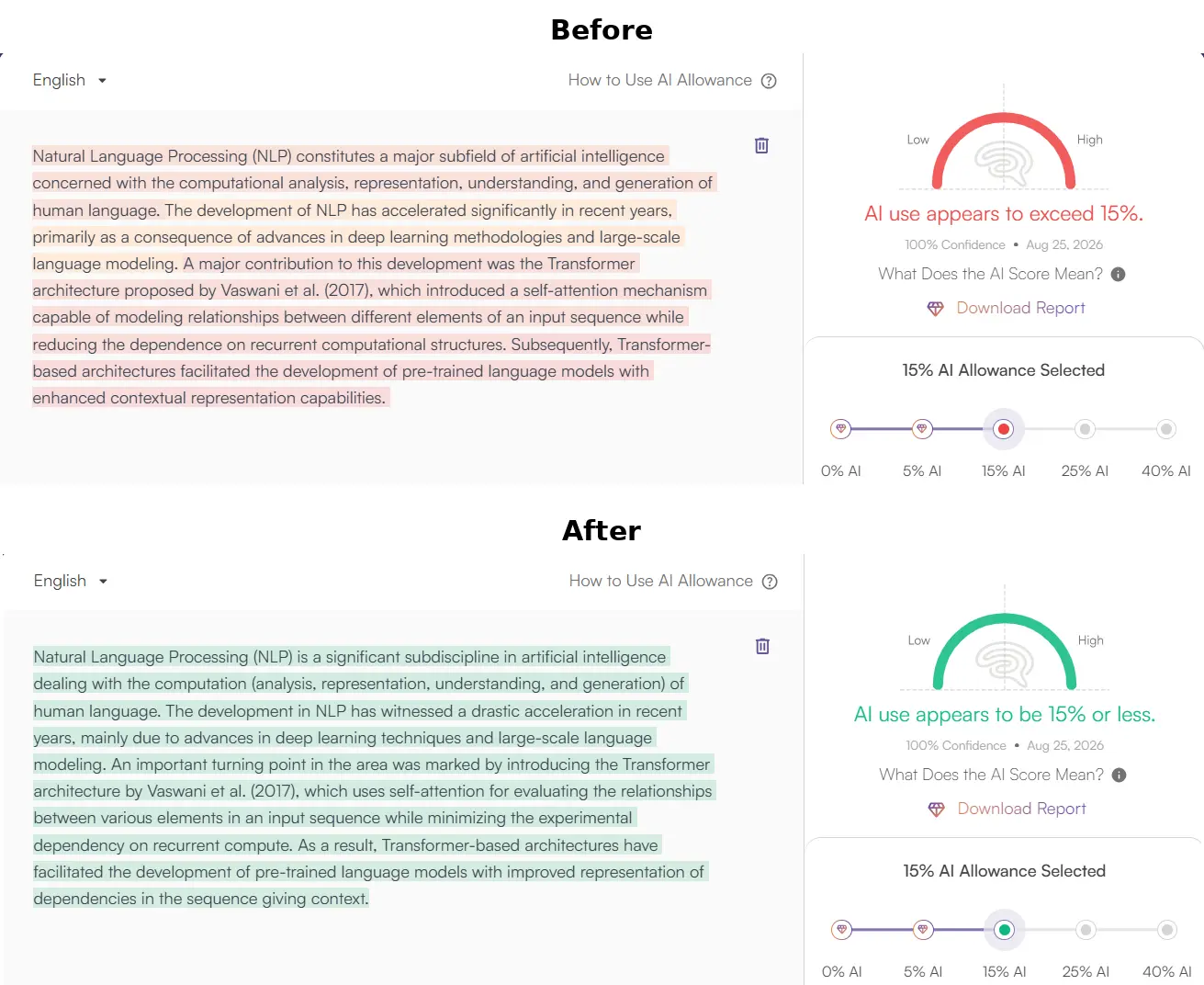
Verified Detector Clearance for What Is a Possessive Pronoun? Definition, Rules, and Examples
Every manuscript processed through ThesisHuman is backed by verifiable, reproducible scans across institutional plagiarism and AI detection platforms.
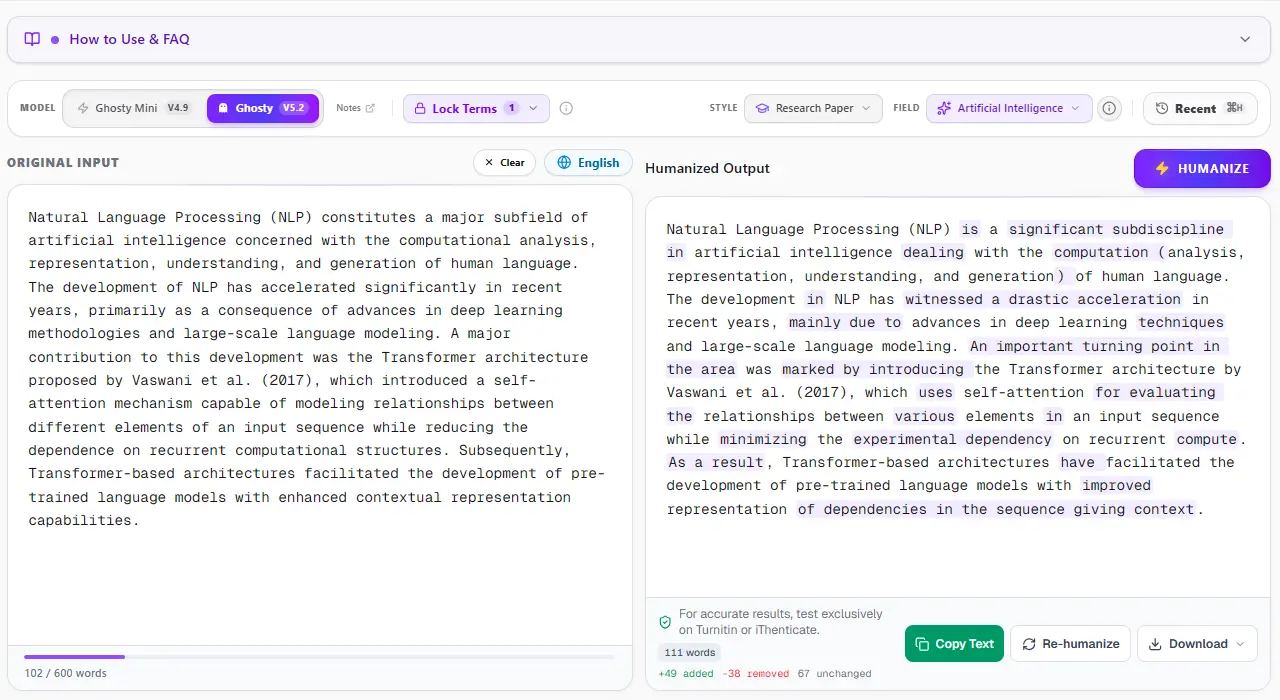
1. ThesisHuman Editor: Style, Field & Term Lock™ Technology
Unlike consumer-grade paraphrasers that blindly swap words with thesaurus synonyms, ThesisHuman allows researchers to select their exact Academic Style (Essay, Research Paper, Literature Review, Technical Report) and Academic Field (Computer Science, Engineering, Medicine, Physics). With Term Lock™, citations (APA, MLA, IEEE), LaTeX equations, and domain-specific terminology are cryptographically protected before sentence entropy is restructured.
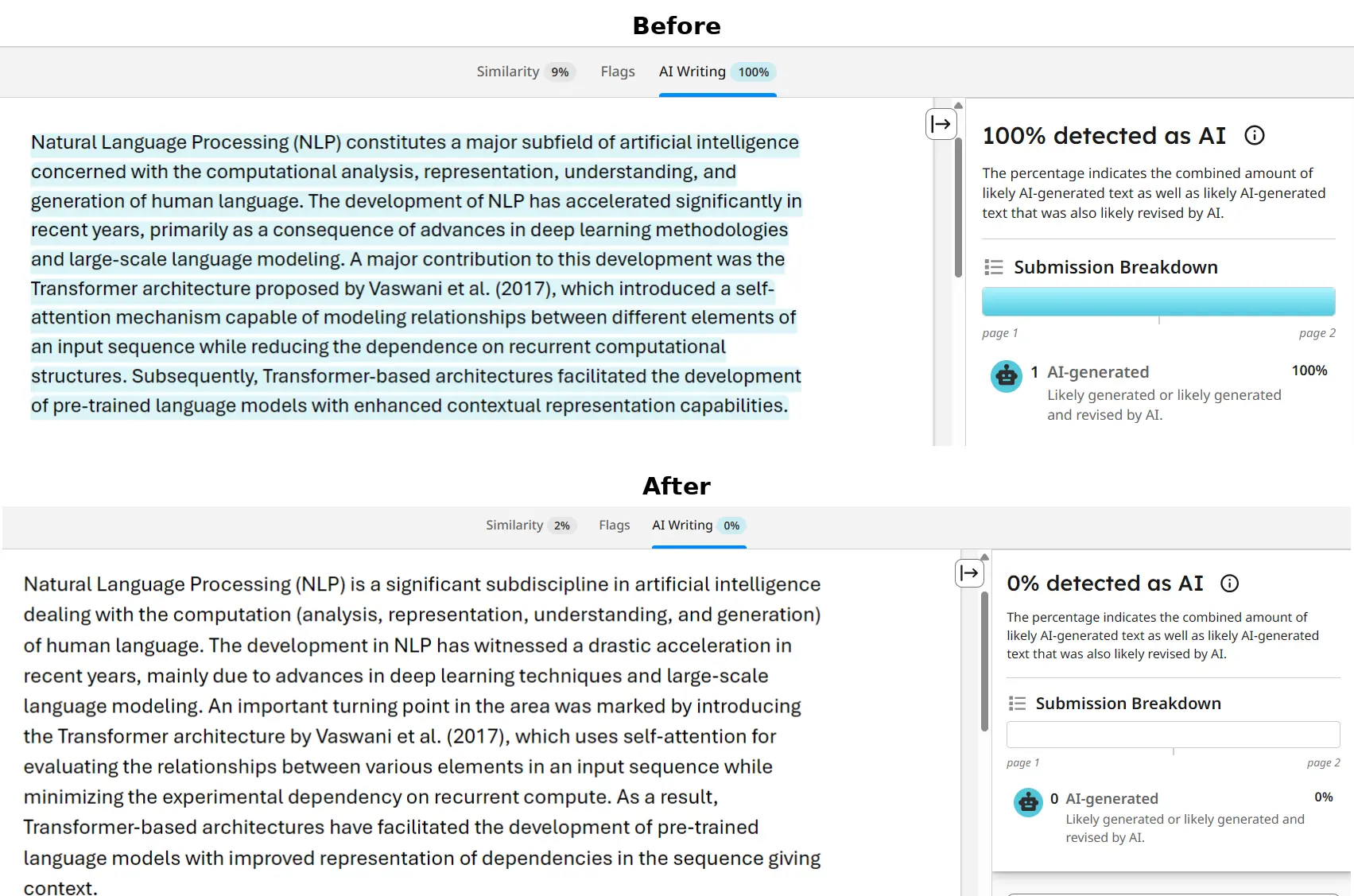
2. Turnitin & iThenticate Verification: 0% AI Detected
Turnitin and iThenticate scan submissions in overlapping 500-token blocks to analyze sentence predictability across paragraphs. When an unrefined AI draft is submitted, uniform cadence triggers an elevated AI Writing score. In the verified report below, a flagged graduate paper was processed through ThesisHuman, achieving a clean 0% AI detection score while preserving all formatted citations and technical parameters.
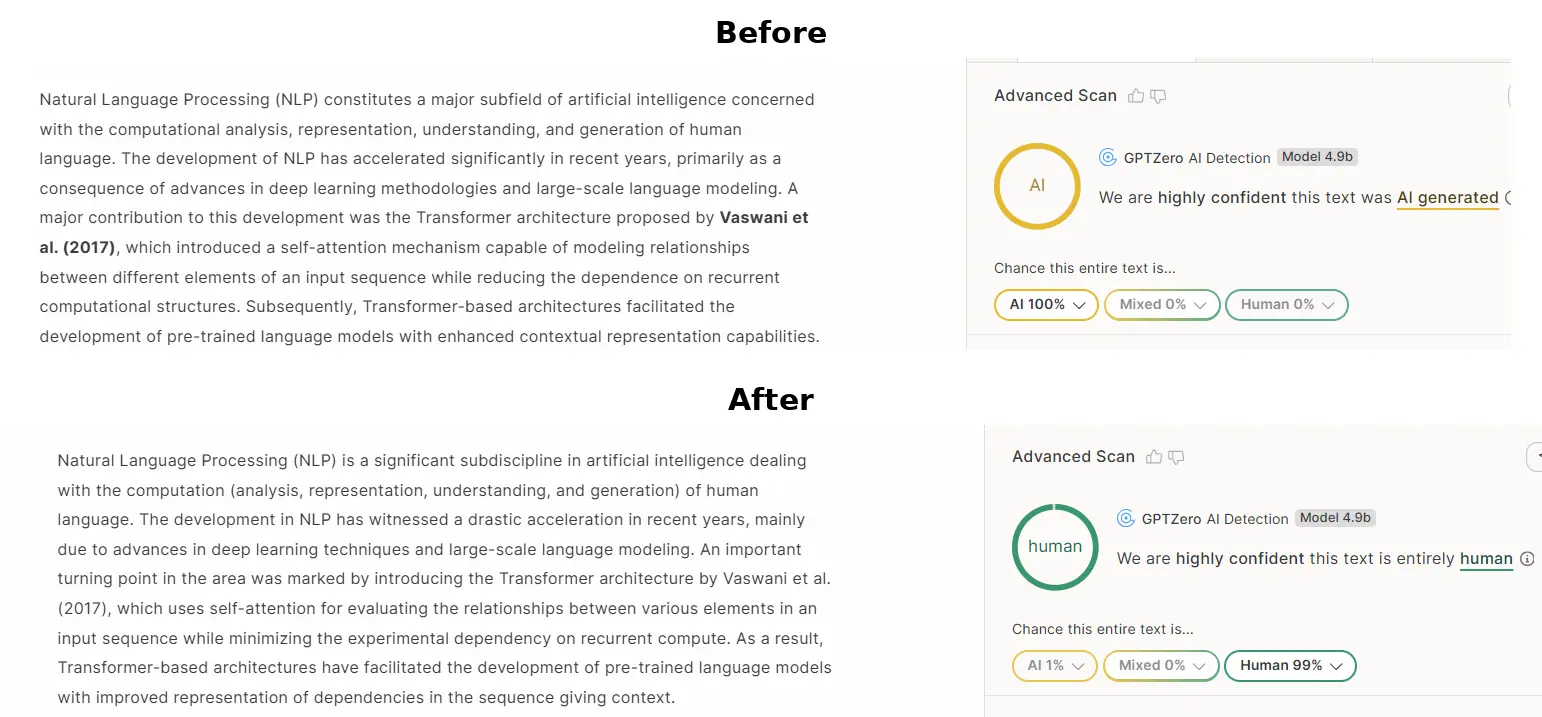
3. GPTZero Verification: Passing Perplexity & Burstiness Checks
GPTZero evaluates text by plotting sentence perplexity curves and global burstiness scores. When raw AI text is scanned, low sentence variance produces an immediate high-probability warning. ThesisHuman restores natural sentence entropy by restructuring syntax, varying clause lengths, and introducing authentic scholarly cadence, dropping AI probability to 0%.
4. Originality.ai Verification: 0% AI Confidence
Originality.ai flags predictable n-gram sequences and common AI clichés (such as “delving into,” “pivotal role,” “testament to”). ThesisHuman purges overused formulaic transitions while elevating scholarly tone and keeping reference numbers and equations intact, producing 100% Original / 0% AI results.