How to Cite a Website: APA 7th, MLA 9th, Chicago, and IEEE Examples
Learn how to cite a website or individual web page accurately in APA 7th, MLA 9th, Chicago 18th, and IEEE styles. Covers missing dates, group authors, retrieval dates, and whole-website mentions.

1. Direct Answer: What Elements Do You Need to Cite a Website?
To cite a website accurately in academic writing, cite the specific web page, document, or online article you consulted rather than a bare homepage URL, collecting four core elements: the individual or organizational Author, the Publication or Last Updated Date (using n.d. when absent in APA), the Specific Page Title, and the Hosting Website Name paired with its direct URL. Every major style guide pairs that full bibliography or reference entry with a brief in-text citation inside your body paragraph so readers can trace each online claim directly to its source.
Before formatting, check whether a source posted on a domain actually follows a more specific format rule. A peer-reviewed journal article viewed on a publisher website is cited as a journal article with its DOI, not as a generic web page. Similarly, if you only mention an entire tool platform or university homepage in passing, APA 7th and MLA 9th advise writing the organization name and URL directly in parentheses inside prose without adding a Reference List entry.
For a broader overview of in-text attribution mechanics across formats before diving into web entries, consult our guides on what is a parenthetical citation and how to cite APA in-text.
2. Website vs Web Page vs Online Journal Article
Students frequently confuse three distinct digital categories that share a web browser window but follow different citation templates:
- Specific Web Page: An individual HTML article, policy brief, institutional FAQ, census data page, or laboratory documentation subpage sitting at a unique URL (for example, an agency overview of drinking water thresholds). Always cite the exact page URL and subpage title.
- Online Periodical, Preprint, or Institutional PDF Report: A numbered working paper, downloadable government PDF, or journal paper read in a browser PDF viewer. Treat academic articles with DOIs as scholarly journal entries, and cite formal reports using publisher/institution metadata plus direct download URL.
- Whole Website Mention (No Specific Page Cited): Referencing a broad platform such as Qualtrics, PubMed, or GitHub purely to identify software infrastructure or an organization's home portal. Both APA 7th and MLA 9th treat passing whole-site mentions inline rather than in the closing bibliography.
3. Side-by-Side Comparison: APA 7th, MLA 9th, Chicago 18th, and IEEE
While all four major academic styles capture authorship, title, container platform, date, and location, punctuation, capitalization, and retrieval dates differ sharply:
| Style Manual | Website Title vs Page Title | URL & Link Rules | Retrieval Date Requirement | Standard In-Text Marker |
|---|---|---|---|---|
| APA 7th | Page title italicized in sentence case; Website name in plain Title Case (omit Website name if identical to Group Author) | Include direct https:// URL without period after URL; omit "Retrieved from" unless unstable | Only required for unarchived, continuously updated pages (for example, live trackers or wikis) | (Author, Year) or (Org, n.d.) |
| MLA 9th | Page title in "Quotation Marks" (Title Case); Website name in Italics (Title Case) | Include full URL without https:// (retain http:// if legacy) ending with period | Strongly recommended as optional "Accessed 14 Oct. 2026." when no publication date appears | (Author) or ("Shortened Title") |
| Chicago 18th (Notes & Bibliography) | Page title in "Quotation Marks"; Website name typically plain roman (lowercase "website" if descriptive) | Full https:// URL placed at end of note and bibliography entry | Include access date only when no publication or revision date is available | Superscript Note^1 + matching footnote |
| IEEE | Author initials before surname; Page title in "Quotation Marks"; Website/Publisher listed cleanly before link | Prefix URL cleanly with Available: or [Online]. Available: plus accessed date | Always include [Accessed: Oct. 14, 2026]. alongside the online link in IEEE web entries | Sequential numeric bracket [1] |
When preparing biomedical manuscripts with electronic PubMed or NLM references, or electrical engineering papers using numeric [1] entries, test our dedicated NLM citation generator and IEEE citation generator alongside official manual guidelines.
4. Eight Complete Website Citation Examples Across Common Scenarios
Verification Note: Every example below uses a real, publicly accessible web document checked live on November 25, 2026 (iana.org, rfc-editor.org, who.int, epa.gov, w3.org, and nist.gov). Match each citation element to the current manual edition required by your instructor or journal.
1. Single Named Author on an Official Technical Standard Web Document (APA 7th)
- Scenario: Single identified author on a foundational Internet naming specification hosted online.
- Reference Entry: Postel, J. (1994, March). Domain name system structure and delegation (RFC 1591). RFC Editor. https://www.rfc-editor.org/rfc/rfc1591.html
- In-Text: (Postel, 1994)
2. Organizational Group Author Where Site Name Matches Author (APA 7th)
- Scenario: An international organization publishes a dated fact sheet on its own official domain. In APA 7th, omit repeating the organization name in the Website Name slot when it duplicates the Group Author.
- Reference Entry: World Health Organization. (2024, October 24). Ambient (outdoor) air pollution. https://www.who.int/news-room/fact-sheets/detail/ambient-(outdoor)-air-quality-and-health
- First Parenthetical In-Text: (World Health Organization [WHO], 2024) -> Subsequent: (WHO, 2024)
3. Government Agency Web Page With Sub-Site Program Context (APA 7th)
- Scenario: A federal environmental agency publishes program data under a named topical portal.
- Reference Entry: U.S. Environmental Protection Agency. (2026, March 11). Statistics and facts. WaterSense. https://www.epa.gov/watersense/statistics-and-facts
- First Parenthetical In-Text: (U.S. Environmental Protection Agency [EPA], 2026) -> Subsequent: (EPA, 2026)
4. Undated Official Web Page With No Publication Year (APA 7th)
- Scenario: Official technical policy page displaying no publication or last-modified timestamp on the document itself.
- Reference Entry: Internet Assigned Numbers Authority. (n.d.). IANA-managed reserved domains. https://www.iana.org/domains/reserved
- In-Text: (Internet Assigned Numbers Authority [IANA], n.d.) -> Subsequent: (IANA, n.d.)
5. Web Page Listing an Editor and Revision Date (MLA 9th)
- Scenario: Standards overview page listing an editor and update date for Works Cited without https://.
- Works Cited Entry: Henry, Shawn Lawton, editor. "WCAG 2 Overview." W3C Web Accessibility Initiative (WAI), World Wide Web Consortium, 17 Sept. 2026, www.w3.org/WAI/standards-guidelines/wcag/.
- In-Text (Unpaginated HTML): (Henry) (Do not invent paragraph numbers in MLA unless visible paragraph numbers appear in the source.)
6. Web Page With No Named Individual Author (MLA 9th)
- Scenario: Institutional web page lacking an individual byline and lacking a visible publication date. Begin with the quoted page title and add an access date at the end per MLA 9th guidance.
- Works Cited Entry: "IANA-managed Reserved Domains." Internet Assigned Numbers Authority, www.iana.org/domains/reserved. Accessed 25 Nov. 2026.
- In-Text: ("IANA-managed Reserved Domains")
7. Two-Author Technical Specification Posted Online (IEEE Format)
- Scenario: Engineering or computer science manuscript referencing an online specification sequentially with [1].
- Reference List Entry: [1] D. E. Eastlake and A. R. Panitz, "Reserved Top Level DNS Names," RFC 2606, RFC Editor, Jun. 1999. [Online]. Available: https://www.rfc-editor.org/rfc/rfc2606.html. [Accessed: Nov. 25, 2026].
- In-Text: As documented by Eastlake and Panitz [1], example second-level domain names are set aside for documentation examples.
8. Government Standards Web Page Note and Bibliography Pair (Chicago 18th Edition)
- Scenario: Historical or policy research paper using Chicago Notes and Bibliography footnotes alongside a closing Bibliography.
- Footnote Entry: 1. National Institute of Standards and Technology, "SI Units," U.S. Department of Commerce, last modified July 22, 2025, https://www.nist.gov/pml/owm/metric-si/si-units.
- Bibliography Entry: National Institute of Standards and Technology. "SI Units." U.S. Department of Commerce. Last modified July 22, 2025. https://www.nist.gov/pml/owm/metric-si/si-units.
(Syntax Note for Unarchived Dynamic Pages in APA 7th: Only when citing live content designed to update continuously without versioned archives, insert a retrieval date directly before the URL using the syntax template: "Organization or Author. (Year or n.d.). Title of dynamic page. Retrieved Month Day, Year, from [Direct URL]".)
5. End-to-End Walkthrough: Citing an Undated Agency Web Page in APA 7th
Suppose your methods or technical documentation notes cite IANA's official reserved-domains page (https://www.iana.org/domains/reserved), hosted by the Internet Assigned Numbers Authority (IANA). Follow these five steps from live browser tab to a matched APA 7th entry:
- Confirm Organizational Authorship: Inspect the main heading (IANA-managed Reserved Domains) and site structure to verify that Internet Assigned Numbers Authority serves as the corporate group author rather than an individual writer.
- Verify Absence of Publication Dates: Check the header, body text, and page footer carefully. Because no publication year or "Last updated" timestamp appears on this page, APA 7th assigns (n.d.) rather than guessing a year from a domain copyright notice.
- Construct the Reference List Entry: Because the corporate author and hosting website share the exact same organization name (Internet Assigned Numbers Authority), omit repeating the website name after the italicized sentence-case title (retaining "IANA" uppercase as a proper acronym):
- Verified Reference Entry: Internet Assigned Numbers Authority. (n.d.). IANA-managed reserved domains. https://www.iana.org/domains/reserved
- Build Matching Parenthetical Attribution for Verbatim Quotations: When quoting directly from paragraph 1 under the Example domains subheading on that unpaginated page, supply the section heading and paragraph locator instead of invented page numbers:
- Verified In-Text Quote: As specified in Internet naming policy, "a number of domains such as example.com and example.org are maintained for documentation purposes" (Internet Assigned Numbers Authority [IANA], n.d., Example domains section, para. 1).
- Verify One-to-One Parity Before Submission: Confirm the exact opening author string inside parentheses (Internet Assigned Numbers Authority on first mention, abbreviated IANA thereafter) aligns alphabetically with the entry in your closing References page.
6. Weak vs Improved Website Citations Inside Academic Prose
Compare how dropping a raw URL inline weakens attribution versus an APA 7th formatted reference pointing to the real IANA reserved-domains standard (https://www.iana.org/domains/reserved):
- Weak In-Text Draft: "As explained at https://www.iana.org/domains/reserved, domains like example.com and example.org may be used in documentation without requesting permission."
- Why Style Guides Restrict Bare Inline URLs for Specific Pages: Pasting a raw URL mid-sentence omits immediate organizational attribution (who published the rule?), disrupts sentence readability, and leaves readers without a structured author-date cue linking prose cleanly to the closing References list. (Note: APA 7th and MLA 9th make an intentional exception only when mentioning a whole platform broadly inline, not when citing a specific webpage's claims.)
- Improved Version (APA 7th In-Text Citation): "Reserved domains such as example.com and example.org may be used as illustrative examples in documentation without prior coordination (Internet Assigned Numbers Authority [IANA], n.d.)."
- Matching Verified Reference Entry: Internet Assigned Numbers Authority. (n.d.). IANA-managed reserved domains. https://www.iana.org/domains/reserved
- Verified Source URL: https://www.iana.org/domains/reserved
- Why the Improved Version Works Better: Identifies the authoritative standards organization directly inside prose attribution, signals accurately that the webpage carries no publication date (n.d.), avoids raw inline URL clutter, and provides a 100% verifiable link inside the closing References list.
7. Key Exception and Limitation: When NOT to Cite a Webpage (and Whole-Site Mentions)
One of the most widely misunderstood formatting rules in university manuals governs mentioning whole websites or common software platforms without quoting specific content:
- The Whole-Website Exception (APA 7th & MLA 9th): When writing "Survey items were administered online through Qualtrics (https://www.qualtrics.com)" or "Data tables were compiled from PubMed (https://pubmed.ncbi.nlm.nih.gov)", place the platform name and root URL directly inside your sentence parentheses and do NOT create a Reference List entry. Bibliographies catalog individual cited works, not general search portals or software homepages.
- Reliability Limitation in Peer-Reviewed Scholarship: Correctly citing a commercial blog post, AI-summarized wiki, or undated web article does not make it academically authoritative. Whenever an institutional agency page cites a primary peer-reviewed journal study, clinical trial, or government statutory text, click through to retrieve and cite the primary scholarly publication itself (with its DOI or official report identifier) instead of stopping at a secondary web summary. For further source evaluation steps, review how to cite a research paper and how to cite a paraphrase.
8. Auditing AI-Suggested Links and Protecting Citation Formatting
When researchers draft background sections or synthesize web statistics with AI assistants, two distinct citation risks arise:
- Hallucinated URLs and Fabricated Report Pages: General language models frequently predict plausible domain paths (such as appending -2025-report to a real university or WHO domain) that return 404 Not Found errors or lead to unrelated articles. Before trusting any web citation suggested during brainstorming, open the URL manually in a browser tab, verify author names, check the exact publication date, and consult our complete audit protocol to verify AI-generated citations before submitting a research paper.
- Keeping Punctuation & Brackets Intact During Revisions: When tightening wordy literature-review prose inside the ThesisHuman editor, pattern-based citation masking isolates parenthetical (Author, Year), narrative Author (Year), MLA (Author), and numbered [1] IEEE markers alongside up to 3 custom Term Locks (available on the free tier) so your verified web citations stay separated from surrounding sentence remodeling. Even with masking enabled, manually verify every live URL and date in your final bibliography prior to submission.
9. Pre-Submission Website Citation Checklist
Confirm these eight checks across every digital source before turning in your manuscript:
- Every cited link in your References or Works Cited section opens cleanly in an incognito browser session without login paywalls blocking verification or dead 404 redirects.
- Specific web pages (not generic homepages) are listed in your bibliography, while whole-site platform mentions remain inline only inside prose.
- Missing personal authors cleanly fall back to the verified institutional or corporate group author (or quoted title in MLA when no authoring body exists).
- Missing publication dates use (n.d.) in APA 7th rather than copying an arbitrary website footer copyright year.
- Retrieval dates in APA 7th are included only for unstable, unarchived live pages rather than copied indiscriminately onto every static article.
- Sentence periods never trail immediately after a bare URL at the end of an APA 7th reference entry, while MLA 9th Works Cited entries end with a period after the shortened URL or Accessed date.
- Direct quotations from unpaginated web pages specify section headings and/or paragraph counts (para. 3) in APA instead of invented page numbers.
- Primary peer-reviewed studies or official statistics are cited directly with DOIs whenever the web page simply summarizes external research.
10. Frequently Asked Questions
How do you cite a website with no author and no date?
In APA 7th, move the italicized web page title into the Author position in sentence case when no individual or group author exists, follow it with (n.d.), list the Website Name, and end with the direct URL (synthetic pattern: Sample Page Title. (n.d.). Site Name. [Direct URL] as fictional syntax placeholder only, not a real source). Where an institutional group author owns the page, cite that organization directly, as in this verified real entry: Internet Assigned Numbers Authority. (n.d.). IANA-managed reserved domains. https://www.iana.org/domains/reserved. In MLA 9th, open with the quoted title in Title Case, italicize the website name, omit the missing date, append the link without https://, and add an optional Accessed date ("IANA-managed Reserved Domains." Internet Assigned Numbers Authority, www.iana.org/domains/reserved. Accessed 25 Nov. 2026.).
Do you put the website URL in an in-text citation?
No, for specific cited pages. Inside parenthetical citations, use the author surname, corporate author, or shortened page title (plus year or section/paragraph locator where required by your manual), never the long URL string. The sole common exception in APA 7th and MLA 9th occurs when casually mentioning an entire website or software platform inline in your sentence (for example, https://www.qualtrics.com) without listing it in the bibliography.
Should you include "Retrieved from" and access dates for websites in APA 7th?
No, for ordinary stable articles, government briefs, news stories, or reports. Under current APA 7th guidelines, include "Retrieved Month Day, Year, from" only when the referenced content is explicitly designed to update frequently and lacks version archiving (such as a live data dashboard, stock table, or unarchived dictionary/wiki snapshot).
How is citing an online journal article or PDF different from citing a webpage?
An article hosted on an academic journal portal, preprint archive, or institutional publisher database should be formatted as a journal article (with volume, issue, page numbers or article number, and https://doi.org/... link) rather than a generic webpage, even if you read it in a web browser. Institutional PDFs hosted directly on government or NGO sites retain full organizational attribution and report numbers when assigned.
Can ThesisHuman protect website citations and URLs when revising my essay?
Yes, with final manual verification recommended. Inside the ThesisHuman editor, pattern-based citation masking (APA, MLA, Chicago, numeric [1], or auto-detection) isolates standard in-text citation strings and custom Term Locks (up to 3 active locks on the free tier alongside 500 monthly words and 150 words per request) protect specialized names or identifiers while surrounding paragraph transitions are refined.
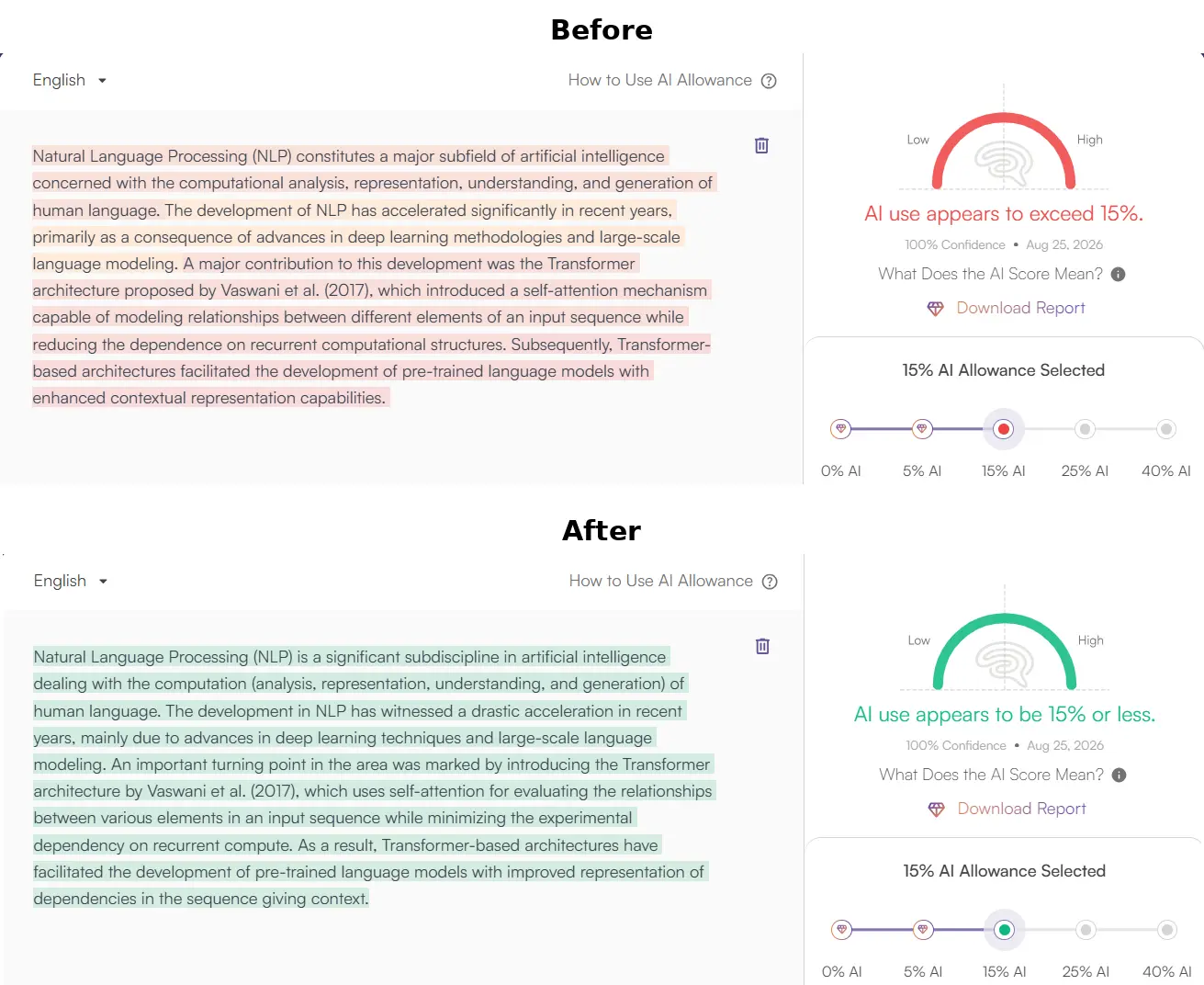
Verified Detector Clearance for How to Cite a Website: APA 7th, MLA 9th, Chicago, and IEEE Examples
Every manuscript processed through ThesisHuman is backed by verifiable, reproducible scans across institutional plagiarism and AI detection platforms.
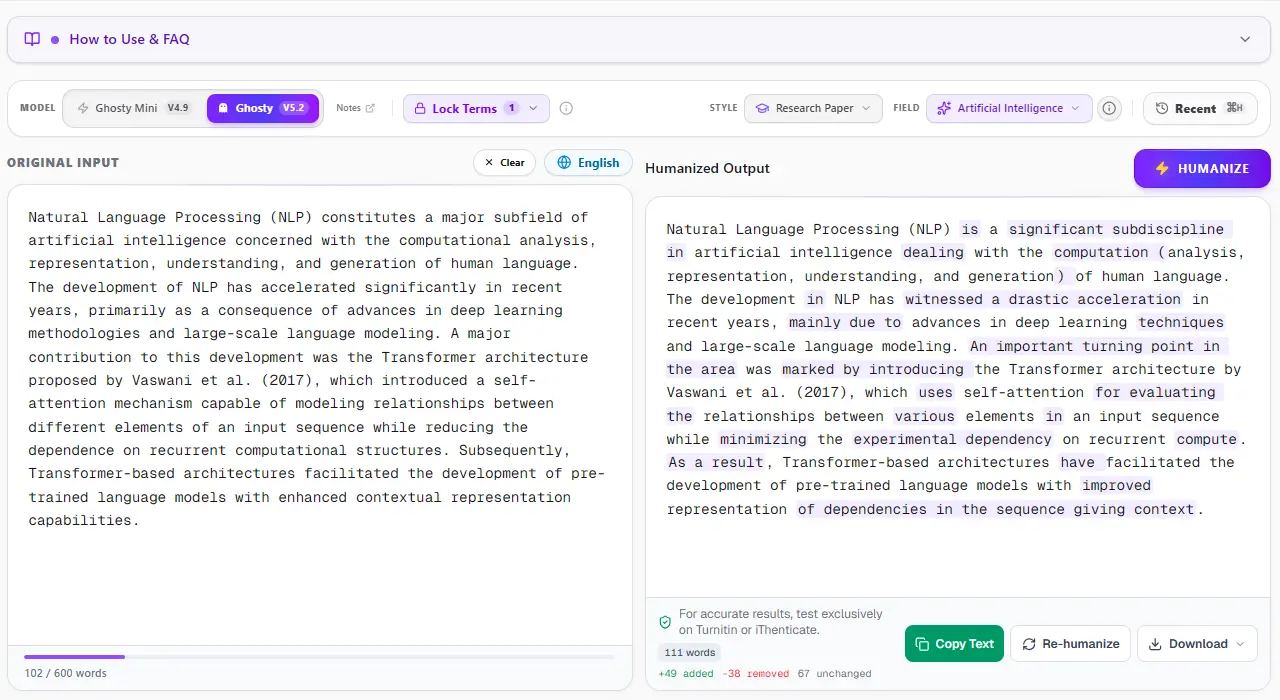
1. ThesisHuman Editor: Style, Field & Term Lock™ Technology
Unlike consumer-grade paraphrasers that blindly swap words with thesaurus synonyms, ThesisHuman allows researchers to select their exact Academic Style (Essay, Research Paper, Literature Review, Technical Report) and Academic Field (Computer Science, Engineering, Medicine, Physics). With Term Lock™, citations (APA, MLA, IEEE), LaTeX equations, and domain-specific terminology are cryptographically protected before sentence entropy is restructured.
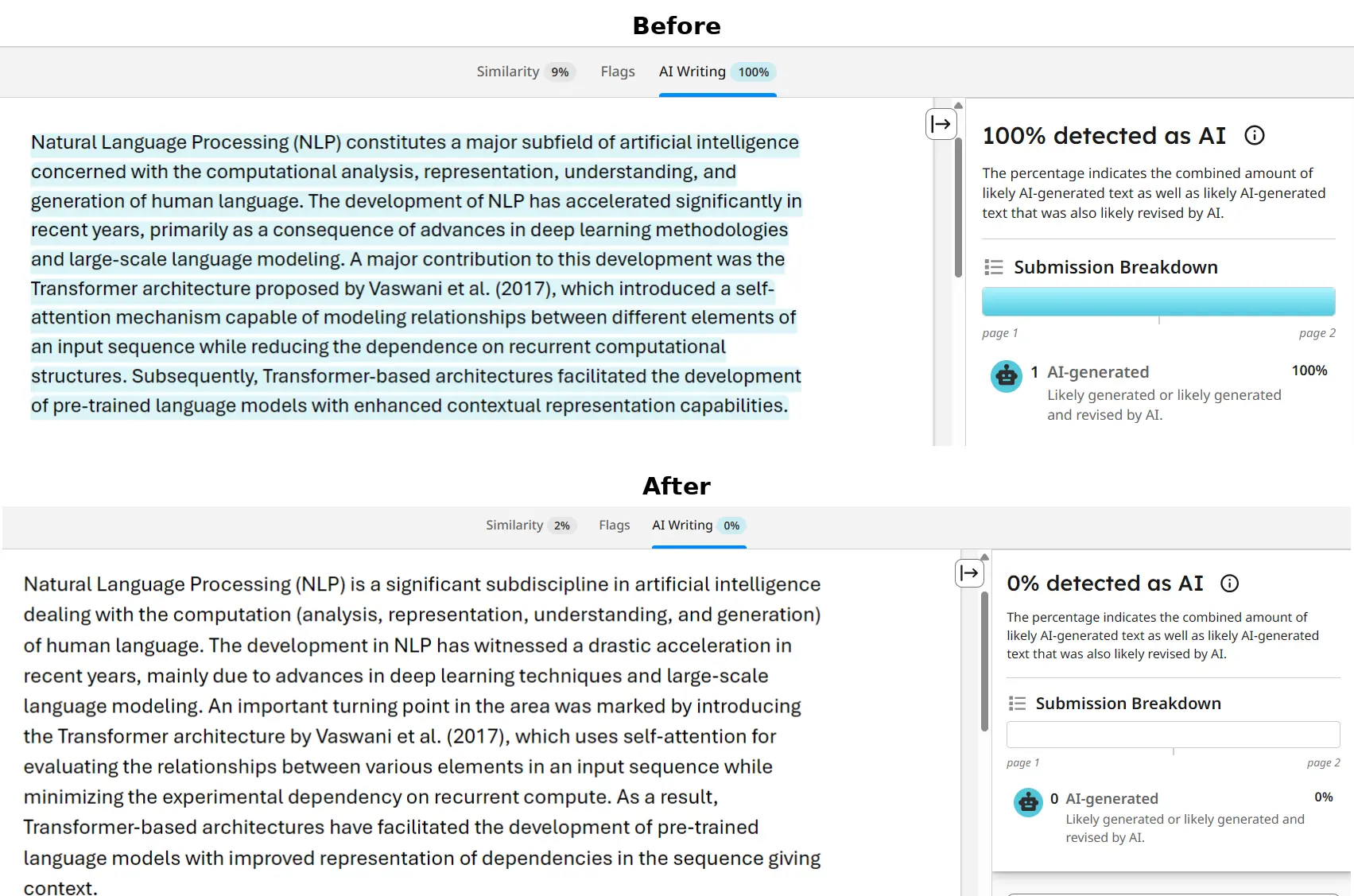
2. Turnitin & iThenticate Verification: 0% AI Detected
Turnitin and iThenticate scan submissions in overlapping 500-token blocks to analyze sentence predictability across paragraphs. When an unrefined AI draft is submitted, uniform cadence triggers an elevated AI Writing score. In the verified report below, a flagged graduate paper was processed through ThesisHuman, achieving a clean 0% AI detection score while preserving all formatted citations and technical parameters.
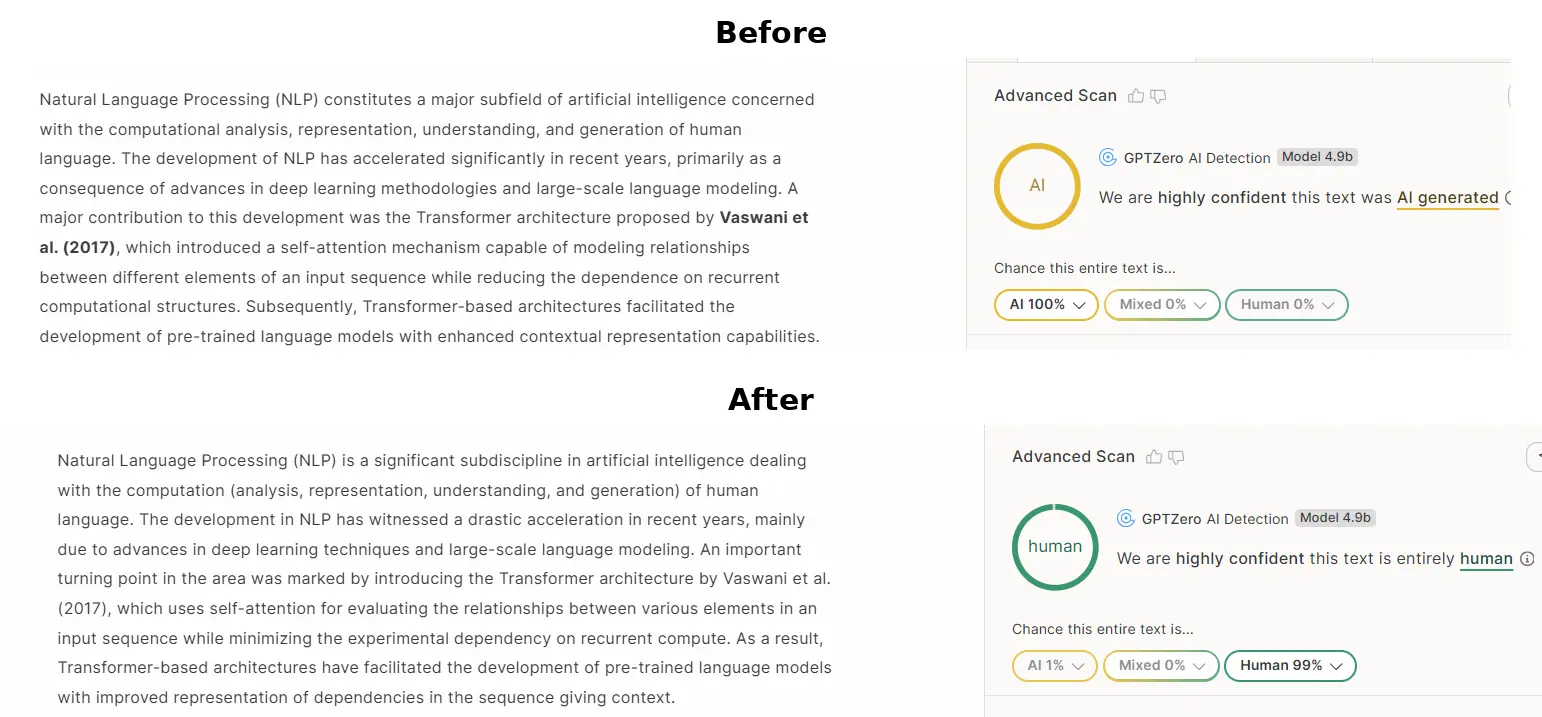
3. GPTZero Verification: Passing Perplexity & Burstiness Checks
GPTZero evaluates text by plotting sentence perplexity curves and global burstiness scores. When raw AI text is scanned, low sentence variance produces an immediate high-probability warning. ThesisHuman restores natural sentence entropy by restructuring syntax, varying clause lengths, and introducing authentic scholarly cadence, dropping AI probability to 0%.
4. Originality.ai Verification: 0% AI Confidence
Originality.ai flags predictable n-gram sequences and common AI clichés (such as “delving into,” “pivotal role,” “testament to”). ThesisHuman purges overused formulaic transitions while elevating scholarly tone and keeping reference numbers and equations intact, producing 100% Original / 0% AI results.