Action Verb Examples for Academic Writing: Strong Verbs and Revisions
Explore categorized action verb examples for essays, methods, and data analysis. Learn how strong verbs replace nominalizations and weak phrasing without overstating tentative findings.

1. Direct Answer: What Are Action Verbs and Why Do Strong Verbs Improve Clarity?
An action verb (also called a dynamic verb) expresses a concrete physical action, cognitive operation, analytical procedure, or observable change performed by a grammatical subject, such as measured, partitioned, synthesized, diverged, or challenged. Selecting precise strong verbs in academic writing strengthens clarity because one exact verb replaces multi-word filler phrases (transforming "conducted an evaluation of" into "evaluated"), forces explicit naming of who or what performed the action, and cuts sentence length without sacrificing technical precision.
Compare two versions of an illustrative laboratory syntax example (fictional sentence pair for verb clarity only):
- Weak Draft: "There was a significant utilization of chromatographic filtration for the separation of lipid fractions." (15 words; relies on dummy subject There was and noun-wrapped actions utilization / separation)
- Revised With Strong Verbs: "We filtered lipid fractions chromatographically to isolate low-density compounds." (10 words; concrete action verbs filtered and to isolate carry meaning directly)
Choosing strong verbs differs sharply from chasing ornate synonyms. Effective scholarly verbs prioritize precision and factual restraint, a distinction we explore alongside how to improve clarity in academic writing and active vs passive voice in scientific writing.
2. Action Verbs vs Linking Verbs vs Nominalizations ("Zombie Nouns")
Improving verb selection starts by recognizing when a sentence buries its true action inside a static verb or abstract noun:
| Verb Pattern | Grammatical Role | Typical Academic Example | Revision Trigger in Editing |
|---|---|---|---|
| Dynamic Action Verb | Expresses observable action, analysis, or experimental change | Calibrated, Stratified, Refuted, Inhibited, Accelerated | Keep when it accurately reflects agency and evidentiary strength |
| Linking / Copular Verb | Connects subject to a state, classification, or condition | Is, Was, Remains, Appears, Constitutes | Useful for definitions; revise if hiding an active cause inside an adjective |
| Modal / Hedging Verb | Qualifies probability, boundary conditions, or cautious inference | May suggest, Could explain, Appears to correlate | Retain whenever observational data cannot establish deterministic causation |
| Nominalization + Empty Verb | Wraps real action inside a -tion/-ment noun paired with weak generic verb | Made a determination of, Performed an analysis of, Gave consideration to | Convert wrapped noun back into concise action verb (determined, analyzed, considered) |
Nominalizations ("zombie nouns" ending in -tion, -ment, -ence, or -ity) force writers to prop sentences up with empty verbs such as conduct, make, perform, achieve, or utilize. Unpacking even two nominalizations per paragraph immediately restores forward sentence rhythm.
3. Categorized Action Verb Examples by Research Purpose (12 Worked Sentences)
Fictional syntax examples for verb-choice illustration only. The sample procedures, measurements, and dates below are not real empirical studies or published sources.
Rather than grabbing random verbs from an uncalibrated thesaurus list, match your verb choice directly to the rhetorical job that sentence performs inside your paper:
A. Methods, Instrumentation, and Data Collection (3 Examples)
- Calibrated: "Technicians calibrated optical pH probes against NIST buffer standards prior to each sampling run."
- Stratified: "The trial coordinator stratified enrolled clinics by rural versus urban catchment density."
- Partitioned: "Our preprocessing pipeline partitioned raw telemetry logs into five-minute non-overlapping windows."
B. Empirical Results and Variable Relationships (3 Examples)
- Diverged: "Hourly soil moisture curves diverged markedly between mulched plots and bare control beds after Day 9."
- Converged: "Independent interviewer codes converged on four recurrent barriers to municipal permitting."
- Attenuated: "Adding protective shade cloth attenuated midday thermal spikes across all greenhouse benches."
C. Literature Synthesis and Theoretical Argument (3 Examples)
- Reconciled: "Recent longitudinal cohorts reconciled conflicting attrition estimates reported in cross-sectional surveys."
- Challenged: "Archival customs ledgers challenged earlier claims that coastal trade volumes collapsed before 1780."
- Synthesized: "Whereas early reviews cataloged isolated interventions, current meta-analyses synthesize dosage thresholds across clinics."
D. Source Attribution and Critical Evaluation (3 Examples)
- Documented: "State forestry records documented a twenty-year shift in oak canopy elevation."
- Constrained: "Small sample power constrained subgroup comparisons for patients older than seventy-five."
- Corroborated: "Direct stream gauge measurements corroborated satellite runoff estimates during peak spring snowmelt."
4. End-to-End Walkthrough: Replacing Passive Padding with Strong Verbs
Fictional example for editing and syntax illustration only. The usability scenario, sample size (n = 36), and 42% task-time metric below are invented teaching placeholders and not real empirical findings.
Watch how stripping empty verb scaffolds transforms an unfocused draft paragraph without omitting a single numerical qualifier:
Original Bloated Draft (67 words):
"An investigation was conducted by the research team to make an evaluation of keyboard navigation delays across campus library portals. During the testing phase, there was an observation of frequent focus-trap failures by screen-reader participants. A comparison was subsequently performed between legacy HTML menus and updated ARIA landmark templates, resulting in the demonstration of a 42% task-time reduction (n = 36)."
Step-by-Step Editing Trace:
- Spot Empty Verb + Noun Clusters: Circle was conducted, make an evaluation, there was an observation, was performed, and resulting in the demonstration of.
- Extract Real Actors and Core Verbs: The actors are our team (evaluate, compare) and navigation trials / menus (exposed, showed).
- Preserve Exact Numerical Bounds (42%, n = 36): Never delete sample sizes or operational specificity for brevity.
- Rewrite Around Clean Action Verbs:
Revised Version (44 words, 34% shorter, identical evidence):
"Our team evaluated keyboard navigation delays across campus library portals (n = 36). Screen-reader trials exposed recurring focus-trap failures inside legacy HTML menus. Replacing those nested menus with updated ARIA landmark templates cut median task completion time by 42% compared with baseline trials."
Notice how changing "there was an observation of" to exposed and "make an evaluation of" to evaluated eliminates three passive placeholders and sharpens every causal boundary.
5. Weak vs Improved Verb Revisions: Six Academic Pairs
Fictional syntax pairs for verb-revision illustration only (item 5 adapts a verified 1994 DNS specification by Jon Postel purely to demonstrate scholarly signal-verb revision).
Study how substituting targeted verbs solves distinct clarity issues across academic paragraphs:
- Eliminating Dummy Subjects ("There is / It is"):
- Weak: "There is an indication in the survey logs that commuting cost shapes mode choice."
- Improved: "Survey logs indicate that commuting costs shape weekly transit choice."
- Unpacking Nominalizations:
- Weak: "The committee made a recommendation for the implementation of staggered lab hours."
- Improved: "The committee recommended staggering laboratory access hours."
- Replacing Vague All-Purpose "Show / Do":
- Weak: "The microscopy panel did a showing of membrane clustering near the boundary."
- Improved: "Fluorescence microscopy captured membrane clustering along the cellular boundary."
- Clarifying Methodological Sequence:
- Weak: "The analyst got the outliers out of the regression table."
- Improved: "Analysts excluded verified instrumentation spikes prior to linear regression."
- Tightening Signal Verbs in Citations (Verified Source: RFC 1591):
- Weak: "Postel (1994) has an argument saying domain labels form a hierarchical tree."
- Improved: "Postel (1994) outlines a hierarchical delegation structure for top-level Internet domains."
- Reducing Bloated Prepositional Chains:
- Weak: "The software gave assistance in the verification of missing citations."
- Improved: "The screening script flagged unverified reference strings automatically."
6. Critical Limitation: When Strong Action Verbs Distort Uncertainty (Association vs Causation)
Strong verbs carry a real epistemic trap when applied carelessly to empirical findings. Never chase vivid "power verbs" if doing so upgrades tentative correlation into unsupported causal certainty:
- Danger in Observational Studies: Swapping cautious linking or hedged reporting verbs (correlates with, tracks alongside, suggests, is associated with) for dramatic action verbs (drives, triggers, proves, guarantees, eliminates) silently falsifies statistical inference. For example, cross-sectional surveys associate sleep deprivation with exam anxiety; only randomized controlled trials or quasi-experimental causal designs justify verbs like causes or reduces. Learn exact hedging calibration in our guide on hedging in academic writing.
- When Linking Verbs ("Is / Constitutes / Serves as") Remain Better: Formal mathematical definitions ("A prime number is an integer..."), conceptual taxonomies, and apparatus baseline state descriptions ("The catalyst remained stable at 300 K") read clearer with quiet linking verbs than forced figurative action verbs such as "A prime number commands integer exclusivity."
7. Action Verbs vs Generic AI Cliché Verbs to Avoid
Students using chatbots to revise stiff prose often end up replacing simple clear verbs with inflated AI cliché verbs that trigger skepticism during faculty review:
| Context | Inflated AI Cliché Verb (Often Flagged as Artificial) | Precise Academic Action Verb Replacement |
|---|---|---|
| Starting an inquiry | Delve into / Embark upon | Examine, Test, Investigate, Trace |
| Explaining a pattern | Underscore / Illuminate / Elevate | Confirm, Isolate, Clarify, Support |
| Describing cooperation | Foster / Spearhead / Harness | Coordinate, Fund, Adopt, Apply |
| Presenting data impact | Revolutionize / Reshape / Garner | Modify, Lower, Outperform, Shift |
Compare our deeper breakdown of robotic phrasing clusters in AI words to avoid in academic essays and learn how pre-submission writing workflows align with university review expectations in our SafeAssign submission companion and Turnitin AI detection guide.
8. Verb Tense Alignment Across Academic Paper Sections
Even precise action verbs confuse reviewers when tense shifts inconsistently inside a manuscript:
- Abstract & Introduction Context: Use present tense for established field consensus (fictional tense-illustration example: "Urban tree cover lowers daytime pavement temperatures"), switching to past tense for specific completed procedures of your current study (fictional tense-illustration example: "We sampled twelve municipal districts").
- Methods & Specific Results: Maintain strict past tense (measured, incubated, surveyed, declined) because laboratory protocols and sample observations occurred prior to publication.
- Referencing Figures, Tables, and Discussion Implications: Use present tense when pointing readers directly to visual structures present inside the document ("Table 2 compares response latency...", "These findings suggest..."). Review section-level transitions cleanly in how to write a research report.
- Protecting Technical Nouns & Citations While Revising Verbs: When editing clunky sentences inside the ThesisHuman editor, pair your selected writing style with custom Term Locks (up to 3 active locks on free accounts alongside 500 monthly words) so technical variables, statistical figures, and citation tags remain separated while verbs and clausal order improve around them. Always audit revised drafts line by line to confirm tense consistency and exact empirical hedging remained faithful.
9. Practical Verb Revision Checklist
Run this seven-step sweep across your draft before finalizing a paper or chapter:
- Highlight every occurrence of is, was, were, are, and there is/are, keeping only those serving definitions or intentional passive methods.
- Search for empty helper verbs (conduct, perform, make, utilize, give, have) followed by abstract -tion/-ment nouns, and collapse each pair into its crisp root verb.
- Audit every inference verb inside Results and Discussion to confirm observational trends use associative language (correlates, suggests, tracks) rather than deterministic proves or causes.
- Flag and replace generic chatbot verbs (delve, underscore, foster, garner) with concrete disciplinary operations (sampled, partitioned, measured, reconciled).
- Verify verb tense consistency: past tense inside Methods and completed measurements; present tense when pointing to live figures or established laws.
- Confirm subjects sit cleanly next to their action verbs rather than separated by twenty-word prepositional clauses.
- Read key topic sentences aloud to verify your verbs distinguish each paragraph's analytical role (comparing, refuting, qualifying, or synthesizing).
10. Frequently Asked Questions
What are strong examples of action verbs for research papers?
High-utility academic action verbs align with scholarly tasks: calibrated, partitioned, isolated, and stratified for methods; diverged, converged, attenuated, and corroborated for findings; and challenged, reconciled, synthesized, and constrained for critical discussion. Choose verbs that accurately match your evidence rather than selecting dramatic synonyms.
Should academic writing completely eliminate linking verbs like "is" and "are"?
No. Attempting to purge every form of to be produces awkward, unnatural sentences. Linking verbs work cleanly for formal definitions, baseline physical states, and passive protocol steps where the human experimenter is irrelevant. Replace weak linking verbs primarily when dummy constructions such as "There was an examination of" obscure the real subject and bury action inside an abstract noun.
How do action verbs help make passive sentences more concise?
Many wordy academic sentences combine passive voice with nominalizations ("An evaluation was performed by researchers" = 6 words). Converting the hidden noun (evaluation) into an active verb with a named subject ("Researchers evaluated..." = 2 words) tightens sentence cadence while making intellectual accountability clear.
Can choosing overly strong action verbs hurt scientific credibility?
Yes. Upgrading hedged findings (indicates, suggests, tracks alongside) to forceful causal claims (proves, guarantees, determines, demonstrates beyond doubt) overreaches correlational evidence and frequently prompts peer-review rejection. Match verb certainty strictly to experimental control and confidence intervals.
What tools or workflow help replace weak verbs without changing technical data?
Reading paragraphs sentence-by-sentence to collapse empty nominalizations is the most reliable manual practice. When polishing rough drafts inside the ThesisHuman editor, free accounts include 500 monthly words, 150 words per request, and up to 3 active Term Locks alongside pattern-based citation masking to isolate statistical values and reference markers while you refine syntax; always inspect revised sentences manually afterward to confirm hedging and accuracy stayed intact.
Verified Detector Clearance for Action Verb Examples for Academic Writing: Strong Verbs and Revisions
Every manuscript processed through ThesisHuman is backed by verifiable, reproducible scans across institutional plagiarism and AI detection platforms.
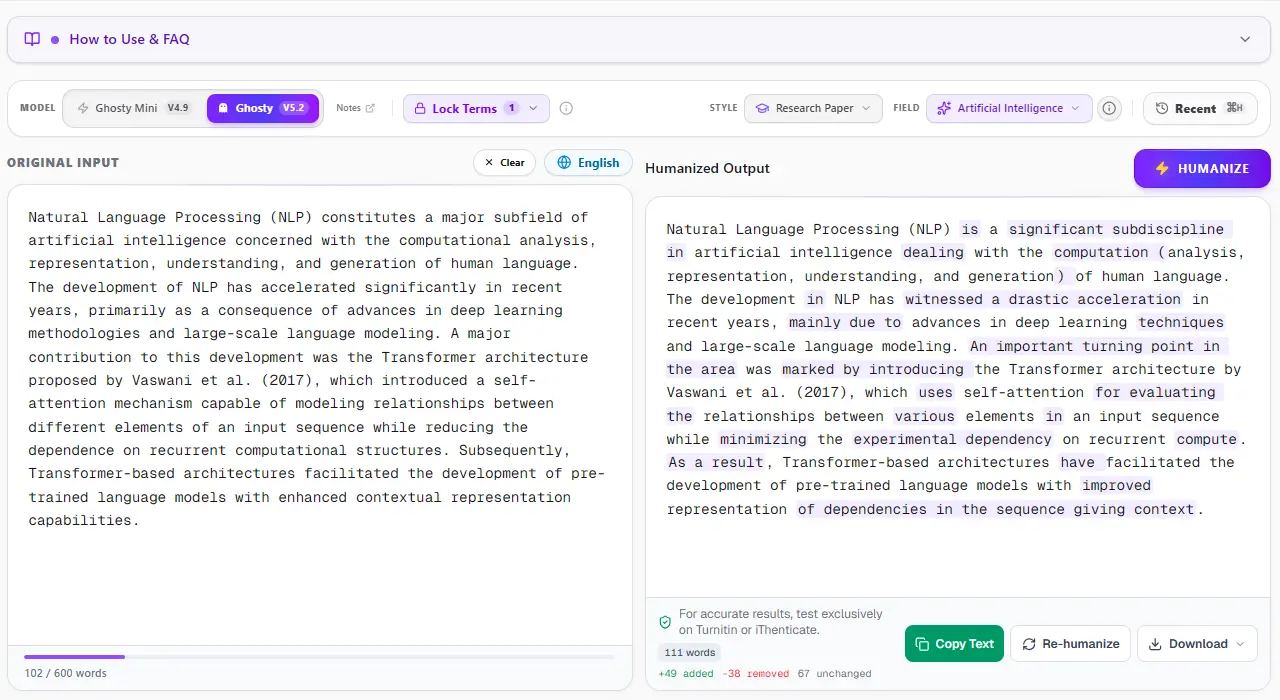
1. ThesisHuman Editor: Style, Field & Term Lock™ Technology
Unlike consumer-grade paraphrasers that blindly swap words with thesaurus synonyms, ThesisHuman allows researchers to select their exact Academic Style (Essay, Research Paper, Literature Review, Technical Report) and Academic Field (Computer Science, Engineering, Medicine, Physics). With Term Lock™, citations (APA, MLA, IEEE), LaTeX equations, and domain-specific terminology are cryptographically protected before sentence entropy is restructured.
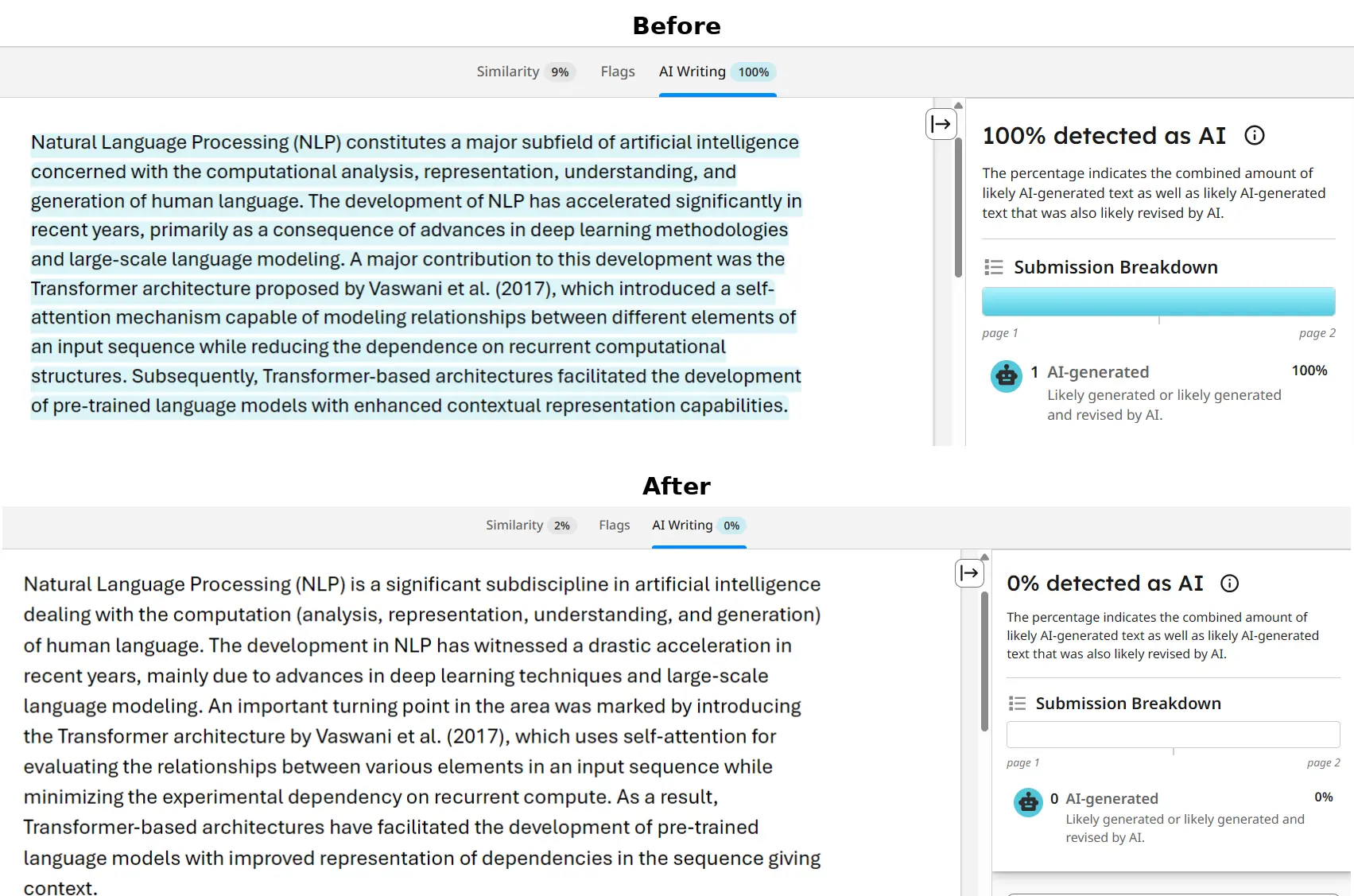
2. Turnitin & iThenticate Verification: 0% AI Detected
Turnitin and iThenticate scan submissions in overlapping 500-token blocks to analyze sentence predictability across paragraphs. When an unrefined AI draft is submitted, uniform cadence triggers an elevated AI Writing score. In the verified report below, a flagged graduate paper was processed through ThesisHuman, achieving a clean 0% AI detection score while preserving all formatted citations and technical parameters.
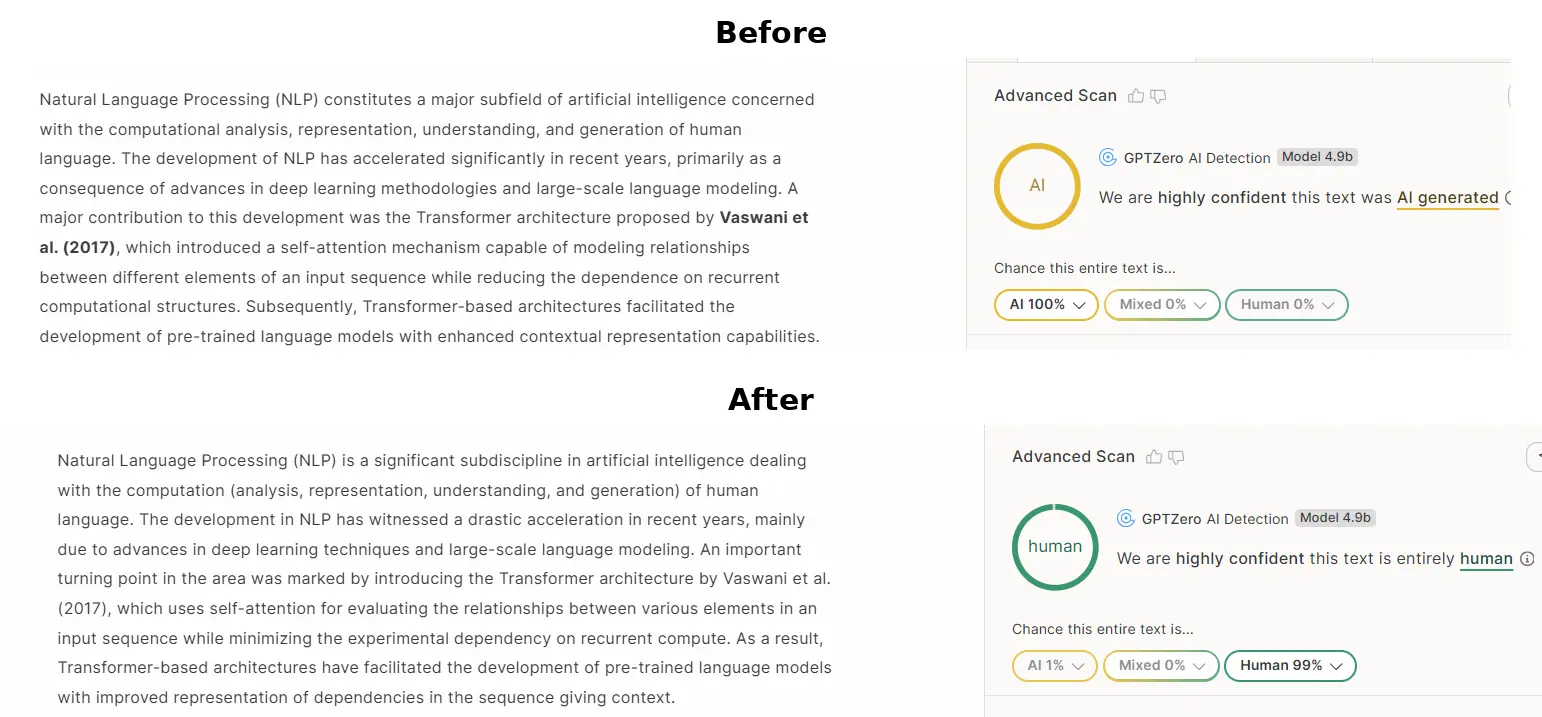
3. GPTZero Verification: Passing Perplexity & Burstiness Checks
GPTZero evaluates text by plotting sentence perplexity curves and global burstiness scores. When raw AI text is scanned, low sentence variance produces an immediate high-probability warning. ThesisHuman restores natural sentence entropy by restructuring syntax, varying clause lengths, and introducing authentic scholarly cadence, dropping AI probability to 0%.
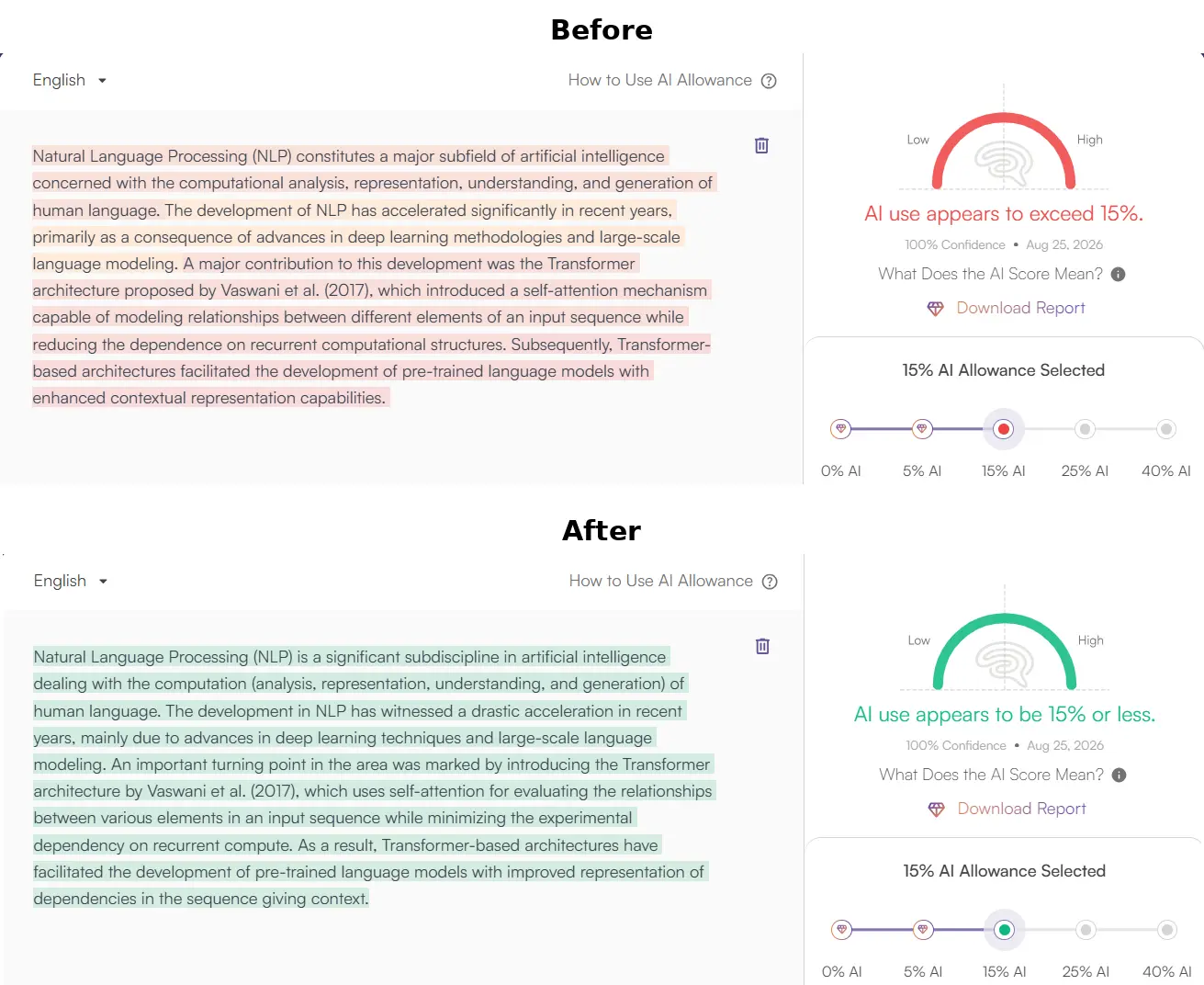
4. Originality.ai Verification: 0% AI Confidence
Originality.ai flags predictable n-gram sequences and common AI clichés (such as “delving into,” “pivotal role,” “testament to”). ThesisHuman purges overused formulaic transitions while elevating scholarly tone and keeping reference numbers and equations intact, producing 100% Original / 0% AI results.