What Is a Subject in a Sentence? Definition, Types, and Examples
Learn how to identify the grammatical subject in any sentence. Covers simple, complete, and compound subjects, passive subjects vs semantic agents, questions, imperatives, and 10 practice drills.

1. Direct Answer: What Is a Subject in a Sentence?
A subject is the grammatical noun, pronoun, or noun phrase that controls the finite verb of a clause and identifies who or what the sentence is about. Together with the predicate (the verb and everything that modifies or completes it), the subject forms the structural core of every complete English sentence.
In ordinary English grammar sentences such as "The microscope revealed cellular damage" or "Water boils at 100 degrees Celsius", the highlighted opening noun phrases (the microscope and water) are the subjects governing the verbs revealed and boils. However, subjects do not always perform an action, and they do not always sit at the front of the clause: in passive sentences, questions, imperatives, and inverted constructions, finding the true grammatical subject requires checking which noun phrase governs the verb rather than relying on word order alone.
2. Subject vs Predicate: The Two Core Parts of Every Clause
Every independent clause splits cleanly into two structural halves:
- The Complete Subject: The naming element (the person, concept, measurement, group, or thing) about which the clause makes an assertion or asks a question.
- The Complete Predicate: The verb plus all objects, complements, and adverbial modifiers describing the action, state, or condition attributed to that subject.
Look at how the boundary falls cleanly across everyday and scholarly sentence examples:
- "The automated centrifuge [subject] | stopped abruptly during calibration [predicate]."
- "Three independent chemistry labs [subject] | replicated the baseline protocol [predicate]."
- "Early evening humidity [subject] | affects battery voltage stability [predicate]."
- "Careful proofreading [subject] | prevents avoidable agreement errors [predicate]."
When a sentence lacks either a grammatical subject (except for understood commands) or a finite predicate verb, it becomes a sentence fragment rather than a complete clause. Review our guide on what makes a good sentence and our companion reference on what a declarative sentence is to see how clear subject-predicate pairing strengthens sentence readability.
3. Simple Subjects, Complete Subjects, and Compound Subjects
Grammar handbooks classify subjects along two axes: how many modifiers wrap around the core noun (simple vs complete), and how many coordinated heads share the same verb (compound vs single).
| Subject Category | Definition | Illustrative Grammar Example | Exact Head Word(s) |
|---|---|---|---|
| Simple Subject | The single core noun, pronoun, or nominal head stripped of all articles, adjectives, and phrases | The tall ceramic beaker near the sink cracked. | beaker |
| Complete Subject | The simple subject together with all determiners, adjectives, and modifiers attached to it | The tall ceramic beaker near the sink cracked. | The tall ceramic beaker near the sink |
| Compound Subject | Two or more coordinated simple subjects linked by a conjunction (and, or, nor) sharing one verb | Baseline temperature and wind speed shaped the curve. | temperature and speed |
| Understood ("You") Subject | Omitted grammatical subject implied directly in direct commands or procedural imperatives | (You) Record each voltage reading before closing the latch. | You (implied) |
| Dummy / Expletive Subject | Structural placeholder word (there or it) occupying subject position while the real logical noun follows the verb | There are four remaining samples on the tray. | There (syntactic placeholder) / four remaining samples (logical subject controlling are) |
| Gerund or Clause Subject | An -ing verbal phrase or that/what noun clause acting as a single abstract grammatical subject | Calibrating the optical lens takes twelve minutes. | Calibrating the optical lens (singular unit) |
Key Distinctions Inside Complex Modifiers
Notice that modifiers attached inside a complete subject often contain nouns inside prepositional phrases, yet those object nouns never become the simple subject:
- "A box of stainless steel syringes sits on the bench."
- Complete subject: A box of stainless steel syringes
- Simple subject: box (controlling singular verb sits, not plural syringes)
- "Neither the lead coordinator nor the junior analysts were informed."
- Compound subject: Neither the lead coordinator nor the junior analysts (linked by nor, with the closer plural noun analysts governing were).
For a full walkthrough of how prepositional phrases tuck inside complete subjects without altering verb agreement, see our guide on what a prepositional phrase is.
4. Subjects in Declarative Sentences, Questions, and Imperatives
Word order shifts systematically depending on clause mood, which explains why "look for the first noun" fails outside basic statements.
1. Declarative Sentences (Standard Subject-First Order)
In standard statements, the grammatical subject usually precedes the verb:
- "Students in the evening seminar completed their laboratory logs early." (Simple subject: Students)
- "What the committee decided changed the fall schedule." (Noun clause subject: What the committee decided)
2. Interrogative Sentences (Inverted Word Order)
In English questions (yes/no questions and wh- questions), an auxiliary verb (do, does, did, is, are, can, has) splits the predicate and moves in front of the subject. To spot the subject reliably, rewrite the question as a statement:
- Question: "Did the regional library extend its weekend hours?" -> Statement check: "The regional library did extend its weekend hours." (the regional library is the subject.)
- Question: "Why have these three sensors drifted since Tuesday?" -> Statement check: "These three sensors have drifted since Tuesday." (these three sensors is the subject.)
- Subject Wh-Question Exception: When who, what, or which itself asks for the doer, no auxiliary inversion occurs: "Which reagent caused the color shift?" (Which reagent is directly the subject.)
3. Imperative Sentences (Implied Subject *You*)
Commands, warnings, and experimental method instructions typically omit the surface subject altogether:
- "Inspect the seal for hairline fractures before pressurizing the chamber." (Implied grammatical subject: you -> "You inspect...")
- "Do not open the incubator during the final cycle." (Implied subject: you.)
5. Subjects in Passive Voice vs Semantic Agents
One of the most important grammar distinctions for essay writers, linguists, and researchers is the gap between grammatical subject (syntax) and semantic agent (meaning).
- Grammatical Subject: The noun phrase structurally paired with the finite verb and controlling verb agreement (was/were, is/are).
- Semantic Agent: The real-world entity that intentionally or physically initiates the action described by the verb.
In active voice, grammatical subject and semantic agent align in the same phrase. In passive voice, the patient or recipient of the action moves into the grammatical subject slot, while the semantic agent either drops completely or moves into an optional by-phrase at the end:
- Active Voice: "The research team [grammatical subject AND semantic agent] filtered forty water samples."
- Passive Voice: "Forty water samples [grammatical subject, NOT the agent] were filtered [by the research team (semantic agent in optional by-phrase)]."
Look closely at two additional academic examples illustrating why syntax and meaning separate:
- "The draft contract was reviewed by two legal advisors."
- Grammatical subject: The draft contract (singular, governing singular verb was).
- Semantic agent: two legal advisors (the people actually performing the review, tucked inside a prepositional phrase).
- "Three anomalies were observed across the northern ridge."
- Grammatical subject: Three anomalies (plural, governing plural verb were observed).
- Semantic agent: Unspecified (omitted in agentless passive reporting).
Recognizing this separation prevents writers from confusing the "doer" with the grammatical subject when checking singular/plural verb endings.
6. Subjects vs Objects, Inverted Word Order, and Expletives
Even experienced writers mislabel subjects when a clause starts with an adverbial modifier, a location phrase, or dummy placeholders like there and it.
Grammatical Subject vs Direct Object and Object of a Preposition
- Direct Object receives the verb's action and follows transitive active verbs: "The technician tightened the brass valve." (The technician = subject; the brass valve = direct object, never the subject.)
- Object of a Preposition follows words such as in, on, of, with, between, during: "During the afternoon session, participants completed two short surveys." (session is the object of during; participants is the grammatical subject.)
Inverted Word Order
In formal prose and narrative descriptions, prepositional phrases or negative adverbs occasionally move first and pull the verb ahead of the subject:
- "Beside the central courtyard stand two brick archives." (Verb: stand; true plural grammatical subject: two brick archives.)
- "Rarely have longitudinal surveys captured such rapid turnover." (Inverted auxiliary have precedes grammatical subject longitudinal surveys.)
Existential *There* and Weather/Cleft *It*
- "There remain three unresolved questions in Appendix B." (Grammatical placeholder There holds subject slot; logical plural noun three unresolved questions dictates plural remain, not remains.)
- "It became clear that early drainage failed." (Dummy pronoun It fills required grammatical subject slot before the delayed that-clause.)
7. Subject-Verb Agreement Rules and Common Identification Traps
Once you identify the exact simple subject (or compound pattern), selecting the right present-tense or auxiliary verb follows predictable rules:
- Ignore Intervening Prepositional Phrases: Phrases starting with of, with, along with, in addition to, or as well as do not change grammatical number: "The collection [singular] of archival maps requires acid-free folders."
- Compound Subjects With And vs Or/Nor: Pairs joined by and usually take a plural verb ("Copper and zinc conduct heat well"), unless they name one unified item ("Macaroni and cheese remains popular"). With or or nor, the verb agrees with whichever subject element sits closer to the verb ("Neither the advisor nor the students were notified" vs "Neither the students nor the advisor was notified").
- Indefinite Pronouns Stay Singular: Each, everyone, everybody, neither, anyone, nobody, someone function as singular subjects despite plural-sounding of-phrases: "Everyone in all three cohorts submits a weekly log."
- Collective Nouns Follow Intended Sense: Words like committee, team, jury, faculty take singular verbs in US academic English when acting as one body ("The committee approves the syllabus") and plural verbs only when members act individually.
8. Five Weak vs Corrected Sentence Subject Revisions
Strong subjects anchor clear academic prose. Below are five common structural defects (invented editing illustrations) alongside clean revisions:
| Weak Original Draft | Core Subject Defect | Corrected Revision |
|---|---|---|
| "There was an observation of lower soil moisture by the field crew." | Dummy there + nominalization hides the real actor and stretches the sentence | "The field crew observed lower soil moisture." |
| "A series of calibration errors were recorded overnight." | Plural object errors tricked the writer into plural were instead of singular series | "A series of calibration errors was recorded overnight." |
| "After reviewing the rubric, the final grade seemed clearer to Maya." | Misaligned main subject (the final grade cannot perform the reviewing) | "After reviewing the rubric, Maya understood her final grade more clearly." |
| "To analyze raw water salinity require clean glass vials." | Infinitive phrase acting as a singular subject erroneously took plural require | "Analyzing raw water salinity requires clean glass vials." (or To analyze raw water salinity requires...) |
| "Between the two proposals sit one practical budget constraint." | Inverted prepositional phrase concealed the singular subject one constraint | "Between the two proposals sits one practical budget constraint." |
9. A Practical Four-Step Method to Identify Any Subject
Apply this mechanical checklist whenever a long sentence obscures which noun governs the verb:
- Locate the Main Finite Verb: Find the action or linking verb showing tense (past, present, or modal auxiliary like has/will). Skip infinitives (to measure) and participles (measuring).
- Cross Out Opening Transitions and Prepositional Phrases: Temporarily bracket phrases starting with during, in, of, after, because of, despite. The simple grammatical subject almost never lives inside a prepositional phrase.
- Ask "Who or What + [Finite Verb]?": If a sentence reads "Around the perimeter stood six steel bollards", ask "Who or what stood?" Answer: six steel bollards.
- Convert Questions or Negatives to Statements: Undo auxiliary inversion ("Has the sensor stabilized?" -> "The sensor has stabilized") and verify singular/plural verb parity.
For more sentence-tightening strategies once your subjects are sharp, read our guide on how to improve clarity in academic writing and explore strong action verb examples.
10. Ten Practice Exercises: Identify the Subject (With Answers)
Test your grasp on ten original grammar sentences spanning simple, compound, passive, interrogative, imperative, and inverted structures:
- Sentence: "Every graduate fellow in the physics department teaches one introductory lab."
- Answer: Simple subject: fellow | Complete subject: Every graduate fellow in the physics department (in the physics department is a prepositional modifier).
- Sentence: "Has the revised manuscript cleared formatting inspection?"
- Answer: Simple subject: manuscript | Complete subject: the revised manuscript (reconstruct as statement: The revised manuscript has cleared...).
- Sentence: "Back up your raw spreadsheet before sorting column three."
- Answer: Implied subject: you (imperative command).
- Sentence: "Two corroded valves were replaced by the maintenance engineer."
- Answer: Grammatical subject: Two corroded valves (governing were replaced); semantic agent: the maintenance engineer.
- Sentence: "Reading peer-reviewed critiques sharpens methodological judgment."
- Answer: Gerund phrase subject: Reading peer-reviewed critiques (singular unit governing sharpens).
- Sentence: "Neither excessive heat nor sudden pressure drops damaged the seal."
- Answer: Compound subject: Neither excessive heat nor sudden pressure drops (simple heads: heat, drops; plural drops sits closer to verb).
- Sentence: "Along the quiet canal walked three botany students carrying clipboards."
- Answer: Simple subject: students | Complete subject: three botany students carrying clipboards (inverted word order places verb walked before subject).
- Sentence: "There remain several unresolved discrepancies in Table 4."
- Answer: Syntactic placeholder subject: There; logical subject governing plural remain: several unresolved discrepancies.
- Sentence: "Which diagnostic checklist did the nursing coordinator distribute?"
- Answer: Subject: the nursing coordinator (statement order: the nursing coordinator did distribute which diagnostic checklist; which diagnostic checklist is the fronted direct object).
- Sentence: "The battery pack and the cooling fan draw power from separate rails."
- Answer: Compound subject: The battery pack and the cooling fan (coordinated with and, taking plural verb draw).
11. Frequently Asked Questions
What is the difference between a simple subject and a complete subject?
A simple subject is only the core head noun, pronoun, or nominal word stripped of modifiers (for example, report in "The quarterly budget report arrived today"). The complete subject includes that core noun together with every article, adjective, and modifying phrase attached to it ("The quarterly budget report").
Can a sentence have a subject that does not perform the action?
Yes. In passive sentences such as "The samples were frozen overnight", the samples is the grammatical subject controlling the plural verb were, even though the samples underwent the action rather than performing it. The entity performing an action is the semantic agent, whereas the grammatical subject is strictly a structural role paired with the finite verb.
How do you find the subject in a question or command?
In a question, convert the sentence back into a standard statement to undo auxiliary verb inversion: "Did the advisor sign the form?" becomes "The advisor did sign the form." In an imperative command ("Check all citations carefully"), the grammatical subject is the implied second-person pronoun (you) even though it is omitted on the surface.
Can the grammatical subject sit inside a prepositional phrase?
No, in standard English clauses, nouns following prepositions (of, in, on, with, during, between) serve as objects of those prepositions rather than the main subject. In "A box of porcelain dishes sits on the shelf", box is the singular subject governing sits, not dishes.
How can writers keep subjects and verbs clear when revising rough drafts?
Check long sentences by highlighting the main finite verb first and verifying its nearest governing noun. When polishing wordy drafts in the ThesisHuman editor, writers can apply Term Locks (up to 3 active locks on free accounts with 500 monthly words and 150 words per request) around key technical terms while tightening buried subjects, then manually verify subject-verb agreement before submission.
Verified Detector Clearance for What Is a Subject in a Sentence? Definition, Types, and Examples
Every manuscript processed through ThesisHuman is backed by verifiable, reproducible scans across institutional plagiarism and AI detection platforms.
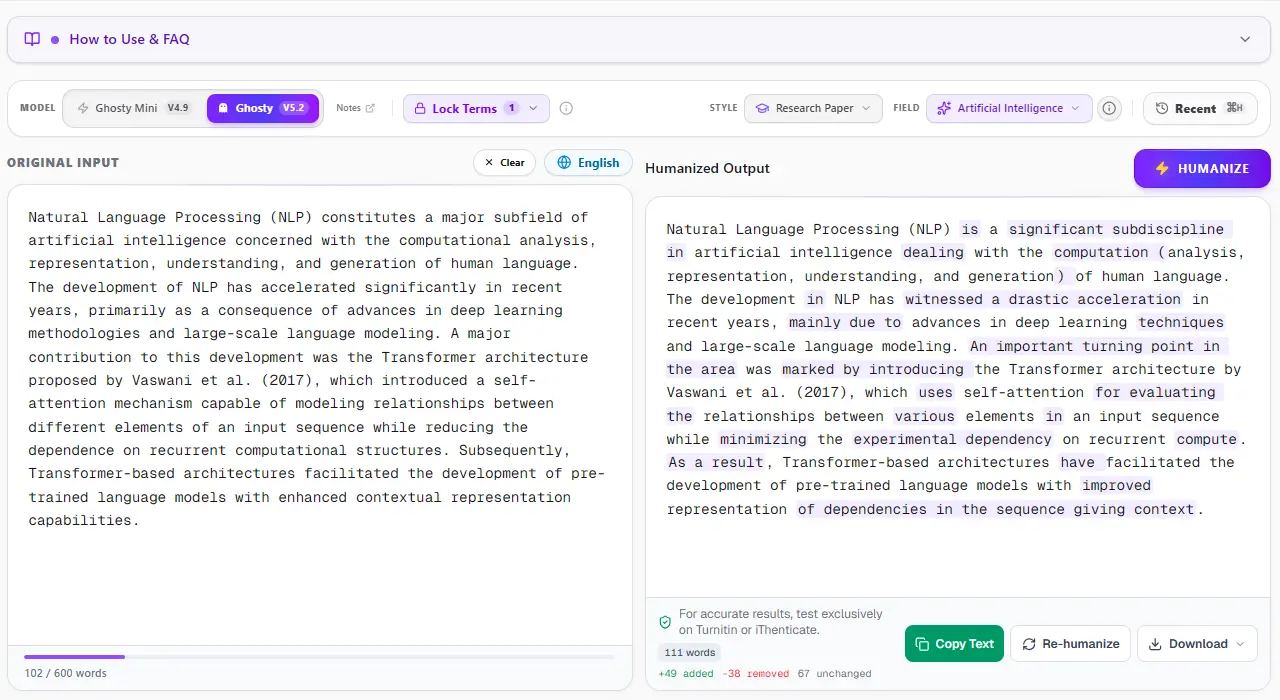
1. ThesisHuman Editor: Style, Field & Term Lock™ Technology
Unlike consumer-grade paraphrasers that blindly swap words with thesaurus synonyms, ThesisHuman allows researchers to select their exact Academic Style (Essay, Research Paper, Literature Review, Technical Report) and Academic Field (Computer Science, Engineering, Medicine, Physics). With Term Lock™, citations (APA, MLA, IEEE), LaTeX equations, and domain-specific terminology are cryptographically protected before sentence entropy is restructured.
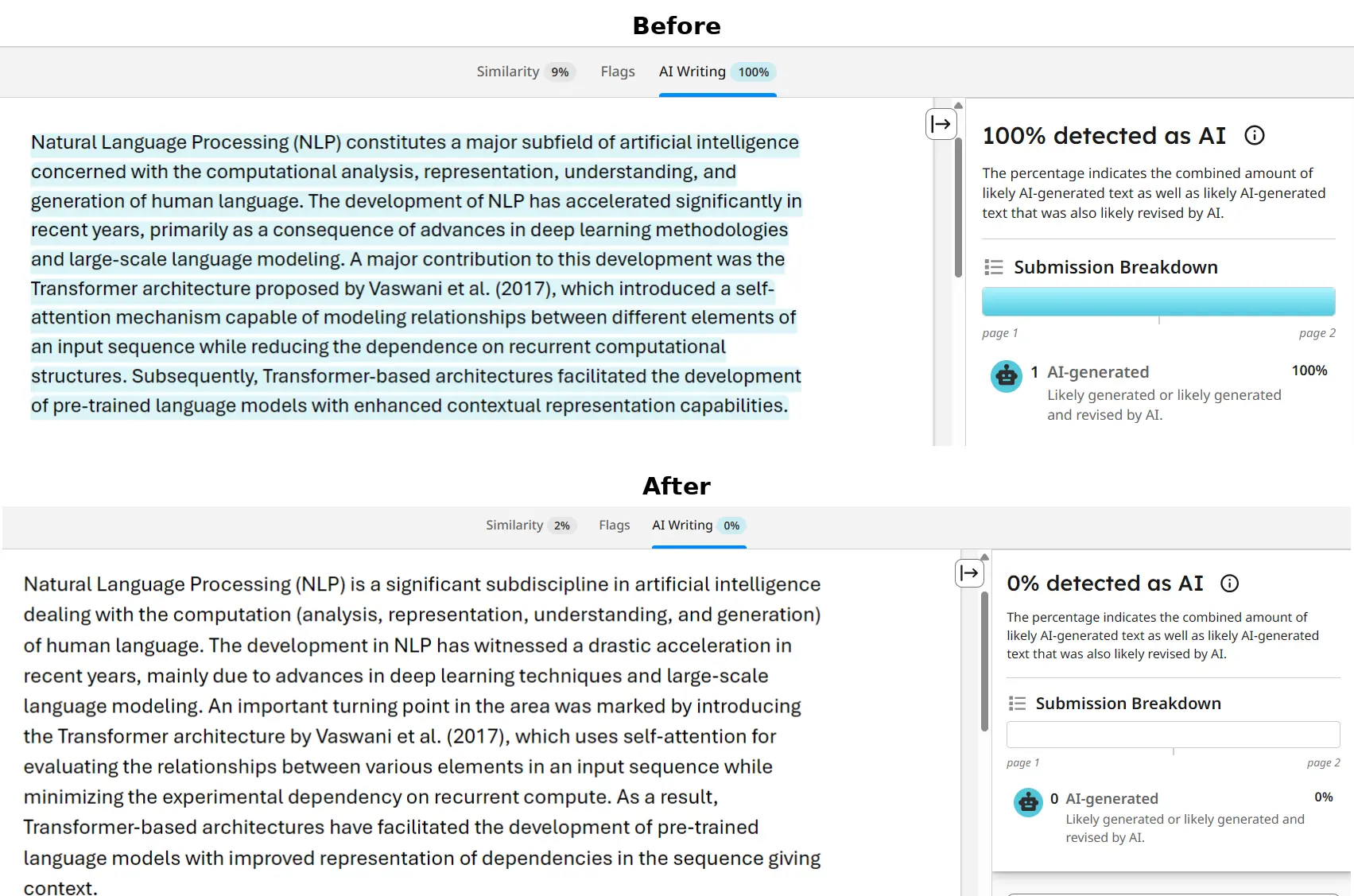
2. Turnitin & iThenticate Verification: 0% AI Detected
Turnitin and iThenticate scan submissions in overlapping 500-token blocks to analyze sentence predictability across paragraphs. When an unrefined AI draft is submitted, uniform cadence triggers an elevated AI Writing score. In the verified report below, a flagged graduate paper was processed through ThesisHuman, achieving a clean 0% AI detection score while preserving all formatted citations and technical parameters.
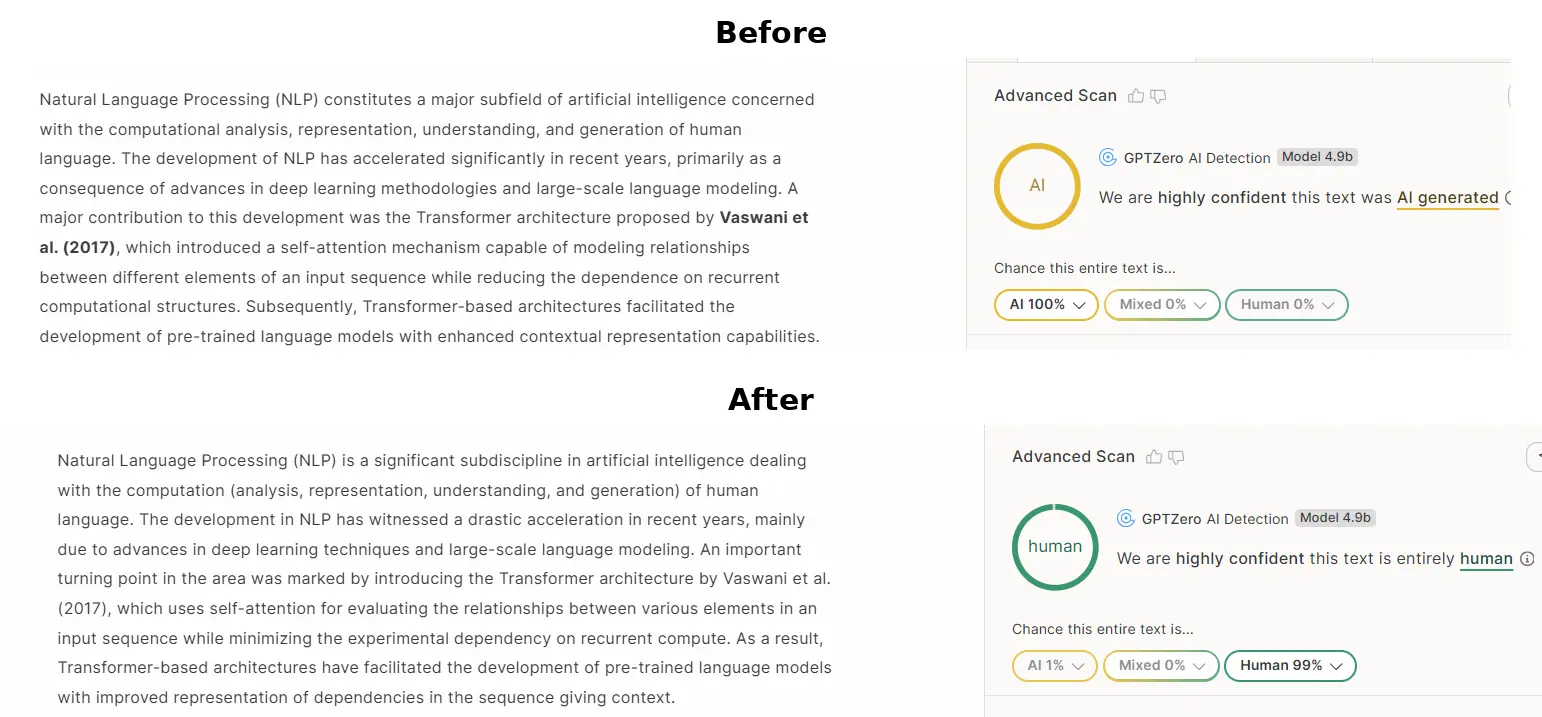
3. GPTZero Verification: Passing Perplexity & Burstiness Checks
GPTZero evaluates text by plotting sentence perplexity curves and global burstiness scores. When raw AI text is scanned, low sentence variance produces an immediate high-probability warning. ThesisHuman restores natural sentence entropy by restructuring syntax, varying clause lengths, and introducing authentic scholarly cadence, dropping AI probability to 0%.
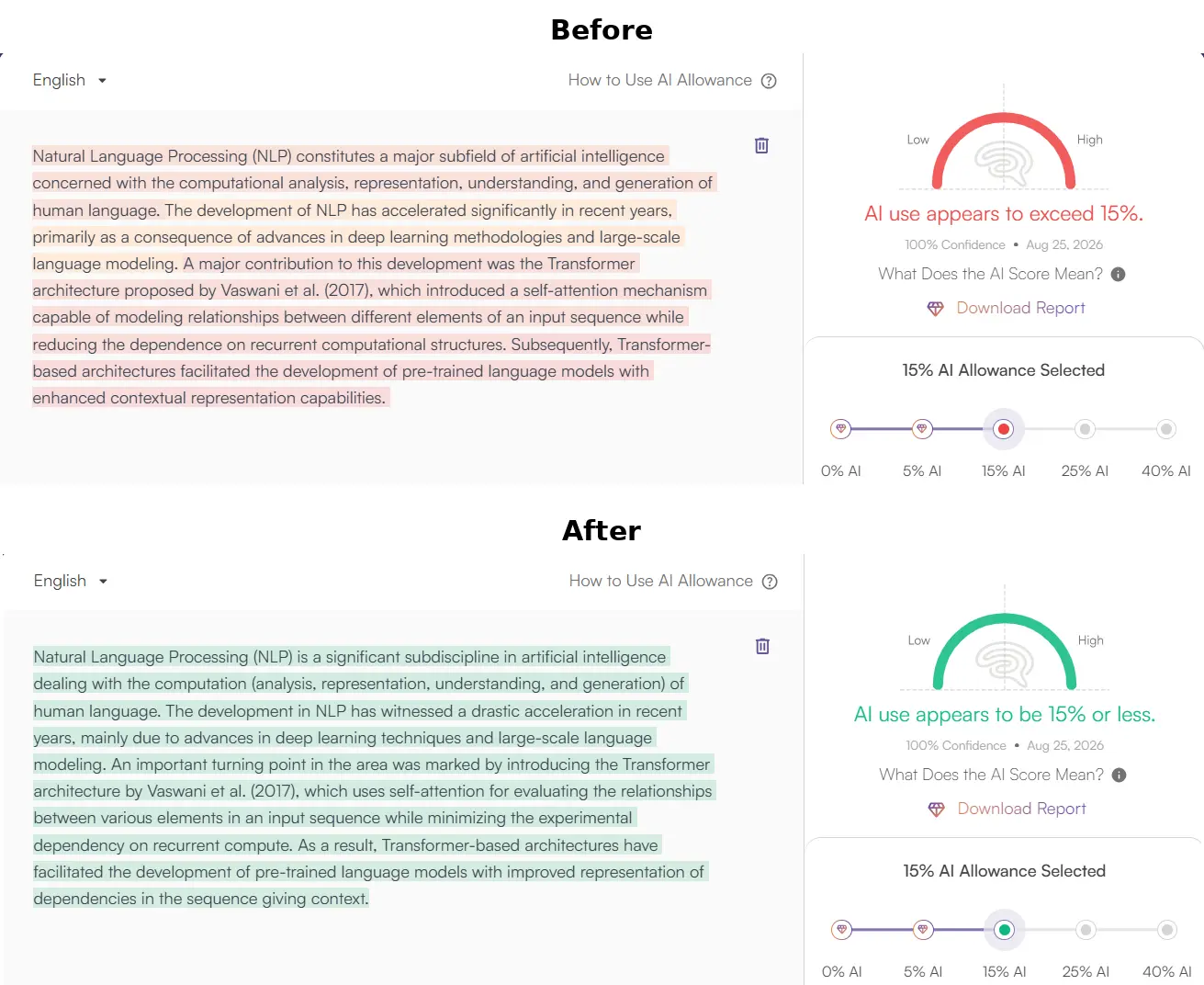
4. Originality.ai Verification: 0% AI Confidence
Originality.ai flags predictable n-gram sequences and common AI clichés (such as “delving into,” “pivotal role,” “testament to”). ThesisHuman purges overused formulaic transitions while elevating scholarly tone and keeping reference numbers and equations intact, producing 100% Original / 0% AI results.