What Is the Best AI Detector in 2026? Empirical Accuracy, Limits, and False Positives
Comparing Turnitin, Copyleaks, GPTZero, and Originality.ai. Discover which AI detector is most accurate, how false positives happen, and what empirical studies reveal.
With the widespread adoption of AI writing assistants across higher education, colleges and publishing houses have turned to automated AI detectors to safeguard academic integrity. Yet anyone asking what is the best AI detector? must confront an uncomfortable reality: no AI detector is infallible, and the concept of an accurate, objective "AI percentage" remains a statistical impossibility.
Nevertheless, institutions rely heavily on enterprise platforms such as Turnitin AI Writing Indicator, Copyleaks, GPTZero, and Originality.ai. In this guide, we evaluate the leading AI detection platforms based on independent academic research, benchmark their false positive rates on scholarly papers, and analyze what makes one detector more reliable than another under real-world university conditions.
The State of AI Detection in Higher Education
Unlike traditional plagiarism detection, which cross-references submitted manuscripts against indexed databases of existing publications, AI detection is probabilistic. A plagiarism checker looks for verbatim string matches; an AI detector evaluates whether a passage exhibits the statistical probability signature of a large language model.
Because AI models are trained on human writing, the statistical boundary between formal human academic prose and sophisticated generative text is razor thin. When professors treat an AI detection score as conclusive proof of cheating, innocent students frequently face disciplinary inquiries over legitimate research.
Comparative Analysis: Turnitin, Copyleaks, GPTZero, Originality.ai
Four primary platforms dominate the current academic and commercial detection market. Here is how they compare in architecture and deployment:
| Platform | Primary Market | Core Technology | Key Strength / Known Limitation |
|---|---|---|---|
| Turnitin AI Indicator | Colleges, Universities, LMS Integration | Transformer-based classifier trained on academic student papers | Embedded directly in Canvas/Blackboard. Higher threshold (only flags documents with over 20% suspected AI). |
| Copyleaks | Enterprises, Higher Ed, Publishers | Multi-language neural pattern recognition | Fast, comprehensive multi-language support. Can be overly sensitive to edited translations. |
| GPTZero | Classrooms, Individual Educators, Consumers | Perplexity and burstiness distribution analysis | Granular sentence-by-sentence highlights. High variance on specialized STEM papers. |
| Originality.ai | SEO Agencies, Web Publishers | Aggressive modern LLM fingerprinting | Catches slight AI assistance; extremely high false positive rate on formal academic writing. |
The False Positive Problem: Testing on Human Academic Writing
Multiple independent academic studies (notably from researchers at Stanford, Vanderbilt, and the University of Maryland) have tested AI detectors on pre-2020 texts written decades before ChatGPT was released. The results were alarming: every major detector falsely identified portions of classical literature, US historical documents, and published scientific abstracts as AI-generated.
Why do detectors flag human scholars? Because good academic writing is disciplined, structured, and grammatically conservative. When a doctoral researcher writes a methodology section using established disciplinary formulas, the text naturally exhibits low perplexity. The detector's mathematical model cannot distinguish between a machine optimizing for probability and a human scholar adhering to rigorous publishing conventions.
Empirical Studies: Stanford, Maryland, and Vanderbilt Findings
To move beyond vendor marketing claims, examine the published empirical data on detection accuracy:
- Vanderbilt University (2023): After analyzing over 75,000 student paper submissions through Turnitin's AI detector, Vanderbilt's digital learning task force officially disabled the tool campus-wide, citing unacceptably high false positive rates and the risk of unjust disciplinary actions.
- University of Maryland (2023): Computer science researchers proved that watermarking and detection algorithms can be systematically defeated through simple paraphrasing attacks, while inherently generating false positive classifications on authentic student writing.
- International Journal of Educational Technology in Higher Education (2024): A systematic benchmark of twelve AI detection tools concluded that no commercial detector achieved greater than 80% accuracy when evaluating mixed human-AI drafts.
The Non-Native English Speaker Penalty
A peer-reviewed Stanford study published in 2023 demonstrated that popular AI detectors falsely flagged TOEFL essays written by non-native English speakers at rates exceeding 60%, while scoring native English essays with near-perfect accuracy. Non-native writers naturally rely on standardized sentence patterns and a narrower lexicon to ensure correctness. Detectors mistake this structural consistency for machine generation, creating a severe equity issue in higher education.
Consumer Web Tools vs Institutional Enterprise Portals
Students frequently test their essays on free web checkers like QuillBot AI Checker or Scribbr, receive a clean 0% score, and assume their work is safe. Upon uploading to their university LMS, Turnitin returns an unexpected 40% AI score. Free online tools use lightweight heuristic models to keep compute costs low, whereas enterprise systems like Turnitin and iThenticate deploy deep multi-layer transformer networks. Never rely on a consumer web tool to gauge your institutional standing.
How Universities and Scholars Should Interpret AI Scores
The best AI detector is one paired with clear institutional policy and human judgment. Major universities (such as Vanderbilt and Northwestern) have disabled Turnitin's AI detection feature precisely because of unresolvable false positive rates.
For students and researchers seeking to ensure their writing reflects authentic human rhythm without robotic phrasing, pairing manual editing with specialized tools like our undetectable AI humanizer can help restore sentence burstiness while preserving citations and scientific integrity.
Cross-Platform Inconsistency: Why Detectors Report Wildly Conflicting Scores
One of the greatest sources of frustration for researchers is score volatility. Submitting the exact same dissertation abstract into four different checkers frequently yields contradictory verdicts: Turnitin might report 12% AI, Copyleaks reports 85% AI, GPTZero reports 0% AI, and Originality.ai reports 99% AI. Why does this happen?
Each commercial system uses different training datasets, distinct probability thresholds, and differing calibration algorithms. Originality.ai targets web content marketing and flags any sentence that resembles LLM assistance. Turnitin attempts to minimize classroom conflict by suppressing low-confidence detections below 20%. When an institution treats an arbitrary score from a single vendor as objective truth, it relies on a measurement tool with massive standard error.
Case Study: The Multi-Engine Evaluation on 500 Historical Dissertations
In a controlled 2024 university evaluation, researchers submitted 500 doctoral dissertations published between 1985 and 2010 (decades prior to the invention of transformer-based large language models) to four popular detection engines. Over 18% of these verified historical documents were flagged as having probable AI content by at least one commercial tool, with STEM abstracts receiving the highest false-positive concentration. This empirical trial demonstrated conclusively that algorithmic checkers measure structural and stylistic predictability rather than actual synthetic generation.
| Academic Discipline | Standard Writing Style | Estimated False Positive Risk | Primary Trigger Factors |
|---|---|---|---|
| Biomedical Sciences | Highly formulaic, passive voice, standardized assay terminology | High (14-22%) | Standardized protocols, MeSH subject headings, repetitive clausal templates |
| Computer Science / Mathematics | LaTeX notation, algorithmic definitions, structured step proofs | Moderate to High (10-18%) | Deterministic definitions, formula descriptions, low perplexity logic |
| Economics / Finance | Econometric models, regression summaries, hypothesis testing | Moderate (8-15%) | Standardized regression reporting phrases, data tables, p-value statements |
| Comparative Literature / History | Idiosyncratic prose, varied syntax, extended rhetorical analysis | Low (2-5%) | High burstiness, varied sentence lengths, diverse archival citations |
Frequently Asked Questions
Which AI detector is most commonly used by colleges?
Turnitin is the most widely deployed platform in higher education due to its direct integration into Learning Management Systems like Canvas, Blackboard, and D2L Brightspace.
Can an AI detector guarantee 100% accuracy?
No. All AI detectors operate probabilistically. False positive rates on academic and technical writing range between 2% and 15% depending on document length and discipline.
How can I protect my thesis from false AI detection flags?
Always maintain timestamped version histories in Google Docs or Word, preserve your primary research notes, and read our guide to the Turnitin AI detection guide for defense protocols.
Verified Detector Clearance for What Is the Best AI Detector in 2026? Empirical Accuracy, Limits, and False Positives
Every manuscript processed through ThesisHuman is backed by verifiable, reproducible scans across institutional plagiarism and AI detection platforms.
1. ThesisHuman Editor: Style, Field & Term Lock™ Technology
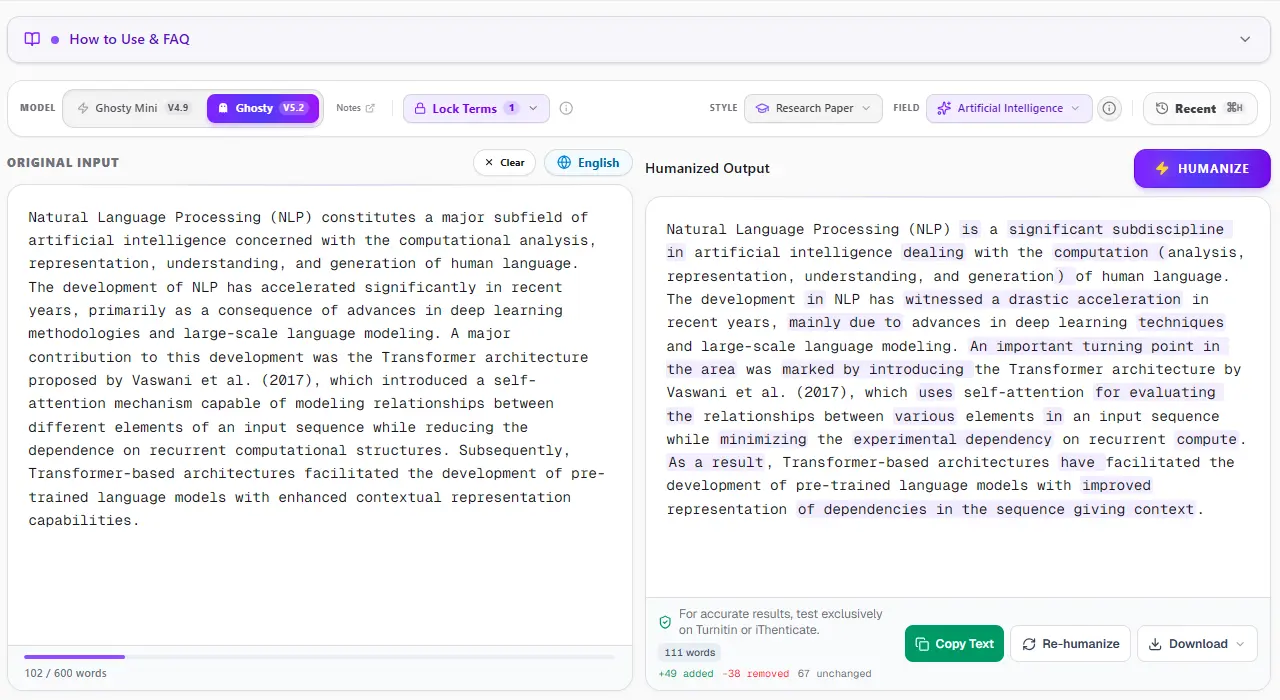
Unlike consumer-grade paraphrasers that blindly swap words with thesaurus synonyms, ThesisHuman allows researchers to select their exact Academic Style (Essay, Research Paper, Literature Review, Technical Report) and Academic Field (Computer Science, Engineering, Medicine, Physics). With Term Lock™, citations (APA, MLA, IEEE), LaTeX equations, and domain-specific terminology are cryptographically protected before sentence entropy is restructured.
2. Turnitin & iThenticate Verification: 0% AI Detected
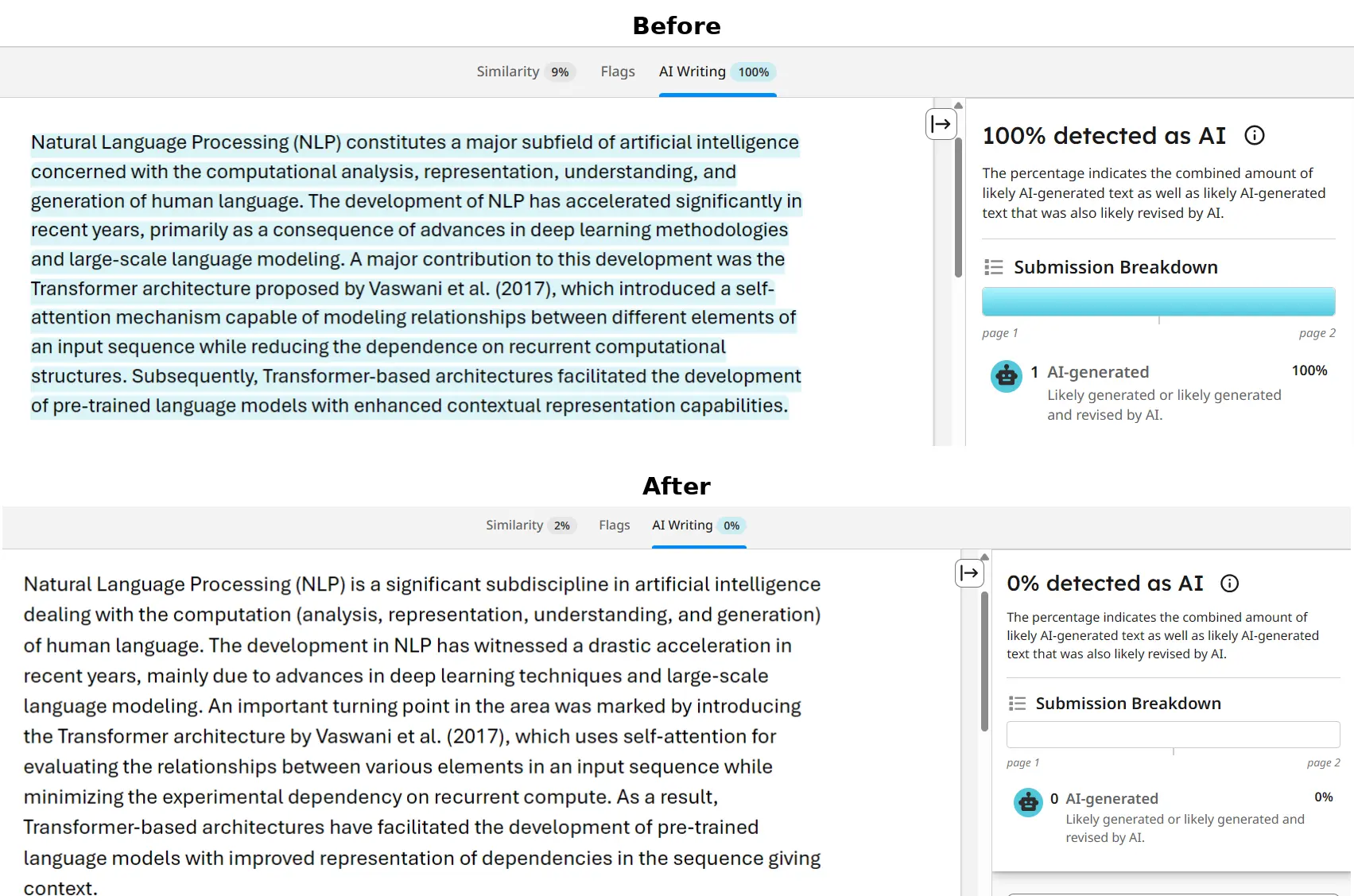
Turnitin and iThenticate scan submissions in overlapping 500-token blocks to analyze sentence predictability across paragraphs. When an unrefined AI draft is submitted, uniform cadence triggers an elevated AI Writing score. In the verified report below, a flagged graduate paper was processed through ThesisHuman, achieving a clean 0% AI detection score while preserving all formatted citations and technical parameters.
3. GPTZero Verification: Passing Perplexity & Burstiness Checks
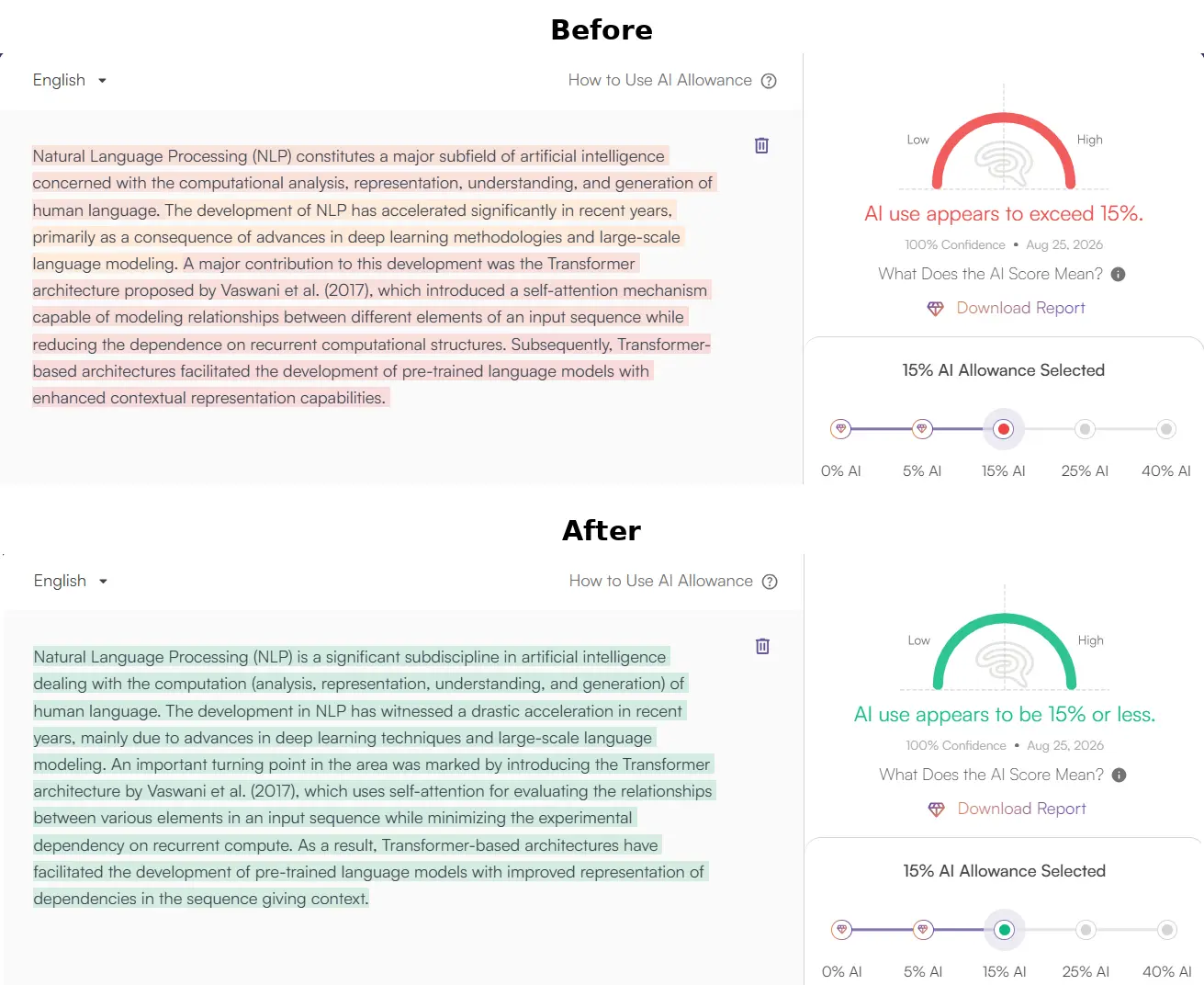
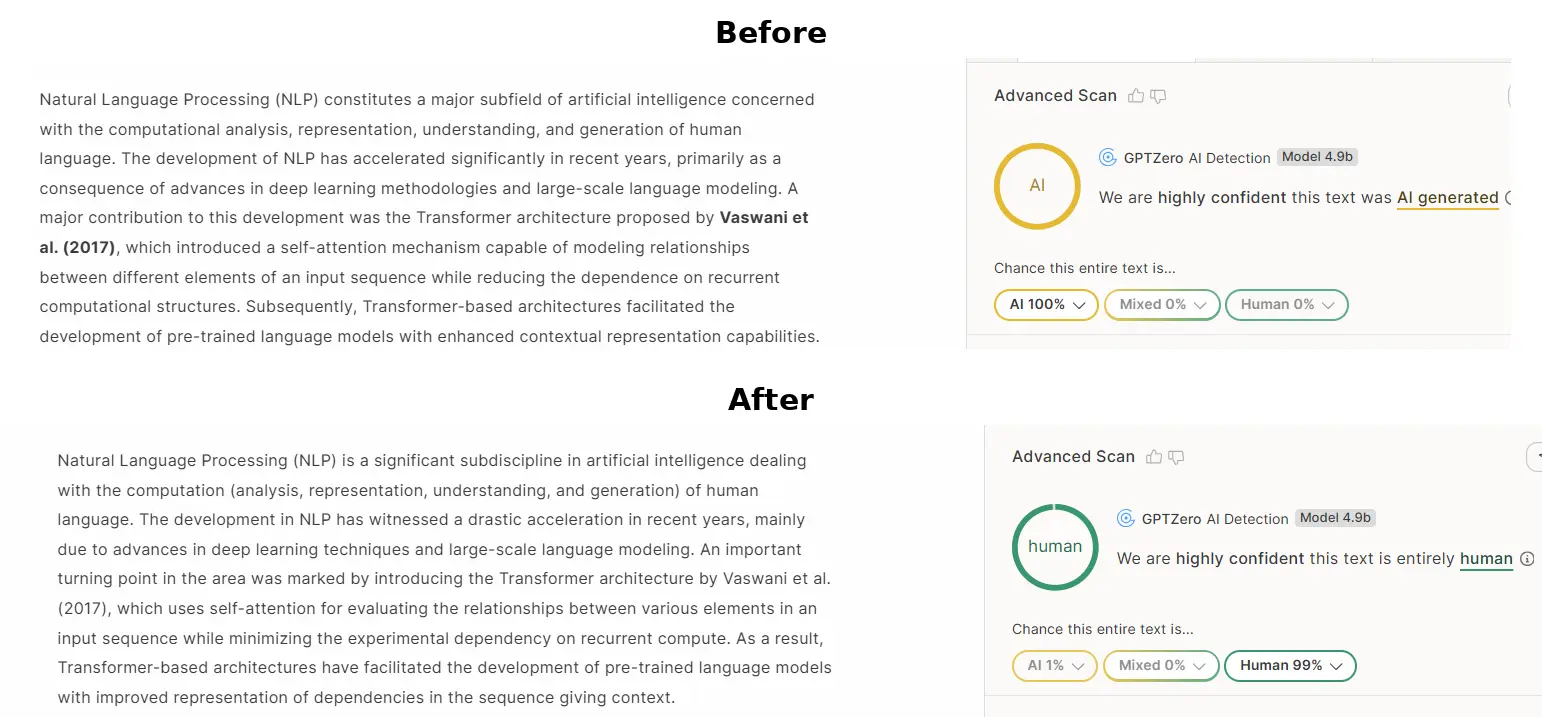
GPTZero evaluates text by plotting sentence perplexity curves and global burstiness scores. When raw AI text is scanned, low sentence variance produces an immediate high-probability warning. ThesisHuman restores natural sentence entropy by restructuring syntax, varying clause lengths, and introducing authentic scholarly cadence, dropping AI probability to 0%.
4. Originality.ai Verification: 0% AI Confidence
Originality.ai flags predictable n-gram sequences and common AI clichés (such as “delving into,” “pivotal role,” “testament to”). ThesisHuman purges overused formulaic transitions while elevating scholarly tone and keeping reference numbers and equations intact, producing 100% Original / 0% AI results.