Why Generic AI Humanizers Alter Scientific Meaning (And How to Prevent Factual Drift)
Generic paraphrasers prioritize evading detectors at all costs, resulting in hallucinated claims, altered sample sizes, and scrambled statistical conclusions. Understand the risks of factual drift and how academic humanization prevents it.

When a researcher receives a high AI writing score on an unpublished manuscript, the emotional response is often acute panic. Desperate to lower the score before a looming submission deadline, many authors turn to generic consumer "AI humanizers" or text spinners. These tools boast about achieving "100% undetectable human scores" on marketing landing pages. Yet in scholarly publishing, achieving a clean detection score at the expense of scientific accuracy is a catastrophic bargain.
Consumer humanizers have a single algorithmic objective: lower token predictability at all costs. To achieve this, their underlying models aggressively paraphrase text, swap specialized terminology for colloquial synonyms, and rephrase cautious empirical assertions into sweeping generalizations. In academic research, this creates **factual drift**, a silent corruption of scientific meaning that leads directly to desk rejections, peer review embarrassment, or post-publication retractions.
The Hidden Risk of Consumer Humanizers in Research
In creative writing or marketing copy, subtle shifts in tone or precision are harmless. If a marketing rewriter changes "effective product" to "dynamic solution," nothing is lost. In scientific writing, however, precision is everything. An assertion that "Compound A demonstrated moderate in vitro cytotoxicity ($IC_{50} = 24.5\ \mu\text{M}$)" cannot be casually rewritten into "Compound A showed strong cell-killing power in the lab."
When generic humanizers process academic manuscripts, they routinely commit three critical errors:
- Ontological Degradation: Established scientific taxonomy is replaced with everyday phrases that obscure meaning.
- Distortion of Epistemic Modality: Cautiously hedged scientific claims are transformed into unwarranted factual certainties.
- Numerical Corruption: P-values, sample counts, and confidence intervals are rounded, dropped, or separated from their corresponding variables.
The Three Forms of Factual Drift in Scientific Writing
1. Modality Shifting (Altering Scientific Hedging)
Scientific scholarship relies on precise epistemic hedging. A researcher writes: "The data suggests a potential association between dietary sodium and arterial stiffness in hypertensive cohorts." A consumer humanizer, striving to sound colloquial and punchy, rewrites this as: "The study proves that salt causes stiff arteries in people with high blood pressure." The nuanced, defensible empirical claim has been transformed into an unscientific overstatement that any peer reviewer will reject.
2. Jargon Misalignment
In specialized fields, near-synonyms are not interchangeable. In economics, "endogeneity" is not merely "internal factors." In immunology, an "antigen" is not simply a "foreign substance." When a consumer spinner replaces disciplinary terms to evade perplexity checks, it introduces conceptual errors that undermine the author's credibility.
3. Numerical and Statistical Detachment
When text rewriters reorder clauses to boost burstiness, they frequently misplace statistical qualifiers. A sentence stating: "Cohort 1 showed a 12% improvement ($p = .04$), whereas Cohort 2 showed no significant change ($p = .38$)" can be rearranged into: "Cohort 1 and Cohort 2 showed 12% improvements with $p$-values of .04 and .38 respectively," completely reversing the study's conclusions.
How ThesisHuman Prevents Factual Mutation
ThesisHuman was engineered specifically for researchers to solve the problem of factual drift. Rather than applying unconstrained paraphrasing, ThesisHuman operates within strict semantic guardrails:
- Term Lock Isolation: Quantitative values, confidence intervals, sample counts, and domain-specific vocabulary are safely protected before processing.
- Syntax-Only Cadence Re-Engineering: The engine modifies grammatical rhythm, sentence length entropy, and transitional cadence around the frozen terms, without touching propositional content.
- Semantic Verification: A validation layer checks that epistemic hedging and factual claims remain fully consistent.
A Pre-Submission Fact-Audit Checklist
Before submitting any humanized manuscript to a peer-reviewed journal, complete this pre-flight verification:
- Audit Every Number: Check that every sample size ($N$), percentage, p-value, and confidence interval matches your original laboratory data.
- Confirm Hedging Register: Verify that claims in the abstract and discussion reflect appropriate scientific caution rather than absolute assertions.
- Check Technical Definitions: Ensure discipline-specific concepts retain exact nomenclature. Review our companion guide on how to humanize AI text without altering facts, numbers, or claims.
COPE Compliance and Scientific Authorship
Under Committee on Publication Ethics (COPE) position statements and publisher guidelines across Elsevier, Wiley, Springer Nature, and IEEE, authors bear sole legal and intellectual responsibility for manuscript contents. Blaming an automated tool for an altered p-value or a scrambled citation is considered professional negligence. By using an academic humanizer that respects factual fidelity, you protect your research integrity and reputation.
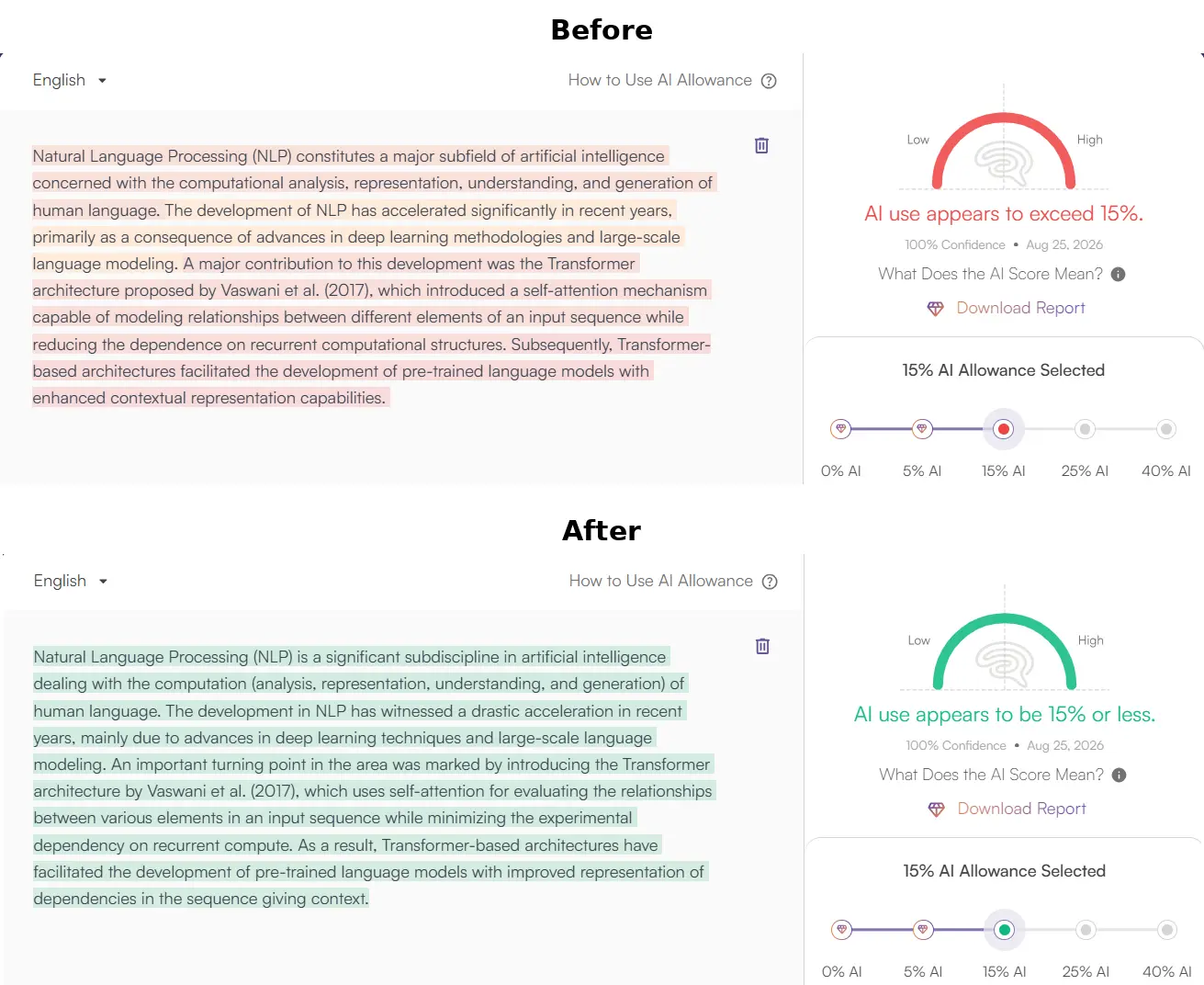
Verified Detector Clearance for Why Generic AI Humanizers Alter Scientific Meaning (And How to Prevent Factual Drift)
Every manuscript processed through ThesisHuman is backed by verifiable, reproducible scans across institutional plagiarism and AI detection platforms.
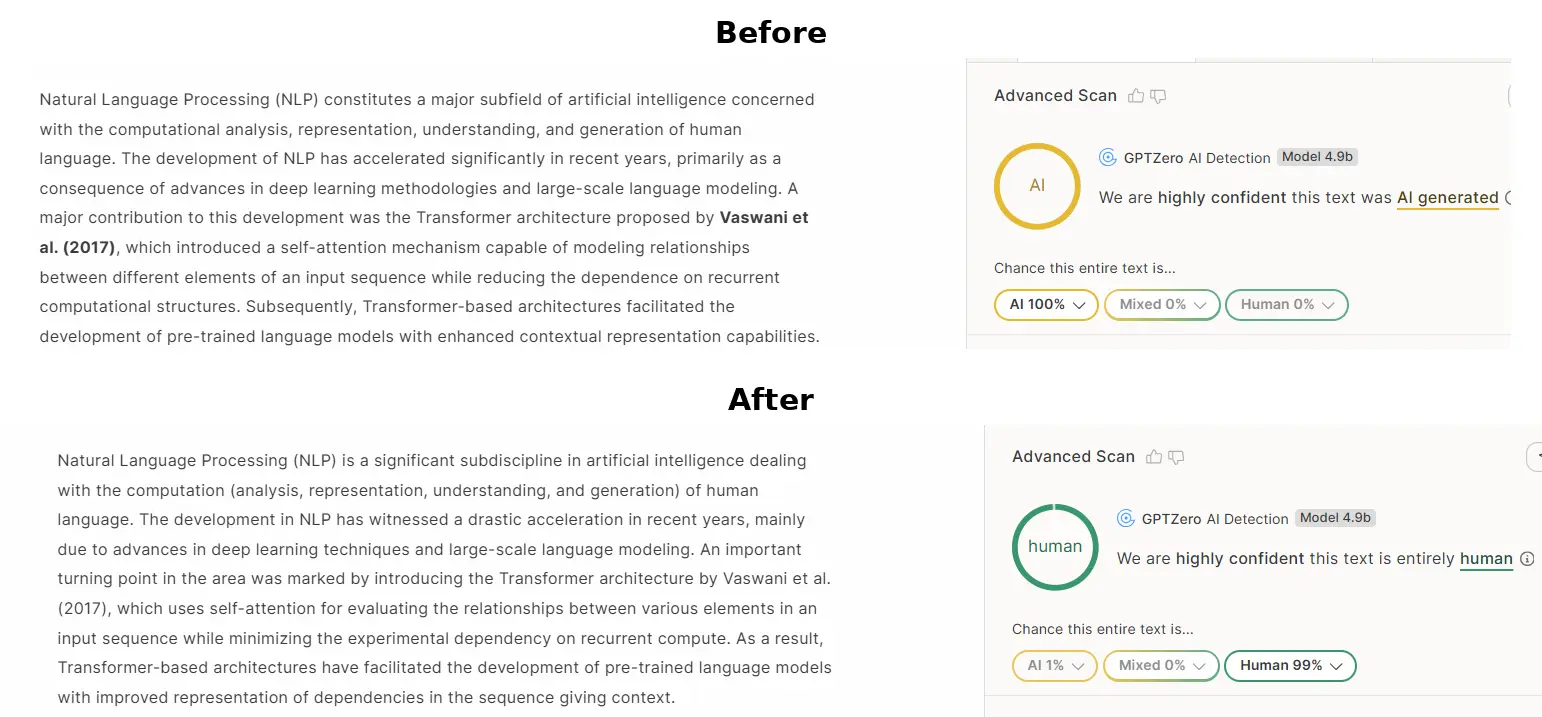
1. ThesisHuman Editor: Style, Field & Term Lock™ Technology
Unlike consumer-grade paraphrasers that blindly swap words with thesaurus synonyms, ThesisHuman allows researchers to select their exact Academic Style (Essay, Research Paper, Literature Review, Technical Report) and Academic Field (Computer Science, Engineering, Medicine, Physics). With Term Lock™, citations (APA, MLA, IEEE), LaTeX equations, and domain-specific terminology are cryptographically protected before sentence entropy is restructured.
2. Turnitin & iThenticate Verification: 0% AI Detected
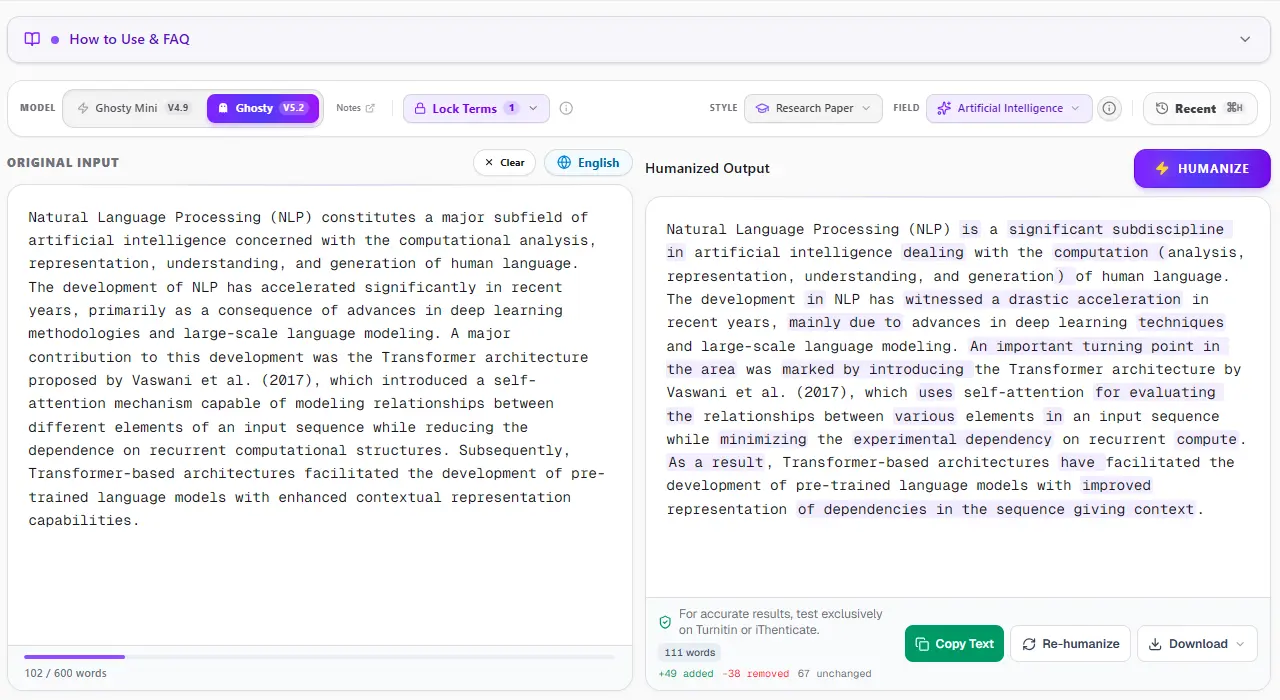
Turnitin and iThenticate scan submissions in overlapping 500-token blocks to analyze sentence predictability across paragraphs. When an unrefined AI draft is submitted, uniform cadence triggers an elevated AI Writing score. In the verified report below, a flagged graduate paper was processed through ThesisHuman, achieving a clean 0% AI detection score while preserving all formatted citations and technical parameters.
3. GPTZero Verification: Passing Perplexity & Burstiness Checks
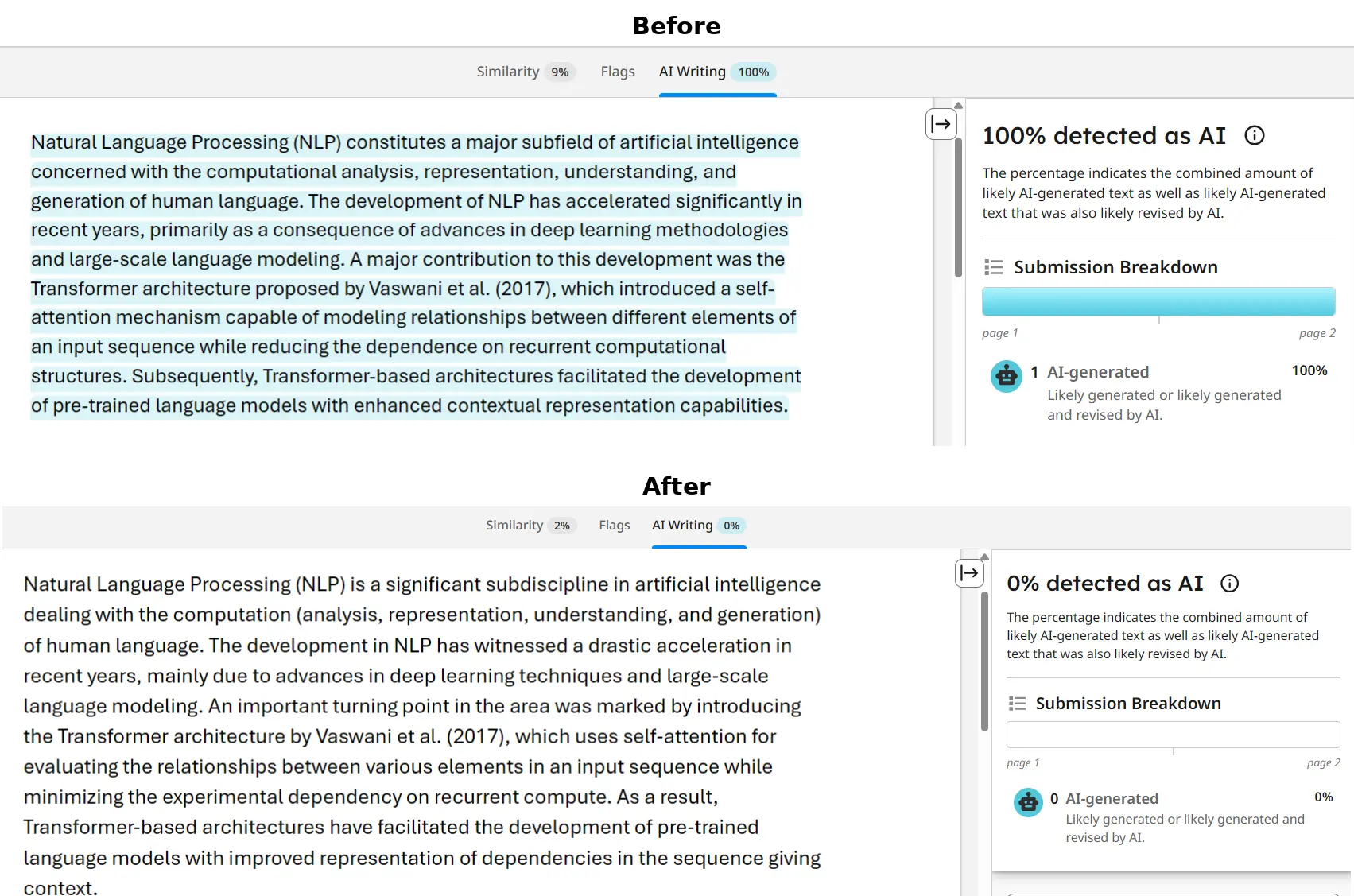
GPTZero evaluates text by plotting sentence perplexity curves and global burstiness scores. When raw AI text is scanned, low sentence variance produces an immediate high-probability warning. ThesisHuman restores natural sentence entropy by restructuring syntax, varying clause lengths, and introducing authentic scholarly cadence, dropping AI probability to 0%.
4. Originality.ai Verification: 0% AI Confidence
Originality.ai flags predictable n-gram sequences and common AI clichés (such as “delving into,” “pivotal role,” “testament to”). ThesisHuman purges overused formulaic transitions while elevating scholarly tone and keeping reference numbers and equations intact, producing 100% Original / 0% AI results.