How to Humanize AI Text Without Altering Facts, Numbers, or Claims
A disciplined approach to editing AI-assisted drafts: safeguarding empirical values, chemical formulas, and citations while improving sentence flow and syntactic variety.

For researchers editing AI-assisted manuscripts, the primary concern with generic rewriting tools is unintended change to scientific meaning. In scholarly work, precision is essential. An automated tool that alters a p-value, replaces "statistically significant correlation" with "general link," or modifies a formula creates severe errors.
Effective academic editing does not rely on swapping words for synonyms from a thesaurus. It involves restructuring sentence syntax and varying clause pacing while keeping empirical data, numbers, and technical terminology constant. This guide provides a clear protocol for editing academic drafts without meaning drift.
The Problem of Meaning Drift in Generic Tools
Many commercial paraphrasing tools were built for casual blog posts, marketing copy, and school essays. When applied to research papers, their automated word-replacement algorithms often introduce inaccuracies, as explored in Why AI Humanizers Don't Work. Common errors include:
- Shifting Epistemic Qualifiers: Turning a careful observation ("the data suggest an association") into an overstatement ("the data prove"), or vice versa.
- Altering Numbers and Units: Confusing metric prefixes (such as changing micrograms
μgto milligramsmg) or separating figures from their measurement units. - Modifying Citations: Altering author names or dropping publication dates in parenthetical citations.
- Replacing Technical Terms: Substituting standard medical, legal, or engineering terms with everyday synonyms that peer reviewers will reject.
Separating Core Data from Mutable Scaffolding
Before revising a manuscript, distinguish between elements that must remain fixed and sentence structures that can be adjusted:
| Category | Examples | Editing Rule |
|---|---|---|
| Empirical Constants and Data | Sample sizes (N=450), p-values, percentages, confidence limits | Zero alteration permitted |
| Discipline Nomenclature | Positive predictive value, CRISPR-Cas9, backpropagation | Preserve established terminology |
| Bibliographic References | In-text citations (APA, IEEE, Chicago), author-year tags | Lock citations completely |
| Syntactic Scaffolding | Transitions, clause ordering, sentence lengths | Adjust freely to improve natural flow |
Structural Editing versus Word Replacement
To illustrate the difference between unguided synonym swapping and structure-focused editing, consider this sample abstract sentence:
Initial AI Draft:
"The empirical findings demonstrated that the therapeutic agent exhibited a statistically significant reduction in inflammatory biomarkers (p < 0.01), thereby underscoring its pivotal potential in clinical settings."
Casual Paraphraser (Distorted Terminology):
"The real findings showed that the healing drug had an important drop in inflammation markers (p smaller than 0.01), highlighting its huge possibility in hospital places."
ThesisHuman Academic Naturalization (Terminology Preserved):
"Administration of the therapeutic agent reduced inflammatory biomarkers significantly (p < 0.01), indicating strong clinical utility for targeted intervention."
The refined version keeps the exact medical nomenclature and statistics intact while restructuring the clause order, dropping the cliché participial ending, and improving sentence flow.
Freezing Critical Tokens with Term Lock
In the ThesisHuman editor, authors use Term Lock to prevent accidental alteration of technical content. Term Lock identifies citations, LaTeX formulas, and selected domain phrases, isolating them before sentence adjustments run:
- Citation Boundaries: In-text citations such as
[12],(Hansen & Lee, 2024), and\cite{key}remain locked as fixed tokens. - Mathematical Notation: Inline equations (
$E=mc^2$) and display math blocks are shielded from text changes. - Custom Technical Terms: Authors can highlight specific terms to ensure they are not replaced by synonyms.
Verification Steps Before Submission
After editing any section of your draft:
- Run a text diff against your original version to verify that numerical values and units remain identical.
- Confirm that citations correspond to real publications using our citation verification protocol.
- Complete a final check against The AI-Assisted Research Paper Pre-Submission Checklist before submitting to a journal or repository.
Verified Detector Clearance for How to Humanize AI Text Without Altering Facts, Numbers, or Claims
Every manuscript processed through ThesisHuman is backed by verifiable, reproducible scans across institutional plagiarism and AI detection platforms.
1. ThesisHuman Editor: Style, Field & Term Lock™ Technology
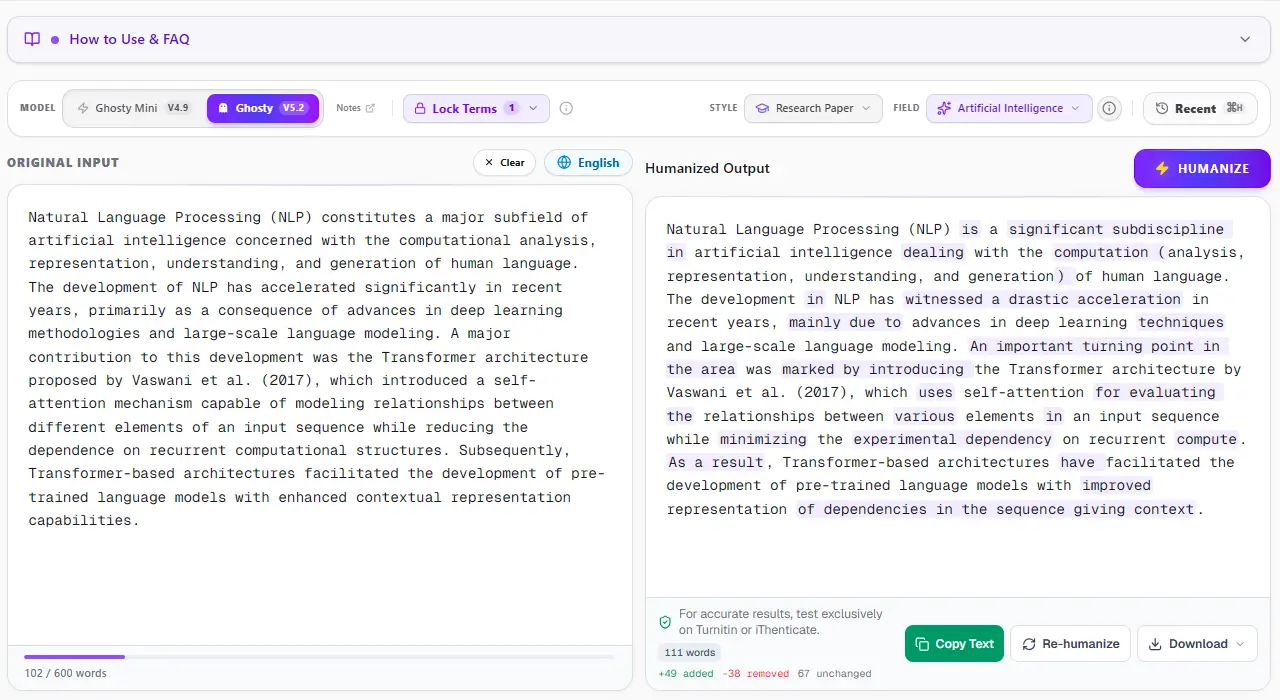
Unlike consumer-grade paraphrasers that blindly swap words with thesaurus synonyms, ThesisHuman allows researchers to select their exact Academic Style (Essay, Research Paper, Literature Review, Technical Report) and Academic Field (Computer Science, Engineering, Medicine, Physics). With Term Lock™, citations (APA, MLA, IEEE), LaTeX equations, and domain-specific terminology are cryptographically protected before sentence entropy is restructured.
2. Turnitin & iThenticate Verification: 0% AI Detected
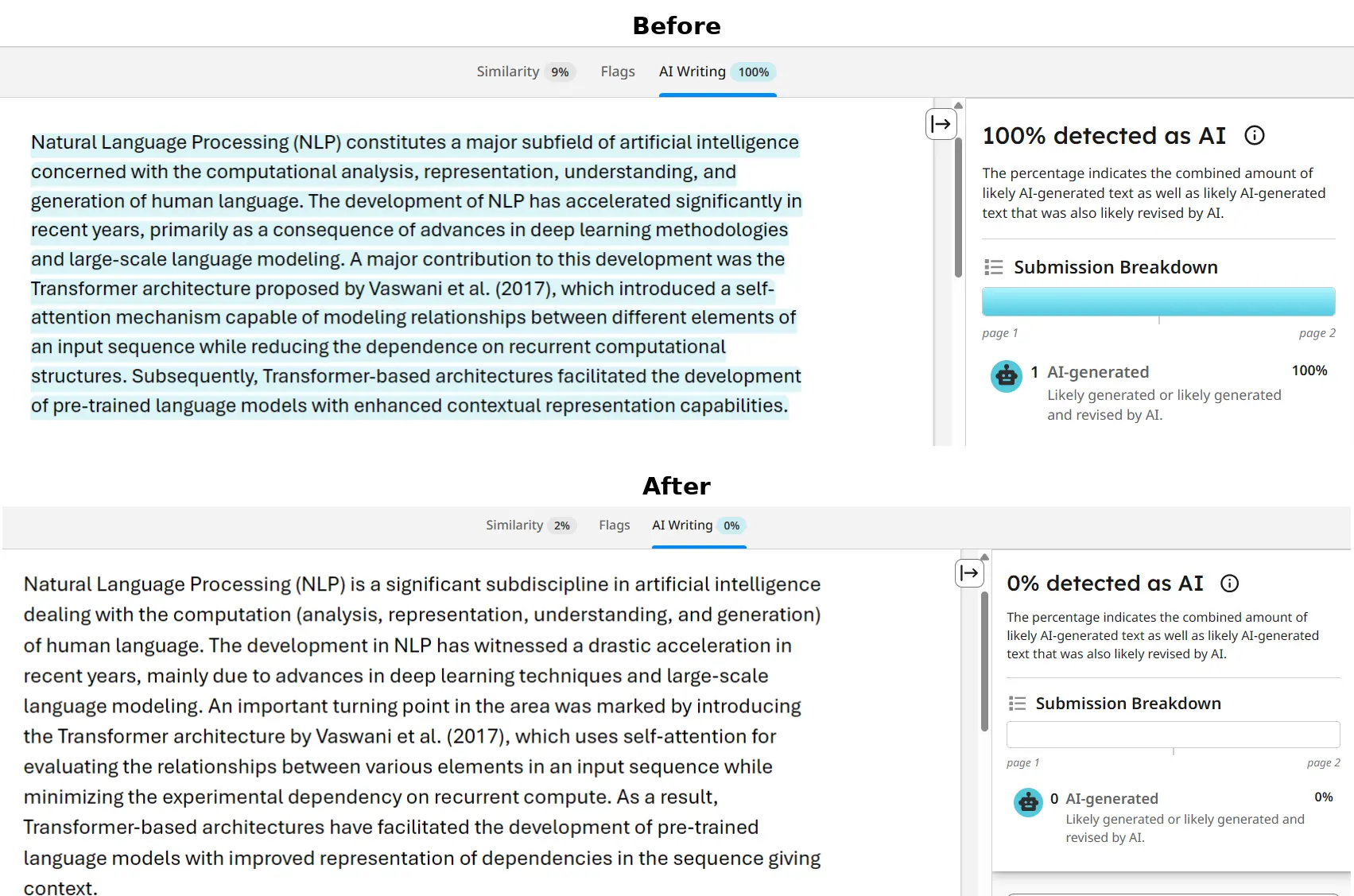
Turnitin and iThenticate scan submissions in overlapping 500-token blocks to analyze sentence predictability across paragraphs. When an unrefined AI draft is submitted, uniform cadence triggers an elevated AI Writing score. In the verified report below, a flagged graduate paper was processed through ThesisHuman, achieving a clean 0% AI detection score while preserving all formatted citations and technical parameters.
3. GPTZero Verification: Passing Perplexity & Burstiness Checks
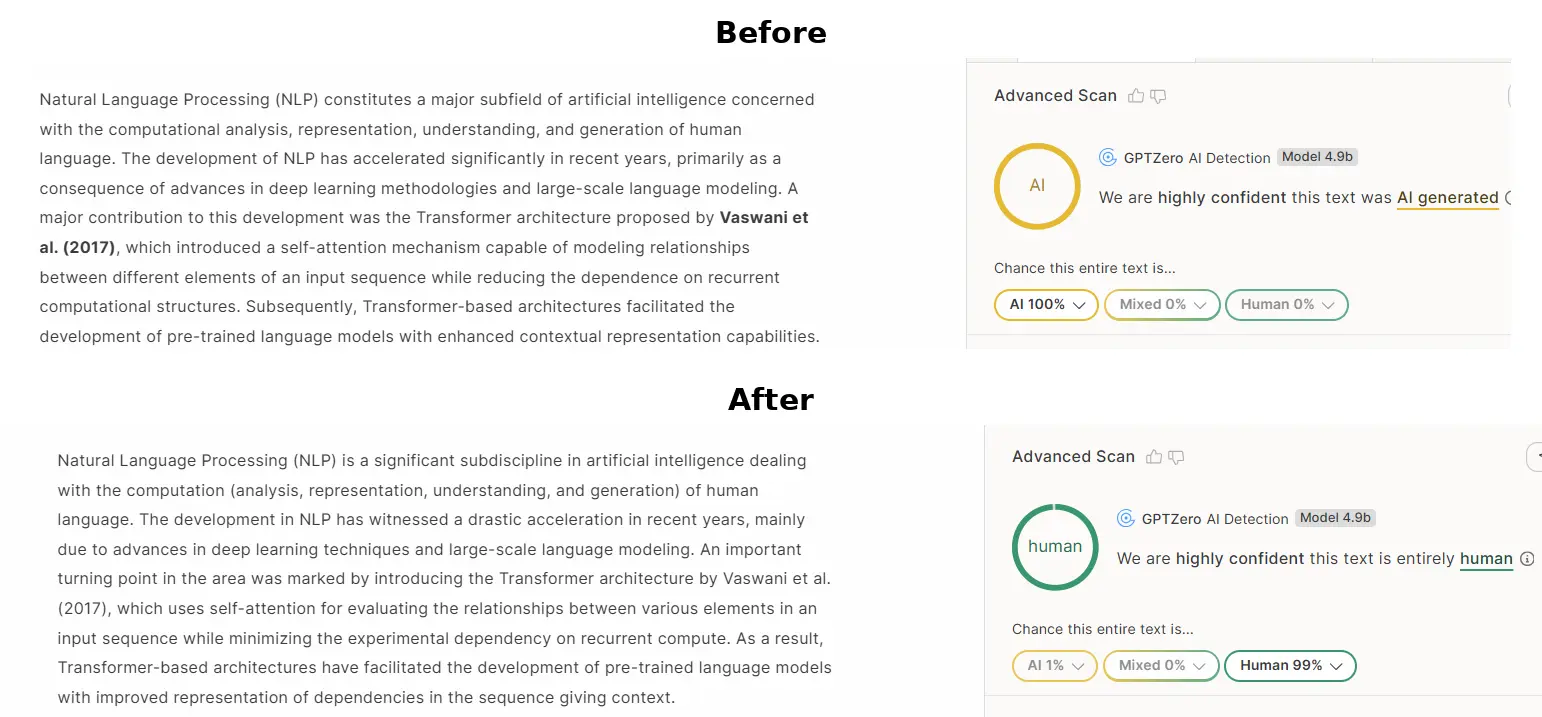
GPTZero evaluates text by plotting sentence perplexity curves and global burstiness scores. When raw AI text is scanned, low sentence variance produces an immediate high-probability warning. ThesisHuman restores natural sentence entropy by restructuring syntax, varying clause lengths, and introducing authentic scholarly cadence, dropping AI probability to 0%.
4. Originality.ai Verification: 0% AI Confidence
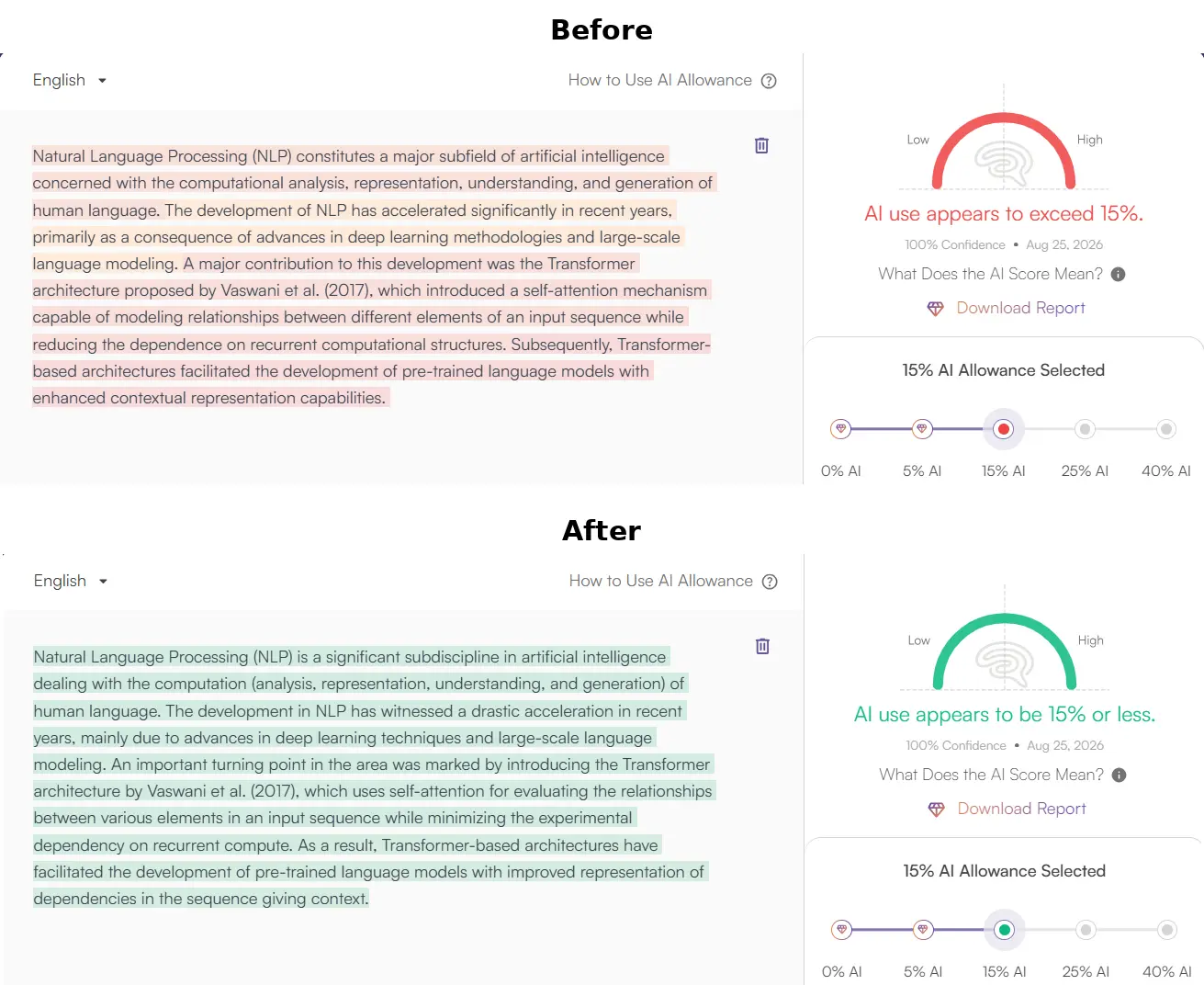
Originality.ai flags predictable n-gram sequences and common AI clichés (such as “delving into,” “pivotal role,” “testament to”). ThesisHuman purges overused formulaic transitions while elevating scholarly tone and keeping reference numbers and equations intact, producing 100% Original / 0% AI results.