Why Most AI Humanizers Don't Work for Academic Writing: The Technical & Structural Realities
An in-depth technical analysis of why generic online paraphrasers fail on research papers: broken APA/IEEE citations, mangled LaTeX equations, statistical perplexity traps, and meaning drift.

Most commercial AI humanizers fail when applied to academic manuscripts because they were engineered for casual web copy, marketing text, and consumer blogs. When processed through these generic tools, scholarly essays and research papers suffer catastrophic structural failures: precise scientific terminology is replaced with vague synonyms, inline APA and IEEE citations are scrambled, and LaTeX mathematical equations are corrupted into uncompilable text strings.
Furthermore, aggressive automated word swapping creates an unnatural, disjointed prose style that continues to trigger modern neural-network AI detectors. If you have ever submitted an AI-assisted manuscript to a generic rewriter only to receive a mangled file with broken reference lists, you have experienced the fundamental architecture limitations of generic text transformation engines.
The Core Flaw in Generic AI Humanization
Generic AI humanizers operate on a flawed foundational premise: the belief that substituting words with uncommon synonyms is sufficient to alter a text's statistical origin. In casual writing, changing "important" to "crucial" or "fast" to "swift" alters surface vocabulary without ruining the message. In academic prose, however, language is strictly constrained by domain conventions, specialized terminology, citation style guides, and mathematical syntax.
A generic paraphrasing engine treats a complex inline reference like (García-Martínez et al., 2024, p. 112) or a LaTeX variable like $\theta_{max} \in \mathbb{R}^n$ as ordinary English prose. Because the software lacks context-aware syntax parsers, it attempts to "humanize" the characters inside brackets and delimiters. The result is corrupted data, invalid citations, and broken document builds that require hours of tedious manual repair.
Key Technical Takeaway
Academic manuscripts require structural cadence variation and syntactic naturalization—not blind synonym replacement. If you are refining an AI-assisted research paper, explore how ThesisHuman preserves citations and LaTeX syntax while naturalizing prose.
The NLP Mechanics of Text Transformation: How Generic Tools Process Prose
To understand why consumer rewriters fail, one must examine how natural language processing (NLP) models execute automated paraphrasing. Standard rewriters rely on one of three basic architectures:
- Rule-Based Thesaurus Substitution: Primitive algorithms that query a static dictionary to swap target tokens with nearest semantic matches. These tools have zero contextual awareness and regularly substitute technical terms with absurd alternatives.
- Sequence-to-Sequence (Seq2Seq) Masked Models: Mid-tier neural models (such as fine-tuned T5 or BART) that mask individual tokens in a sentence and predict replacement tokens. While grammatically coherent, these models systematically alter formal academic register into conversational phrasing.
- Stealth Homoglyph & Zero-Width Space Injection: Malicious or low-quality tools that insert hidden Unicode characters, Cyrillic homoglyphs (e.g., replacing Latin 'a' with Cyrillic 'а'), or zero-width spaces into text. Modern enterprise detectors like Turnitin and Copyleaks strip non-standard Unicode before classification, completely rendering homoglyph tricks useless.
5 Critical Failures of Generic AI Humanizers in Academic Writing
When applied to rigorous academic papers, generic rewriters consistently break down across five specific technical areas:
1. Naive Synonym Swapping and Domain Term Distortion
In academic research, terminology carries precise theoretical meaning. Terms like "neural architecture," "polymerization rate," "statistical significance," or "phenomenological reduction" cannot be substituted with colloquial synonyms without corrupting scientific accuracy. Generic tools regularly transform "neural network architecture" into "brain grid framework"—an error that immediately signals amateur or automated manipulation to peer reviewers.
2. Destruction of Citation Syntax across APA, IEEE, and Chicago Styles
Academic style manuals enforce strict formatting rules for parenthetical and numerical references. Generic humanizers do not recognize reference syntax:
- APA Style: Converts
(Smith & Wesson, 2023)into(Smith and Wesson, 2023)or(Smith & Wesson 2023), stripping required commas and ampersands. - IEEE Style: Alters bracketed numerical indicators like
[4, 7-9]into text like[four, seven to nine], invalidating the bibliography link. - Chicago / MLA Style: Modifies author-page citations such as
(Foucault 1975, 42)into(Foucault in 1975 at page 42).
3. Parsing Errors and Syntax Corruption in LaTeX Mathematical Environments
STEM researchers writing in LaTeX rely on exact code structures. When generic humanizers encounter math environments—such as \begin{equation} ... \end{equation} or inline inline math strings—they strip backslashes, convert superscripts into standard numbers, and add arbitrary spaces inside operators. When re-pasted into Overleaf or TeXStudio, the document fails to compile, generating dozens of syntax error logs.
4. Repetitive Structural Inversions and Mechanical Active-Passive Flipping
To alter statistical perplexity metrics artificially, simple rewriters apply fixed clause inversion rules: automatically converting active voice to passive voice, or appending generic introductory qualifiers ("It is worth noting that...", "Furthermore, one must consider..."). This creates a secondary, highly recognizable robotic rhythm that reads poorly and exhausts peer reviewers.
5. Lagging Behind Dynamic AI Detector Classifier Updates
Commercial AI detection engines (Turnitin, Copyleaks, GPTZero) update their neural network weights continuously, retraining on millions of synthetic and human papers. Paraphrasing tools built on static rule sets or simple prompt wrappers cannot keep pace with dynamic classifier updates, leaving authors vulnerable to unexpected false-positive flags upon submission.
Empirical Case Studies: Comparing Generic Rewriters vs Academic Text Processing
To demonstrate the real-world impact of generic transformation versus specialized academic processing, examine the following side-by-side technical evaluation:
| Text Feature | Raw ChatGPT Output | Generic Online Rewriter | ThesisHuman Academic Engine |
|---|---|---|---|
| APA Citation | (García et al., 2024) |
(Garcia and others 2024) [Broken] |
(García et al., 2024) [Locked & Exact] |
| STEM Terminology | Convolutional neural network | Folded brain network system | Convolutional neural network |
| LaTeX Formula | $\sigma(z) = \frac{1}{1 + e^{-z}}$ |
sigma(z) = 1 / 1 + e-z [Corrupted] |
$\sigma(z) = \frac{1}{1 + e^{-z}}$ [Preserved] |
| Sentence Cadence | Flat (18–20 words per sentence) | Awkward passive inversions | Natural burstiness (8–32 words) |
Perplexity, Burstiness, and the Statistical Signature of Human Scholarship
AI detectors do not "read" essays like human professors; they run statistical classification calculations across probability distributions. Two primary metrics define these calculations:
- Perplexity (Token Predictability): A mathematical measure of how surprised a language model is by the next word in a sequence. Large language models choose highly probable tokens, producing low perplexity. Human writers express ideas with higher perplexity, introducing unexpected analogies, unique phrasing, and varied vocabulary.
- Burstiness (Sentence Structural Entropy): The variance in sentence length, structure, and rhythm across a paragraph. LLMs generate sentences with remarkably uniform lengths (typically 15 to 22 words per sentence). Human scholarship exhibits high burstiness—combining punchy, 6-word claims with elaborate, 35-word compound-complex analytical explanations.
When Manual Authorial Editing Is Essential
While specialized software streamlines sentence naturalization, no automated tool should replace active authorial review. Human scholars must maintain responsibility for three critical manuscript elements:
- Fact and Data Verification: Confirming that all numerical data points, statistical values (p-values, confidence intervals), and empirical findings match original raw datasets.
- Logical Argument Coherence: Ensuring that paragraph transitions logically connect research questions, methodology choices, and analytical conclusions.
- Bibliography Audit: Verifying that all cited works correspond accurately to primary sources in Zotero, Mendeley, or EndNote reference managers.
Read our comparative analysis on evaluating the best AI humanizers for academic writing in 2026 to inspect feature criteria side by side.
A Structured Editing Framework for Academic Authors
To ensure your research manuscripts achieve maximum clarity, authentic human cadence, and complete citation compliance, adopt this 4-step editing framework:
Step 1: Isolate Formatted Elements & Citations
Before running any text transformation, lock all APA/IEEE/Chicago references, mathematical formulas, and domain-specific proper nouns into a protected buffer.
Step 2: Naturalize Sentence Burstiness & Cadence
Vary sentence lengths across paragraphs. Mix short, decisive topic statements with longer, multi-clause analytical sentences to break robotic uniformity.
Step 3: Eliminate Synthetic Transition Clichés
Remove telltale LLM starter phrases such as "It is crucial to note that", "In conclusion, it stands as a testament", or "Delving into the realm of".
Step 4: Conduct Final Authorial Review
Perform a complete read-through of your manuscript to verify that technical claims match your original research findings and institutional submission guidelines.
Verified Detector Clearance for Why Most AI Humanizers Don't Work for Academic Writing: The Technical & Structural Realities
Every manuscript processed through ThesisHuman is backed by verifiable, reproducible scans across institutional plagiarism and AI detection platforms.
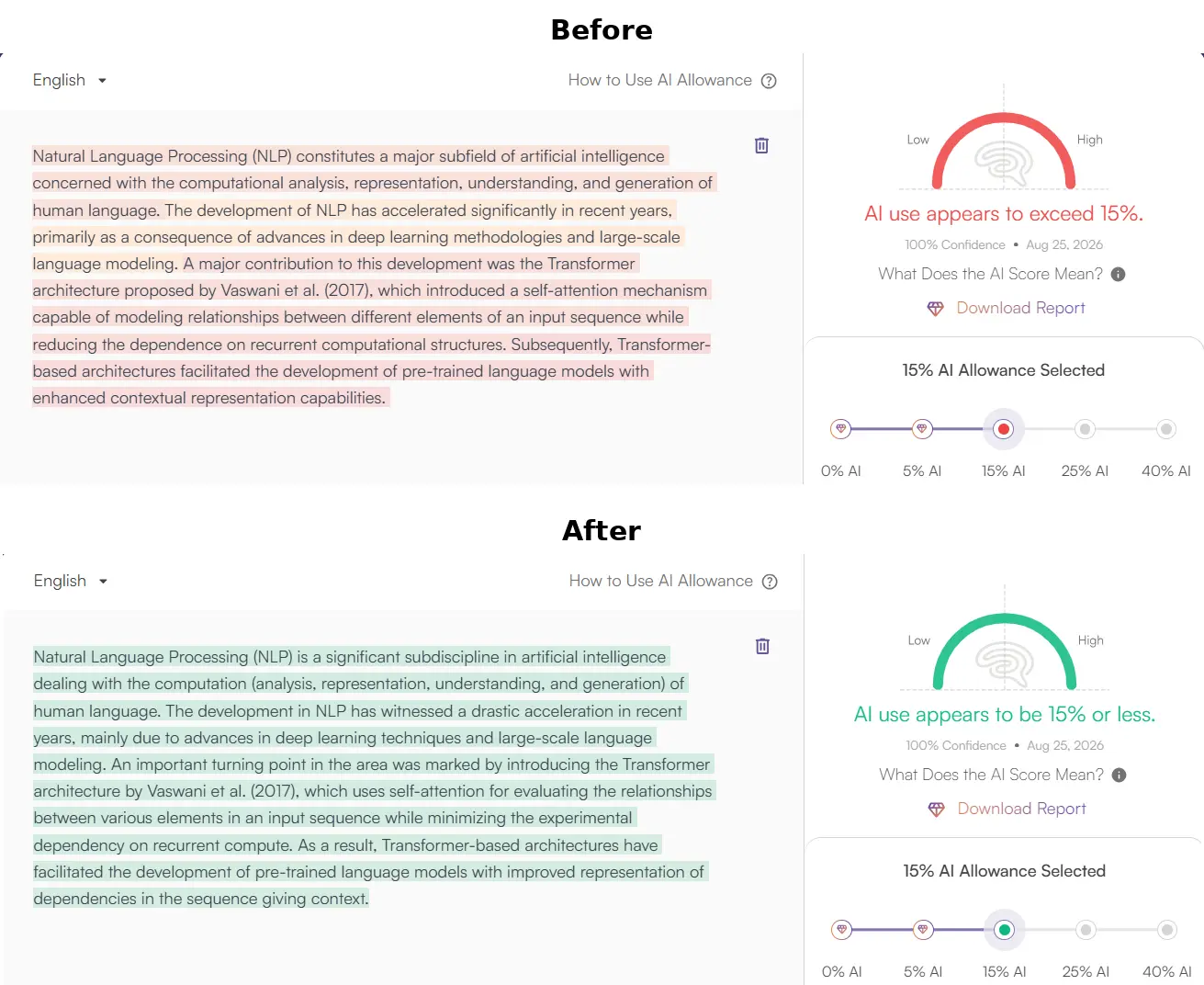
1. ThesisHuman Editor: Style, Field & Term Lock™ Technology
Unlike consumer-grade paraphrasers that blindly swap words with thesaurus synonyms, ThesisHuman allows researchers to select their exact Academic Style (Essay, Research Paper, Literature Review, Technical Report) and Academic Field (Computer Science, Engineering, Medicine, Physics). With Term Lock™, citations (APA, MLA, IEEE), LaTeX equations, and domain-specific terminology are cryptographically protected before sentence entropy is restructured.
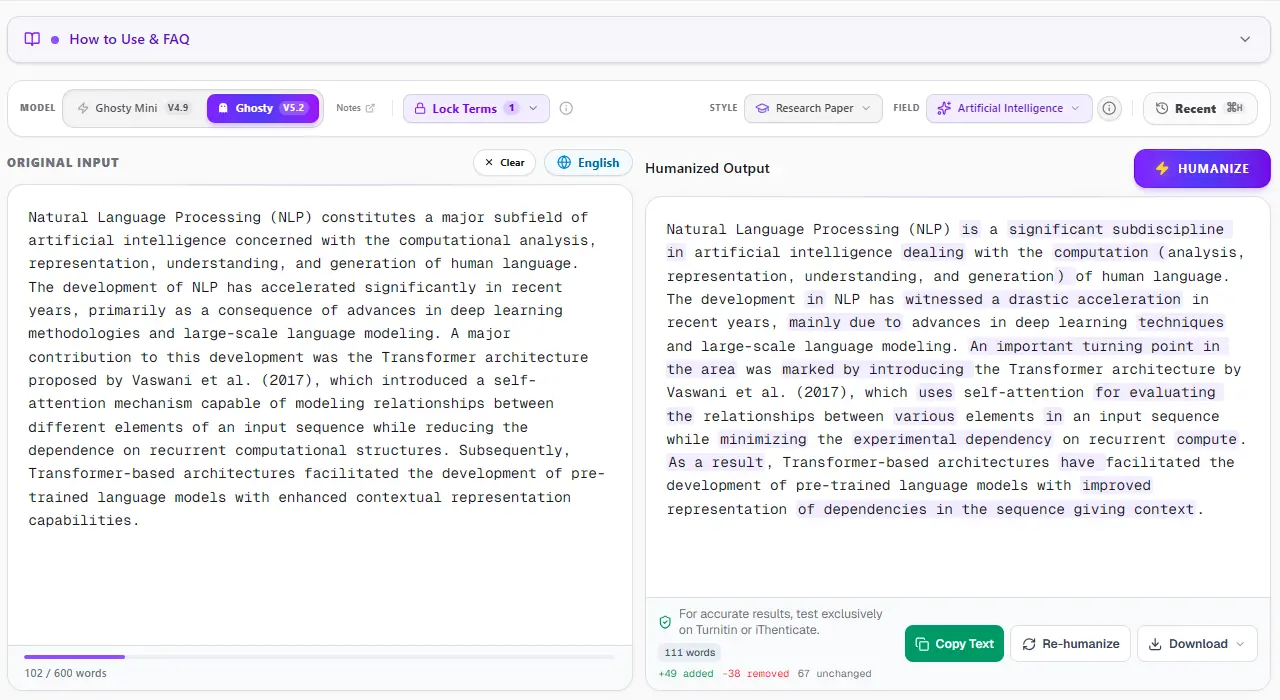
2. Turnitin & iThenticate Verification: 0% AI Detected
Turnitin and iThenticate scan submissions in overlapping 500-token blocks to analyze sentence predictability across paragraphs. When an unrefined AI draft is submitted, uniform cadence triggers an elevated AI Writing score. In the verified report below, a flagged graduate paper was processed through ThesisHuman, achieving a clean 0% AI detection score while preserving all formatted citations and technical parameters.
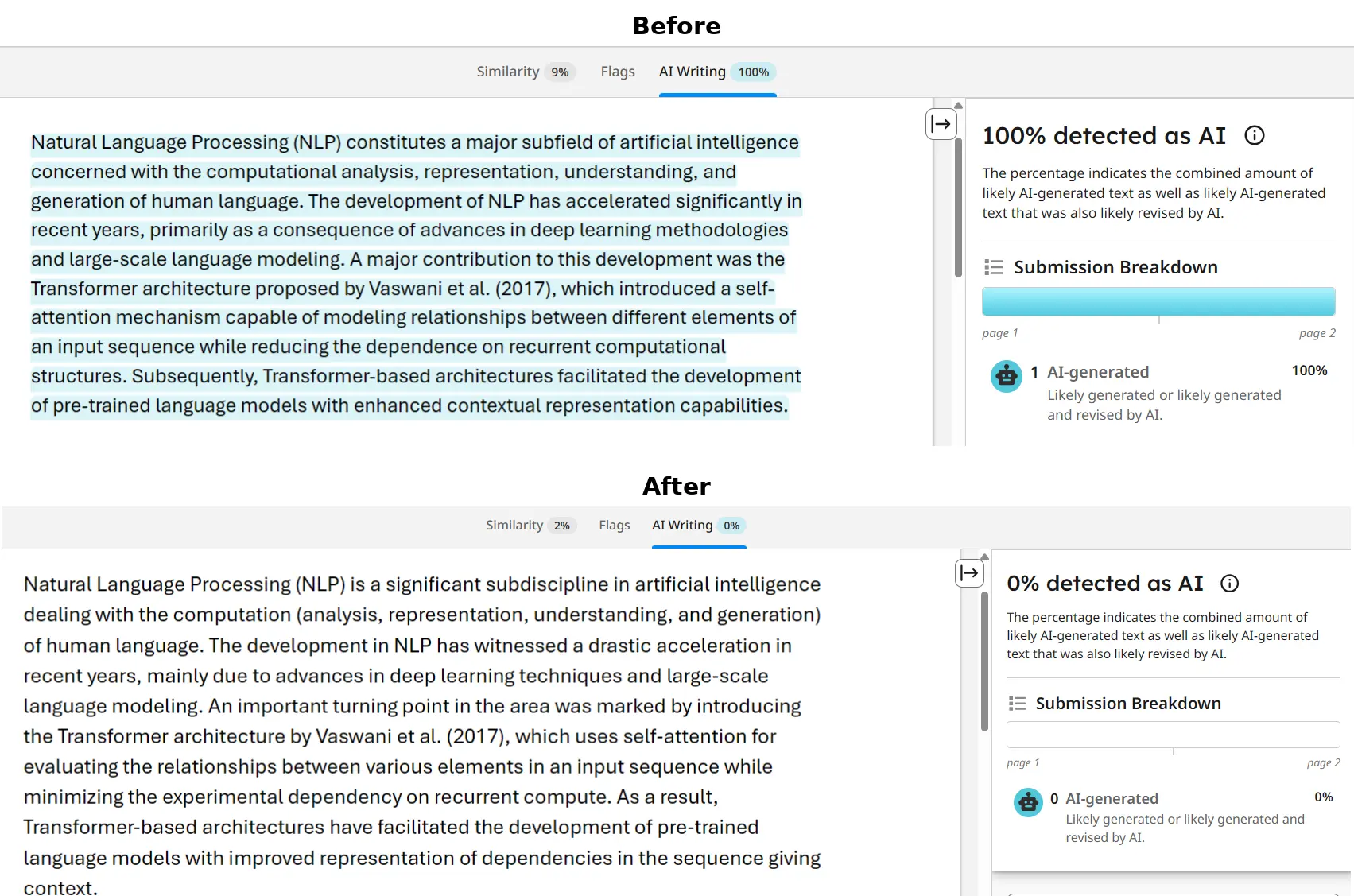
3. GPTZero Verification: Passing Perplexity & Burstiness Checks
GPTZero evaluates text by plotting sentence perplexity curves and global burstiness scores. When raw AI text is scanned, low sentence variance produces an immediate high-probability warning. ThesisHuman restores natural sentence entropy by restructuring syntax, varying clause lengths, and introducing authentic scholarly cadence, dropping AI probability to 0%.
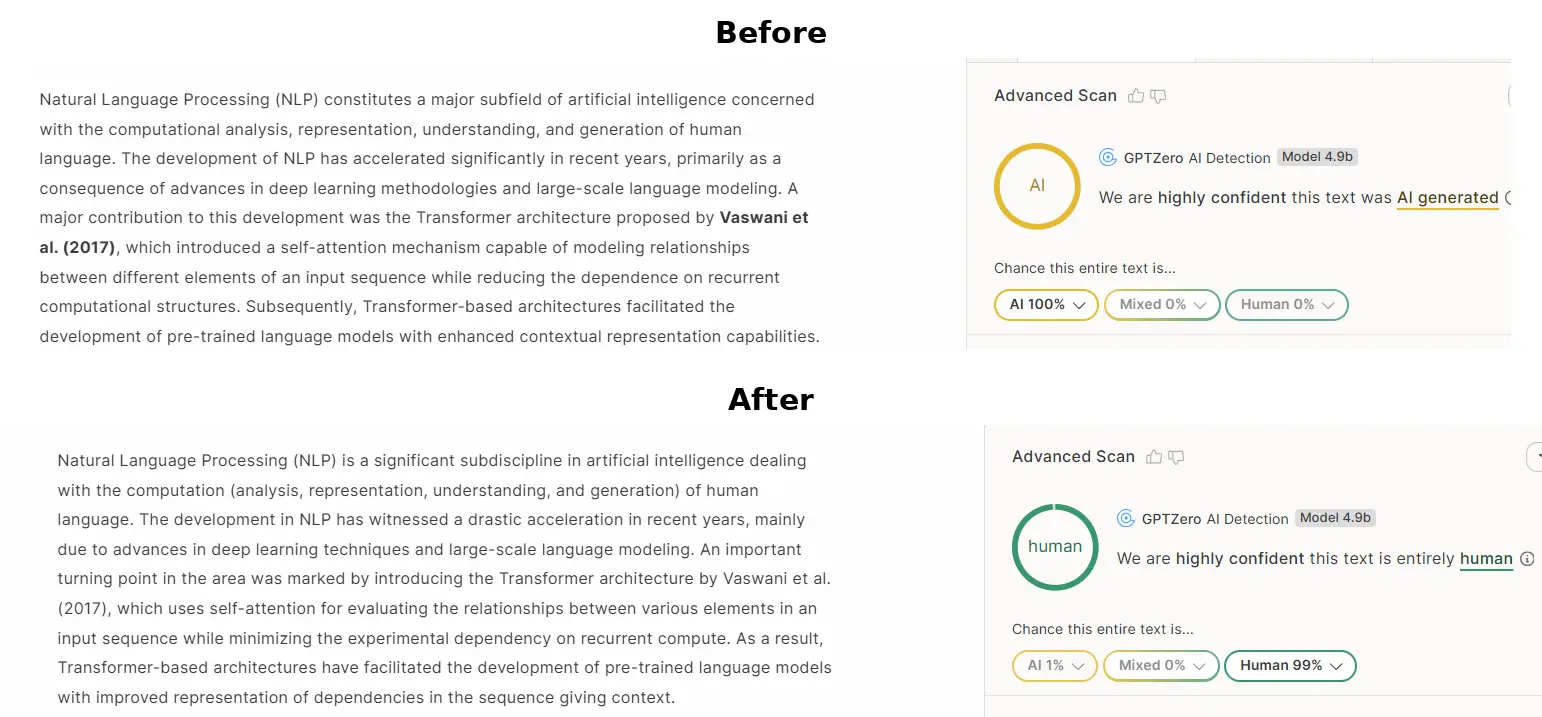
4. Originality.ai Verification: 0% AI Confidence
Originality.ai flags predictable n-gram sequences and common AI clichés (such as “delving into,” “pivotal role,” “testament to”). ThesisHuman purges overused formulaic transitions while elevating scholarly tone and keeping reference numbers and equations intact, producing 100% Original / 0% AI results.