Winston AI in Higher Education: Evaluating Detection Accuracy, Readability Scores, and Humanization Workflows
Winston AI is increasingly chosen by university instructors seeking explainable AI assessments. Learn how its readability and probability maps evaluate student submissions and how to refine AI-assisted drafts safely.

While institutional platforms like Turnitin and Copyleaks dominate campus-wide LMS contracts, an increasing number of university professors and department chairs utilize standalone auditing tools. Among these, Winston AI has achieved notable adoption across college writing programs, English departments, and social science faculties. Marketed as an educator-focused detection platform, Winston emphasizes explainability, generating sentence-by-sentence color-coded overlays that instructors use during office-hour conferences and academic integrity inquiries.
For undergraduate and graduate students, facing a Winston AI audit presents distinct challenges. Unlike black-box detectors that offer no justification for a score, Winston highlights specific sentences in red and yellow. Understanding what those highlights actually mean, and how to refine your writing so your natural scholarship shines through, is essential for navigating modern academic coursework.
Why University Instructors Turn to Winston AI
Many university faculty members find institutional LMS detector reports frustrating. A Turnitin score of 40% AI provides little actionable insight into whether the student used AI for brainstorming, language polishing, or wholesale generation. Winston AI addresses this educator concern by emphasizing visual transparency. Its dashboard produces:
- Overall Human Score: A percentage rating representing estimated human authorship likelihood.
- Sentence-Level Heat Maps: Granular highlights categorizing sentences into human, likely AI, and highly likely AI.
- Readability Metrics: Integrated text complexity evaluations that correlate readability with writing authenticity.
How Winston AI Evaluates Prose: Probability and Explainability
Winston AI does not identify AI by matching text against a database of past student essays. Instead, it evaluates the **statistical likelihood** of your word choices. Two core metrics govern its classification engine:
1. Token Predictability (Perplexity)
Large language models generate text by selecting high-probability next tokens. When a sentence unfolds in a way that a model easily predicts, Winston's classifier registers low perplexity and highlights the sentence. Human writing, shaped by personal idiom and stylistic variation, exhibits higher perplexity.
2. Structural Variance (Burstiness)
Human writing is naturally bursty: we follow a 35-word complex periodic sentence with an 8-word blunt observation. Machine-generated text, particularly when unedited, maintains a flat, uniform rhythm. Winston's algorithm monitors sentence length variance across paragraphs; when variance drops below a set threshold, the probability score drops rapidly.
Common Triggers in Conscientious Student Writing
The irony of statistical detection is that careful, conscientious student writing often looks identical to machine output under Winston's algorithms:
- Introductory Essay Framing: Standard academic openings like "Throughout history, scholars have debated the fundamental relationship between..." are highly predictable, lighting up Winston's heatmap immediately.
- Over-Edited Formal Prose: Students who spend hours polishing their essays using grammar checkers often unintentionally smooth away natural sentence variation, flattening burstiness and tripping flags.
- Non-Native English Vocabulary: Multilingual students who rely on standard textbook phrasing produce low-perplexity text that is frequently misclassified as synthetic.
An Ethical Workflow to Humanize Coursework for Winston AI
If you have used AI as an ideation or drafting partner, follow this ethical naturalization protocol to ensure your work reflects your genuine voice:
1. Break Synthetic Triads
Language models frequently group observations into mechanical lists of three: "This policy promotes economic stability, fosters social equity, and ensures environmental preservation." Break these triads into distinct, reasoned analytical points.
2. Naturalize with ThesisHuman's Winston Mode
Process your draft through ThesisHuman's AI Humanizer for Winston AI. The engine introduces authentic clausal variance and neutralizes predictable n-gram patterns, while locking APA, MLA, and Chicago citations in place.
3. Review Against Our Natural Essay Guide
For practical essay editing techniques that improve clarity and flow, explore our companion guide on how to make AI-assisted essays sound natural and evaluate our dedicated essay humanizer tool.
University Integrity Hearings and Winston Reports
If an instructor presents you with a flagged Winston AI report, remember that a detector heatmap is not definitive evidence of misconduct. Explainability maps show statistical probability, not origin. Offer your initial outlines, your browser research history, and timestamped document drafts. Demonstrating command of your topic in an open discussion is your most powerful asset.
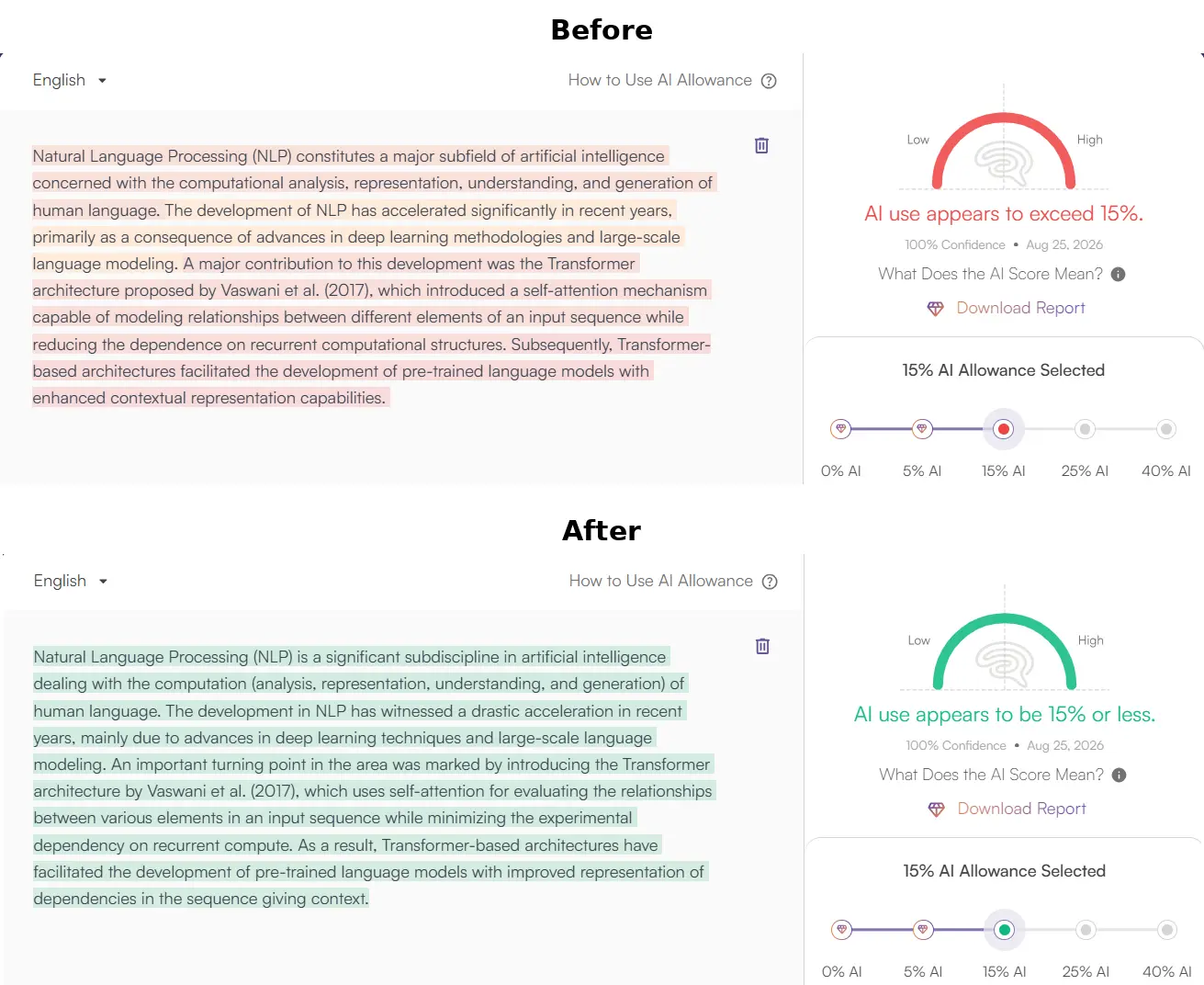
Verified Detector Clearance for Winston AI in Higher Education: Evaluating Detection Accuracy, Readability Scores, and Humanization Workflows
Every manuscript processed through ThesisHuman is backed by verifiable, reproducible scans across institutional plagiarism and AI detection platforms.
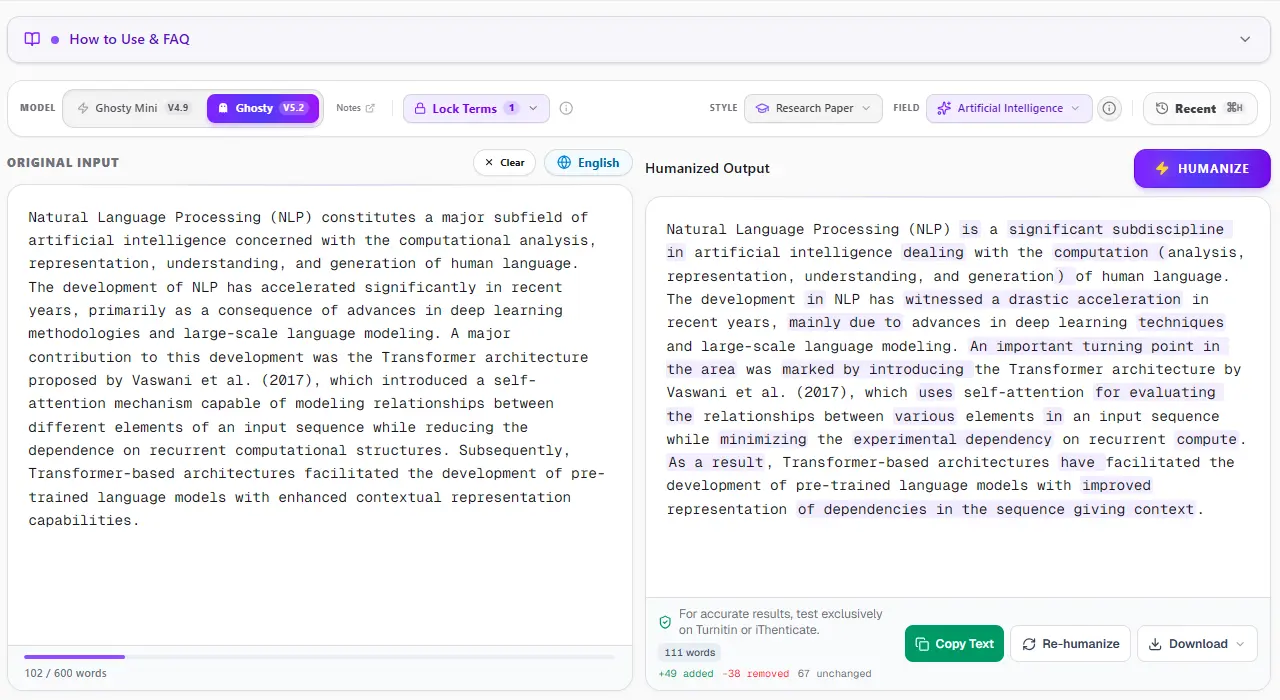
1. ThesisHuman Editor: Style, Field & Term Lock™ Technology
Unlike consumer-grade paraphrasers that blindly swap words with thesaurus synonyms, ThesisHuman allows researchers to select their exact Academic Style (Essay, Research Paper, Literature Review, Technical Report) and Academic Field (Computer Science, Engineering, Medicine, Physics). With Term Lock™, citations (APA, MLA, IEEE), LaTeX equations, and domain-specific terminology are cryptographically protected before sentence entropy is restructured.
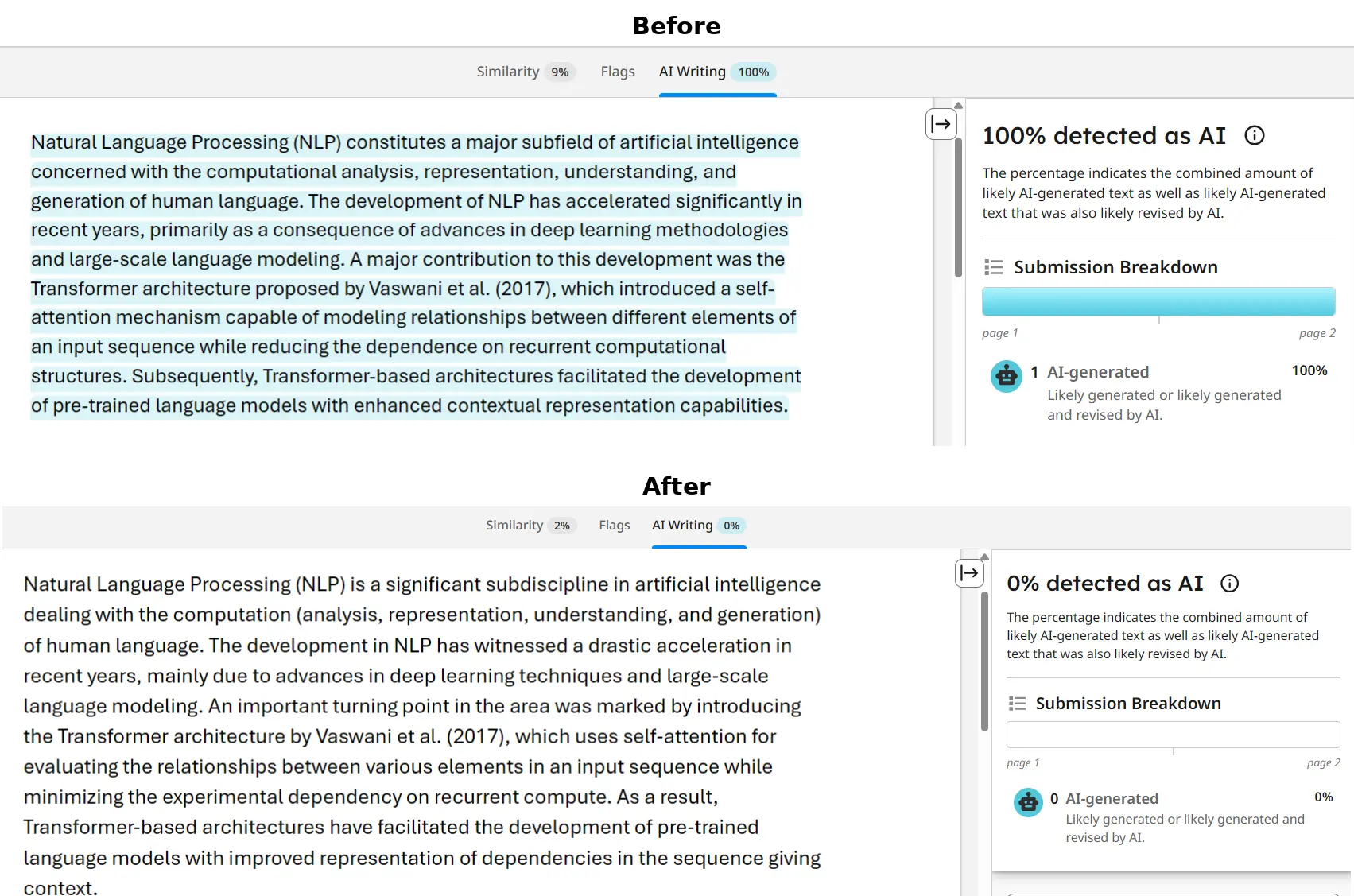
2. Turnitin & iThenticate Verification: 0% AI Detected
Turnitin and iThenticate scan submissions in overlapping 500-token blocks to analyze sentence predictability across paragraphs. When an unrefined AI draft is submitted, uniform cadence triggers an elevated AI Writing score. In the verified report below, a flagged graduate paper was processed through ThesisHuman, achieving a clean 0% AI detection score while preserving all formatted citations and technical parameters.
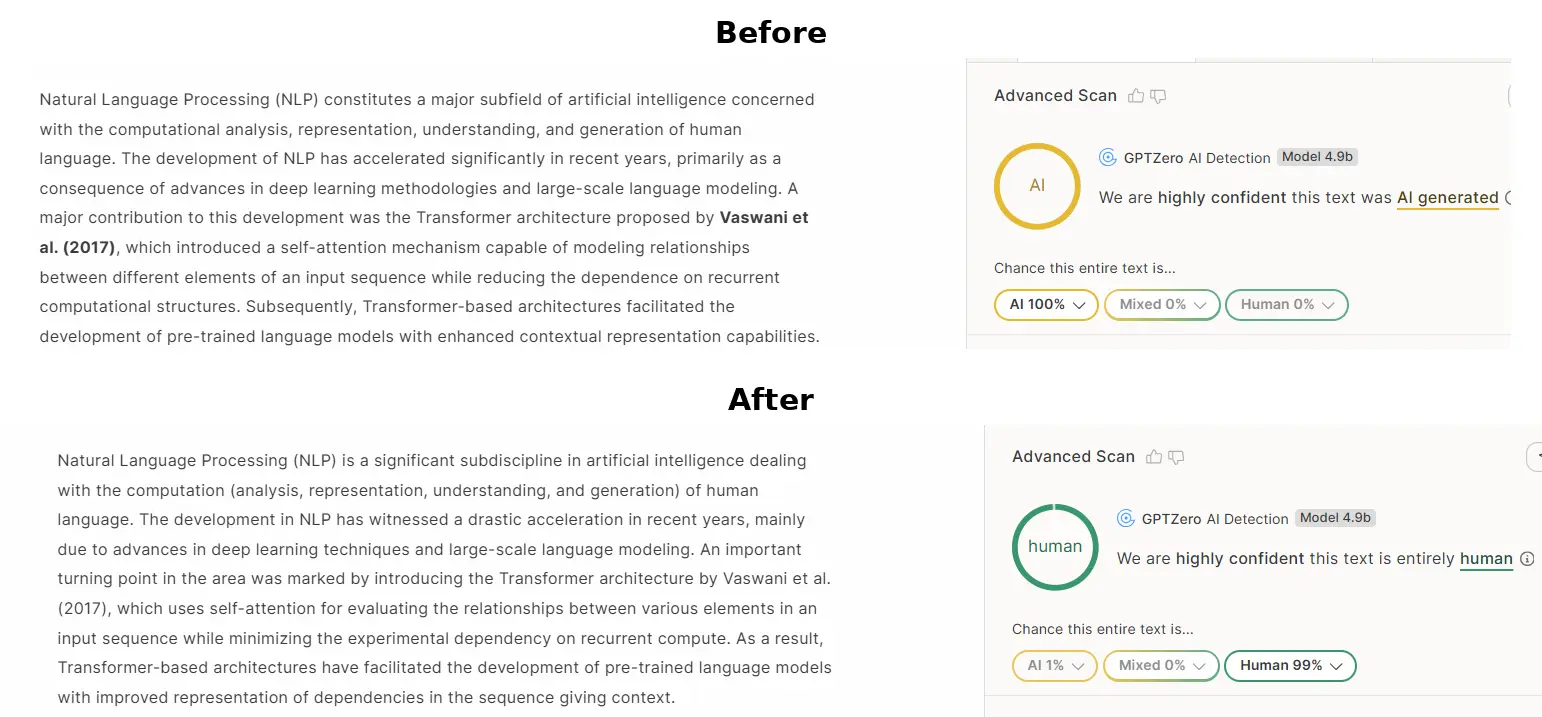
3. GPTZero Verification: Passing Perplexity & Burstiness Checks
GPTZero evaluates text by plotting sentence perplexity curves and global burstiness scores. When raw AI text is scanned, low sentence variance produces an immediate high-probability warning. ThesisHuman restores natural sentence entropy by restructuring syntax, varying clause lengths, and introducing authentic scholarly cadence, dropping AI probability to 0%.
4. Originality.ai Verification: 0% AI Confidence
Originality.ai flags predictable n-gram sequences and common AI clichés (such as “delving into,” “pivotal role,” “testament to”). ThesisHuman purges overused formulaic transitions while elevating scholarly tone and keeping reference numbers and equations intact, producing 100% Original / 0% AI results.