How to Make AI-Assisted Essays Sound Natural: 5-Step Academic Editing Protocol
Learn how to edit AI-assisted draft paragraphs into natural academic writing. Step-by-step guide on sentence cadence, personal voice, and evidence integration.

Raw AI draft paragraphs often feel synthetic. They rely on repetitive transition starter words ("furthermore," "moreover," "it is important to note"), uniform sentence lengths, copula avoidance, and generic claims that lack specific empirical research evidence.
To make an AI-assisted essay sound natural, authentic, and academically rigorous, authors must actively edit sentence cadence, inject specific domain details, remove synthetic filler clichés, and protect their citations.
Why Raw AI Drafts Sound Synthetic: Recognizing the Robotic Tells
Large language models generate text using statistical probability sampling, resulting in distinct stylistic patterns that read unnaturally to human professors and peer reviewers.
The 5 Tell-Tale Signs of AI-Generated Essays
| Robotic Tell | Pattern Example | How to Fix It |
|---|---|---|
| 1. Inflated Fillers | "delve", "tapestry", "pivotal milestone", "stands as a testament" | Delete filler starter phrases; begin directly with the argument claim |
| 2. Uniform Length | Every sentence is exactly 18–20 words long | Mix short 7-word assertions with complex 30-word analytical clauses |
| 3. Copula Avoidance | "serves as an illustration of", "boasts a capability" | Use direct active verbs ("illustrates", "demonstrates") |
| 4. Trailing Clauses | "...underscoring its critical role in modern society." | Cut trailing participial tags; state specific empirical impacts |
| 5. Generic Vague Claims | "Many scholars argue that technology is important." | Insert specific scholar names, publication years, and page markers |
5-Step Protocol to Naturalize AI-Assisted Essays for Faculty Review
1. Eliminate Inflated Transition Clichés
Delete generic introductory phrases like "In today's digital landscape" or "It is crucial to consider." Begin paragraphs with direct claims.
2. Inject Specific Arguments and Local Examples
AI drafts rely on general statements. Replace broad assertions with specific data points, study locations, author names, or experimental parameters.
3. Vary Sentence Length and Rhythm
Human writing alternates short assertions with complex explanations. Break up mid-length sentences to create a varied, natural rhythm.
4. Replace Copula Avoidance with Active Verbs
Instead of writing "The framework serves as an illustration of," write "The framework illustrates." Simple, direct verbs sound more authentic.
5. Protect and Verify Inline Citations
Ensure all APA, MLA, or IEEE citations match original sources and pass through editing without alterations. Use ThesisHuman to refine ChatGPT drafts while locking citations.
Before & After Paragraph Editing Breakdowns (With Commentary)
Raw AI Draft Output
"Additionally, it is worth noting that artificial intelligence plays a crucial role in modern healthcare, standing as a pivotal milestone that underscores the growing importance of technology in fostering patient outcomes."
Naturalized Academic Revision
"Artificial intelligence has improved modern healthcare workflows. Recent clinical trials demonstrate that diagnostic algorithms reduce evaluation times while maintaining diagnostic accuracy (Chen et al., 2024, p. 88)."
Maintaining Academic Integrity and Authentic Scholarly Voice
Providing core research ideas, revising sentence structure, verifying facts, and adding specific citations transforms a rough draft into authentic scholarly writing. Read our companion guide on is paraphrasing plagiarism.
Verified Detector Clearance for How to Make AI-Assisted Essays Sound Natural: 5-Step Academic Editing Protocol
Every manuscript processed through ThesisHuman is backed by verifiable, reproducible scans across institutional plagiarism and AI detection platforms.
1. ThesisHuman Editor: Style, Field & Term Lock™ Technology
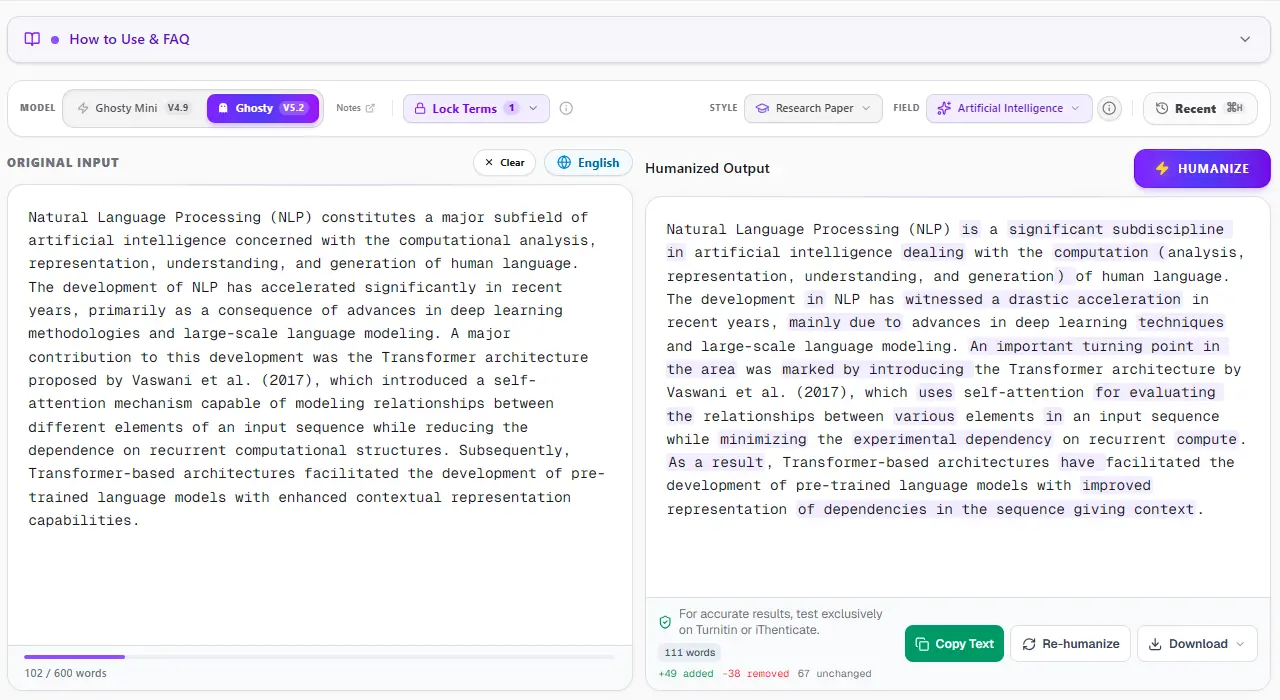
Unlike consumer-grade paraphrasers that blindly swap words with thesaurus synonyms, ThesisHuman allows researchers to select their exact Academic Style (Essay, Research Paper, Literature Review, Technical Report) and Academic Field (Computer Science, Engineering, Medicine, Physics). With Term Lock™, citations (APA, MLA, IEEE), LaTeX equations, and domain-specific terminology are cryptographically protected before sentence entropy is restructured.
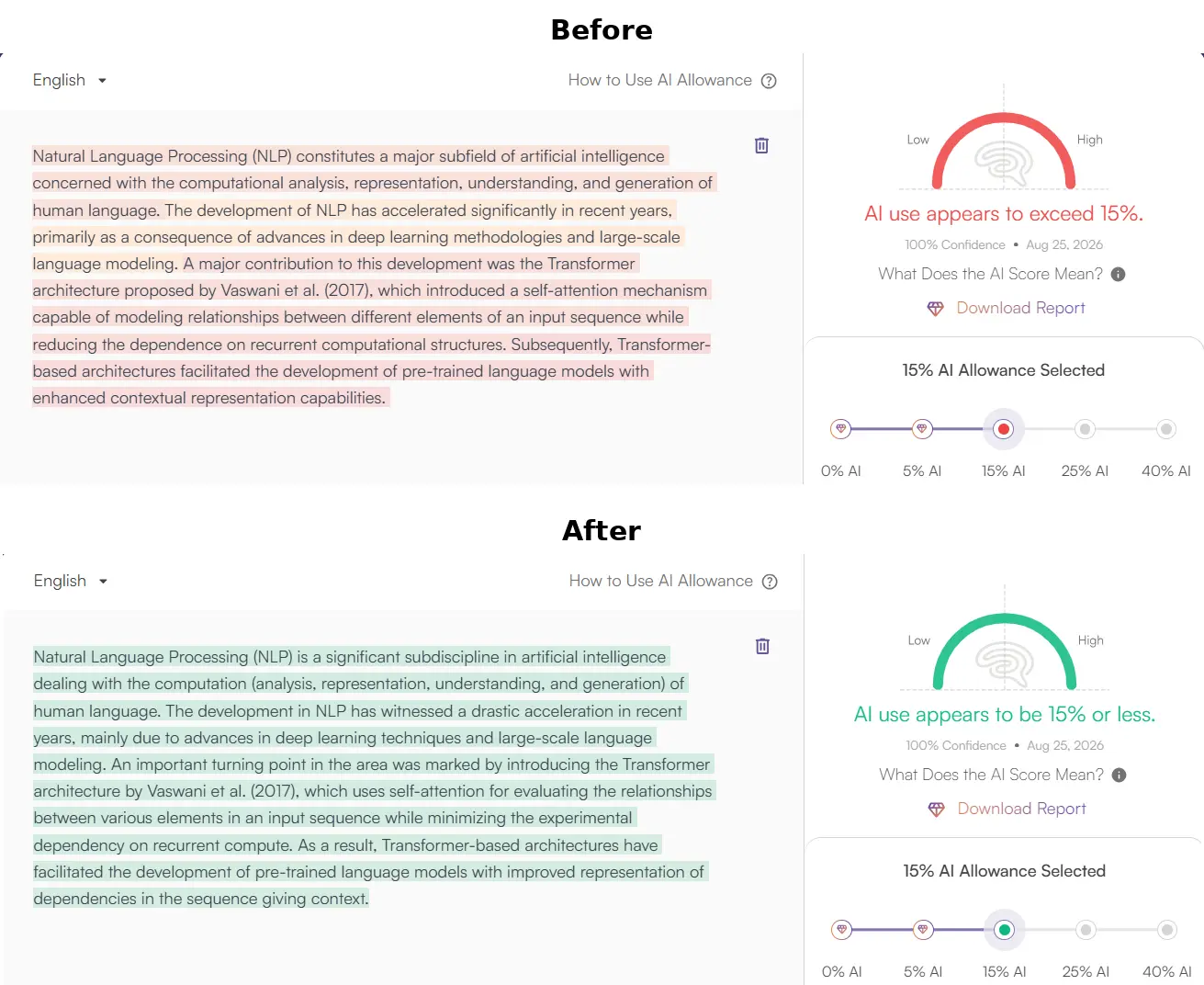
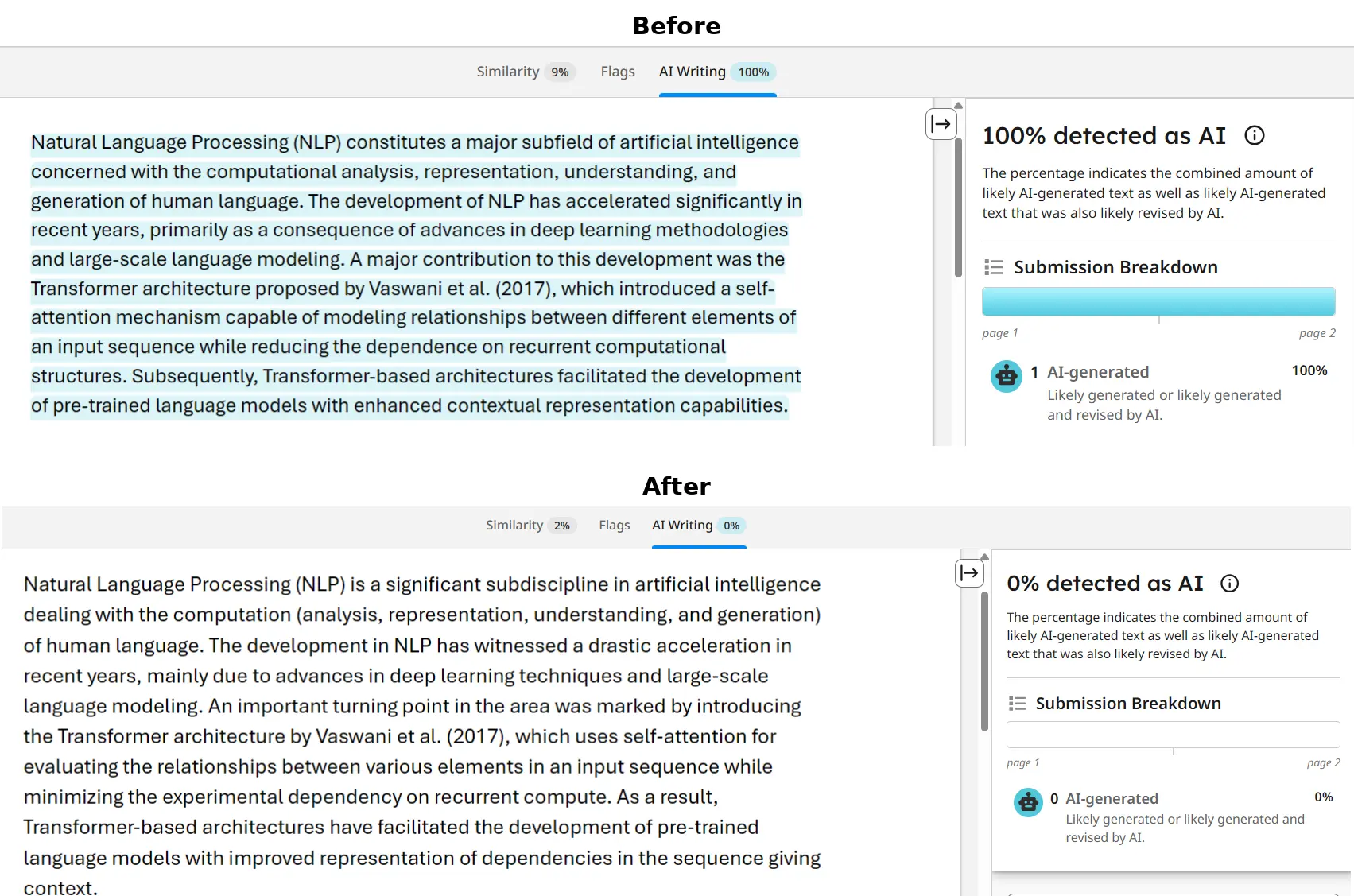
2. Turnitin & iThenticate Verification: 0% AI Detected
Turnitin and iThenticate scan submissions in overlapping 500-token blocks to analyze sentence predictability across paragraphs. When an unrefined AI draft is submitted, uniform cadence triggers an elevated AI Writing score. In the verified report below, a flagged graduate paper was processed through ThesisHuman, achieving a clean 0% AI detection score while preserving all formatted citations and technical parameters.
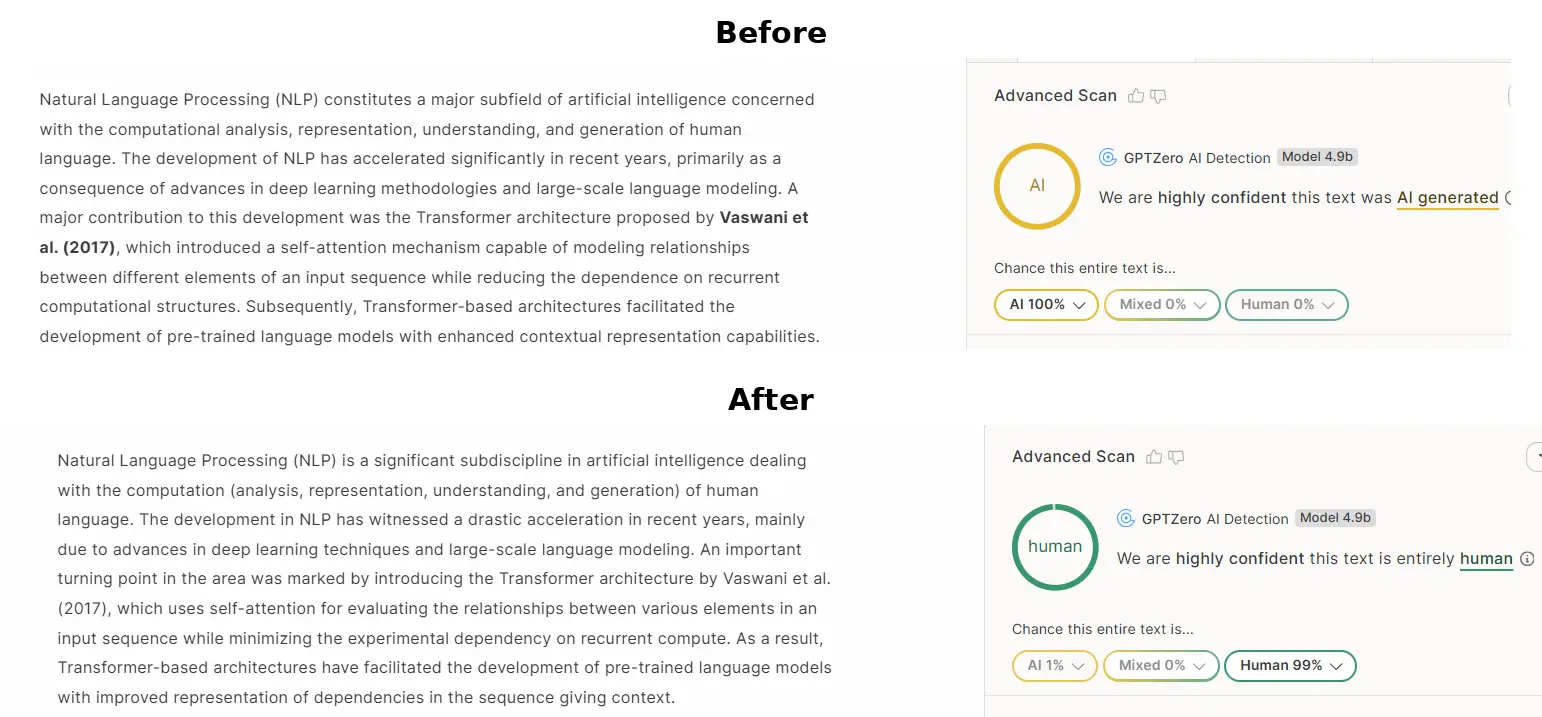
3. GPTZero Verification: Passing Perplexity & Burstiness Checks
GPTZero evaluates text by plotting sentence perplexity curves and global burstiness scores. When raw AI text is scanned, low sentence variance produces an immediate high-probability warning. ThesisHuman restores natural sentence entropy by restructuring syntax, varying clause lengths, and introducing authentic scholarly cadence, dropping AI probability to 0%.
4. Originality.ai Verification: 0% AI Confidence
Originality.ai flags predictable n-gram sequences and common AI clichés (such as “delving into,” “pivotal role,” “testament to”). ThesisHuman purges overused formulaic transitions while elevating scholarly tone and keeping reference numbers and equations intact, producing 100% Original / 0% AI results.