Writesonic AI Humanizer vs Academic Writing: Can Marketing Tools Pass Turnitin?
Can Writesonic's AI humanizer adapt to university research papers, or does its marketing-oriented rewriter break citations and alter scholarly precision? An in-depth technical analysis.
HamzaPhD Researcher
13 min read
University researchers, graduate candidates, and undergraduates frequently encounter aggressive marketing campaigns promoting commercial AI rewriters. Among these tools, the Writesonic AI humanizer is widely cited across digital marketing forums as a fast way to bypass AI detection classifiers.
However, academic manuscripts possess structural, lexical, and evidentiary requirements fundamentally distinct from search engine optimization blog posts or corporate newsletters. Applying a general-purpose marketing tool to a doctoral dissertation, peer-reviewed journal submission, or capstone literature review introduces significant risks.
This guide provides an objective technical analysis of how Writesonic's rewriter operates, why its marketing-first design conflicts with academic writing standards, and what is required to maintain scholarly integrity while refining AI-assisted academic drafts.
---
## Marketing AI Suites vs Scholarly Rigor
Writesonic established its reputation as an automated content marketing generator designed to draft ad copy, product descriptions, and commercial blog articles. Its underlying language models are tuned to maximize conversational engagement, lower reading difficulty grades, and produce punchy, sales-oriented syntax.
When Writesonic introduced its text humanizer feature, the primary optimization goal was circumventing basic web classifiers such as Originality.ai and Copyleaks on commercial marketing copy. The typical input is a 600-word promotional post; the expected output is casual, readable web content.
In contrast, academic scholarship operates under an opposite set of linguistic conventions:
1. **Epistemic Modality and Hedging**: Academic writers rarely make absolute claims. Scholars rely on cautious formulations such as "the findings suggest," "data tend to indicate," or "the evidence points toward a probable correlation." Marketing rewriters frequently strip these hedges, converting measured scholarly hypotheses into unsubstantiated assertions.
2. **Dense Domain Nomenclature**: Fields such as molecular biology, econometrics, and jurisprudence depend on fixed multi-word terms. These terms cannot be substituted with colloquial synonyms without rendering the text scientifically incoherent.
3. **Rigid Referencing Standards**: Academic arguments derive validity from precise in-text citations linking claims to empirical literature. Marketing tools are not calibrated to detect, protect, or format bibliographic markers.
Applying a marketing content generator to a thesis or research paper often produces text that reads like an informal blog rather than a disciplined academic study.
---
## How Writesonic's Humanizer Actually Functions
To evaluate Writesonic's utility for research writing, it is essential to understand the transformation pipeline applied by commercial humanizers.
Most commercial AI humanizers, including Writesonic, utilize a three-part pipeline:
### 1. Synonym Replacement via General Lexical Embeddings
The rewriter identifies tokens with high statistical probability in standard large language model outputs and substitutes them with alternatives selected from general-purpose semantic embeddings. For example, the term "utilize" is replaced with "use," and "demonstrates" is replaced with "shows."
While this lowers the formal register of marketing prose, it causes serious issues in academic writing where subtle differences between terms carry methodological significance.
### 2. Sentence Length Truncation
Marketing content prioritizes low Flesch-Kincaid grade levels. As a result, Writesonic's algorithm frequently fragments complex compound-complex sentences into short, punchy clauses. A 45-word sentence describing a multi-step empirical methodology is broken into three disjointed fragments, disrupting the logical progression of the argument.
### 3. Insertion of Informal Conversational Transitions
To simulate human writing on web pages, marketing humanizers frequently inject casual discourse markers such as "to be honest," "in plain English," or "the bottom line is." In an academic literature review or methodology chapter, these phrases appear jarring, unprofessional, and out of place.
---
## Why Marketing Paraphrasing Fails Turnitin and iThenticate
A primary motivation for students and researchers exploring humanizer tools is avoiding false positive flags on institutional integrity platforms such as Turnitin AI Writing Indicator and Crossref Similarity Check (powered by iThenticate).
Marketing humanizers often claim high bypass success rates against consumer tools. However, enterprise academic classifiers employ fundamentally different detection architectures:
```
+-------------------------------------------------------------+
| Institutional Detection Landscape |
+-------------------------------------------------------------+
| Consumer Classifiers Institutional Classifiers |
| (Originality, GPTZero basic) (Turnitin, iThenticate) |
| - High sensitivity to - Document-level perplexity |
| colloquial token variance distribution tracking |
| - Surface-level n-gram - Cross-sentence burstiness |
| disruption easily passes entropy scoring |
| - Easily misled by - Multi-million academic |
| unusual word pairings paper reference baseline |
+-------------------------------------------------------------+
```
Turnitin does not simply scan for informal words. Instead, it measures token perplexity across the entire submission, analyzing whether sentence structures deviate from the statistical norms of authentic academic writing.
When a marketing humanizer replaces words with random synonyms while flattening sentence rhythm, the text exhibits an unnatural combination: low academic sophistication paired with erratic lexical choices. Turnitin's classifier identifies this statistical signature as automated paraphrasing, often resulting in higher suspicion scores than the original draft.
For a deeper analysis of how institutional classifiers evaluate token entropy, read our comprehensive [QuillBot AI Humanizer vs Academic Rewriting guide](/blog/quillbot-ai-humanizer-vs-academic-paraphrasing).
---
## The Rogeting Trap: Scrambling Technical Terminology
In computational linguistics, the "Rogeting Trap" refers to the uncritical substitution of specialized technical words with near-synonyms that sound bizarre or incorrect in context. This phenomenon was historically observed in basic thesaurus tools, but it persists in general-purpose AI rewriters that lack domain awareness.
Consider the following examples observed when general marketing humanizers process academic manuscripts:
| Original Academic Term | Marketing Humanizer Output | Impact on Research Validity |
|---|---|---|
| **Control group** | *Restrained assemblage* | Completely destroys experimental methodology description |
| **Statistical significance** | *Numerical importance* | Strips quantitative scientific meaning from p-value reporting |
| **Linear regression model** | *Straight-line backward pattern* | Incomprehensible mathematical gibberish |
| **Positive feedback loop** | *Beneficial response circle* | Replaces formal systems dynamics term with layman misunderstanding |
| **Randomized controlled trial** | *Accidental supervised test* | Fatal flaw in medical or psychological methodology |
When an instructor, peer reviewer, or thesis committee member reads a paper containing phrases like "accidental supervised test," they immediately recognize that automated paraphrasing software was used. The manuscript loses all credibility, even if the underlying research was sound.
---
## Citation Scrambling and LaTeX Corruption Risks
For STEM researchers and social scientists, the greatest danger of using marketing rewriters is the silent corruption of citations and mathematical notation.
### In-Text Citation Corruption
Academic writing relies on standard citation formats including APA 7th edition, IEEE numbered brackets, Chicago author-date, and MLA. Writesonic's general text input field does not treat parenthetical citations as protected entities.
When processing text containing citations such as `(Hansen & Johansen, 2021, p. 114)`, general rewriters frequently:
- Convert the ampersand to "and" inconsistently.
- Separate the author names from the publication date.
- Alter parenthetical punctuation into narrative text.
- Re-order numbered references like `[3, 7, 12]` into random sequences.
Repairing these scrambled citations across a 30-page literature review can take dozens of hours of manual verification.
### LaTeX and Mathematical Notation Destruction
If your manuscript was prepared in LaTeX or contains mathematical formulations, marketing tools invariably corrupt the syntax. Superscripts, subscripts, Greek variables, and inline equations like `$R^2 = 0.84$` are rewritten as plain text or deleted entirely.
Specialized academic tools, by contrast, implement cryptographic syntax freezing: before any naturalization occurs, citations, formulas, and domain entities are extracted, hashed, and locked into protected memory slots.
---
## What Academic Text Naturalization Actually Requires
If marketing humanizers like Writesonic are ill-suited for academic work, what is the legitimate methodology for refining AI-assisted scholarship?
True academic naturalization is not about swapping synonyms. It requires restructuring the rhythm, density, and cadence of the writing while strictly preserving domain terminology.
```
+-------------------------------------------------------------+
| Authentic Academic Naturalization |
+-------------------------------------------------------------+
| 1. Cryptographic Citation Lock |
| - APA, IEEE, MLA, Chicago references frozen in place |
| |
| 2. Domain Nomenclature Freezing |
| - Technical terms, gene symbols, case citations locked |
| |
| 3. Academic Burstiness Injection |
| - Varying clause complexity from concise claims to |
| nuanced qualifying arguments |
| |
| 4. Preserving Epistemic Hedging |
| - Scholarly caution retained without colloquialisms |
| |
| 5. Zero Repository Indexing |
| - In-memory processing with no public database storage |
+-------------------------------------------------------------+
```
When revising your drafts, focus on the following foundational techniques:
1. **Vary Sentence Architecture**: Follow a dense 35-word analytical sentence with a direct, assertive 12-word claim. This structural variance mirrors human scholarly cognition and naturally disrupts the uniform rhythm typical of raw AI text.
2. **Eliminate Formulaic AI Transitions**: Remove predictable discourse markers such as "Furthermore, it is crucial to note," "Delving deeper into this phenomenon," and "A testament to the multifaceted nature." Replace them with substantive subject-verb transitions.
3. **Audit Every Citation Manually**: Ensure that every empirical claim is anchored to a genuine, verified publication in your Mendeley or Zotero library. Never rely on an AI tool to generate or preserve references automatically without manual cross-referencing.
For students looking to polish their term papers and capstone projects with structural integrity, using an [academic essay rewriter](/essay-rewriter) engineered specifically for scholarly prose provides reference protection that marketing suites cannot offer.
---
## Direct Comparison: Writesonic vs Academic Naturalization
To summarize the technical differences, consider how Writesonic compares directly against dedicated academic naturalization platforms like ThesisHuman:
| Evaluation Dimension | Writesonic AI Humanizer | Dedicated Academic Naturalization (ThesisHuman) |
|---|---|---|
| **Target Use Case** | Marketing copy, SEO blogs, social media posts | Theses, dissertations, peer-reviewed journal papers |
| **Tone and Register** | Casual, conversational, simplified readability | Rigorous, scholarly, formal academic English |
| **Citation Handling** | None; treats references as standard text to paraphrase | Cryptographic freezing of APA, MLA, IEEE, Chicago formats |
| **Technical Nomenclature** | High risk of synonym swapping (Rogeting) | Domain entity preservation across STEM and humanities |
| **LaTeX / Formula Support** | Unsupported; corrupts mathematical syntax | Full delimiter recognition and equation freezing |
| **Detection Target** | Basic web detectors (Originality, Copyleaks basic) | Institutional academic classifiers (Turnitin, iThenticate) |
| **Privacy Architecture** | Commercial account history with cloud retention | Ephemeral in-memory processing with zero repository indexing |
If your writing task involves commercial marketing copy or general web content, Writesonic is a capable platform. But for high-stakes academic submissions where your degree or publication reputation is on the line, relying on a marketing rewriter introduces severe structural and academic integrity risks.
Researchers preparing papers for institutional repositories should review our [Turnitin AI Writing Indicator guide](/ai-humanizer-for-turnitin) and explore our transparent [subscription pricing plans](/pricing).
---
## Frequently Asked Questions
### Can Writesonic humanize academic papers without breaking citations?
No. Writesonic is designed for commercial web copy and does not distinguish academic citations from standard prose. It frequently paraphrases author names, scrambles publication years, and converts parenthetical citations into fragmented sentences.
### Will Writesonic bypass Turnitin AI detection on a college essay?
Writesonic may occasionally reduce detection scores on basic web tools, but it performs poorly against Turnitin and iThenticate. Its rewriter simplifies sentence structures and inserts colloquial transitions, producing an unnatural statistical profile that institutional classifiers easily detect.
### What is the difference between an AI paraphraser and an academic humanizer?
A generic paraphraser simply replaces words with synonyms and alters sentence clause order. An academic humanizer preserves technical nomenclature and formatted references while restructuring sentence entropy and burstiness to match authentic scholarly peer-reviewed prose.
### Is it safe to paste confidential thesis chapters into commercial marketing tools?
Commercial platforms often retain user prompts to train future language models or store them in user history logs. Academic researchers working with proprietary data, unpublished laboratory results, or institutional ethics committee constraints should only use tools with explicit zero-retention ephemeral processing guarantees.
Empirical Verification
Verified Detector Clearance for Writesonic AI Humanizer vs Academic Writing: Can Marketing Tools Pass Turnitin?
Every manuscript processed through ThesisHuman is backed by verifiable, reproducible scans across institutional plagiarism and AI detection platforms.
Phase 1: Academic Engine Configuration
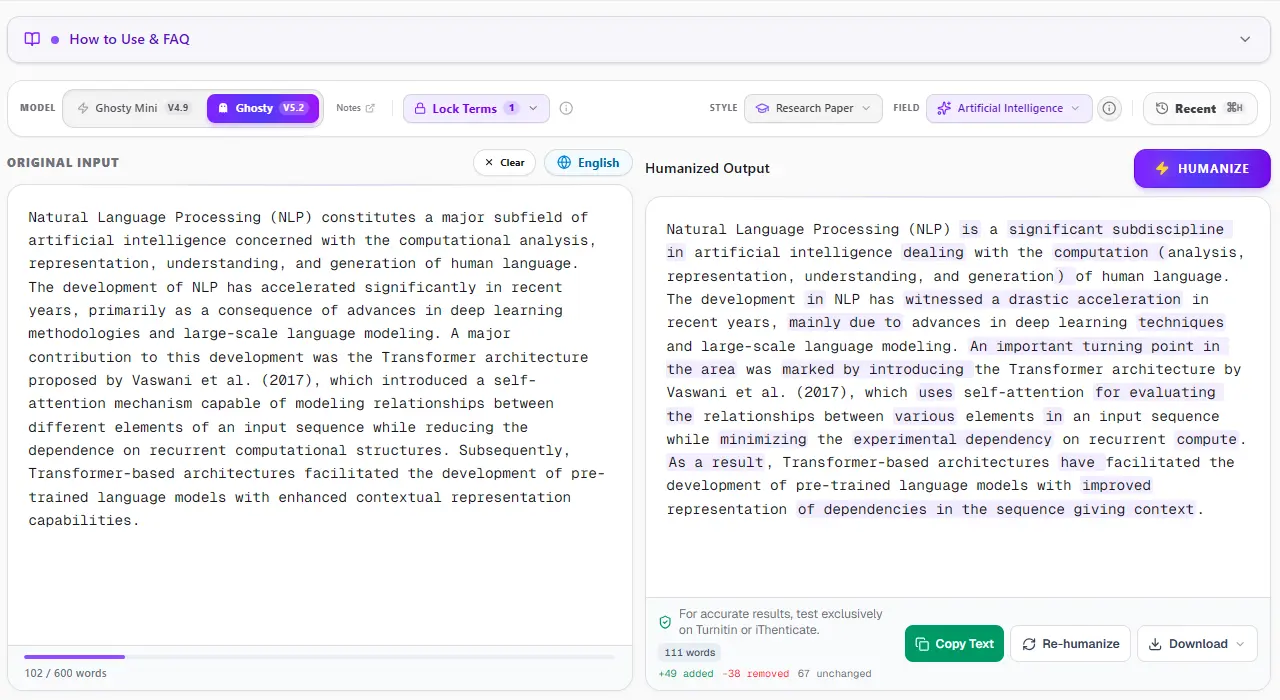
1. ThesisHuman Editor: Style, Field & Term Lock™ Technology
Unlike consumer-grade paraphrasers that blindly swap words with thesaurus synonyms, ThesisHuman allows researchers to select their exact Academic Style (Essay, Research Paper, Literature Review, Technical Report) and Academic Field (Computer Science, Engineering, Medicine, Physics). With Term Lock™, citations (APA, MLA, IEEE), LaTeX equations, and domain-specific terminology are cryptographically protected before sentence entropy is restructured.
Figure 1: The ThesisHuman editor processing an academic manuscript — featuring Academic Style selection, Academic Field customization, and Term Lock controls.
Phase 2: Institutional Integrity Screening
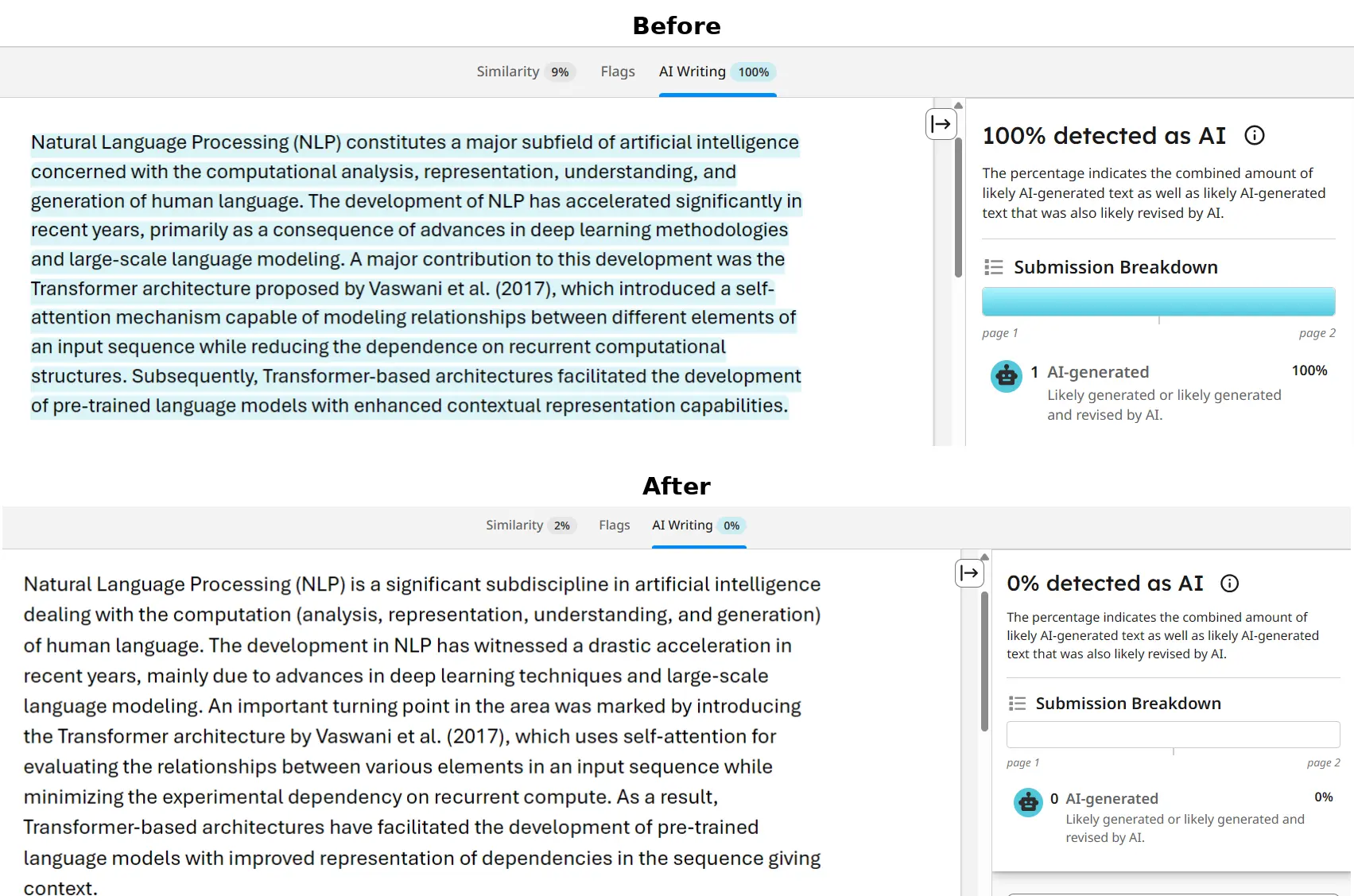
2. Turnitin & iThenticate Verification: 0% AI Detected
Turnitin and iThenticate scan submissions in overlapping 500-token blocks to analyze sentence predictability across paragraphs. When an unrefined AI draft is submitted, uniform cadence triggers an elevated AI Writing score. In the verified report below, a flagged graduate paper was processed through ThesisHuman, achieving a clean 0% AI detection score while preserving all formatted citations and technical parameters.
Figure 2: Turnitin AI detection scan — demonstrating complete 0% AI indicator clearance after ThesisHuman academic naturalization.
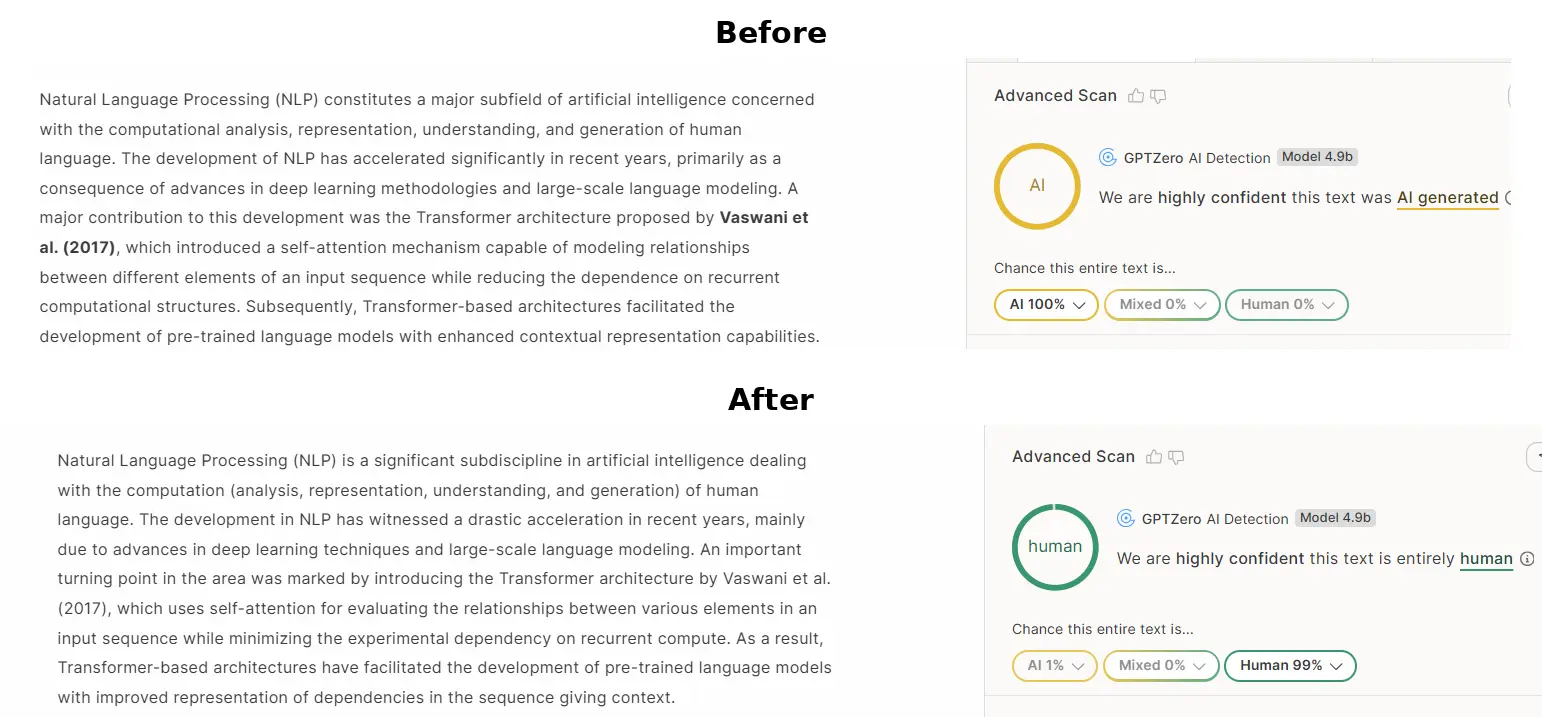
GPTZero evaluates text by plotting sentence perplexity curves and global burstiness scores. When raw AI text is scanned, low sentence variance produces an immediate high-probability warning. ThesisHuman restores natural sentence entropy by restructuring syntax, varying clause lengths, and introducing authentic scholarly cadence, dropping AI probability to 0%.
Figure 3: GPTZero perplexity and burstiness verification — raw machine-generated text (100% AI) transformed into 0% AI human-grade academic prose.
Phase 4: Cliché & N-Gram Elimination
4. Originality.ai Verification: 0% AI Confidence
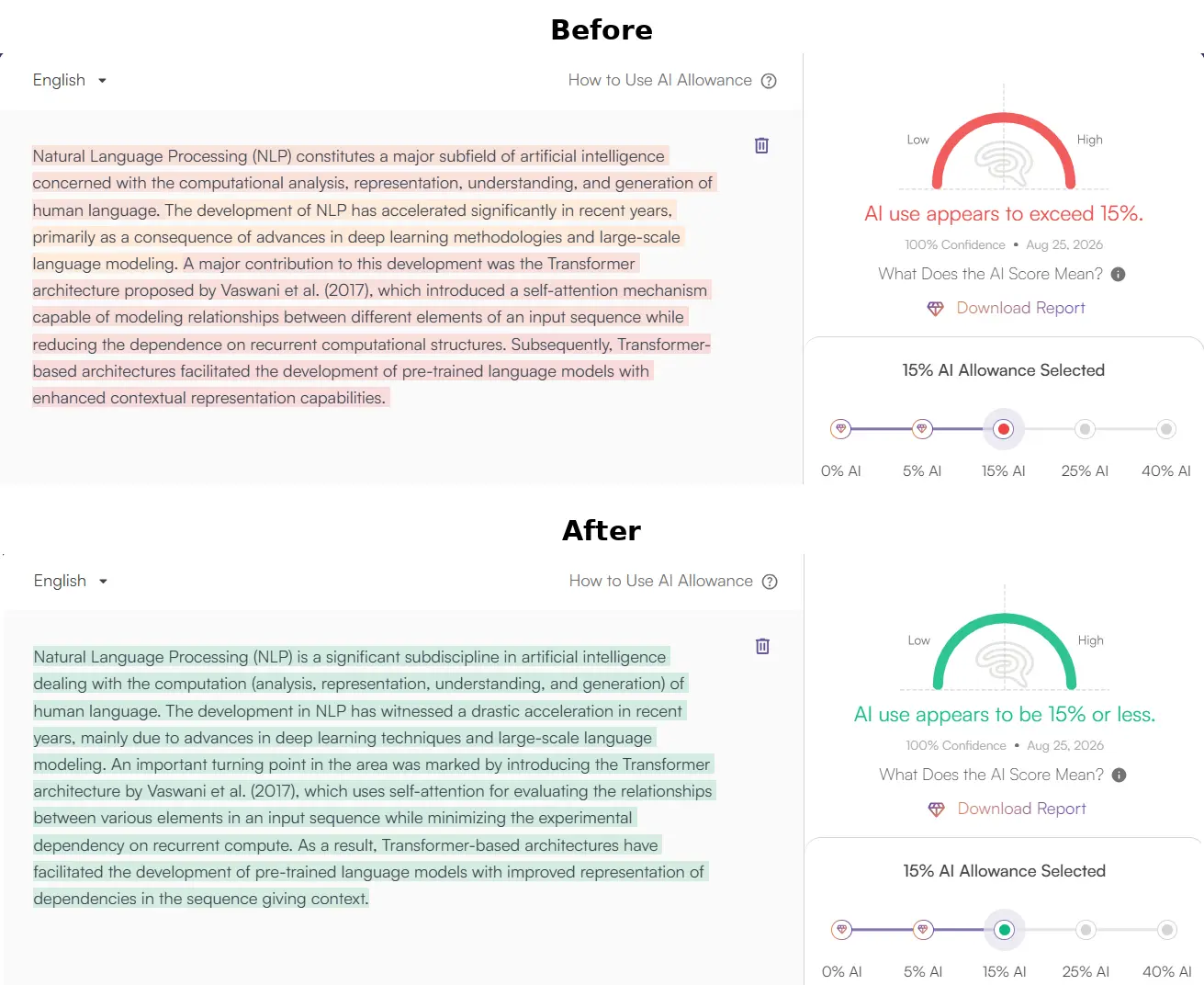
Originality.ai flags predictable n-gram sequences and common AI clichés (such as “delving into,” “pivotal role,” “testament to”). ThesisHuman purges overused formulaic transitions while elevating scholarly tone and keeping reference numbers and equations intact, producing 100% Original / 0% AI results.
Figure 4: Originality.ai detector scan — confirming complete removal of synthetic n-gram patterns and 0% AI detection confidence.
Can Writesonic humanize academic papers without breaking citations?
No. Writesonic is designed for commercial web copy and does not distinguish academic citations from standard prose. It frequently paraphrases author names, scrambles publication years, and converts parenthetical citations into fragmented sentences.
Will Writesonic bypass Turnitin AI detection on a college essay?
Writesonic may occasionally reduce detection scores on basic web tools, but it performs poorly against Turnitin and iThenticate. Its rewriter simplifies sentence structures and inserts colloquial transitions, producing an unnatural statistical profile that institutional classifiers easily detect.
What is the difference between an AI paraphraser and an academic humanizer?
A generic paraphraser simply replaces words with synonyms and alters sentence clause order. An academic humanizer preserves technical nomenclature and formatted references while restructuring sentence entropy and burstiness to match authentic scholarly peer-reviewed prose.
Is it safe to paste confidential thesis chapters into commercial marketing tools?
Commercial platforms often retain user prompts to train future language models or store them in user history logs. Academic researchers working with proprietary data, unpublished laboratory results, or institutional ethics committee constraints should only use tools with explicit zero-retention ephemeral processing guarantees.
Prepare Your Manuscript for iThenticate & Journal Review
Humanize AI-assisted academic prose while keeping your research claims, technical terminology, and citations completely intact. 500 words included free.