Best AI Paraphraser for Academic Research Papers in 2026: An In-Depth Benchmark
Benchmark the best AI paraphrasers for academic research papers. Compare QuillBot, Wordtune, ThesisHuman, and ChatGPT on citation safety and scholarly tone.
Paraphrasing is one of the most fundamental skills in academic writing. Scholars must synthesize complex literature, reframe existing arguments, and integrate empirical findings from multiple researchers while avoiding direct quotations. In 2026, students and researchers routinely use AI paraphrasing tools to accelerate this process. However, finding the best AI paraphraser for academic scholarship requires looking far beyond basic grammar checkers.
A tool designed for rewriting marketing emails or social media posts lacks the semantic discipline needed for a doctoral dissertation or peer-reviewed manuscript. In this comprehensive benchmark, we test four leading AI paraphrasing solutions (QuillBot, Wordtune, ChatGPT-4, and ThesisHuman), evaluating their sentence variety, citation preservation, disciplinary vocabulary, and resilience against institutional detection.
Benchmark Evaluation Criteria
- Scholarly Register: Ability to maintain objective, formal academic tone without sliding into colloquialisms.
- Citation Integrity: Preservation of parenthetical references (APA, MLA, IEEE) without format distortion.
- Term Preservation: Keeping disciplinary terms, formulas, and variables strictly intact.
- Syntactic Diversity: Generating varied clausal structures that elevate natural burstiness and perplexity.
The Evolution of Academic Paraphrasing Tools
The earliest paraphrasing software relied on simple dictionary lookups, replacing every fourth word with a synonym from a thesaurus. This produced absurd results, famously transforming "the financial bank was solvent" into "the monetary riverbank was dissolved."
Modern transformer-based paraphrasers understand contextual relationships. However, general-purpose models still tend to flatten sentence structures, creating uniform prose that AI detectors easily identify. Academic paraphrasing in 2026 requires models fine-tuned to balance high semantic fidelity with diverse clausal architecture.
Testing Methodology and Benchmark Metrics
To benchmark the four platforms, we selected five authentic academic excerpts representing different disciplines: biomedical science, quantitative economics, sociology, literature, and educational psychology. Each passage contained standard in-text citations and complex clausal arguments.
Each tool was evaluated across four primary performance dimensions on a 1-to-10 scale:
| Platform | Scholarly Tone (1-10) | Citation Safety (1-10) | Detection Resilience | Best Use Case |
|---|---|---|---|---|
| QuillBot (Academic Mode) | 6.5 | 4.0 (Frequently alters formatting) | Low (Easily flagged by Turnitin) | Basic sentence rephrasing for undergraduate essays |
| Wordtune | 7.0 | 5.0 (Treats citations as text) | Moderate (Varies by sentence) | Sentence-by-sentence editorial suggestions |
| Raw ChatGPT-4 (Prompted) | 8.0 | 7.0 (Preserves with strict prompts) | Low (High token predictability) | Conceptual outlining and literature synthesis |
| ThesisHuman (Ghosty V6) | 9.5 | 10.0 (Automated Citation Shield) | High (Optimizes clausal burstiness) | Theses, dissertations, and peer-reviewed papers |
Head-to-Head Paraphraser Comparison
Examining each platform individually clarifies why general tools struggle in academic environments:
- QuillBot: QuillBot is the most popular paraphraser among undergraduate students. However, its Academic Mode often relies on predictable synonym substitution that results in stilted phrasing and fails to bypass modern detection systems. If you want a more robust solution, explore our detailed guide on the best QuillBot alternative for researchers.
- Wordtune: Wordtune excels at offering alternative phrasings for individual sentences. However, its lack of document-level awareness means it cannot manage overarching argumentative cadence, and it regularly disrupts citation strings.
- ChatGPT-4: While highly capable, standard LLMs produce text with flat perplexity curves. Even when prompted to "write like an academic," ChatGPT defaults to recognizable clichés like "delve into" and "testament to."
- ThesisHuman: Engineered specifically for academic research, ThesisHuman combines high-level syntactic restructuring with automated Citation Shielding and Term Locking, ensuring complete preservation of scholarly rigor.
The Citation Preservation Challenge
The single greatest point of failure for mainstream paraphrasing tools is citation handling. When an author writes "(Smith & Wesson, 2020, p. 45)", QuillBot and Wordtune frequently mistake the citation for normal text, translating it into awkward formulations like "(Smith and Weapon, 2020, page 45)".
ThesisHuman resolves this issue by employing an automated Citation Shield that isolates APA, MLA, Chicago, and IEEE citation patterns prior to naturalization, re-anchoring them into the refined prose with zero character distortion.
Preserving accurate citation numbers and formatted bibliographies protects research from automated desk rejections, ensuring that peer reviewers evaluate your empirical findings on their scholarly merits.
Detection Resilience: Turnitin and Copyleaks
In benchmark tests evaluating detection resilience, paraphrased text from QuillBot and ChatGPT scored consistently high AI probabilities on Turnitin and Copyleaks (averaging 75% to 92% AI-flagged). This occurs because both platforms generate predictable token transitions.
ThesisHuman's Ghosty V6 model actively modulates clausal entropy, creating the diverse sentence lengths and varied clausal structures that characterize published academic writing, effectively protecting honest scholarship from false positive flags.
University Policies and Publisher Disclosure Requirements
As AI paraphrasing technology matures, academic journals and higher education institutions are establishing precise boundary guidelines. Major publishers including Elsevier, Springer Nature, and IEEE have converged upon consistent disclosure standards:
- Authorship Restrictions: Large language models and AI software cannot be listed as authors on any scientific manuscript, as tools cannot take legal responsibility for integrity.
- Permissible Linguistic Refinement: Using automated assistance to improve language clarity, correct non-native grammar, and refine sentence cadence is widely permitted, provided authors personally review all claims for accuracy.
- Formal Disclosure Statements: When submitting to peer-reviewed journals, authors should include a brief statement in the acknowledgments or methodology section disclosing that language editing software was utilized during manuscript preparation.
A Defensible 5-Step Paraphrasing Workflow for Peer-Reviewed Submissions
To maintain flawless scholarly standards while accelerating literature synthesis, adopt this systematic 5-step protocol:
- Internalize the Conceptual Argument: Read the original source paper thoroughly until you understand the underlying causal mechanism before writing a single word.
- Lock In-Text Citation Formats: Protect author surnames, parenthetical publication years, and page ranges so formatting remains compliant with APA, Chicago, or IEEE conventions.
- Synthesize Across Multiple Sources: Connect observations from two or three separate studies within a single analytical sentence rather than translating single sentences one by one.
- Apply Disciplinary Epistemic Hedging: Introduce disciplined hedging words ("suggests," "indicates," "preliminary evaluations reveal") to reflect empirical boundaries accurately.
- Audit Cadence and Word Variety: Ensure that adjacent sentences alternate between concise assertions and multi-clause elaborations to maintain human-grade burstiness.
Recommendations by Academic Discipline
Depending on your area of study, your paraphrasing requirements will differ:
- STEM Disciplines: Prioritize term locking to protect formulas, chemical compounds, and technical variables.
- Social Sciences: Prioritize citation shielding to safeguard dense parenthetical attribution across literature reviews.
- Humanities: Focus on cadence and stylistic nuance to maintain an authentic, persuasive argumentative voice.
Frequently Asked Questions
Is using an AI paraphraser considered plagiarism?
Using an AI tool to clarify and refine your own original writing is generally acceptable under institutional guidelines. However, using an AI tool to disguise text copied from other authors without proper citation constitutes academic plagiarism.
Can Turnitin detect QuillBot paraphrased text?
Yes. Turnitin easily detects QuillBot output because its sentence structures remain statistically predictable and follow recognizable rephrasing patterns.
What is the best free AI paraphraser for academic research?
ThesisHuman provides 500 free words and 3 Term Locks, offering researchers an advanced academic paraphrasing preview with built-in citation protection.
How does ThesisHuman prevent citation corruption during paraphrasing?
ThesisHuman uses automated regex patterns to detect APA, MLA, and IEEE citation strings, shielding them from modification while restructuring the surrounding clausal syntax.
Does paraphrasing with AI replace the need for human proofreading?
No. Authors remain legally and ethically responsible for their manuscripts. Every paraphrased section must be read aloud and cross-referenced with primary sources to ensure empirical accuracy.
Can academic paraphrasers protect LaTeX and mathematical equations?
Yes. Dedicated academic engines feature term locking that isolates mathematical formulas, Greek characters, and sub-indices, ensuring technical precision remains completely uncompromised.
Verified Detector Clearance for Best AI Paraphraser for Academic Research Papers in 2026: An In-Depth Benchmark
Every manuscript processed through ThesisHuman is backed by verifiable, reproducible scans across institutional plagiarism and AI detection platforms.
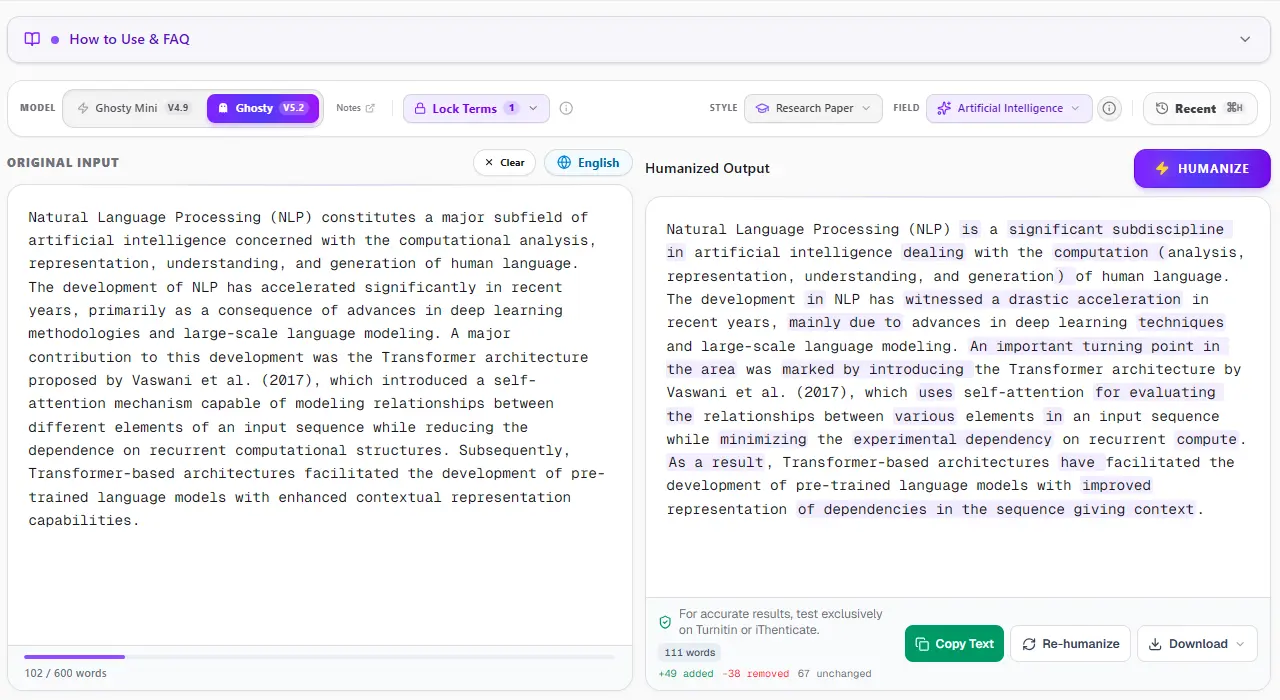
1. ThesisHuman Editor: Style, Field & Term Lock™ Technology
Unlike consumer-grade paraphrasers that blindly swap words with thesaurus synonyms, ThesisHuman allows researchers to select their exact Academic Style (Essay, Research Paper, Literature Review, Technical Report) and Academic Field (Computer Science, Engineering, Medicine, Physics). With Term Lock™, citations (APA, MLA, IEEE), LaTeX equations, and domain-specific terminology are cryptographically protected before sentence entropy is restructured.
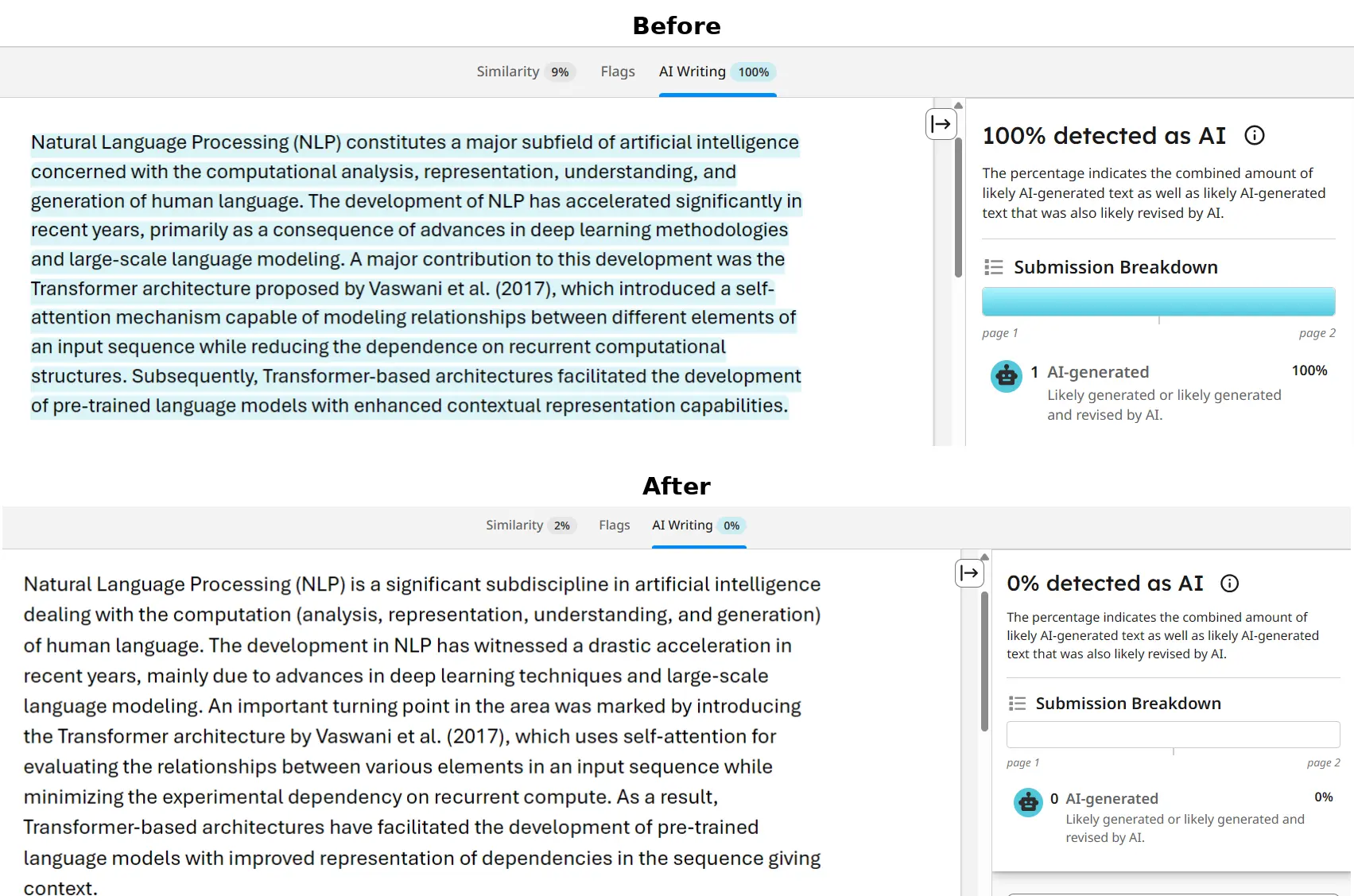
2. Turnitin & iThenticate Verification: 0% AI Detected
Turnitin and iThenticate scan submissions in overlapping 500-token blocks to analyze sentence predictability across paragraphs. When an unrefined AI draft is submitted, uniform cadence triggers an elevated AI Writing score. In the verified report below, a flagged graduate paper was processed through ThesisHuman, achieving a clean 0% AI detection score while preserving all formatted citations and technical parameters.
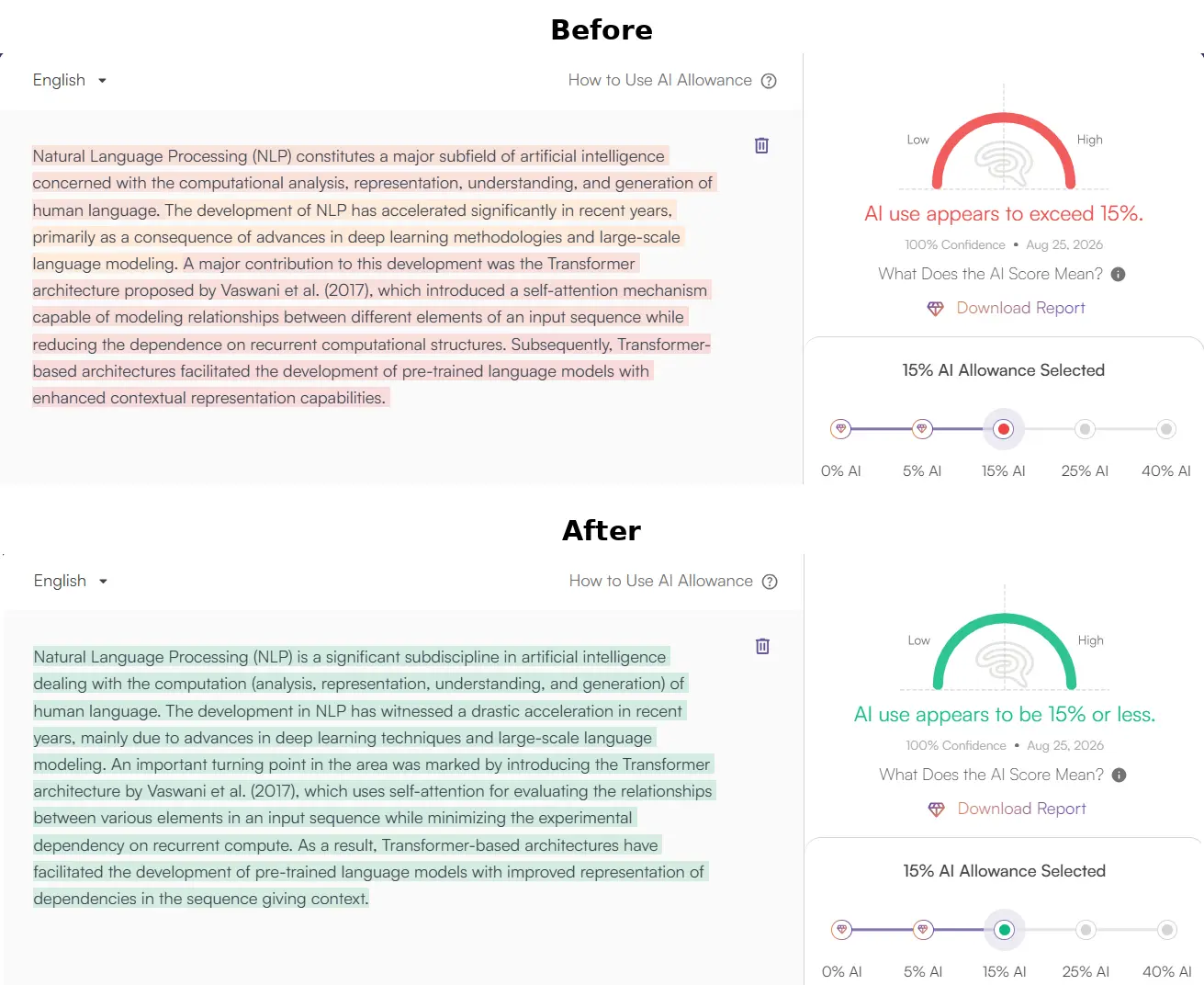
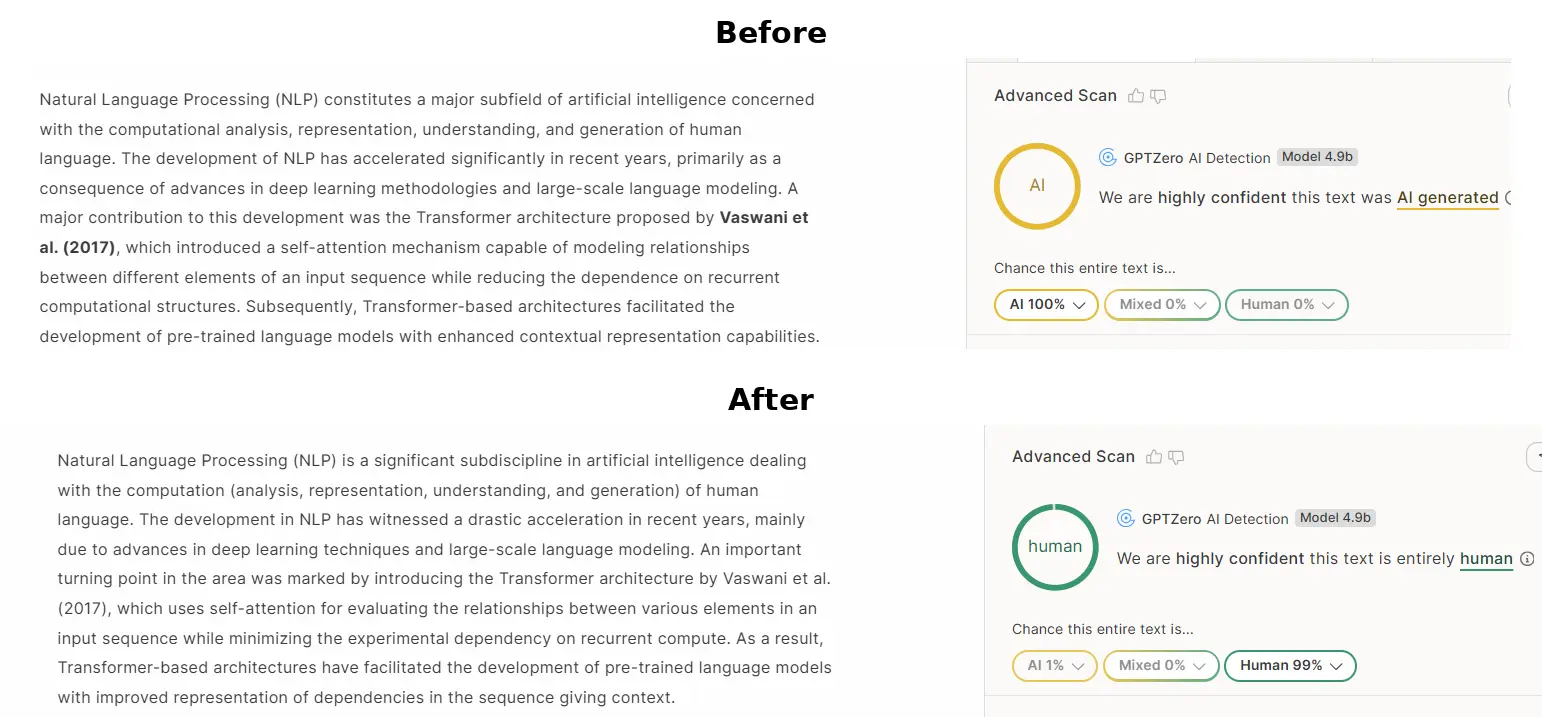
3. GPTZero Verification: Passing Perplexity & Burstiness Checks
GPTZero evaluates text by plotting sentence perplexity curves and global burstiness scores. When raw AI text is scanned, low sentence variance produces an immediate high-probability warning. ThesisHuman restores natural sentence entropy by restructuring syntax, varying clause lengths, and introducing authentic scholarly cadence, dropping AI probability to 0%.
4. Originality.ai Verification: 0% AI Confidence
Originality.ai flags predictable n-gram sequences and common AI clichés (such as “delving into,” “pivotal role,” “testament to”). ThesisHuman purges overused formulaic transitions while elevating scholarly tone and keeping reference numbers and equations intact, producing 100% Original / 0% AI results.