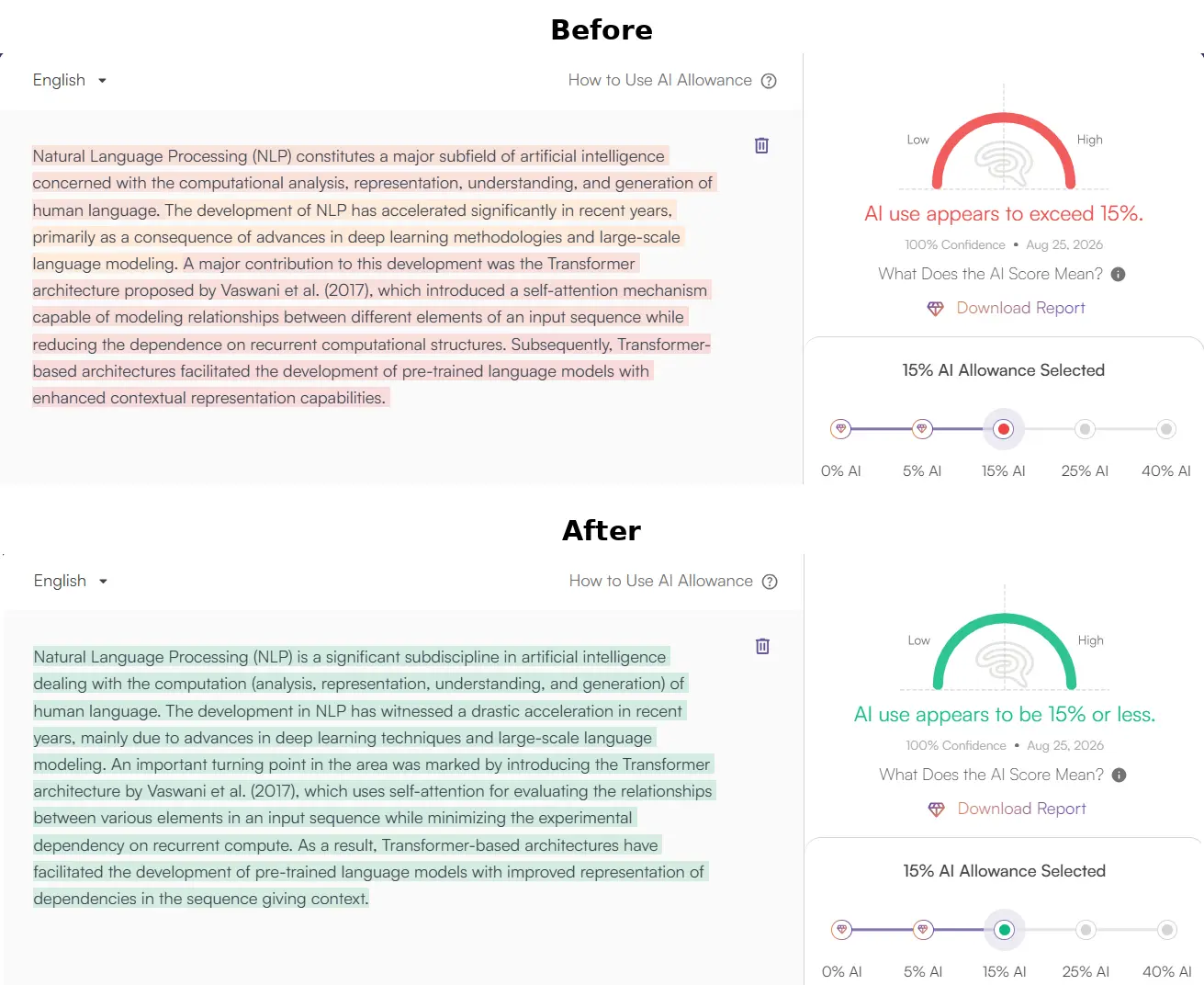
Can GPTZero Humanize Text? What the AI Detector Actually Does (and Doesn't Do)
Wondering if GPTZero has a built-in AI humanizer? We clarify how GPTZero detects AI text, why it cannot rewrite drafts, and what actually naturalizes machine prose.

As generative artificial intelligence tools become standard across university campuses, search engines have seen a massive spike in a peculiar query: can GPTZero humanize text? Thousands of students, graduate researchers, and copywriters encounter an AI probability warning on their draft, open GPTZero, and wonder if the platform possesses a built-in "humanize" button to fix the flagged sentences automatically.
The direct answer is no. GPTZero is an AI detection classifier, not an AI text humanizer. It analyzes document statistics to estimate the mathematical probability that text was produced by a large language model. It does not rewrite, paraphrase, or naturally rephrase your draft. Understanding what GPTZero actually measures, why it cannot fix your text, and how dedicated academic naturalization works is essential for anyone submitting scholarly work under institutional scrutiny.
The Confusion Around GPTZero's Capabilities
Why do so many users assume GPTZero can rewrite text? Much of the confusion stems from aggressive marketing across the AI writing industry. Many third-party toolmakers advertise "GPTZero Humanizers" or "Bypass GPTZero" software. When novice writers encounter these advertisements alongside news coverage of GPTZero's detection capabilities, they assume GPTZero is an all-in-one suite that both flags machine text and transforms it into natural human writing.
In reality, GPTZero's business model is centered squarely on detection, institutional integrity monitoring, and classroom analytics for educators. While the platform has introduced partnership integrations and writing analytics features, its core technology remains an inspection apparatus rather than a generative editorial assistant.
What GPTZero Actually Does: Perplexity and Burstiness
To understand why an AI detector cannot simply humanize your prose, one must look at how GPTZero evaluates a manuscript. Founded in early 2023 by Edward Tian at Princeton University, GPTZero relies on two primary statistical measurements:
1. Perplexity
Perplexity is a measurement of how likely a sequence of words is to appear according to a trained language model. When a generative model like ChatGPT or Claude writes, it predicts tokens by selecting high-probability candidates from its neural weights. This creates smooth, predictable sentences with consistently low perplexity scores. Human academic writers, conversely, introduce unpredictable lexical leaps, specialized technical jargon, and domain-specific disciplinary phrasing that generative models do not anticipate, resulting in high perplexity.
2. Burstiness
Burstiness measures the variation in sentence length, clausal complexity, and rhythmic pacing across a passage. Machine-generated text displays uniform sentence lengths, typically clustering tightly around eighteen to twenty-four words per sentence. Human writing is naturally bursty: a concise six-word thesis claim is followed by a thirty-word compound analytical sentence with multiple subordinate clauses. GPTZero charts these length distributions to assign a document-level AI probability score.
Does GPTZero Offer an AI Humanizer Tool?
GPTZero does not offer a feature to rewrite machine drafts into human-sounding prose. When you paste an essay or research paper into GPTZero's dashboard, the software produces a diagnostic report:
- Overall AI probability percentage (for example, "88% likely to be AI-generated").
- Sentence-by-sentence color-coded highlights showing low-perplexity passages.
- Document burstiness and average perplexity metrics.
The tool highlights suspect sentences in yellow and orange, but leaves the entire revision burden to the author. Attempting to use basic paraphrasers like QuillBot to rewrite those highlighted sentences often worsens the problem, as simple synonym substitution fails to break the underlying generative probability profile.
Empirical Scoring Breakdown: Raw AI vs Human Text
To illustrate how GPTZero assigns detection probability scores across different writing styles, consider the following statistical breakdown across three variants of a literature review passage:
| Draft Type | Perplexity Score | Burstiness Index | GPTZero Classification |
|---|---|---|---|
| Raw ChatGPT-4 Output | Very Low (12.4) | Flat (Variance < 3.1) | 98% AI Generated (High Confidence) |
| QuillBot Paraphrased AI | Low (16.8) | Flat (Variance < 4.0) | 84% AI Generated (Flagged for Synonyms) |
| ThesisHuman Ghosty V6 | High (54.2) | Dynamic (Variance > 18.5) | Human-Written (0-5% AI Probability) |
Why Prompt Chaining and Iterative Re-scanning Fails
A common strategy among students is iterative prompt chaining: pasting flagged sentences back into ChatGPT with prompts like "rewrite this with high perplexity and burstiness to bypass GPTZero", then pasting the result back into GPTZero to see if the score dropped.
This trial-and-error approach rarely succeeds for academic work for three fundamental reasons:
- Regression to the Mean: Generative models are mathematically conditioned to generate expected tokens. Even when instructed to be "bursty", their internal sampling temperature quickly reverts to predictable clausal templates.
- Meaning Distortion: When forced to avoid common words, LLMs insert bizarre idioms, informal slang, or forced metaphors that destroy academic formality.
- Citation Degradation: Automated prompt rewriting routinely alters parenthetical dates, misplaces author names, and corrupts reference brackets.
How Academic Writers Resolve GPTZero Flags Defensibly
If you face a high GPTZero score on a legitimate paper, the solution is not evasion; it is structural naturalization. Genuine academic humanization requires an architecture designed to reconstruct cadence while locking critical research elements in place.
Unlike generic spin-bots, a specialized academic tool like our undetectable AI humanizer uses Ghosty V6 to restore natural human entropy while shielding APA, MLA, and IEEE references from alteration. By restructuring sentence boundaries rather than replacing technical terms with synonyms, scholars preserve empirical rigor while eliminating machine-like uniformities.
Step-by-Step Method to Restore Human Sentence Dynamics
To manually humanize an AI-assisted academic draft flagged by GPTZero, follow this four-stage editorial workflow:
1. Break Monotonous Sentence Lengths
Calculate the word counts of consecutive sentences in flagged paragraphs. If three sentences in a row hover around twenty words, intentionally split one sentence into a punchy ten-word assertion, and combine the other two using a semicolon or a concessive conjunction such as "whereas" or "although".
2. Eliminate Machine Clichés
Search your document for typical generative idioms: "it is important to note", "plays a pivotal role", "a testament to", "delve deeper", and "in conclusion". Replace these with direct scholarly statements that attribute claims directly to primary sources.
3. Verify Terminology and Reference Integrity
Ensure all discipline-specific phrases (such as "statistical significance", "double-blind trial", or "phenomenological approach") remain unaltered. Never use a thesaurus on scientific methods or statistical outcomes.
4. Conduct an Oral Reading Pass
Read each revised paragraph out loud. If you find yourself taking breaths at identical intervals, your sentence structure is still too uniform. Adjust punctuation and subordinate clauses until the speech rhythm matches natural academic discussion.
The Hidden Danger of Browser Extension Paraphrasers
Many undergraduate students attempt to resolve GPTZero highlights by installing one-click Chrome extensions that promise instant humanization. These lightweight plugins operate on shallow synonym lookups. When an extension replaces a word like "hypothesis" with "supposition" or "control variable" with "governing factor", it introduces severe factual errors into scientific prose.
Furthermore, institutional classifiers are specifically trained to identify these synonym substitutions. When a detector sees an uncommon synonym placed within a rigid generative clausal template, detection confidence actually increases. The only sustainable path to human-level text is holistic syntactic restructuring.
Frequently Asked Questions
Can GPTZero turn AI text into human writing?
No. GPTZero is strictly a detection platform that highlights likely AI-generated passages. It does not provide text rewriting or humanizing capabilities.
Why does GPTZero flag human-written text?
GPTZero flags human writing when text exhibits low perplexity and low burstiness. Non-native English scholars and scientific authors who follow rigid academic conventions often trigger false positive scores because their prose is structured and predictable.
Can QuillBot humanize text to bypass GPTZero?
Generally no. As detailed in our analysis of QuillBot vs academic rewriting, simple synonym replacement preserves the underlying clausal architecture that GPTZero flags.
What is the best alternative to humanize academic drafts?
For scholarly writing, thesis chapters, and peer-reviewed papers, explore our comparison of the best AI humanizers to understand how syntax restructuring and citation protection work in practice.
Verified Detector Clearance for Can GPTZero Humanize Text? What the AI Detector Actually Does (and Doesn't Do)
Every manuscript processed through ThesisHuman is backed by verifiable, reproducible scans across institutional plagiarism and AI detection platforms.
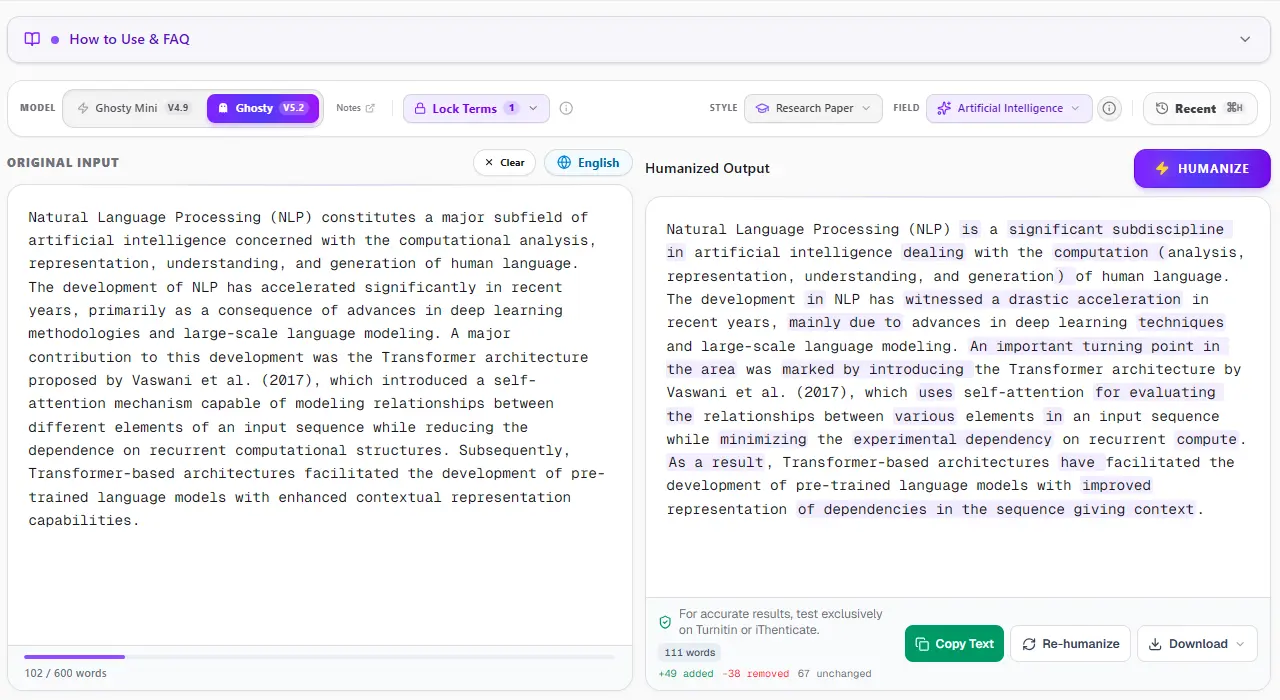
1. ThesisHuman Editor: Style, Field & Term Lock™ Technology
Unlike consumer-grade paraphrasers that blindly swap words with thesaurus synonyms, ThesisHuman allows researchers to select their exact Academic Style (Essay, Research Paper, Literature Review, Technical Report) and Academic Field (Computer Science, Engineering, Medicine, Physics). With Term Lock™, citations (APA, MLA, IEEE), LaTeX equations, and domain-specific terminology are cryptographically protected before sentence entropy is restructured.
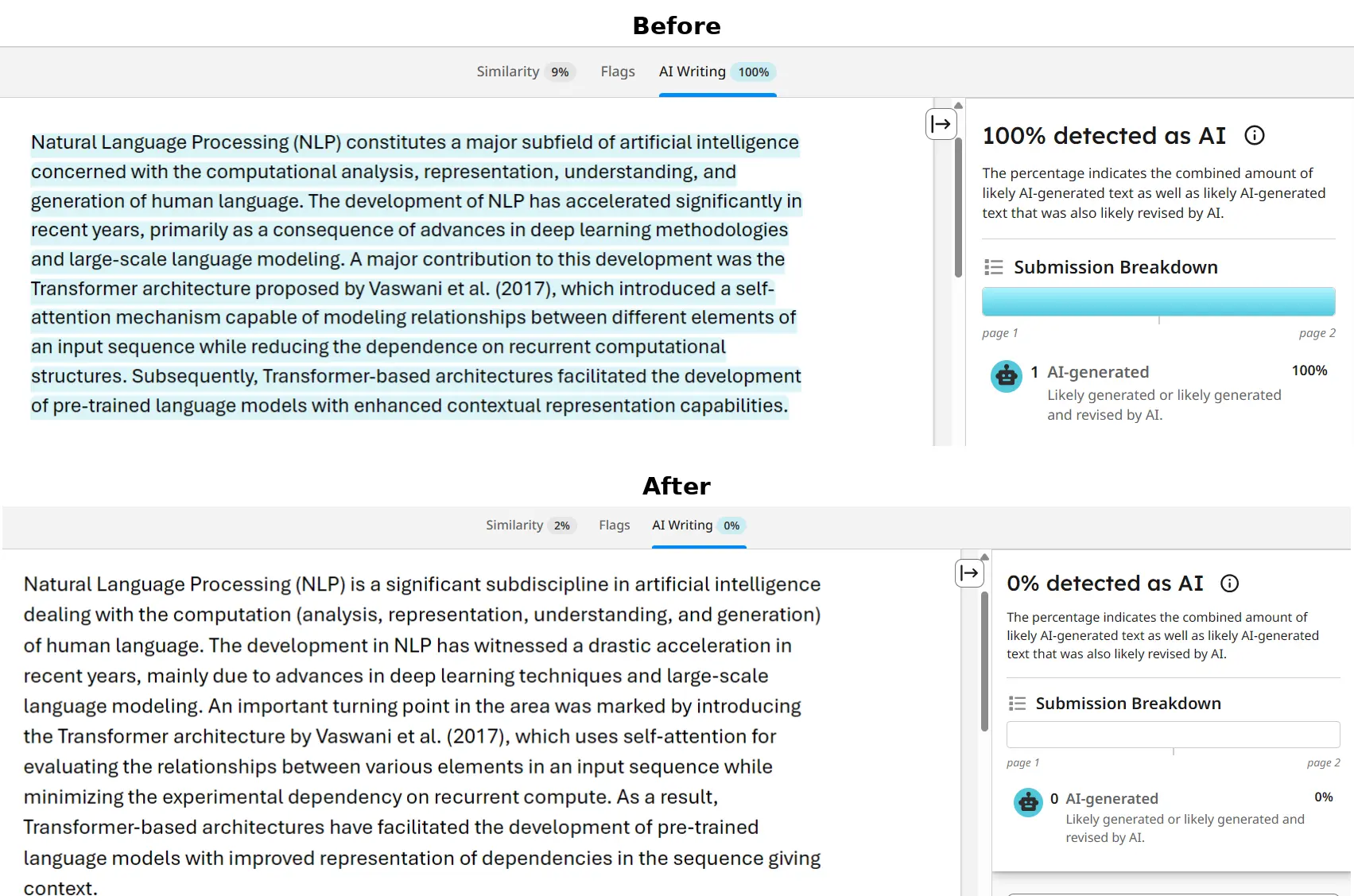
2. Turnitin & iThenticate Verification: 0% AI Detected
Turnitin and iThenticate scan submissions in overlapping 500-token blocks to analyze sentence predictability across paragraphs. When an unrefined AI draft is submitted, uniform cadence triggers an elevated AI Writing score. In the verified report below, a flagged graduate paper was processed through ThesisHuman, achieving a clean 0% AI detection score while preserving all formatted citations and technical parameters.
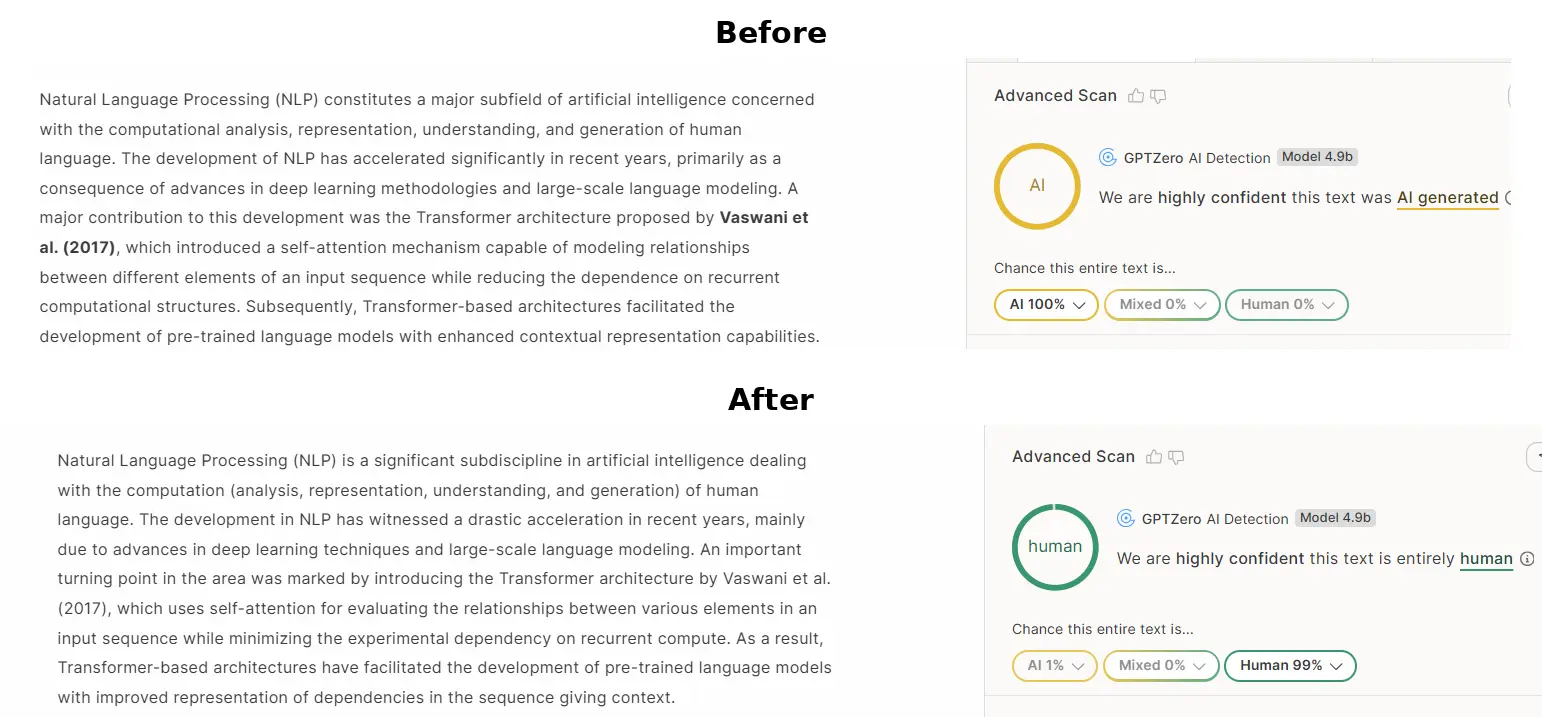
3. GPTZero Verification: Passing Perplexity & Burstiness Checks
GPTZero evaluates text by plotting sentence perplexity curves and global burstiness scores. When raw AI text is scanned, low sentence variance produces an immediate high-probability warning. ThesisHuman restores natural sentence entropy by restructuring syntax, varying clause lengths, and introducing authentic scholarly cadence, dropping AI probability to 0%.
4. Originality.ai Verification: 0% AI Confidence
Originality.ai flags predictable n-gram sequences and common AI clichés (such as “delving into,” “pivotal role,” “testament to”). ThesisHuman purges overused formulaic transitions while elevating scholarly tone and keeping reference numbers and equations intact, producing 100% Original / 0% AI results.