How to Cite a Paraphrase: Academic Citation Rules for APA, MLA, and Chicago Styles
Master the precise rules of citing paraphrased sources across APA 7th, MLA 9th, and Chicago 18th editions. Learn parenthetical vs. narrative formatting, page number guidelines, and sustained attribution techniques.

In scholarly writing, few skills are as foundational or as frequently misunderstood as learning how to cite a paraphrase correctly. Many students and early-career researchers understand that verbatim quotations require quotation marks and page anchors. Yet uncertainty often arises when summarizing an author's argument, synthesizing empirical findings across multiple papers, or integrating a methodological framework into a dissertation chapter.
A widespread misconception is that rewording a passage frees you from citing the source. In reality, academic integrity protocols evaluate intellectual provenance rather than surface vocabulary. Summarizing another scholar's hypothesis or empirical findings without attribution constitutes plagiarism of ideas. Conversely, inserting citations clumsily can disrupt narrative flow or create citation clutter across paragraphs.
This comprehensive academic manual explains exactly how to cite a paraphrase with rigorous scholarly precision. We analyze the specific formatting guidelines for APA 7th Edition, MLA 9th Edition, and Chicago 18th Edition (2024), provide concrete side-by-side examples, and detail the mechanics of the sustained multi-sentence paraphrase.
The Core Mandate: Why Every Paraphrase Demands Formal Citation
Academic scholarship functions as an interconnected conversation. Every journal article and dissertation builds upon discoveries established by prior investigators. When you publish research, your citations serve as the verifiable paper trail documenting where your evidence originated.
When you cite a paraphrase, you achieve three indispensable scholarly goals:
- Intellectual Attribution: You give rightful credit to the researchers whose labor, theoretical creativity, and empirical analysis produced the insight.
- Evidentiary Verification: You enable peer reviewers, editors, and future scholars to track down primary evidence, verify your interpretations, and evaluate methodology.
- Boundary Demarcation: You clarify the boundary between existing academic consensus and your own novel analytical contribution.
Without accurate paraphrase citations, readers cannot determine which insights represent your original thesis versus external research. That ambiguity violates peer-review standards and can trigger academic integrity reviews.
In-Text Citation Mechanics: Parenthetical vs. Narrative Formats
Across all major academic citation systems, in-text citations for paraphrased text appear in one of two fundamental structural formats: parenthetical citations or narrative citations. Understanding the rhetorical difference between these two approaches allows you to vary sentence structures while maintaining rigorous attribution.
1. Parenthetical Citations
In a parenthetical citation, the author's surname and the publication year (or page number) appear together inside parentheses at the end of the paraphrased statement or clause.
Example (APA 7): Linguistic markers of synthetic text often manifest as suppressed token burstiness across technical paragraphs (Alvarez & Thorne, 2024).
2. Narrative Citations
In a narrative citation, the author's name is woven directly into the grammatical sentence structure as the subject or agent, with the publication year immediately following in parentheses.
Example (APA 7): Alvarez and Thorne (2024) demonstrated that synthetic writing manifests suppressed token burstiness across technical prose.
Narrative citations foreground the researcher, which is ideal when comparing competing theoretical viewpoints. Parenthetical citations place primary emphasis on the empirical finding, which is preferred when synthesizing literature.
APA 7th Edition: Guidelines for Paraphrased Material
The American Psychological Association (APA 7th Edition) standard is the dominant citation system across the behavioral sciences, psychology, education, nursing, business, and many social sciences. APA employs an author-date citation format that connects in-text references to an alphabetical reference list.
The APA Page Number Question: Section 8.23 Recommendations
A question that frequently creates friction between graduate students and thesis advisors is whether APA requires page numbers for paraphrased passages. The official guidance in the Publication Manual of the American Psychological Association (7th ed., Section 8.23) provides clear clarification:
For a paraphrase, an in-text citation must include the author's last name and the year of publication. While a page or paragraph number is not required for a paraphrase, APA recommends including one when it helps interested readers locate the relevant passage in a long or complex work.
Therefore, if you are paraphrasing an overarching thesis or general conclusion of a short empirical study, an author-date citation without a page number is fully compliant with APA rules:
General Paraphrase: Cognitive fatigue significantly reduces syntactic processing velocity in bilingual adults (Kaufman, 2023).
However, if you are paraphrasing a specific statistical finding, an intricate diagram, or a distinct argument from page 184 of a monograph, academic best practice calls for a precise page locator:
Specific Paraphrase with Page Anchor: Kaufman (2023, p. 184) observed that working memory depletion reduced clausal subordinate density by nearly thirty percent.
Formatting Multiple Authors in APA 7 Paraphrases
Under APA 7, any source with three or more authors is shortened to the first author plus 'et al.' from the very first in-text citation:
One Author: Parenthetical: (Reynolds, 2022) | Narrative: Reynolds (2022)
Two Authors: Parenthetical: (Reynolds & Chen, 2023) | Narrative: Reynolds and Chen (2023)
Three or More Authors: Parenthetical: (Reynolds et al., 2024) | Narrative: Reynolds et al. (2024)
Organization / Group Author: Parenthetical: (National Institutes of Health [NIH], 2023) | Narrative: National Institutes of Health (NIH, 2023)
Notice the punctuation distinction: in parenthetical citations with two authors, use the ampersand symbol ('&'). In narrative citations within the main text, spell out the word 'and'.
MLA 9th Edition: Author-Page Conventions for Paraphrases
The Modern Language Association (MLA 9th Edition) format is the standard for scholarship in literature, cultural studies, art history, and the humanities. Unlike APA, which prioritizes the recency of research via publication years, MLA emphasizes the textual location through author-page citation.
When Page Numbers Are Mandatory in MLA Paraphrasing
Under MLA 9 guidelines, whenever a source has stable pagination (such as printed books, academic journals, or paginated PDF articles), you must include the specific page number or range for every paraphrased statement. MLA does not use a comma between the author's surname and the page number, nor does it include 'p.' or 'pp.'
MLA Parenthetical Paraphrase:
Victorian industrial fiction systematically depicted mechanical looms as predatory organisms that devoured human vitality (Eagleton 114).
MLA Narrative Paraphrase:
Eagleton contends that Victorian industrial fiction systematically treated mechanical looms as predatory beasts consuming worker vitality (114).
If you are paraphrasing an unpaginated web article, include only the author's surname. If the web source lacks an author, use a shortened version of the title in quotation marks, such as ("Ethical Research Standards").
Chicago 18th Edition: Notes-Bibliography vs. Author-Date Systems
The Chicago Manual of Style (18th Edition, published in 2024) encompasses two distinct documentation systems: the Notes and Bibliography system, favored in history, religion, and the humanities; and the Author-Date system, widely used in the physical, natural, and social sciences.
In the Notes-Bibliography system, paraphrased passages receive a superscript number placed outside closing punctuation, directing the reader to a corresponding footnote or endnote. Crucially, Chicago 18 strongly prefers shortened notes (author surname, shortened title, and page locator) for repeated citations to prevent ambiguity in digital formats, while still permitting 'ibid.' as an acceptable option when citing consecutive references to the same source:
Paraphrase Text: Early modern printing guilds maintained strict geographic monopolies over vernacular translation rights in northern Italy.1
Footnote Citation (Initial Note): 1. Francesca Moretti, The Venetian Press and the Vernacular Canon, 1530-1580 (Chicago: University of Chicago Press, 2021), 88-91.
Footnote Citation (Subsequent Shortened Note, Preferred in Chicago 18): 2. Moretti, Venetian Press, 94.
In the Chicago Author-Date system, an in-text parenthetical paraphrase includes the author surname and year without an intervening comma, followed by a comma before the specific page locator: (Moretti 2021, 88-91). In narrative citations, the year and page appear in parentheses: Moretti (2021, 88-91). For sources with three or more authors, Chicago 18 shortens the in-text citation to the first author followed by 'et al.' (e.g., Reynolds et al. 2024, 112).
The Sustained Paraphrase: Citing Across Multi-Sentence Paragraphs
A frequent challenge researchers face is formatting a sustained paraphrase: summarizing a complex argument across three or four consecutive sentences without cluttering every clause with identical parenthetical citations.
Placing a single citation at the end of a long paragraph obscures where external evidence ends and your analysis begins. Conversely, tacking '(Miller, 2024)' onto consecutive sentences creates tedious repetition.
The solution is the narrative anchor protocol:
- Initial Sentence Anchor: Introduce the author and publication year in a narrative citation at the outset of the summary. For example: 'Miller (2024) developed an alternative statistical framework for evaluating non-linear ecological threshold effects.'
- Syntactic Continuations: In the second and third sentences, maintain attribution through explicit rhetorical pronouns and referential verbs rather than repeating the full citation. For example: 'The author argued that standard regression models consistently miss catastrophic regime shifts because they assume parameter stationarity. Miller further demonstrated that factoring in feedback delays doubled predictive accuracy across estuarine ecosystems.'
- Concluding Page Anchor: If the summary spans multiple pages or culminates in a specific statistical figure, conclude the final sentence with the page anchor in parentheses: '(pp. 412-414).'
This structured approach guarantees unbroken attribution while preserving the fluid, readable cadence expected of high-impact journal manuscripts.
Secondary Sources: Citing an Indirect Paraphrase Responsibly
Scholarly ethics dictate citing the primary source whenever accessible. However, when an original source is out of print, paywalled, or untranslated, you may cite through a secondary source.
In APA 7th Edition, identify the original scholar in the text, but list the secondary source in parentheses with the formula 'as cited in':
APA Indirect Paraphrase: Vygotsky argued that linguistic self-regulation emerges from social dialogue (1934, as cited in Berk, 2022).
In your reference list at the end of the manuscript, you only include Berk (2022). In MLA 9th Edition, state the relationship clearly in your text narrative: 'In a 1934 study, Vygotsky formulated the concept of inner speech (cited in Berk 78).'
Five Critical Paraphrase Citation Mistakes and How to Prevent Them
When manuscript editors and journal reviewers assess submissions, they frequently flag common citation errors that compromise scholarly rigor:
- 1. The Disconnected Citation Orphan: Placing an author-date citation in an isolated sentence without connecting it grammatically to surrounding evidence, leaving readers confused about whether previous sentences were also paraphrased.
- 2. Quotation Punctuation in Paraphrases: Including quotation marks around phrases within a paraphrase without citing exact page numbers. If you retain three or more consecutive distinctive words from the source, you must enclose them in quotation marks.
- 3. Citation Misplacement Relative to Punctuation: Placing parenthetical citations outside terminal periods. In APA and MLA, the parenthetical citation belongs inside the period: '...as observed in longitudinal trials (Smith, 2024).'
- 4. Corrupted Author Names from Automated Tools: Using generic software that translates 'et al.' into full author strings or misinterprets hyphenated foreign names, corrupting bibliographic reference matching.
- 5. Citation Loss During Language Editing: Running drafts through consumer rewriters that accidentally delete or modify parenthetical references during text simplification.
When polishing academic drafts, researchers should rely on disciplined revision workflows. Dedicated platforms like the ThesisHuman editor feature Term Lock technology that shields in-text citations, author names, and publication dates while remodeling clausal syntax. You can also explore our AI sentence rewriter for sentence-level syntactic variety or use our ethical academic paraphrasing tool to refine drafts while keeping citations intact.
For additional guidance on related research writing topics, consult our guide on whether paraphrasing is plagiarism, review our comprehensive Turnitin AI detection guide, or study our manual on how to restate a thesis statement in academic conclusions.
Frequently Asked Questions
Verified Detector Clearance for How to Cite a Paraphrase: Academic Citation Rules for APA, MLA, and Chicago Styles
Every manuscript processed through ThesisHuman is backed by verifiable, reproducible scans across institutional plagiarism and AI detection platforms.
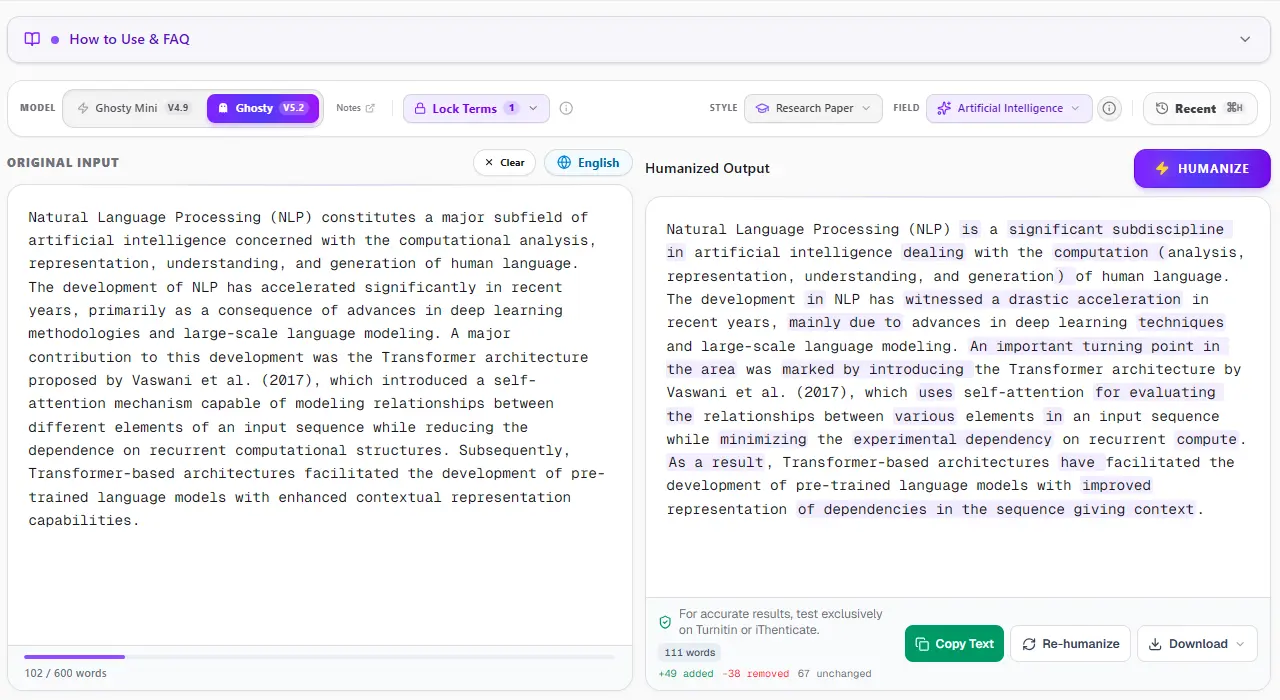
1. ThesisHuman Editor: Style, Field & Term Lock™ Technology
Unlike consumer-grade paraphrasers that blindly swap words with thesaurus synonyms, ThesisHuman allows researchers to select their exact Academic Style (Essay, Research Paper, Literature Review, Technical Report) and Academic Field (Computer Science, Engineering, Medicine, Physics). With Term Lock™, citations (APA, MLA, IEEE), LaTeX equations, and domain-specific terminology are cryptographically protected before sentence entropy is restructured.
2. Turnitin & iThenticate Verification: 0% AI Detected
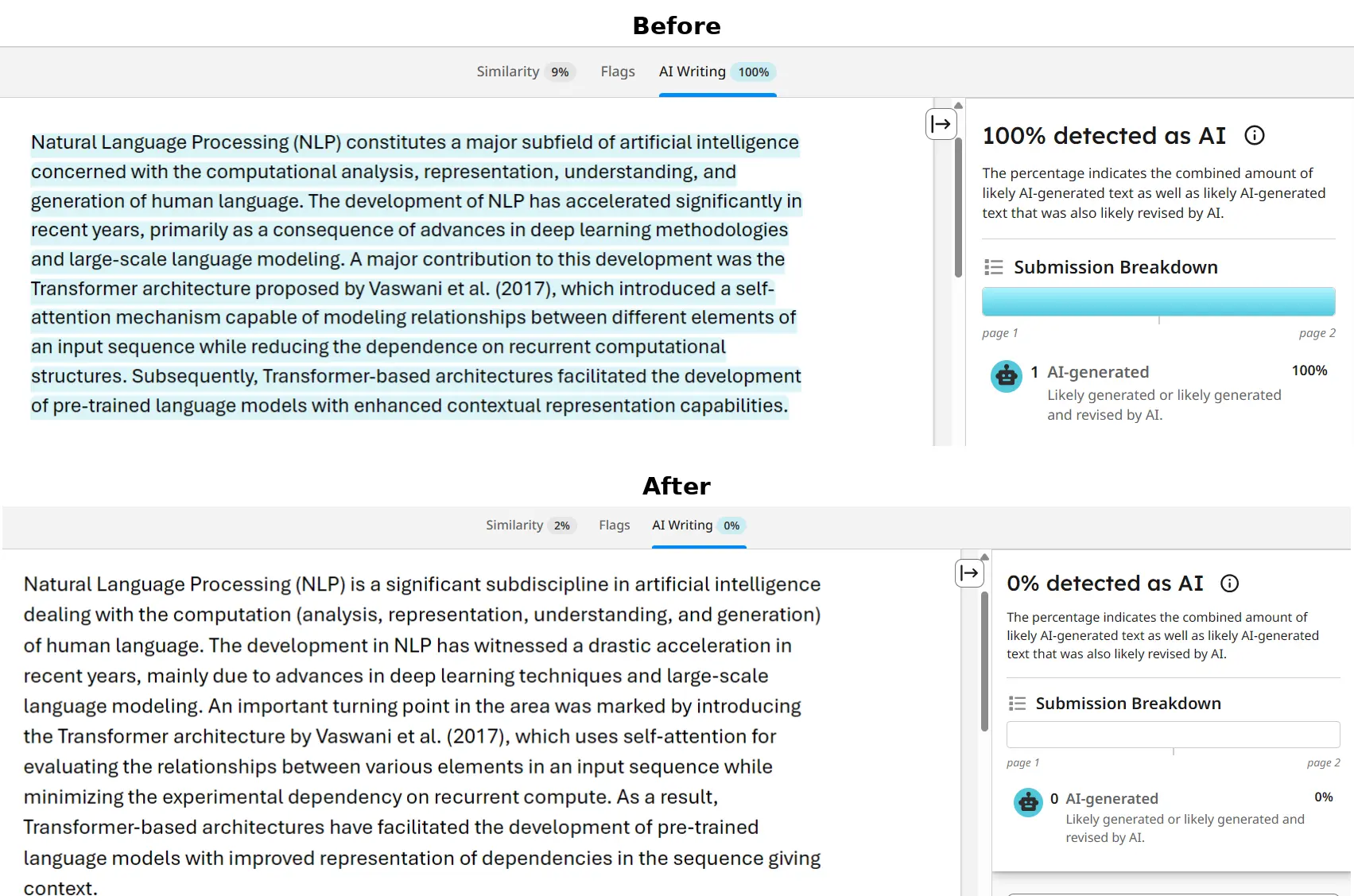
Turnitin and iThenticate scan submissions in overlapping 500-token blocks to analyze sentence predictability across paragraphs. When an unrefined AI draft is submitted, uniform cadence triggers an elevated AI Writing score. In the verified report below, a flagged graduate paper was processed through ThesisHuman, achieving a clean 0% AI detection score while preserving all formatted citations and technical parameters.
3. GPTZero Verification: Passing Perplexity & Burstiness Checks
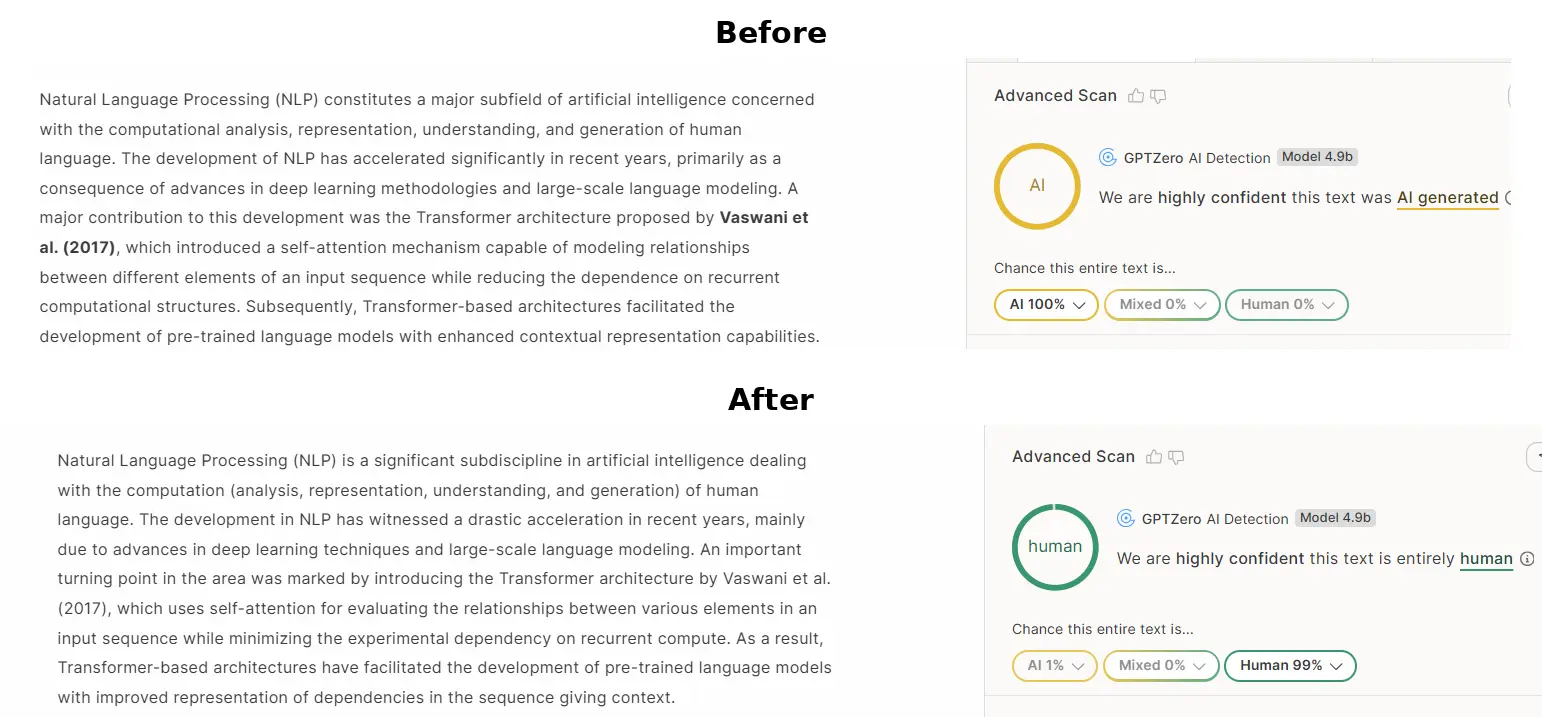
GPTZero evaluates text by plotting sentence perplexity curves and global burstiness scores. When raw AI text is scanned, low sentence variance produces an immediate high-probability warning. ThesisHuman restores natural sentence entropy by restructuring syntax, varying clause lengths, and introducing authentic scholarly cadence, dropping AI probability to 0%.
4. Originality.ai Verification: 0% AI Confidence
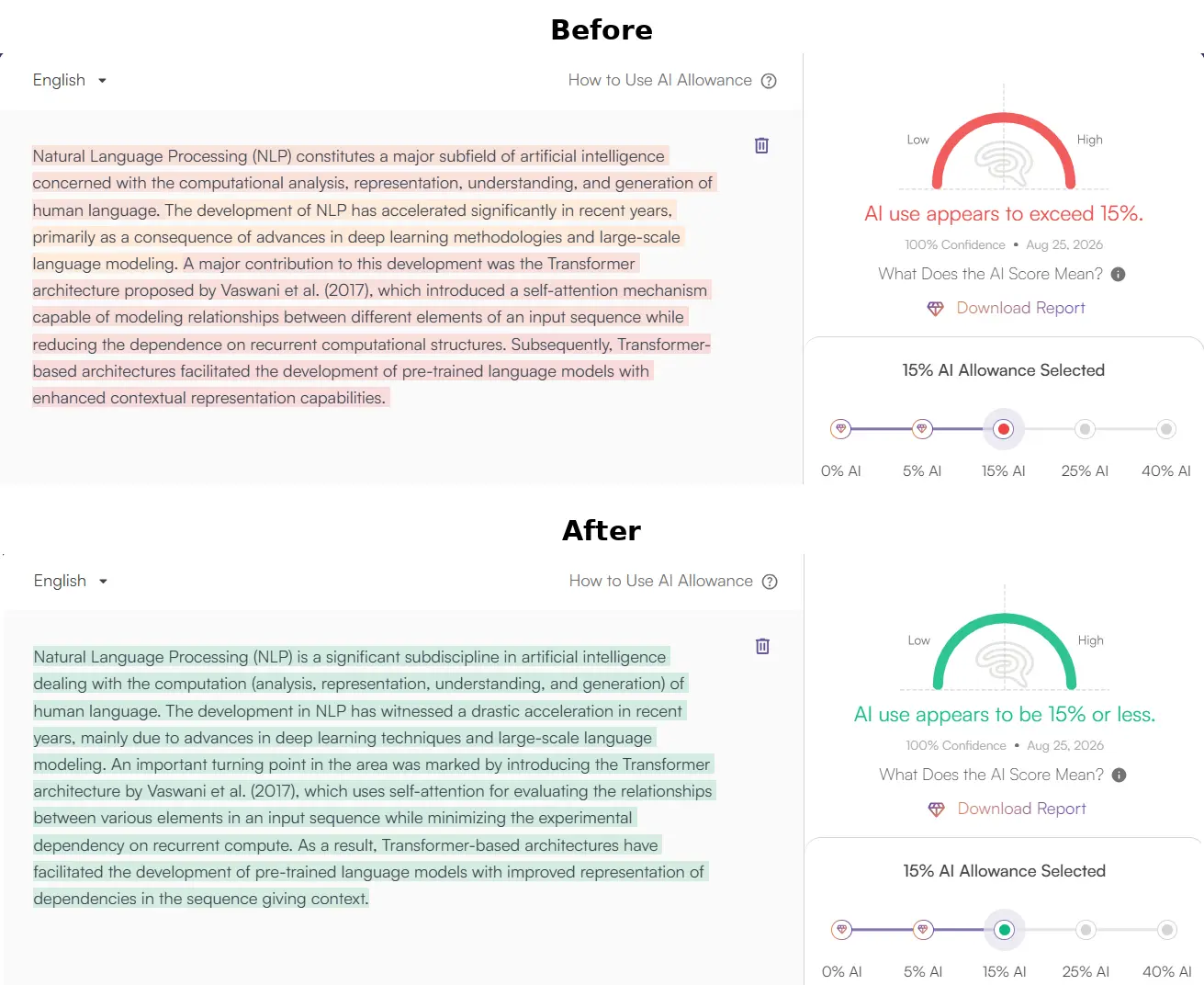
Originality.ai flags predictable n-gram sequences and common AI clichés (such as “delving into,” “pivotal role,” “testament to”). ThesisHuman purges overused formulaic transitions while elevating scholarly tone and keeping reference numbers and equations intact, producing 100% Original / 0% AI results.