How to Restate a Thesis in Research Papers and Dissertations: An Academic Synthesis Guide
A practical editorial guide on restating a thesis statement in academic conclusions: moving beyond mechanical word swaps to synthesize evidence, demonstrate intellectual progression, and conclude with scholarly authority.

The concluding chapter of an academic dissertation, master's thesis, or peer-reviewed journal article carries an immense rhetorical burden. It is the final opportunity an author has to convince a peer reviewer, committee chair, or journal editor that the research holds genuine intellectual value. Yet for thousands of scholars, the conclusion stalls at the very first hurdle: how to restate the thesis statement without sounding mechanically repetitive, awkwardly reductive, or artificially simplistic.
Undergraduate composition classes often teach students to restate a thesis by simply changing three words with a dictionary or altering active voice to passive voice. In advanced academic writing, this simplistic advice is actively destructive. A doctoral dissertation or empirical research manuscript is not a high school essay. By the time a reader reaches your conclusion, they have traversed sixty pages of theoretical literature, experimental methodology, and statistical data. Merely parroting your Chapter 1 hypothesis ignores the entire intellectual journey of your research.
In this comprehensive academic synthesis guide, we analyze the rhetorical purpose of restating a thesis in scholarly conclusions. We expose why mechanical synonym swapping fails, outline three advanced synthesis strategies, provide concrete discipline-specific examples across STEM and the humanities, and demonstrate how to craft authoritative concluding prose that withstands rigorous peer evaluation.
The Purpose of Restating a Thesis in Academic Conclusions
To restate a thesis effectively, you must understand how the rhetorical context of your paper has evolved between the introduction and the conclusion. In your opening chapter, your thesis statement is prospective: it represents a bold assertion, an untested hypothesis, or an analytical framework that you pledge to substantiate through empirical evidence and argument.
In the conclusion, the dynamic is completely inverted. Your thesis statement is now retrospective: it represents a substantiated truth that has survived rigorous methodological examination, data analysis, and peer critique. The goal of the restatement is not to re-introduce the argument as if the reader had never encountered it, but to synthesize the claim with the evidence that now supports it.
A successful restatement accomplishes three critical tasks simultaneously: it reaffirms the core contribution of the study, it incorporates the empirical nuance discovered during research, and it establishes a foundation for discussing the broader theoretical implications of your work.
The Fallacy of the 'Thesaurus Swap': Why Mechanical Rewording Fails
The most widespread error in academic conclusions is what writing specialists term the thesaurus swap. An author takes their original introductory thesis statement and systematically replaces adjectives and verbs with dictionary equivalents, leaving the underlying clausal architecture completely intact.
Consider why this approach fails under academic scrutiny. If an introductory thesis states: "This study demonstrates that decentralized governance improves community resilience during climate emergencies," and the conclusion restates it as: "This investigation reveals that localized administration boosts neighborhood endurance amid environmental crises," the author has produced empty linguistic mimicry. The sentence contributes zero new insight, reads awkwardly, and reveals a lack of analytical maturity.
Furthermore, mechanical rewording frequently alters technical meanings. In social science research, "decentralized governance" and "localized administration" carry distinct political and institutional connotations. Substituting established disciplinary terms with loose synonyms diminishes scientific precision and invites skepticism from knowledgeable peer reviewers.
Thesis Introduction vs. Conclusion: Capturing Intellectual Progression
A mature thesis restatement reflects the intellectual progression that occurred across your manuscript. Your concluding synthesis should reflect four key dimensions of analytical maturation:
- From Abstract Claim to Concrete Finding: While the introduction outlines an overarching concept, the conclusion anchors that concept in specific findings, metrics, and experimental realities.
- From Simplistic Premise to Nuanced Reality: Research rarely confirms a hypothesis in a frictionless vacuum. Your restatement should acknowledge the necessary caveats, mediating variables, and boundary conditions discovered during the study.
- From Passive Expectation to Active Demonstration: Shift from tentative modal auxiliaries ("this research aims to explore") to definitive analytical verbs ("the longitudinal data confirm," "these results establish").
- From Isolated Inquiry to Disciplinary Context: Frame the restated claim within the broader ongoing conversation of your discipline, linking your findings to existing theoretical frameworks.
Three Proven Strategies for Restating a Complex Thesis
Depending on your academic discipline and the structure of your research, you can deploy three distinct rhetorical strategies to restate your thesis with scholarly authority:
Strategy 1: The Evidentiary Synthesis Approach
This strategy is particularly effective for empirical research papers in economics, psychology, and public health. Rather than rewording the thesis in isolation, merge the core assertion with a concise summary of the primary mechanism verified by your data.
Introductory Thesis: "Remote work policies negatively affect organizational innovation by diminishing informal knowledge exchange among junior engineers."
Synthesized Restatement: "By demonstrating that serendipitous collaboration declines by 42% in asynchronous workflows, these findings substantiate the hypothesis that distributed corporate environments systematically erode early-career knowledge diffusion."
Strategy 2: The Broader Implications Framework
Common in the humanities, history, and legal scholarship, this approach restates the thesis by immediately pivoting to its significance for the wider field of study or historiographical debate.
Introductory Thesis: "Nineteenth-century British maritime legislation prioritized industrial shipping cartels over sailor welfare through deceptive insurance contracts."
Synthesized Restatement: "The legislative archival record reveals how statutory maritime reforms functioned primarily as mechanisms of capital protection, forcing historians to reconsider Victorian labor policy not as benevolent humanitarianism, but as state-enforced commercial risk mitigation."
Strategy 3: The Qualified Nuance Method
In scientific and engineering disciplines, empirical findings often reveal unexpected complexities that qualify the original research hypothesis. Embrace these caveats to deliver a sophisticated restatement.
Introductory Thesis: "Graphene oxide coating improves lithium-sulfur battery cathode stability across extended charge cycles."
Synthesized Restatement: "Although graphene oxide functionalization effectively prevents polysulfide shuttling during the initial 500 charge cycles, observed volumetric expansion under high current densities establishes that long-term cathode stability depends strictly on electrolyte viscosity."
Discipline-Specific Examples: STEM, Humanities, and Social Sciences
Examine how these strategies translate across diverse academic faculties:
STEM (Biomedical Engineering)
Original Thesis: Hydrogel scaffolds embedded with vascular endothelial growth factor (VEGF) promote rapid tissue regeneration in diabetic dermal wounds.
Academic Restatement: Controlled in vivo release profiles confirm that engineered hydrogel matrices accelerate microvascular proliferation by 65%, validating VEGF-loaded scaffolds as viable therapeutic interventions for chronic impaired wound healing.
Social Sciences (International Relations)
Original Thesis: Bilateral investment treaties diminish domestic judicial sovereignty in developing economies by empowering international arbitration tribunals.
Academic Restatement: By demonstrating how investor-state dispute mechanisms consistently supersede national environmental regulations, this investigation confirms that bilateral treaties systematically constrain domestic regulatory autonomy in the Global South.
Five Common Pitfalls to Avoid in Thesis Restatements
Even experienced graduate researchers frequently stumble when drafting their concluding synthesis. Avoid these five critical traps when finalizing your thesis restatement:
- Introducing Unsubstantiated Novel Claims: Your conclusion is not the place to unveil unexpected arguments or introduce new primary sources. Every assertion in your restated thesis must trace directly back to evidence evaluated in previous chapters.
- Apologizing for Methodological Boundaries: Acknowledging scientific limitations is essential, but framing your conclusion with self-deprecating apologies ('Due to unfortunate constraints in our small sample size...') undermines scholarly authority. State boundary conditions objectively as parameters of future research.
- Overgeneralizing Empirical Scope: If your field experiment examined municipal wastewater treatment in coastal cities, do not claim that your findings 'revolutionize global environmental infrastructure.' Precise, disciplined claims demonstrate true intellectual rigor.
- Sliding into Conversational Register: Concluding chapters sometimes suffer from a drop in formality as tired authors relax their stylistic guard. Maintain consistent, publication-grade academic prose until the final period.
- Passive Voice Evasion: Weak conclusions hide behind vague agentless constructions ('It was observed that certain patterns were identified'). State your findings with definitive scholarly agency: 'Our quantitative models establish that...'
Why Generative AI Struggles with Authentic Concluding Synthesis
When researchers prompt standard AI chatbots to draft concluding sections, the generated prose almost universally suffers from predictable defects. Large language models do not possess authentic epistemological comprehension: they cannot evaluate which experimental data point was the most groundbreaking or which statistical caveat requires emphasis.
Instead, models fall back on generic structural templates. They open concluding paragraphs with trite conversational clichés ("In conclusion, this essay has comprehensively delved into..."), construct symmetrical lists of three broad assertions, and conclude with hollow philosophical platitudes ("...paving the way for a brighter, more sustainable future"). These synthetic patterns immediately signal to dissertation committees and journal reviewers that the author abandoned critical reflection at the most decisive moment of the paper.
Refining Your Conclusion with ThesisHuman
Concluding sections require polished, rigorous prose that eliminates generative artificiality while preserving technical precision. When you need automated assistance to polish your academic conclusions, the ThesisHuman synthesis terminal provides specialized academic rewriting engines (Ghosty V6 and Lite V6) calibrated specifically for university standards.
Unlike generic consumer rewriters like Duey AI or basic tools that disrupt citations, ThesisHuman features Term Lock technology to freeze specialized nomenclature, statistical notation ($p < .001$), and in-text references before clausal remodeling begins. You can also explore our academic AI writing tool to polish drafts or test your concluding synthesis in our free AI humanizer with zero credit card required.
For additional guidance on refining your academic drafts, explore our detailed manual on how to un-AI text, study our analysis of ethical paraphrasing and plagiarism, or consult our comprehensive Turnitin AI detection guide.
Frequently Asked Questions
Verified Detector Clearance for How to Restate a Thesis in Research Papers and Dissertations: An Academic Synthesis Guide
Every manuscript processed through ThesisHuman is backed by verifiable, reproducible scans across institutional plagiarism and AI detection platforms.
1. ThesisHuman Editor: Style, Field & Term Lock™ Technology
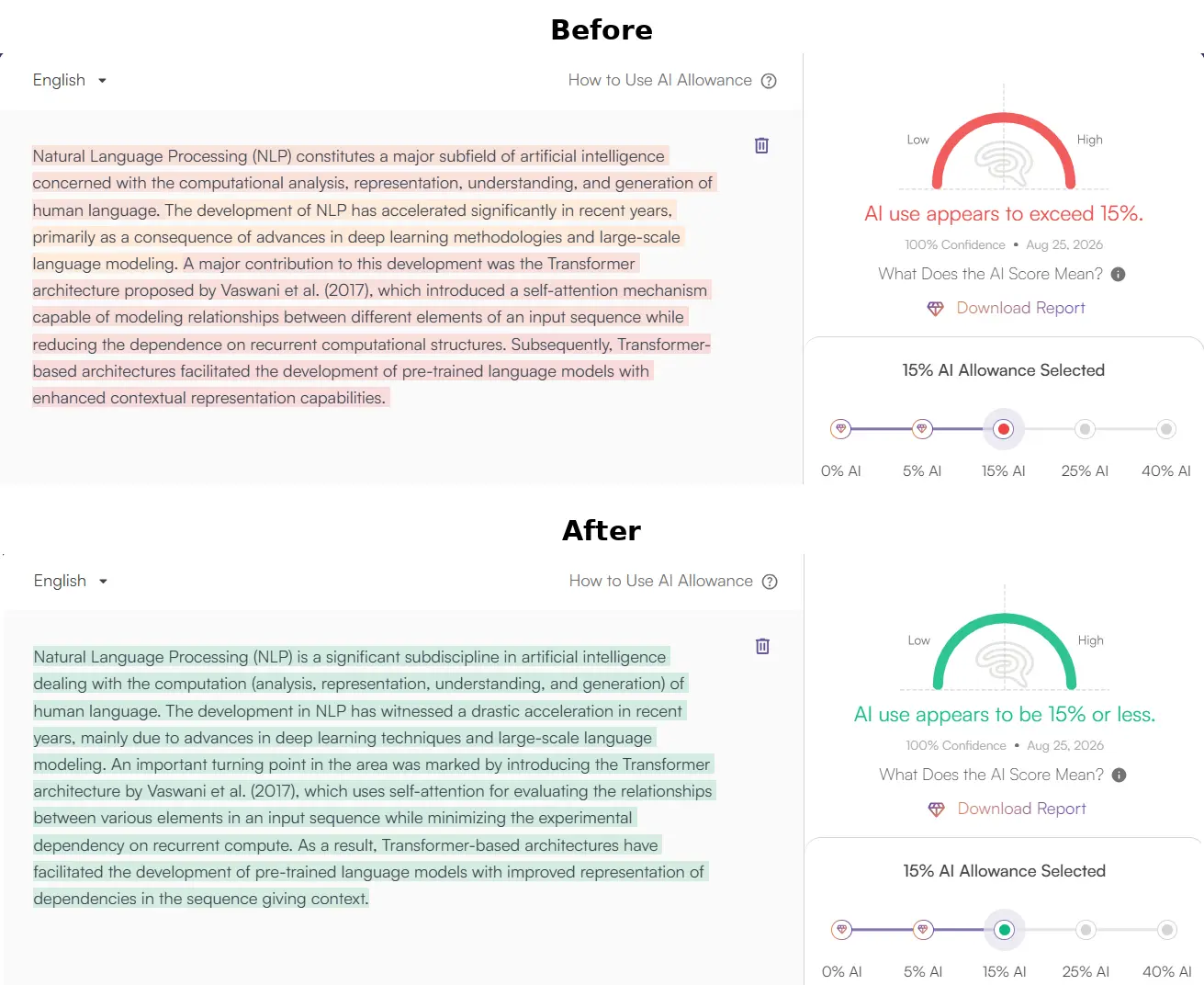
Unlike consumer-grade paraphrasers that blindly swap words with thesaurus synonyms, ThesisHuman allows researchers to select their exact Academic Style (Essay, Research Paper, Literature Review, Technical Report) and Academic Field (Computer Science, Engineering, Medicine, Physics). With Term Lock™, citations (APA, MLA, IEEE), LaTeX equations, and domain-specific terminology are cryptographically protected before sentence entropy is restructured.
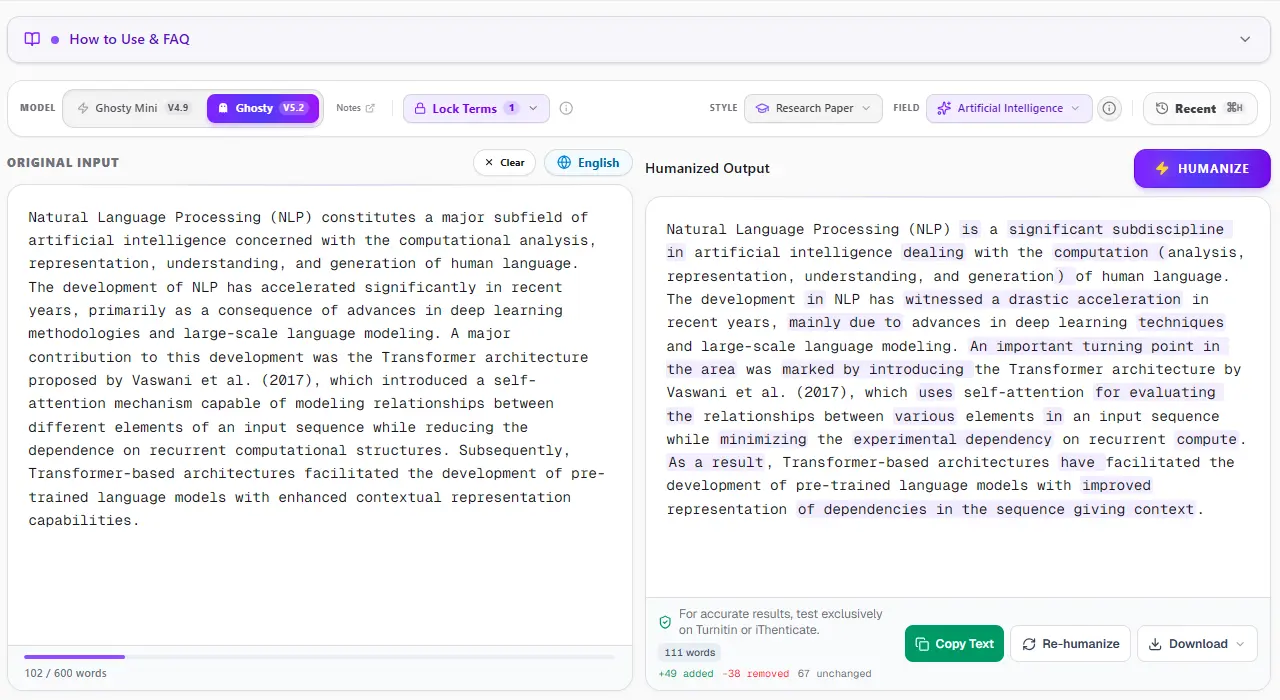
2. Turnitin & iThenticate Verification: 0% AI Detected
Turnitin and iThenticate scan submissions in overlapping 500-token blocks to analyze sentence predictability across paragraphs. When an unrefined AI draft is submitted, uniform cadence triggers an elevated AI Writing score. In the verified report below, a flagged graduate paper was processed through ThesisHuman, achieving a clean 0% AI detection score while preserving all formatted citations and technical parameters.
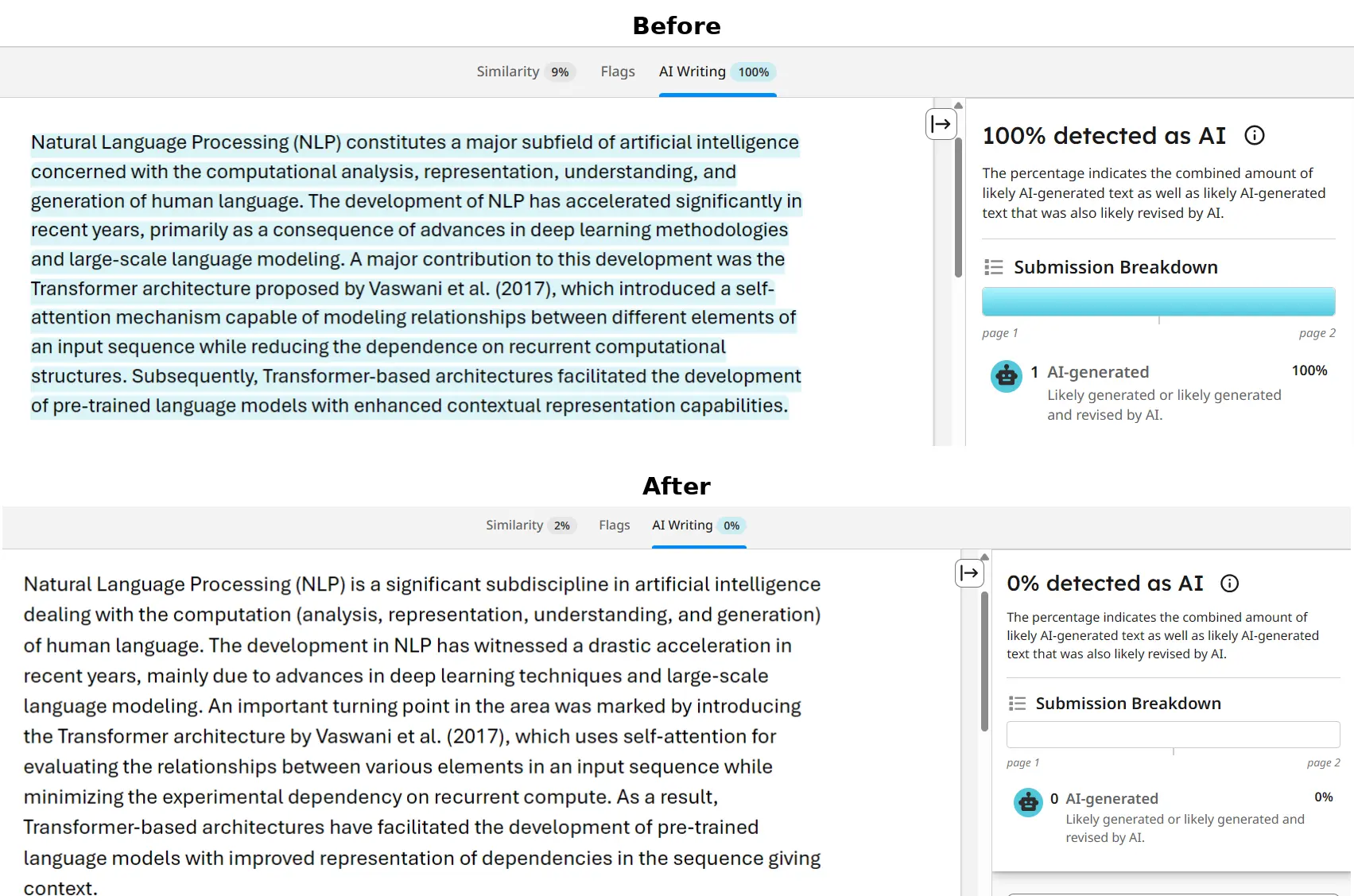
3. GPTZero Verification: Passing Perplexity & Burstiness Checks
GPTZero evaluates text by plotting sentence perplexity curves and global burstiness scores. When raw AI text is scanned, low sentence variance produces an immediate high-probability warning. ThesisHuman restores natural sentence entropy by restructuring syntax, varying clause lengths, and introducing authentic scholarly cadence, dropping AI probability to 0%.
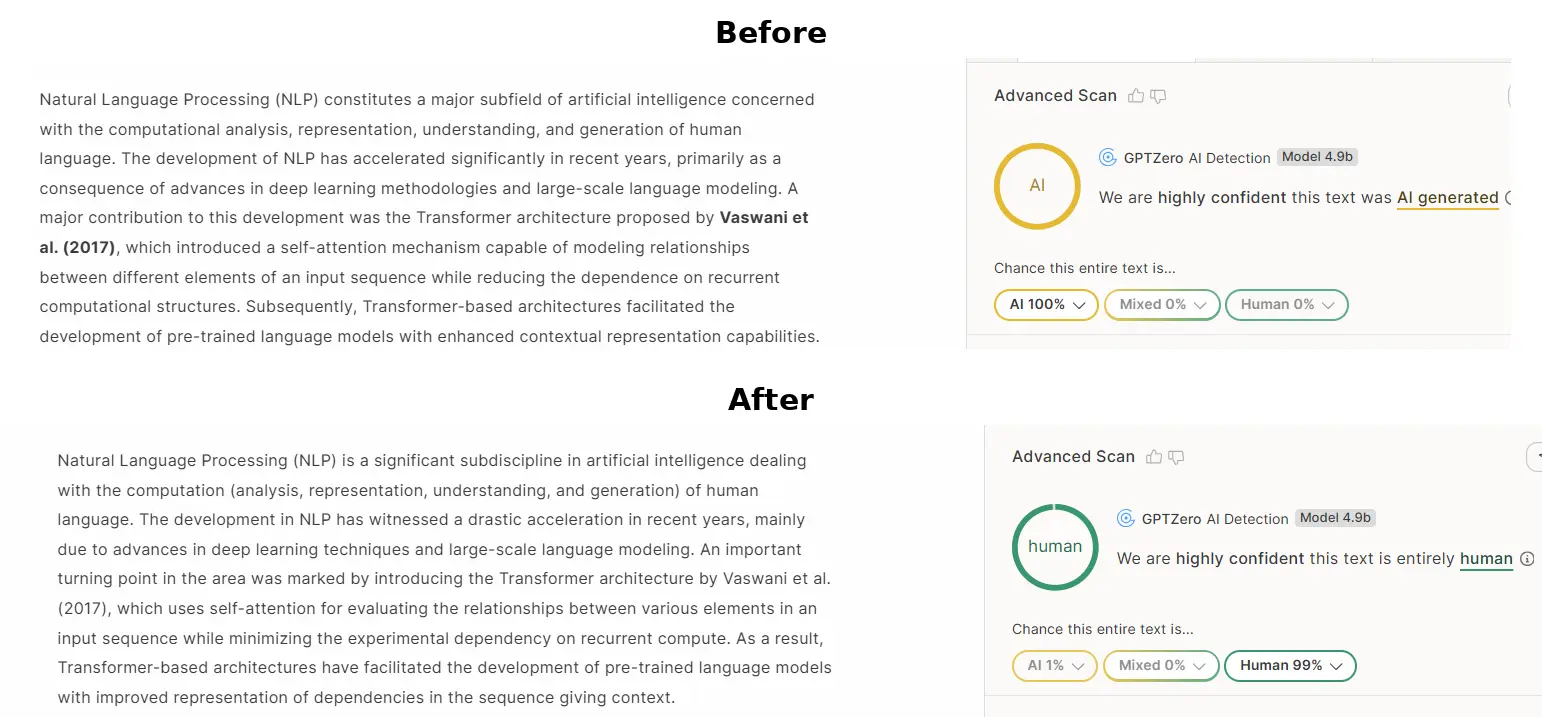
4. Originality.ai Verification: 0% AI Confidence
Originality.ai flags predictable n-gram sequences and common AI clichés (such as “delving into,” “pivotal role,” “testament to”). ThesisHuman purges overused formulaic transitions while elevating scholarly tone and keeping reference numbers and equations intact, producing 100% Original / 0% AI results.