Do AI Detection Bypass Prompts Work? Technical Evaluation & Prompt Engineering Myths
Do Claude or ChatGPT prompts bypass AI detection? Learn why prompt tricks produce inconsistent detector scores, damage academic clarity, and fail on research papers.
No, prompts designed to bypass AI detection—such as instructing Claude Sonnet or ChatGPT to "write with high perplexity and burstiness" or "use an informal student voice with subtle human errors"—are unreliable and frequently degrade academic paper quality. While prompt engineering can alter surface vocabulary, large language models inherently generate text using statistical probability sampling. AI detectors evaluate these statistical token distributions regardless of prompt instructions.
Furthermore, attempting to force models into unnatural writing styles introduces grammatical awkwardness, damages logical flow, scrambles inline citations, and corrupts LaTeX mathematical equations.
Direct Answer: Why Prompt Tricks Fail to Guarantee AI Detection Bypass
AI detectors evaluate text by running neural-network sliding window classifiers across sequence probabilities. Prompt instructions like "write with high perplexity" cause models to pick obscure, low-probability words from their vocabulary dictionaries. Rather than sounding human, the output features inflated vocabulary that reads unnaturally to academic reviewers while continuing to trigger detector classifiers.
Popular Bypass Prompts Tested (and Why They Fail Technical Evaluation)
| Bypass Prompt Technique | Intended Effect | Actual Result on Academic Papers |
|---|---|---|
| "Write with high perplexity & burstiness" | Force unexpected word choices & varied sentence lengths | Inserts bizarre, obscure synonyms that ruin scientific precision |
| "Write as an undergraduate student" | Simulate informal human writing style | Strips required academic register & replaces formal terms with slang |
| "Insert subtle human typos & errors" | Mimic human writing mistakes | Introduces embarrassing errors without lowering Turnitin scores |
How Bypass Prompts Damage Academic Paper Quality and Citation Precision
Attempting to bypass detection through prompt tricks introduces three severe risks for scholarly manuscripts:
- Scrambled APA/IEEE Citations: Asking models to rewrite text aggressively often corrupts formatted inline references like
(Smith et al., 2024). - Corrupted LaTeX Math Syntax: Mathematical syntax and LaTeX markup are frequently altered when models attempt stylistic gymnastics.
- Meaning Drift in Findings: Important research qualifications ("the data suggests") get replaced by absolute or inaccurate claims.
Prompt Engineering vs. Specialized Academic Text Processing
Prompt engineering operates inside an LLM's probability generation loop, which cannot alter its core token sampling mechanics. Specialized academic engines (like ThesisHuman) operate outside the LLM, isolating citations and math syntax before naturalizing sentence cadence.
Read our guide on why standard AI humanizers fail on research papers or explore how ThesisHuman preserves citations and LaTeX syntax.
Ethical Revision Roadmap for AI-Assisted Researchers
Instead of using fragile bypass prompt tricks, adopt an authentic revision workflow:
- Vary sentence length intentionally throughout every paragraph.
- Remove synthetic transition starter words ("furthermore", "it is important to note").
- Inject original empirical data and specific primary citations.
- Maintain complete Google Docs version history or Word Track Changes.
Verified Detector Clearance for Do AI Detection Bypass Prompts Work? Technical Evaluation & Prompt Engineering Myths
Every manuscript processed through ThesisHuman is backed by verifiable, reproducible scans across institutional plagiarism and AI detection platforms.
1. ThesisHuman Editor: Style, Field & Term Lock™ Technology
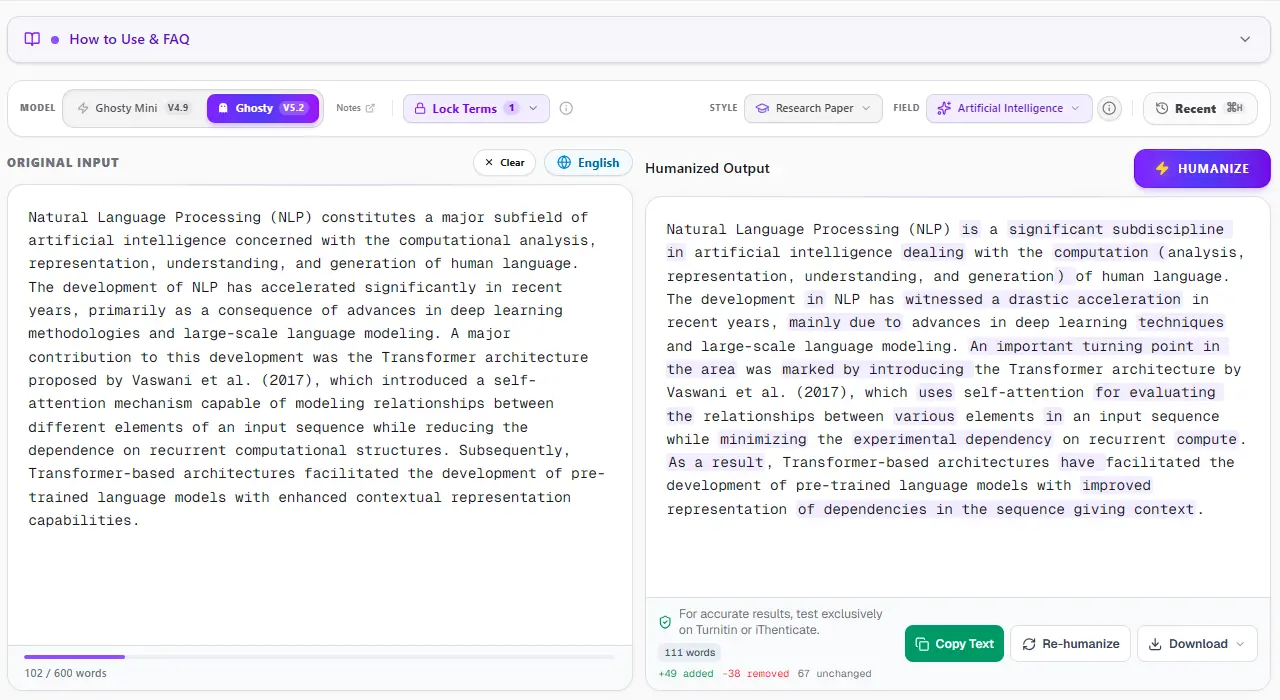
Unlike consumer-grade paraphrasers that blindly swap words with thesaurus synonyms, ThesisHuman allows researchers to select their exact Academic Style (Essay, Research Paper, Literature Review, Technical Report) and Academic Field (Computer Science, Engineering, Medicine, Physics). With Term Lock™, citations (APA, MLA, IEEE), LaTeX equations, and domain-specific terminology are cryptographically protected before sentence entropy is restructured.
2. Turnitin & iThenticate Verification: 0% AI Detected
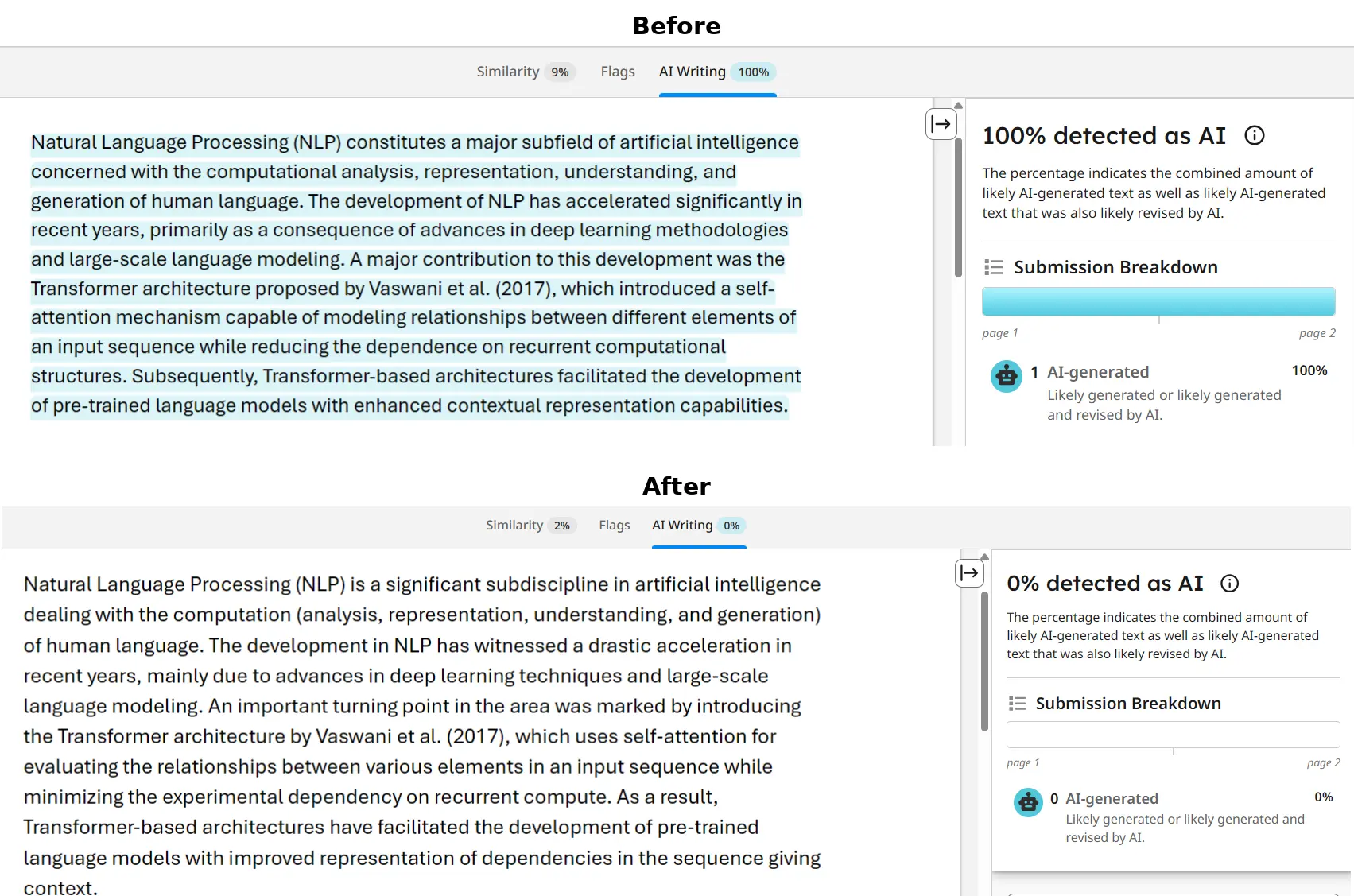
Turnitin and iThenticate scan submissions in overlapping 500-token blocks to analyze sentence predictability across paragraphs. When an unrefined AI draft is submitted, uniform cadence triggers an elevated AI Writing score. In the verified report below, a flagged graduate paper was processed through ThesisHuman, achieving a clean 0% AI detection score while preserving all formatted citations and technical parameters.
3. GPTZero Verification: Passing Perplexity & Burstiness Checks
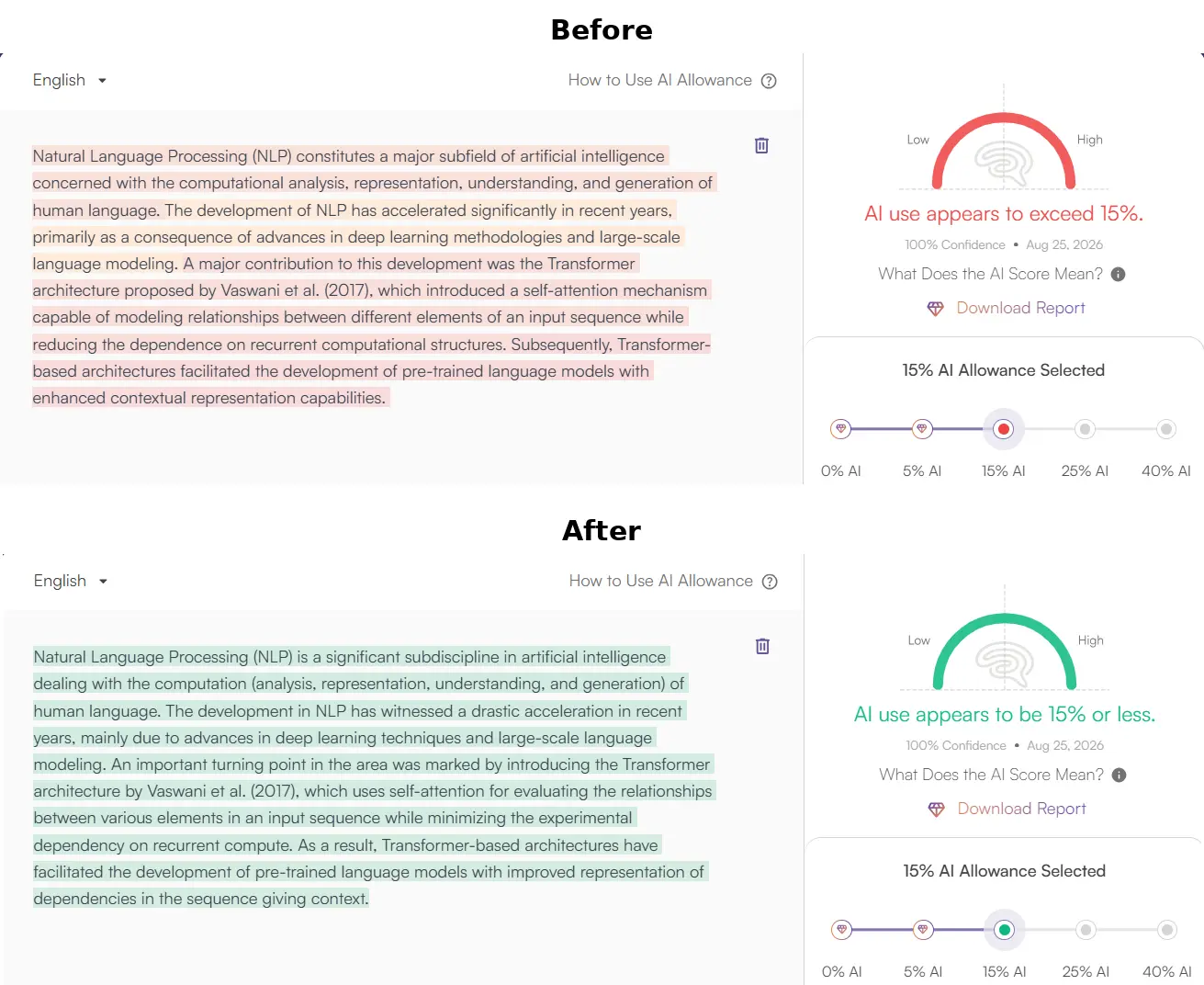
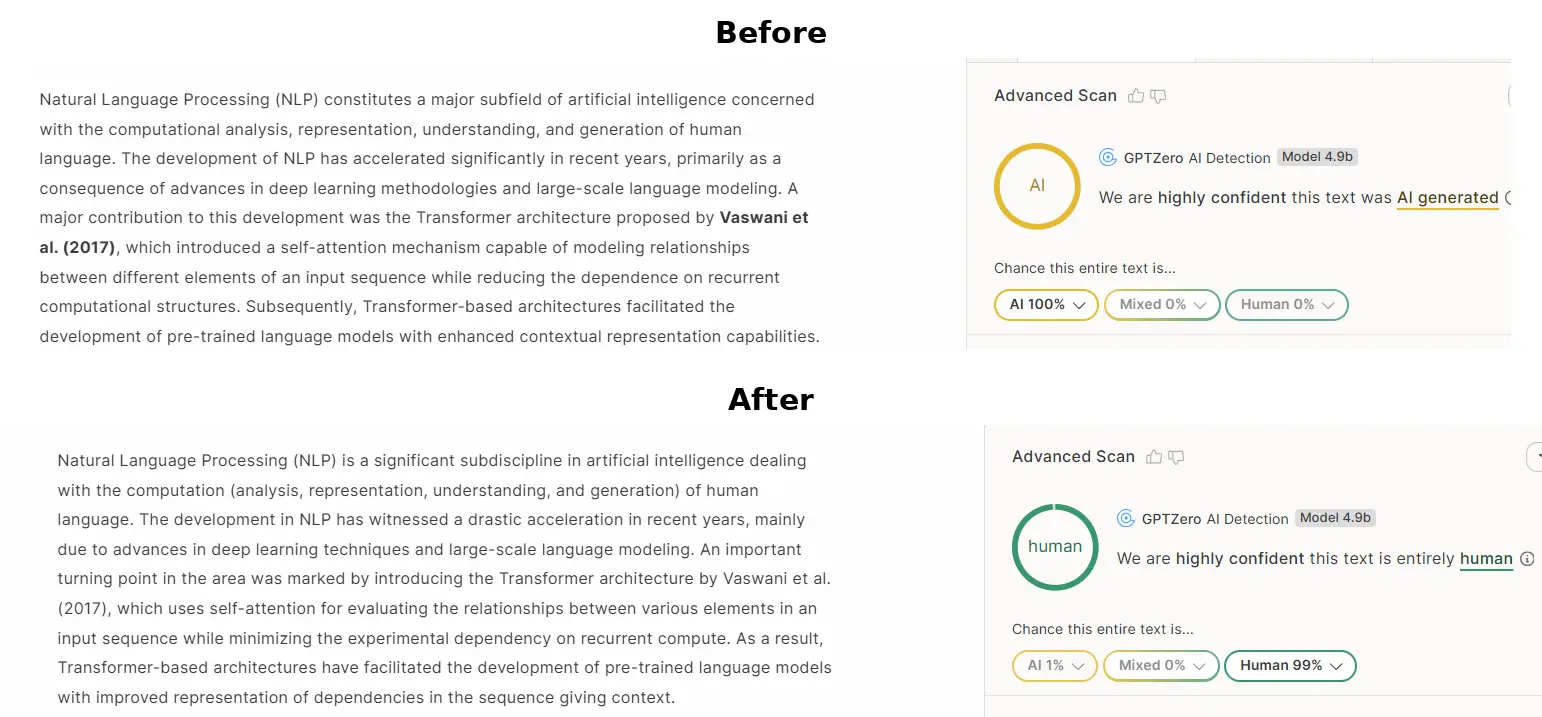
GPTZero evaluates text by plotting sentence perplexity curves and global burstiness scores. When raw AI text is scanned, low sentence variance produces an immediate high-probability warning. ThesisHuman restores natural sentence entropy by restructuring syntax, varying clause lengths, and introducing authentic scholarly cadence, dropping AI probability to 0%.
4. Originality.ai Verification: 0% AI Confidence
Originality.ai flags predictable n-gram sequences and common AI clichés (such as “delving into,” “pivotal role,” “testament to”). ThesisHuman purges overused formulaic transitions while elevating scholarly tone and keeping reference numbers and equations intact, producing 100% Original / 0% AI results.