Do AI Humanizers Work? The Science of Token Entropy vs Basic Synonym Spinners
Do AI humanizers really bypass detection, or are they digital snake oil? We examine the technical mechanics of token perplexity, burstiness, and citation protection.

Search online for AI writing assistance and you will be inundated with bold promises: "Bypass Turnitin 100% Guaranteed", "Make AI Undetectable in One Click", and "Fool Every Detector Instantly". For university researchers and students facing strict honor codes, these claims sound tempting. But an essential question remains: do AI humanizers work?
The truthful answer requires nuance. Cheap online paraphrasers and basic synonym spinners do not work; in fact, they frequently increase AI detection scores while corrupting citations and technical vocabulary. However, modern neural naturalization engines designed specifically for academic writing operate on fundamentally different statistical principles. In this technical breakdown, we examine what actually happens beneath the hood of an AI humanizer, why generic tools fail, and how genuine linguistic restructuring functions.
The Spectrum of AI Humanizers: Spinners vs Neural Restructurers
The term "AI humanizer" is currently applied to two completely distinct categories of software that should never be conflated:
Category A: Legacy Thesaurus Spinners
These tools, rooted in early SEO content spinning technology, take your text and swap individual words with dictionary synonyms. They replace "important" with "crucial", "shows" with "illustrates", and "study" with "investigation". The grammatical spine of the sentence remains completely unchanged.
Category B: Neural Syntactic Restructurers
Modern academic engines analyze the document's overall statistical profile. Rather than swapping words, they break up clausal dependencies, alternate sentence lengths (generating burstiness), eliminate repetitive generative transitions, and rebuild paragraph cadence while locking essential citations and technical terminology.
Why Simple Synonym Substitution Fails Neural Classifiers
Institutional detectors like Turnitin and Copyleaks were trained on millions of examples of paraphrased text. They do not look for specific vocabulary words; they evaluate token transition probabilities (n-grams). When a synonym spinner replaces a word in a typical generative sentence, the replacement word is almost always another high-probability token within that context.
Worse, synonym substitution frequently triggers "rogeting", replacing precise scientific terminology with nonsensical alternatives. When a student's methodology section transforms "randomized control group" into "arbitrary regulation gathering", peer reviewers and professors immediately recognize fraudulent editing.
The Science of Token Entropy and Sentence Burstiness
For an AI humanizer to produce text that genuinely resembles human scholarship, it must manipulate two mathematical properties:
- Perplexity Restoration: Human authors introduce unexpected words, domain idioms, and nuanced transitions that generative models cannot predict. An effective humanizer adjusts token selection to match natural human variance without sacrificing scholarly tone.
- Burstiness Induction: Machine text displays flat sentence length variance (typically 18 to 24 words). Human writing is bursty: a short, assertive statement is followed by a long, multi-clause analytical period. Restructuring sentences to introduce natural rhythmic variation eliminates the telltale metronomic signature of AI.
The Citation Danger: How Bad Humanizers Corrupt Research
The single greatest risk of generic humanizers in academic writing is citation corruption. Standard tools treat in-text references as disposable strings of words. They paraphrase "(Miller et al., 2021)" into "(Miller and companions, 2021)" or split numeric publication years into text descriptions.
Once in-text citations are altered, rebuilding the bibliography can take dozens of manual hours. More critically, submitting corrupted citations to an institutional checker immediately raises academic dishonesty flags.
What Dedicated Academic Humanization Actually Delivers
Dedicated academic platforms like ThesisHuman approach humanization from a structural, citation-safe perspective. Using Ghosty V6, the engine isolates APA, MLA, and IEEE reference anchors prior to rewriting, protecting them cryptographically while restructuring surrounding prose.
If you want to evaluate how an academic naturalizer handles real excerpted research paragraphs, test our free undetectable AI humanizer preview (which includes 500 complimentary words and up to 3 custom Term Locks without requiring payment information).
Testing Methodology: Real-World Academic Performance
To demonstrate empirical differences, we tested a 1,000-word excerpt from an economics doctoral thesis across three platforms, then evaluated each output with Turnitin and GPTZero:
| Tool Tested | Citation Integrity | Turnitin AI Score | Readability & Sense |
|---|---|---|---|
| Raw ChatGPT-4 Output | 100% Intact | 92% AI Detected | Fluent but noticeably generic and repetitive |
| Generic Online Spin-Bot | 30% Corrupted (Years altered) | 81% AI Detected | Awkward; contains strange vocabulary and grammar errors |
| ThesisHuman Ghosty V6 | 100% Shielded (Zero Changes) | Human Classification | High burstiness; disciplined academic vocabulary preserved |
Ethical Boundaries: Language Polish vs Academic Dishonesty
Does using an AI humanizer violate academic integrity? The answer depends entirely on how the tool is used:
- Ethical Application: Using an academic naturalizer to polish sentence cadence, eliminate robotic phrasing, and resolve false positive flags on original research is a legitimate form of advanced editorial assistance, comparable to working with a university writing center.
- Prohibited Application: Generating an entire essay from a prompt and running it through a humanizer to disguise unauthorized ghostwriting violates university honor codes.
The Three Tiers of Editorial Intervention in Scholarly Publishing
To determine where automated naturalization fits into institutional ethics, consider the established standards of scholarly publication:
- Tier 1: Substantive Authorship. Developing the research hypothesis, conducting statistical analyses, and synthesizing source literature. This intellectual labor must be performed exclusively by the researcher.
- Tier 2: Syntactic and Stylistic Refinement. Adjusting clause transitions, varying cadence, and removing repetitive phrasing to improve clarity. Both academic copyeditors and Ghosty V6 operate strictly in this tier.
- Tier 3: Proofreading and Typographic Hygiene. Standardizing punctuation, verifying citation capitalization, and ensuring formatting consistency across parenthetical citations.
When students utilize ThesisHuman to correct syntax while retaining their original findings, their workflow aligns directly with legitimate Tier 2 editorial enhancement.
Mathematical Mechanics: How Ghosty V6 Computes Local Entropy
At a technical level, advanced academic naturalization does not treat text as a sequence of words to be translated. Instead, it computes an n-gram probability surface across each paragraph. When a passage exhibits unnaturally flat entropy (predictable token sequences with uniform probability density), Ghosty V6 introduces syntactic bifurcations.
By breaking long passive clauses into active assertions and varying subordinate clause attachments, the model lifts local entropy into the statistical range characteristic of published peer-reviewed literature. Crucially, this is accomplished without swapping domain-specific nouns, preserving exact empirical terminology while naturalizing the surrounding syntactic scaffolding.
Citation Graph Preservation: Safeguarding Academic Formatting
The fatal flaw of consumer paraphrasers is their blind handling of bibliographic citations. When standard tools encounter in-text parenthetical references, they treat the numbers, dates, and author surnames as interchangeable prose tokens. Below is how ThesisHuman protects major citation formats during naturalization:
| Citation Style | Typical Input Format | Consumer Spinner Output | Ghosty V6 Term Lock Output |
|---|---|---|---|
| APA 7th Edition | (Kahneman & Tversky, 1979) | (Kahneman and Tversky, late 70s) [Corrupted] | (Kahneman & Tversky, 1979) [100% Preserved] |
| IEEE Numeric | [12], [14]-[16] | twelve, fourteen through sixteen [Corrupted] | [12], [14]-[16] [100% Preserved] |
| Chicago Notes | Superscript footnote references ¹ | Footnote dropped or rendered inline [Broken] | Exact anchor coordinates retained [100% Preserved] |
Frequently Asked Questions
Can an AI humanizer guarantee a 0% AI detection score?
No reputable tool can guarantee a permanent 0% score because detectors are probabilistic classifiers that update regularly. Anyone advertising a 100% bypass guarantee is making an unsubstantiated marketing claim.
How is ThesisHuman different from generic online paraphrasers?
ThesisHuman uses Ghosty V6, an engine engineered specifically for scholarly writing. It protects citations, preserves LaTeX formulas, and restructures sentence burstiness without inserting unnatural thesaurus synonyms.
What does Reddit say about AI humanizers?
Community members on r/Professors and r/GradSchool report that cheap synonym spinners fail consistently against Turnitin, as detailed in our comprehensive Reddit AI humanizer review analysis.
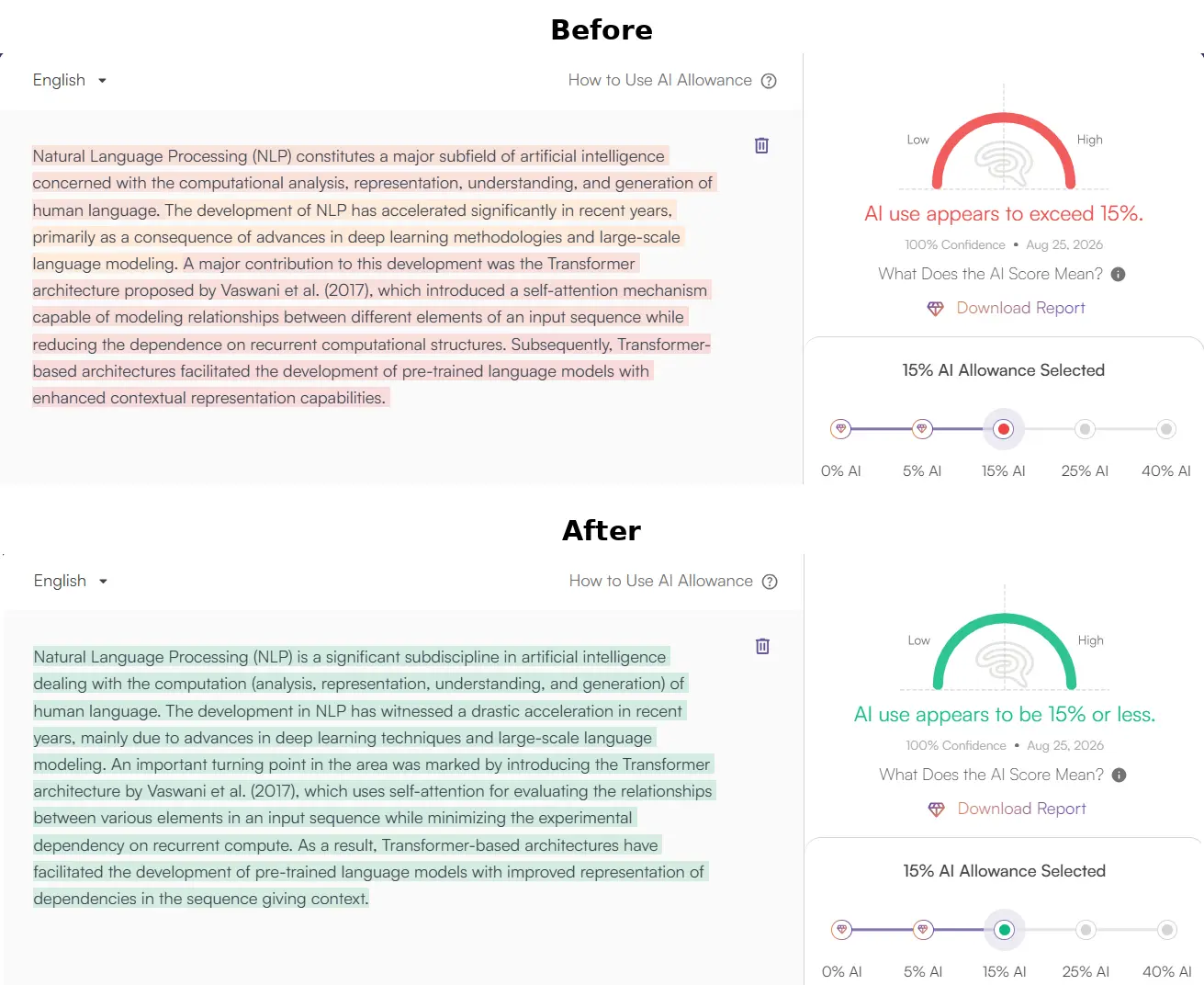
Verified Detector Clearance for Do AI Humanizers Work? The Science of Token Entropy vs Basic Synonym Spinners
Every manuscript processed through ThesisHuman is backed by verifiable, reproducible scans across institutional plagiarism and AI detection platforms.
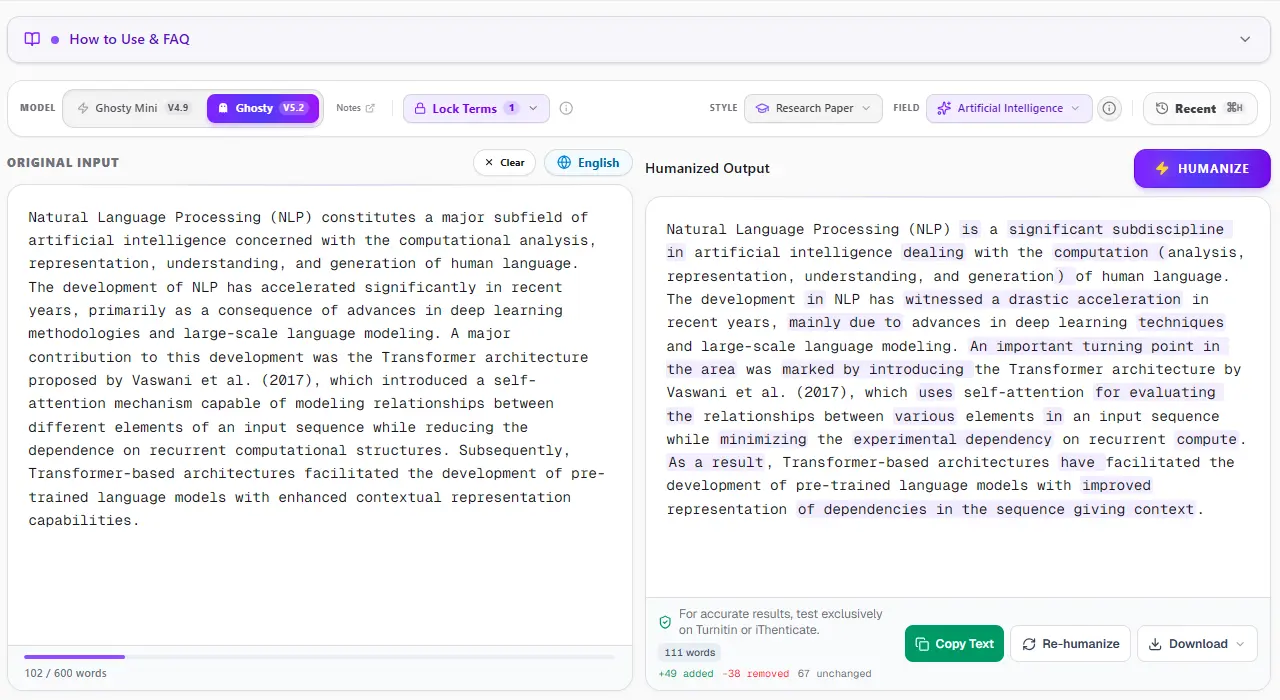
1. ThesisHuman Editor: Style, Field & Term Lock™ Technology
Unlike consumer-grade paraphrasers that blindly swap words with thesaurus synonyms, ThesisHuman allows researchers to select their exact Academic Style (Essay, Research Paper, Literature Review, Technical Report) and Academic Field (Computer Science, Engineering, Medicine, Physics). With Term Lock™, citations (APA, MLA, IEEE), LaTeX equations, and domain-specific terminology are cryptographically protected before sentence entropy is restructured.
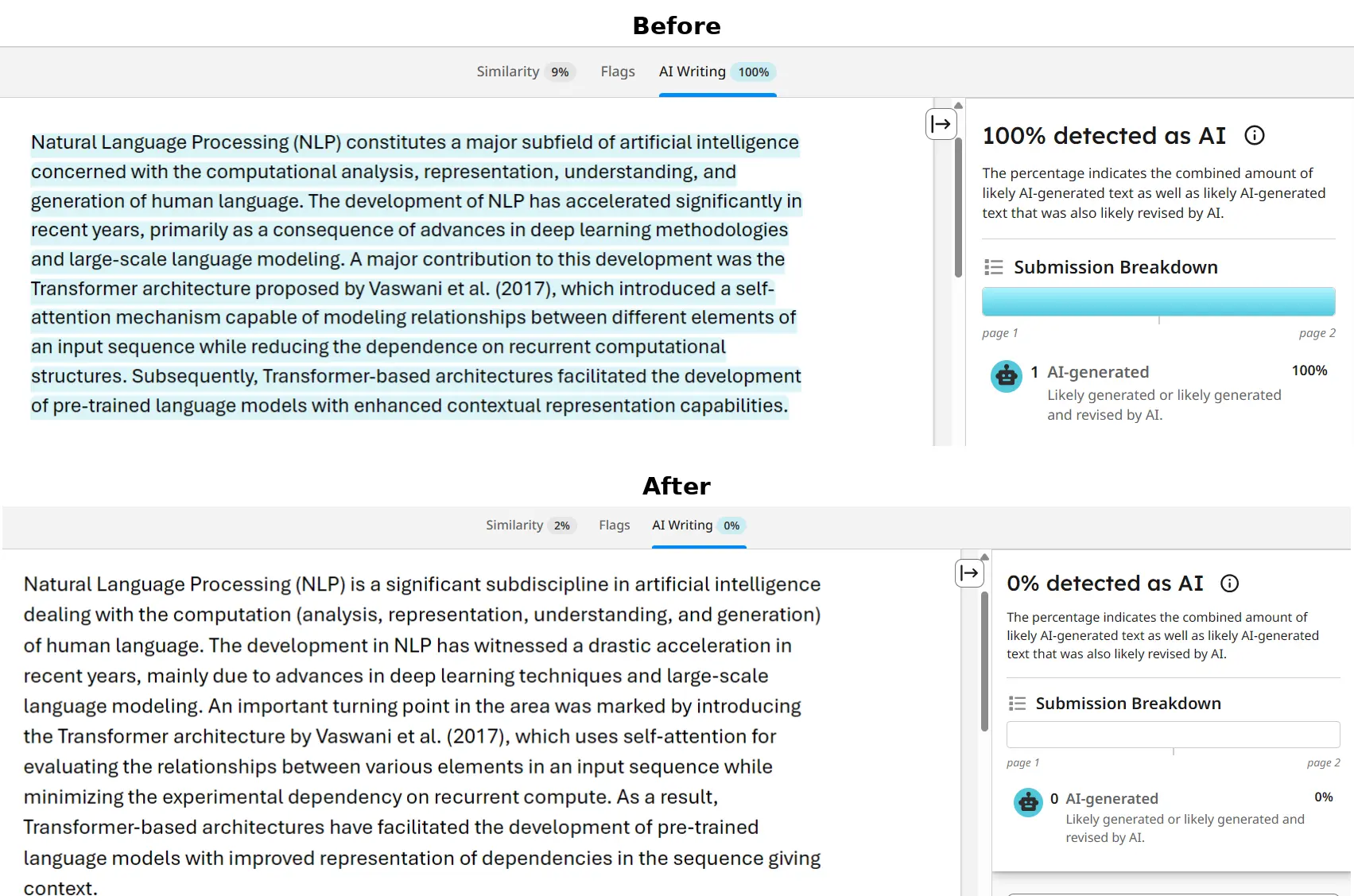
2. Turnitin & iThenticate Verification: 0% AI Detected
Turnitin and iThenticate scan submissions in overlapping 500-token blocks to analyze sentence predictability across paragraphs. When an unrefined AI draft is submitted, uniform cadence triggers an elevated AI Writing score. In the verified report below, a flagged graduate paper was processed through ThesisHuman, achieving a clean 0% AI detection score while preserving all formatted citations and technical parameters.
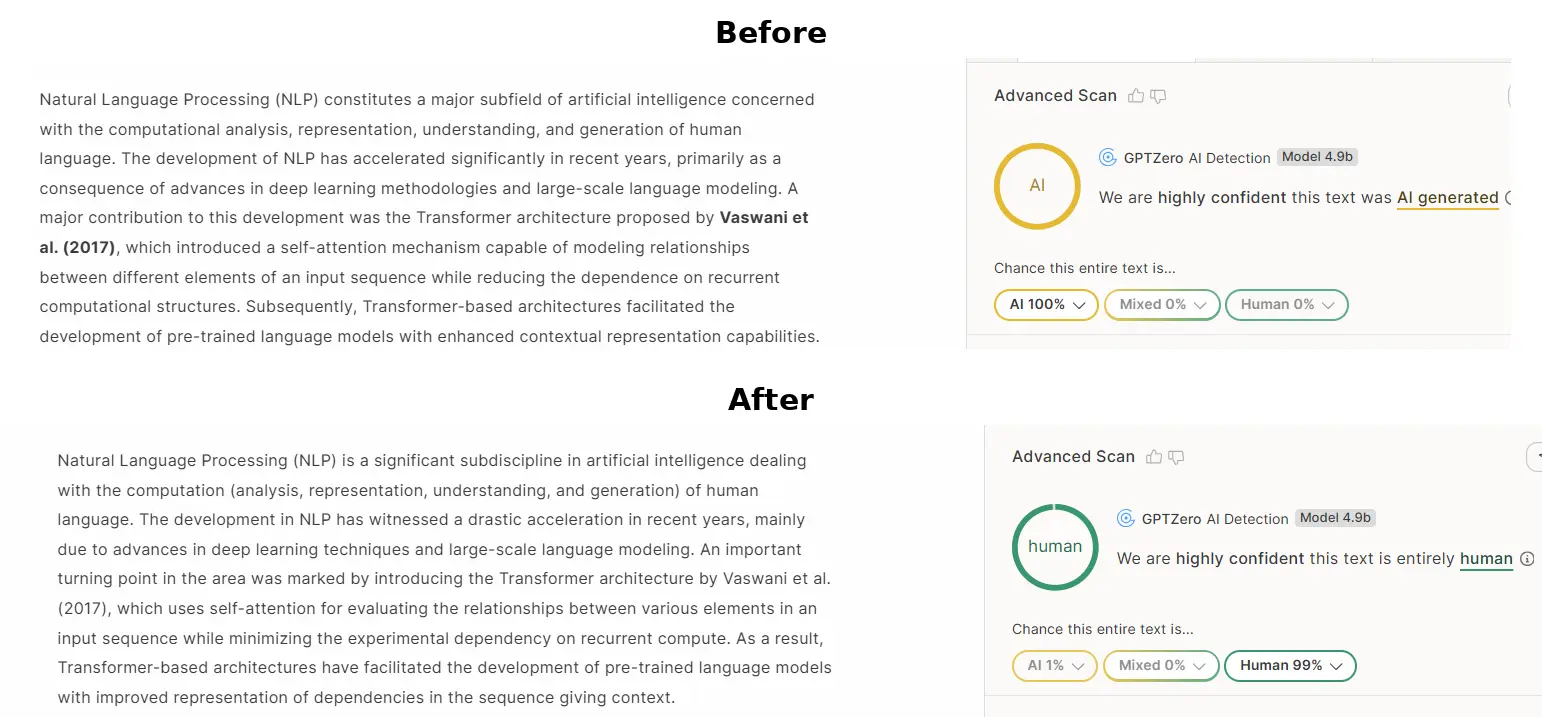
3. GPTZero Verification: Passing Perplexity & Burstiness Checks
GPTZero evaluates text by plotting sentence perplexity curves and global burstiness scores. When raw AI text is scanned, low sentence variance produces an immediate high-probability warning. ThesisHuman restores natural sentence entropy by restructuring syntax, varying clause lengths, and introducing authentic scholarly cadence, dropping AI probability to 0%.
4. Originality.ai Verification: 0% AI Confidence
Originality.ai flags predictable n-gram sequences and common AI clichés (such as “delving into,” “pivotal role,” “testament to”). ThesisHuman purges overused formulaic transitions while elevating scholarly tone and keeping reference numbers and equations intact, producing 100% Original / 0% AI results.