Does Turnitin Detect ChatGPT? Complete 2026 Technical Guide & Empirical Evaluation
A comprehensive technical breakdown of how Turnitin's AI Writing Indicator evaluates ChatGPT, GPT-4, and GPT-4o output, analyzing perplexity, burstiness, 50-word window models, and false positive margins.
Yes, Turnitin actively detects text generated by ChatGPT (including GPT-3.5, GPT-4, and GPT-4o) using an enterprise AI detection model embedded directly into university grading workflows. Unlike Turnitin's traditional similarity scanner—which matches student text against a database of published books, academic journals, and student submissions—its AI Writing Indicator evaluates statistical word patterns, structural predictability, and sentence length variance across submitting documents.
However, Turnitin's AI score is an advisory indicator designed to guide faculty review, not an absolute proof of academic dishonesty. Understanding the technical mechanics of Turnitin's classifier enables students, researchers, and academic authors to refine AI-assisted drafts ethically, defend against false positives, and ensure their submissions meet university standards.
Direct Answer: How Turnitin Evaluates ChatGPT, GPT-4, and GPT-4o Writing
Turnitin's AI classifier evaluates text by passing submitted document streams through a transformer-based neural network trained on millions of human academic papers and synthetic LLM outputs. When ChatGPT generates text, it selects words based on maximum statistical probability. Turnitin flags paragraphs where token choices consistently match low-perplexity LLM patterns.
Crucially, Turnitin does not require ChatGPT to leave hidden digital watermarks or tracking codes. The detection model relies entirely on probability distributions inherent in machine-generated prose. If you are preparing a manuscript evaluated by Turnitin, discover how ThesisHuman refines sentence cadence while preserving citations.
The Technical Architecture of Turnitin's AI Detection Engine
Turnitin's AI writing detection architecture operates on three core technical pillars:
1. Perplexity Analysis and N-Gram Predictability
Perplexity measures how predictable words are in sequence. Large language models are optimized to select statistically probable word combinations (low perplexity). Human scholars, by contrast, utilize varied vocabulary, unconventional metaphors, and domain-specific stylistic choices that register as higher perplexity. When Turnitin detects extended passages of uniformly low perplexity, its neural network assigns a high probability of AI origin.
2. Burstiness and Sentence Length Entropy
Burstiness refers to variations in sentence structure, length, and syntactic rhythm. Human writing naturally fluctuates: a short, punchy sentence is often followed by a long, complex clause with multiple prepositional phrases. ChatGPT prose exhibits low burstiness, producing sentences of remarkably consistent length (typically 15 to 22 words per sentence) across entire paragraphs.
3. The 50-Word Sliding Window Classifier Model
Turnitin divides an uploaded document into overlapping 50-word text segments. Each segment is evaluated independently by the classifier and assigned an AI probability score from 0.0 to 1.0. Segments scoring above threshold are aggregated to compute the document's overall AI percentage metric displayed in the instructor's SpeedGrader panel.
Similarity Index vs. AI Writing Indicator: Decoding the Dual Report
It is critical to distinguish between Turnitin's two independent reporting systems:
| Report Metric | Similarity Index (Plagiarism Score) | AI Writing Indicator |
|---|---|---|
| Primary Function | Identifies matching text in Turnitin's global database | Predicts statistical probability of LLM-generated prose |
| Detection Source | Internet archives, published journals, student papers | Statistical perplexity & burstiness classifier model |
| Acceptable Target | Under 15–20% (with valid quotes & citations) | 0% (or within university policy guidelines) |
Empirical Analysis of False Positives in Academic Submissions
Automated AI detection classifiers make errors. Turnitin's official documentation acknowledges a false-positive rate (incorrectly flagging human text as AI), particularly in specific academic contexts:
Non-Native English Academic Writers (ESL/EFL)
Stanford University researchers demonstrated that AI detectors systematically misclassify essays written by non-native English scholars. Non-native writers frequently use structured, formulaic transition phrases and standardized vocabulary taught in academic writing courses—patterns that closely resemble LLM low-perplexity output.
STEM, Law, and Highly Standardized Methodology Writing
Papers in organic chemistry, legal analysis, and clinical trials rely on rigid nomenclature and standardized methodology descriptions. Because authors cannot deviate from precise technical phrasing, these passages present low statistical variance, triggering elevated false-positive AI flags. If your original paper was incorrectly flagged, read our guide on what to do when Turnitin flags your writing as AI.
What Instructors See Inside the Turnitin SpeedGrader Portal
When a professor opens an assignment inside Canvas or Blackboard, Turnitin displays an interactive sidebar. Highlighting indicates specific paragraphs flagged by the classifier, along with an overall percentage score (e.g., "48% AI Generated"). Instructors can click on highlighted sections to view individual segment confidence metrics.
Step-by-Step Guide: Ethically Editing ChatGPT Drafts for University Review
If you use ChatGPT for literature research or initial outline creation, execute this 5-step ethical editing protocol before submission:
- Strip AI Filler Clichés: Remove words like "delving", "tapestry", "pivotal", "underscores", and "furthermore".
- Inject Original Primary Research Data: Include specific page numbers, primary archival sources, or lab measurements that AI models cannot generate.
- Restructure Sentence Cadence: Vary short assertions with longer analytical arguments to raise sentence burstiness.
- Verify and Lock Citations: Use ThesisHuman to refine prose while locking APA/IEEE citations.
- Preserve Document Version Logs: Save your Google Docs version history or Microsoft Word revision tracks to prove authentic authorial evolution.
Institutional Policies, COPE Guidelines, and Student Rights
The Committee on Publication Ethics (COPE) and major university academic senates maintain clear rules regarding automated detection: an AI score alone cannot constitute conclusive proof of academic misconduct. Students retain the right to present draft version histories, research outlines, and complete bibliographic files during academic honor hearings.
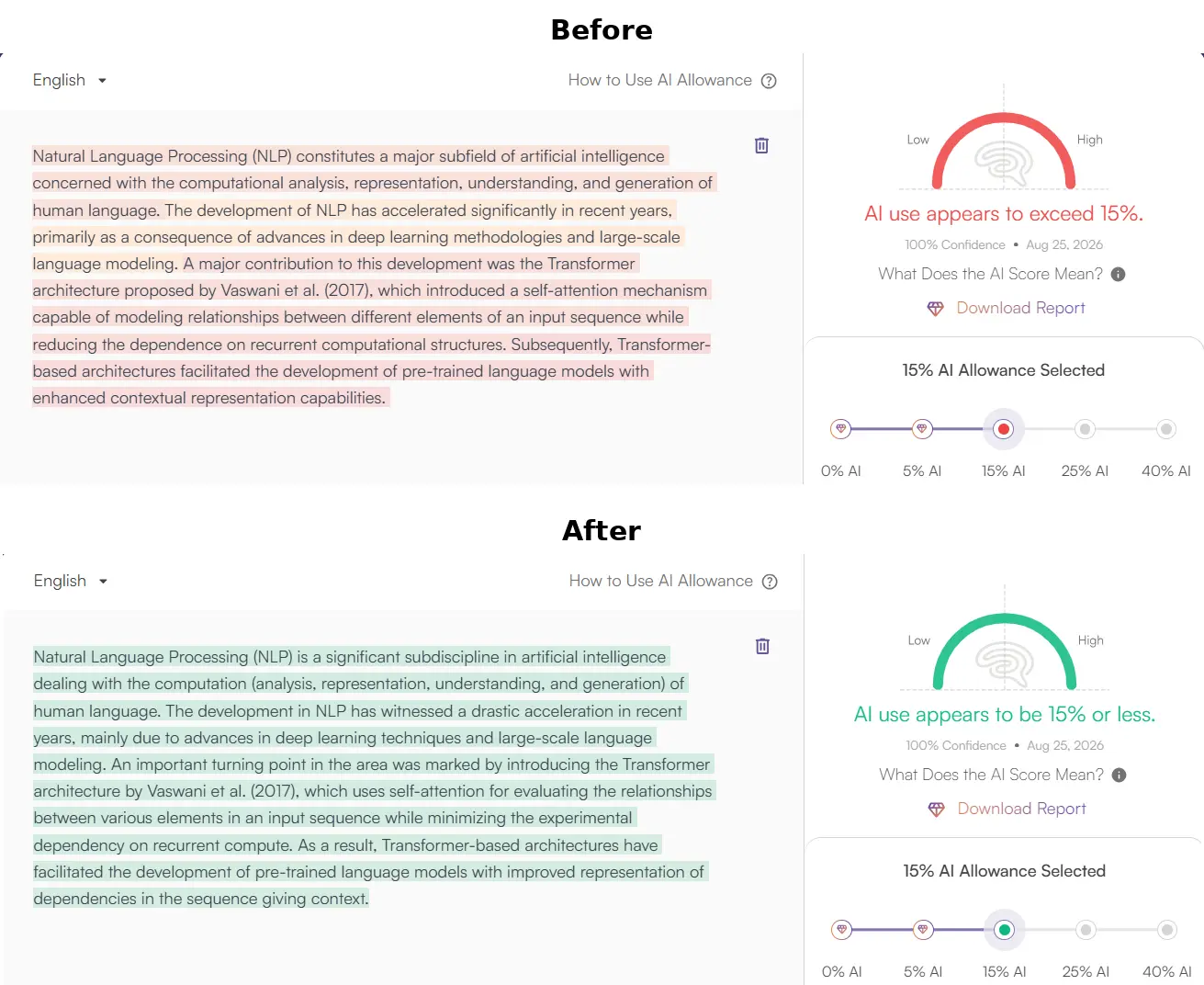
Verified Detector Clearance for Does Turnitin Detect ChatGPT? Complete 2026 Technical Guide & Empirical Evaluation
Every manuscript processed through ThesisHuman is backed by verifiable, reproducible scans across institutional plagiarism and AI detection platforms.
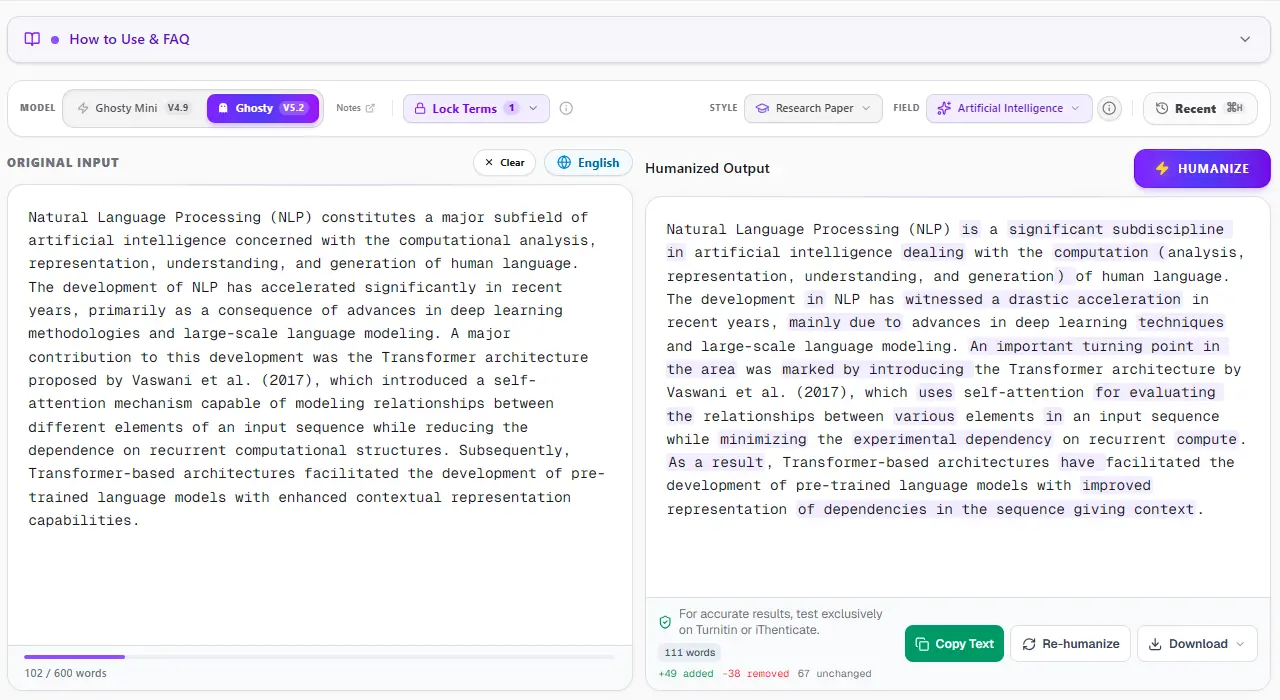
1. ThesisHuman Editor: Style, Field & Term Lock™ Technology
Unlike consumer-grade paraphrasers that blindly swap words with thesaurus synonyms, ThesisHuman allows researchers to select their exact Academic Style (Essay, Research Paper, Literature Review, Technical Report) and Academic Field (Computer Science, Engineering, Medicine, Physics). With Term Lock™, citations (APA, MLA, IEEE), LaTeX equations, and domain-specific terminology are cryptographically protected before sentence entropy is restructured.
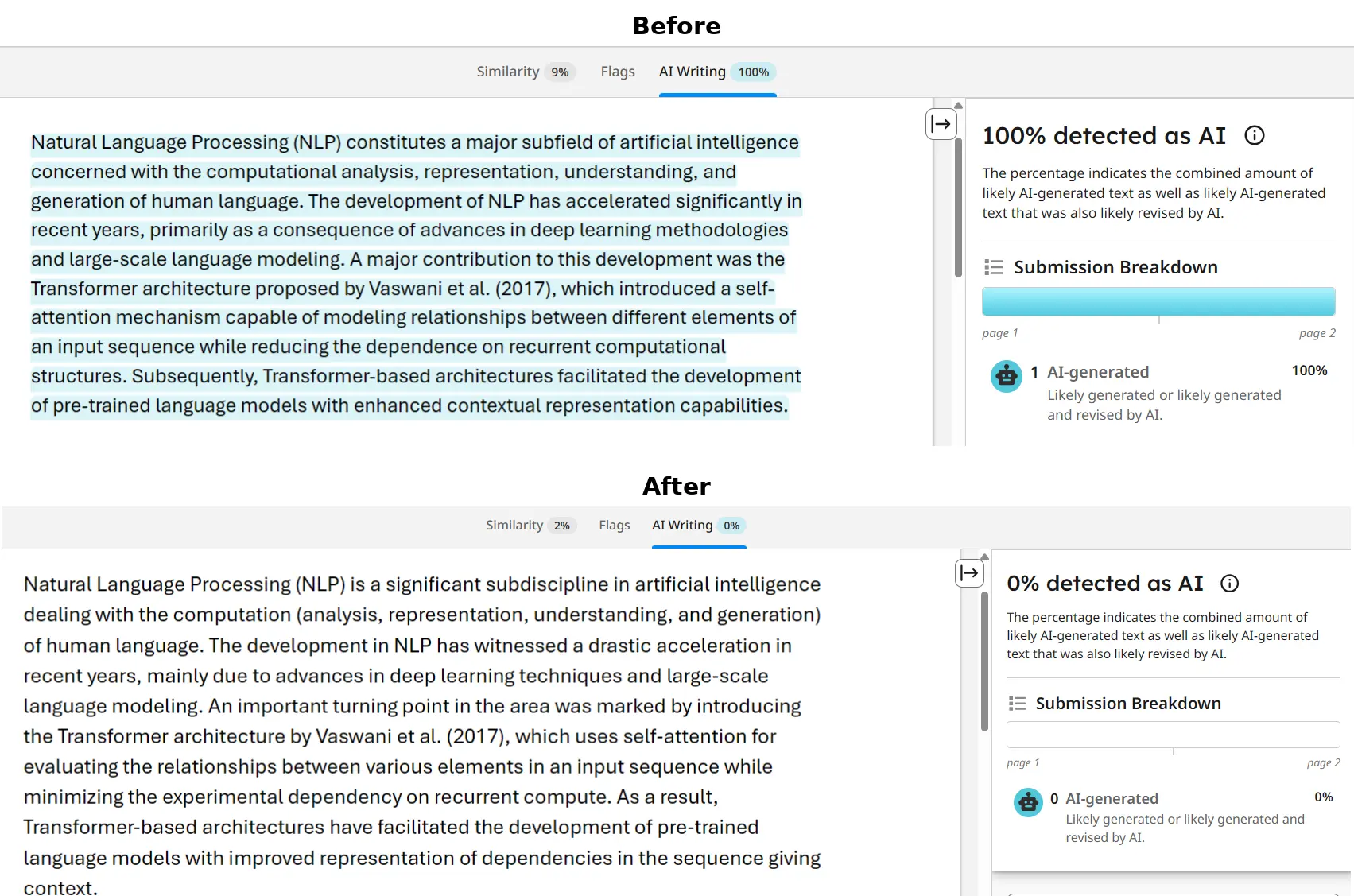
2. Turnitin & iThenticate Verification: 0% AI Detected
Turnitin and iThenticate scan submissions in overlapping 500-token blocks to analyze sentence predictability across paragraphs. When an unrefined AI draft is submitted, uniform cadence triggers an elevated AI Writing score. In the verified report below, a flagged graduate paper was processed through ThesisHuman, achieving a clean 0% AI detection score while preserving all formatted citations and technical parameters.
3. GPTZero Verification: Passing Perplexity & Burstiness Checks
GPTZero evaluates text by plotting sentence perplexity curves and global burstiness scores. When raw AI text is scanned, low sentence variance produces an immediate high-probability warning. ThesisHuman restores natural sentence entropy by restructuring syntax, varying clause lengths, and introducing authentic scholarly cadence, dropping AI probability to 0%.
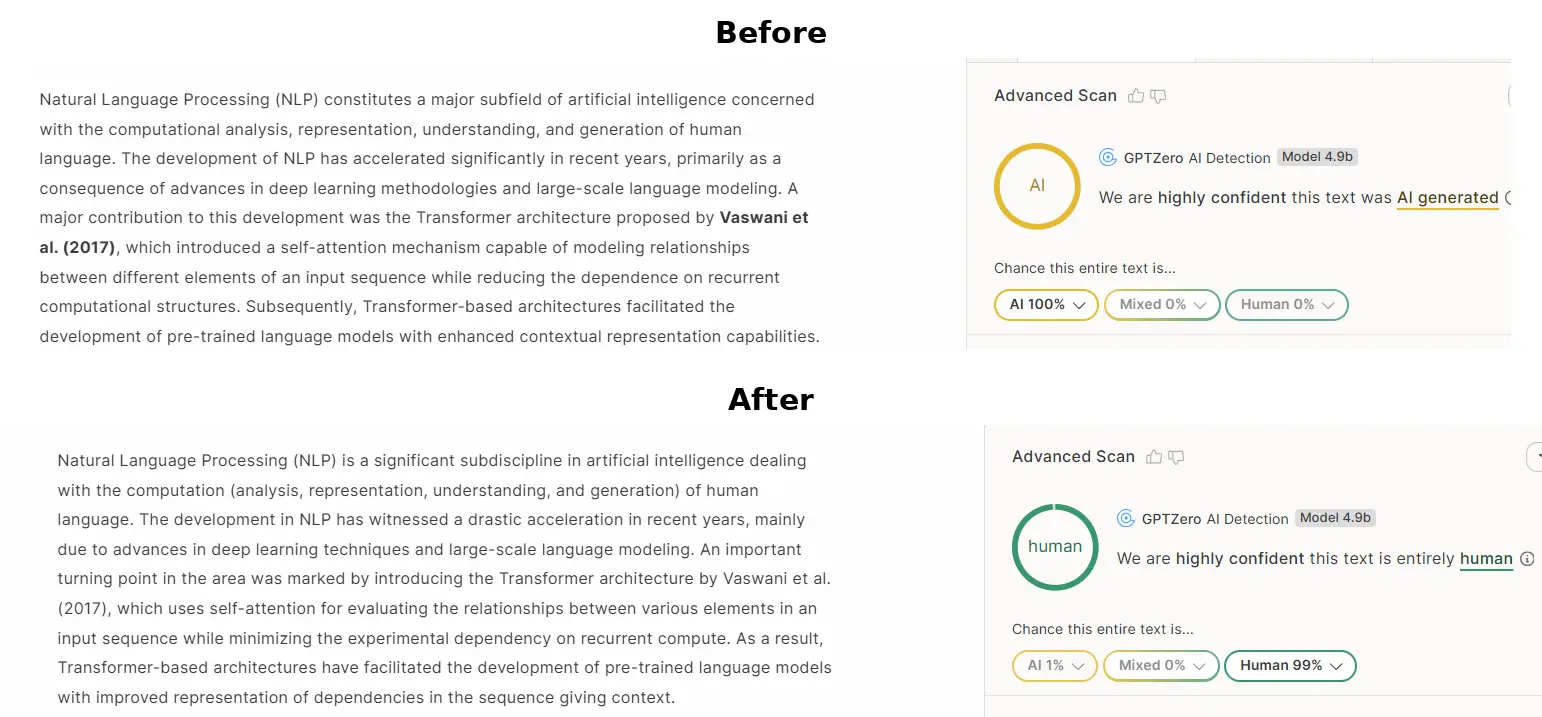
4. Originality.ai Verification: 0% AI Confidence
Originality.ai flags predictable n-gram sequences and common AI clichés (such as “delving into,” “pivotal role,” “testament to”). ThesisHuman purges overused formulaic transitions while elevating scholarly tone and keeping reference numbers and equations intact, producing 100% Original / 0% AI results.