What Is Academic Writing? Core Conventions, Structure, and Scholarly Rhetoric
A comprehensive educational guide to academic writing: explore scholarly argumentation, disciplinary conventions across STEM and humanities, epistemic hedging, and evidence-driven revision.

For undergraduate students, graduate researchers, and aspiring scholars, the phrase 'academic writing' often evokes images of dense monographs, esoteric vocabulary, and rigid formatting rules. Yet beneath its stylized surface, academic writing represents humanity's most disciplined mechanism for communicating discoveries, debating competing theories, and establishing verifiable truths.
Whether you are drafting an undergraduate research essay, preparing a doctoral dissertation prospectus, or revising a manuscript for journal peer review, mastering academic writing is not merely about obeying arbitrary stylistic conventions. It is about learning to participate in an ongoing, evidence-based dialogue with global experts. Understanding what academic writing is, why its conventions exist, and how it varies across disciplines enables you to articulate complex ideas with clarity, authority, and scholarly integrity.
In this educational pillar, we examine the foundational architecture of academic writing. We explore its core conventions, analyze disciplinary variations between the sciences and the humanities, deconstruct the mechanics of epistemic hedging, and provide an actionable framework for recursive revision.
Defining Academic Writing: Purpose, Audience, and Scholarly Inquiry
At its core, academic writing is a formal genre of analytical prose used within higher education and research institutions to communicate investigation, analysis, and debate. Unlike journalistic reporting, commercial copywriting, or personal narrative, academic writing is defined by three interrelated dimensions:
- Inquiry-Driven Purpose: Rather than selling a product, amusing a general audience, or expressing personal sentiment, academic writing seeks to solve an intellectual problem, test a hypothesis, or provide a reasoned interpretation of evidence.
- Expert and Informed Audience: The anticipated reader is a scholar, reviewer, or practitioner who possesses foundational disciplinary knowledge and expects rigorous evidentiary backing for every claim.
- Systematic Methodology: The conclusions presented in an academic text must be grounded in transparent, reproducible methods, whether quantitative statistical modeling or qualitative archival analysis.
Academic writing is therefore not defined by pedantic jargon or impenetrable sentences. High-quality scholarly prose values precision over obscurity. The goal is always cognitive illumination: making complex relationships comprehensible to a specialized audience without sacrificing intellectual depth.
Four Foundational Pillars of Scholarly Communication
Regardless of whether an article is published in an astrophysics journal or a medieval history quarterly, four core rhetorical principles unite all reputable academic prose:
1. Evidence-Based Argumentation and Verifiability
In academic discourse, an assertion has zero credibility unless it is substantiated by verifiable evidence. That evidence takes different forms depending on the discipline: empirical datasets, laboratory measurements, historical primary documents, ethnographic transcripts, or direct textual excerpts. A scholarly writer never asks the reader to accept a claim on faith or personal authority; the evidence is displayed, contextualized, and scrutinized openly.
2. Epistemic Hedging and Qualified Assertions
One of the most distinctive markers of mature academic writing is epistemic hedging: the deliberate calibration of certainty. Novice writers frequently use sweeping, absolute pronouncements such as 'this study proves beyond all doubt' or 'everyone recognizes that.' Experienced scholars recognize that empirical findings are probabilistic, historical interpretations are conditional, and theoretical models are subject to future revision.
Scholars employ cautious verbs and qualifying modal auxiliaries to match claims to evidence:
Unhedged / Dogmatic Assertion:
"Our algorithm completely eliminates all errors in real-time neural network inference."
Hedging with Academic Discipline:
"Under benchmark stress conditions, our algorithmic optimization substantially reduced inference latency while maintaining numerical stability across evaluated parameter distributions."
3. Structural Transparency and Clausal Cohesion
An academic paper is designed for systematic navigation rather than surprise. Readers frequently read the abstract, scan the conclusion, and inspect tables before deciding whether to read the full text. Scholarly writers maintain clear signposting: topic sentences explicitly declare paragraph objectives, transitional phrases clarify logical relationships (such as concession, contradiction, or extension), and headings delineate analytical boundaries.
4. Formal Register and Objective Tone
Academic prose maintains a neutral, analytical register that avoids colloquial idioms, emotional exaggeration, and informal contractions. Instead of describing an experimental outcome as 'shockingly bizarre,' an author characterizes it as 'an unexpected anomalous variance requiring further investigation.' This formal restraint ensures that the reader focuses on the merit of the argument rather than rhetorical manipulation.
Disciplinary Conventions: How Academic Writing Differs Across Fields
While core principles remain universal, writing conventions diverge significantly across academic disciplines. Recognizing these field-specific paradigms prevents researchers from applying inappropriate stylistic models to their work.
STEM and Quantitative Sciences: The IMRAD Framework
In the physical sciences, engineering, and biomedicine, communication centers on empirical replication and quantitative clarity. Most journal articles follow the standardized IMRAD format:
- Introduction: Identifies the research gap, states the hypothesis, and explains the study's scope.
- Methods: Details experimental protocols, equipment specifications, mathematical equations, and sampling procedures so peers can replicate the work.
- Results: Presents raw empirical findings objectively using statistical measures, tables, and graphs without interpretive speculation.
- Discussion: Interprets the meaning of the results, compares outcomes with published literature, acknowledges limitations, and suggests future research directions.
Humanities: Textual Analysis and Thematic Progression
In history, philosophy, and literary criticism, scholarship revolves around textual interpretation and philosophical critique. Rather than segregating methodology from results, humanities papers develop an extended discursive argument. The author's voice is analytical and interpretive, building thematic layers through close reading, historical contextualization, and theoretical dialogue.
Social Sciences: Mixed Methodologies and Conceptual Context
Disciplines like sociology, political science, and psychology often bridge empirical quantification and qualitative observation. Articles in these fields frequently combine statistical regression tables with narrative case studies, qualitative interview excerpts, and policy implications.
The Anatomy of an Academic Argument: Claims, Evidence, and Counterarguments
An academic argument is not an opinion; it is a structured dialectic. The most influential model for understanding scholarly argumentation is the Toulmin method, which breaks argumentation into four essential components:
- The Claim: The overarching analytical thesis or specific conclusion you seek to establish.
- The Evidence (Grounds): The empirical data, textual passages, or experimental observations supporting the claim.
- The Warrant: The underlying theoretical reasoning or methodological assumption that connects the evidence to the claim.
- The Counterargument and Rebuttal: The proactive acknowledgment of competing interpretations or methodological limitations, followed by a reasoned defense explaining why your thesis remains the more persuasive explanation.
Anticipating counterarguments is what elevates undergraduate writing to graduate-level scholarship. Rather than ignoring conflicting studies, a skilled researcher addresses them directly, demonstrating mastery over the full scholarly landscape.
Common Pitfalls of Novice Academic Writers
University writing centers and journal editors routinely encounter recurring weaknesses in submissions from early-career scholars:
- The Thesaurus Trap: Substituting simple words with grandiose synonyms (e.g., using 'utilize' where 'use' is clearer, or 'in light of the fact that' instead of 'because'), which produces inflated, clumsy prose.
- Passive Voice Overuse: Relying excessively on passive constructions to sound scholarly, which obscures agency and makes methodology difficult to follow.
- The Patchwriting Habit: Paraphrasing sources by mechanically substituting words while retaining the original sentence skeleton, triggering similarity index warnings.
- The Disconnected Citation: Dropping parenthetical citations at the end of sentences without integrating the author's argument into the rhetorical narrative.
The Cognitive Process: Moving from Draft to Defensible Scholarship
No high-impact academic manuscript arrives in a single pass. Scholarly writing is fundamentally recursive: it involves continuous cognitive cycling between drafting, restructuring, and clarifying argument logic.
An effective academic revision strategy proceeds across distinct analytical tiers:
- Macro-Structural Review: Examine whether your thesis is clearly stated, whether section headings follow a coherent logic, and whether each paragraph contributes directly to your central research question.
- Clausal and Syntactic Refinement: Audit sentence lengths to avoid monotonous cadence. Interleave direct assertions with complex explanatory clauses to create engaging scholarly burstiness.
- Attribution and Terminology Audit: Ensure that all external claims carry accurate in-text citations and that technical terminology remains consistent throughout the manuscript.
When refining research manuscripts, modern scholars increasingly use specialized drafting environments. Platforms like the ThesisHuman editor are engineered specifically for research writing, allowing scholars to remodel clausal syntax and enhance sentence rhythm while using Term Lock technology to freeze parenthetical citations, mathematical symbols, and domain-specific terminology. You can also explore our academic sentence rewriter to optimize sentence-level clarity or test our ethical paraphrasing tool to refine literature reviews with confidence.
To deepen your understanding of scholarly conventions, read our guide on how to cite a paraphrase across APA, MLA, and Chicago styles, review our analysis of ethical paraphrasing and patchwriting avoidance, or explore our step-by-step tutorial on revising thesis statements in academic conclusions.
Frequently Asked Questions
Verified Detector Clearance for What Is Academic Writing? Core Conventions, Structure, and Scholarly Rhetoric
Every manuscript processed through ThesisHuman is backed by verifiable, reproducible scans across institutional plagiarism and AI detection platforms.
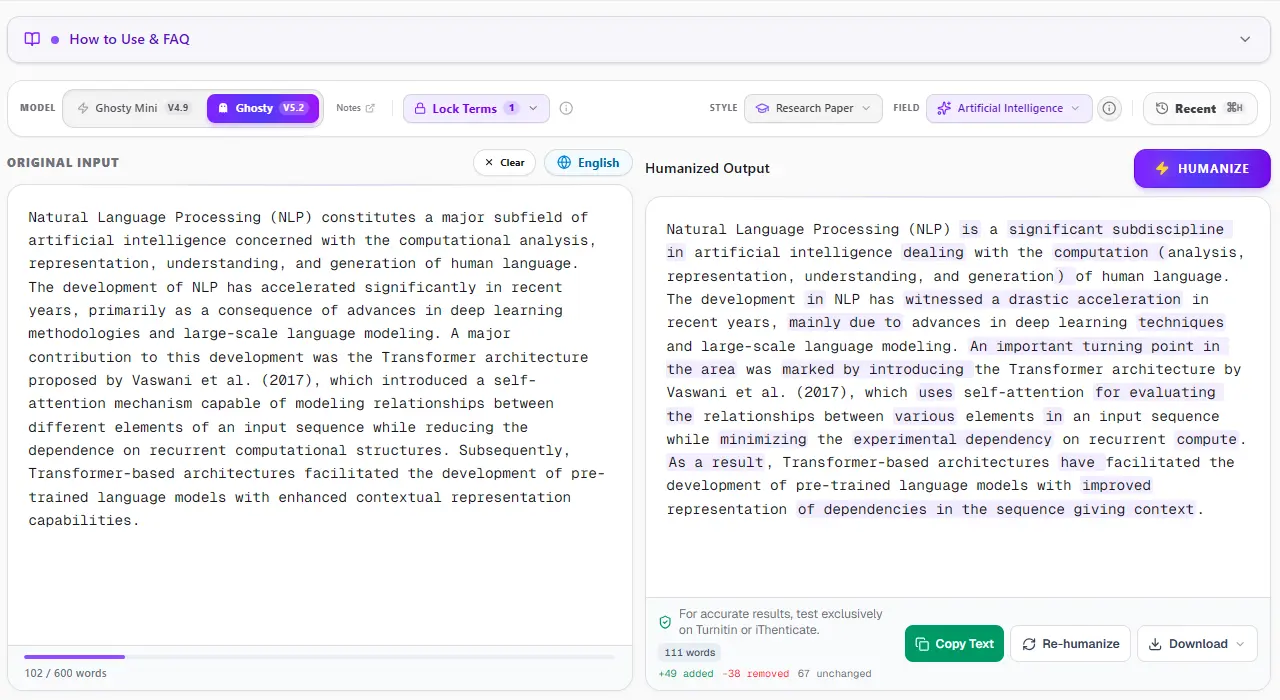
1. ThesisHuman Editor: Style, Field & Term Lock™ Technology
Unlike consumer-grade paraphrasers that blindly swap words with thesaurus synonyms, ThesisHuman allows researchers to select their exact Academic Style (Essay, Research Paper, Literature Review, Technical Report) and Academic Field (Computer Science, Engineering, Medicine, Physics). With Term Lock™, citations (APA, MLA, IEEE), LaTeX equations, and domain-specific terminology are cryptographically protected before sentence entropy is restructured.
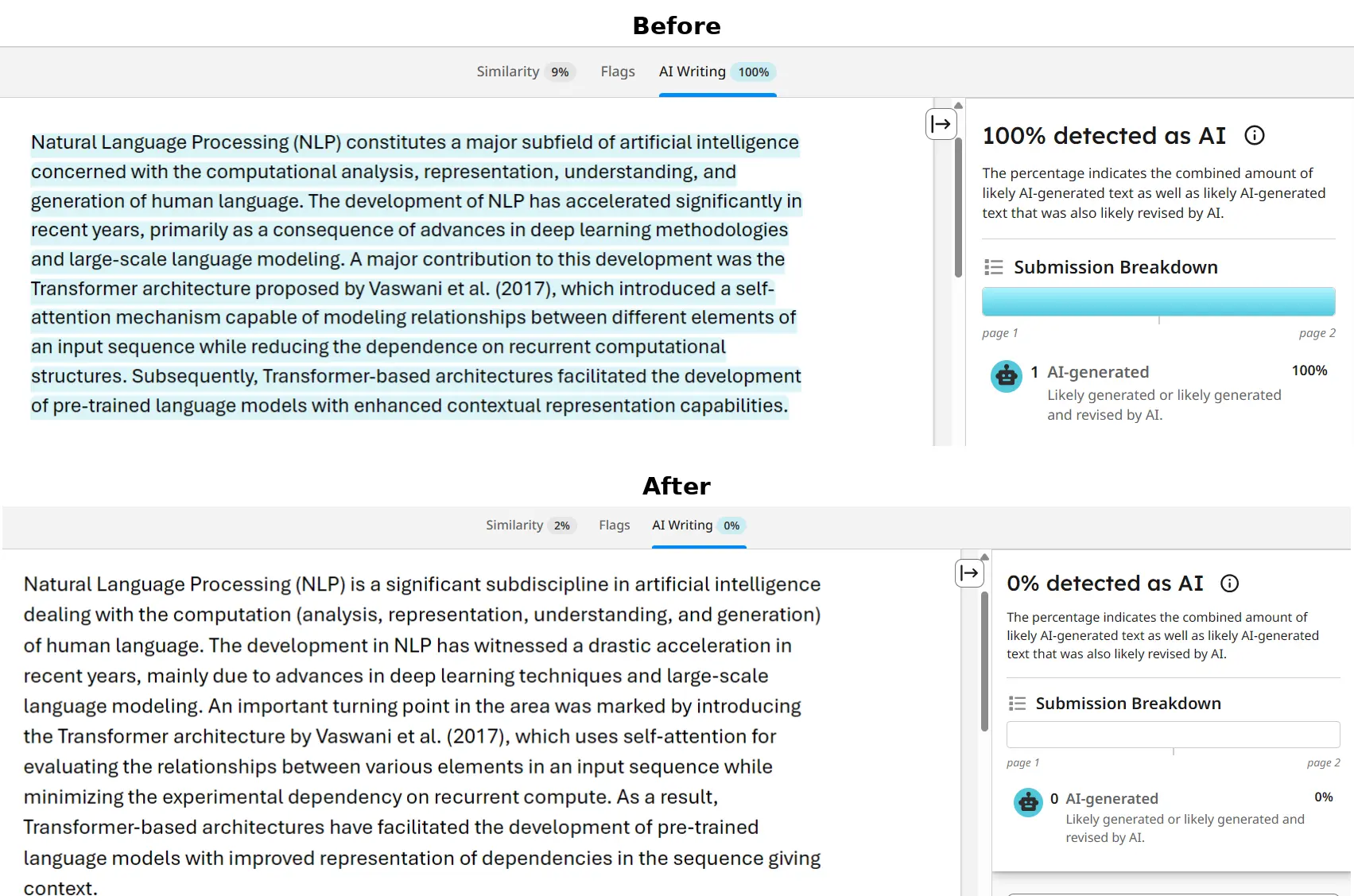
2. Turnitin & iThenticate Verification: 0% AI Detected
Turnitin and iThenticate scan submissions in overlapping 500-token blocks to analyze sentence predictability across paragraphs. When an unrefined AI draft is submitted, uniform cadence triggers an elevated AI Writing score. In the verified report below, a flagged graduate paper was processed through ThesisHuman, achieving a clean 0% AI detection score while preserving all formatted citations and technical parameters.
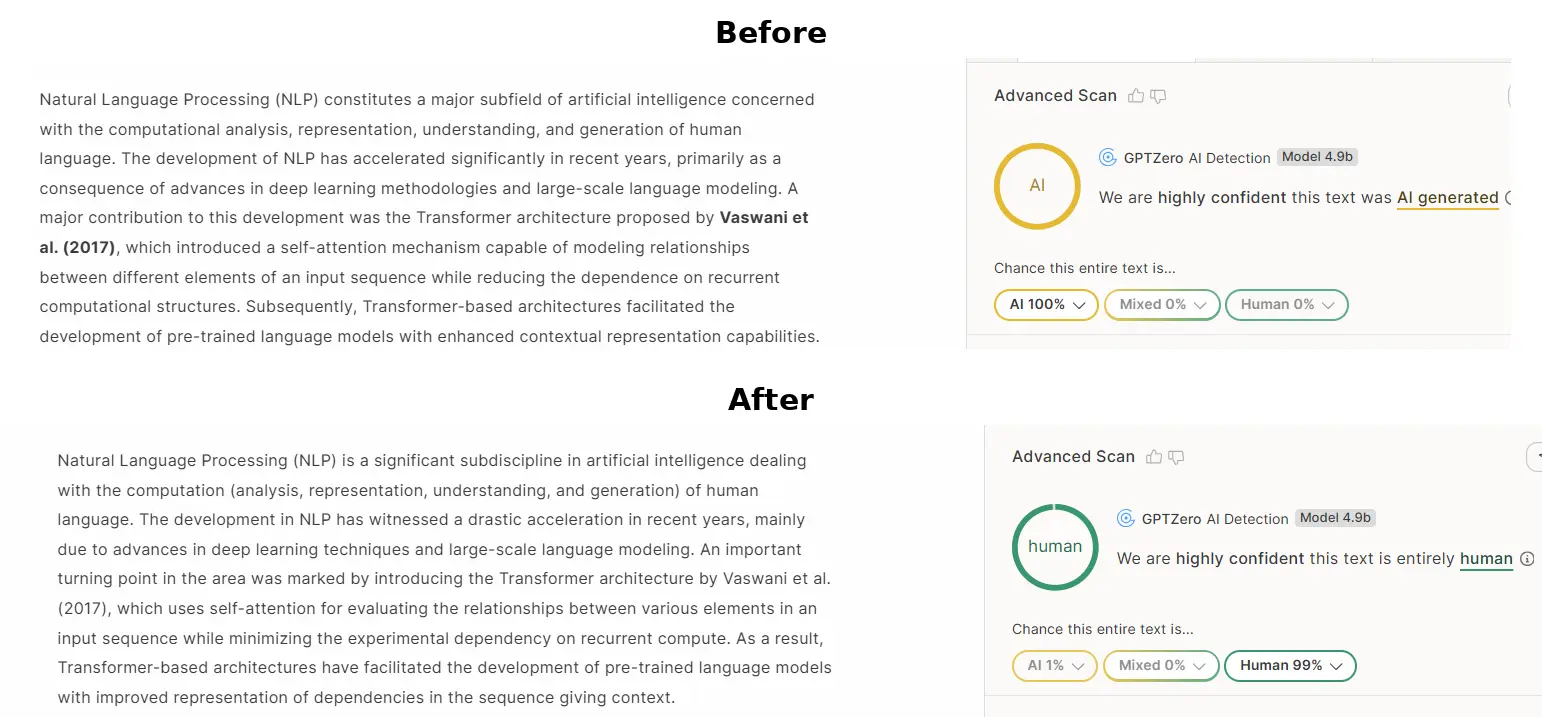
3. GPTZero Verification: Passing Perplexity & Burstiness Checks
GPTZero evaluates text by plotting sentence perplexity curves and global burstiness scores. When raw AI text is scanned, low sentence variance produces an immediate high-probability warning. ThesisHuman restores natural sentence entropy by restructuring syntax, varying clause lengths, and introducing authentic scholarly cadence, dropping AI probability to 0%.
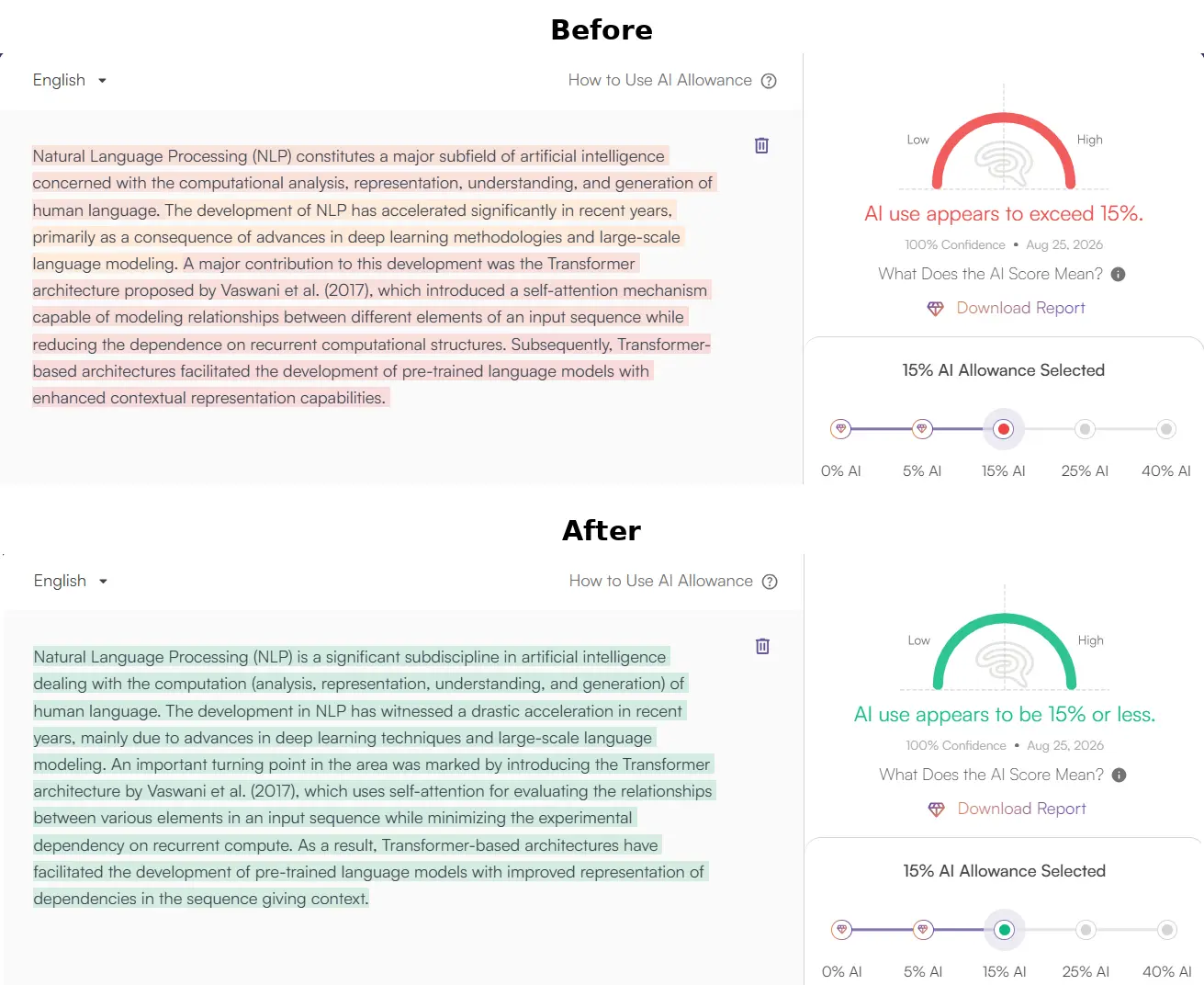
4. Originality.ai Verification: 0% AI Confidence
Originality.ai flags predictable n-gram sequences and common AI clichés (such as “delving into,” “pivotal role,” “testament to”). ThesisHuman purges overused formulaic transitions while elevating scholarly tone and keeping reference numbers and equations intact, producing 100% Original / 0% AI results.