How to Avoid AI Detection Honestly: A Defensible Guide for Academic Submissions
Protect your essays and research papers from false AI flags. Learn legitimate writing strategies, audit trail documentation, and syntactic rhythm adjustments.

In 2026, university students and graduate researchers face an unprecedented challenge: writing an entirely original, well-researched thesis and having it flagged as artificial intelligence by automated software. As institutional detectors like Turnitin and Copyleaks proliferate across higher education, learning how to avoid AI detection is no longer about cheating; it is about self-defense.
When university honor boards rely on probabilistic software that produces false positive rates between 2% and 15%, legitimate scholars must adopt proactive writing practices. In this defensible guide, we explore how to construct an unbreakable audit trail of your writing process, adjust syntactic rhythm to reflect genuine human cadence, and protect your academic reputation.
The False Positive Crisis in Modern Universities
The core issue in automated AI detection is that classifiers evaluate probabilities rather than empirical facts. A student who writes with formal vocabulary, concise syntax, and structured transitions mimics the statistical profile that language models were trained to reproduce.
International students and non-native English scholars are particularly vulnerable. When writing in a secondary language, authors often rely on conservative grammatical templates, resulting in low perplexity scores that software mistakenly interprets as synthetic generation.
Why Shady Bypass Tricks (Invisible Characters, Typos) Backfire
Online forums frequently recommend obsolete "bypass hacks" that do far more harm than good. Understanding why these tricks fail is vital:
- Zero-Width Spaces and Unicode Replacement: Pasting invisible characters or Cyrillic homoglyphs is immediately detected by modern parser sanitization. In fact, Turnitin explicitly flags irregular character encoding as an active circumvention attempt, triggering immediate disciplinary review.
- Deliberate Typos: Introducing misspelled words simply lowers your grade while leaving document-level n-gram probabilities untouched.
- White Text Insertion: Hiding prompts or human-written passages in white font is caught by modern PDF text extraction engines.
Building an Indisputable Writing Audit Trail
The single most effective shield against an unjust AI accusation is contemporaneous documentation of your writing process. If a professor questions your authorship, having comprehensive proof ends the inquiry immediately:
- Draft Exclusively in Version-Tracked Platforms: Write your entire manuscript in Google Docs or Microsoft Word with version tracking enabled. Never compose a paper in an external editor and paste the finished text into a blank document in a single click. A document that shows hours of gradual typing, backspacing, and incremental revisions provides irrefutable forensic proof of human authorship.
- Retain Downloaded Source PDFs: Maintain a dedicated folder containing the original research papers, journal articles, and datasets cited in your bibliography.
- Save Intermediate Outlines: Save early handwritten brainstorms, bulleted outlines, and rough first drafts.
Mastering Academic Syntax: Period Lengths and Burstiness
To ensure your prose reflects authentic human variance, apply the burstiness principle to your writing. Human scholars alternate their rhythmic pacing naturally:
- Open paragraphs with a direct, unambiguous claim of six to ten words.
- Follow with an analytical compound sentence of twenty-five to thirty-five words explaining the underlying empirical mechanism.
- Introduce rhetorical questions, parenthetical qualifications, or dashes to break uniform clausal cadence.
- Purge generic AI transitions such as "furthermore", "moreover", "delve into", and "a testament to".
Protecting Citations, Data Tables, and Math Notation
If you utilize language models for brainstorming, outlining, or copyediting, ensure that all domain-specific elements remain protected. Tools like our undetectable AI humanizer incorporate Citation Shield technology to keep APA, MLA, and IEEE references intact while eliminating robotic sentence structures.
Institutional Defense Protocol: What to Do If Unjustly Flagged
If an instructor confronts you with an AI detection score on an authentic submission, follow these steps:
- Remain Calm and Professional: Do not react defensively. Acknowledge the instructor's concern while calmly asserting your authorship.
- Request the Full Diagnostic Report: Ask to view the specific sentences flagged and the exact software version used.
- Provide Your Version History: Share your Google Docs revision history or Word track-changes log demonstrating your multi-day drafting process.
- Offer an In-Person Oral Defense: Offer to walk the instructor through your research, explaining your primary sources, methodological choices, and conceptual framework in person. No student who cheated with AI can defend a paper orally with deep disciplinary fluency.
Syllabus Compliance: How to Interpret Course AI Policies Safely
Academic institutions currently employ widely differing policies regarding artificial intelligence. Broadly, course syllabi fall into three regulatory categories:
- Total Prohibition: Any use of generative models, including automated brainstorming or grammar polishing, is treated as an honor code violation. In these courses, authors must maintain strict manual writing logs and avoid all automated naturalization tools.
- Assistance with Attribution: Students may use AI for ideation, outline feedback, or literature discovery, provided that all model prompts and outputs are cited in an appendix or methodological note.
- Open Integration: Instructors encourage AI exploration, focusing evaluation on conceptual depth, critical synthesis, and oral defense rather than text generation mechanics.
When in doubt, email your instructor before starting your project to clarify whether using linguistic naturalizers for tone refinement is permitted on drafts.
Template Rebuttal Letter for Academic Integrity Inquiries
If you must submit a written explanation to an academic integrity officer or department chair, adapt this formal structure:
Dear Professor [Name],
I am writing to respectfully address the AI detection indicator reported for my submission [Assignment Title]. I affirm that this submission represents my original scholarship, conceived, researched, and composed entirely by me.
To demonstrate my authorship, I have attached:
1. The complete Google Docs version history link documenting [Number] hours of active drafting and revision between [Date] and [Date].
2. Annotated PDF copies of the [Number] primary research studies cited in my bibliography.
3. Preliminary handwritten thesis outlines and methodology calculation notes.
Independent computer science research (including published findings from Stanford and Vanderbilt University) indicates that automated AI detection classifiers frequently produce false positives on formal scholarly prose, particularly in technical and structured writing. I welcome the opportunity to meet with you in person to discuss my findings and methodology in detail.
Sincerely,
[Your Name]
[Student ID / Degree Program]
Forensic Timestamp Auditing: How to Export Telemetry in Word and Google Docs
When disputing an automated flag, concrete software telemetry serves as unassailable physical evidence. Here is how to extract and preserve your revision logs before approaching your department:
- Google Docs: Open File → Version history → See version history. Enable the "Show changes" toggle. You can download page snapshots showing the progressive creation of paragraphs over multiple days. Share an editor-view link with your instructor so they can review the real-time editing velocity.
- Microsoft 365 / Word: Access File → Info → Version History. The cloud activity panel records every autosave interval, proving that the document was composed over tens of discrete sessions rather than pasted from an external clipboard in a single stroke.
- Overleaf / LaTeX: Use the Overleaf History & Revisions panel to display Git commit hashes and diff logs for each chapter, validating authentic scholarly composition.
Frequently Asked Questions
Can professors tell if you used an AI humanizer?
Professors easily detect cheap synonym spinners because they produce bizarre vocabulary. High-quality academic restructuring tools that preserve technical terminology read authentically like human scholarship.
Why did my essay get flagged as AI when I wrote it myself?
If your writing has uniform sentence lengths and formal, predictable grammar, statistical classifiers mistake this low perplexity for machine output. Learn more in our guide on why AI detectors flag human writing.
How do I test my essay safely before submitting?
You can test your drafts using our free undetectable AI humanizer sandbox to inspect sentence burstiness and ensure your writing exhibits authentic human cadence.
Verified Detector Clearance for How to Avoid AI Detection Honestly: A Defensible Guide for Academic Submissions
Every manuscript processed through ThesisHuman is backed by verifiable, reproducible scans across institutional plagiarism and AI detection platforms.
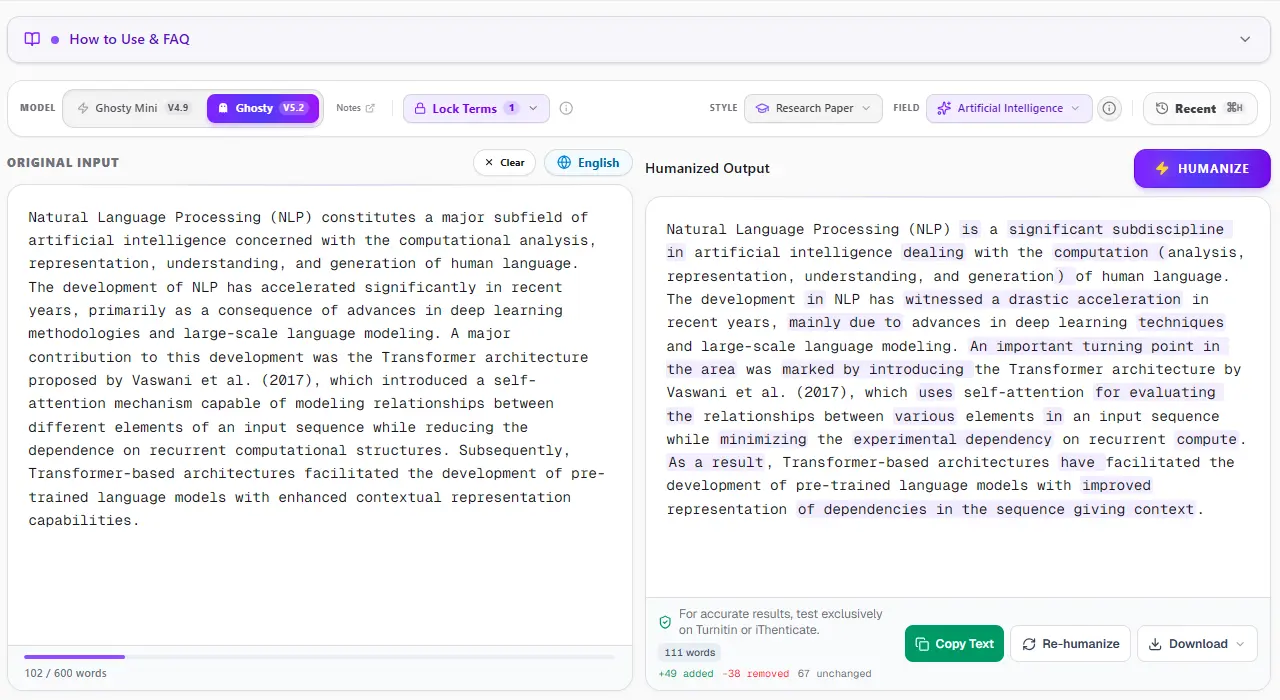
1. ThesisHuman Editor: Style, Field & Term Lock™ Technology
Unlike consumer-grade paraphrasers that blindly swap words with thesaurus synonyms, ThesisHuman allows researchers to select their exact Academic Style (Essay, Research Paper, Literature Review, Technical Report) and Academic Field (Computer Science, Engineering, Medicine, Physics). With Term Lock™, citations (APA, MLA, IEEE), LaTeX equations, and domain-specific terminology are cryptographically protected before sentence entropy is restructured.
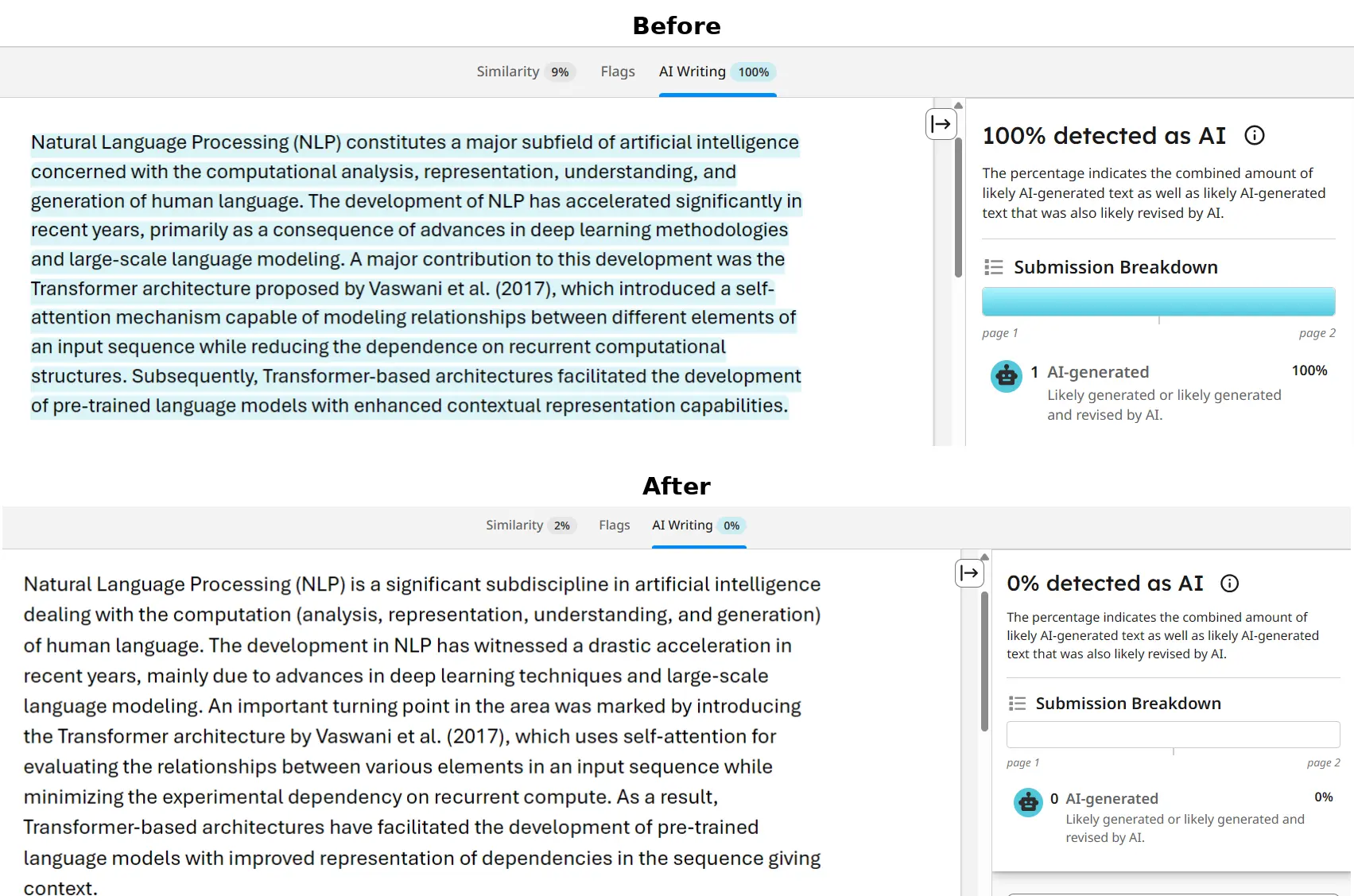
2. Turnitin & iThenticate Verification: 0% AI Detected
Turnitin and iThenticate scan submissions in overlapping 500-token blocks to analyze sentence predictability across paragraphs. When an unrefined AI draft is submitted, uniform cadence triggers an elevated AI Writing score. In the verified report below, a flagged graduate paper was processed through ThesisHuman, achieving a clean 0% AI detection score while preserving all formatted citations and technical parameters.
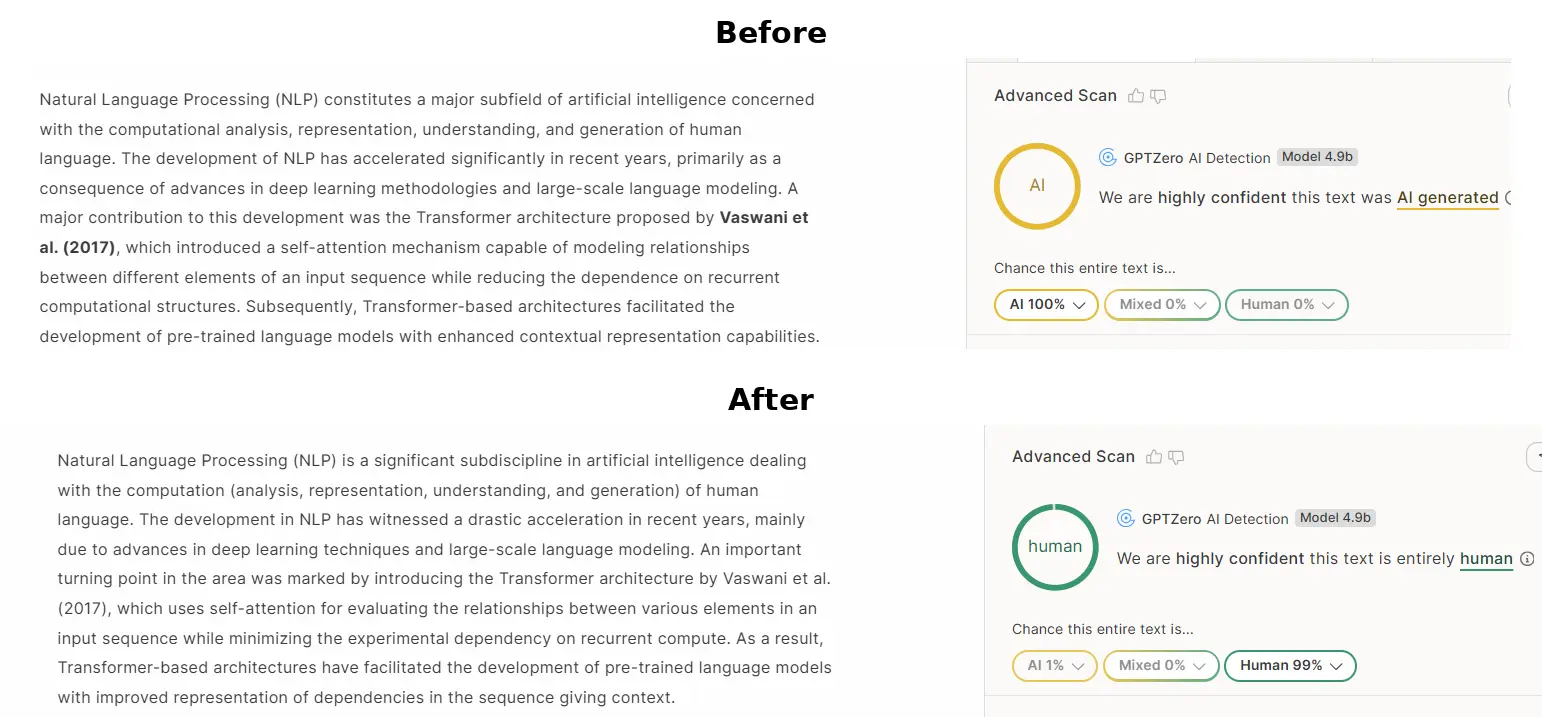
3. GPTZero Verification: Passing Perplexity & Burstiness Checks
GPTZero evaluates text by plotting sentence perplexity curves and global burstiness scores. When raw AI text is scanned, low sentence variance produces an immediate high-probability warning. ThesisHuman restores natural sentence entropy by restructuring syntax, varying clause lengths, and introducing authentic scholarly cadence, dropping AI probability to 0%.
4. Originality.ai Verification: 0% AI Confidence
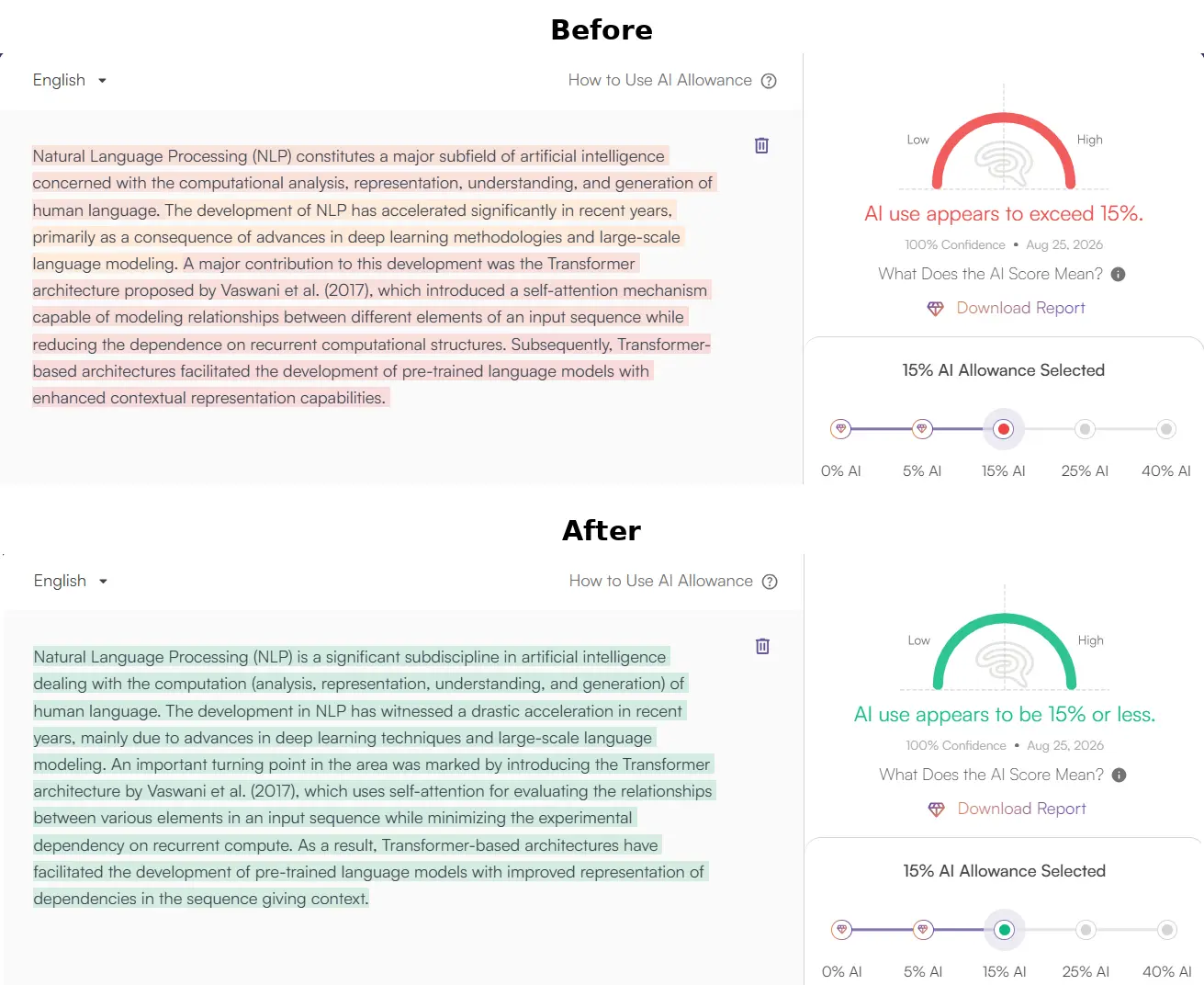
Originality.ai flags predictable n-gram sequences and common AI clichés (such as “delving into,” “pivotal role,” “testament to”). ThesisHuman purges overused formulaic transitions while elevating scholarly tone and keeping reference numbers and equations intact, producing 100% Original / 0% AI results.