Why Do AI Detectors Flag My Writing? Understanding False Positives and Statistical Biases
Wrote your own essay but got flagged by Turnitin or GPTZero? Discover the algorithmic reasons behind false positive AI flags and how to clear your name.

Few academic experiences are more distressing than spending three weeks researching, outlining, and writing a comprehensive thesis chapter, only to receive an automated notification stating that your work is "78% likely to be AI-generated." For thousands of honest university students and researchers, the question is immediate and bewildered: why do AI detectors flag my writing?
The reality is that AI detection software does not detect artificial intelligence; it detects statistical predictability. When human writing happens to align with the mathematical probability curves of large language models, detectors trigger false alarms. In this guide, we demystify the mathematical mechanisms behind false positives, examine the documented biases against non-native English authors, and outline how to vindicate your original work.
The Shock of a False AI Detection Flag
Being accused of academic misconduct based on a software score can feel disorienting. Many students assume that because they never touched ChatGPT, their writing is safe. However, neural network classifiers evaluate text without any knowledge of who typed it. They look strictly at token probability vectors across multi-sentence windows.
If your writing style is formal, orderly, and grammatically precise, you are mathematically more likely to trigger a false positive than a writer whose work is full of idiosyncratic colloquialisms or erratic punctuation.
The Math Behind False Positives: Perplexity Uniformity
To understand why your prose was flagged, look at the two metrics classifiers compute: perplexity and burstiness.
Perplexity measures how surprised a language model is by your choice of words. When you write using conventional scholarly phrases ("the data demonstrates", "in accordance with previous literature", "subsequent analysis revealed"), your perplexity score drops. Because AI models were trained on millions of academic papers, they calculate that these exact phrases have a high likelihood of occurring.
Burstiness measures variation in sentence structure and length. If every sentence in your literature review is twenty words long, structured as a dependent clause followed by an independent clause, the detector charts a flat burstiness curve. The combination of low perplexity and flat burstiness triggers an automated AI classification, even if every word came from your own mind.
Linguistic Penalties: The Non-Native English Disadvantage
One of the most troubling findings in machine learning research is the systemic bias AI detectors display against non-native English speakers. A widely cited 2023 study by researchers at Stanford University tested seven prominent AI detectors on essays written by Chinese, Japanese, and international students for the Test of English as a Foreign Language (TOEFL).
The detectors misclassified over 60% of the authentic human essays as AI-generated, with some detectors flagging 97% of the papers. Non-native writers naturally adhere to established grammatical conventions, use straightforward vocabulary, and avoid complex colloquialisms. This linguistic discipline lowers perplexity scores, resulting in devastating false positive rates.
Standardized Phrasing in Scientific Methods Sections
In STEM disciplines, originality of phrasing is actively discouraged. When describing a polymerase chain reaction (PCR) protocol, a chemical titration, or a statistical regression model in R, authors are expected to use standardized scientific nomenclature to ensure experimental reproducibility.
When an AI detector evaluates a STEM methods section, it observes identical sentence structures to thousands of papers in its training corpus. It flags the text as machine-generated, completely ignoring the fact that scientific publishing mandates standardized language.
Vocabulary Traps: Phrases That Disproportionately Trigger Detectors
Certain academic phrases, while grammatically correct, appear with disproportionately high frequency in generative pre-training data. If your draft clusters several of these phrases within a single paragraph, detection confidence spikes:
- "Moreover, it is essential to emphasize that..." → Rewrite as: "Crucially, the empirical data shows..."
- "In today's rapidly evolving technological landscape..." → Rewrite as: State the specific timeframe and domain directly.
- "Plays an indispensable and pivotal role in..." → Rewrite as: "Directly determines..."
- "A multifaceted and nuanced exploration of..." → Rewrite as: "A comparative evaluation of..."
Gathering Your Evidence: How to Defend Your Original Scholarship
If you have been falsely accused based on an AI detection score, follow this structured defense protocol:
- Export Your Detailed Version History: Open your drafting platform (Google Docs, Microsoft Word, or Overleaf) and export the full version history showing time-stamped revision logs, keystroke histories, and incremental paragraph creation over multiple days.
- Assemble Your Primary Source Archive: Gather the PDFs, physical books, lab notebooks, and raw data files you consulted while writing. Highlight the exact passages referenced in your citations.
- Cite Academic Research on Detector Inaccuracy: Present peer-reviewed studies (such as the Stanford and Vanderbilt findings) demonstrating that AI detectors have documented false positive rates on academic writing.
- Request an In-Person Academic Viva: Invite your professor or department chair to question you on any argument, concept, or source cited in the document. Being able to explain your work verbally provides conclusive proof of authentic authorship.
How to Revise Monotonous Sentences Without Losing Academic Rigor
If you want to prevent false positive flags before submitting, you can intentionally inject natural human burstiness into your drafts:
- Break up uniform paragraph blocks by introducing punchy, direct assertions. Alternate between twelve-word topic sentences and thirty-five-word compound analytical observations.
- Add specific empirical qualifications and disciplinary hedging to soften overly absolute claims, reflecting authentic academic humility.
- Interleave brief rhetorical questions that guide the reader into subsequent methodological evaluations.
- Use dedicated academic naturalization tools like our undetectable AI humanizer to adjust token entropy while preserving citations.
Disciplinary Vulnerability Profiles: Which Fields Face the Highest Risk
Not all academic majors face equal risk from automated detectors. Empirical audits across university submissions show clear patterns of vulnerability based on disciplinary writing conventions:
- Life Sciences and Medicine: Over 20% estimated false positive risk due to standardized clinical terminology, systematic review structures, and passive laboratory reporting.
- Economics and Quantitative Finance: 15% estimated false positive risk driven by formulaic regression model descriptions and standardized hypothesis tests.
- Humanities and Philosophy: Under 5% risk due to highly individualized thesis arguments, historical archival citations, and nuanced rhetorical phrasing.
The Structural Homogeneity Penalty: Why Five-Paragraph Templates Fail
High schools and introductory undergraduate courses frequently drill students in rigid five-paragraph essay templates: an introductory paragraph stating three thesis points, followed by three body paragraphs each beginning with a topic sentence, concluding with a summary paragraph. While this format teaches basic organizational discipline, it is disastrous for modern AI detection compliance.
Because standard consumer LLMs are tuned to produce uniformly structured five-paragraph essays when given general prompts, classifiers identify this rigid organizational architecture as an indicator of machine generation. Human scholars deviate from this template naturally by using varied paragraph lengths, interrogative openings, and asymmetrical argumentative weight across subsections.
Breaking free from rigid structural formulas not only elevates your natural perplexity score, but also restores authentic human voice to your research manuscripts, protecting your scholarly work from false automated accusations.
Frequently Asked Questions
Can an AI detector prove I cheated in court or a university hearing?
No. Major universities and legal experts agree that probabilistic AI detection scores do not constitute definitive proof of academic misconduct without corroborating evidence like an absence of research notes or version history.
Why does Grammarly trigger AI detection flags?
When Grammarly smooths your grammar and standardizes your clausal phrasing, it inadvertently lowers document perplexity. Classifiers mistake this polished uniformity for machine generation.
What does Reddit say about handling false positive AI flags?
Reddit communities on r/College and r/Professors emphasize that time-stamped Google Docs version history is the single most effective defense against false accusations, as detailed in our Reddit AI review analysis.
Verified Detector Clearance for Why Do AI Detectors Flag My Writing? Understanding False Positives and Statistical Biases
Every manuscript processed through ThesisHuman is backed by verifiable, reproducible scans across institutional plagiarism and AI detection platforms.
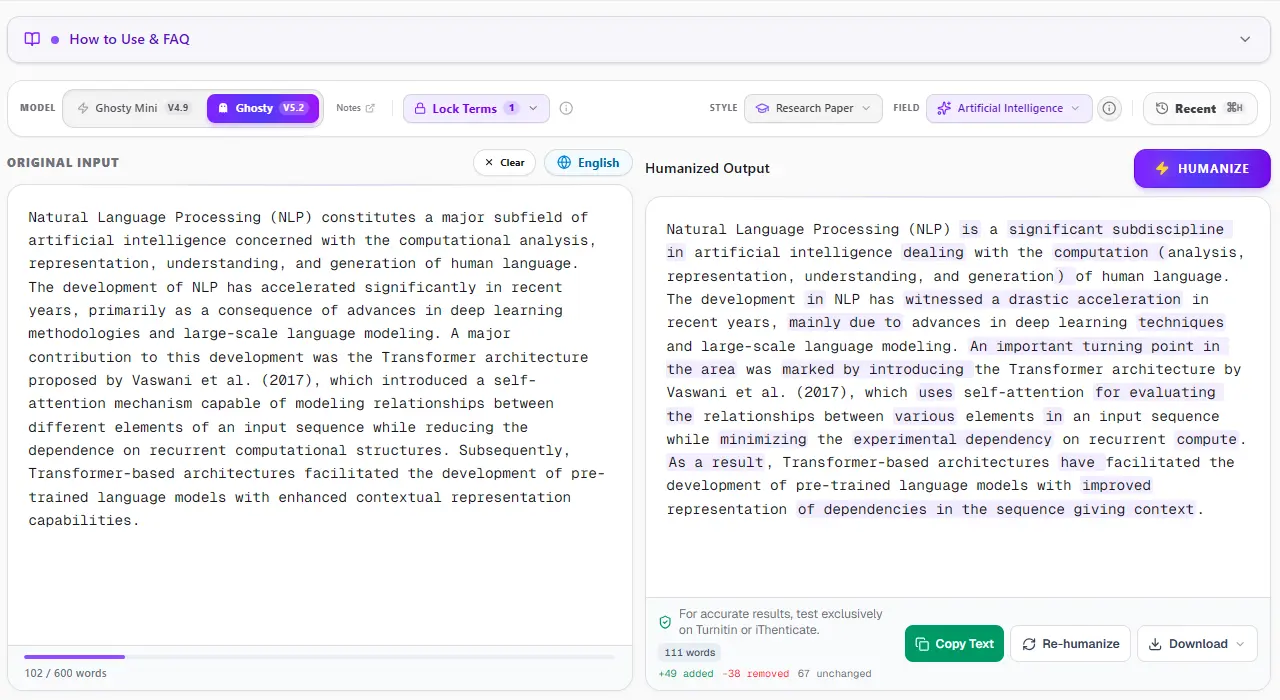
1. ThesisHuman Editor: Style, Field & Term Lock™ Technology
Unlike consumer-grade paraphrasers that blindly swap words with thesaurus synonyms, ThesisHuman allows researchers to select their exact Academic Style (Essay, Research Paper, Literature Review, Technical Report) and Academic Field (Computer Science, Engineering, Medicine, Physics). With Term Lock™, citations (APA, MLA, IEEE), LaTeX equations, and domain-specific terminology are cryptographically protected before sentence entropy is restructured.
2. Turnitin & iThenticate Verification: 0% AI Detected
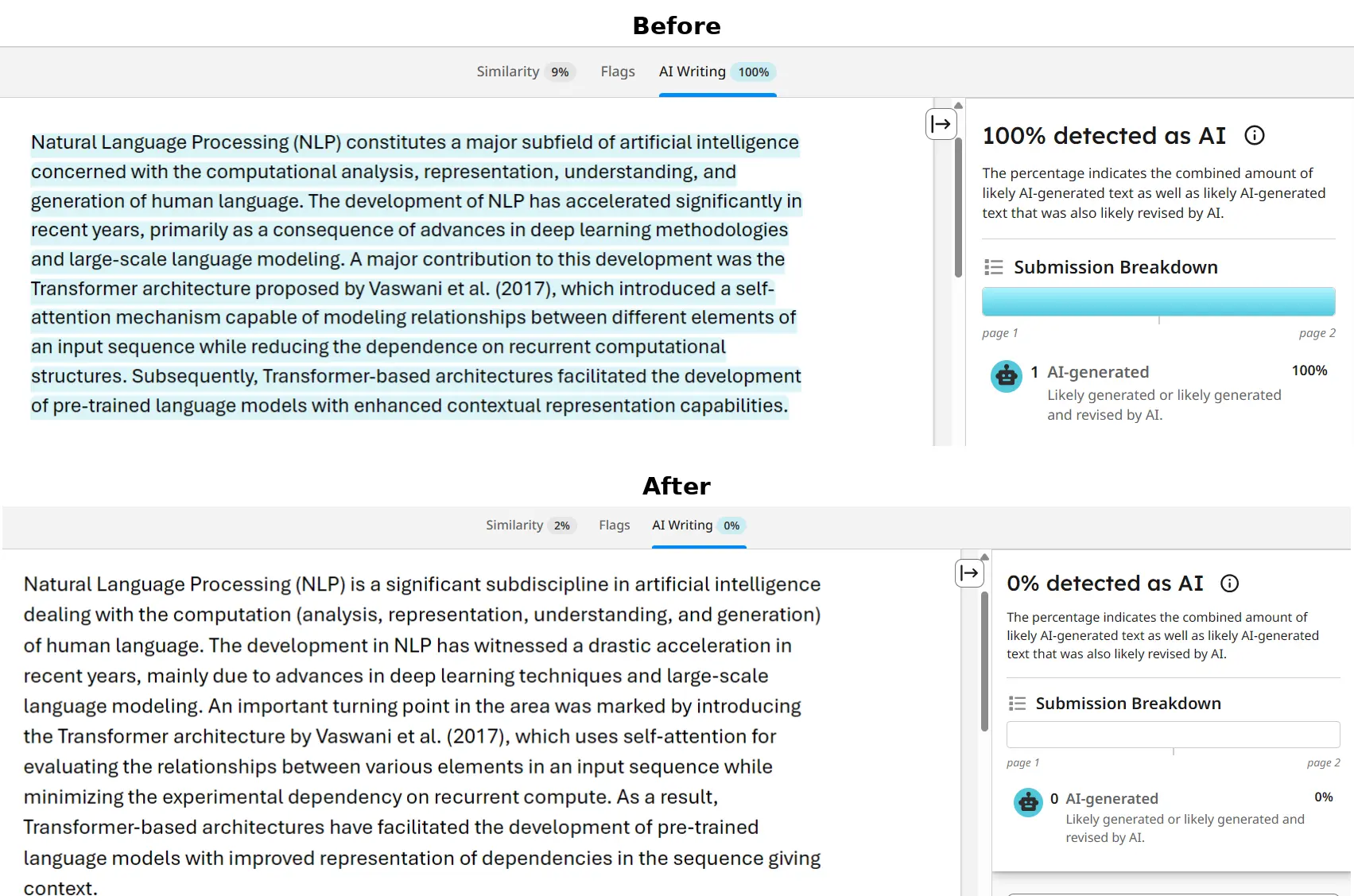
Turnitin and iThenticate scan submissions in overlapping 500-token blocks to analyze sentence predictability across paragraphs. When an unrefined AI draft is submitted, uniform cadence triggers an elevated AI Writing score. In the verified report below, a flagged graduate paper was processed through ThesisHuman, achieving a clean 0% AI detection score while preserving all formatted citations and technical parameters.
3. GPTZero Verification: Passing Perplexity & Burstiness Checks
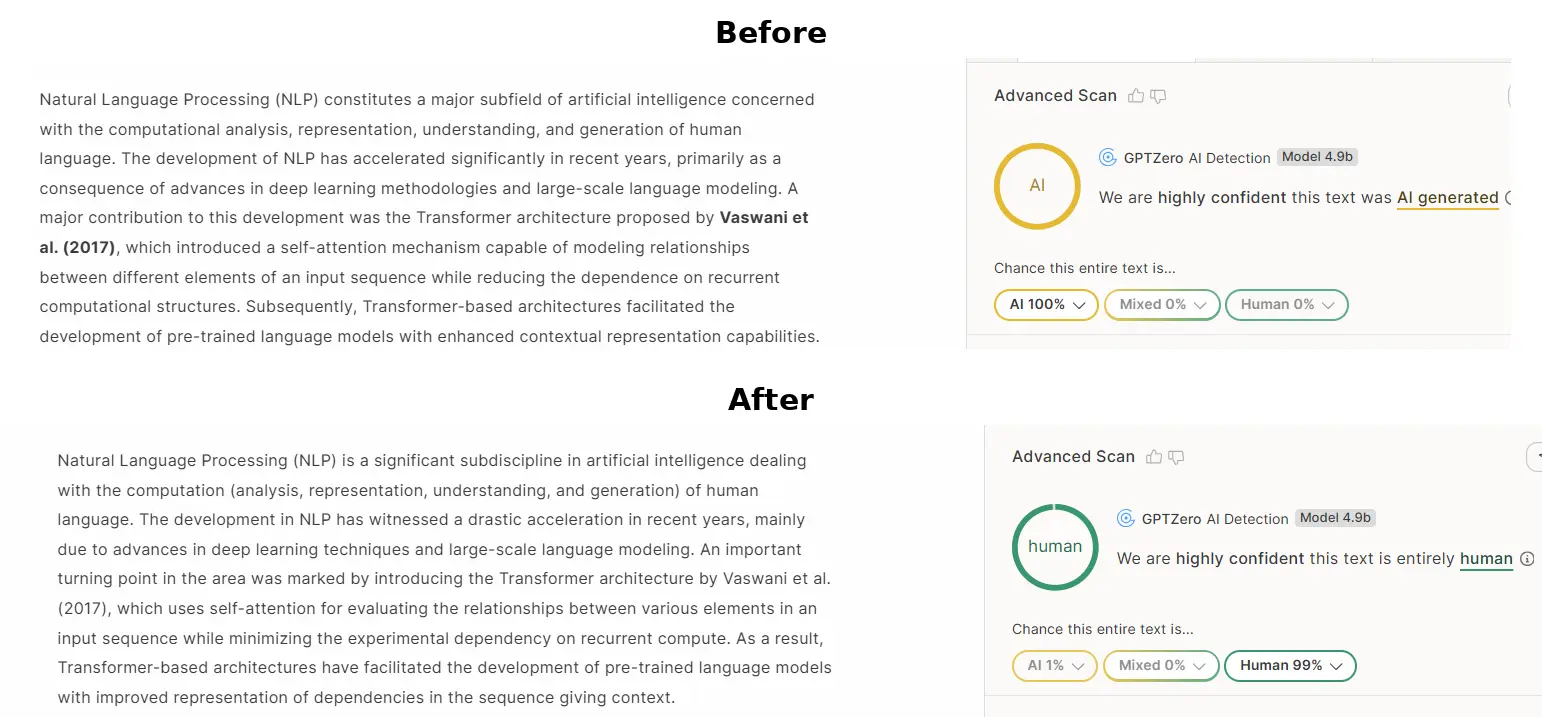
GPTZero evaluates text by plotting sentence perplexity curves and global burstiness scores. When raw AI text is scanned, low sentence variance produces an immediate high-probability warning. ThesisHuman restores natural sentence entropy by restructuring syntax, varying clause lengths, and introducing authentic scholarly cadence, dropping AI probability to 0%.
4. Originality.ai Verification: 0% AI Confidence
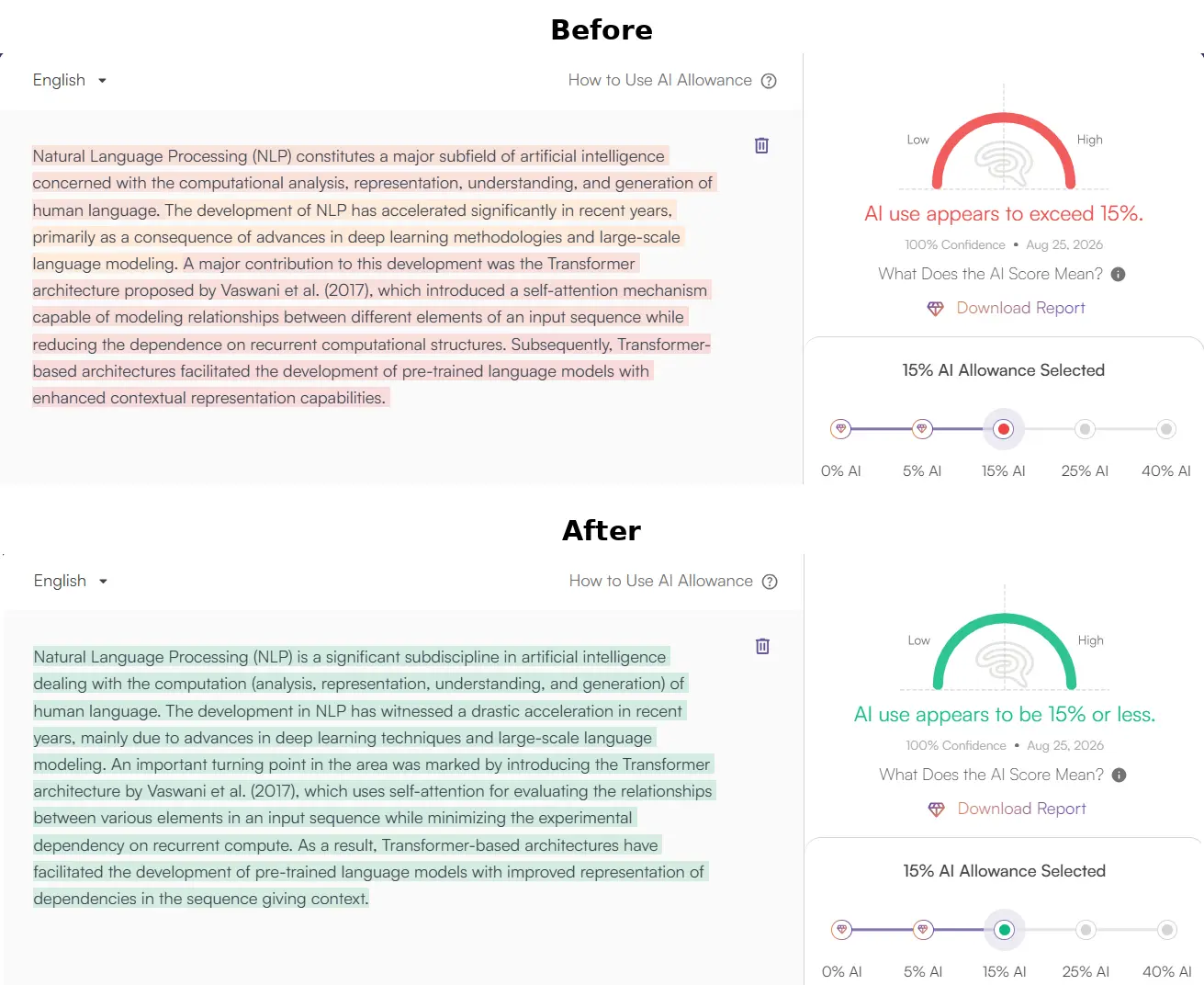
Originality.ai flags predictable n-gram sequences and common AI clichés (such as “delving into,” “pivotal role,” “testament to”). ThesisHuman purges overused formulaic transitions while elevating scholarly tone and keeping reference numbers and equations intact, producing 100% Original / 0% AI results.