Is Paraphrasing Plagiarism? Academic Guidelines, Patchwriting & Citation Rules
Is paraphrasing plagiarism? Learn when rephrasing requires citations, what patchwriting is, and how to cite sources correctly according to APA and MLA rules.
Paraphrasing is **not** plagiarism if you restate an author's ideas in your own original sentence structure and include a proper inline citation. However, paraphrasing **becomes** plagiarism if you rephrase source text without citing the original author, or if you simply swap a few words while keeping the author's exact sentence architecture—a common academic infraction known as **patchwriting**.
Understanding the precise academic boundary between legitimate paraphrasing, direct quotation, patchwriting, and self-plagiarism is essential for ensuring your research manuscripts comply with university honor codes and journal publication ethics.
Direct Answer: When Is Paraphrasing Considered Plagiarism?
Paraphrasing is considered plagiarism under two specific conditions: (1) presenting another author's original arguments, data, or theoretical framework without an inline citation, or (2) copying another author's sentence structure and using a thesaurus to swap synonyms without synthesizing the concept in your own voice (patchwriting).
If you want to rephrase sentence structure while protecting inline references, discover how ThesisHuman preserves citations and LaTeX syntax.
The Academic Paraphrasing Spectrum: Legitimate Paraphrase vs. Patchwriting vs. Plagiarism
| Writing Technique | Sentence Architecture | Citation Included? | Academic Status |
|---|---|---|---|
| Legitimate Paraphrase | Fully original sentence structure | Yes | ✅ Compliant & Encouraged |
| Direct Quotation | Exact word-for-word text + quotes | Yes (with page number) | ✅ Compliant |
| Patchwriting | Matches source sentence framework | Yes or No | ⚠️ Academic Infraction |
| Uncited Paraphrase | Original or swapped structure | No | ❌ Plagiarism Violation |
The Dangers of Self-Plagiarism in Academic Publishing & Dissertations
Reusing significant portions of text from a paper you submitted for a previous course or published in an earlier journal without attribution is self-plagiarism. Academic publishers and university dissertation committees run manuscripts through iThenticate to detect text recycling across an author's prior work.
How Turnitin and iThenticate Detect Patchwriting and Rephrased Text
Plagiarism checkers do not rely on matching exact sentences. They use n-gram sequence matching algorithms that identify shared clause structures even when every third word has been replaced with a synonym. If the underlying grammatical framework matches a published source, Turnitin flags the passage as a similarity match.
Step-by-Step Guide to Ethical Academic Paraphrasing
To paraphrase source material ethically in scholarly papers:
- Read and Synthesize: Read the source passage until you fully grasp the theoretical concept, then close the document.
- Draft from Memory: Write your explanation without looking at the original text to ensure you use your own natural sentence rhythm.
- Cross-Check and Refine: Reopen the source file to verify that your synthesis is accurate and that your sentence structure does not mimic the original.
- Add Immediate Citation: Insert the required APA
(Author, Year)or IEEE[1]reference indicator.
Read our related guide on how to restate a thesis statement in essay conclusions.
Verified Detector Clearance for Is Paraphrasing Plagiarism? Academic Guidelines, Patchwriting & Citation Rules
Every manuscript processed through ThesisHuman is backed by verifiable, reproducible scans across institutional plagiarism and AI detection platforms.
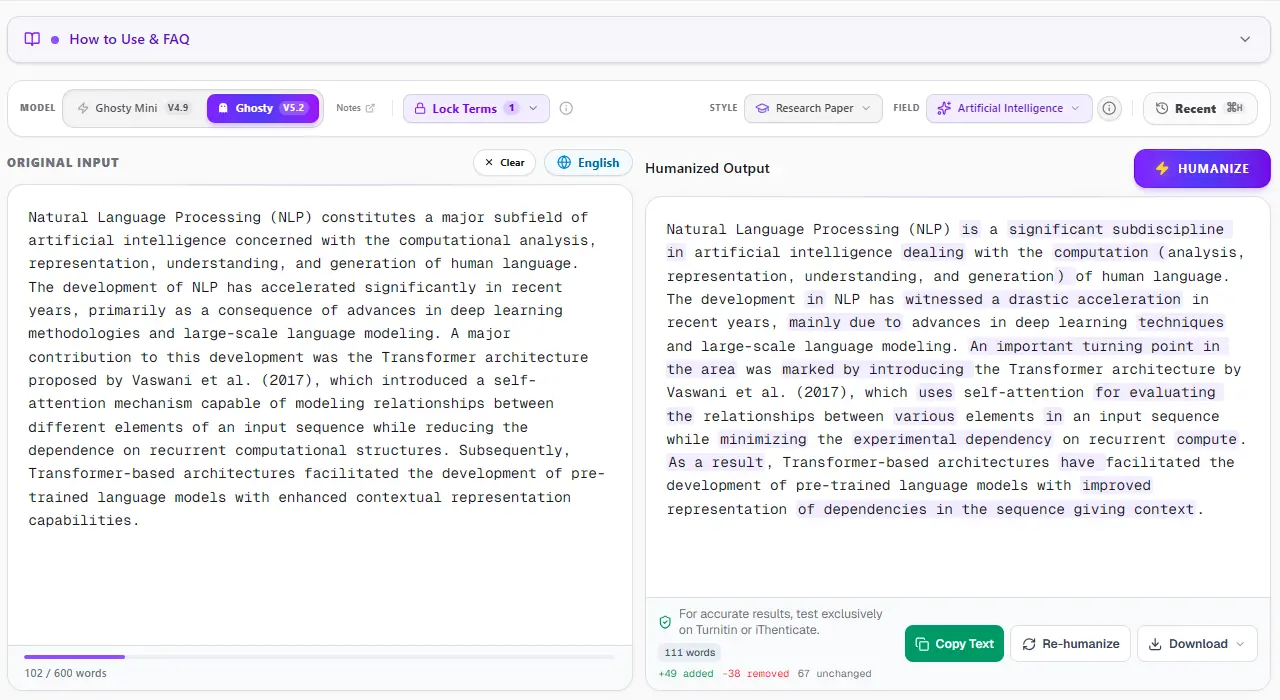
1. ThesisHuman Editor: Style, Field & Term Lock™ Technology
Unlike consumer-grade paraphrasers that blindly swap words with thesaurus synonyms, ThesisHuman allows researchers to select their exact Academic Style (Essay, Research Paper, Literature Review, Technical Report) and Academic Field (Computer Science, Engineering, Medicine, Physics). With Term Lock™, citations (APA, MLA, IEEE), LaTeX equations, and domain-specific terminology are cryptographically protected before sentence entropy is restructured.
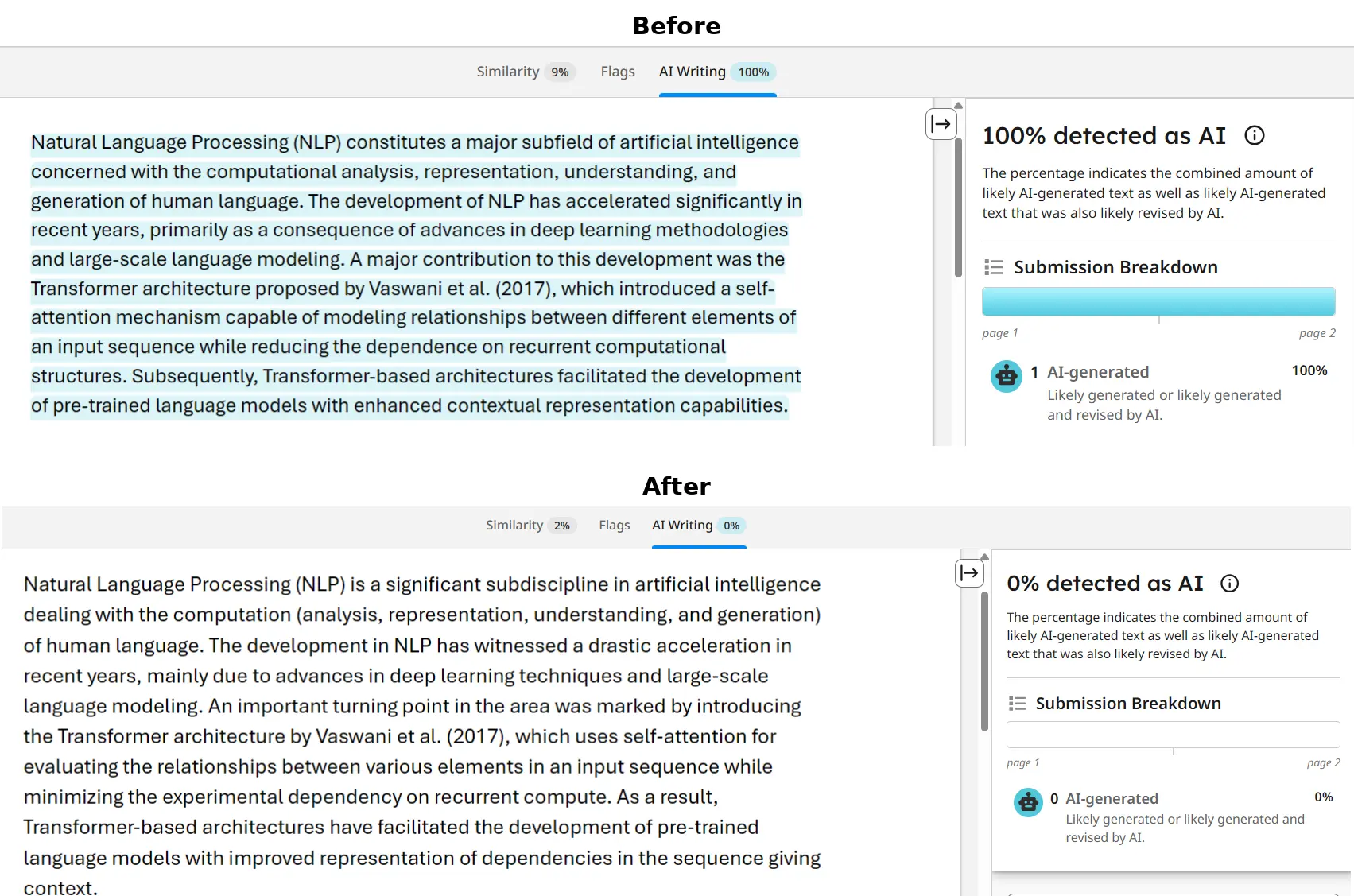
2. Turnitin & iThenticate Verification: 0% AI Detected
Turnitin and iThenticate scan submissions in overlapping 500-token blocks to analyze sentence predictability across paragraphs. When an unrefined AI draft is submitted, uniform cadence triggers an elevated AI Writing score. In the verified report below, a flagged graduate paper was processed through ThesisHuman, achieving a clean 0% AI detection score while preserving all formatted citations and technical parameters.
3. GPTZero Verification: Passing Perplexity & Burstiness Checks
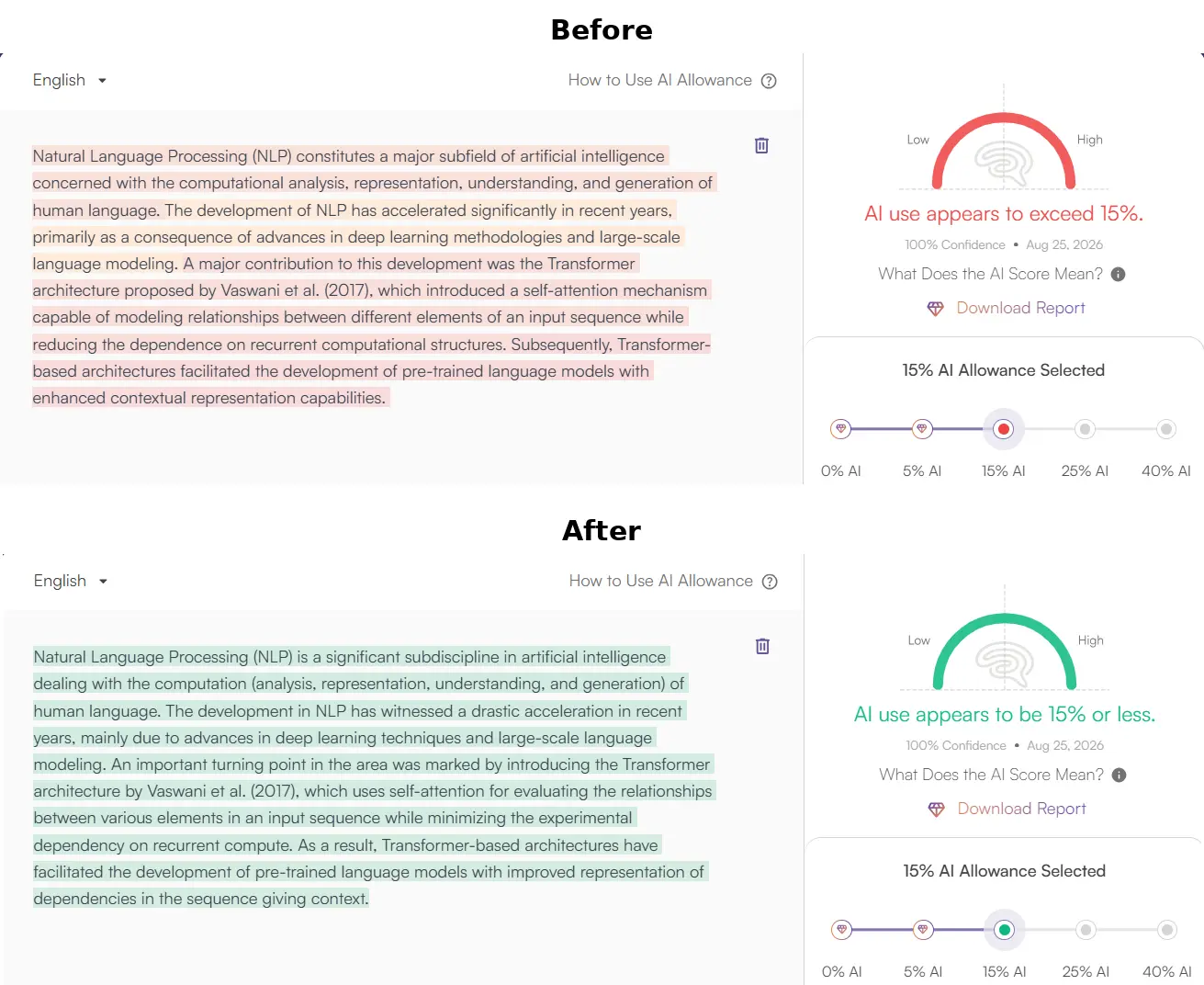
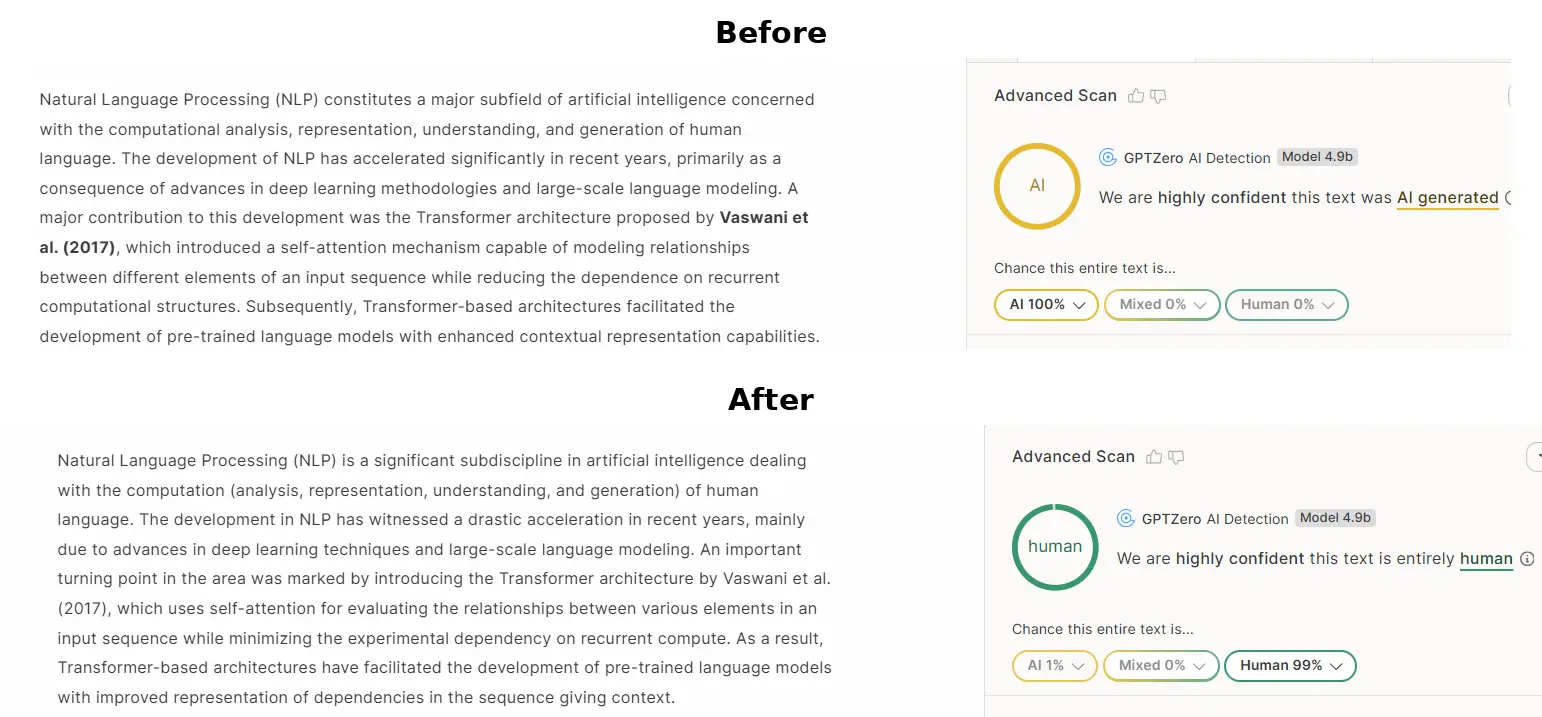
GPTZero evaluates text by plotting sentence perplexity curves and global burstiness scores. When raw AI text is scanned, low sentence variance produces an immediate high-probability warning. ThesisHuman restores natural sentence entropy by restructuring syntax, varying clause lengths, and introducing authentic scholarly cadence, dropping AI probability to 0%.
4. Originality.ai Verification: 0% AI Confidence
Originality.ai flags predictable n-gram sequences and common AI clichés (such as “delving into,” “pivotal role,” “testament to”). ThesisHuman purges overused formulaic transitions while elevating scholarly tone and keeping reference numbers and equations intact, producing 100% Original / 0% AI results.