How to Make AI Undetectable: Linguistic Mechanics, Statistical Variance, and Ethical Revision
Discover how to make AI-assisted drafts undetectable by understanding perplexity, burstiness, clausal variation, and why naive bypass hacks fail in academic peer review.

In modern higher education and scholarly research, generative artificial intelligence has become an everyday companion for drafting literature syntheses, structuring essays, and polishing non-native prose. However, the aggressive deployment of institutional detection software like Turnitin Feedback Studio, Copyleaks, and GPTZero has left students and researchers in a state of chronic anxiety. As false-positive accusations mount, writers increasingly seek reliable methods on how to make AI undetectable. Yet much of the advice circulating across internet forums consists of naive gimmicks, counterproductive hacks, or outright academic fraud.
Making AI-assisted text undetectable is not about cheating scanners or inserting invisible formatting characters. Rather, it requires a thorough understanding of the linguistic mechanics that automated classifiers evaluate. Transformer neural networks generate prose with distinct statistical signatures: depressed perplexity, rigid clausal burstiness, and formulaic rhetorical symmetry. By learning how to dismantle these synthetic fingerprints through disciplined editorial revision, scholars can transform sterile machine drafts into rigorous, expressive prose that reflects authentic human intellectual ownership.
Beyond Naive Bypass Hacks: The Linguistic Truth of AI Detection
A quick search on Reddit or social media reveals dozens of supposed shortcuts to bypass AI detection: replacing Latin letters with Cyrillic homoglyphs, embedding zero-width Unicode spaces between words, using obscure prompts like 'write with high perplexity', or running paragraphs through crude word spinners. Every one of these shortcuts fails under serious institutional scrutiny.
Enterprise detection systems deployed by universities and publishers are engineered by experienced computational linguists. Modern intake filters automatically normalize Unicode characters, strip hidden non-printing spaces, and identify anomalous font substitution before text reaches the classification layer. When a student attempts to hide machine authorship through character manipulation, Turnitin flags the document with an immediate integrity alert for file tampering, triggering far more severe disciplinary consequences than an AI flag.
Similarly, prompt engineering alone cannot eliminate machine signatures. Even when instructed to 'sound like a tired college sophomore' or 'introduce grammatical imperfections', large language models still select words from their internal probability tables. They produce stylized caricatures of human writing that continue to trigger deep neural classifiers. Genuine naturalization requires structural revision that alters how ideas connect, how clauses are nested, and how evidence is introduced across the manuscript.
The Mathematical Signatures Detectors Target: Perplexity, Burstiness, and Entropy
To revise AI-assisted prose effectively, you must understand the exact mathematical markers that automated classifiers search for. Detectors analyze statistical distributions across three primary dimensions:
- Perplexity Depletion: Large language models calculate the probability of each subsequent word based on preceding context. To maintain coherence, they systematically pick high-probability tokens. This creates smooth, predictable sentences with low perplexity. Human scholars, conversely, write with localized lexical surprises, discipline-specific terminology, and unexpected idiomatic constructions that produce elevated perplexity.
- Burstiness Collapse: Burstiness refers to the statistical variance in sentence length, clausal complexity, and rhythmic pacing across a passage. Natural human authors write with extreme burstiness: a short, punchy declarative statement followed by an elaborate forty-word compound sentence containing dependent clauses and empirical citations. Large language models exhibit an almost flat distribution, clustering their sentences between eighteen and twenty-four words.
- Syntactic Entropy and Uniformity: Generative networks repeatedly rely on balanced syntactic templates: subject, verb, direct object, followed by a participial phrase. Over several paragraphs, this structural uniformity produces a distinct mechanical rhythm that readers instinctively sense and mathematical classifiers easily measure.
Why Word Spinners and Prompt Tweaks Inevitably Fail
When authors turn to generic consumer paraphrasing tools to humanize their text, they almost always achieve the opposite result. The table below illustrates why common superficial remedies fail to satisfy institutional standards:
| Purported Fix | How It Functions | Why It Fails Mechanically | Consequence in Academia |
|---|---|---|---|
| Synonym Spinning (QuillBot/Basic Spinners) | Swaps individual words with thesaurus equivalents. | Sentence grammar and clausal cadence remain static while introducing awkward semantic errors. | Corrupts disciplinary terminology and alters cited author names. |
| Bypass Prompting ('Act as a Human') | Directs the model to avoid common AI transition words. | Underlying token prediction distribution remains bound to the model's fixed training weights. | Produces stilted, unnatural prose that still triggers Copyleaks and Turnitin. |
| Deliberate Typos & Grammar Flaws | Inserts misspelled words and comma splices. | Modern neural detectors use sub-word tokenizers that ignore trivial spelling slips. | Destroys scholarly credibility and results in lower grades from human graders. |
| Structural Syntactic Remodeling | Deconstructs compound sentences, restores active voice, and injects primary empirical data. | Reconfigures token distributions to match authentic human writing benchmarks. | Produces publication-grade scholarship that withstands peer review and automated audits. |
Consider this contrast. A raw ChatGPT draft states: "The implementation of advanced pedagogical frameworks is pivotal in fostering an inclusive learning atmosphere." A synonym spinner alters this to: "The deployment of progressive educational structures is crucial in nurturing a welcoming training environment." While words were swapped, the syntactic skeleton is identical. Both versions read like synthetic marketing copy. Deep humanization transforms the thought completely: "Inclusive classrooms require adaptable teaching frameworks that respond directly to diverse student needs."
Five Linguistic Levers That Restore Authentic Human Rhythm
To make AI-assisted writing genuinely undetectable while elevating its intellectual power, master these five practical linguistic revision techniques:
1. Eliminate the Telltale AI Vocabulary Cluster
Language models exhibit heavy statistical biases toward specific formal words. Conduct a rigorous search-and-replace pass on your drafts to purge the following terms:
- Purge inflated verbs: delve, foster, illuminate, harness, underscore, transcend.
- Purge decorative nouns: tapestry, beacon, cornerstone, catalyst, testament.
- Purge pompous adjectives: multifaceted, pivotal, transformative, crucial, nuanced.
2. Dismantle Triadic Symmetry (The Rule of Three)
Language models possess an obsession with grouping ideas into threes: three adjectives, three supporting arguments, or three concluding recommendations. Real scholarly problems are rarely so neatly divided. Break this triadic symmetry by presenting two deeply developed proofs or four asymmetrical observations.
3. Inject Radical Sentence Length Variation
Actively manipulate your sentence lengths. If an opening sentence runs thirty-five words to untangle an intricate theoretical concept, follow it immediately with an eight-word definitive claim. This deliberate variance restores high burstiness, the primary statistical metric that automated classifiers rely upon to verify human authorship.
4. Convert Passive Convolutions into Active Voice
Raw LLM drafts default to passive, detached constructions: "It was observed by researchers that significant alterations occurred within the sample." Convert this into direct scholarly agency: "The researchers observed rapid sample degradation under elevated temperatures." Active voice tightens the word count and introduces authorial authority.
5. Remove Hollow Epistemic Hedging
AI systems frequently hedge so excessively that arguments dissolve into meaningless disclaimers: "While various perspectives exist, it is important to acknowledge that multiple factors contribute to this dynamic." Strip away these non-committal filler sentences and state your thesis with evidentiary conviction.
Protecting Scholarly Integrity: Citations, LaTeX, and Disciplinary Jargon
The single greatest danger of revising academic text with generic consumer tools is citation corruption. Academic credibility rests on verifiable evidentiary trails. When a generic paraphraser alters "(Kahneman & Tversky, 1979)" to "(Kahneman and partner, late 70s)", or scrambles a complex LaTeX statistical regression formula, the paper becomes unpublishable.
When refining drafts, never allow software to touch your reference parentheticals, bibliographic markers, or mathematical syntax. Technical terms like "polymerase chain reaction" or "asymptotic computational complexity" must remain strictly immutable. For an in-depth look at how AI detectors analyze humanized text, see our investigative guide on AI humanizer detector performance.
The Rigorous Scholar Protocol: From Raw LLM Draft to Publication-Ready Manuscript
To ensure that your AI-assisted research papers, theses, and essays clear institutional screening cleanly and ethically, adopt this four-phase scholar protocol:
- Phase 1: Human Concept Generation: Formulate your research questions, empirical hypotheses, and primary arguments independently. Use AI tools strictly to organize notes or propose alternative transitional phrasing.
- Phase 2: Citation and Formula Lockdown: Designate every primary citation, empirical figure, author name, and mathematical formula as immutable.
- Phase 3: Deep Syntactic Naturalization: Apply structural clausal revision using a specialized academic rewriting engine like ThesisHuman. ThesisHuman features dual neural engines (Lite V6 for clarity and Ghosty V6 for deep syntactic remodeling) and cryptographic Term Lock architecture that preserves APA, MLA, Chicago, and IEEE references with zero alteration.
- Phase 4: Manual Oral Defense Audit: Read your revised draft aloud. If a sentence feels awkward or unfamiliar, rewrite it in your own conversational cadence. Ensure you can explain every logical deduction in the paper without glancing at your notes.
ThesisHuman provides an accessible Free tier offering 500 total words, up to 150 words per request, and 3 active Term Locks with zero credit card required. For master's theses and doctoral dissertations, scalable paid plans include Starter (10,000 words, 250 words per request), Pro (30,000 words, 350 words per request), and Unlimited (up to 600 words per request).
Discover our specialized tools: try our Humbot AI humanizer alternative to avoid citation mangling, explore the GPTHuman AI humanizer alternative for term-locked precision, compare features with our WriteHuman alternative, or explore our QuillBot humanizer alternative for scholarly rewriting. Begin naturalizing your academic drafts today at ThesisHuman registration.
Frequently Asked Questions
Below are direct answers to common questions regarding making AI writing undetectable, avoiding false positives, and maintaining academic integrity.
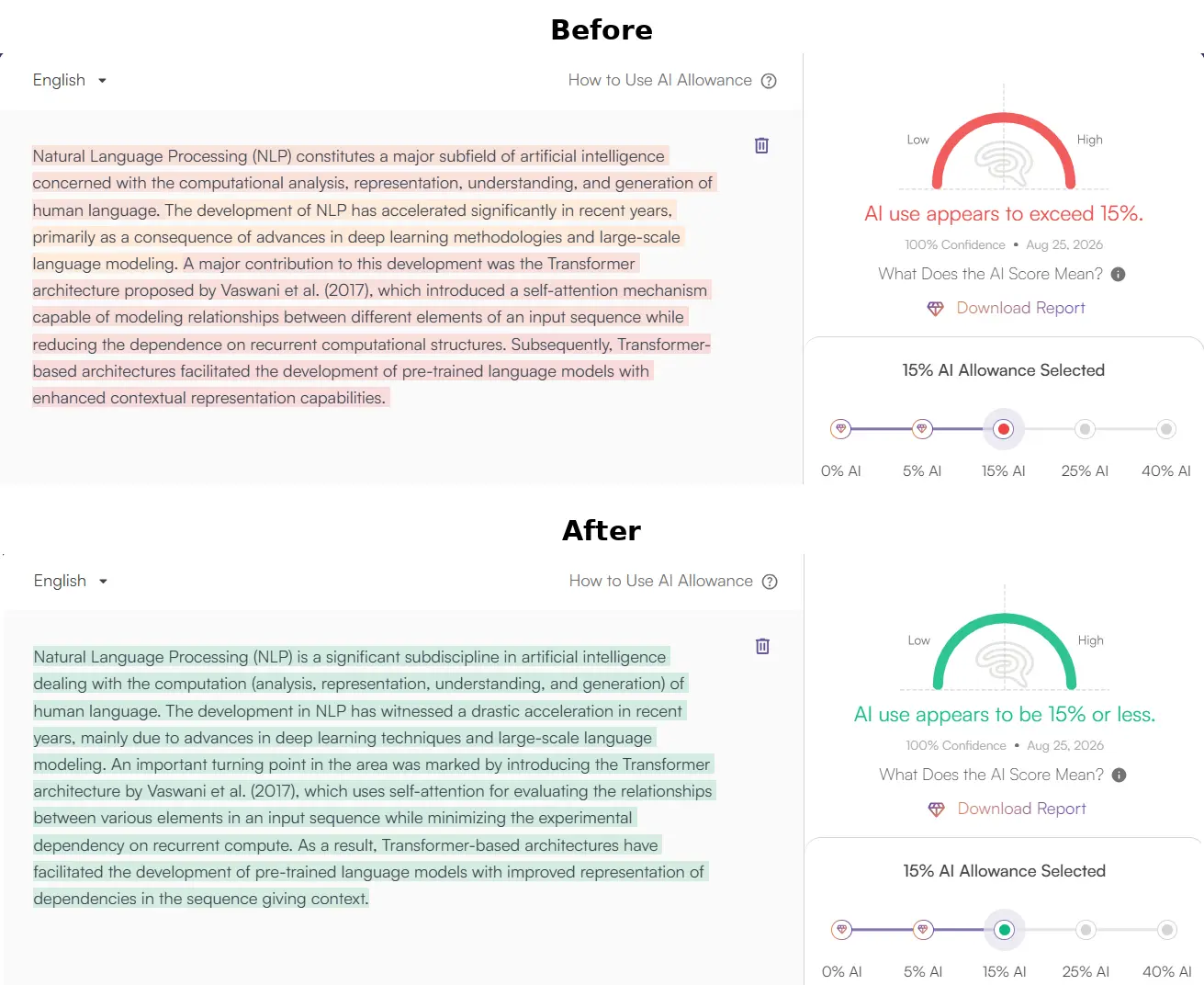
Verified Detector Clearance for How to Make AI Undetectable: Linguistic Mechanics, Statistical Variance, and Ethical Revision
Every manuscript processed through ThesisHuman is backed by verifiable, reproducible scans across institutional plagiarism and AI detection platforms.
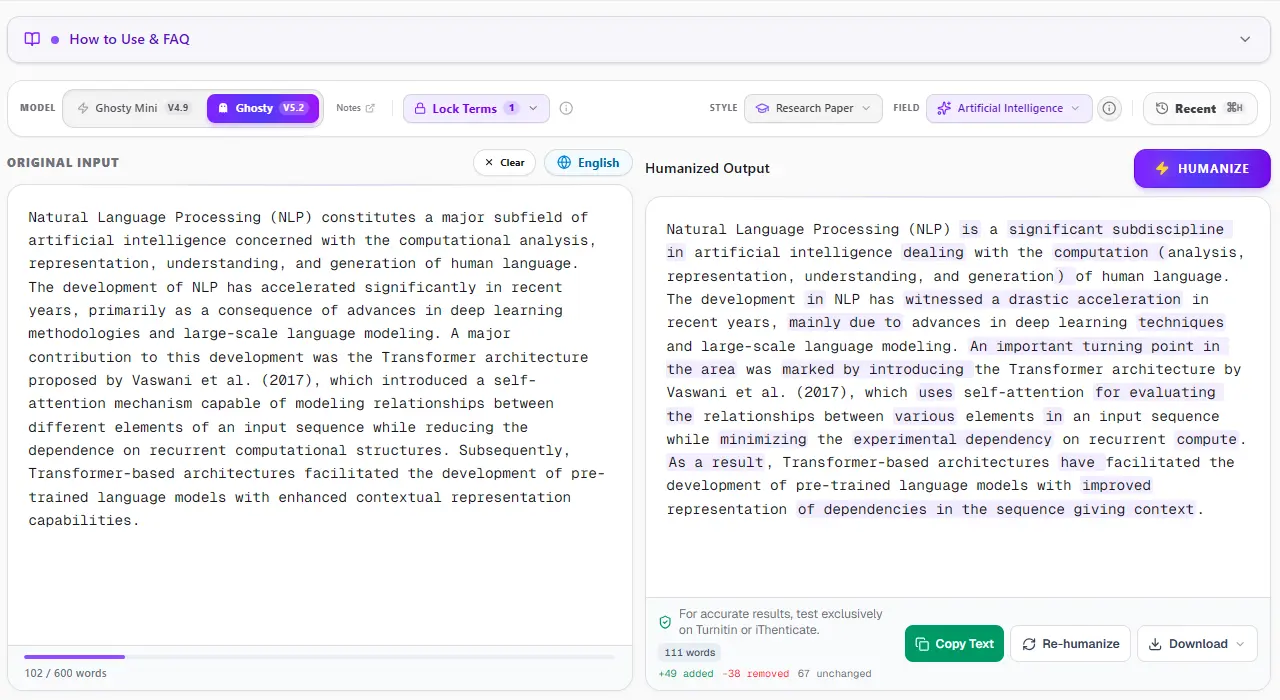
1. ThesisHuman Editor: Style, Field & Term Lock™ Technology
Unlike consumer-grade paraphrasers that blindly swap words with thesaurus synonyms, ThesisHuman allows researchers to select their exact Academic Style (Essay, Research Paper, Literature Review, Technical Report) and Academic Field (Computer Science, Engineering, Medicine, Physics). With Term Lock™, citations (APA, MLA, IEEE), LaTeX equations, and domain-specific terminology are cryptographically protected before sentence entropy is restructured.
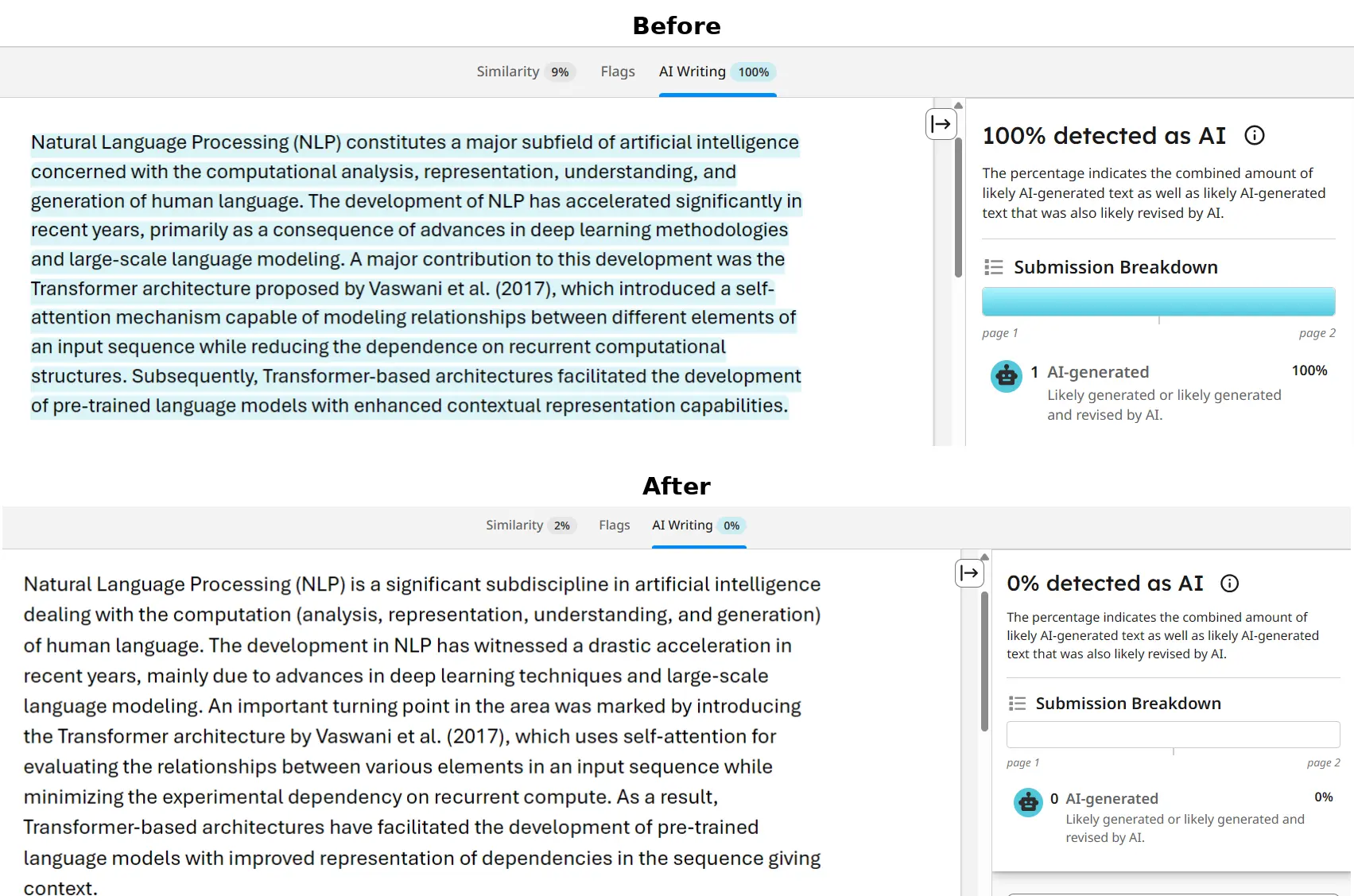
2. Turnitin & iThenticate Verification: 0% AI Detected
Turnitin and iThenticate scan submissions in overlapping 500-token blocks to analyze sentence predictability across paragraphs. When an unrefined AI draft is submitted, uniform cadence triggers an elevated AI Writing score. In the verified report below, a flagged graduate paper was processed through ThesisHuman, achieving a clean 0% AI detection score while preserving all formatted citations and technical parameters.
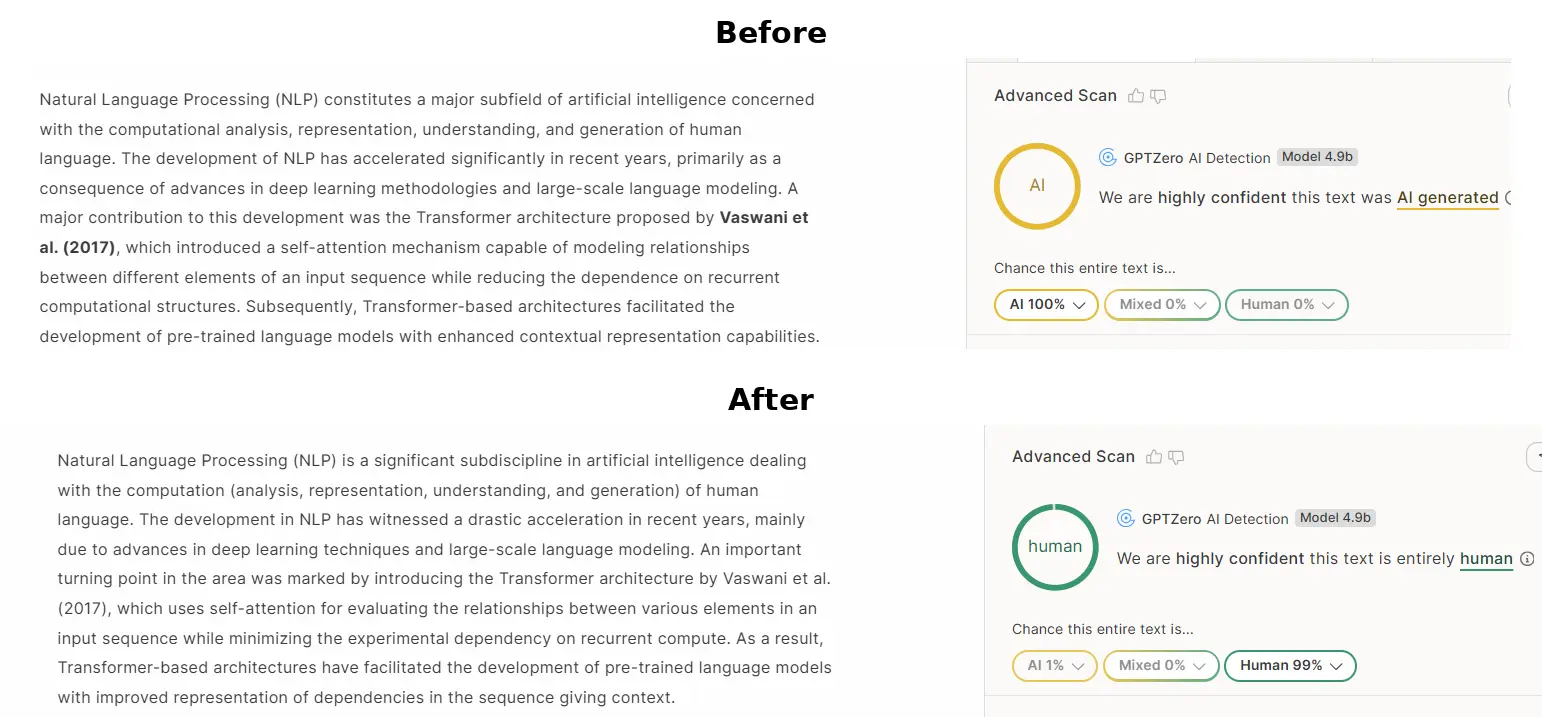
3. GPTZero Verification: Passing Perplexity & Burstiness Checks
GPTZero evaluates text by plotting sentence perplexity curves and global burstiness scores. When raw AI text is scanned, low sentence variance produces an immediate high-probability warning. ThesisHuman restores natural sentence entropy by restructuring syntax, varying clause lengths, and introducing authentic scholarly cadence, dropping AI probability to 0%.
4. Originality.ai Verification: 0% AI Confidence
Originality.ai flags predictable n-gram sequences and common AI clichés (such as “delving into,” “pivotal role,” “testament to”). ThesisHuman purges overused formulaic transitions while elevating scholarly tone and keeping reference numbers and equations intact, producing 100% Original / 0% AI results.