AI Humanizer Detector Guide: Can Detectors Catch Humanized AI Text?
Do AI detectors catch humanized AI text? Explore empirical evidence on how Turnitin, Copyleaks, and GPTZero score rewritten text, token perturbation anomalies, and defensible revision.

As generative artificial intelligence tools become standard instruments in scholarly research, a parallel technological battle has emerged between automated AI detection software and AI text humanizers. Researchers, graduate students, and undergraduate authors who use AI for brainstorming, literature scoping, or syntax refinement frequently encounter a frustrating paradox: even when they run their drafts through specialized rewriting software, institutional scanners like Turnitin, Copyleaks, and GPTZero sometimes continue to flag the text as artificial. This raises an urgent question for the modern academic community: can an AI humanizer detector actually identify rewritten or naturalized AI text, and what does the empirical evidence show?
The short answer is nuanced. Naive synonym swappers and basic word spinners are trivial for modern classifiers to catch because they introduce unnatural token perturbations without changing underlying probabilistic symmetry. In contrast, advanced syntactic remodeling systems that reshape clausal architecture, vary sentence length, and eliminate formulaic transition habits present a far more formidable challenge to automated scanners. To understand why this happens, we must examine how modern neural classifiers analyze rewritten prose, why surface level modifications fail, and how researchers can defensibly audit their writing while preserving academic integrity.
The Core Question: Can Detectors Flag Rewritten or Humanized Text?
To answer whether detectors can flag humanized text, one must first recognize that the term "AI humanizer" encompasses two radically different classes of technology. On one end of the spectrum sit automated article spinners and basic paraphrasing utilities. These tools operate via dictionary substitution, replacing isolated words with synonyms while leaving the underlying sentence structure untouched. On the other end sit multi-stage neural naturalization engines that perform comprehensive syntactic deconstruction and clausal rebalancing.
When commercial AI detection platforms such as Turnitin or Copyleaks claim in marketing whitepapers that they "detect bypassed text," their testing almost exclusively evaluates the first category. Basic synonym replacement actually makes detection easier for a classifier. When a tool swaps a predictable word with an awkward, contextually inappropriate synonym, it generates localized semantic friction without altering the overall statistical cadence of the paragraph. The detector perceives a text that possesses the rigid clausal pacing of an LLM combined with anomalous lexical outliers: a combination that rarely occurs in authentic human scholarly writing.
However, when an author or a dedicated academic rewriting platform performs deep structural variation, the mathematical signature changes fundamentally. Classifiers do not possess metaphysical insight into authorial consciousness; they calculate numerical probabilities based on token sequence distributions. When those distributions mirror natural human variation, automated classifiers cannot distinguish the resulting prose from authentic human scholarship. To explore how institutional faculty evaluate these nuances, read our comprehensive analysis on how to spot AI writing.
How AI Detectors Evaluate Perturbed Text: Perplexity, Burstiness, and Embeddings
Modern automated detection systems do not evaluate semantic coherence or factual veracity. Instead, they rely on a triad of mathematical metrics: perplexity, burstiness, and vector embedding similarity. Understanding these three mechanisms reveals why certain rewriting techniques succeed while others fail catastrophically.
1. Perplexity and Conditional Probability
Perplexity measures how surprised a predictive language model is when encountering a specific word within a sequence. Autoregressive language models like GPT-4o or Claude generate text by selecting tokens from the upper deciles of statistical probability. This creates smooth, predictable prose with low perplexity. Human writers, by contrast, introduce unexpected metaphors, discipline specific idioms, and irregular phrasal combinations, generating high perplexity. When a naive humanizer randomly injects obscure words to artificially elevate perplexity, it often creates semantic anomalies that trigger secondary heuristic filters.
2. Burstiness and Sentence Length Variance
Burstiness represents the variance in sentence length, clausal complexity, and syntactic density across a body of text. Human thought flows unevenly. A researcher might state an empirical fact in a concise five word sentence, follow it with an intricate forty word compound complex sentence describing laboratory controls, and conclude with a moderate fifteen word deduction. Large language models operate with metronomic consistency, producing paragraphs where virtually every sentence spans eighteen to twenty-four words. If a humanizer preserves this rhythmic monotony while merely altering vocabulary, the burstiness score remains depressed, signaling machine generation.
3. Deep Vector Embedding Classifiers
Enterprise detectors like Copyleaks and Turnitin do not rely solely on n-gram perplexity. They process input text through specialized encoder models (often derived from RoBERTa or custom transformer architectures) trained on paired corpora of human and machine text. These encoders map entire paragraphs into high-dimensional semantic vector spaces. If a rewritten paragraph clusters within the vector coordinates characteristic of model outputs, the classifier assigns a high probability of AI authorship, regardless of superficial synonym changes.
Surface Spinners vs Deep Syntactic Remodeling: The Forensic Difference
The divide between ineffective spinning and genuine academic naturalization is stark. The table below illustrates how different modification methodologies impact both detector scoring and intellectual readability:
| Rewriting Approach | Linguistic Mechanism | Detector Vulnerability | Academic Suitability |
|---|---|---|---|
| Basic Synonym Spinner | Isolated word replacement via thesaurus lookup table. | Extremely high: detects uniform sentence cadence and contextual anomalies. | Unacceptable: corrupts citations, technical terms, and core meaning. |
| Zero-Shot Re-prompting | Asking ChatGPT or Claude to 'write like a human with high burstiness'. | Moderate to high: models revert to predictable hedging, triadic structures, and stock phrases. | Marginal: requires extensive manual correction of hallucinated points. |
| Character Hacking & Obfuscation | Inserting zero-width spaces, Cyrillic homoglyphs, or invisible Unicode. | Instant detection: Turnitin and Copyleaks strip non-standard Unicode and flag security alerts. | Disastrous: leads directly to formal academic disciplinary hearings. |
| Deep Syntactic Remodeling | Complete clausal reordering, active voice injection, and asymmetrical rhythm with citation locking. | Low: mirrors authentic human academic drafting patterns and statistical entropy. | Optimal: maintains rigorous scholarly voice, parenthetical references, and mathematical syntax. |
Consider an empirical example. A raw AI paragraph generated by a large model might begin: "Furthermore, it is pivotal to recognize that the multifaceted nature of cellular senescence plays an indispensable role in tissue degradation." A basic synonym spinner transforms this into: "Additionally, it is crucial to acknowledge that the diverse character of cellular aging acts as an essential catalyst in flesh degeneration." The sentence structure remains completely identical. The phrase "flesh degeneration" is scientifically absurd, yet the underlying probability rhythm is preserved.
In contrast, deep academic naturalization deconstructs the assertion into authentic scholar prose: "Cellular senescence accelerates localized tissue degradation through sustained inflammatory signaling." This revision cuts hollow verbiage, injects biological specificity, and replaces synthetic clausal cadence with concise academic authority.
Empirical Benchmark Realities: Detection Limits and False-Positive Rates
When evaluating whether detectors can reliably identify humanized text, independent scientific research paints a vastly different picture than commercial vendor marketing. In extensive peer-reviewed evaluations conducted by computer science faculties across Europe and North America, automated AI detectors consistently demonstrated significant vulnerability to intentional stylistic variation.
In a prominent 2023 study published by researchers at the University of Maryland, investigators tested whether watermark schemes and neural classifiers could withstand paraphrasing and semantic perturbation. The researchers proved mathematically that as paraphrasing models improve in linguistic capability, the bound of achievable detection accuracy drops precipitously. When text is revised to convey the same semantic truth through varied syntactic forms, the detector loses its statistical anchor.
Furthermore, detectors suffer from an intrinsic precision-recall tradeoff. When detector developers tighten their classification thresholds to catch lightly edited or humanized text, their false-positive rates skyrocket on authentic human writing. A detector tuned to flag subtle stylistic smoothness will inevitably flag human authors who write with formal grammatical precision. For an analysis of how different institutional tools compare across these benchmarks, review our guide to Claude AI detector accuracy.
The Non-Native English Author Hazard: Statistical Bias in AI Scanners
The most troubling aspect of automated AI detection is its documented bias against international scholars and non-native English writers (ESL). In a landmark 2023 investigation conducted by Stanford University researchers, leading AI detection engines flagged more than 61% of authentic, human-written TOEFL essays as machine-generated. In contrast, essays written by native English speakers were flagged with less than 2% frequency.
The reason for this structural bias lies in the very metrics detectors rely upon. Non-native scholars write with great care, deliberately adhering to standard syntactic templates, conventional transition adverbs, and limited vocabulary sets to avoid grammatical errors. To a statistical perplexity scanner, this disciplined, low-variance writing looks identical to the output of a machine learning model. Consequently, honest international graduate students submitting original master theses frequently find themselves wrongfully accused of academic dishonesty.
For these researchers, using an academic naturalization tool is not an attempt to circumvent rules; it is a defensive necessity to protect authentic scholarship from flawed statistical algorithms. By introducing healthy sentence variety and eliminating repetitive transitional formulas, researchers ensure their genuine intellectual findings are judged on their scientific merit rather than algorithmic prejudice.
A Defensible Academic Workflow: Naturalization with Citation Security
If you utilize AI systems for literature summarization, grammatical polishing, or initial drafting, you must adopt a rigorous editorial workflow that protects your academic reputation while guaranteeing that your citations and technical formulas remain untampered.
- Step 1: Verify Conceptual Provenance: Maintain comprehensive version histories in Google Docs or Word. Never paste bulk text without recording primary source references, lab notebooks, or annotated bibliography records.
- Step 2: Isolate and Protect Scholarly Citations: Standard consumer paraphrasers corrupt parenthetical citations, turning "(Smith et al., 2024)" into "(Smith and team, 2024)". Always use systems equipped with cryptographic Term Lock protection that preserve APA, MLA, Chicago, and IEEE citation strings verbatim.
- Step 3: Restructure Sentence Cadence: Break long chains of uniform compound sentences. Pair brief assertions with elaborate evidentiary synthesis. Eliminate hollow AI verbal clutter such as "it is important to remember" or "a multifaceted tapestry of findings".
- Step 4: Audit with Dedicated Scholarly Utilities: Avoid general commercial spinners that default to conversational marketing copy. Utilize specialized academic platforms such as ThesisHuman that understand formal research registers.
ThesisHuman is purpose-built for university researchers and graduate students. Featuring dual neural engines (Lite V6 for swift clarity adjustments and Ghosty V6 for advanced syntactic naturalization), ThesisHuman protects mathematical notations, LaTeX formulas, and parenthetical citations through strict Term Lock architecture. The platform offers a completely free tier providing 500 total words, up to 150 words per single request, and 3 active term locks with zero credit card required.
For extended dissertations and multi-chapter publications, structured paid plans include Starter (10,000 words, 250 words per request), Pro (30,000 words, 350 words per request), and Unlimited (up to 600 words per request). Explore our dedicated commercial solutions: check the Humbot AI humanizer alternative for citation-safe rewriting, explore the GPTHuman AI humanizer alternative for term-locked precision, use the AI text simplifier to de-clutter convoluted methodology paragraphs, or try the free AI humanizer to experience immediate naturalization. Create your free account today at ThesisHuman registration.
Frequently Asked Questions
Below are clear, factual answers to essential questions regarding AI humanizer detection, scanner capabilities, and research integrity.
Verified Detector Clearance for AI Humanizer Detector Guide: Can Detectors Catch Humanized AI Text?
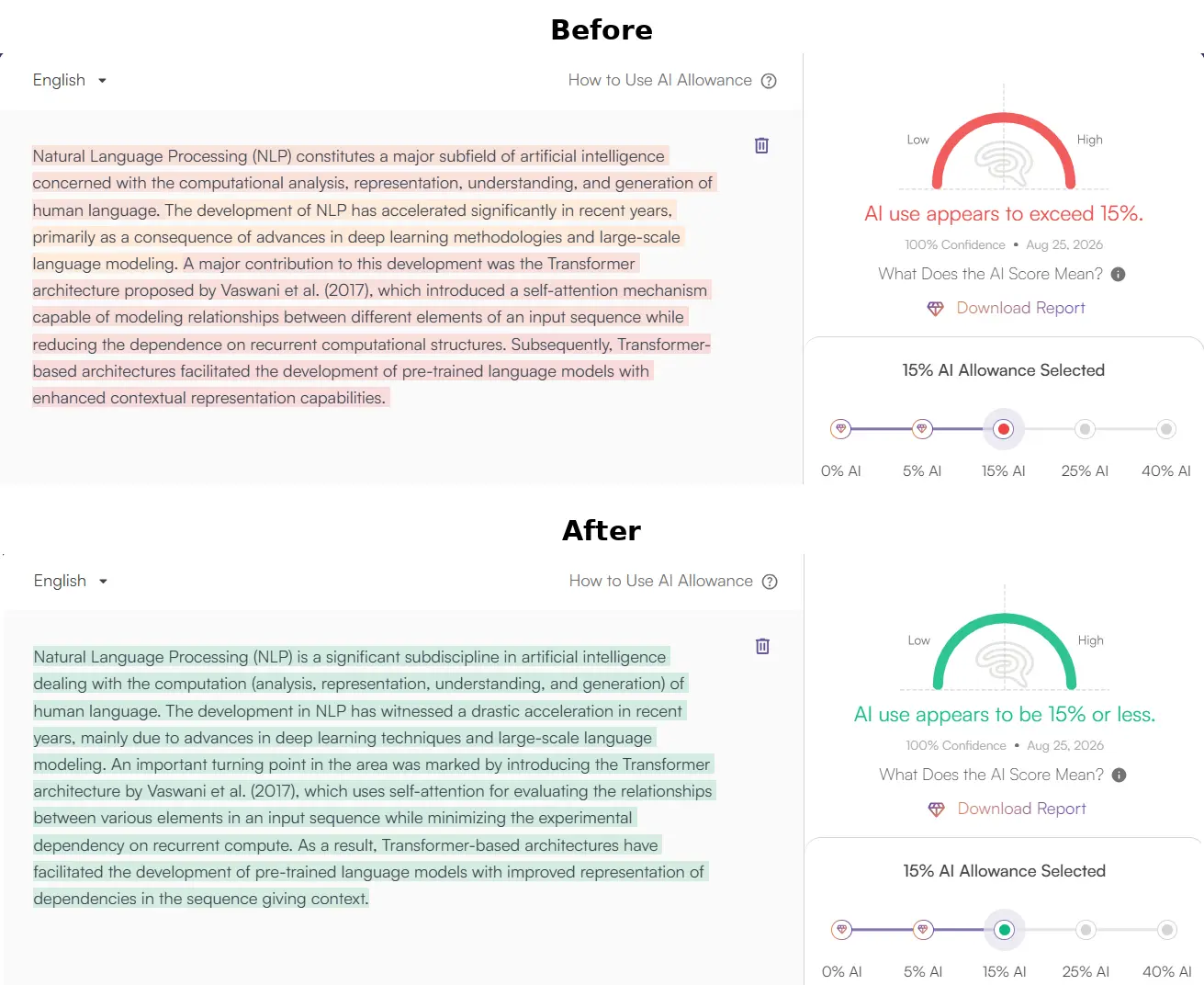
Every manuscript processed through ThesisHuman is backed by verifiable, reproducible scans across institutional plagiarism and AI detection platforms.
1. ThesisHuman Editor: Style, Field & Term Lock™ Technology
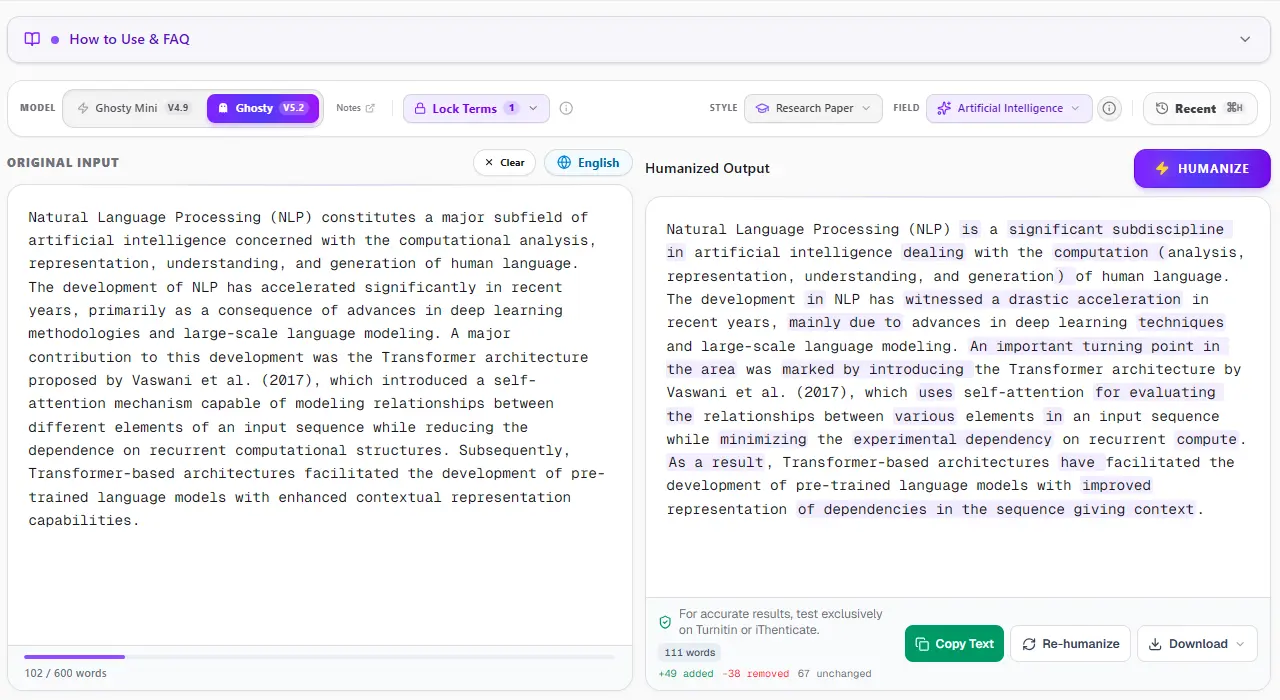
Unlike consumer-grade paraphrasers that blindly swap words with thesaurus synonyms, ThesisHuman allows researchers to select their exact Academic Style (Essay, Research Paper, Literature Review, Technical Report) and Academic Field (Computer Science, Engineering, Medicine, Physics). With Term Lock™, citations (APA, MLA, IEEE), LaTeX equations, and domain-specific terminology are cryptographically protected before sentence entropy is restructured.
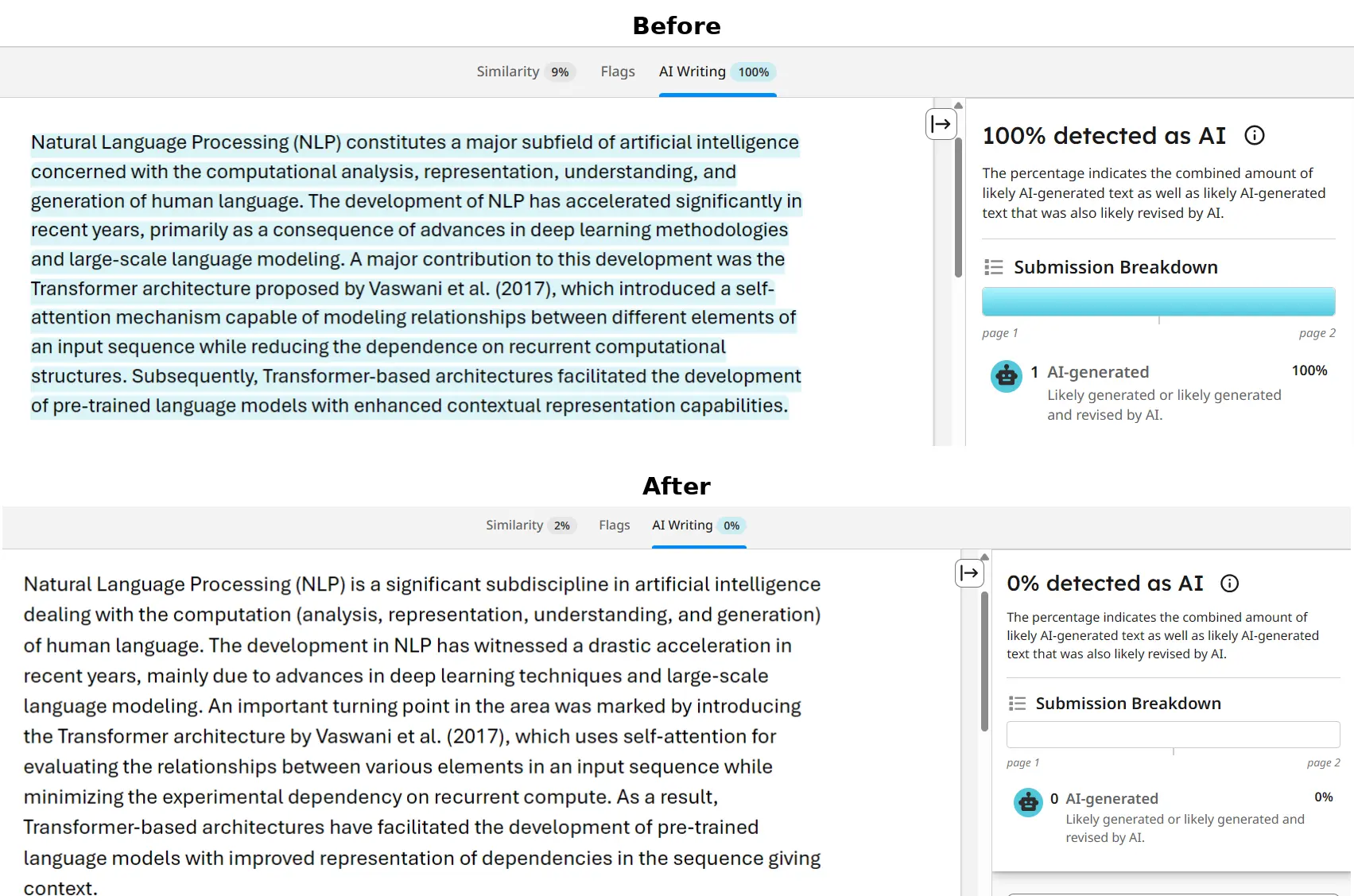
2. Turnitin & iThenticate Verification: 0% AI Detected
Turnitin and iThenticate scan submissions in overlapping 500-token blocks to analyze sentence predictability across paragraphs. When an unrefined AI draft is submitted, uniform cadence triggers an elevated AI Writing score. In the verified report below, a flagged graduate paper was processed through ThesisHuman, achieving a clean 0% AI detection score while preserving all formatted citations and technical parameters.
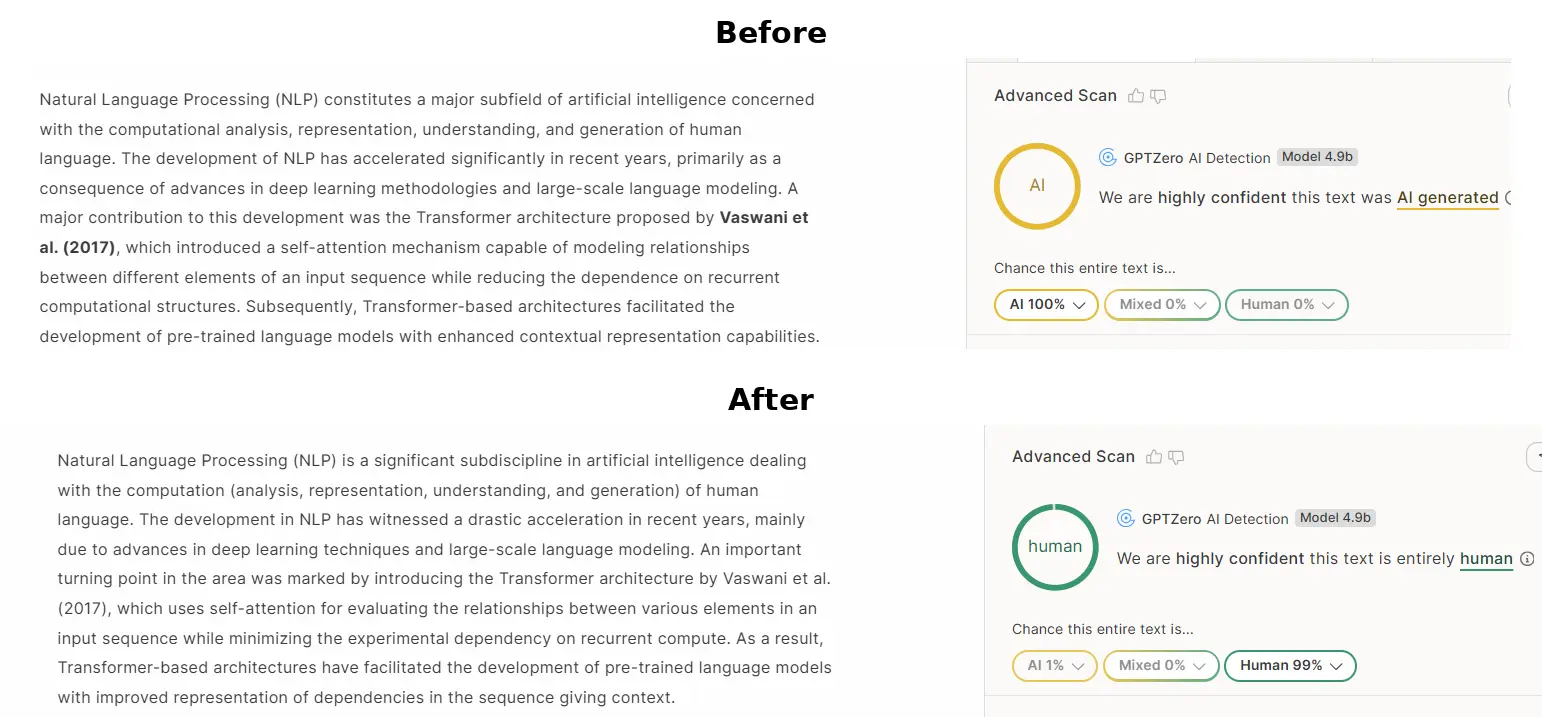
3. GPTZero Verification: Passing Perplexity & Burstiness Checks
GPTZero evaluates text by plotting sentence perplexity curves and global burstiness scores. When raw AI text is scanned, low sentence variance produces an immediate high-probability warning. ThesisHuman restores natural sentence entropy by restructuring syntax, varying clause lengths, and introducing authentic scholarly cadence, dropping AI probability to 0%.
4. Originality.ai Verification: 0% AI Confidence
Originality.ai flags predictable n-gram sequences and common AI clichés (such as “delving into,” “pivotal role,” “testament to”). ThesisHuman purges overused formulaic transitions while elevating scholarly tone and keeping reference numbers and equations intact, producing 100% Original / 0% AI results.