How to Make ChatGPT Sound More Human: Advanced Prompting and Structural Revision
Eliminate robotic AI habits from your writing. Learn how prompt constraints, syntactic variation, and academic editing make ChatGPT drafts read authentically human.

Generative artificial intelligence has permanently transformed academic drafting, literature review synthesis, and essay outlining. Yet anyone who has spent ten minutes reading unedited output from ChatGPT, Claude, or Gemini recognizes the unmistakable signature of machine prose: smooth, polite, perfectly grammatical, and completely devoid of human rhythm.
When submitted to university instructors or peer reviewers, raw ChatGPT prose raises immediate alarms, not necessarily because reviewers run detection software, but because the writing sounds robotic. In this comprehensive guide, we examine the structural reasons why ChatGPT sounds synthetic and provide a proven toolkit of prompt constraints and editing techniques to transform stiff AI text into authentic, defensible academic writing.
Why Default ChatGPT Writing Sounds Synthetic
To make ChatGPT write like a human, one must first identify what makes it sound like a machine. Large language models do not write with intent, emotional nuance, or skepticism. Instead, they choose next tokens based on probability calculations across vast internet corpora.
This mathematical process introduces four consistent stylistic anomalies:
- Symmetrical Paragraph Structure: ChatGPT almost always begins paragraphs with a broad topic assertion, adds two mid-length explanatory sentences, and concludes with a summary wrap-up sentence.
- Unnaturally Uniform Sentence Lengths: While humans naturally vary sentence lengths from four words to forty words, generative models default to an unvarying rhythm of eighteen to twenty-four words.
- Forced Symmetry and Rule-of-Three Lists: When asked to explain a concept, ChatGPT defaults to bullet points or tripartite lists ("clarity, precision, and efficiency").
- Excessive Politeness and Balanced Hedging: Generative models are trained via Reinforcement Learning from Human Feedback (RLHF) to avoid controversial stances, leading to repetitive phrases like "while both perspectives offer merit, it is essential to consider...".
5 Prompting Constraints That Eliminate AI Fluff
Generic prompts like "write this in a human tone" or "make it sound casual" produce mediocre results because they fail to address the mathematical roots of generative cadence. Instead, use these five concrete negative and structural constraints in your system prompt:
Constraint 1: Ban the Generative Cliché Lexicon
Explicitly instruct the model: "Do not use the following words or phrases under any circumstances: delve, testament, tapestry, pivotal, crucial role, navigate, foster, moreover, furthermore, in conclusion, beacon, or vibrant." Banning these high-probability tokens forces the model to search deeper in its vocabulary distribution.
Constraint 2: Mandate Sentence Length Heterogeneity
Add this structural instruction: "Vary sentence lengths aggressively. Write at least two short declarative sentences (under eight words) per paragraph, followed by a compound sentence of over twenty-five words. Avoid uniform rhythmic cadence."
Constraint 3: Eliminate Summary Wrap-Up Sentences
Generative models love to finish every paragraph with a moralizing conclusion. Instruct the model: "Do not end paragraphs with summary sentences or trite conclusions. Conclude each paragraph on a specific empirical observation or unanswered research question."
Constraint 4: Force Active Disciplinary Voice
Direct the model: "Write from the perspective of an empirical researcher. Favor active verbs over nominalizations. Instead of writing 'an analysis was conducted by the team', write 'the authors analyzed'."
Constraint 5: Require Concrete Evidence Before Abstraction
Instruct: "Anchor every theoretical claim in a specific methodological detail, statistical dataset, or historical case study before stating the conceptual takeaway."
The Rhythm Principle: Injecting Burstiness Manually
Prompting alone can only take your writing so far. To make your prose genuinely human, you must apply manual rhythm editing. Read your draft aloud. If your voice follows a hypnotic, repetitive meter, you are looking at synthetic cadence.
Consider this side-by-side comparison of a literature review excerpt:
| Drafting Stage | Sample Text | Linguistic Characteristics |
|---|---|---|
| Raw ChatGPT Draft | "Furthermore, it is crucial to recognize that automated evaluation systems play a pivotal role in modern educational assessment, fostering student engagement while streamlining administrative workflows across diverse learning environments." | Monotonous 29-word sentence; packed with clichés ("crucial to recognize", "pivotal role", "fostering engagement"). Flat cadence. |
| Humanized Academic Revision | "Automated grading tools save instructor time. Yet their pedagogical value remains contentious. When algorithmic rubrics assess open-ended research essays, students frequently adjust their syntax to satisfy the scoring model rather than refining conceptual arguments." | Dynamic burstiness: sentences of 6 words, 6 words, and 23 words. Specific disciplinary critique without hollow buzzwords. |
Before and After: Humanities, STEM, and Social Sciences
Different academic disciplines require different humanization adjustments. Here is how to apply targeted structural revisions across three primary academic fields:
1. Humanities and History
Raw AI: "The French Revolution stands as a testament to the transformative power of popular discontent, navigating a complex tapestry of social upheavals that reshaped European governance."
Humanized: "In the summer of 1789, bread shortages converged with fiscal collapse. The resulting peasant revolts dismantled feudal land tenures across rural France in weeks, forcing the National Assembly to abolish aristocratic privileges."
2. STEM and Life Sciences
Raw AI: "CRISPR-Cas9 technology plays a crucial role in modern genomic engineering, offering researchers unprecedented precision in modifying cellular mechanisms."
Humanized: "By utilizing a guide RNA complementary to target genomic sequences, the Cas9 endonuclease introduces double-strand breaks at designated loci. Non-homologous end joining then repairs the break, frequently introducing targeted insertions or deletions."
3. Social Sciences and Economics
Raw AI: "It is important to remember that inflationary pressures significantly impact low-income households, creating multifaceted economic challenges in modern society."
Humanized: "When annual consumer inflation exceeds 5%, households in the bottom income quartile spend over 40% of disposable earnings on non-discretionary energy and groceries. Real purchasing power deteriorates rapidly."
Purging the 12 Most Common Generative Clichés
Whenever you review a draft generated with ChatGPT assistance, conduct a search-and-replace audit for these high-frequency machine markers:
- "Delve deeper into..." → Replace with: "Investigate", "Examine", or "Analyze"
- "A testament to..." → Replace with: "Evidence of", "Demonstrates", or "Illustrates"
- "Plays a pivotal/crucial role..." → Replace with: "Influences", "Shapes", or "Directly affects"
- "Rich tapestry of..." → Replace with: "Complex body of", "Diverse range of"
- "In the fast-paced realm of..." → Replace with: State the specific discipline and timeframe directly
- "It is important to remember that..." → Delete entirely and state the claim directly
Injecting Scholarly Hedging and Conceptual Specificity
Human scholars rarely make sweeping, absolute assertions without evidentiary qualification. Where ChatGPT writes "AI will revolutionize higher education", a university researcher writes "Preliminary trial data suggests automated synthesis tools reduce literature sorting times, though longitudinal effects on retention remain unmeasured."
Introduce calibrated academic hedging tokens: "tends to indicate", "under specific experimental parameters", "with notable exceptions in quantitative cohorts", and "subject to methodological constraints". This grounds your writing in genuine academic humility.
Preserving In-Text Citations and Technical Data
The greatest danger when rewriting ChatGPT text is corrupting your citations. If you rely on automated online rewriters, in-text references like "(Smith & Wesson, 2022)" can be mangled into nonsensical words. Always preserve citation brackets, LaTeX equations, and statistical markers intact.
For an automated solution built specifically to preserve APA, MLA, and IEEE standards while eliminating robotic cadence, test our humanize ChatGPT workflow or try our free undetectable AI humanizer to experience citation-safe rewriting.
Frequently Asked Questions
Can prompting alone make ChatGPT 100% undetectable?
No prompt can guarantee complete bypass of institutional classifiers because large language models inherently generate tokens based on statistical probability. However, advanced prompt constraints combined with human rhythm editing drastically reduce false positive triggers.
Why does ChatGPT use the word 'delve' so often?
The word 'delve' appears frequently in the reinforcement learning datasets used by OpenAI trainers, making it a high-probability transition word for essay introductions and conclusions.
Does running ChatGPT text through QuillBot make it sound human?
No. As analyzed in our QuillBot vs academic humanizing report, synonym spinners swap words within the same robotic sentence structure, often producing awkward phrasing that raises plagiarism flags.
Verified Detector Clearance for How to Make ChatGPT Sound More Human: Advanced Prompting and Structural Revision
Every manuscript processed through ThesisHuman is backed by verifiable, reproducible scans across institutional plagiarism and AI detection platforms.
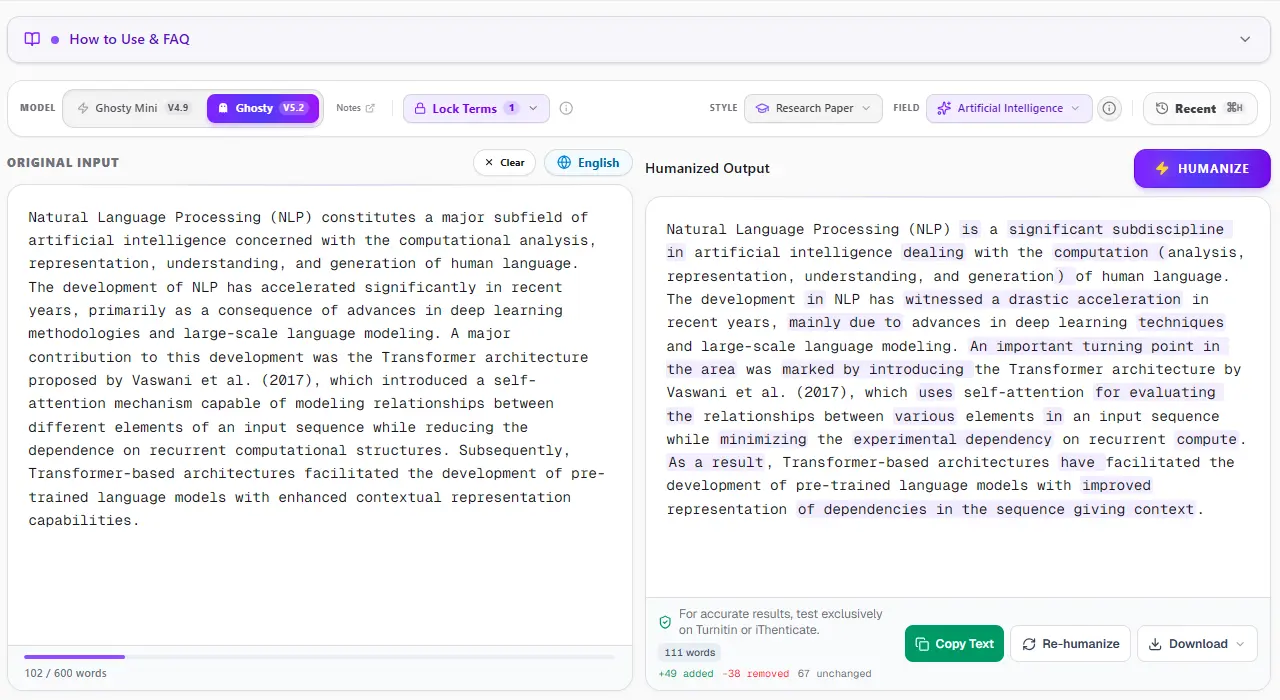
1. ThesisHuman Editor: Style, Field & Term Lock™ Technology
Unlike consumer-grade paraphrasers that blindly swap words with thesaurus synonyms, ThesisHuman allows researchers to select their exact Academic Style (Essay, Research Paper, Literature Review, Technical Report) and Academic Field (Computer Science, Engineering, Medicine, Physics). With Term Lock™, citations (APA, MLA, IEEE), LaTeX equations, and domain-specific terminology are cryptographically protected before sentence entropy is restructured.
2. Turnitin & iThenticate Verification: 0% AI Detected
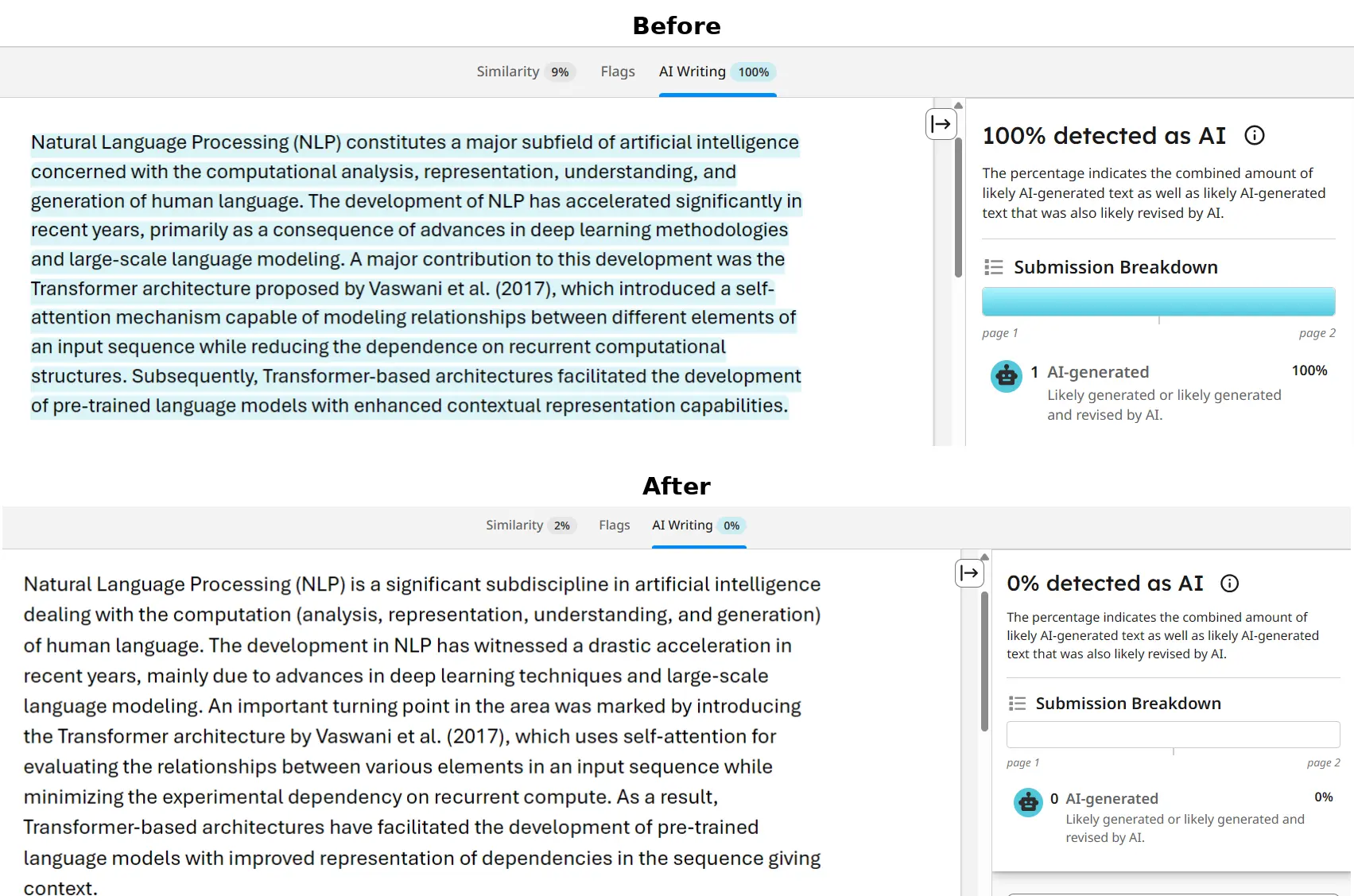
Turnitin and iThenticate scan submissions in overlapping 500-token blocks to analyze sentence predictability across paragraphs. When an unrefined AI draft is submitted, uniform cadence triggers an elevated AI Writing score. In the verified report below, a flagged graduate paper was processed through ThesisHuman, achieving a clean 0% AI detection score while preserving all formatted citations and technical parameters.
3. GPTZero Verification: Passing Perplexity & Burstiness Checks
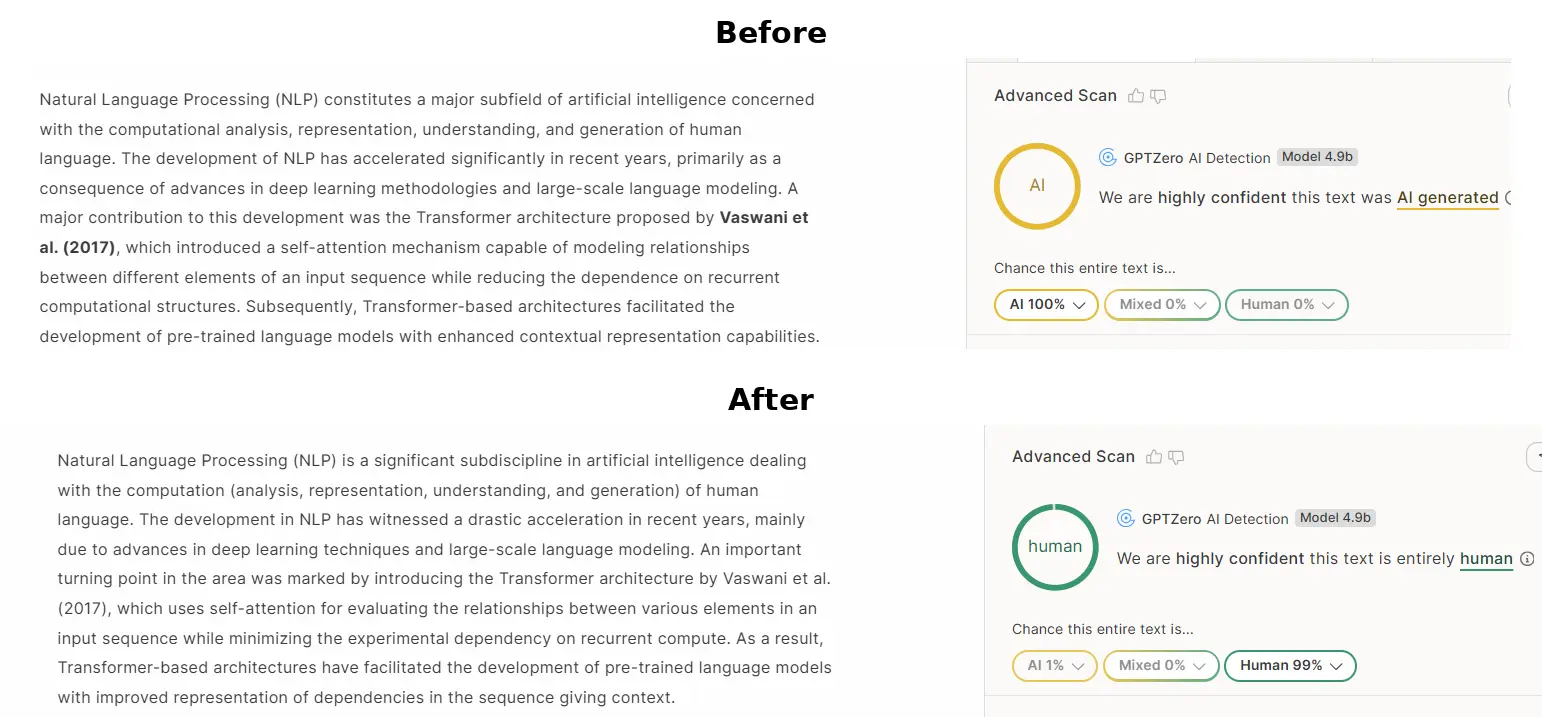
GPTZero evaluates text by plotting sentence perplexity curves and global burstiness scores. When raw AI text is scanned, low sentence variance produces an immediate high-probability warning. ThesisHuman restores natural sentence entropy by restructuring syntax, varying clause lengths, and introducing authentic scholarly cadence, dropping AI probability to 0%.
4. Originality.ai Verification: 0% AI Confidence
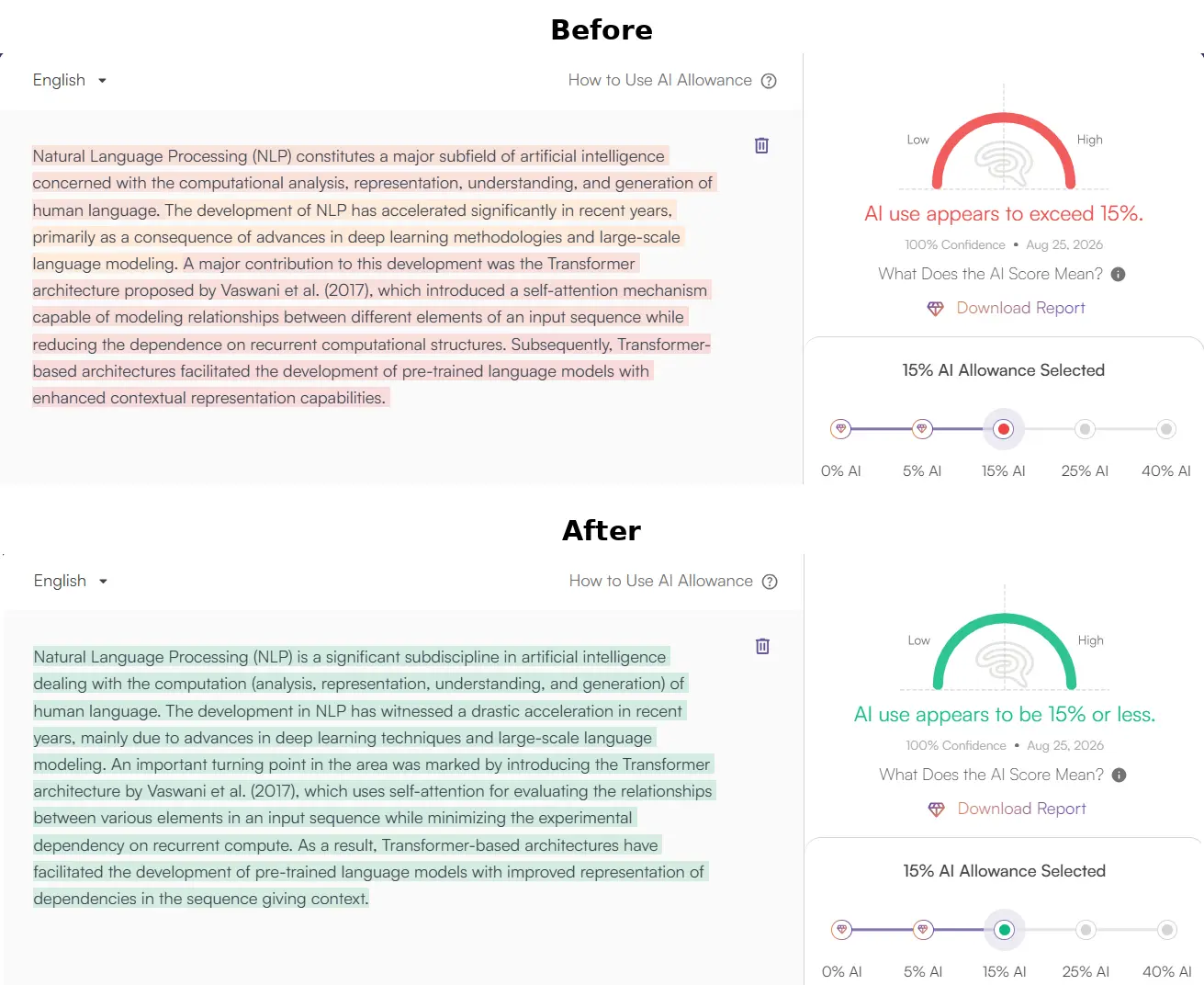
Originality.ai flags predictable n-gram sequences and common AI clichés (such as “delving into,” “pivotal role,” “testament to”). ThesisHuman purges overused formulaic transitions while elevating scholarly tone and keeping reference numbers and equations intact, producing 100% Original / 0% AI results.