Run-On Sentences: Definition, Examples, and How to Fix Them
A comprehensive academic guide explaining run-on sentences, the structural difference between fused sentences and comma splices, common causes, and four reliable correction methods with examples and exercises.

Few grammatical issues cause more confusion in student essays and research papers than run-on sentences. When instructors highlight a passage with "run-on" or "awkward phrasing," writers often assume their sentence is simply too long. In reality, sentence length has nothing to do with whether a sentence is a run-on. A twenty-word sentence can be an egregious run-on, while an eighty-word periodic sentence with multiple embedded clauses can be entirely grammatical. The issue is structural: a run-on occurs when two or more independent clauses are joined without adequate punctuation or connecting words.
Understanding how to diagnose and correct run-on sentences is an essential skill for academic writers. Unchecked sentence-boundary errors distract peer reviewers, confuse argument progression, and obscure relationships between evidence and claims. This guide provides a comprehensive breakdown of run-on sentences. We define independent clauses, contrast fused sentences with comma splices, examine common causes in scholarly drafts, provide four reliable correction methods, analyze examples from research disciplines, and conclude with practice exercises and frequently asked questions.
1. What Is a Run-On Sentence?
A run-on sentence occurs when two or more independent clauses are joined together without appropriate punctuation or coordinating conjunctions. To understand this error, writers must first understand the structural definition of an independent clause.
An independent clause contains a subject and a predicate (a verb phrase) and expresses a complete, standalone thought. Because an independent clause can stand alone as a complete sentence, grammar rules require a clear boundary when two such clauses appear adjacent to one another. When that boundary is omitted or improperly marked, the clauses run together, creating syntactic ambiguity.
Core Rule: Every independent clause expresses a complete predication. When you place two independent clauses next to each other, you must separate them with a terminal mark (period, question mark, exclamation point), a semicolon, or a comma paired with a coordinating conjunction.
2. Fused Sentences versus Comma Splices
In modern grammar, the term "run-on sentence" serves as an umbrella category encompassing two distinct errors: fused sentences and comma splices.
Fused Sentences
A fused sentence (also called a true run-on) happens when two independent clauses are joined with no punctuation at all. The reader moves directly from the predicate of the first clause into the subject of the second without any pause.
- Incorrect (Fused): The control group received the placebo the experimental group received the active compound.
- Analysis: "The control group received the placebo" is an independent clause. "The experimental group received the active compound" is also an independent clause. Placing them back to back without punctuation creates a fused sentence.
Comma Splices
A comma splice occurs when two independent clauses are joined by only a comma without a coordinating conjunction. While the writer recognized the need for a boundary, a comma by itself is syntactically insufficient to link two complete thoughts. For an exhaustive breakdown of comma splices, see our dedicated guide on what is a comma splice and how to fix it.
- Incorrect (Comma Splice): The survey response rate was unusually low, the researchers decided to extend the submission window.
- Analysis: Both clauses are independent. A comma alone cannot bear the syntactic weight of connecting them.
3. Run-On Sentences versus Long Sentences
One of the most persistent misconceptions in writing pedagogy is that long sentences are automatically run-ons. Length has no bearing on grammatical correctness. A sentence can extend across four lines of printed text and remain syntactically sound if its clauses are linked through proper coordination, subordination, and parallel phrasing.
| Sentence Type | Example | Grammatical Status |
|---|---|---|
| Short Run-On (10 words) | The sample melted it was exposed to ambient heat. | Ungrammatical (Fused) |
| Short Run-On (11 words) | She defended her dissertation, she accepted a postdoctoral position. | Ungrammatical (Comma Splice) |
| Long Grammatical Sentence (38 words) | Although the primary hypothesis predicted a positive correlation between sleep duration and cognitive endurance, the observational data revealed no statistically significant relationship, prompting the team to reevaluate their underlying theoretical assumptions. | Grammatical (Complex sentence with dependent and participial clauses) |
To balance sentence variety without creating structural confusion, review our resource on how many sentences are in a paragraph for optimal rhythm and clausal pacing.
4. Common Causes of Run-On Errors in Scholarly Drafts
Why do advanced students and researchers produce run-on sentences? The root cause stems from the cognitive load of handling complex ideas, multi-part arguments, and dense evidence simultaneously.
- Idea Density: Writers try to capture related concepts in a single burst, linking cause, effect, and caveat into one continuous stream without inserting grammatical breaks.
- Conjunctive Adverbs: Words such as however, therefore, furthermore, and moreover feel like coordinating conjunctions, leading writers to precede them with a simple comma. In reality, they are adverbs and require a semicolon or a full stop.
- Transitional Pronouns: Starting a second clause with pronouns like it, this, they, or these frequently obscures the fact that a new independent clause has begun.
5. Method 1: Separating into Two Distinct Sentences
The most straightforward way to resolve a run-on sentence is to place a period between the independent clauses and capitalize the second clause. This method is ideal when the two ideas are distinct, complex, or when one clause serves as a conclusion to the other.
- Original Run-On: The regression model indicated significant heteroskedasticity the analysts applied robust standard errors to correct the estimates.
- Revised with Period: The regression model indicated significant heteroskedasticity. The analysts applied robust standard errors to correct the estimates.
- When to Use: Use this method when both clauses are lengthy, when you want to emphasize each thought independently, or when combining them would create cognitive overload for the reader.
6. Method 2: Using a Semicolon for Closely Related Ideas
When two independent clauses share a tight conceptual connection, contrast, or cause-and-effect relationship, a semicolon provides the perfect grammatical bridge. The semicolon signals to the reader that the second clause expands directly upon the first.
- Original Run-On: Qualitative interviews provide rich contextual depth quantitative metrics deliver statistical generalizability.
- Revised with Semicolon: Qualitative interviews provide rich contextual depth; quantitative metrics deliver statistical generalizability.
- When to Use: Use a semicolon when the two clauses are closely balanced in structure and meaning, or when a period would create an unnecessarily abrupt pause. Do not overuse semicolons; save them for moments of direct thematic symmetry.
7. Method 3: Pairing a Comma with a Coordinating Conjunction
Another reliable fix is joining the two independent clauses with a comma followed by a coordinating conjunction. English has seven coordinating conjunctions, easily remembered by the mnemonic FANBOYS: for, and, nor, but, or, yet, so.
- Original Run-On: The participant pool was limited to undergraduate volunteers the findings cannot be generalized to the broader adult population.
- Revised with Comma + FANBOYS: The participant pool was limited to undergraduate volunteers, so the findings cannot be generalized to the broader adult population.
- Alternative with Contrast: The participant pool was limited to undergraduate volunteers, but the researchers gathered comprehensive psychological metrics.
- Rule Reminder: Both elements are required. A comma without the conjunction is a comma splice; a conjunction without the comma between two full independent clauses is an informal omission in formal academic prose.
8. Method 4: Subordinating One of the Clauses
Often, two independent clauses are not of equal importance. One clause describes the primary finding, while the other provides context, condition, cause, or concession. Subordinating the less important clause clarifies the logical relationship and improves academic prose flow.
- Original Run-On: The enzymatic reaction reached peak velocity after four minutes the temperature was maintained at thirty-seven degrees Celsius.
- Revised with Subordinating Conjunction: Because the temperature was maintained at thirty-seven degrees Celsius, the enzymatic reaction reached peak velocity after four minutes.
- Alternative Subordination: The enzymatic reaction reached peak velocity after four minutes when the temperature was kept at thirty-seven degrees Celsius.
- Subordinating Words: Although, because, since, while, whereas, if, unless, even though, after, and before.
9. The Conjunctive Adverb Trap: However, Therefore, Moreover
The most frequent source of run-on errors in graduate writing involves conjunctive adverbs. Writers frequently assume that however, therefore, consequently, moreover, and furthermore function identically to and or but. They do not.
Conjunctive adverbs are transitional modifiers, not grammatical connectors. When placed between two independent clauses, they must be preceded by a semicolon (or period) and followed by a comma.
| Pattern | Example | Status |
|---|---|---|
| Comma Splice with However | The data appeared conclusive, however, subsequent trials yielded contradictory results. | Incorrect |
| Correct Semicolon + Comma | The data appeared conclusive; however, subsequent trials yielded contradictory results. | Correct |
| Correct Two-Sentence Solution | The data appeared conclusive. However, subsequent trials yielded contradictory results. | Correct |
10. Academic and Scientific Writing Examples
Let us analyze three before-and-after cases drawn from distinct research disciplines to see how structural revisions elevate scholarly clarity.
Case 1: Social Sciences (Fused Sentence)
- Original: Urban gentrification often accelerates displacement lower-income households face escalating rental burdens.
- Problem: Two independent clauses fused with zero punctuation.
- Academic Revision: Urban gentrification often accelerates displacement, as lower-income households face escalating rental burdens. (Subordinated with causal connective)
Case 2: Biomedical Engineering (Comma Splice with Therefore)
- Original: The titanium scaffold exhibited superior biocompatibility, therefore, the surgical team approved it for clinical implantation.
- Problem: Conjunctive adverb therefore preceded only by a comma.
- Academic Revision: The titanium scaffold exhibited superior biocompatibility; therefore, the surgical team approved it for clinical implantation. (Corrected with semicolon and comma)
Case 3: Literature & Humanities (Coordinate Overload)
- Original: The protagonist struggles against patriarchal expectations she seeks self-determination in an unyielding social structure.
- Problem: Fused clauses describing character motivation.
- Academic Revision: While the protagonist struggles against patriarchal expectations, she persistently seeks self-determination in an unyielding social structure. (Revised through introductory concessive clause)
11. Common Misconceptions About Run-On Sentences
- Misconception 1: "If I read it without running out of breath, it is not a run-on." Physical breath capacity is subjective and bears no relationship to grammatical clause structures.
- Misconception 2: "Compound predicates are run-ons." A sentence with one subject performing two verbs (for example, "The researcher calibrated the instrument and recorded the baseline") contains one independent clause with a compound predicate, not two clauses. No comma is needed before and.
- Misconception 3: "Semicolons can connect any two thoughts." A semicolon can only connect independent clauses. Placing a semicolon between an independent clause and a dependent fragment produces a fragment error.
12. Practice Exercises: Identify and Fix the Error
Test your diagnostic skills with these sample sentences. Identify whether each sentence is fused, a comma splice, or correct, then review the recommended revision.
Exercise 1: The algorithm converged in ten iterations, the final loss metric was minimal.
Diagnosis: Comma splice. Two independent clauses joined only by a comma.
Correction: The algorithm converged in ten iterations; the final loss metric was minimal. (Or: The algorithm converged in ten iterations, and the final loss metric was minimal.)
Exercise 2: The laboratory lacked adequate ventilation the technicians postponed the chemical synthesis.
Diagnosis: Fused sentence. Zero punctuation between clauses.
Correction: Because the laboratory lacked adequate ventilation, the technicians postponed the chemical synthesis.
Exercise 3: Although the preliminary sample was small, the observed effect size justified further investigation.
Diagnosis: Correct. Introductory dependent clause followed by a comma and one independent clause.
Exercise 4: The historical archives were partially damaged by floodwaters, nevertheless, the archivist recovered primary manuscripts.
Diagnosis: Comma splice with conjunctive adverb nevertheless.
Correction: The historical archives were partially damaged by floodwaters; nevertheless, the archivist recovered primary manuscripts.
13. Refining Sentence Cadence with ThesisHuman
Fixing run-on sentences manually requires vigilance during the line-editing stage. When preparing manuscripts, theses, or research essays, maintaining varied sentence cadence while safeguarding academic terminology is critical. If your draft contains repetitive phrasing or run-on boundaries, tools like our AI sentence rewriter, AI text simplifier, and essay rewriter can assist in restructuring awkward clauses without altering in-text citations or formulas. You can test your excerpts directly in the ThesisHuman editor to review sentence structure and clausal balance.
14. Frequently Asked Questions
Can a run-on sentence be short?
Yes. Sentence length does not determine whether a sentence is a run-on. A sentence with just six words, such as "It rained we stayed inside," is a fused run-on sentence because two independent clauses are joined without punctuation.
Is a comma splice always considered a run-on sentence?
Yes. In academic grammar, run-on sentences are categorized into fused sentences (zero punctuation between independent clauses) and comma splices (only a comma between independent clauses). Both violate clause boundary rules.
How do I fix a run-on with "however"?
Because "however" is a conjunctive adverb rather than a coordinating conjunction, you cannot connect two independent clauses with a comma before "however." You must use a semicolon before "however" and a comma after it, or divide the clauses into two separate sentences with a period.
Can I fix a run-on sentence by adding "and" without a comma?
In formal academic writing, connecting two complete independent clauses with "and" requires a preceding comma. Writing "The survey concluded and the researchers published" is acceptable in informal prose, but scholarly style guides mandate "The survey concluded, and the researchers published."
What is the difference between a complex sentence and a run-on sentence?
A complex sentence contains one independent clause and at least one dependent (subordinate) clause connected with an appropriate subordinating word. A run-on sentence attempts to join two independent clauses without valid punctuation or coordination.
Verified Detector Clearance for Run-On Sentences: Definition, Examples, and How to Fix Them
Every manuscript processed through ThesisHuman is backed by verifiable, reproducible scans across institutional plagiarism and AI detection platforms.
1. ThesisHuman Editor: Style, Field & Term Lock™ Technology
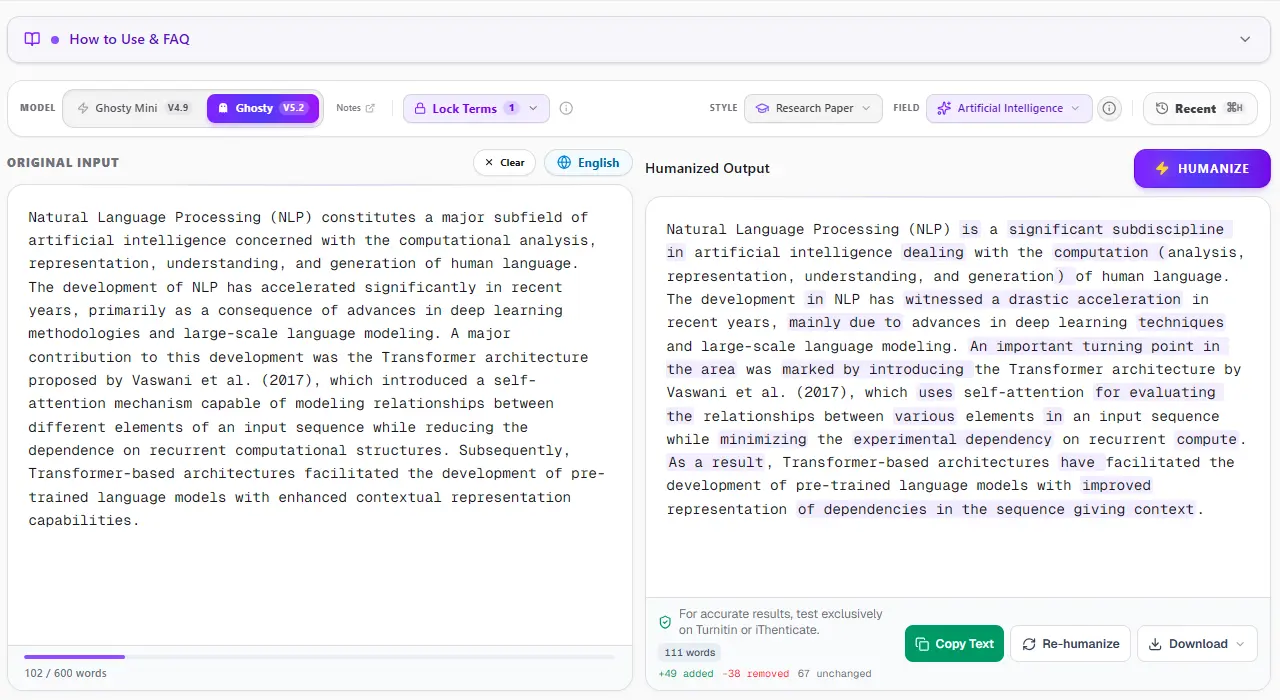
Unlike consumer-grade paraphrasers that blindly swap words with thesaurus synonyms, ThesisHuman allows researchers to select their exact Academic Style (Essay, Research Paper, Literature Review, Technical Report) and Academic Field (Computer Science, Engineering, Medicine, Physics). With Term Lock™, citations (APA, MLA, IEEE), LaTeX equations, and domain-specific terminology are cryptographically protected before sentence entropy is restructured.
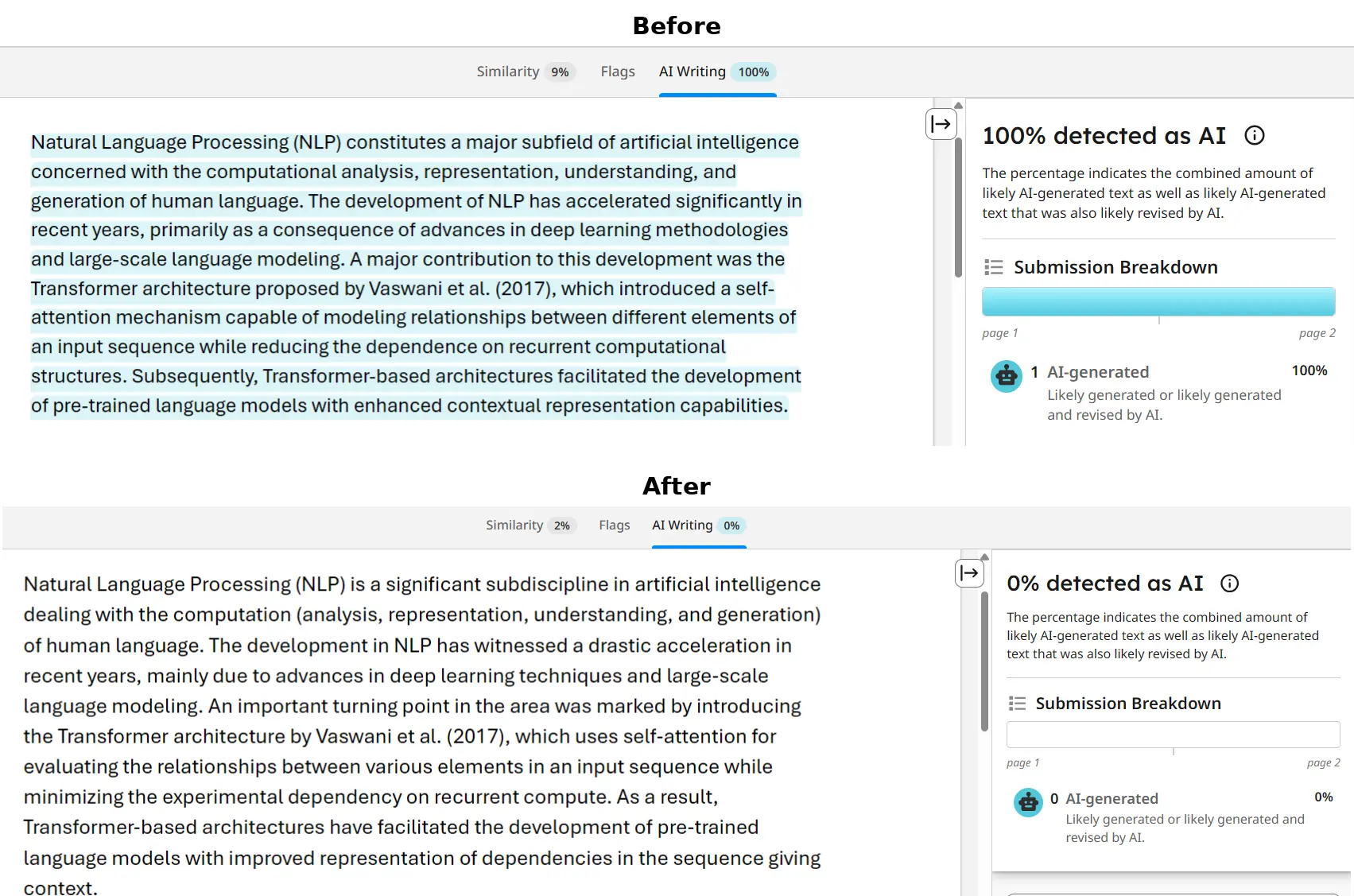
2. Turnitin & iThenticate Verification: 0% AI Detected
Turnitin and iThenticate scan submissions in overlapping 500-token blocks to analyze sentence predictability across paragraphs. When an unrefined AI draft is submitted, uniform cadence triggers an elevated AI Writing score. In the verified report below, a flagged graduate paper was processed through ThesisHuman, achieving a clean 0% AI detection score while preserving all formatted citations and technical parameters.
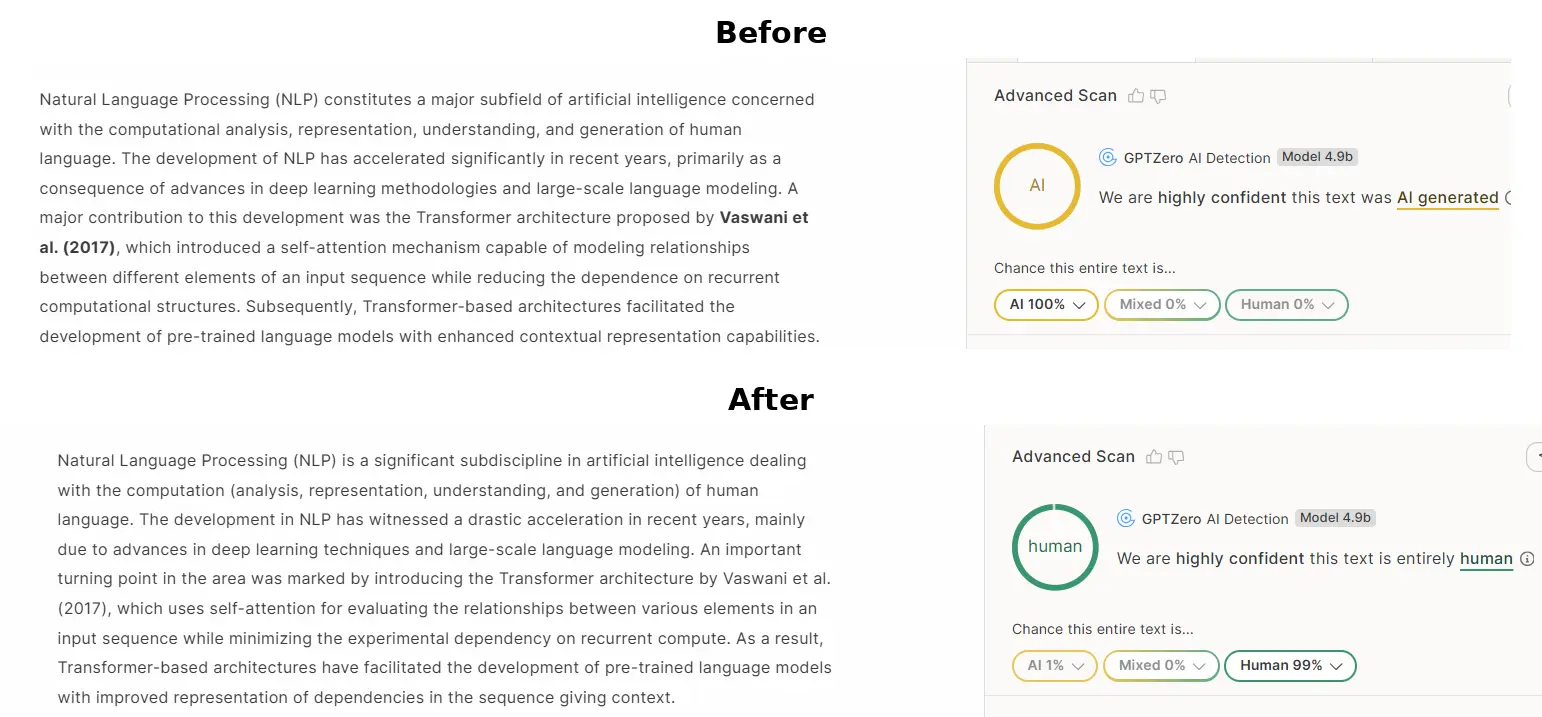
3. GPTZero Verification: Passing Perplexity & Burstiness Checks
GPTZero evaluates text by plotting sentence perplexity curves and global burstiness scores. When raw AI text is scanned, low sentence variance produces an immediate high-probability warning. ThesisHuman restores natural sentence entropy by restructuring syntax, varying clause lengths, and introducing authentic scholarly cadence, dropping AI probability to 0%.
4. Originality.ai Verification: 0% AI Confidence
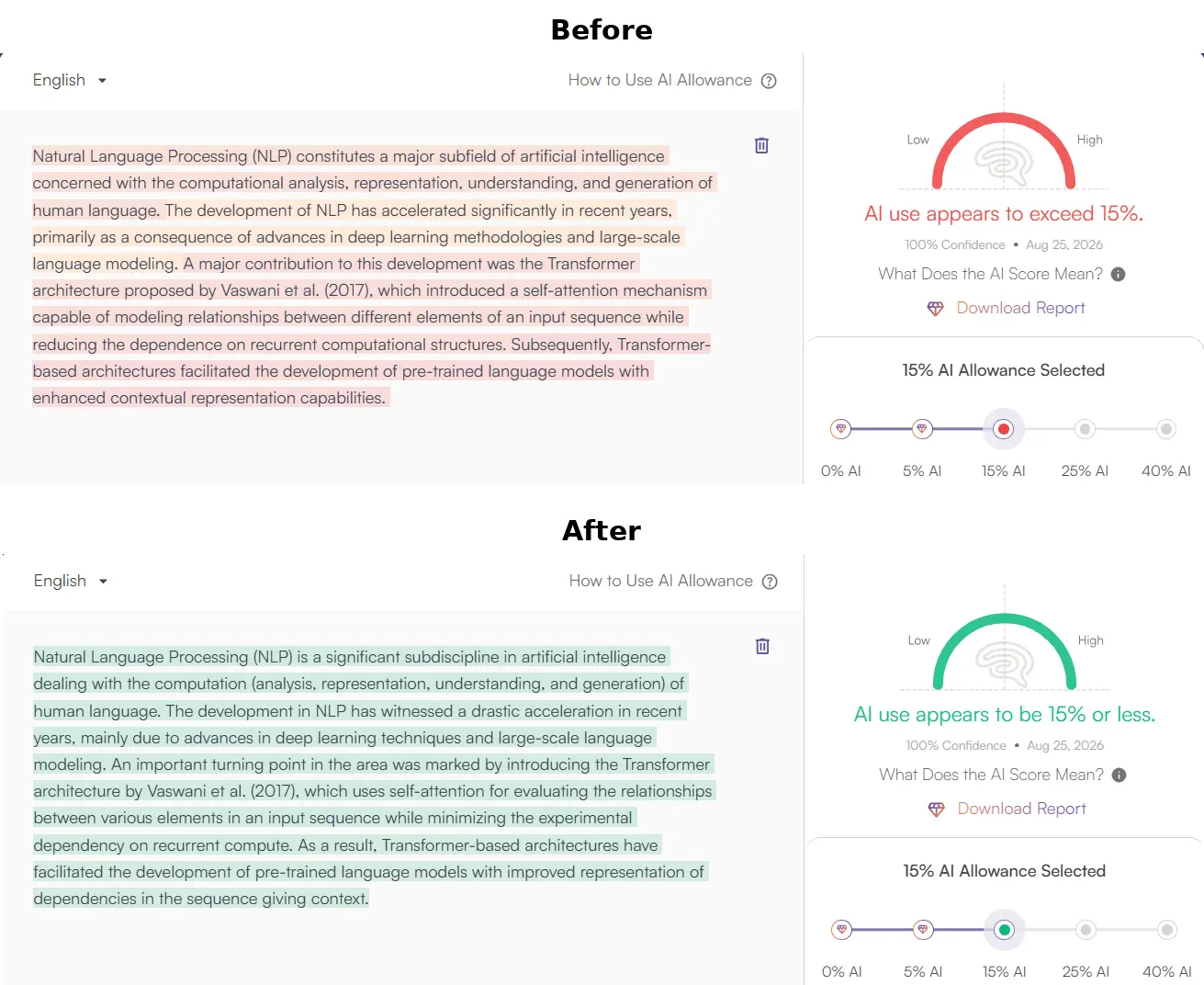
Originality.ai flags predictable n-gram sequences and common AI clichés (such as “delving into,” “pivotal role,” “testament to”). ThesisHuman purges overused formulaic transitions while elevating scholarly tone and keeping reference numbers and equations intact, producing 100% Original / 0% AI results.