How to Write a Research Paper: A Practical Step-by-Step Guide
A complete, step-by-step academic guide to writing a research paper, from topic selection and literature synthesis to methodology, drafting, and citation integrity.

Writing an academic research paper is one of the most demanding tasks in higher education and scholarly publishing. Whether you are an undergraduate tackling an end-of-term seminar paper, a graduate student preparing a master's thesis chapter, or a postdoctoral scholar preparing a manuscript for peer review, the core challenge remains identical: transforming a broad subject of interest into a methodical, evidence-based inquiry that contributes to your discipline. Many authors struggle not because they lack analytical ability, but because they treat research writing as an unstructured burst of drafting rather than a systematic, phase-driven process.
This comprehensive guide walks you through every stage of the research writing lifecycle. By deconstructing the assignment, narrowing your inquiry, synthesizing scholarly literature, structuring empirical or theoretical arguments, and polishing the final manuscript, you can produce a publishable paper that meets the rigorous standards of modern academia.
1. Understanding the Assignment Scope and Objectives
Every successful research project begins with a careful reading of institutional guidelines, course rubrics, or journal author instructions. Before writing a single word, verify the structural parameters of your submission. Identify the target word count, citation style (such as APA 7th, MLA 9th, Chicago 18th, or IEEE), required source types (peer-reviewed articles, primary archival data, or government datasets), and methodological expectations.
Understanding the fundamental nature of academic discourse is essential before planning your inquiry. For a detailed breakdown of scholarly conventions, objectivity, and evidence integration, review our guide on what is academic writing. Clarify whether your paper requires empirical data collection, secondary archival analysis, or systematic theoretical synthesis.
2. Selecting a Focused and Manageable Topic
The most common mistake among early-career researchers is choosing a topic that is either far too broad or excessively narrow. A broad topic leads to superficial generalizations that fail to offer critical insight. Conversely, an excessively narrow topic may leave you with insufficient peer-reviewed literature to support an academic discussion.
To find the ideal middle ground, move systematically from a general subject area to an operationalized inquiry. For example, instead of choosing "Artificial Intelligence in Healthcare," narrow your focus to "Algorithmic Diagnostic Bias in Deep Learning Models for Dermatological Screening Among Underrepresented Demographic Groups." This targeted scope provides clear boundaries for your literature search and data evaluation.
3. Formulating a Rigorous Research Question
Your research question serves as the intellectual compass for your entire project. Every paragraph in your literature review, methodology, and discussion must directly or indirectly address this core question. A strong research question satisfies the established FINER criteria:
- Feasible: Can the inquiry be conducted within your timeframe, budget, and data access limits?
- Interesting: Does the question engage ongoing scholarly debates and disciplinary problems?
- Novel: Does the inquiry provide fresh empirical data, a new case study, or an alternative theoretical framework?
- Ethical: Does the study comply with human subjects regulations and institutional review board requirements?
- Relevant: Will the findings advance scholarly knowledge or inform professional practice?
4. Research Question, Hypothesis, or Thesis Statement?
Scholars frequently confuse these three core concepts, which differ based on academic methodology and research design:
- Research Question (RQ): An open-ended inquiry guiding exploration (common in qualitative, exploratory, and humanities scholarship).
- Hypothesis: A testable, falsifiable proposition predicting the relationship between variables (standard in quantitative and experimental sciences).
- Thesis Statement: A central argumentative claim that asserts the paper's principal conclusion and interpretive position.
If you are working within argumentative essay or humanities traditions, crafting an assertive, defensible claim is paramount. Consult our comprehensive guide on what is a thesis statement to learn how to construct claims that resist trivial counterarguments. For broader structural differences across graduate milestones, see our analysis of dissertation vs thesis.
5. Conducting and Synthesizing the Literature Review
A literature review is not an annotated bibliography or a sequential list of summaries. Rather, it is a critical synthesis that organizes existing scholarly findings thematically, methodologically, or chronologically. The objective is to identify trends, methodological limitations, and unresolved controversies that justify your study.
Create a synthesis matrix to cross-reference studies by research question, sample size, methodology, core findings, and acknowledged limitations. This approach prevents you from writing isolated study summaries and enables you to connect authors in dialogue. When paraphrasing complex prior research, ensure you avoid patchwriting and adhere to ethical standards by reviewing our tutorial on how to cite a paraphrase.
6. Developing a Cohesive Structural Outline
Before drafting your manuscript, create a detailed outline that maps the logical progression of your argument. For empirical sciences, the IMRaD format (Introduction, Methods, Results, and Discussion) remains the gold standard. For humanities and theoretical social sciences, a thematic outline organized around analytical sub-claims often proves more effective.
Regardless of disciplinary convention, assign an estimated word count and a clear topic sentence to each projected section. This structural discipline ensures balanced pacing and prevents your literature review from overwhelming your original analysis.
7. Establishing an Appropriate Methodology
Your methodology chapter must demonstrate why your chosen research design represents the most valid and reliable pathway to answering your research question. Transparency and replicability are vital. Readers should understand exactly how data was collected, cleaned, measured, and analyzed.
In quantitative research, detail operational variables, sample selection criteria, survey instruments, and statistical tests. In qualitative research, describe your epistemological framework, coding procedures, participant recruitment criteria, and strategies for establishing trustworthiness (such as member-checking or triangulation).
8. Drafting the Core Manuscript Sections
Drafting an academic manuscript is rarely a linear activity. Many productive scholars write the methodology and results sections first, followed by the literature review, discussion, introduction, and abstract. Dividing the paper into distinct functional components makes the writing process significantly more manageable.
Crafting the Introduction
A compelling introduction follows an inverted pyramid structure. Open with the broader context of the problem, narrow down to the specific gap in the current literature, and conclude with your research objective or hypothesis. Clearly state the original contribution your paper makes to the field.
Methods, Results, and Discussion (IMRaD)
Maintain clear boundaries between observation and interpretation. The Results section presents raw findings objectively using tables, figures, and statistical summaries without editorializing. The Discussion section interprets these results, explains theoretical mechanisms, evaluates limitations, and contextualizes findings within previously published literature.
Composing the Conclusion
Your conclusion must do more than summarize preceding chapters. Synthesize your principal insights, emphasize practical or policy implications, acknowledge unresolvable methodological boundaries, and outline specific avenues for future scholarly inquiry.
9. Integrating Evidence and Safeguarding Attribution
Academic scholarship relies upon rigorous attribution. Every claim that is not common knowledge or an original finding of your study requires a formal citation. Avoid overusing direct quotations; synthesized paraphrasing demonstrates a deeper intellectual mastery of the material.
When paraphrasing sources, ensure that you restructure sentence clauses and vocabulary rather than relying on superficial word swaps. To verify that your reformulations remain distinct from source texts while maintaining citation integrity, you can utilize our dedicated AI paraphrasing tool.
10. Revising Academic Register and Paragraph Flow
First drafts inevitably contain clunky syntax, passive voice obscurities, and repetitive sentence rhythms. Effective revision requires multiple passes focused on different aspects of writing. In your developmental pass, examine argument cohesion and evidence placement. In your line-editing pass, focus on sentence variety, clausal cadence, and lexical precision.
Adopt the MEAL framework (Main idea, Evidence, Analysis, Link) to ensure that every paragraph functions as a coherent argumentative unit. If your prose feels rigid or overly robotic, evaluate your drafts using our specialized research paper humanizer to introduce natural burstiness while safeguarding scholarly tone.
11. Common Research Writing Pitfalls to Avoid
Awareness of common authorial mistakes can save dozens of revision hours before peer evaluation. Watch out for these frequent pitfalls:
- Scope Creep: Introducing tangential theoretical debates or historical context that does not directly address your central research question.
- Descriptive Drift: Summarizing study after study without providing critical comparative analysis or identifying contradictions.
- Unsupported Generalizations: Making sweeping claims without citing empirical evidence or qualitative data.
- Inconsistent Terminology: Using shifting synonyms for established theoretical variables, which confuses evaluators and readers.
- Citation Negligence: Forgetting to verify that every parenthetical in-text citation matches an entry in your final reference list.
12. Practical Research Paper Pre-Submission Checklist
Before submitting your manuscript for grading or editorial review, run through this rigorous quality audit:
- Title and Abstract: Does the title accurately convey the methodology and scope? Does the abstract summarize objective, method, result, and conclusion?
- Research Question Alignment: Does every section directly contribute to answering the stated research question or hypothesis?
- Methodological Transparency: Could an independent researcher replicate your experimental or sampling procedure based on your description?
- Data Presentation: Are all tables, figures, and charts cleanly labeled with descriptive titles, units of measurement, and source notes?
- Citation Formatting: Are all parenthetical citations, footnotes, and bibliographic entries formatted consistently according to your target style manual?
- Objectivity and Hedging: Are claims appropriately qualified using cautious academic verbs (such as suggests, indicates, or correlates) rather than absolute assertions?
- Clausal Cadence and Rhythm: Do your sentences exhibit natural variation in length and structure, avoiding monotonous syntax?
- Formatting Compliance: Have you adhered to specific margin, font, line spacing, and file format requirements?
13. Refining Your Manuscript with ThesisHuman
Polishing an advanced academic paper requires balancing clear communication with disciplinary rigor. Many researchers turn to automated tools for language refinement, but standard rewriters often damage formatted citations, corrupt scientific notation, or introduce informal conversational phrasing.
ThesisHuman was engineered specifically for scholarly prose. With its proprietary Term Lock capability, you can protect parenthetical citations, mathematical symbols, and domain-specific terminology while refining surrounding sentences. Test your manuscript in our interactive academic editor to enhance sentence variety, eliminate robotic phrasing, and preserve the scholarly integrity of your research.
Verified Detector Clearance for How to Write a Research Paper: A Practical Step-by-Step Guide
Every manuscript processed through ThesisHuman is backed by verifiable, reproducible scans across institutional plagiarism and AI detection platforms.
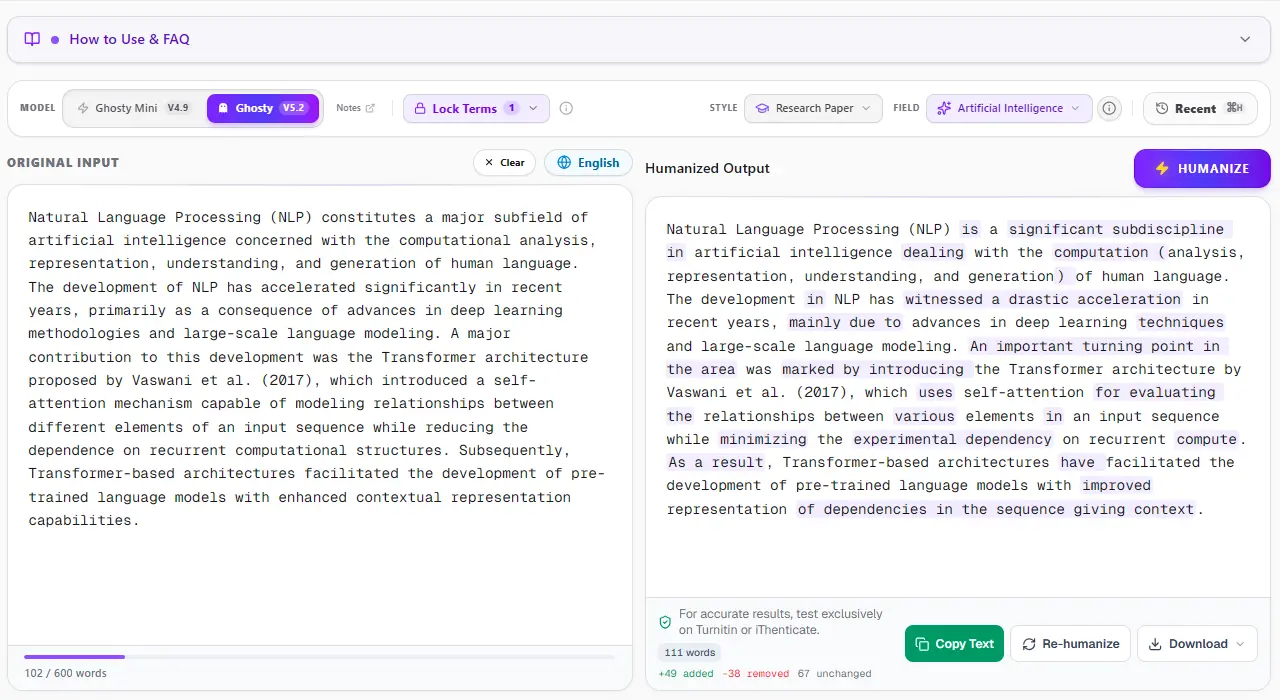
1. ThesisHuman Editor: Style, Field & Term Lock™ Technology
Unlike consumer-grade paraphrasers that blindly swap words with thesaurus synonyms, ThesisHuman allows researchers to select their exact Academic Style (Essay, Research Paper, Literature Review, Technical Report) and Academic Field (Computer Science, Engineering, Medicine, Physics). With Term Lock™, citations (APA, MLA, IEEE), LaTeX equations, and domain-specific terminology are cryptographically protected before sentence entropy is restructured.
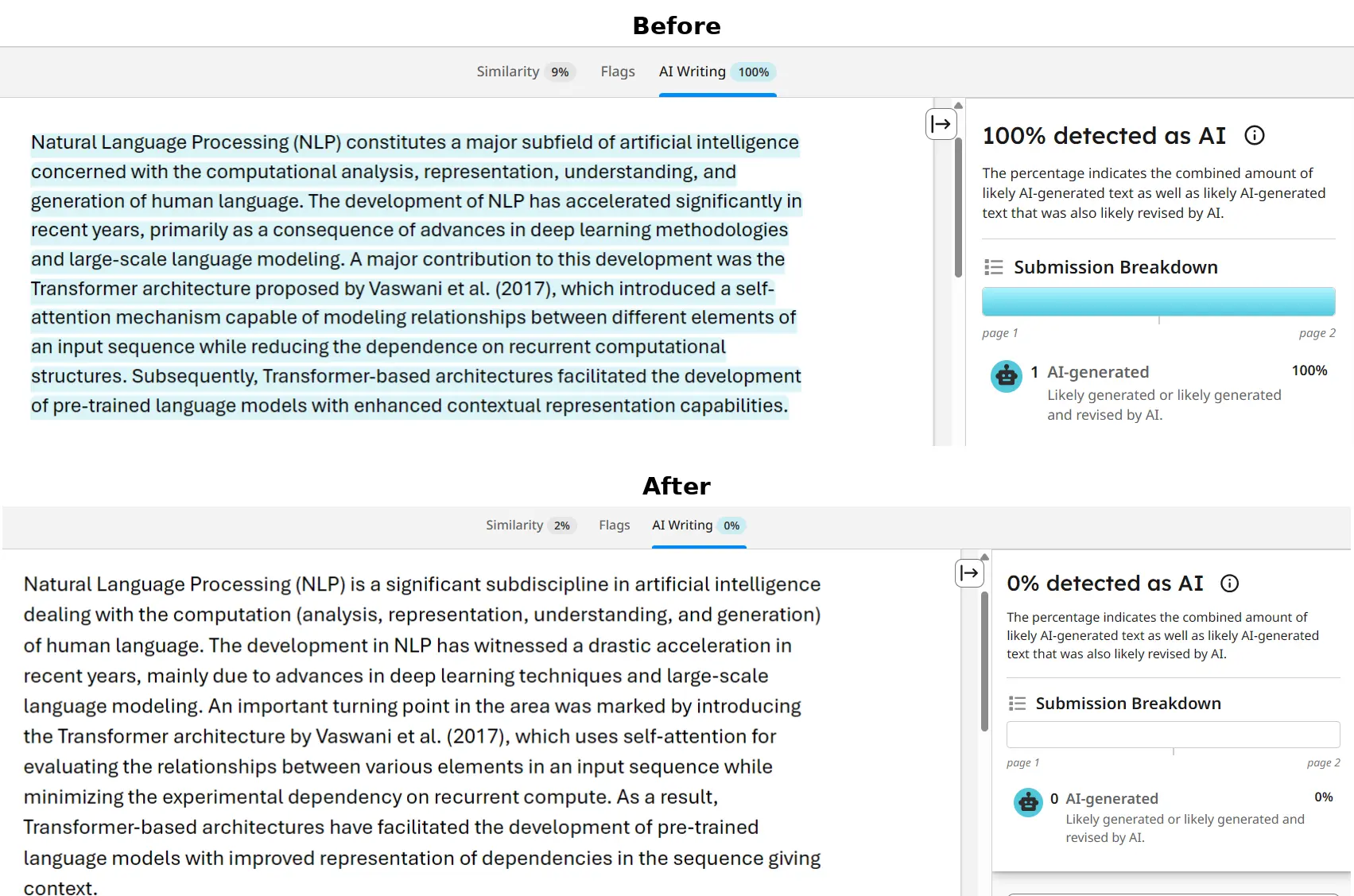
2. Turnitin & iThenticate Verification: 0% AI Detected
Turnitin and iThenticate scan submissions in overlapping 500-token blocks to analyze sentence predictability across paragraphs. When an unrefined AI draft is submitted, uniform cadence triggers an elevated AI Writing score. In the verified report below, a flagged graduate paper was processed through ThesisHuman, achieving a clean 0% AI detection score while preserving all formatted citations and technical parameters.
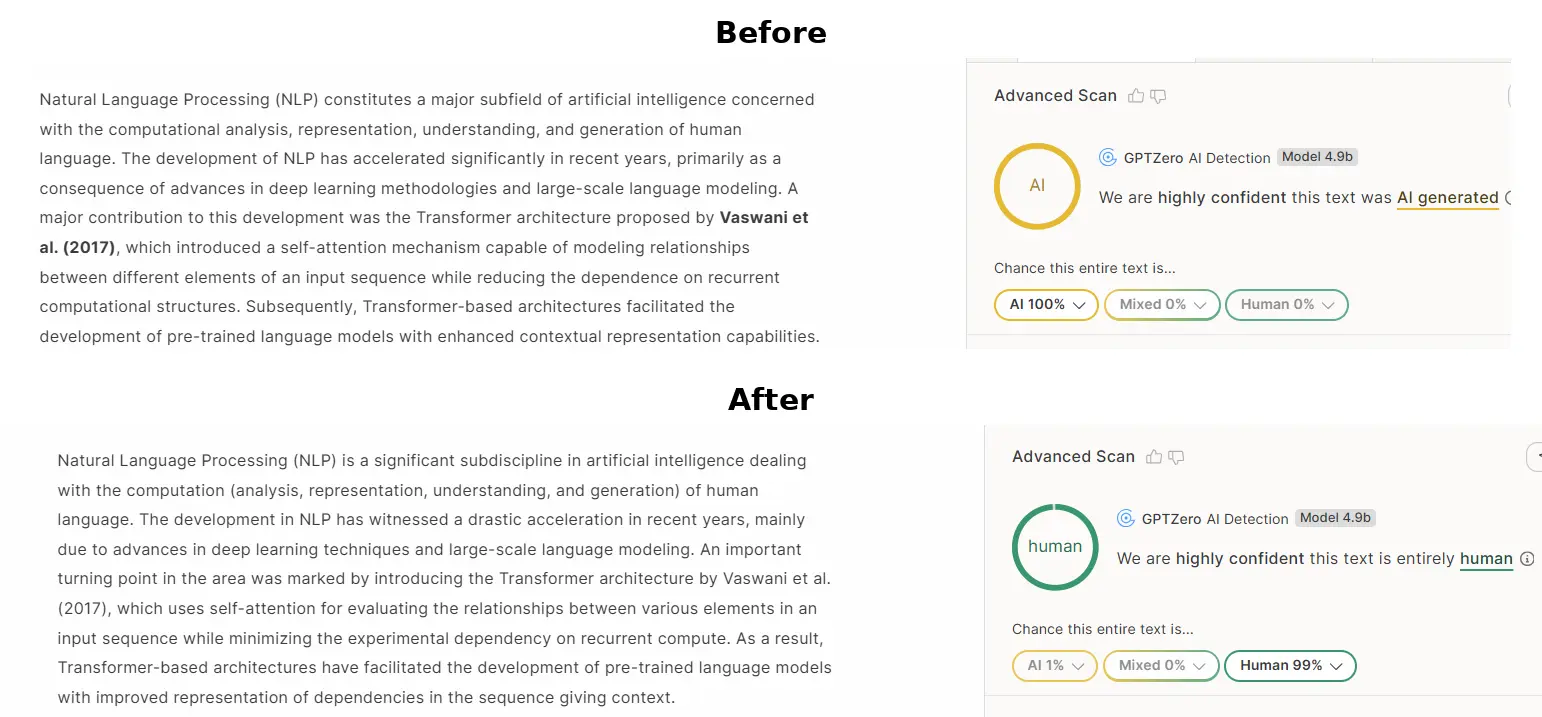
3. GPTZero Verification: Passing Perplexity & Burstiness Checks
GPTZero evaluates text by plotting sentence perplexity curves and global burstiness scores. When raw AI text is scanned, low sentence variance produces an immediate high-probability warning. ThesisHuman restores natural sentence entropy by restructuring syntax, varying clause lengths, and introducing authentic scholarly cadence, dropping AI probability to 0%.
4. Originality.ai Verification: 0% AI Confidence
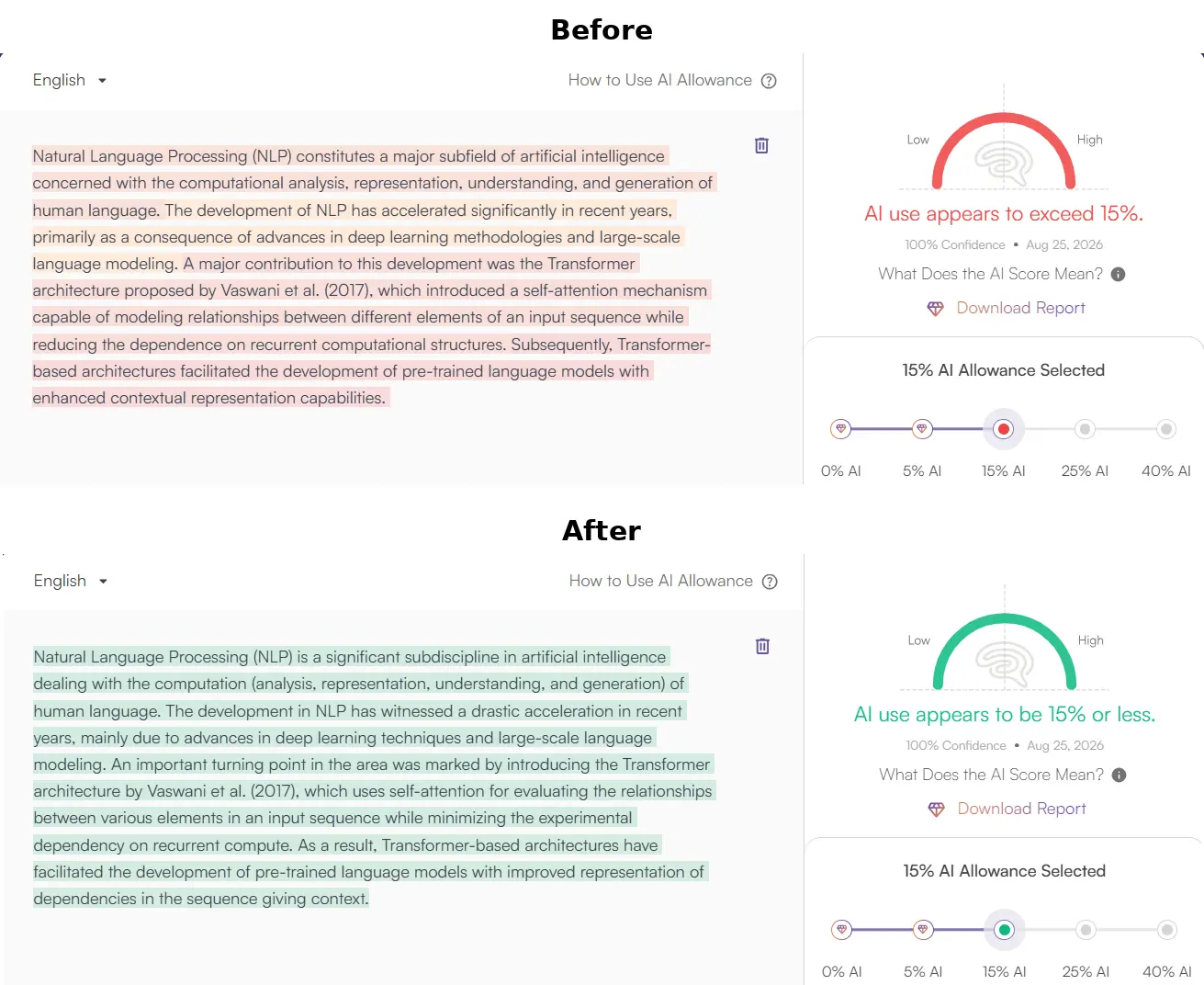
Originality.ai flags predictable n-gram sequences and common AI clichés (such as “delving into,” “pivotal role,” “testament to”). ThesisHuman purges overused formulaic transitions while elevating scholarly tone and keeping reference numbers and equations intact, producing 100% Original / 0% AI results.