What Is Paraphrasing? Definition, Examples, and Academic Writing Rules
Understand the true definition of paraphrasing in academic writing, how it differs from quoting and summarizing, how to avoid patchwriting, and how to cite sources correctly.

Understanding the precise definition of paraphrasing is essential for every researcher, university student, and professional writer. While the term appears frequently in academic syllabi and writing guidelines, many authors hold misconceptions about what genuine paraphrasing entails. Some believe that swapping words with dictionary synonyms satisfies academic standards, while others assume that changing sentence wording removes the obligation to cite original sources. Both assumptions are incorrect and can lead to unintentional plagiarism.
This guide provides a comprehensive examination of paraphrasing in academic writing. You will learn the foundational definition, examine key distinctions between paraphrasing, quoting, and summarizing, discover why superficial synonym replacement fails, and master a practical four-step workflow illustrated with real-world disciplinary examples.
1. Paraphrase Definition: What Does Paraphrasing Actually Mean?
At its core, a paraphrase is a restatement of a text or passage that conveys the original meaning using entirely different words and sentence architecture. Originating from the Greek word paraphrasis, meaning "additional manner of expression," paraphrasing is the intellectual act of translating someone else's ideas into your own analytical voice.
Paraphrasing in Simple Language
In everyday communication, paraphrasing is simply explaining what someone else said without repeating their exact words. For example, if a meteorologist announces that "atmospheric moisture indices indicate an eighty percent probability of localized precipitation," you might tell a colleague, "The weather report says it will probably rain today." The informational payload remains identical, but the wording is simplified and adapted to a casual audience.
Paraphrasing in Academic Writing
In scholarly contexts, paraphrasing carries far greater methodological weight. It demonstrates that you have read, analyzed, and synthesized a source rather than simply memorized or copied it. An effective academic paraphrase reconstructs the clausal relationships of the original passage, integrates the concept seamlessly into your overarching argument, and preserves disciplinary precision. Most importantly, an academic paraphrase always includes a formal citation acknowledging the original author.
2. Paraphrasing vs Quoting vs Summarizing
Scholars employ three distinct techniques when integrating external research into their manuscripts. Understanding when to deploy each method is critical for effective academic writing:
| Technique | Definition & Mechanism | Approximate Length | Best Use Case |
|---|---|---|---|
| Direct Quotation | Represents the source's exact words enclosed in quotation marks with author, year, and page number. | Identical to original source span. | Preserving unique definitions, literary prose, or contested policy statements. |
| Paraphrasing | Restates a specific passage or argument using original sentence structure, clausal syntax, and vocabulary. | Roughly equal to the original source passage. | Explaining complex theories, empirical findings, or methodological rationales in your own voice. |
| Summarizing | Condenses broad arguments, entire articles, or book chapters into main conceptual takeaways. | Significantly shorter than the original text. | Providing background context or synthesizing broad scholarly consensus in literature reviews. |
3. Paraphrasing versus Superficial Synonym Replacement
One of the most dangerous misconceptions in student writing is that paraphrasing consists of looking up synonyms in a thesaurus and substituting every third word. Linguists and writing instructors often call this practice "rogeting." Superficial synonym swapping fails because it ignores grammatical context, collocational norms, and disciplinary connotations.
Consider an engineering text describing a "stress-strain curve under tensile loading." If an inexperienced author replaces these terms with "anxiety-tension arc beneath pulling weight," the technical meaning is completely destroyed. Genuine paraphrasing operates at the structural level: you must dismantle the sentence clauses, understand the underlying relationship between variables, and reconstruct the idea in a new syntactic framework.
4. Understanding Patchwriting and Structural Plagiarism
Coined by writing scholar Rebecca Moore Howard, patchwriting describes the practice of copying from a source text while deleting a few words, altering grammatical forms, or plugging in one-to-one synonyms. Although patchwriters rarely intend to deceive, modern university evaluation panels and similarity detection algorithms treat patchwriting as structural plagiarism.
Patchwriting occurs when a writer mimics the grammatical skeleton of the source text. Even if you cite the author at the end of the paragraph, keeping the original clausal order and rhythm demonstrates insufficient authorial independence. To understand institutional consequences and academic integrity policies regarding patchwriting, consult our deep dive on is paraphrasing plagiarism.
5. Weak versus Strong Paraphrase: Concrete Academic Examples
Examining concrete disciplinary examples clarifies the distinction between unacceptable patchwriting and rigorous academic paraphrasing.
Original Source (Environmental Economics):
"Carbon taxation systems incentivize industrial emissions reductions by internalizing negative environmental externalities, though their political viability often depends on transparent revenue-recycling mechanisms (Kaufman & Miller, 2023, p. 114)."
Weak Paraphrase (Patchwriting / Synonym Swap):
Carbon tax frameworks encourage corporate emissions decreases by internalizing harmful environmental side effects, but their legislative feasibility frequently relies on clear revenue-redistribution systems (Kaufman & Miller, 2023).
Analysis: The writer simply replaced individual words with synonyms while retaining the exact clause structure, rhythm, and connective logic. This represents patchwriting.
Strong Academic Paraphrase (Syntactic Restructuring):
When governments implement transparent protocols for redistributing collected revenues, carbon pricing policies achieve broader public and legislative support while successfully obligating polluters to bear the financial costs of environmental degradation (Kaufman & Miller, 2023).
Analysis: The writer completely reorganized the conditional relationships, moved the policy mechanism to the subordinate clause, and expressed the economic concept in a fresh analytical cadence. The citation is correctly maintained.
6. Why Accurate Attribution Remains Mandatory
A widespread myth among novice authors suggests that if a passage is phrased in their own words, a citation is no longer needed. This belief is entirely false. Plagiarism encompasses both the theft of words and the theft of ideas. Whenever you adopt an empirical statistic, a theoretical framework, an analytical interpretation, or a factual claim discovered by another scholar, ethical conventions mandate formal attribution.
In APA 7th, MLA 9th, Chicago 18th, and IEEE documentation styles, an in-text citation must accompany every paraphrased sentence or cluster of related sentences. For an authoritative reference on formatting parenthetical markers and bibliographic entries across citation styles, refer to our comprehensive guide on how to cite a paraphrase.
7. Preserving Technical Terminology and Core Facts
A crucial rule of academic paraphrasing that many writing manuals overlook is that specialized terminology should not be altered. Trying to find creative alternatives for standardized scientific terminology degrades clarity and signals authorial amateurism.
Do not attempt to paraphrase:
- Proper Nouns and Named Theories: Key terms such as Maslow's Hierarchy of Needs, the Doppler Effect, or CRISPR-Cas9 gene editing must remain verbatim.
- Methodological Variables: Statistical terms such as regression analysis, standard deviation, and p-value cannot be replaced with arbitrary synonyms.
- Diagnostic and Anatomical Terms: Medical classifications, chemical compounds, and statutory legal citations have precise universal definitions that resist substitution.
8. The 4-Step Academic Paraphrasing Workflow
To ensure that your paraphrases remain both structurally original and conceptually faithful to the source, implement this proven four-step method:
- Read for Complete Comprehension: Read the source passage two or three times until you fully understand its argument, underlying assumptions, and evidence. If you cannot explain the concept without looking at the page, you are not yet ready to paraphrase it.
- Cover and Restructure from Memory: Set the original source aside. Write your restatement based on your understanding, focusing on how this information connects to your paper's central argument. Experiment with changing active and passive voice, breaking complex sentences into multiple statements, or reversing subordinate clauses.
- Cross-Check for Accuracy and Cadence: Compare your draft directly against the original text. Verify that you have not introduced factual errors, exaggerated claims, or inadvertently retained distinctive phrasing. If your draft shares three or more consecutive non-technical words with the source, revise further.
- Attach Immediate Attribution: Add the author's surname and publication year immediately into your draft. Never postpone citing until the proofreading stage, as this is the primary cause of accidental plagiarism.
9. Common Paraphrasing Mistakes to Avoid
Even experienced scholars occasionally stumble when reformulating source material. Protect your manuscripts by steering clear of these common pitfalls:
- Distorting Authorial Intent: Shifting an author's cautious hypothesis into an absolute claim, or presenting a minority critique as the consensus view.
- Over-Paraphrasing: Rewriting clear, concise empirical numbers into convoluted verbal descriptions that confuse readers.
- Losing the Narrative Thread: Dropping isolated paraphrased facts into a paragraph without connecting them back to your own topic sentence.
- Failing to Naturalize Syntax: Producing rigid, awkward sentences that mimic translation software rather than natural scholarly cadence.
10. Practical Exercises: Test Your Paraphrasing Skills
Practice applying structural reformulation with these four disciplinary exercises. Compare your draft against the provided model solutions:
Exercise 1 (Social Psychology):
Original: "Prolonged exposure to algorithmic social media feeds amplifies confirmation bias among adolescent users by reinforcing pre-existing political identities (Gomez, 2022)."
Model Paraphrase:
Adolescent political viewpoints become increasingly entrenched when recommendation systems continuously present content that validates their initial ideological preferences (Gomez, 2022).
Exercise 2 (Biomedical Sciences):
Original: "The administration of monoclonal antibodies within seventy-two hours of symptom onset significantly reduced hospital admission rates in high-risk diabetic cohorts (Vance & Zhao, 2023)."
Model Paraphrase:
Early clinical intervention using monoclonal antibody therapy effectively prevented inpatient hospitalization among diabetic patients when initiated during the initial three-day window of infection (Vance & Zhao, 2023).
Exercise 3 (Urban Planning):
Original: "Municipal zoning policies that restrict high-density multifamily housing correlate with escalating suburban vehicular emissions and lengthened commute durations (Nakamura, 2021)."
Model Paraphrase:
Suburban transportation emissions and travel times rise when local land-use regulations prohibit the development of dense, multi-unit residential properties (Nakamura, 2021).
Exercise 4 (Higher Education Pedagogy):
Original: "Asynchronous lecture modalities foster greater autonomous learning self-regulation among graduate learners than conventional in-person lecture series (Larson & Thorne, 2024)."
Model Paraphrase:
Postgraduate scholars demonstrate superior independent study discipline when engaging with self-paced digital lectures compared to traditional classroom seminars (Larson & Thorne, 2024).
11. Refining Your Paraphrases with ThesisHuman
Developing an authentic scholarly voice requires extensive practice. While drafting literature reviews and research proposals, scholars frequently find their sentences sounding repetitive or overly influenced by source structures. Utilizing tools to restructure clausal rhythm can be immensely helpful, provided that critical citations and domain terms remain untouched.
ThesisHuman provides specialized tools designed specifically for academic revision. With our AI paraphrasing tool and sentence-level AI sentence rewriter, you can protect parenthetical references and discipline-specific vocabulary using Term Lock while rearticulating complex ideas into natural, polished academic prose. You can also explore our guidance on how to un-AI text to eliminate formulaic sentence patterns. Open the ThesisHuman editor today to elevate your academic writing while safeguarding full intellectual integrity.
Verified Detector Clearance for What Is Paraphrasing? Definition, Examples, and Academic Writing Rules
Every manuscript processed through ThesisHuman is backed by verifiable, reproducible scans across institutional plagiarism and AI detection platforms.
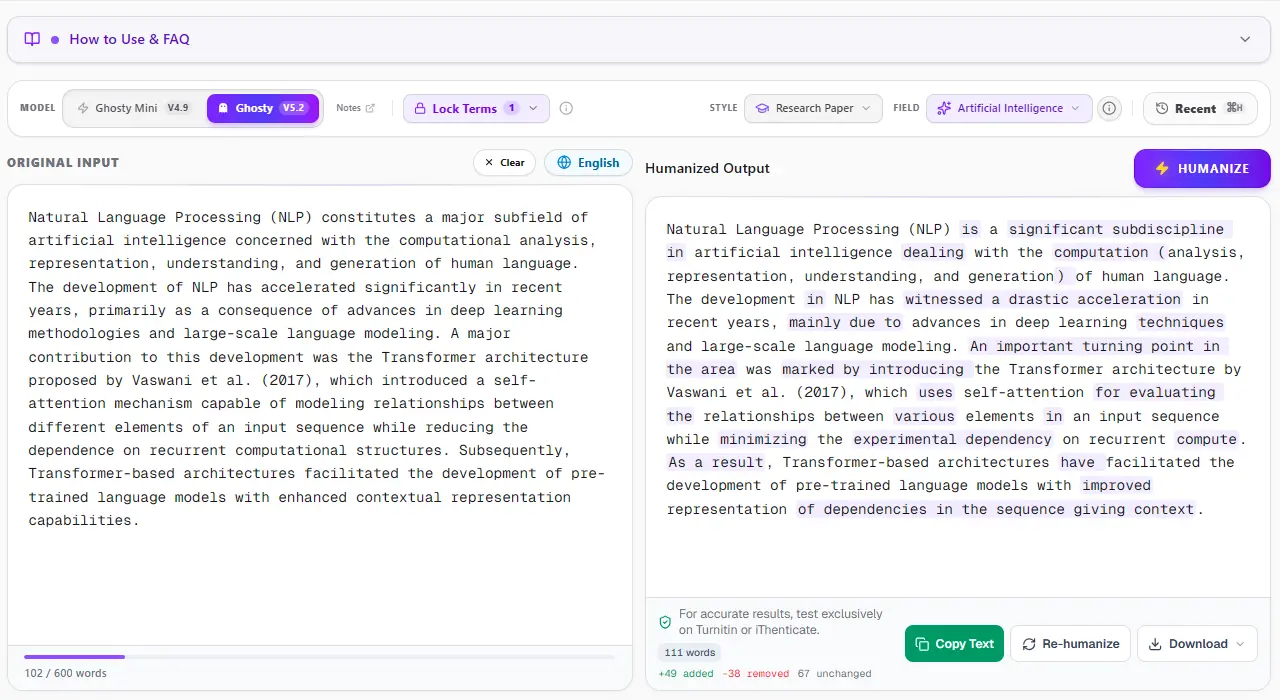
1. ThesisHuman Editor: Style, Field & Term Lock™ Technology
Unlike consumer-grade paraphrasers that blindly swap words with thesaurus synonyms, ThesisHuman allows researchers to select their exact Academic Style (Essay, Research Paper, Literature Review, Technical Report) and Academic Field (Computer Science, Engineering, Medicine, Physics). With Term Lock™, citations (APA, MLA, IEEE), LaTeX equations, and domain-specific terminology are cryptographically protected before sentence entropy is restructured.
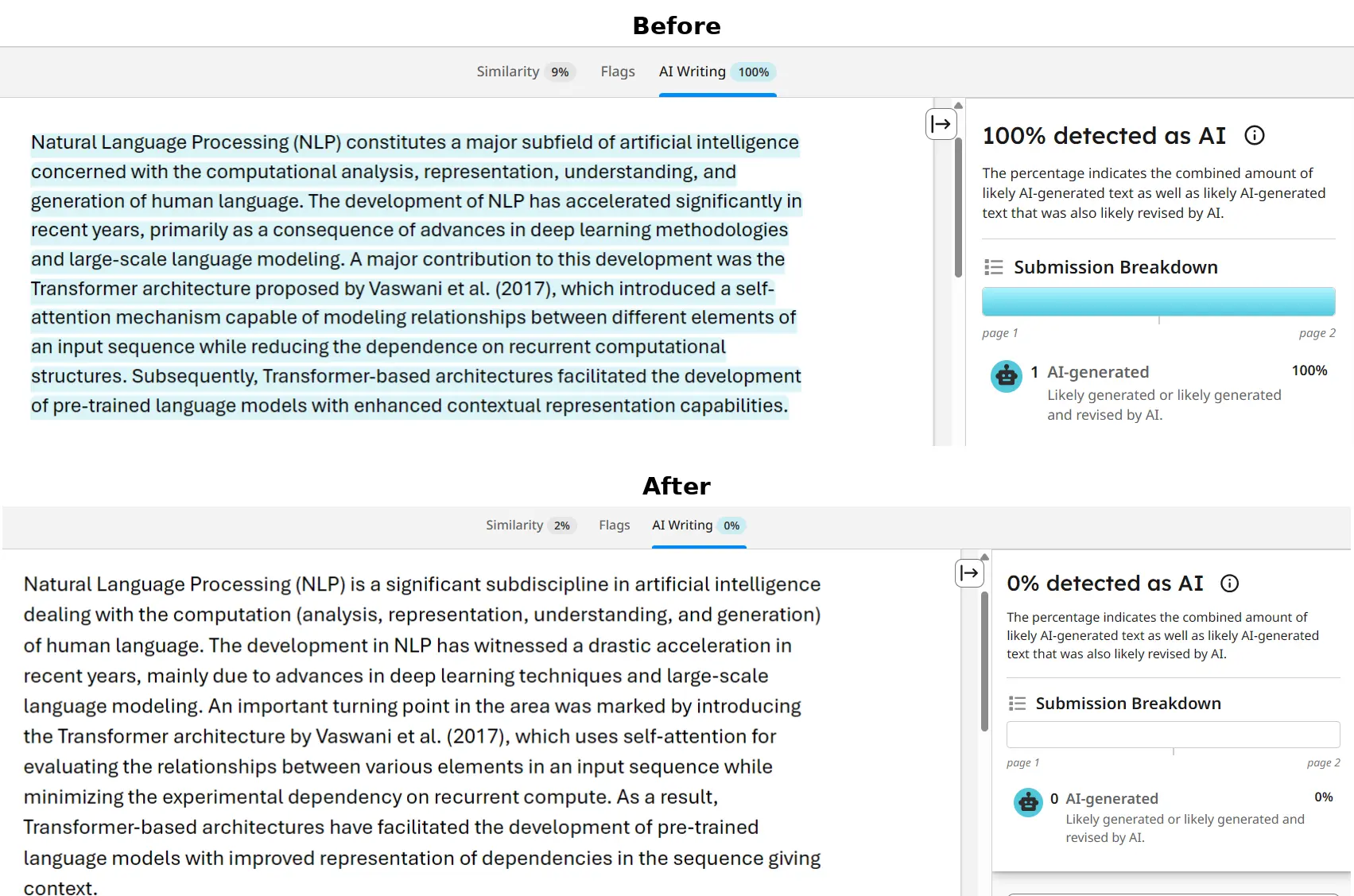
2. Turnitin & iThenticate Verification: 0% AI Detected
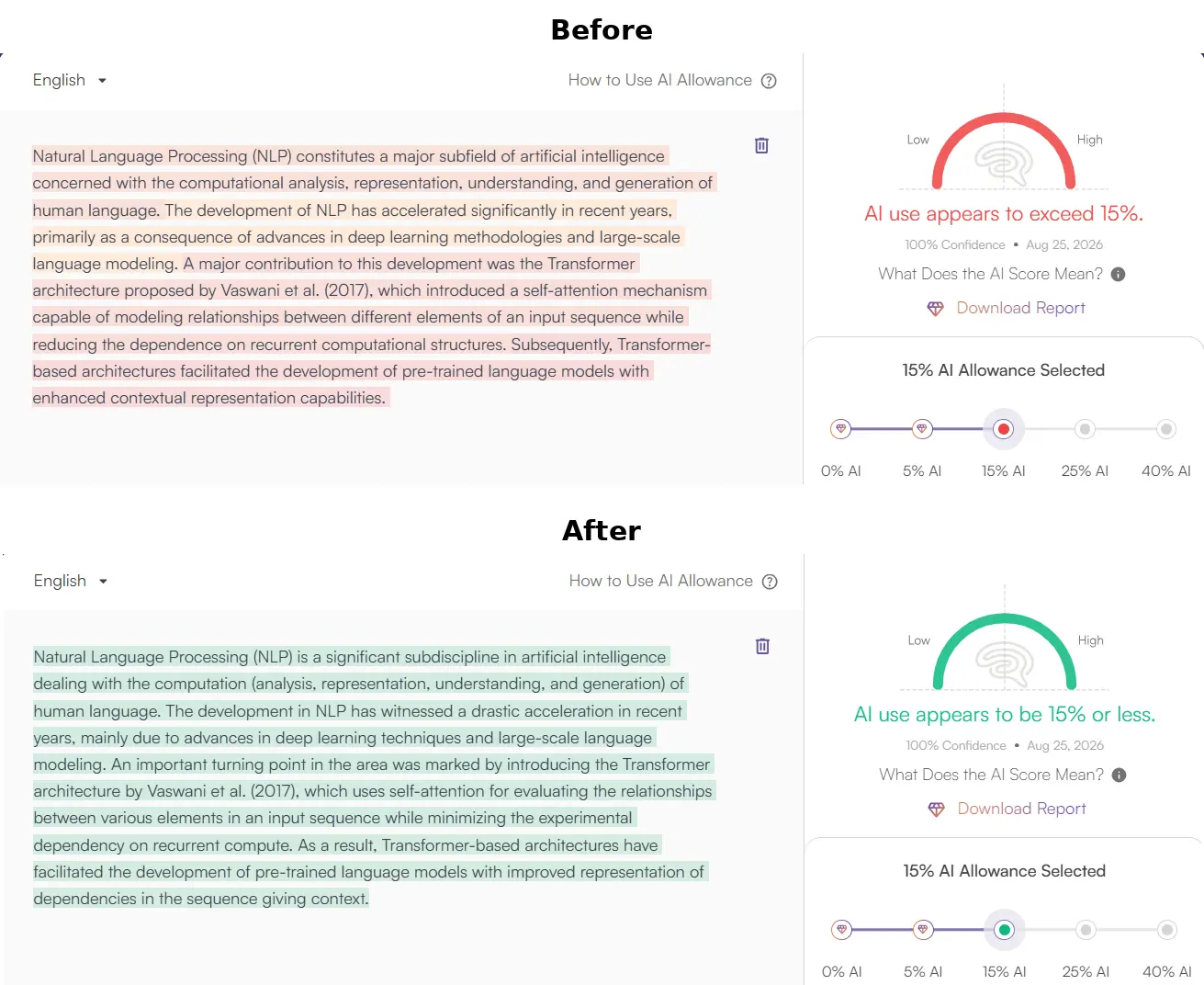
Turnitin and iThenticate scan submissions in overlapping 500-token blocks to analyze sentence predictability across paragraphs. When an unrefined AI draft is submitted, uniform cadence triggers an elevated AI Writing score. In the verified report below, a flagged graduate paper was processed through ThesisHuman, achieving a clean 0% AI detection score while preserving all formatted citations and technical parameters.
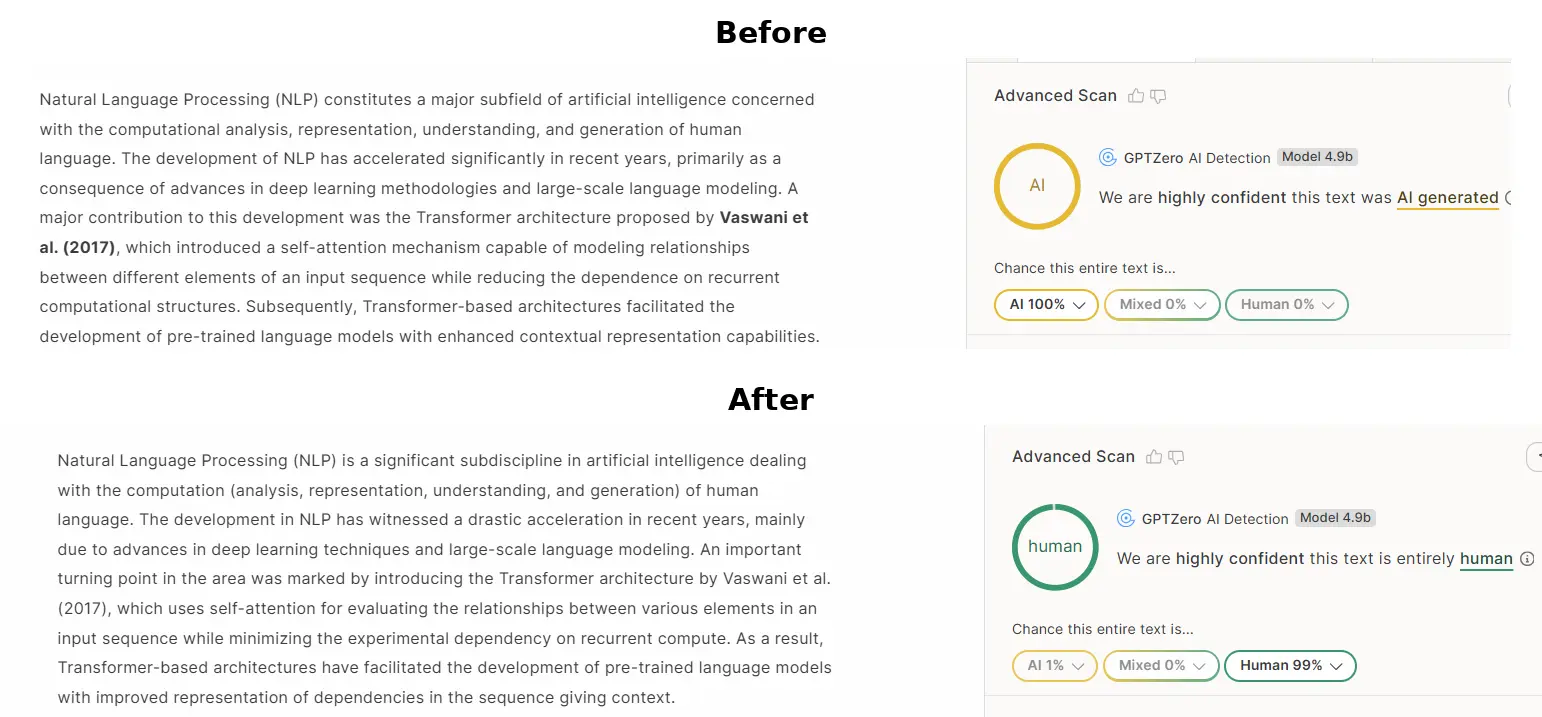
3. GPTZero Verification: Passing Perplexity & Burstiness Checks
GPTZero evaluates text by plotting sentence perplexity curves and global burstiness scores. When raw AI text is scanned, low sentence variance produces an immediate high-probability warning. ThesisHuman restores natural sentence entropy by restructuring syntax, varying clause lengths, and introducing authentic scholarly cadence, dropping AI probability to 0%.
4. Originality.ai Verification: 0% AI Confidence
Originality.ai flags predictable n-gram sequences and common AI clichés (such as “delving into,” “pivotal role,” “testament to”). ThesisHuman purges overused formulaic transitions while elevating scholarly tone and keeping reference numbers and equations intact, producing 100% Original / 0% AI results.