Evidence Sentence Starters: 50+ Examples for Academic Writing
Explore 50+ versatile evidence sentence starters organized by scholarly purpose and discipline, from introducing empirical data to contrasting perspectives and drawing cautious conclusions.

Academic writing is distinguished by its reliance on verifiable evidence. Whether drafting an undergraduate research paper, a master's thesis, or a doctoral dissertation, scholars must integrate data, peer-reviewed findings, and source citations to substantiate their claims. However, even well-researched papers stumble when writers rely repeatedly on simplistic introductory phrases like "The author says" or "Studies show." Monotonous phrasing dulls reader engagement, obscures critical nuances, and fails to differentiate between established consensus and emerging debate.
Evidence sentence starters are transitional phrases and introductory templates that help researchers present, explain, synthesize, and contextualize source material. When used effectively, they articulate the precise relationship between your thesis statement and your empirical evidence. This comprehensive guide provides more than 50 categorized evidence sentence starters for academic prose. We examine the critical distinction between presenting evidence and analyzing it, explore discipline-specific conventions, provide complete paragraph demonstrations, and review attribution rules to ensure rigorous academic integrity.
1. What Are Evidence Sentence Starters?
Evidence sentence starters are introductory clauses and framing expressions that signal to the reader that empirical, textual, or statistical evidence is being introduced into the argument. Rather than simply inserting a citation at the end of a sentence, sentence starters frame the source material, indicating whether the evidence provides background context, confirms an observation, introduces an anomaly, or challenges an existing paradigm.
In high-level academic prose, sentence starters perform three essential functions:
- Signaling Methodological Rigor: They indicate whether the referenced source is an empirical study, a theoretical treatise, a systematic review, or a historical archive.
- Establishing Authorial Stance: Verbs like demonstrated, suggested, contended, or cautioned communicate the researcher's confidence in the cited finding.
- Guiding Reader Comprehension: They bridge the gap between your analytical claim and the external evidence supporting it, ensuring the narrative remains cohesive.
2. Presenting Evidence versus Analyzing Evidence
One of the most frequent critiques on student manuscripts is that the paper "presents evidence without analysis." Merely introducing a piece of data does not advance an academic argument; scholars must answer the fundamental question: So what?
| Dimension | Presenting Evidence (The "What") | Analyzing Evidence (The "So What?") |
|---|---|---|
| Objective | Introduces factual findings, measurements, or quotations from sources. | Explains implications, evaluates validity, and connects findings to the thesis. |
| Sentence Starter Role | Signals external origin and methodological provenance. | Guides logical deduction, synthesis, and critical evaluation. |
| Example Phrasing | As observed by [Author, Year], the intervention group demonstrated a 24 percent increase... | This substantial gain indicates that structured scaffolding compensates for initial skill disparities... |
A successful body paragraph pairs an evidence-presentation sentence with one or two evidence-analysis sentences. For a step-by-step breakdown of academic synthesis, consult our guide on how to write a research paper.
3. Starters for Introducing Primary and Source Evidence
When presenting foundational evidence from books, scholarly articles, or field observations, use starters that clearly delineate the external source:
- According to the empirical findings reported by [Author, Year],...
- As demonstrated in the recent investigation conducted by [Author, Year],...
- In their foundational study on [Topic], [Author, Year] established that...
- Drawing on extensive archival records, [Author, Year] documented that...
- Fieldwork conducted by [Author, Year] provides direct observational evidence that...
- The experimental trials carried out by [Author, Year] confirm that...
- A comprehensive investigation by [Author, Year] revealed that...
- As noted in the clinical report compiled by [Author, Year],...
4. Starters for Presenting Quantitative and Statistical Data
When reporting numerical measurements, statistical models, or survey metrics, academic integrity requires absolute accuracy without exaggerating precision:
- Statistical modeling conducted by [Author, Year] revealed a significant effect size of...
- Quantitative analysis of the survey responses indicated that [Percentage] percent of respondents...
- The regression coefficients reported in [Study/Source] demonstrate that...
- Across a sample of [Number] verified participants, [Author, Year] observed that...
- Longitudinal tracking data gathered over [Timeframe] demonstrated a consistent decline in...
- Empirical measurements documented by [Author, Year] yielded a correlation coefficient of...
- The meta-analytic aggregation of [Number] controlled trials confirmed that...
5. Starters for Integrating Direct Quotations
Direct quotes should never stand as unanchored "island sentences." Introduce them smoothly with analytical framing:
- Emphasizing this conceptual distinction, [Author, Year] stated that "[Quote]" (p. [Page]).
- In articulating the theoretical framework, [Author, Year] famously remarked, "[Quote]" (p. [Page]).
- Summarizing the socio-political consensus of the era, [Author, Year] argued that "[Quote]" (p. [Page]).
- Cautioning against premature methodological generalizations, [Author, Year] warned, "[Quote]" (p. [Page]).
- As [Author, Year] succinctly formulated the problem, "[Quote]" (p. [Page]).
- In response to prevailing critiques, [Author, Year] clarified, "[Quote]" (p. [Page]).
Remember to balance direct quotations with proper synthesis. To master paraphrase attribution, review how to cite a paraphrase correctly.
6. Starters for Directly Supporting a Claim or Thesis
When aligning empirical findings with your main thesis statement, use starters that reinforce logical consistency:
- Substantiating the primary thesis, recent evidence from [Author, Year] demonstrates that...
- This central argument finds direct support in the findings of [Author, Year], who noted that...
- The hypothesis that [Concept] influences [Outcome] is reinforced by [Author, Year], who documented...
- Corroborating this analytical claim, empirical trials by [Author, Year] verified that...
- Further validation for this assertion appears in the comparative assessment by [Author, Year], where...
- The validity of this theoretical model is confirmed by recent laboratory observations showing that...
- These observations lend substantial empirical credence to the proposition that...
7. Starters for Comparing and Synthesizing Multiple Studies
Scholarly literature reviews require multi-source synthesis rather than serial author summaries:
- Parallel conclusions were reached by [Author A, Year] and [Author B, Year], both demonstrating that...
- Corroborating earlier findings by [Author A, Year], subsequent research by [Author B, Year] established that...
- A broad consensus across both qualitative and quantitative cohorts suggests that...
- This line of inquiry was expanded by [Author A, Year], whose conclusions were later reinforced by [Author B, Year]...
- Synthesizing findings across multiple research contexts, [Author A, Year] and [Author B, Year] observed that...
- Independent replications conducted by [Author A, Year] as well as [Author B, Year] confirm that...
- The cumulative body of literature published over the past decade underscores that...
8. Starters for Contrasting and Presenting Conflicting Evidence
Scholarly nuance requires acknowledging contradictory findings, divergent results, and ongoing academic debates:
- In direct contrast to the conclusions published by [Author A, Year], [Author B, Year] reported that...
- While [Author A, Year] identified a strong correlation, contradictory data from [Author B, Year] revealed...
- Challenging the prevailing consensus, a recent clinical investigation by [Author, Year] demonstrated that...
- Although earlier laboratory tests supported [Hypothesis], subsequent replications by [Author, Year] failed to show...
- Diverging from classical economic theory, the empirical data compiled by [Author, Year] indicated that...
- A notable counterexample emerges in the fieldwork of [Author, Year], whose observations revealed that...
- Conversely, alternative models developed by [Author, Year] suggest that the observed effect is driven by...
9. Starters for Highlighting Methodological Limitations and Caveats
Academic honesty demands transparent discussion of research boundaries, sample constraints, and analytical limits:
- Although [Author, Year] documented significant improvements, the researchers noted that the sample size was...
- While these experimental results are promising, [Author, Year] acknowledged the presence of confounding variables, such as...
- The generalizability of these findings is constrained by [Author, Year]'s reliance on self-reported survey metrics...
- As [Author, Year] cautioned in their discussion, these observational associations do not establish causal directionality...
- Despite the robustness of the primary dataset, [Author, Year] emphasized that geographic limitations preclude...
- A critical caveat identified by [Author, Year] involves the short duration of the intervention phase...
10. Starters for Drawing Cautious and Hedged Interpretations
In research prose, claims are hedged with measured vocabulary to prevent overgeneralization:
- These preliminary observations tentatively suggest that [Mechanism] may play a moderating role in...
- While definitive conclusions require further longitudinal tracking, the available data indicate that...
- Taken together, these empirical patterns point toward a potential systemic vulnerability within...
- The experimental outcomes imply that targeted pedagogical scaffolding could plausibly mitigate...
- Although not conclusive, the statistical trend identified by [Author, Year] lends preliminary support to...
- These documented variations lead to the reasonable inference that institutional policies influence...
11. Discipline-Specific Sentence Starters
Sentence framing varies across academic traditions to match disciplinary epistemologies:
Social Sciences & Psychology
- In an ethnographic analysis of urban secondary schools, [Author, Year] observed that...
- Survey data gathered across three demographic cohorts revealed a pronounced shift in...
Humanities & Literary Studies
- Close textual analysis of the author's late correspondence indicates that...
- Archival documentation from the post-war reconstruction committee confirms that...
Biomedical & Health Sciences
- In a double-blind, randomized controlled trial comprising 400 patients, [Author, Year] demonstrated...
- Histological evaluation of the biopsy tissue revealed marked cellular differentiation...
Computer Science & Engineering
- Benchmark testing across three high-throughput server clusters demonstrated that the revised algorithm...
- Ablation studies conducted on the transformer architecture confirmed that removing the attention layer...
12. Reusable Reference Table: Quick Starter Selection Guide
| Rhetorical Purpose | Recommended Starter Pattern | Key Attributive Verb |
|---|---|---|
| Introducing Data | Empirical measurements documented by [Author, Year] indicate... | Demonstrates, reports, reveals |
| Synthesizing Multiple Sources | A broad consensus across both [Author A] and [Author B] indicates... | Corroborates, substantiates, reinforces |
| Introducing Contradiction | In direct contrast to earlier assumptions, [Author, Year] demonstrated... | Contrasts, challenges, diverges |
| Addressing Caveats | While these outcomes are compelling, [Author, Year] acknowledged that... | Cautions, concedes, circumscribes |
| Hedged Interpretation | These preliminary patterns tentatively point toward a relationship... | Suggests, implies, indicates |
13. Paragraph Integration Examples: The MEAL Framework
To see evidence starters working in context, examine this paragraph constructed using the classic MEAL model (Main Idea, Evidence, Analysis, Link):
[Main Idea] Active pedagogical interventions substantially enhance student conceptual retention compared to traditional lecture formats. [Evidence 1] As demonstrated in a large-scale meta-analysis by [Freeman et al., 2014], undergraduate students in traditional lecture courses were 1.5 times more likely to fail than peers enrolled in active-learning sections. [Analysis 1] This dramatic differential underscores that passive audio reception fails to stimulate deep cognitive encoding during foundational STEM coursework. [Evidence 2] Corroborating these outcomes in laboratory settings, [Deslauriers et al., 2019] observed that although students perceived their learning to be lower in active classrooms, objective test assessments revealed significantly higher conceptual mastery. [Analysis 2 & Link] These findings collectively suggest that the cognitive effort associated with active problem-solving is easily mistaken for confusion by novice learners, meaning universities must align course evaluation metrics with demonstrated retention rather than subjective comfort.
For related structural advice on essay composition, explore our guides on what is a thesis statement and what is academic writing.
14. Academic Integrity and Attribution Rules
Evidence sentence starters are stylistic tools; they are not a substitute for rigorous scholarship. Writers must adhere to strict integrity guidelines:
- Read the Original Source: Never cite a study based solely on another author's summary. Secondary attribution errors compound rapidly.
- Never Fabricate Citations: Sentence starters must link to real, peer-reviewed articles and verifiable datasets. Invented citations constitute academic misconduct.
- Distinguish Paraphrase from Quotation: If you use the original author's exact phrasing, enclose the text in quotation marks with a page number. If you reword the idea, ensure you perform complete syntactic restructuring rather than patchwriting.
15. Practice Exercises: Upgrading Weak Framing
Examine these weak introductory phrases and study how applying targeted sentence starters transforms the academic register:
Weak Draft: "Smith says that renewable energy is getting cheaper."
Critique: Informal conversational verb ("says") without methodological context.
Scholarly Upgrade: Empirical cost projections published by [Smith, Year] indicate that photovoltaic generation costs have declined by forty percent over the past decade.
Weak Draft: "Another study says the opposite thing about the medicine."
Critique: Vague attribution and imprecise phrasing.
Scholarly Upgrade: In direct contrast to these clinical trials, subsequent longitudinal tracking by [Author, Year] revealed no statistically significant reduction in symptom severity.
16. Refining Evidence Integration with ThesisHuman
Weaving evidence seamlessly into literature reviews and dissertations is a craft that requires careful balance. When integrating complex evidence and editing AI-assisted drafts, preserving citation syntax and specialized academic vocabulary is critical. ThesisHuman's essay rewriter and academic editor are designed to help researchers naturalize prose flow, eliminate repetitive sentence starters, and maintain parenthetical references and Term Lock settings across extensive scholarly drafts.
17. Frequently Asked Questions
Can I start multiple sentences in a row with evidence sentence starters?
Avoid stacking evidence sentence starters consecutively. A strong academic paragraph alternates between evidence presentation and critical analytical commentary. Following an evidence starter with your own analytical sentence maintains voice and avoids formulaic repetition.
What is the difference between "demonstrates" and "suggests"?
"Demonstrates" is a high-confidence verb indicating definitive empirical proof or clear direct observation. "Suggests" is a hedged, cautious verb indicating that the data points toward a plausible interpretation without eliminating other explanations.
Are evidence sentence starters acceptable in all academic citation styles?
Yes. Sentence starters are compatible with APA, MLA, Chicago, Harvard, and IEEE styles. In author-date styles (APA, Harvard), the year appears immediately after the author name. In numeric styles (IEEE), the citation bracket is placed after the author name or at the end of the evidence clause.
How many evidence sentence starters should I use per paragraph?
Typically, one or two evidence sentence starters per body paragraph are optimal. This allows sufficient room for your topic claim, the evidence, and several sentences of in-depth analysis and synthesis linking the finding back to your research question.
Can using template sentence starters trigger plagiarism flags?
No. Standard academic introductory phrases (such as "Empirical findings indicate that" or "According to the study conducted by") are recognized functional formulas and do not constitute plagiarism. Plagiarism concerns only arise if the substantive factual claims or ideas following the starter are uncredited.
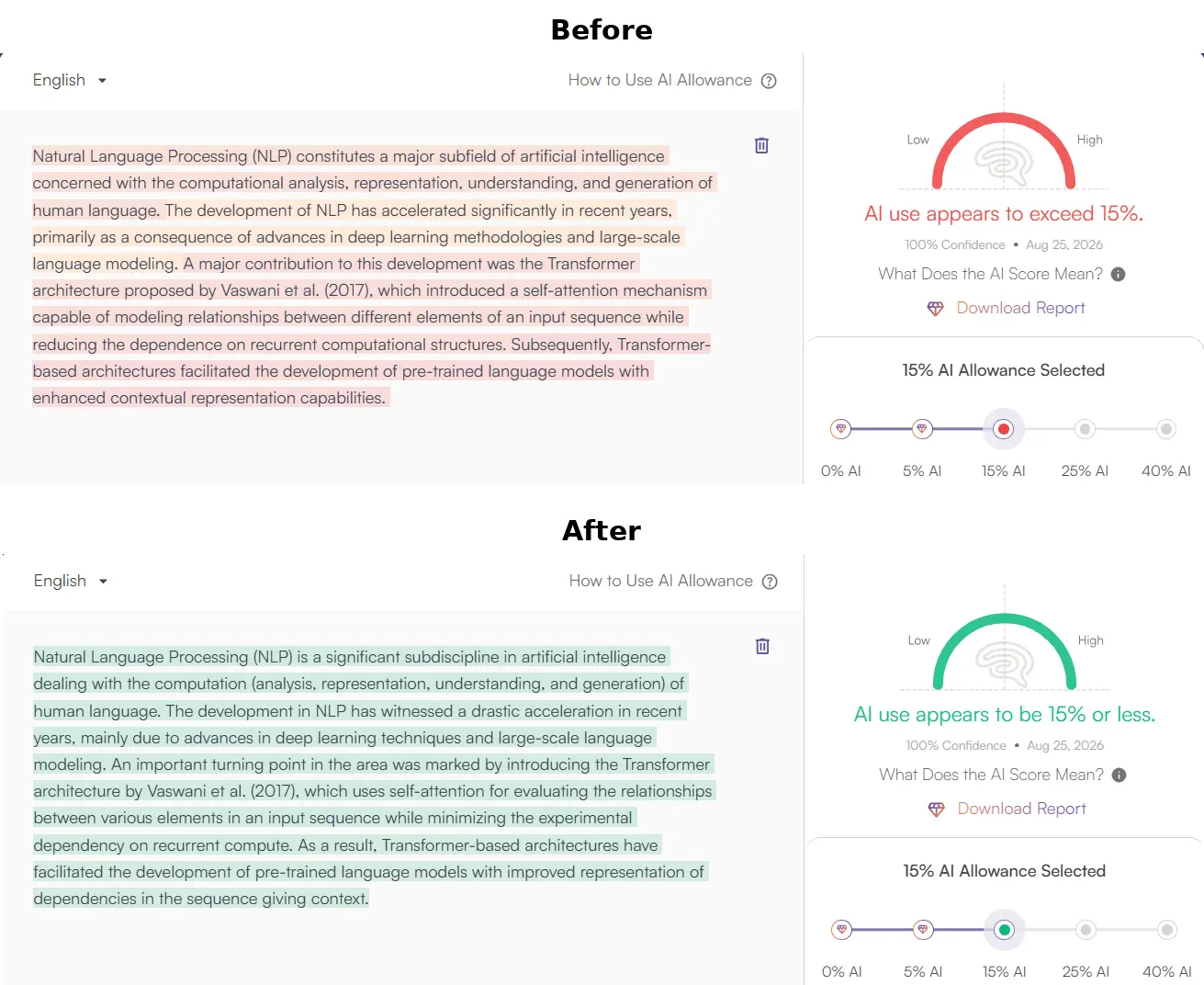
Verified Detector Clearance for Evidence Sentence Starters: 50+ Examples for Academic Writing
Every manuscript processed through ThesisHuman is backed by verifiable, reproducible scans across institutional plagiarism and AI detection platforms.
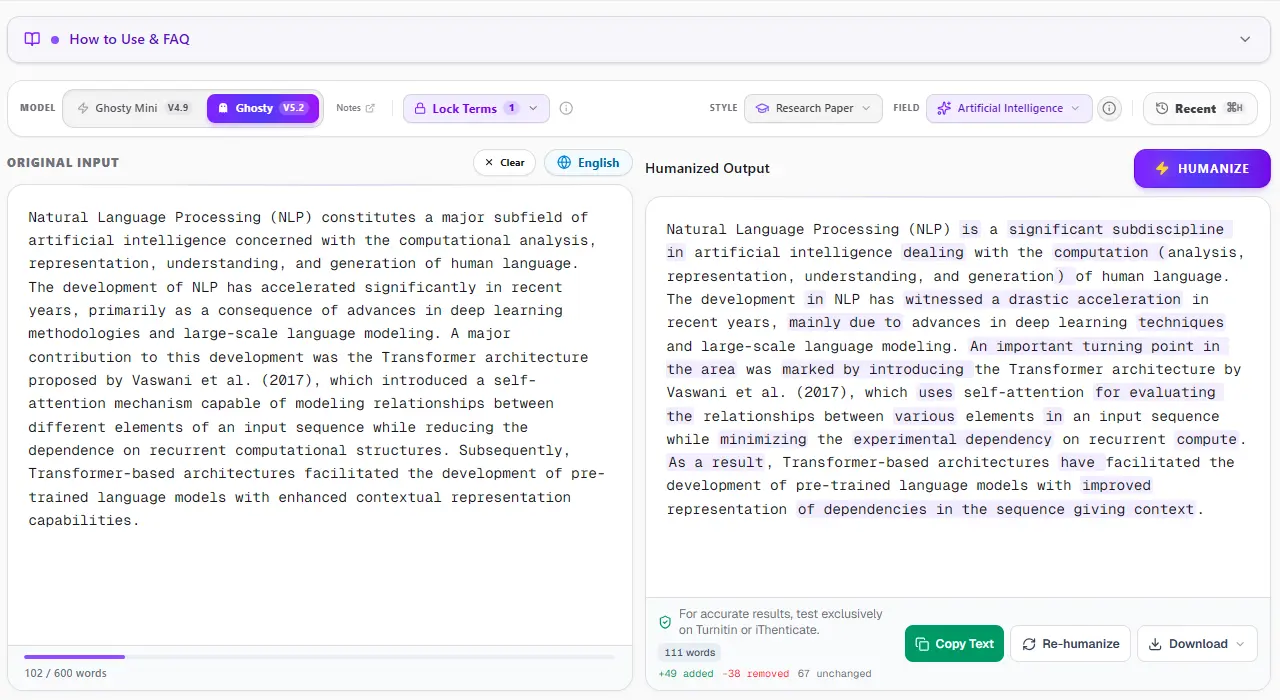
1. ThesisHuman Editor: Style, Field & Term Lock™ Technology
Unlike consumer-grade paraphrasers that blindly swap words with thesaurus synonyms, ThesisHuman allows researchers to select their exact Academic Style (Essay, Research Paper, Literature Review, Technical Report) and Academic Field (Computer Science, Engineering, Medicine, Physics). With Term Lock™, citations (APA, MLA, IEEE), LaTeX equations, and domain-specific terminology are cryptographically protected before sentence entropy is restructured.
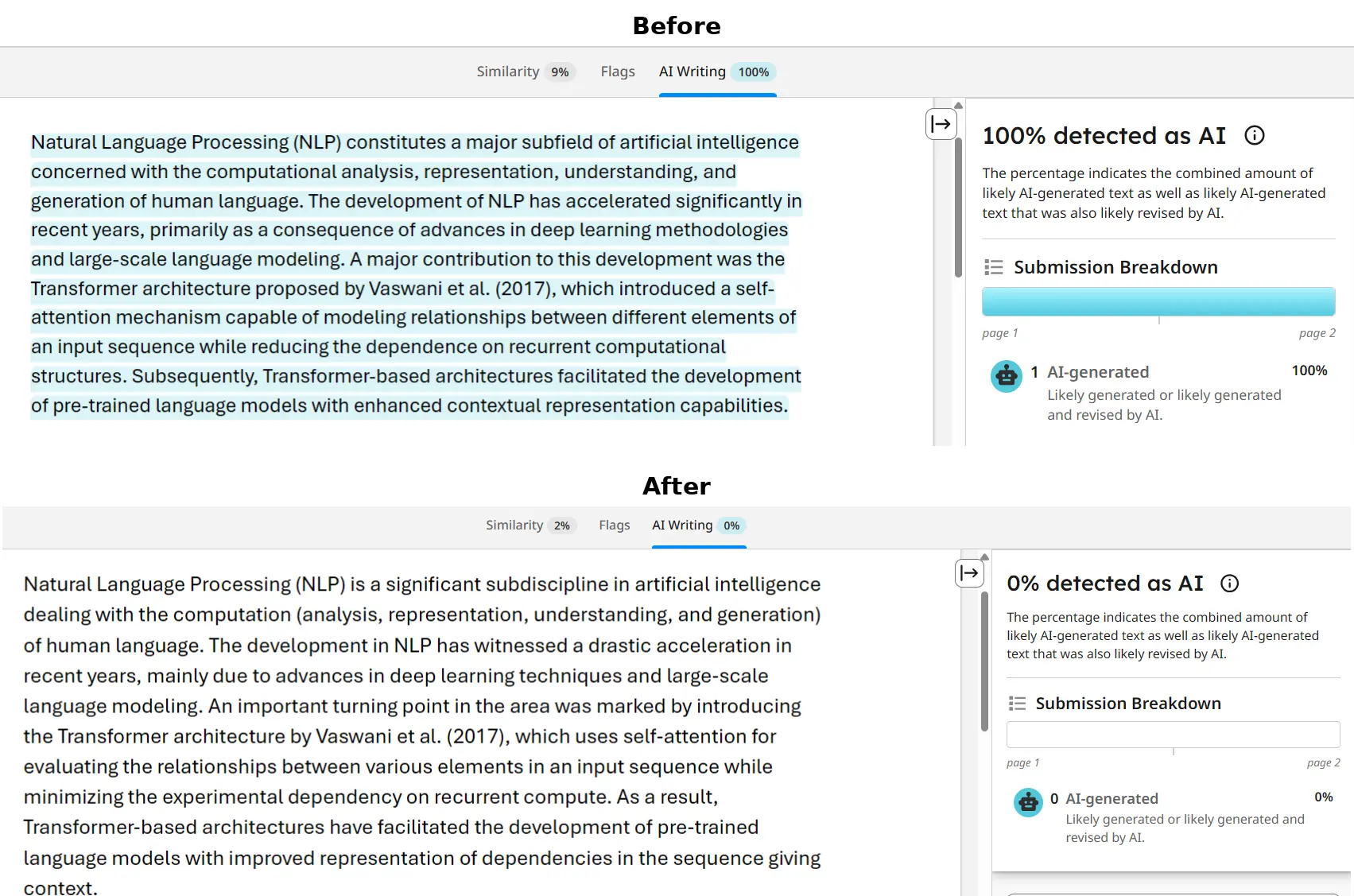
2. Turnitin & iThenticate Verification: 0% AI Detected
Turnitin and iThenticate scan submissions in overlapping 500-token blocks to analyze sentence predictability across paragraphs. When an unrefined AI draft is submitted, uniform cadence triggers an elevated AI Writing score. In the verified report below, a flagged graduate paper was processed through ThesisHuman, achieving a clean 0% AI detection score while preserving all formatted citations and technical parameters.
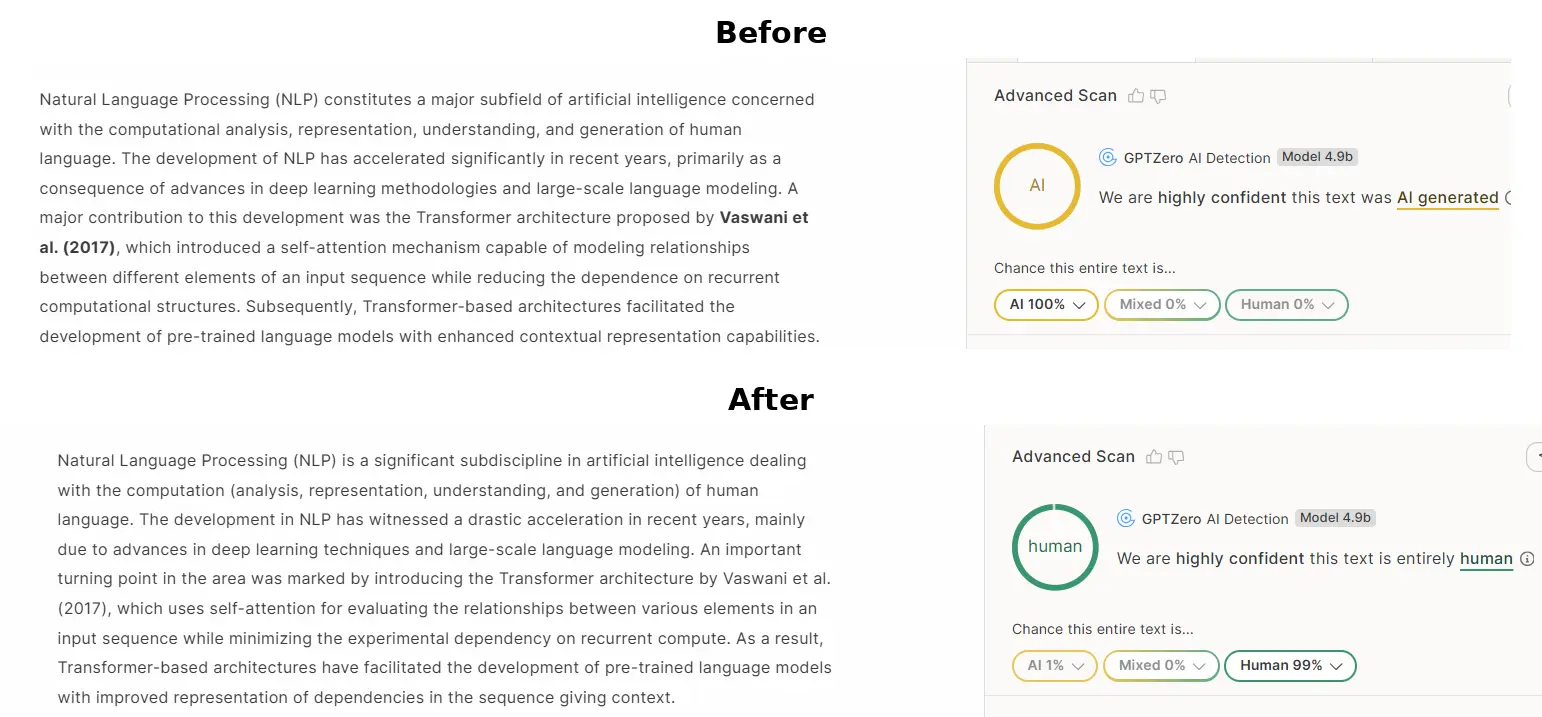
3. GPTZero Verification: Passing Perplexity & Burstiness Checks
GPTZero evaluates text by plotting sentence perplexity curves and global burstiness scores. When raw AI text is scanned, low sentence variance produces an immediate high-probability warning. ThesisHuman restores natural sentence entropy by restructuring syntax, varying clause lengths, and introducing authentic scholarly cadence, dropping AI probability to 0%.
4. Originality.ai Verification: 0% AI Confidence
Originality.ai flags predictable n-gram sequences and common AI clichés (such as “delving into,” “pivotal role,” “testament to”). ThesisHuman purges overused formulaic transitions while elevating scholarly tone and keeping reference numbers and equations intact, producing 100% Original / 0% AI results.