Topic Sentence Starters: 40+ Examples for Academic Essays
Explore 40+ adaptable topic sentence starters organized by academic purpose and discipline, helping you establish clear paragraph claims, direct arguments, and research insights.

The opening sentence of an academic body paragraph carries immense rhetorical responsibility. Known as the topic sentence, it must establish the paragraph's controlling idea, define the analytical boundary of the discussion, and signal how the upcoming evidence directly supports the paper's central thesis. When a topic sentence is vague, overly factual, or missing entirely, readers are left to wander through empirical data without an interpretive roadmap. Conversely, a focused, assertive topic sentence commands reader attention and imbues the subsequent analysis with purposeful direction.
Struggling with paragraph openers is common among undergraduate and graduate writers alike. Many students default to formulaic phrases like "Another point is..." or inadvertently begin paragraphs with dry citations that state facts rather than making claims. This guide provides an exhaustive resource for academic writers. We analyze the theoretical relationship between topic sentences and thesis statements, distinguish topic claims from evidence sentences, provide 50 original topic sentence starters across 10 rhetorical categories, dissect complete paragraph models across academic disciplines, and present diagnostic exercises to elevate your scholarly drafts.
1. What Is an Academic Topic Sentence?
In scholarly prose, a topic sentence is the controlling assertion of a body paragraph. It identifies the subject of the paragraph and articulates a specific claim, perspective, or analytical lens through which that subject will be evaluated.
An effective topic sentence is never a neutral statement of objective fact. Stating that "Photosynthesis converts sunlight into chemical energy" is an undisputed biological reality, not an analytical claim. A true topic sentence offers a perspective that requires defense, evidence, and elaboration: "While early biochemical models treated photosynthesis as a static conversion process, recent cellular assays demonstrate that photoprotective mechanisms actively modulate energy throughput in response to ambient micro-fluctuations." The latter sentence establishes an intellectual premise that justifies an entire paragraph of empirical analysis.
Golden Rule: A topic sentence must make a claim that requires evidence. If the sentence states a universally accepted fact that cannot be contested or elaborated upon, it is a factual announcement, not a topic sentence.
2. Topic Sentences versus Thesis Statements
Understanding academic hierarchy requires clarifying the structural division of labor between a thesis statement and a topic sentence. While both make argumentative assertions, they operate at vastly different levels of scale.
| Dimension | Thesis Statement | Topic Sentence |
|---|---|---|
| Scope | Macro-argument: Governs the entire paper, thesis, or dissertation | Micro-argument: Governs a single body paragraph or thematic cluster |
| Placement | End of the introduction; restated in the conclusion | Opening sentence (or immediate second sentence) of each body paragraph |
| Rhetorical Purpose | Establishes the central contribution and intellectual position of the research | Establishes a single sub-claim that proves one facet of the broader thesis |
| Structural Interdependence | Supported collectively by all body paragraphs | Must directly tie back to and support the central thesis statement |
For an exhaustive exploration of crafting central paper claims, consult our detailed resource on what is a thesis statement.
3. Topic Sentences versus Evidence Sentences
A widespread issue in draft manuscripts is the conflation of topic sentences with evidence sentences. When a paragraph opens with an empirical citation (for example, "According to Miller (2023), 45% of surveyed firms experienced cybersecurity breaches"), the author has surrendered the paragraph's controlling voice to an outside source.
The topic sentence belongs strictly to the author. It introduces the analytical category; the evidence sentence provides the proof. Compare these two structural approaches:
- Weak Opener (Evidence-first): "According to a 2024 institutional audit, 62% of undergraduate students utilized generative AI tools for exam preparation." (States data without establishing what claim the data is proving).
- Strong Opener (Topic Claim): "The proliferation of generative writing tools has fundamentally altered undergraduate study behaviors, forcing academic departments to reevaluate traditional evaluative benchmarks." (Establishes the author's claim; the 62% statistic naturally follows as supporting proof).
To master the integration of empirical data once your topic claim has been asserted, review our collection of evidence sentence starters.
4. Core Structural Functions of Topic Sentences in Body Paragraphs
In well-structured scholarship, a topic sentence performs three simultaneous structural functions:
- Boundary Setting: It defines what is included in the paragraph and, just as importantly, what is excluded. If a thought does not directly serve the topic sentence, it belongs in another paragraph.
- Cognitive Priming: It prepares the reader's mental framework to receive specialized empirical details, statistical comparisons, or theoretical citations.
- Thematic Continuity: When read consecutively, the topic sentences of an essay should form an unbroken executive summary of the paper's complete argument.
5. 40+ Topic Sentence Starters by Academic Purpose
The following 50 original topic sentence starters are categorized by rhetorical objective. Rather than serving as rigid Mad-Libs templates, these sentence stems provide flexible syntactic frameworks adaptable to any scholarly inquiry.
Category 1: Introducing a Central Claim or Argument
- A foundational factor driving [phenomenon] is the systematic interaction between [variable A] and [variable B].
- Central to understanding [issue] is the premise that [institution/process] functions primarily as a mechanism for [objective].
- The primary mechanism through which [variable A] alters [variable B] manifests in the accelerated degradation of [target].
- At the core of this debate lies the contested assumption that [practice] inherently promotes [outcome].
- To understand how [system] adapts to external shocks, one must first recognize that [condition] fundamentally governs [behavior].
Category 2: Expanding on an Established Line of Reasoning
- Building upon the premise that [concept A] remains volatile, subsequent field investigations demonstrate that [trend B] accelerates under [condition C].
- This pattern of institutional centralization extends beyond macroeconomic policy and directly influences [local administrative practice].
- Extending this theoretical framework to digital environments reveals that [traditional behavioral norms] undergo profound reconfiguration.
- A closer inspection of this empirical correlation illuminates an underlying reliance on [unexamined variable].
- Not only does [process A] destabilize established workflows, but it also intensifies structural friction across [interdependent department].
Category 3: Comparing and Contrasting Perspectives
- While prevailing sociological models emphasize [structural determinism], emerging ethnographic fieldwork underscores the decisive role of [individual agency].
- In stark contrast to traditional econometric assumptions regarding [rational choice], behavioral experiments reveal that [cognitive bias] consistently skews outcomes.
- Whereas qualitative assessments highlight [perceived community cohesion], quantitative geographic surveys indicate escalating spatial segregation.
- Although clinical practitioners generally prioritize [immediate intervention], epidemiological researchers increasingly advocate for [upstream preventive protocols].
- The divide between [Theoretical Camp A] and [Theoretical Camp B] hinges fundamentally on their divergent definitions of [core concept].
Category 4: Identifying Gaps in Existing Literature
- Despite extensive scholarship examining [general issue], relatively little empirical attention has focused on how [specific subpopulation] navigates [challenge].
- Although previous studies have thoroughly documented [short-term consequence], the longitudinal durability of [policy] remains virtually unexamined.
- Much of the existing literature presumes a static relationship between [factor A] and [factor B], overlooking the disruptive impact of [recent development].
- While theoretical models predict rapid market equilibrium, real-world archival documentation of [historical event] demonstrates persistent structural lag.
- Existing research frequently conflates [concept X] with [concept Y], obscuring the distinct operational pathways through which each impacts [metric].
Category 5: Explaining Causes and Underlying Mechanisms
- The observed decline in [system metric] is largely attributable to the unintended consequences of [regulatory reform].
- Underlying this acute physiological reaction is a cascade of cellular events triggered by [molecular stimulus].
- Rather than originating from a single catastrophic failure, this organizational breakdown stemmed from cumulative micro-deficiencies in [oversight protocol].
- The historical emergence of [cultural movement] was fundamentally propelled by concurrent shifts in [economic demographic reality].
- Investigating the etiology of [condition] requires examining how prolonged exposure to [environmental stressor] impairs [system function].
Category 6: Evaluating Consequences and Practical Implications
- The immediate operational consequence of this procedural shift was a measurable reduction in [administrative compliance error].
- Beyond immediate clinical stabilization, sustained application of [treatment protocol] yielded unexpected longitudinal benefits for [patient mobility].
- The broader socio-economic fallout from [economic shock] has disproportionately burdened [marginalized demographic cohort].
- These technological advancements carry profound ethical implications for institutional governance and individual data privacy.
- Ultimately, the adoption of [pedagogical framework] altered not merely student test performance, but their lifelong intrinsic motivation toward [discipline].
Category 7: Introducing and Rebutting Counterarguments
- Proponents of [opposing theory] frequently argue that [claim], yet empirical validation of this assertion remains remarkably scarce.
- While skeptics suggest that [intervention] introduces prohibitive capital overhead, budgetary audits demonstrate that downstream savings offset initial outlays.
- It is often contended that [phenomenon A] operates independently of [context B]; however, closer scrutiny of archival logs reveals deep systemic interdependence.
- Although conventional wisdom holds that [popular assumption], recent experimental replications have consistently failed to reproduce those baseline effects.
- Critics rightfully point out the logistical constraints of [proposed strategy], but these operational hurdles do not invalidate its core theoretical efficacy.
Category 8: Detailing Methodological Considerations
- To isolate the causal influence of [treatment variable] from confounding background noise, the experimental protocol utilized a randomized block design.
- Addressing potential sampling bias required implementing a stratified recruitment strategy across three distinct municipal zones.
- The operationalization of [abstract construct] presented significant psychometric challenges that necessitated a multi-stage validation survey.
- Evaluating these high-frequency biometric streams required deploying a custom algorithmic filter calibrated to eliminate sensor artifact distortion.
- Because historical census registries from this era contain significant demographic omissions, archival cross-verification was conducted against parish records.
Category 9: Discussing Limitations and Scope Delimitations
- In interpreting these econometric projections, one must acknowledge that the dataset is restricted to publicly traded corporate entities.
- A notable constraint of this qualitative design lies in the geographic concentration of participants within a single metropolitan healthcare network.
- While the observed molecular affinity is statistically robust in vitro, extrapolating these cellular dynamics to human metabolic pathways requires cautious clinical trials.
- The deliberate omission of [secondary variable] from this analytical simulation represents a necessary trade-off to preserve computational tractability.
- These conclusions should be evaluated with the caveat that participant self-reporting is inherently subject to social desirability bias.
Category 10: Synthesizing Evidence to Support the Main Thesis
- Taken together, these disparate empirical threads substantiate the overarching claim that [central thesis argument].
- This cumulative body of clinical evidence firmly establishes that [disease progression] is governed by immunological rather than purely genetic triggers.
- When evaluated in conjunction with regional labor trends, these legislative case studies confirm the paper's central thesis regarding municipal regulatory capture.
- The convergence of these qualitative interviews with national demographic metrics leaves little doubt that [systemic reform] is urgent and overdue.
- In the final analysis, each of these analytical dimensions reinforces the argument that [core philosophical proposition] remains indispensable to modern statecraft.
6. Discipline-Specific Applications and Case Studies
The tone and syntax of a topic sentence vary noticeably across academic fields. Review how these five disciplinary examples tailor starter frameworks to match professional publication standards.
Education & Pedagogy
Topic Sentence: The implementation of project-based collaborative learning environments significantly improves conceptual retention in secondary STEM classrooms, particularly when paired with structured peer scaffolding.
Computer Science & Cybersecurity
Topic Sentence: Traditional static signature analysis has proven increasingly ineffective at mitigating polymorphic zero-day exploits, prompting security architectures to pivot toward real-time behavioral telemetry.
Sociology & Urban Studies
Topic Sentence: Rapid transit infrastructure expansion often acts as a double-edged sword, stimulating municipal commercial investment while inadvertently pricing out generational neighborhood residents.
Literary Criticism & Cultural Studies
Topic Sentence: Through recurring motifs of claustrophobic architectural spaces, the novel critiques the suffocating domestic domesticity imposed upon middle-class Victorian women.
Biomedical Sciences & Oncology
Topic Sentence: Targeted inhibition of the enzymatic pathway suppressed metastatic tumor angiogenesis in murine models without inducing systemic hepatotoxicity.
7. Anatomy of a Complete Academic Paragraph
To appreciate how a topic sentence anchors a paragraph, examine this complete model following the MEAL structure (Main idea, Evidence, Analysis, Link):
[Topic Sentence / Main Idea]: The rapid adoption of automated algorithmic screening in corporate hiring pipelines has introduced insidious, self-reinforcing gender disparities across technical recruitment cohorts.
[Evidence]: In a recent empirical audit of machine-learning resume parsers trained on ten years of historic corporate applicant records, models penalized curriculum vitae containing women's sports affiliations or women's college designations by an average of 22% compared to identical male control profiles.
[Analysis]: This computational bias did not result from overt programming malice, but rather emerged because the training corpus reflected historic male dominance within senior engineering leadership. When algorithms optimize for predictive similarity against historical hiring precedents, they codify institutional legacy inequities under a veneer of mathematical objectivity.
[Link / Transition]: Consequently, mitigating hiring bias requires not merely surface-level keyword anonymization, but rather a fundamental restructuring of algorithmic training objective functions before deployment in human resource environments.
8. Strong versus Weak Topic Sentence Examples
Subtle adjustments in phrasing can transform a flat, descriptive statement into a compelling scholarly claim. Study these comparative pairs:
| Weak Opener | Critique | Scholarly Revision |
|---|---|---|
| This paragraph will discuss student sleep deprivation and GPA. | Announces topic self-referentially; makes zero analytical claims. | Chronic sleep deprivation directly impairs undergraduate cognitive processing, precipitating measurable drops in academic grade point averages across challenging analytical disciplines. |
| Smartphones were invented in the early 2000s and changed society. | Broad, banal historical fact; lacks academic specificity. | The pervasive integration of mobile push-notification architecture has fragmented adolescent attention spans, creating measurable micro-distractions during sustained classroom instruction. |
| According to Dr. Evans, ocean temperatures are rising quickly. | Surrenders controlling voice to an outside citation. | Accelerating marine thermal anomalies threaten the biological integrity of coastal coral reefs, destabilizing pelagic food webs far beyond the immediate littoral zone. |
9. Common Topic Sentence Mistakes to Avoid
When drafting or revising your manuscripts, keep a sharp eye out for these three recurring pitfalls:
- The Meta-Announcement Trap: Beginning with phrases like "In this section, I will examine..." or "My second paragraph explores..." signals amateur prose. State the finding directly without announcing the writing process.
- The Premature Data Dump: Cramming specific p-values, sample counts, or extended quotations into the very first sentence overwhelms the reader before they understand the overarching claim. Save granular data for the evidence stage of the paragraph.
- The Runaway Topic Sentence: Attempting to squeeze three separate arguments into a single 60-word opening sentence confuses the paragraph's trajectory. If your sentence contains multiple coordinating conjunctions joining disparate concepts, divide it into distinct thematic paragraphs.
10. Practical Revision Checklist for Paragraph Openers
Use this concise self-audit before finalizing any scholarly article, thesis chapter, or conference submission:
- Does this sentence present an interpretive claim rather than a self-evident fact?
- Can the reader predict the general trajectory of the paragraph based solely on this opening sentence?
- Does this sentence avoid opening with a citation or quotation?
- Does this claim directly support, expand, or qualify the overarching thesis statement?
- Is the phrasing concise, assertive, and devoid of meta-writing announcements?
11. Practice Exercises: Transforming Weak Paragraph Openers
Test your editing acumen on these four weak openers. Diagnose their structural flaw and review the revised academic claim.
Exercise 1: Another thing to look at is how water pollution affects fish in rivers.
Flaw: Colloquial phrasing (Another thing to look at) with zero argumentative assertion.
Scholarly Revision: Industrial agricultural runoff introduces elevated nitrate concentrations into freshwater river basins, severely suppressing dissolved oxygen levels and precipitating catastrophic fish mortality.
Exercise 2: Smith (2022) found that remote workers are 15% more productive.
Flaw: Bare citation acting as a paragraph opener without authorial interpretation.
Scholarly Revision: Eliminating daily commuter friction and open-office sensory interruptions allows remote knowledge workers to achieve sustained periods of deep task engagement.
Exercise 3: Many people use social media every single day across the world.
Flaw: Banal, universally known fact with no academic relevance or tension.
Scholarly Revision: The algorithmic gamification of social media notification systems intentionally exploits dopamine reward pathways, fostering compulsive platform re-engagement among adolescent demographics.
Exercise 4: In this paragraph, I will argue why solar panels are cost-effective.
Flaw: First-person meta-announcement of the writing task.
Scholarly Revision: Subsidized photovoltaic installations substantially reduce municipal commercial grid reliance, delivering long-term capital amortization within seven operational fiscal quarters.
12. Refining Paragraph Openers with ThesisHuman
Drafting engaging, authoritative topic sentences across long research dissertations is challenging. When academic writers get bogged down in complex methodologies or dense statistical tables, opening sentences often devolve into repetitive, descriptive formulas. Utilizing specialized academic rewriting tools can help introduce variety, polish clausal cadence, and strengthen argumentative assertions without disturbing in-text citations or technical terms.
If your draft contains repetitive openers or stilted syntax, tools like our essay rewriter and sentence rewriters can help you workshop commanding topic claims. You can paste and evaluate paragraphs directly in the interactive ThesisHuman editor, comparing alternative clausal framings that connect smoothly with your transition sentences and overarching research thesis.
13. Frequently Asked Questions
What is the primary role of a topic sentence in an academic paragraph?
A topic sentence articulates the controlling idea and interpretive claim of a body paragraph. It tells the reader what specific sub-claim will be explored and establishes the analytical scope for all subsequent evidence and analysis in that paragraph.
How does a topic sentence differ from a thesis statement?
A thesis statement expresses the overarching argument of the entire paper or dissertation and appears in the introductory section. A topic sentence operates at the paragraph level, presenting a single, focused premise that supports and proves one component of that thesis.
Can a topic sentence begin with a direct citation or statistical fact?
In formal academic writing, opening a paragraph with a bare fact or direct quotation is discouraged. The first sentence should state the author's analytical claim or line of inquiry; empirical evidence should be introduced in subsequent sentences to support that initial claim.
How long should an academic topic sentence be?
Most effective topic sentences range from 15 to 30 words. They must be concise enough to deliver a clear assertion without overwhelming the reader with premature evidentiary details.
Can a topic sentence also contain a transitional element?
Yes. In advanced scholarly prose, a topic sentence often incorporates a transitional dependent clause that bridges the preceding paragraph's conclusion with the current paragraph's new central claim.
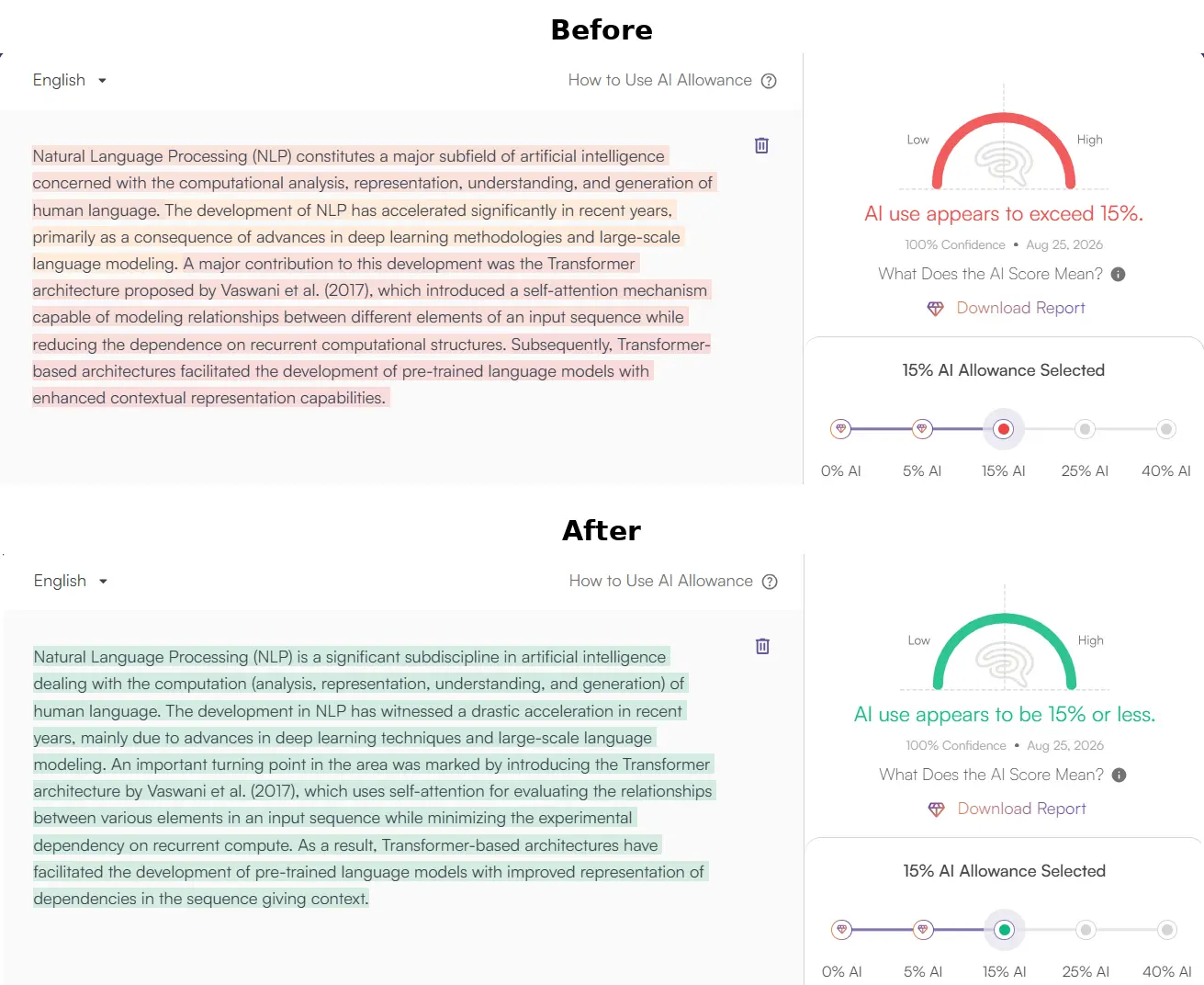
Verified Detector Clearance for Topic Sentence Starters: 40+ Examples for Academic Essays
Every manuscript processed through ThesisHuman is backed by verifiable, reproducible scans across institutional plagiarism and AI detection platforms.
1. ThesisHuman Editor: Style, Field & Term Lock™ Technology
Unlike consumer-grade paraphrasers that blindly swap words with thesaurus synonyms, ThesisHuman allows researchers to select their exact Academic Style (Essay, Research Paper, Literature Review, Technical Report) and Academic Field (Computer Science, Engineering, Medicine, Physics). With Term Lock™, citations (APA, MLA, IEEE), LaTeX equations, and domain-specific terminology are cryptographically protected before sentence entropy is restructured.

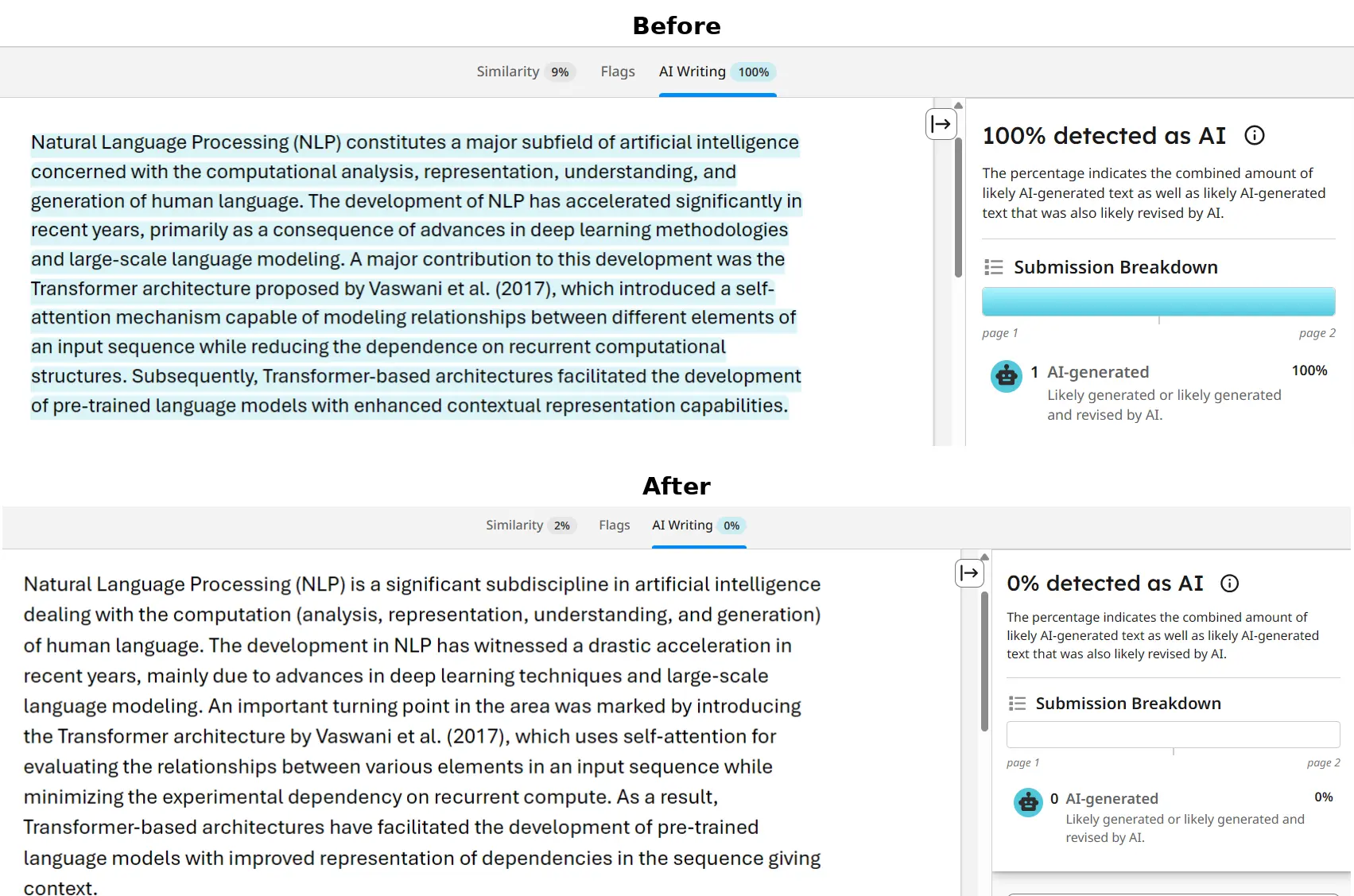
2. Turnitin & iThenticate Verification: 0% AI Detected
Turnitin and iThenticate scan submissions in overlapping 500-token blocks to analyze sentence predictability across paragraphs. When an unrefined AI draft is submitted, uniform cadence triggers an elevated AI Writing score. In the verified report below, a flagged graduate paper was processed through ThesisHuman, achieving a clean 0% AI detection score while preserving all formatted citations and technical parameters.
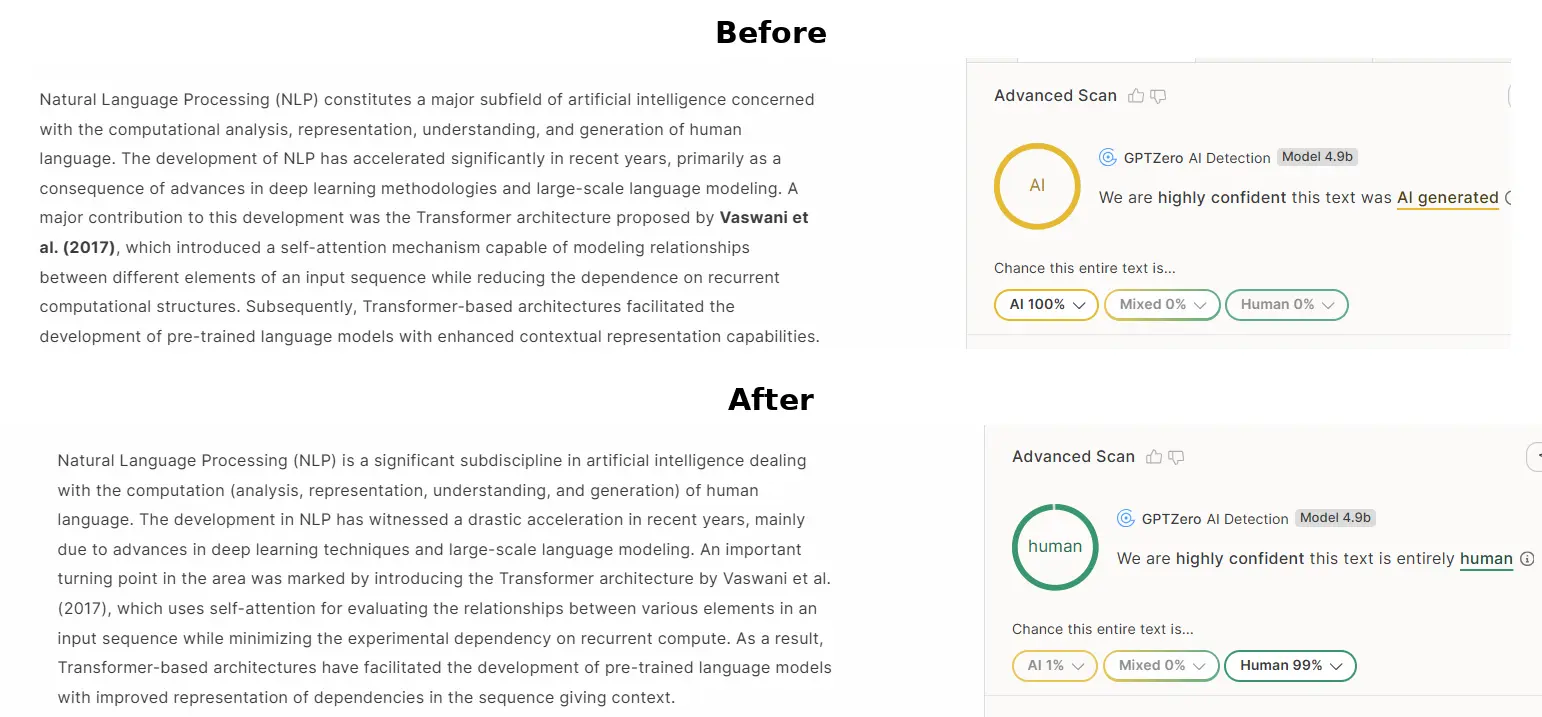
3. GPTZero Verification: Passing Perplexity & Burstiness Checks
GPTZero evaluates text by plotting sentence perplexity curves and global burstiness scores. When raw AI text is scanned, low sentence variance produces an immediate high-probability warning. ThesisHuman restores natural sentence entropy by restructuring syntax, varying clause lengths, and introducing authentic scholarly cadence, dropping AI probability to 0%.
4. Originality.ai Verification: 0% AI Confidence
Originality.ai flags predictable n-gram sequences and common AI clichés (such as “delving into,” “pivotal role,” “testament to”). ThesisHuman purges overused formulaic transitions while elevating scholarly tone and keeping reference numbers and equations intact, producing 100% Original / 0% AI results.