Transition Sentences: Examples and How to Use Them in Academic Writing
A comprehensive academic guide to crafting effective transition sentences that bridge ideas, paragraphs, and research sections with clarity and rigorous scholarly logic.

In academic writing, clear arguments do not succeed on the strength of isolated facts alone. Even the most robust empirical dataset or rigorous theoretical framework will fail to persuade peer reviewers if individual assertions appear disconnected. Readers must never be forced to guess how one finding leads into another, why an unexpected contradiction matters, or how a specific methodological constraint shapes subsequent conclusions. This connective work is performed by transition sentences. A well-crafted transition sentence serves as an intellectual conduit, clarifying the exact logical relationship between adjacent ideas, paragraphs, and research sections.
Many emerging scholars confuse transition sentences with simple transitional words or phrases. While connective adverbs such as furthermore or however indicate a change in direction, a true transition sentence explicitly names the concepts on both sides of the boundary, demonstrating why the argument must advance in that specific direction. This comprehensive guide breaks down the architecture of academic transition sentences. We examine the differences between micro-transitions and macro-transitions, analyze transitional structures across core rhetorical moves, explore before-and-after disciplinary examples, identify mechanical traps, and provide a diagnostic revision checklist for graduate students and researchers.
1. What Is a Transition Sentence?
A transition sentence is a complete grammatical clause or compound structure designed to link two independent ideas, claims, or analytical stages. Its primary function is relational: it signals to the reader both where the argument has been and where it is going next.
Unlike a mechanical signpost that merely asserts sequence (such as "The next point to consider is..."), an effective academic transition sentence articulates the conceptual bridge between two statements. It highlights causal relationships, introduces qualifications, establishes counter-evidence, or narrows the scope of an inquiry. By making the implicit logical scaffolding of an argument explicit, transition sentences transform a disjointed list of observations into a cohesive academic narrative.
Core Principle: A transition sentence does not merely announce that a change in topic is occurring; it demonstrates why the subsequent topic is necessary in light of what has already been proven.
2. Transition Sentences versus Transition Words
To master academic flow, writers must distinguish between a solitary transition word and a substantive transition sentence. While both contribute to cohesion, they operate at fundamentally different structural tiers.
| Feature | Transition Word / Phrase | Substantive Transition Sentence |
|---|---|---|
| Grammatical Unit | Single adverb or prepositional phrase (e.g., Consequently, In addition) | Full independent clause or complex sentence with subject and predicate |
| Explanatory Power | Signals direction without explaining the mechanism | Synthesizes the prior claim and clarifies how the next finding modifies it |
| Structural Scope | Connects adjacent sentences within a paragraph | Bridges distinct paragraphs, theoretical frameworks, or major paper sections |
| Cognitive Impact | Requires the reader to deduce conceptual alignment | Directly guides reader cognition toward the author's analytical synthesis |
Consider this contrast in practice. A writer relying solely on a transition word might write: "However, the second trial produced contradictory outcomes." A writer employing a full transition sentence writes: "Although the initial trial indicated high thermal tolerance under controlled laboratory conditions, subjecting the alloy to cyclic field stress revealed structural degradation." The full sentence grounds the contrast in specific empirical realities rather than abstract grammatical opposition.
3. Why Transitions Matter in Academic Arguments
Academic prose is characterized by high information density. Readers (including dissertation committees, journal editors, and peer reviewers) must digest complex terminologies, quantitative variables, and theoretical abstractions simultaneously. When transitions are absent or superficial, the cognitive load on the reader increases exponentially.
- Preserving Argumentative Momentum: Transitions ensure that the paper moves forward in an inevitable progression, rather than pausing to deliver isolated parcels of data.
- Preventing Over-Interpretation by the Reader: If an author fails to explain how two divergent studies relate, the reader may infer an unintended contradiction or assume the author missed the discrepancy.
- Reinforcing Scholarly Authority: Demonstrating how subtle nuances connect reveals command over the literature and clarity of mind, distinguishing novice drafts from polished scholarly contributions.
4. Transitions Within Paragraphs: Linking Micro-Claims
Within a single body paragraph, micro-transitions connect individual sentences to prevent a staccato cadence. These sentences often pair a subordinating conjunction or relative clause with an explicit reference to the preceding metric or concept.
For example, when presenting a sequence of statistical observations, an internal transition explains how the second observation qualifies the first:
- Observation 1: The baseline survey demonstrated widespread employee dissatisfaction with remote collaboration platforms.
- Internal Transition Sentence: This dissatisfaction did not stem from platform interface latency, but rather correlated directly with a lack of structured communication protocols across departmental teams.
To explore how many sentences to allocate for internal progression before concluding a paragraph, review our detailed guide on how many sentences are in a paragraph for optimal rhythm and clausal pacing.
5. Transitions Between Paragraphs: Guiding Macro-Structure
Macro-transitions occur at paragraph boundaries. Their task is to close the loop on the preceding analytical unit while establishing the controlling idea of the upcoming paragraph. While some writers place transitions at the very end of a paragraph, standard academic convention favors placing the macro-transition as the opening topic sentence of the new paragraph.
An effective macro-transition utilizes a two-part grammatical structure: a retrospective dependent clause followed by a prospective main clause. By acknowledging the validated point from Paragraph A, the writer smoothly anchors the new premise in Paragraph B:
- Retrospective Element (Looking Back): While qualitative interviews underscored the emotional strain experienced by primary caregivers...
- Prospective Element (Looking Forward): ...evaluating clinical biometric logs reveals an equally severe, quantifiable deterioration in biological markers of immune function.
6. Linking Evidence to Critical Interpretation
One of the most critical transitions in an academic paper occurs immediately after an empirical datum, statistical finding, or direct quotation is introduced. Many novice writers insert an excerpt and immediately move on, assuming the quotation speaks for itself. It never does.
A transition from evidence to interpretation must synthesize the citation and direct the reader's attention to the specific variable being analyzed. Consider how these transitions shift focus from what the data is to what the data means:
- Evidence Presentation: In an empirical survey of 420 doctoral students, 68% reported significant anxiety concerning academic job security.
- Analytical Transition: These figures demonstrate that pre-doctoral distress is not an isolated psychological anomaly, but rather a systemic outcome of prevailing academic labor conditions.
For a comprehensive directory of phrases designed specifically to present research data, consult our catalog of evidence sentence starters to support this analytical bridge.
7. Connecting Competing Research Perspectives
In scholarly literature reviews, researchers routinely encounter conflicting paradigms. Transition sentences are the primary instrument for balancing these divergent views without taking an unscientific or partisan stance.
Instead of presenting Study A and Study B as contradictory facts, a sophisticated transition highlights the methodological or contextual divergences that explain their differing results:
- Weak Transition: Smith argues that remote learning reduces student engagement. However, Johnson says it improves it.
- Scholarly Transition Sentence: Where Smith attributes declining student engagement to asynchronous video lectures in secondary education, Johnson examines synchronous seminar discussions in post-graduate cohorts, demonstrating that pedagogical structure, rather than virtual delivery alone, dictates communicative involvement.
8. Contrast and Qualification Transitions
Academic assertions rarely apply universally without qualification. When introducing limitations, exceptions, or caveats to an established theory, transition sentences allow authors to refine their scope without undermining their thesis.
- Theoretical Claim: Market deregulation accelerates capital allocation across high-growth domestic sectors.
- Qualifying Transition Sentence: This capital efficiency, nonetheless, depends on the presence of independent legal infrastructure capable of enforcing property rights and preventing monopolistic collusion.
Notice how words like nevertheless, nonetheless, and whereas operate within an integrated clause that names both the benefit and the condition.
9. Cause-and-Effect Transitional Structures
Demonstrating causality requires precision. In research writing, claiming that A caused B without clarifying whether the link is deterministic, probabilistic, or mediating damages scholarly credibility. Causal transition sentences state the nature of the relationship directly.
| Causal Relationship | Exemplary Transition Sentence |
|---|---|
| Direct Precipitating Cause | As a direct consequence of sustained thermal stress on the lipid bilayer, cell permeability increased by 40%, triggering rapid electrolyte leakage. |
| Mediated / Indirect Cause | Rather than directly suppressing economic growth, monetary tightening operated through consumer credit channels, ultimately diminishing domestic durable goods demand. |
| Feedback Loop / Reciprocal | This initial drop in institutional trust generated an escalating feedback loop, discouraging voter turnout and further delegitimizing legislative authority. |
10. Chronological and Procedural Transitions in Methodology
The Methodology section of a dissertation or journal article requires clear chronological and procedural progression. However, simply writing "First, we did X. Then we did Y. Finally, we did Z" sounds elementary. Effective procedural transitions ground every step in its methodological justification.
- Weak Procedural Step: Next, the tissue samples were spun in a centrifuge for twenty minutes.
- Scholarly Procedural Transition: To isolate cellular supernatant from residual structural debris, the homogenate was centrifuged at 12,000 rpm for twenty minutes under calibrated refrigeration.
- Phase Transition: Having validated the reliability of the baseline survey instrument via Cronbach's alpha, the research team initiated longitudinal participant recruitment across all three target hospitals.
11. Transitions Introducing Additional Evidence and Nuance
When an argument requires cumulative evidence, authors often rely on repetitive phrasing like In addition or Furthermore. To strengthen scholarly cadence, replace generic additives with sentences that explain how the secondary source deepens, corroborates, or refines the primary finding.
- Corroborating Evidence: Reinforcing these regional survey trends, longitudinal administrative records from the Department of Education confirm an identical thirty percent drop in STEM retention over the same five-year timeframe.
- Deepening Evidence: Beyond these macroeconomic indicators, qualitative field interviews conducted with community organizers reveal how municipal tax reallocation altered neighborhood resource accessibility at the household level.
12. Transitions Addressing Limitations and Delimitations
Every empirical study operates under boundaries. Rather than treating limitations as an apologetic concession, transition sentences enable researchers to frame constraints as constructive demarcations of their study's scope.
- Transitional Limitation Sentence: Although the cross-sectional design restricts causal inference regarding cognitive decay over time, the observed correlation between inflammatory biomarkers and executive dysfunction provides a critical baseline for subsequent clinical trials.
- Scope Delimitation Sentence: While these findings illuminate consumer behavior within metropolitan e-commerce hubs, applying these conclusions to rural offline retail environments requires independent empirical testing.
13. Bridging Themes in a Literature Review
A literature review must not read like an annotated bibliography. To demonstrate synthesis, transitions between thematic subheadings must establish how the historical background, theoretical debates, and empirical methodologies converge to expose a gap in existing knowledge.
Notice how this transition moves from historical theory into contemporary empirical dilemmas:
"While classical sociological theories of urbanization focused primarily on industrial labor migration and class segregation, modern digital economies have introduced decentralized remote labor patterns that challenge traditional spatial models of city development."
For strategies on conceptualizing the broader architecture of scholarly articles, consult our foundational resource on how can I write a research paper.
14. Transitioning Between Major Research Paper Sections
Transitioning across major manuscript headings (such as from Methods to Results, or from Results to Discussion) requires macro-level framing. These transitions orient the reader to a major shift in communicative objective.
- Transition from Methods to Results: "With the analytical parameters, data cleaning thresholds, and econometric controls established, the subsequent section presents the empirical estimates generated from the fixed-effects panel regression."
- Transition from Results to Discussion: "The statistical significance of these behavioral shifts confirms the primary hypothesis; however, interpreting their long-term pedagogical implications requires examining them alongside existing cognitive development literature."
- Transition from Discussion to Conclusion: "Synthesizing these empirical findings with prevailing theoretical models underscores both the tangible benefits and ethical hazards of algorithmic content moderation in secondary classrooms."
15. Before-and-After Academic Transformations
To appreciate how transitions alter the clarity and authoritative tone of a manuscript, examine these four transformations drawn from distinct scholarly disciplines.
Case 1: Public Health & Epidemiology
Original (Disjointed): Vaccination rates climbed among urban adults over age fifty. Rural clinics experienced vaccine supply chain disruptions. Health outcomes diverged.
Scholarly Revision: While vaccination rates among urban adults aged fifty and older accelerated rapidly, persistent cold-storage supply chain disruptions across rural clinics restricted dosage availability, culminating in pronounced geographic disparities in health outcomes.
Analysis: The revision links the two regional realities through a concessive clause (While...) and establishes an explicit causal result (culminating in...).
Case 2: Computer Science & Machine Learning
Original (Disjointed): Model precision reached 94% on benchmark datasets. Inference latency spiked when deployed on edge hardware. We redesigned the quantization layer.
Scholarly Revision: Although the model achieved 94% precision across standardized server benchmarks, deploying the network on resource-constrained edge hardware caused an unsustainable spike in inference latency, necessitating a complete redesign of the quantization layer.
Analysis: Contrast and causation are merged into a single sentence that justifies the engineering decision.
Case 3: History & Archival Studies
Original (Disjointed): Official colonial records described peaceful merchant agreements. Private correspondence revealed intense militarized resistance. Official reports were propaganda.
Scholarly Revision: In stark contrast to official colonial archives that framed early merchant treaties as harmonious accords, newly declassified private correspondence from garrison commanders reveals widespread militarized resistance, demonstrating that administrative documentation was intentionally curated for domestic political consumption.
Analysis: The transition clearly frames the archival contradiction as an ideological divergence.
Case 4: Macroeconomics & Monetary Policy
Original (Disjointed): The central bank raised benchmark interest rates by seventy-five basis points. Real estate mortgage applications collapsed. Consumer spending in other sectors remained resilient.
Scholarly Revision: Although the central bank's seventy-five-basis-point rate hike prompted an immediate collapse in residential mortgage applications, broader consumer spending remained remarkably resilient across service and nondurable goods sectors.
Analysis: The sentence captures the targeted sector vulnerability while preserving the broader economic nuance.
16. Mechanical Transition Traps and How to Avoid Them
Even experienced researchers fall into stylistic habits that undermine readability. When auditing your manuscript, look for these three common traps:
- The Sequential Monotony Trap (Firstly, Secondly, Thirdly): Relying on numerical sequence markers suggests that your points are linked only by their order of appearance on the page, rather than by conceptual necessity. Replace ordinal markers with relational transitions that reflect causality or thematic evolution.
- The Conjunctive Adverb Splice: Inserting words like however, furthermore, or therefore between two complete thoughts with only a comma produces a grammatical comma splice. Semicolons or periods must precede them. Review our foundational guide on what is academic writing for standard conventions governing syntactic clauses.
- The Empty Signpost Trap: Writing phrases like "Now we will turn to examine the second variable" tells the reader what you are doing rather than what the argument is proving. Cut metadiscourse and state the substantive transition directly.
17. Practical Revision Checklist for Seamless Flow
Before submitting a thesis, grant proposal, or journal manuscript, perform a dedicated "transitions audit" using this step-by-step checklist:
| Audit Question | Verification Standard | Remediation Action |
|---|---|---|
| Are paragraph openers dual-directional? | The first sentence of each paragraph references prior context before asserting the new claim. | Add an introductory dependent clause summarizing the preceding conclusion. |
| Is causality explicit? | Causal claims specify the mediating mechanism rather than assuming chronological correlation. | Replace generic 'and' connectors with precise verbs like prompted, precipitated, or mediated. |
| Are transitions varied in syntax? | No single transition word or clausal structure repeats across consecutive paragraphs. | Alternate between periodic sentences, semicolon pairings, and prepositional framing. |
| Is evidence immediately interpreted? | Every cited quotation or metric is followed by a sentence connecting it to the thesis. | Insert an analytical bridge explaining the exact theoretical significance of the finding. |
18. Practice Exercises: Diagnose and Improve the Transition
Strengthen your editing intuition by analyzing these four unpolished drafts. Diagnose the weakness in each transition and review the scholarly revision.
Exercise 1: The algorithm reduced query processing time by half. Also, server costs dropped.
Diagnostic Weakness: Weak additive transition (Also). Fails to explain the economic consequence of computational efficiency.
Scholarly Solution: By cutting query processing duration by fifty percent, the redesigned algorithm significantly lowered required cloud compute allocation, generating a corresponding decline in operational infrastructure expenditures.
Exercise 2: Now we will talk about the environmental impacts of lithium extraction.
Diagnostic Weakness: Empty signposting metadiscourse. Informs the reader what the author intends to write rather than presenting the academic claim.
Scholarly Solution: While the rapid expansion of electric vehicle manufacturing has reduced tailpipe carbon emissions, the upstream extraction of raw lithium has exacerbated severe regional groundwater depletion across arid mining corridors.
Exercise 3: The participants were interviewed for one hour. They were all nurses. They were exhausted.
Diagnostic Weakness: Staccato sentence fragments lacking internal clausal coordination.
Scholarly Solution: Throughout sixty-minute semi-structured qualitative interviews, participating critical-care nurses consistently articulated profound emotional and physical exhaustion stemming from chronic clinical understaffing.
Exercise 4: The experiment showed positive results. However, we need more studies.
Diagnostic Weakness: Vague evaluative adjective (positive results) paired with a generic, uninformative limitation statement.
Scholarly Solution: Although these in vitro findings demonstrate statistically significant inhibition of viral replication, validating clinical efficacy and optimal dosing schedules requires controlled in vivo trials in mammalian animal models.
19. Enhancing Scholarly Cohesion with ThesisHuman
Achieving seamless logical flow across an eighty-page thesis or journal manuscript is often an iterative, exhausting line-editing endeavor. When transforming dense drafts into publication-ready prose, specialized writing tools can highlight abrupt pivots, repetitive coordinating conjunctions, and awkward clause boundaries without corrupting in-text citations, LaTeX equations, or technical discipline nomenclature.
If you find that your manuscript suffers from choppy sentence structures or monotonous transitions, utilizing the AI sentence rewriter or our dedicated essay rewriter can suggest elegant clausal alternatives while preserving your academic citations. You can test your paragraphs directly inside the interactive ThesisHuman editor to calibrate paragraph-to-paragraph momentum and scholarly voice.
20. Frequently Asked Questions
What is the primary purpose of a transition sentence in academic writing?
A transition sentence establishes a logical bridge between two concepts, sentences, or paragraphs. Rather than merely signaling a shift, it explains how the preceding evidence or claim informs, contrasts with, or leads into the subsequent argument.
How does a transition sentence differ from a transition word?
A transition word (such as 'however', 'furthermore', or 'consequently') is an isolated signpost that indicates a relationship. A transition sentence synthesizes content from both sides of the boundary, naming specific concepts to demonstrate intellectual continuity.
Where should a transition sentence be placed: at the end of a paragraph or the beginning?
While transition sentences can appear at the conclusion of a paragraph, placing them at the beginning of the new paragraph (as part of the topic sentence) is generally more effective in academic prose. This approach reminds the reader of the established context before introducing the new controlling idea.
Why is relying heavily on 'firstly', 'secondly', and 'moreover' considered weak in scholarly essays?
Mechanical transitions act as superficial organizational markers without communicating conceptual relationships. In academic research, arguments should progress through logical necessity, thematic contrast, or causal development rather than arbitrary sequential ordering.
Can a transition sentence also function as a topic sentence?
Yes. In sophisticated academic prose, the opening sentence of a body paragraph frequently serves a dual role: it looks back to reference the previous point and looks forward to introduce the new paragraph's central claim.
Verified Detector Clearance for Transition Sentences: Examples and How to Use Them in Academic Writing
Every manuscript processed through ThesisHuman is backed by verifiable, reproducible scans across institutional plagiarism and AI detection platforms.
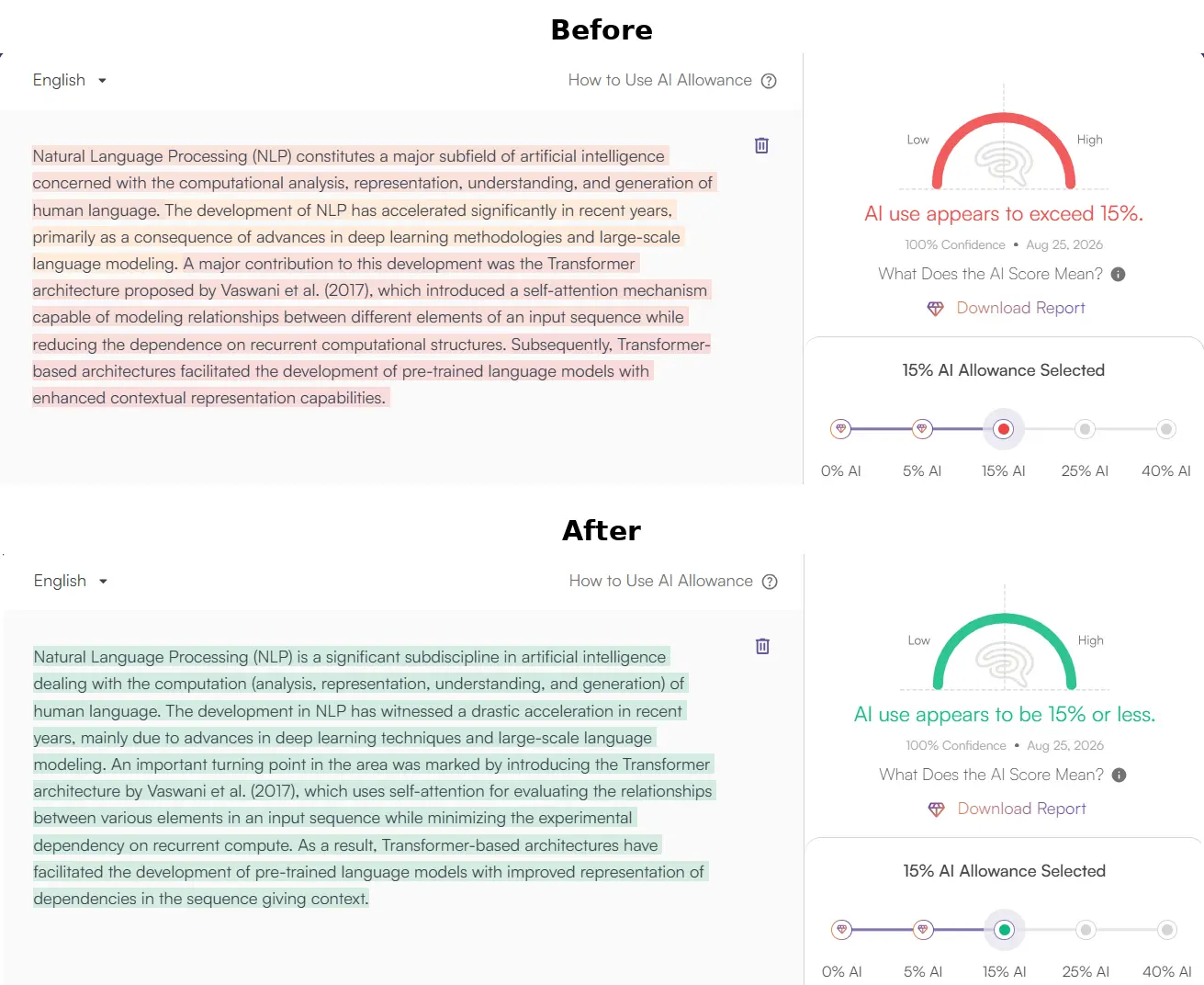
1. ThesisHuman Editor: Style, Field & Term Lock™ Technology
Unlike consumer-grade paraphrasers that blindly swap words with thesaurus synonyms, ThesisHuman allows researchers to select their exact Academic Style (Essay, Research Paper, Literature Review, Technical Report) and Academic Field (Computer Science, Engineering, Medicine, Physics). With Term Lock™, citations (APA, MLA, IEEE), LaTeX equations, and domain-specific terminology are cryptographically protected before sentence entropy is restructured.
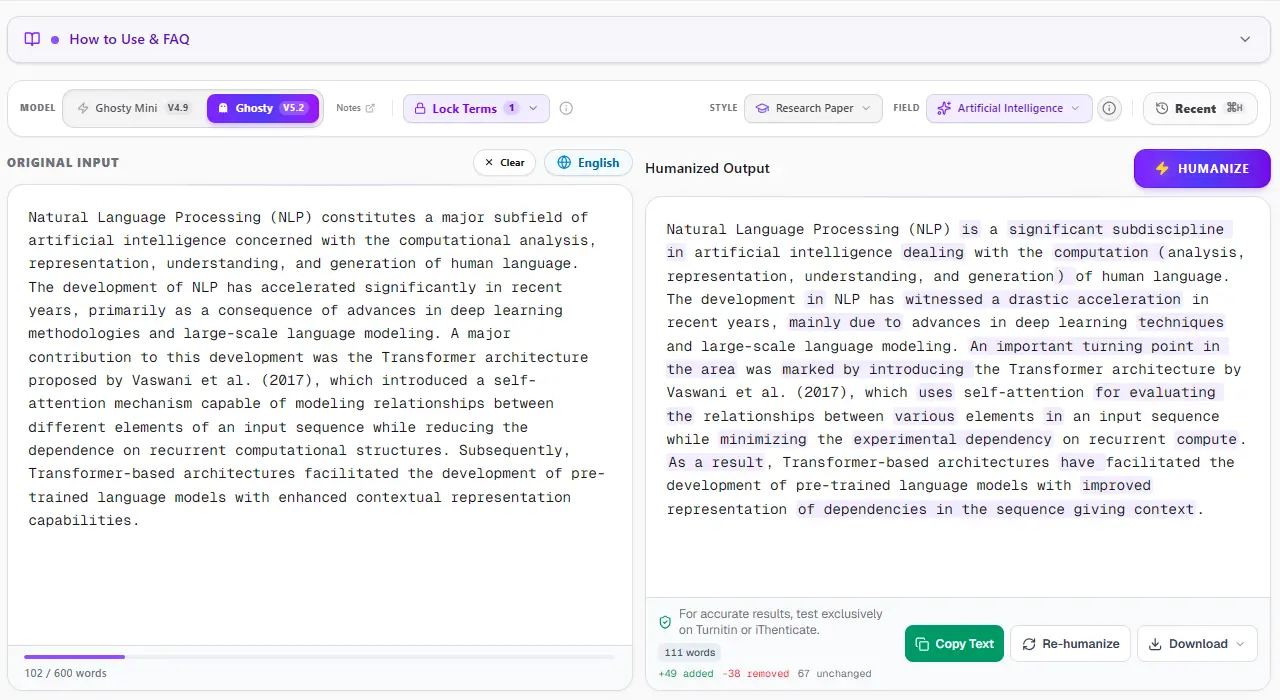
2. Turnitin & iThenticate Verification: 0% AI Detected
Turnitin and iThenticate scan submissions in overlapping 500-token blocks to analyze sentence predictability across paragraphs. When an unrefined AI draft is submitted, uniform cadence triggers an elevated AI Writing score. In the verified report below, a flagged graduate paper was processed through ThesisHuman, achieving a clean 0% AI detection score while preserving all formatted citations and technical parameters.
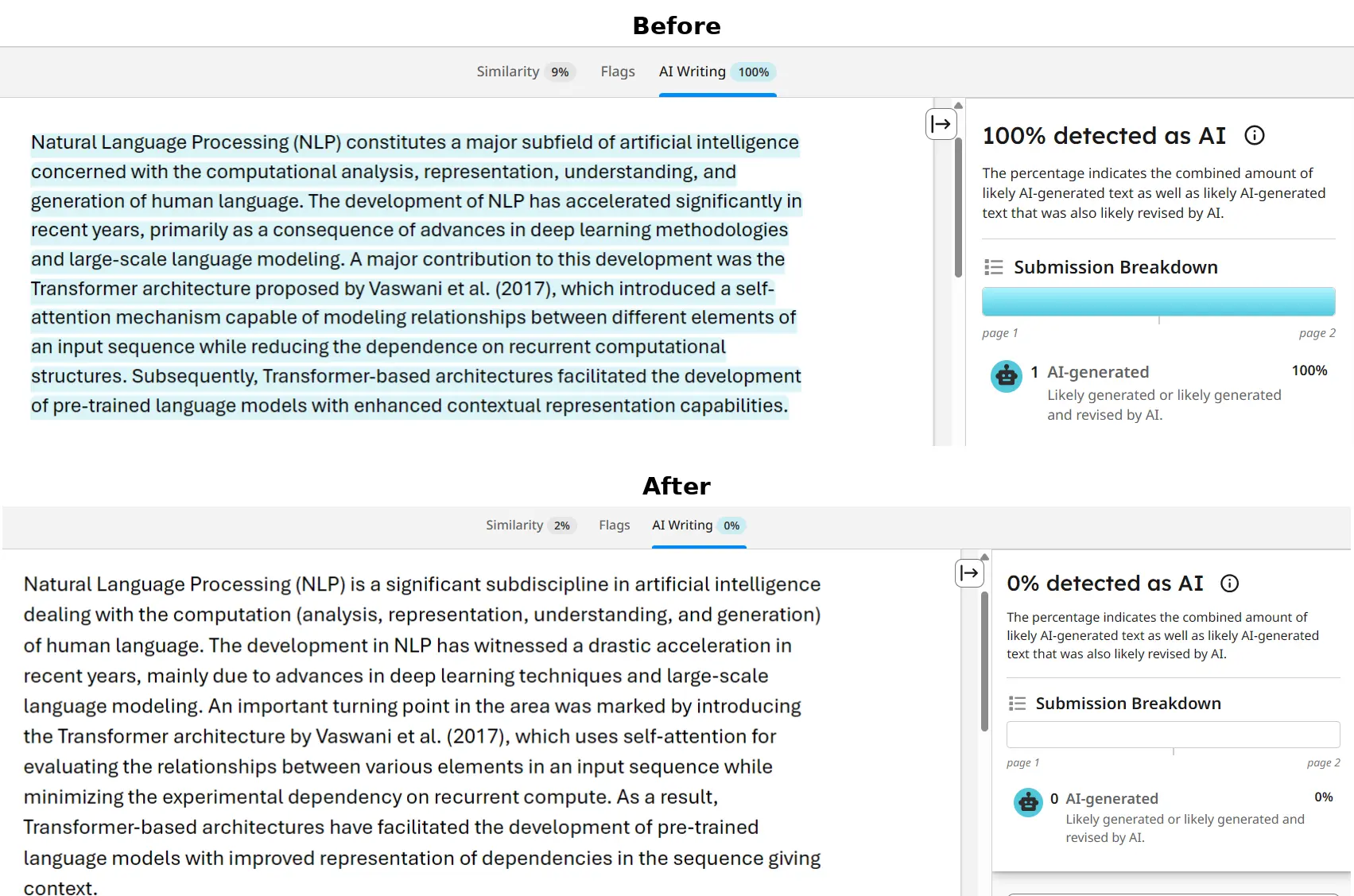
3. GPTZero Verification: Passing Perplexity & Burstiness Checks
GPTZero evaluates text by plotting sentence perplexity curves and global burstiness scores. When raw AI text is scanned, low sentence variance produces an immediate high-probability warning. ThesisHuman restores natural sentence entropy by restructuring syntax, varying clause lengths, and introducing authentic scholarly cadence, dropping AI probability to 0%.
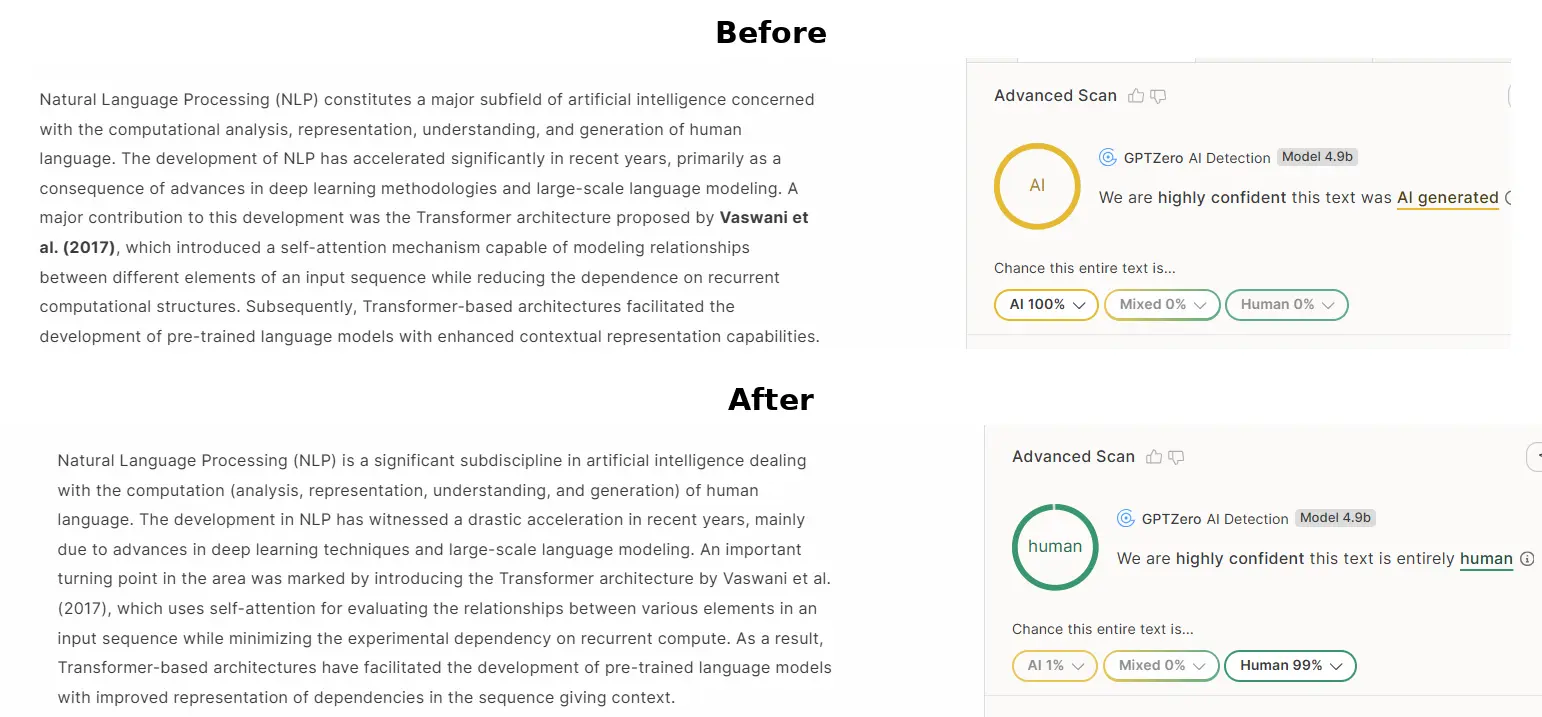
4. Originality.ai Verification: 0% AI Confidence
Originality.ai flags predictable n-gram sequences and common AI clichés (such as “delving into,” “pivotal role,” “testament to”). ThesisHuman purges overused formulaic transitions while elevating scholarly tone and keeping reference numbers and equations intact, producing 100% Original / 0% AI results.