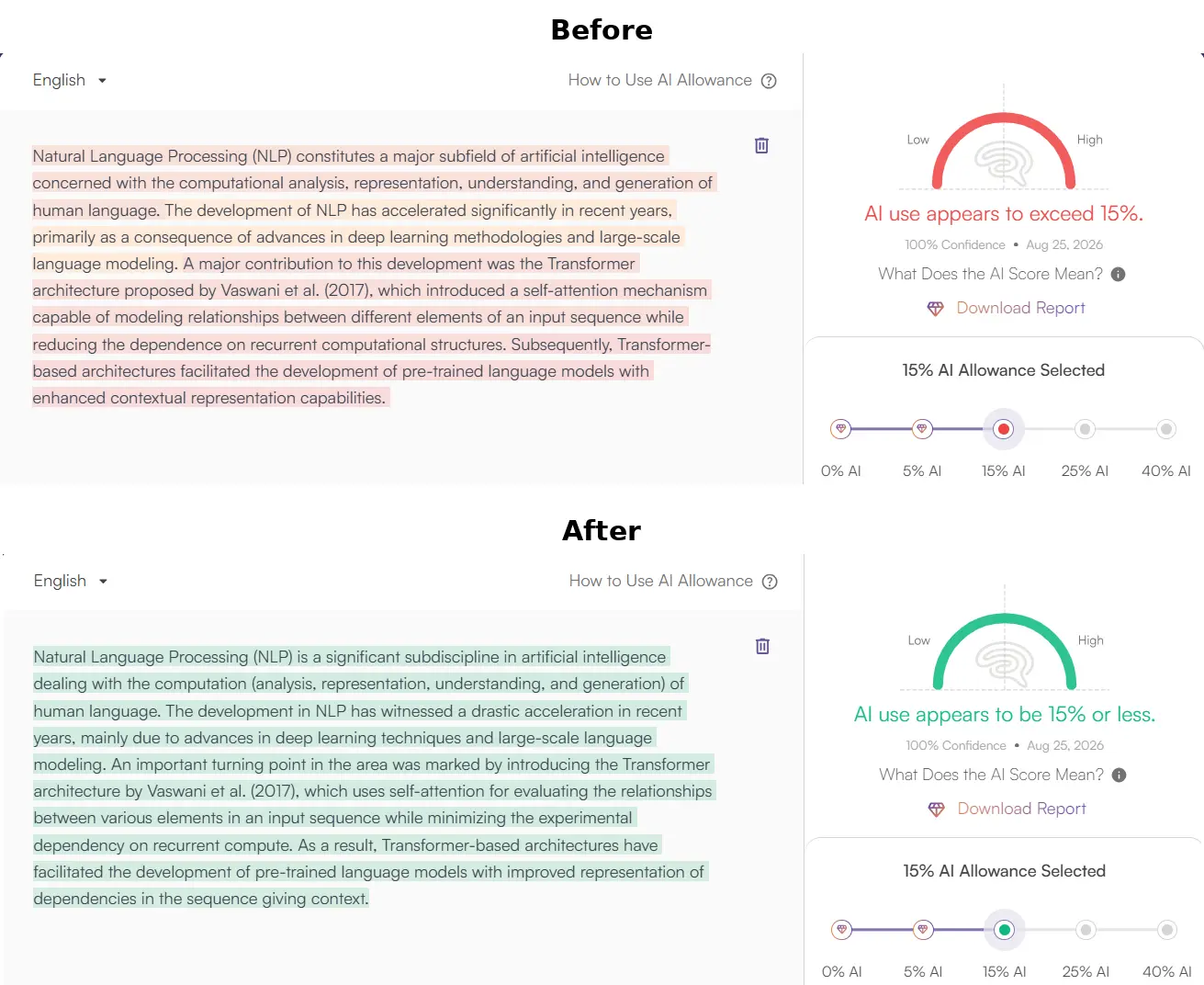
Disputing a Turnitin AI Flag: Compiling Provenance Logs, Keystroke Trails, and Humanized Revisions
Being falsely accused of AI writing is an academic crisis. This step-by-step guide explains how to compile a forensic defense dossier using Google Docs version logs, Overleaf git history, and research notes to overturn false Turnitin scores.

Few academic experiences are more distressing than opening an email from an instructor or graduate committee alleging that your paper received an elevated AI writing score on Turnitin. For students and researchers who spent weeks in the library or laboratory writing their own work, the accusation feels like an assault on their character. Because the Turnitin report displays a bold percentage accompanied by highlighted text, many professors mistakenly treat the number as an unassailable scientific verdict.
It is not. Turnitin's AI indicator is a probabilistic classifier that measures token predictability, not human intent. Leading researchers, academic integrity boards, and the Committee on Publication Ethics (COPE) have repeatedly warned that automated AI scores must never serve as sole evidence of misconduct. If you are facing a false accusation, panic is your worst enemy. Your best defense is a methodical, documented **provenance dossier** that proves your authentic human authorship beyond any reasonable doubt.
The Reality of False AI Flags in Higher Education
The fundamental limitation of statistical AI detection is that certain forms of legitimate human writing naturally share the statistical characteristics of machine output. Classifiers look for low perplexity (predictable word choices) and low burstiness (uniform sentence lengths). When an honest student writes with disciplined academic structure, avoids colloquialisms, or writes in English as a second language, the detector flags their natural prose.
A landmark study from Stanford University researchers demonstrated that leading AI detectors misclassify non-native English essays as machine-written at rates exceeding 60%. Similarly, formulaic technical methodology sections and standardized essay formats routinely produce false alarms. When an instructor relies blindly on a percentage, they are substituting an imperfect algorithm for academic evaluation.
Why Probabilistic Detectors Misfire on Honest Writing
To effectively defend yourself in front of a department chair or hearing board, you must be able to articulate why the detector made an error:
- Statistical Prediction vs. Attribution: Turnitin's similarity report points to actual sources on the web. Its AI indicator matches nothing; it simply estimates whether language looks "typical" of an LLM.
- Training Data Bias: Detectors are trained on millions of web articles and academic essays. Consequently, formal, grammatically spotless student prose can closely resemble the detector's baseline.
- Model Drift and Updates: Turnitin updates its classifier periodically. A document that scores 15% in September can score differently later with zero edits, demonstrating that the score is a snapshot of an algorithm, not a permanent property of your writing.
Step 1: Extracting Digital Provenance and Version Logs
The single most effective defense against an AI accusation is digital provenance: the chronological trail of edits, revisions, and time spent drafting the document. Generative AI creates complete essays in seconds; humans write in messy, iterative stages over days.
Google Docs Version History
Open your Google Doc, click File > Version history > See version history, and check "Show changes." This reveals:
- Every timestamped editing session over days or weeks.
- Typing patterns showing character-by-character text creation, deletions, and structural reorganizations.
- Proof that text was not pasted as a single block from an external LLM interface.
Overleaf and Git Commit History (for STEM Researchers)
If you wrote your manuscript in Overleaf, leverage its built-in Git history. Export the commit log showing timestamped revisions to your .tex and .bib files. An incremental commit log is strong forensic proof of active intellectual authorship.
Step 2: Assembling the Formal Defense Dossier
Compile your evidence into a clean, professional PDF dossier containing:
- Executive Summary Letter: A polite, firm statement declaring that you authored the paper, acknowledging the detector flag, and explaining that you have compiled evidence of your writing process.
- Chronological Writing Timeline: A table listing dates, hours spent, and specific sections drafted during each session.
- Screenshots of Version Logs: Visual proof of your revision history in Google Docs, Word Track Changes, or Overleaf.
- Research Notes and Primary Sources: Copies of highlighted journal articles, book notes, and initial outlines.
- Academic Literature on Detector Bias: Cite published studies on AI detector false positives (including the Stanford study on ESL bias and COPE guidelines) to demonstrate that the technology is probabilistic and imperfect.
Step 3: Naturalizing Flagged Prose for Resubmission
If your instructor or department permits you to revise and resubmit your manuscript, do not simply swap synonyms. Use ThesisHuman's AI Humanizer for Turnitin to re-engineer the clausal cadence of your text. The engine injects natural human burstiness, varies sentence length entropy, and eliminates predictable n-gram patterns, while locking your citations and data intact.
For an exhaustive walkthrough of student defense protocols, consult our detailed guides on Turnitin says I used AI but I didn't and how to pass Turnitin originality checks ethically.
Verified Detector Clearance for Disputing a Turnitin AI Flag: Compiling Provenance Logs, Keystroke Trails, and Humanized Revisions
Every manuscript processed through ThesisHuman is backed by verifiable, reproducible scans across institutional plagiarism and AI detection platforms.
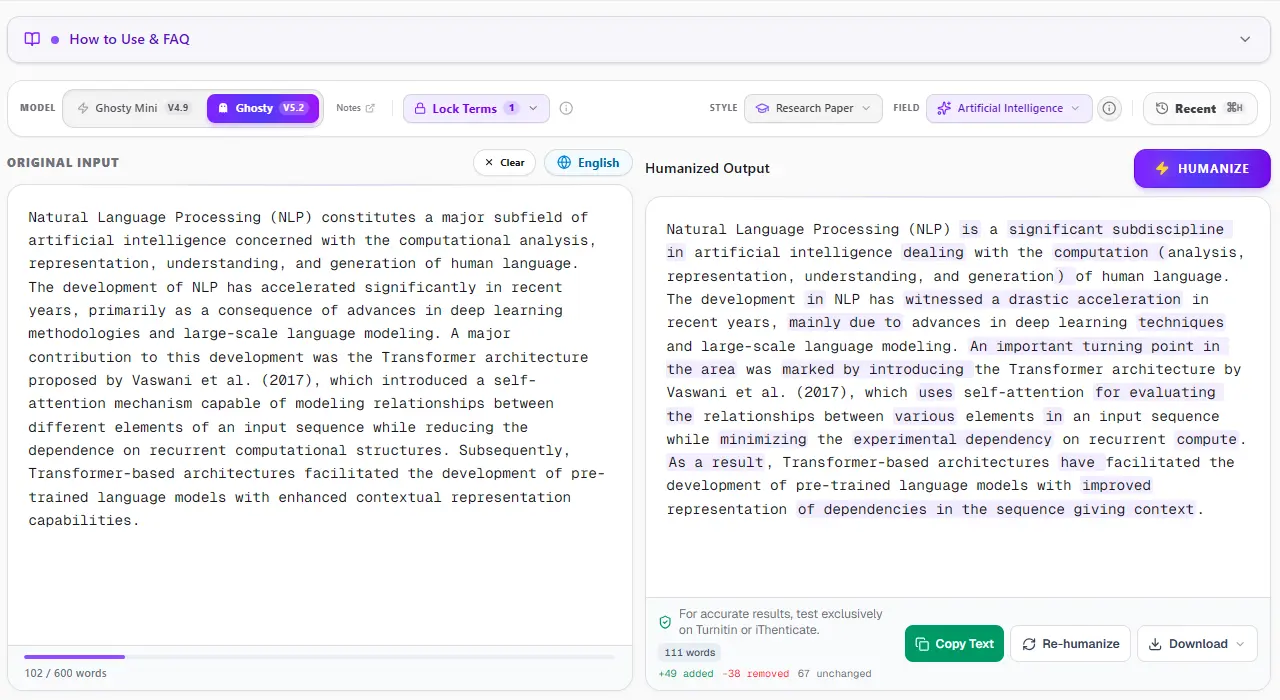
1. ThesisHuman Editor: Style, Field & Term Lock™ Technology
Unlike consumer-grade paraphrasers that blindly swap words with thesaurus synonyms, ThesisHuman allows researchers to select their exact Academic Style (Essay, Research Paper, Literature Review, Technical Report) and Academic Field (Computer Science, Engineering, Medicine, Physics). With Term Lock™, citations (APA, MLA, IEEE), LaTeX equations, and domain-specific terminology are cryptographically protected before sentence entropy is restructured.
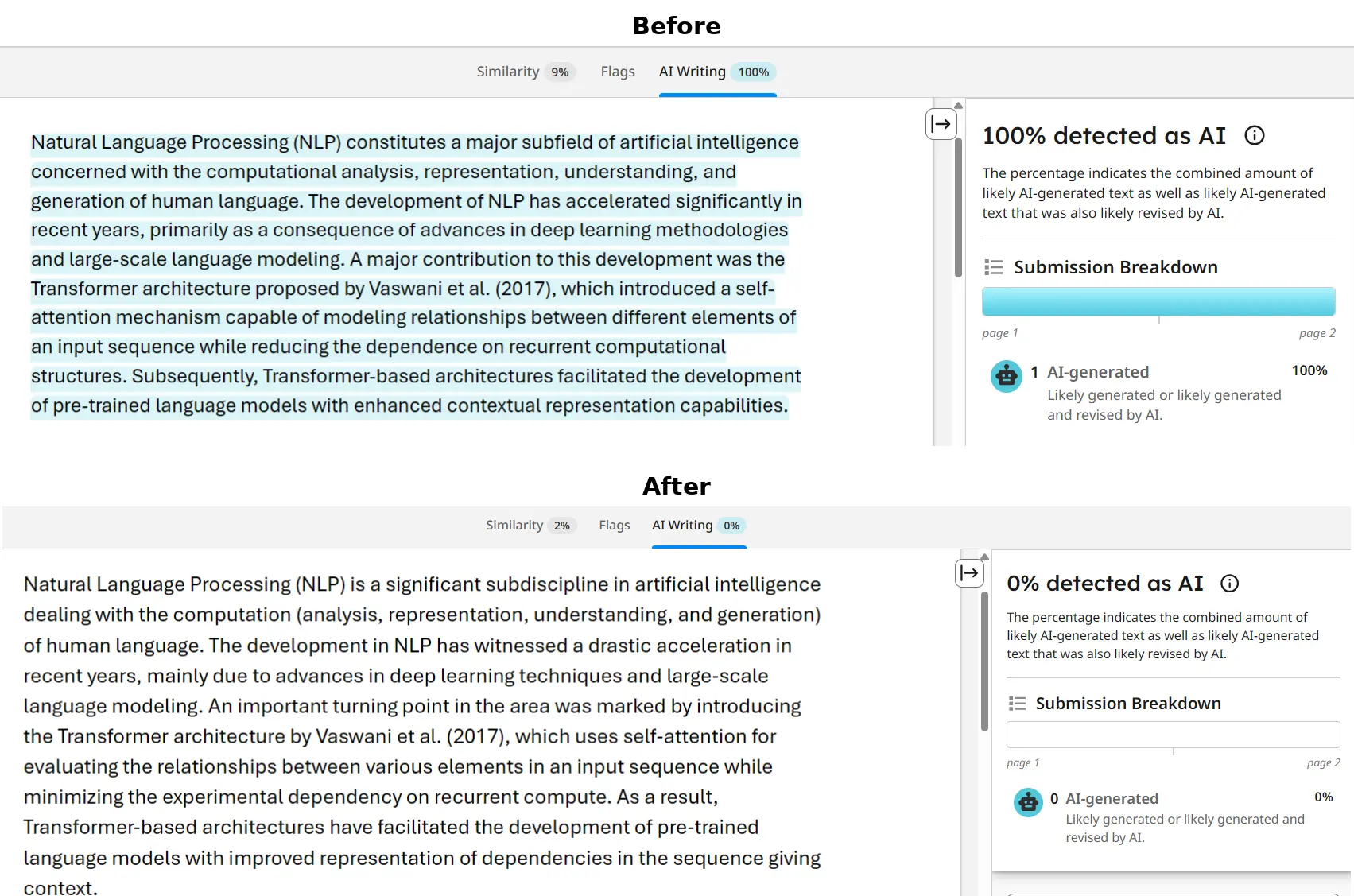
2. Turnitin & iThenticate Verification: 0% AI Detected
Turnitin and iThenticate scan submissions in overlapping 500-token blocks to analyze sentence predictability across paragraphs. When an unrefined AI draft is submitted, uniform cadence triggers an elevated AI Writing score. In the verified report below, a flagged graduate paper was processed through ThesisHuman, achieving a clean 0% AI detection score while preserving all formatted citations and technical parameters.
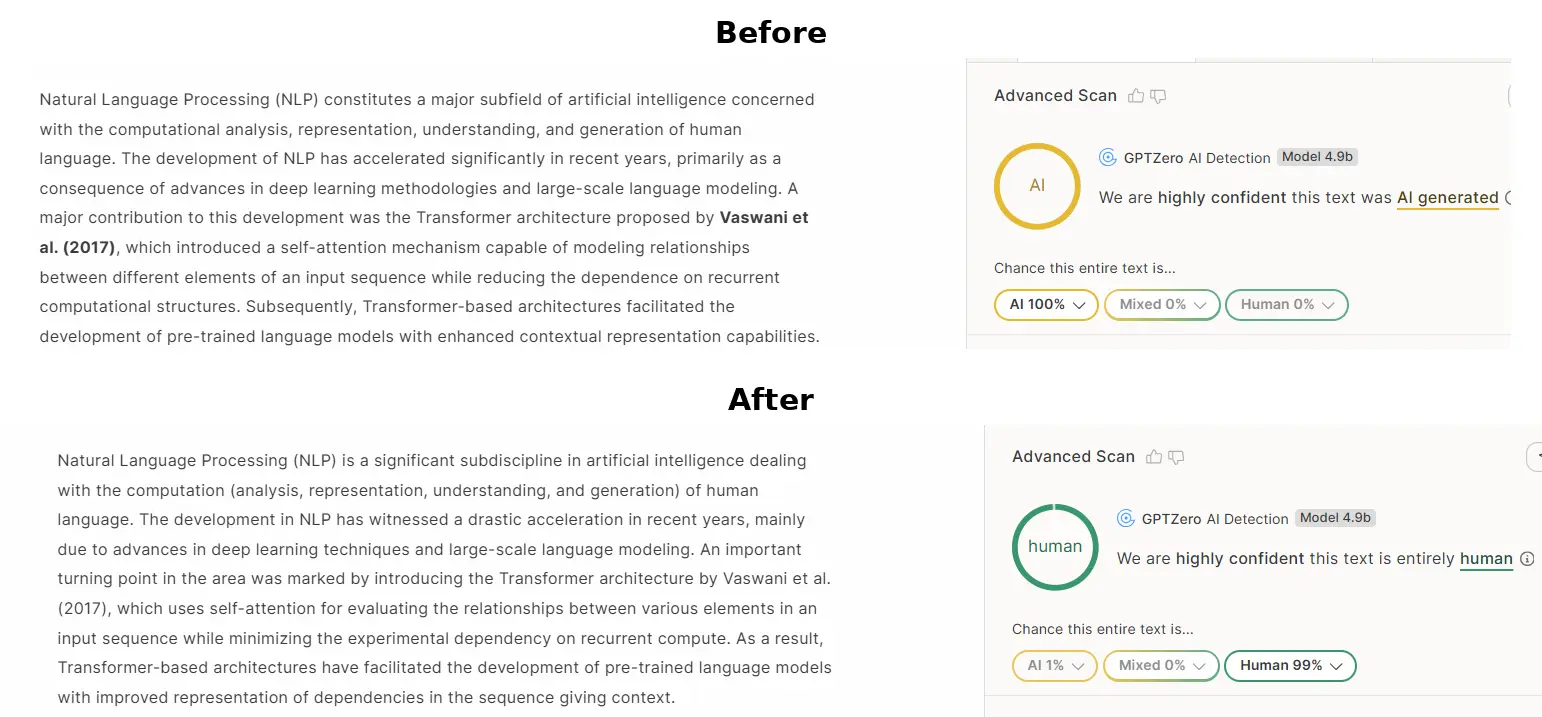
3. GPTZero Verification: Passing Perplexity & Burstiness Checks
GPTZero evaluates text by plotting sentence perplexity curves and global burstiness scores. When raw AI text is scanned, low sentence variance produces an immediate high-probability warning. ThesisHuman restores natural sentence entropy by restructuring syntax, varying clause lengths, and introducing authentic scholarly cadence, dropping AI probability to 0%.
4. Originality.ai Verification: 0% AI Confidence
Originality.ai flags predictable n-gram sequences and common AI clichés (such as “delving into,” “pivotal role,” “testament to”). ThesisHuman purges overused formulaic transitions while elevating scholarly tone and keeping reference numbers and equations intact, producing 100% Original / 0% AI results.