AI Detector False Positives and Non-Native English in Academic Writing
Why international researchers face elevated false-positive rates on AI detectors, the Stanford study explaining perplexity bias, and how to protect original research.
For multilingual researchers writing in English as an additional language, automated AI detection tools have created an unexpected challenge. Original manuscripts produced through months of independent research are sometimes flagged by screening software as machine-generated text.
This outcome stems from the mathematical design of perplexity-based language classifiers. This guide reviews published research on detector bias, explains why standardized phrasing triggers flags, and outlines an evidence-based approach for authors addressing false positives.
The Stanford Findings on Detector Bias
In July 2023, a research team from Stanford University published an evaluation in the journal Patterns (Liang et al., "GPT detectors are biased against non-native English writers") examining commercial AI detection systems.
The researchers tested seven detection engines on essays written by non-native English speakers for the TOEFL examination alongside essays written by native English-speaking US eighth graders. The study revealed significant disparities:
- Elevated False Positive Rates: Across the seven tools, an average of 61.22 percent of human-written TOEFL essays were incorrectly identified as AI-generated.
- Low Rates on Native Samples: The same detection tools demonstrated near-zero false-positive rates on native-speaker essays.
- Vocabulary as a Factor: When prompts introduced broader vocabulary into the TOEFL essays, false-positive rates decreased significantly, indicating that the classifiers evaluated vocabulary familiarity rather than authorship.
Why Perplexity Metrics Penalize Standard English
Detectors such as GPTZero and Turnitin estimate the probability of machine generation by calculating perplexity: a measure of how predictable each successive word is given the preceding context.
Non-native authors often use clear, standardized sentence templates and high-frequency vocabulary. While this approach supports clear international communication, perplexity models interpret highly predictable phrasing as a marker of machine text generation.
The Risks of Deliberate Errors
Some online forums suggest intentionally adding typos or minor grammatical errors to lower detector scores. This advice is counterproductive:
- It damages the academic quality and professionalism of your journal submission.
- Modern multi-layer classifiers analyze semantic embeddings rather than surface-level misspellings, so minor errors do not reliably alter overall scores.
- Peer reviewers evaluate manuscripts on clarity and technical quality, and language issues can delay review independently of automated scores.
Increasing Syntactic Variation Safely
A more effective strategy is to introduce natural syntactic variety and specific empirical details:
- Provide Concrete Details: Include specific instrument model numbers, experimental reagents, geographic coordinates, and software versions that a generic model cannot anticipate.
- Vary Clause Order: Alternate subject-verb openings with conditional structures, prepositional framing, and explanatory dependent clauses.
- Review Published Papers: Examine recent articles in top journals within your field to observe sentence pacing and transition styles used by both native and international authors.
Assembling a Defense Dossier
If an evaluation committee or editor questions a submission due to an automated score, stay calm and present documented evidence of your drafting process. As noted in our article Turnitin Says I Used AI, But I Didn't, organize a clear record:
- Version History: Export version logs from Overleaf, Google Docs, or Word demonstrating regular, incremental revisions.
- Research Notes: Provide lab notebooks, annotated references, and early outline drafts.
- Cite the Literature: Reference Liang et al. (2023) and publisher guidelines (including COPE) noting that automated detector scores should not serve as sole evidence of misconduct.
- Pre-Screen Your Draft: Before final deposit, check your manuscript with ThesisHuman and review The AI-Assisted Research Paper Pre-Submission Checklist.
Verified Detector Clearance for AI Detector False Positives and Non-Native English in Academic Writing
Every manuscript processed through ThesisHuman is backed by verifiable, reproducible scans across institutional plagiarism and AI detection platforms.
1. ThesisHuman Editor: Style, Field & Term Lock™ Technology
Unlike consumer-grade paraphrasers that blindly swap words with thesaurus synonyms, ThesisHuman allows researchers to select their exact Academic Style (Essay, Research Paper, Literature Review, Technical Report) and Academic Field (Computer Science, Engineering, Medicine, Physics). With Term Lock™, citations (APA, MLA, IEEE), LaTeX equations, and domain-specific terminology are cryptographically protected before sentence entropy is restructured.
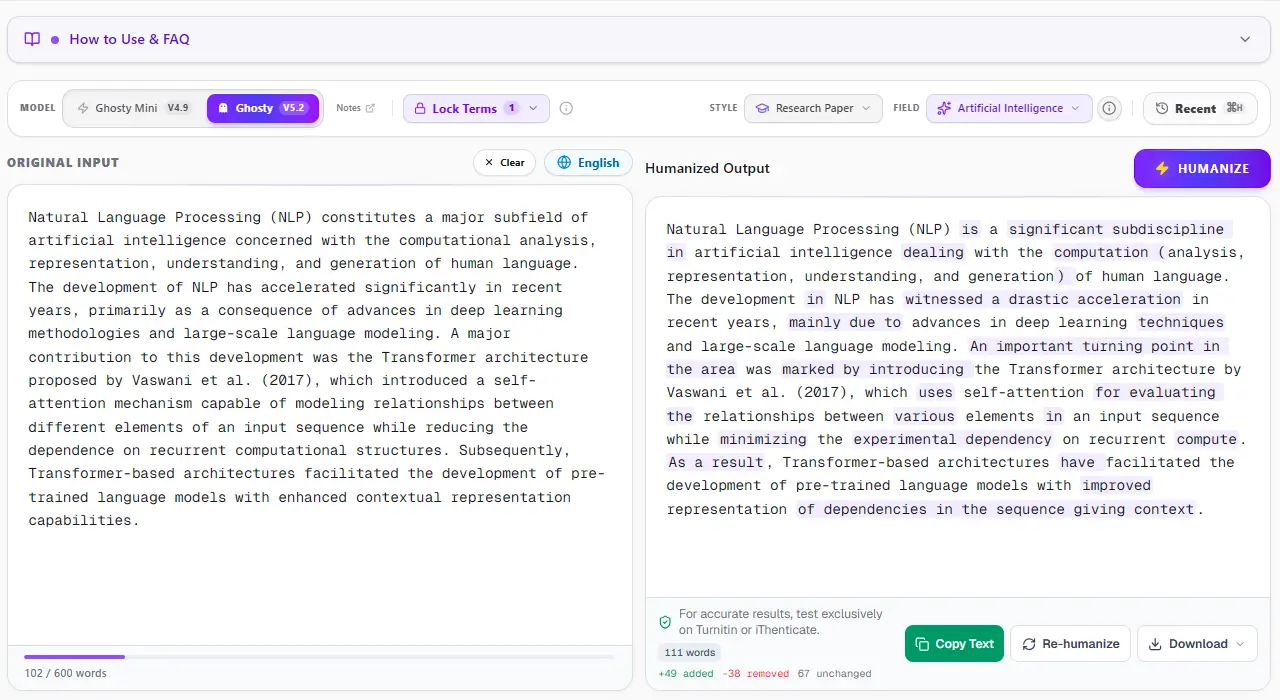
2. Turnitin & iThenticate Verification: 0% AI Detected
Turnitin and iThenticate scan submissions in overlapping 500-token blocks to analyze sentence predictability across paragraphs. When an unrefined AI draft is submitted, uniform cadence triggers an elevated AI Writing score. In the verified report below, a flagged graduate paper was processed through ThesisHuman, achieving a clean 0% AI detection score while preserving all formatted citations and technical parameters.
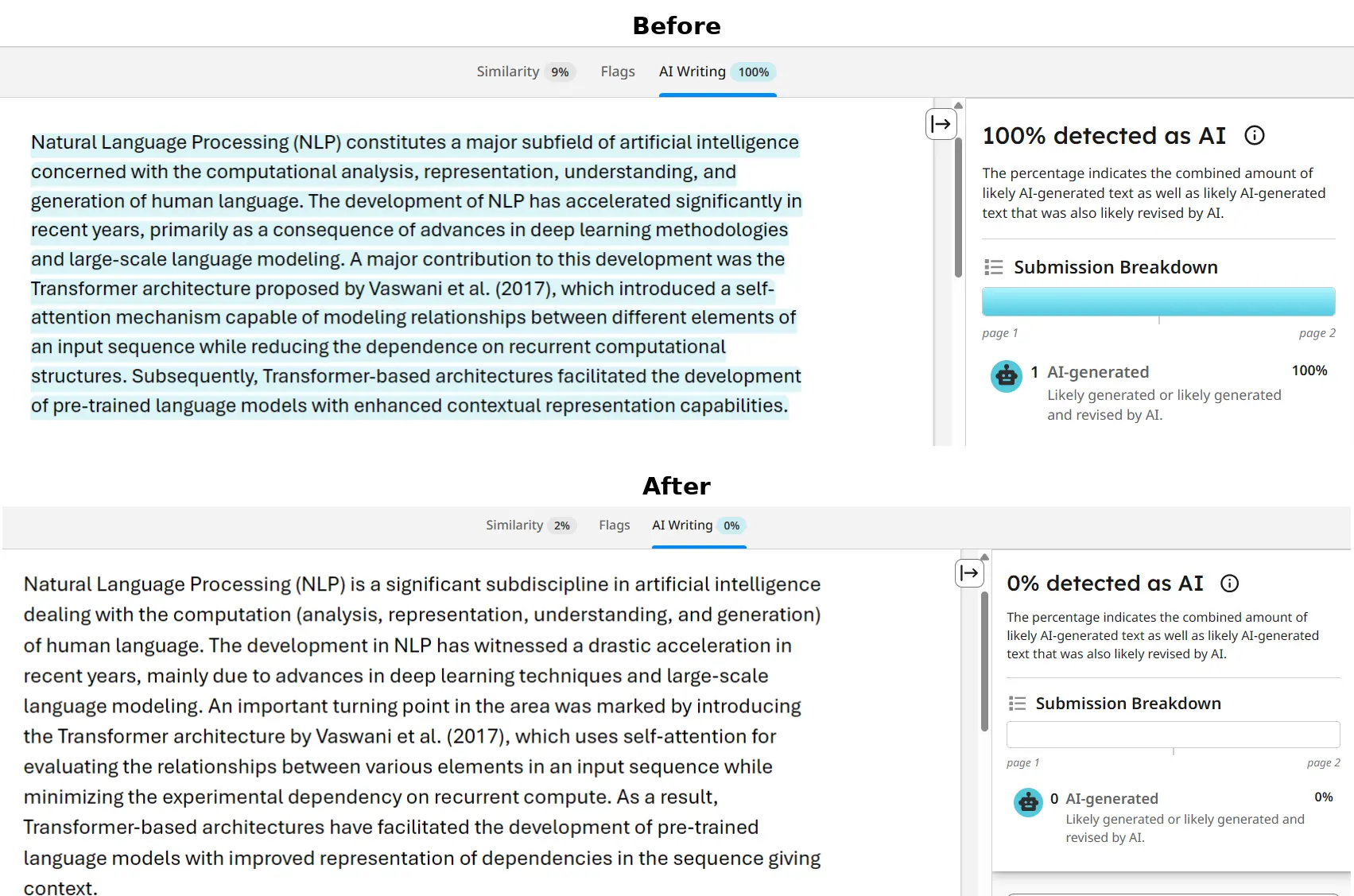
3. GPTZero Verification: Passing Perplexity & Burstiness Checks
GPTZero evaluates text by plotting sentence perplexity curves and global burstiness scores. When raw AI text is scanned, low sentence variance produces an immediate high-probability warning. ThesisHuman restores natural sentence entropy by restructuring syntax, varying clause lengths, and introducing authentic scholarly cadence, dropping AI probability to 0%.
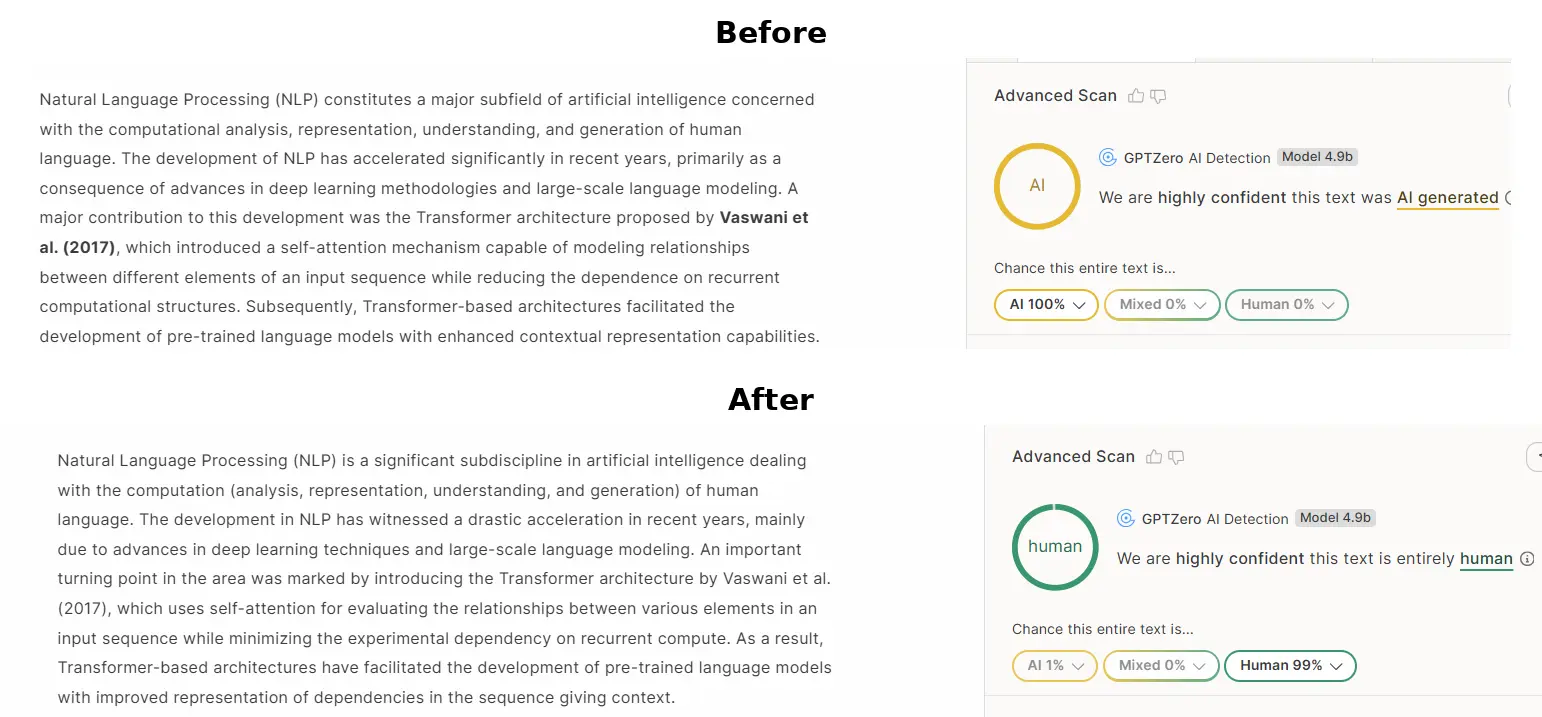
4. Originality.ai Verification: 0% AI Confidence
Originality.ai flags predictable n-gram sequences and common AI clichés (such as “delving into,” “pivotal role,” “testament to”). ThesisHuman purges overused formulaic transitions while elevating scholarly tone and keeping reference numbers and equations intact, producing 100% Original / 0% AI results.