The AI-Assisted Research Paper Pre-Submission Checklist
A seven-step pre-submission protocol for AI-assisted manuscripts: auditing publisher policies, testing citations, verifying formulas, and preserving authorial voice.

Submitting a research paper or thesis chapter with AI assistance requires a methodical review before final deposit. Screening software like iThenticate and university repository scanners examine statistical markers, reference lists, and formatting details. An unchecked draft risks editorial queries, peer review delays, or formal dissertation holds.
This checklist outlines seven verification steps developed for graduate students, postdocs, and university researchers. It covers institutional requirements, data consistency, bibliography records, LaTeX formulas, and authorial style.
Step 1: Institutional and Publisher Policy Verification
Determine your target venue's exact boundary between permitted language polishing and prohibited text generation. For the 2026 to 2027 academic cycle, publishers such as Elsevier, Springer Nature, and IEEE, along with major research universities, have moved from broad prohibitions to structured disclosure models. For a detailed breakdown of university rules, consult our companion guide on University AI Policies in 2026 to 2027.
- Check Target Venue Guidelines: Confirm whether your journal requires a formal declaration statement aligned with Committee on Publication Ethics (COPE) standards.
- Verify Authorship Rules: Check that no generative software appears as a co-author. Publishers require human authors to assume legal and scientific responsibility for submitted manuscripts.
- Review Thesis Deposit Mandates: Check your graduate school handbook for rules governing assistive writing tools during electronic thesis deposit.
Step 2: Factual Claims and Data Integrity Audit
Language models calculate token probabilities rather than querying factual databases. When generating prose, they can introduce subtle factual shifts, such as altering experimental constraints, confidence intervals, or sample counts. Cross-reference every quantitative assertion against your original laboratory notebooks or computational run outputs. Our guide on How to Humanize AI Text Without Altering Facts, Numbers, or Claims explains methods for locking empirical data during editing.
| Element | Verification Method | Acceptance Standard |
|---|---|---|
| Sample Sizes and Demographics | Manual match with study logs | Exact numerical match |
| P-Values and Confidence Intervals | Statistical output audit | Zero rounding alteration |
| Methodological Parameters | Laboratory protocol validation | Exact equipment and reagent specifications |
Step 3: Reference and DOI Verification
Fabricated citations lead directly to desk rejections and academic integrity investigations. Recent computational linguistics studies document thousands of phantom citations appearing in unverified preprints. Audit every in-text citation and bibliography item individually before submission. Follow our step-by-step workflow on How to Verify AI-Generated Citations Before Submitting a Research Paper.
- Resolve Every DOI: Test each digital object identifier directly at
https://doi.org/[DOI]to verify that it points to a genuine article. - Confirm Author and Journal Pairing: Verify that the cited authors published the article in the stated journal, volume, and year.
- Check Substantive Support: Open the source paper to confirm that the text directly supports the claim made in your manuscript.
Step 4: Mathematical and LaTeX Notation
Authors in STEM fields need to confirm that language editing tools have not altered mathematical syntax, inline variables, or citation macros. Generic rewriting software often drops backslashes or modifies variable capitalization. Our guide on LaTeX-Safe Academic Editing outlines automated methods to protect equation markup.
Recompile your revised LaTeX source in Overleaf or TeXstudio, then run a line-by-line diff against your initial draft to catch altered symbols or split citations before generating camera-ready proofs.
Step 5: Rhetorical Cleanup and Pattern Removal
Detection systems like GPTZero Model 4.9b evaluate structural writing habits, including repeated contrastive formulas, participial tails, and mechanical lists of three. Read our technical review of GPTZero AI Patterns and Model 4.9b, along with our practical guide on How to Remove Formulaic AI Phrasing from Academic Writing.
- Remove Cliché Vocabulary: Cut words like delve, tapestry, pivotal, testament, and foster unless required in a specific technical context.
- Break Mechanical Triads: Rework forced three-part lists into clear, substantive statements.
- Vary Sentence Structure: Combine brief factual observations with detailed analytical explanations to reflect natural academic cadence.
Step 6: Authorial Voice and Language Calibration
Drafts produced by language models often sound generic and artificially cautious. Scholarly communication relies on clear authorial positioning and appropriate hedging. Multilingual scholars should also be aware of detector tendencies regarding standardized English. For deeper discussions, see our articles on Preserving Your Academic Voice in AI-Assisted Drafts and AI Detector False Positives and Non-Native English.
Step 7: Integrity Screening and Audit Trail Archiving
Check your manuscript before formal journal submission or thesis deposit:
- Pre-Screen the Draft: Test your prose in the ThesisHuman academic scanner with Term Lock enabled to check sentence rhythm while protecting citations.
- Account for Detector Variation: If different screening programs yield conflicting percentages, consult Why AI Detectors Disagree on the Same Academic Paper to assess the findings.
- Archive Your Writing History: Keep dated draft files, laboratory notes, and version control logs. If an evaluation committee raises questions about an automated score, an orderly record of your revisions provides clear evidence of your work.
Verified Detector Clearance for The AI-Assisted Research Paper Pre-Submission Checklist
Every manuscript processed through ThesisHuman is backed by verifiable, reproducible scans across institutional plagiarism and AI detection platforms.
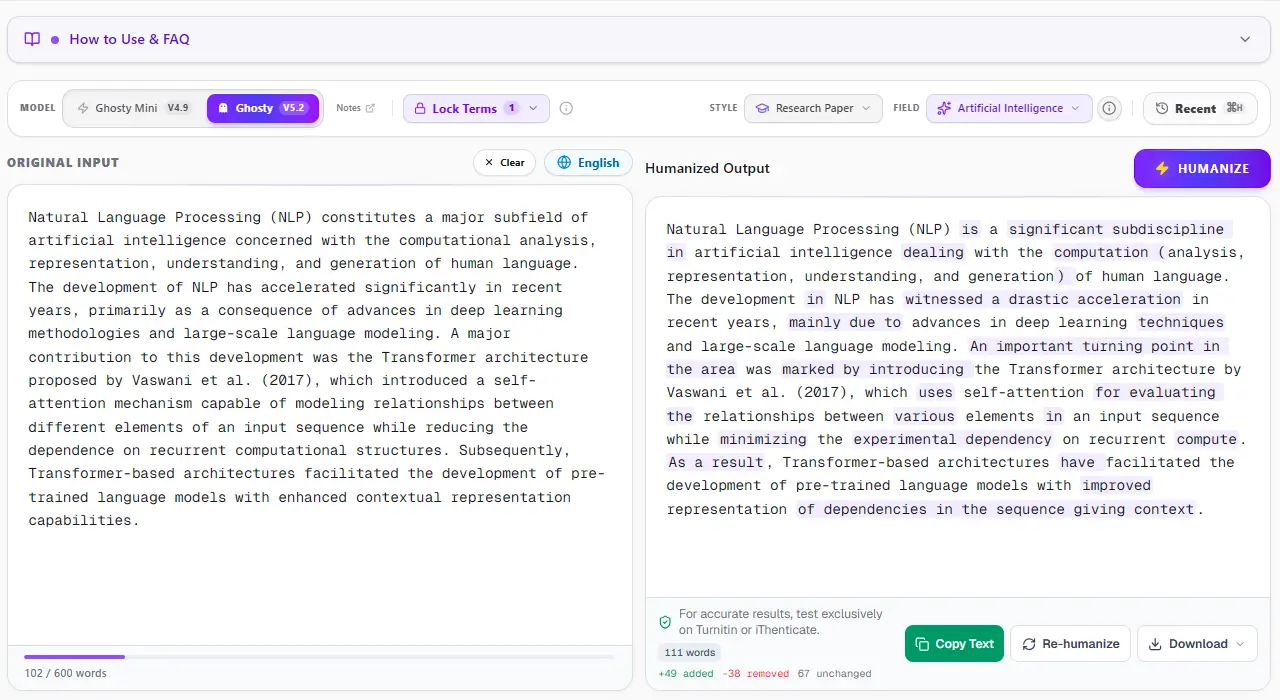
1. ThesisHuman Editor: Style, Field & Term Lock™ Technology
Unlike consumer-grade paraphrasers that blindly swap words with thesaurus synonyms, ThesisHuman allows researchers to select their exact Academic Style (Essay, Research Paper, Literature Review, Technical Report) and Academic Field (Computer Science, Engineering, Medicine, Physics). With Term Lock™, citations (APA, MLA, IEEE), LaTeX equations, and domain-specific terminology are cryptographically protected before sentence entropy is restructured.
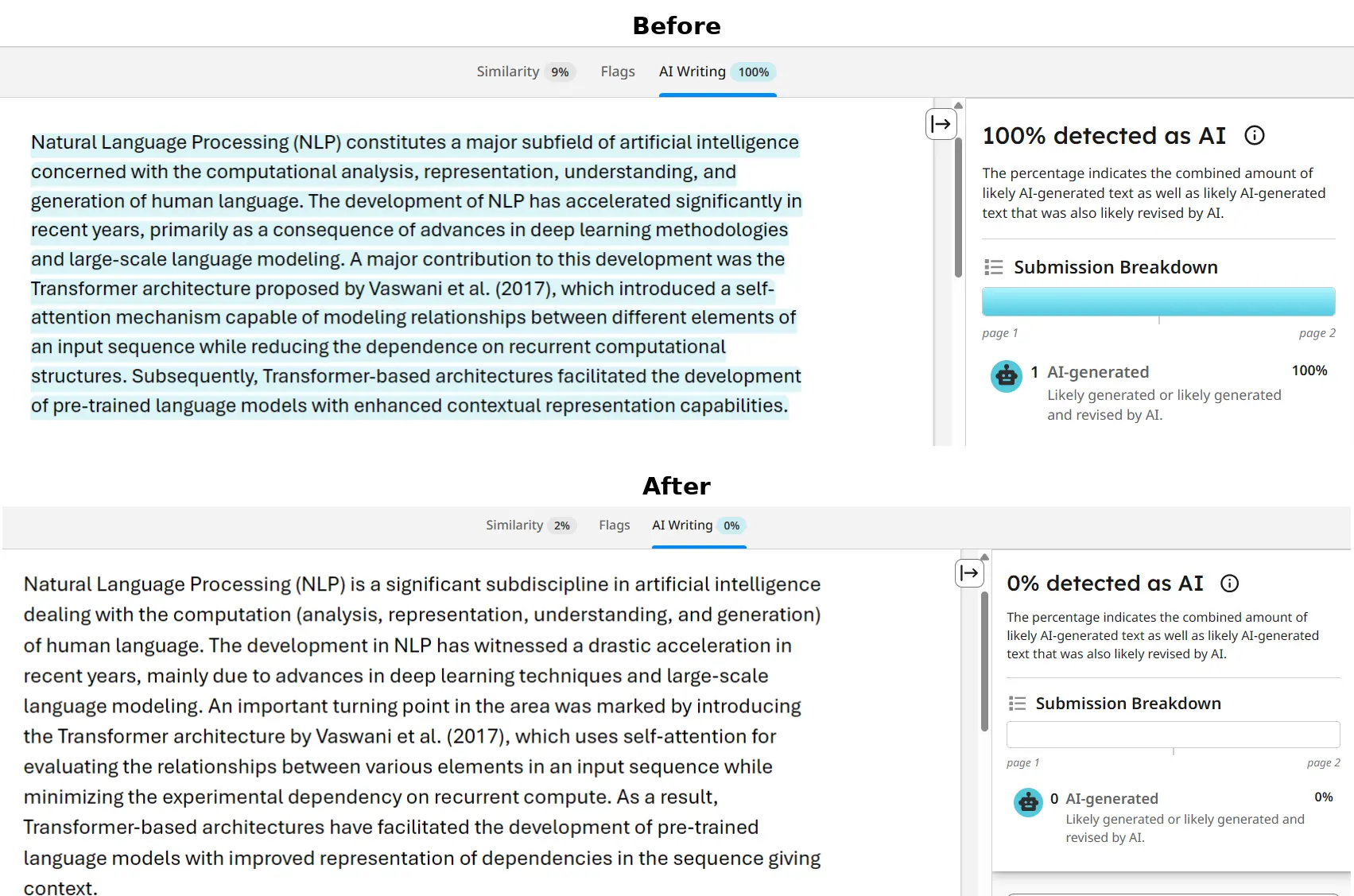
2. Turnitin & iThenticate Verification: 0% AI Detected
Turnitin and iThenticate scan submissions in overlapping 500-token blocks to analyze sentence predictability across paragraphs. When an unrefined AI draft is submitted, uniform cadence triggers an elevated AI Writing score. In the verified report below, a flagged graduate paper was processed through ThesisHuman, achieving a clean 0% AI detection score while preserving all formatted citations and technical parameters.
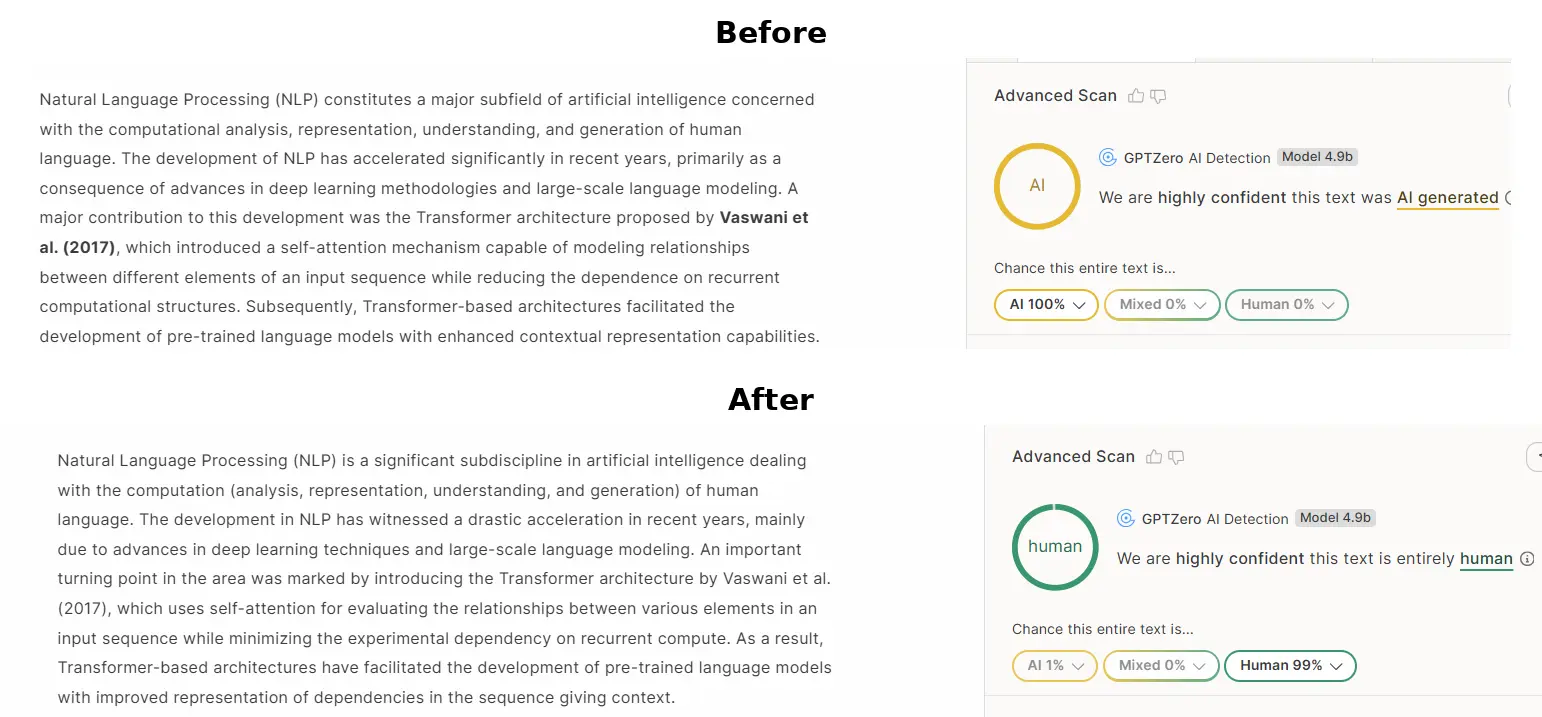
3. GPTZero Verification: Passing Perplexity & Burstiness Checks
GPTZero evaluates text by plotting sentence perplexity curves and global burstiness scores. When raw AI text is scanned, low sentence variance produces an immediate high-probability warning. ThesisHuman restores natural sentence entropy by restructuring syntax, varying clause lengths, and introducing authentic scholarly cadence, dropping AI probability to 0%.
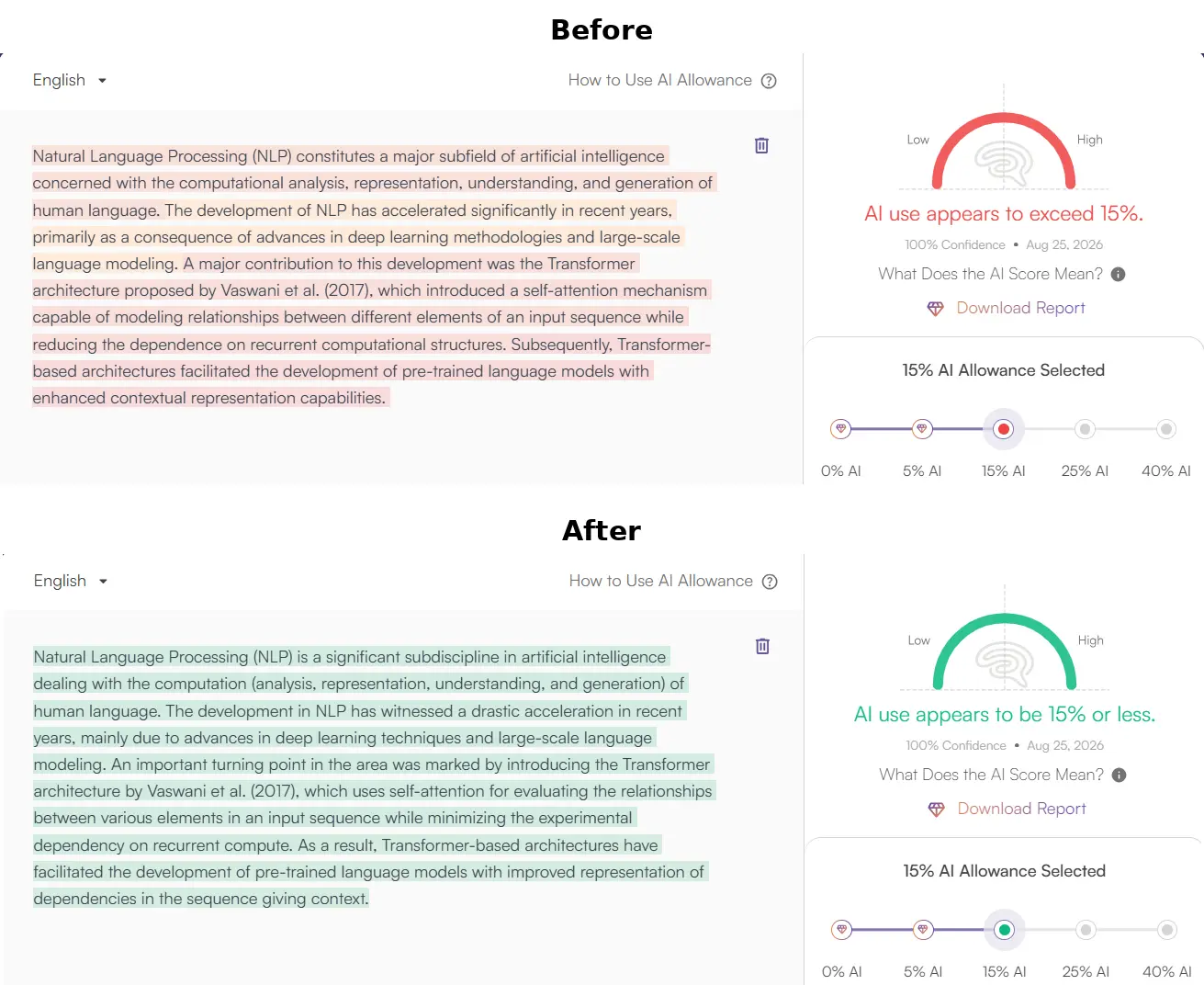
4. Originality.ai Verification: 0% AI Confidence
Originality.ai flags predictable n-gram sequences and common AI clichés (such as “delving into,” “pivotal role,” “testament to”). ThesisHuman purges overused formulaic transitions while elevating scholarly tone and keeping reference numbers and equations intact, producing 100% Original / 0% AI results.