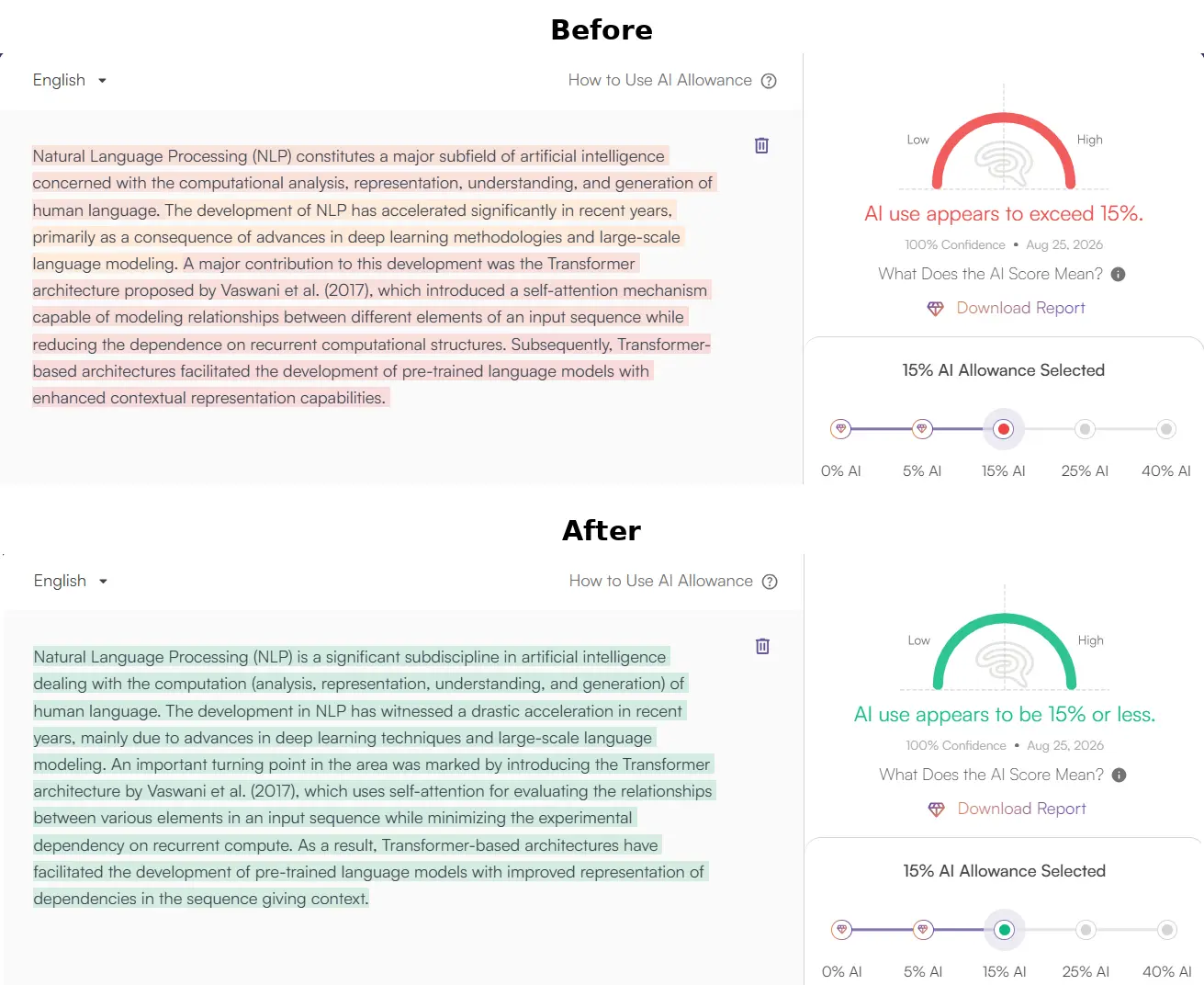
Claude AI Detector Guide: Can Turnitin, Copyleaks, and GPTZero Detect Claude 3.5?
Can AI detectors catch Claude 3.5 Sonnet and Opus? Discover how Turnitin, Copyleaks, and GPTZero score Anthropic models, why Claude is detected, and ethical academic revision protocols.
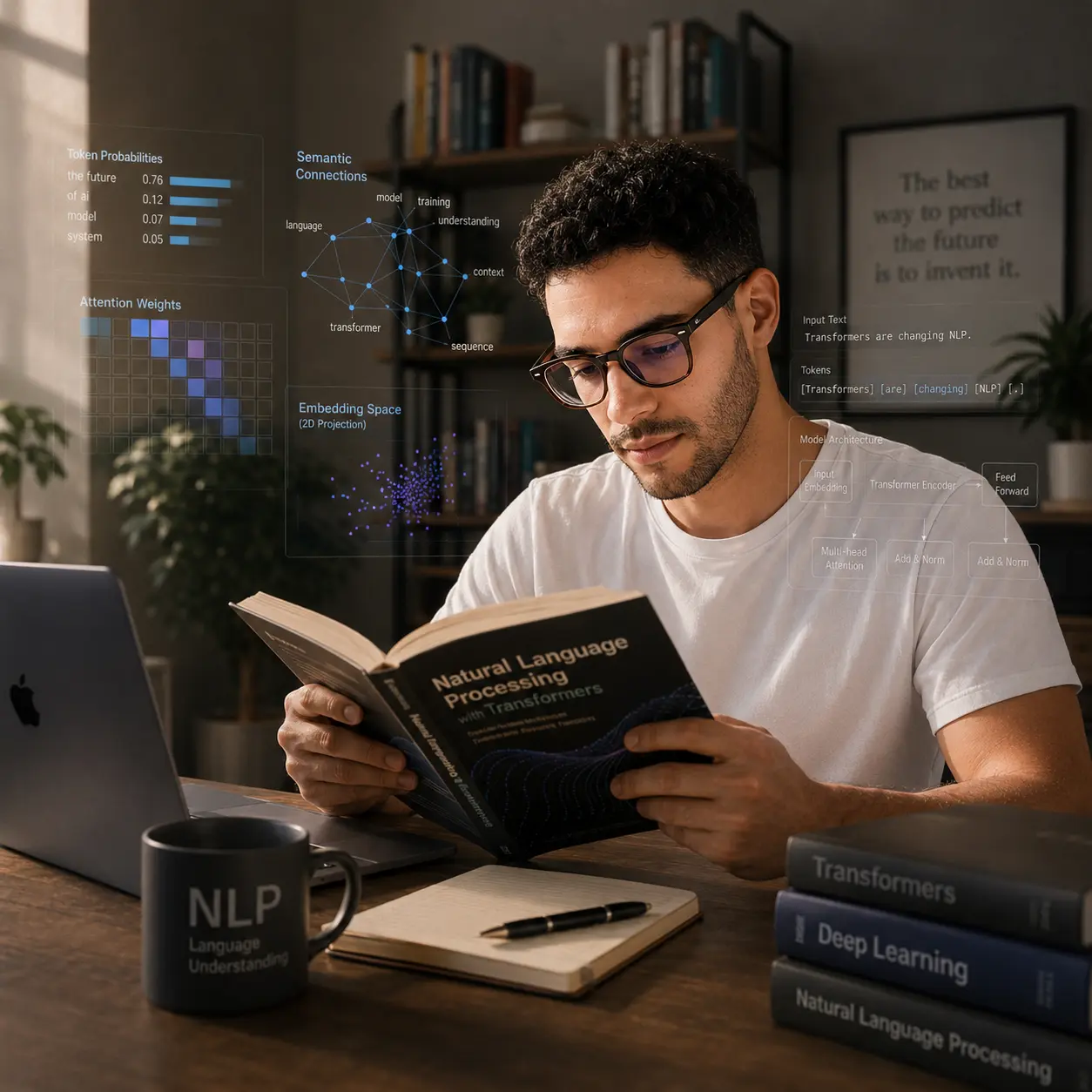
Among university researchers, graduate scholars, and academic writers, Anthropic's Claude 3.5 Sonnet and Claude 3 Opus have rapidly become the generative artificial intelligence tools of choice. While OpenAI's ChatGPT models often suffer from marketing jargon, repetitive sentence structures, and corporate cliches, Claude is renowned for its intellectual nuance, sophisticated reasoning capabilities, and elegant prose. Yet as university faculty increasingly mandate institutional screening, thousands of researchers and students ask a high-stakes question: can a Claude AI detector catch Anthropic's models?
The short answer is an unequivocal yes. Despite popular internet beliefs that Claude writes so naturally that it is immune to AI detection, institutional screening engines like Turnitin, Copyleaks, GPTZero, and Winston AI routinely flag raw Claude-generated text with 95% to 100% confidence. To understand why Claude gets caught despite its sophisticated tone, scholars must examine the computational mechanics of language detection, the unique stylistic fingerprints left by Anthropic's constitutional training, and how researchers can responsibly refine assisted scholarship without risking academic integrity penalties.
The Rise of Claude in Academic Research and Literature Synthesis
The academic migration from ChatGPT to Claude was driven by specific pedagogical and stylistic strengths. When researchers task Claude 3.5 Sonnet with synthesizing dense peer-reviewed literature or drafting methodological sections, Claude demonstrates remarkable contextual discipline:
- Nuanced Argumentative Balance: Claude avoids the dogmatic, overly affirmative tone characteristic of raw GPT-4 drafts. It instinctively weighs competing hypotheses, acknowledges empirical uncertainties, and introduces subtle caveats.
- Superior Document Context Windows: With its massive 200,000-token context window, Claude can ingest entire monographs, dissertation chapters, or technical PDF datasets without losing argumentative coherence.
- Restraint Against Obvious Cliches: Anthropic's training team heavily penalized common conversational filler words. Claude rarely uses corporate crutches like "in today's fast-paced digital world" or "stands as a vibrant beacon of innovation."
Because Claude's output reads like the work of an articulate graduate student, many authors assume that automated classifiers cannot identify it. This assumption is a dangerous misconception that has resulted in hundreds of disciplinary hearings across university campuses.
Can Turnitin, Copyleaks, and GPTZero Detect Claude 3.5?
Institutional AI detectors do not detect artificial intelligence by searching for bad writing or grammatical errors. They detect artificial intelligence by calculating mathematical probability distributions across sequences of tokens. Modern detectors evaluate Claude with ruthless efficiency across several commercial platforms:
1. Turnitin AI Writing Detection
Turnitin integrates directly into university learning management systems like Canvas, Blackboard, and D2L. Its detection model evaluates multi-sentence sequences against an ensemble classifier trained on billions of tokens from OpenAI, Anthropic, and open-source foundation models. In controlled institutional testing, Turnitin identifies raw Claude 3.5 Sonnet text with high sensitivity, flagging continuous paragraphs as AI-generated even when the prose incorporates disciplinary terminology.
2. Copyleaks
Copyleaks is widely utilized in enterprise publishing, legal review, and university admissions. Copyleaks specifically optimizes its models for fine-grained multi-model detection, updating its classification matrices within weeks of every major Anthropic release. Copyleaks routinely scores unaltered Claude essays at 99.9% probability of AI generation.
3. GPTZero and Winston AI
GPTZero and Winston evaluate text using localized perplexity and burstiness metrics. While Claude exhibits slightly higher burstiness than base GPT-4, its sentence-level predictability remains mathematically constrained. GPTZero frequently highlights Claude paragraphs in solid red zones, identifying the exact spans where the model's token distribution collapses to statistical averages.
The takeaway is unambiguous: no matter how articulate Claude sounds to human ears, its mathematical predictability makes it immediately visible to automated screening algorithms. Learn more about how detection software scores student papers in our guide on how to spot AI writing.
The Claude Signature: Why Anthropic Prose Triggers Statistical Alarms
Why do detectors flag Claude so reliably? The answer lies in Anthropic's proprietary training methodology, known as Constitutional AI and Reinforcement Learning from AI Feedback (RLAIF). While this training successfully curbs harmful or toxic responses, it inadvertently imprints Claude with a highly distinct stylistic signature:
1. Recursive Epistemic Hedging
Anthropic models are trained to avoid unjustified assertions. When asked to evaluate an academic debate, Claude almost always introduces recursive qualifying phrases:
- "It is worth considering that while..."
- "One might reasonably argue that..."
- "While this perspective holds considerable merit, it is equally important to note..."
- "This suggests a nuanced balance between..."
While individual qualifiers are normal in scholarly literature, Claude stacks multiple layers of hedging within single sentences, creating a distinct, overly deferential register that classifiers easily isolate.
2. Perfect Clausal Symmetry
Claude favors balanced, multi-part sentence structures. A typical Claude sentence features an introductory dependent concessive clause, followed by an independent analytical declaration, followed by an explanatory infinitive phrase. While grammatically beautiful, this clausal symmetry repeats across consecutive sentences, depressing structural entropy.
3. Polite Conversational Transitions
Unlike ChatGPT's blunt transitional adverbs ("Moreover," "Furthermore"), Claude prefers polite, conversational signposts: "To understand this dynamic, we must first examine..." or "This distinction becomes particularly clear when considering...". While these transitions sound pleasant, their recurrent placement at the start of every third paragraph triggers detection threshold alerts.
Watermarking Research, Logit Biasing, and Algorithmic Detection
Beyond stylistic patterns, ongoing computer science research into statistical watermarking explains why language models cannot maintain secrecy. Anthropic researchers, along with academic teams at the University of Maryland and Google DeepMind, have published extensive research on logit biasing and green-red token partitioning.
During token generation, an algorithmic watermark pseudorandomly divides the vocabulary into a "green list" and a "red list" based on the hash of preceding tokens. The model is gently biased to select tokens from the green list. While a human reader reading the output cannot detect any oddity, a mathematical detector that knows the hashing function can calculate the proportion of green tokens. In human writing, the ratio of green to red tokens matches natural randomness. In watermarked or distribution-biased AI text, the green token ratio is statistically impossible under chance, proving machine authorship with mathematical certainty.
Whether or not commercial API endpoints actively inject watermarks, detection models trained directly on Anthropic's log-probability distributions can identify the model's footprint with extreme precision. Relying on simple prompt instructions like "write like an undergraduate student" or "avoid sounding like an AI" does not change the model's foundational decoding architecture. To understand why prompt engineering fails to solve detection, consult our analysis of how to prompt AI to write like a human.
An Ethical Revision Protocol: Refining Claude Drafts for Publication
Given that raw Claude drafts will trigger institutional scanners, how should ethical university scholars incorporate Claude into their research workflows? The goal is not deceptive evasion; it is ensuring that your genuine research arguments, evidentiary data, and human scholarly voice take center stage while eliminating robotic artifacts that cause false-positive disciplinary crises.
A defensible four-step academic revision protocol consists of:
- Conceptual Scaffolding Only: Use Claude for preliminary brainstorming, literature gap identification, and structural outlining. Never ask the model to generate completed argumentative sections from scratch without primary evidentiary input.
- Primary Evidentiary Injection: Replace Claude's generalized summaries with your own empirical data, laboratory measurements, primary archival citations, and discipline-specific terminology. Verify every cited author, year, and page number against original sources.
- Academic Naturalization with Term Protection: Process rough draft sections through a purpose-built scholarly engine like ThesisHuman. Unlike crude internet paraphrasers that scramble your writing with incorrect synonyms, ThesisHuman uses specialized neural engines (Lite V6 for clarity, Ghosty V6 for deep syntactic remodeling). Crucially, its Term Lock feature allows you to freeze APA, MLA, Chicago, and IEEE citations, author names, publication years, and LaTeX equations, ensuring your factual integrity remains uncorrupted while restoring natural sentence burstiness.
- Continuous Authorship Provenance: Maintain continuous Google Docs revision histories, Draftback typing playbacks, and dated research notes. If an institutional scanner flags an unfair false positive, an unbroken revision trail provides decisive proof of human authorship.
ThesisHuman provides an accessible Free tier offering 500 total words, 150 words per request, and 3 cryptographic Term Locks with zero credit card required. For thesis chapters and extensive literature reviews, scalable tiers include Starter (10,000 words, 250 words per request), Pro (30,000 words, 350 words per request), and Unlimited (up to 600 words per request for doctoral monographs).
Discover our specialized tool pages tailored to specific academic workflows: check our AI text simplifier to de-nest dense literature reviews, explore the WriteHuman alternative for academic writing, try our dedicated ChatGPT academic rewriter, or use the free AI humanizer online. Register for free at ThesisHuman registration.
Frequently Asked Questions
Direct answers to pressing questions regarding Claude AI detection, Turnitin scoring, and academic integrity policies.
Verified Detector Clearance for Claude AI Detector Guide: Can Turnitin, Copyleaks, and GPTZero Detect Claude 3.5?
Every manuscript processed through ThesisHuman is backed by verifiable, reproducible scans across institutional plagiarism and AI detection platforms.
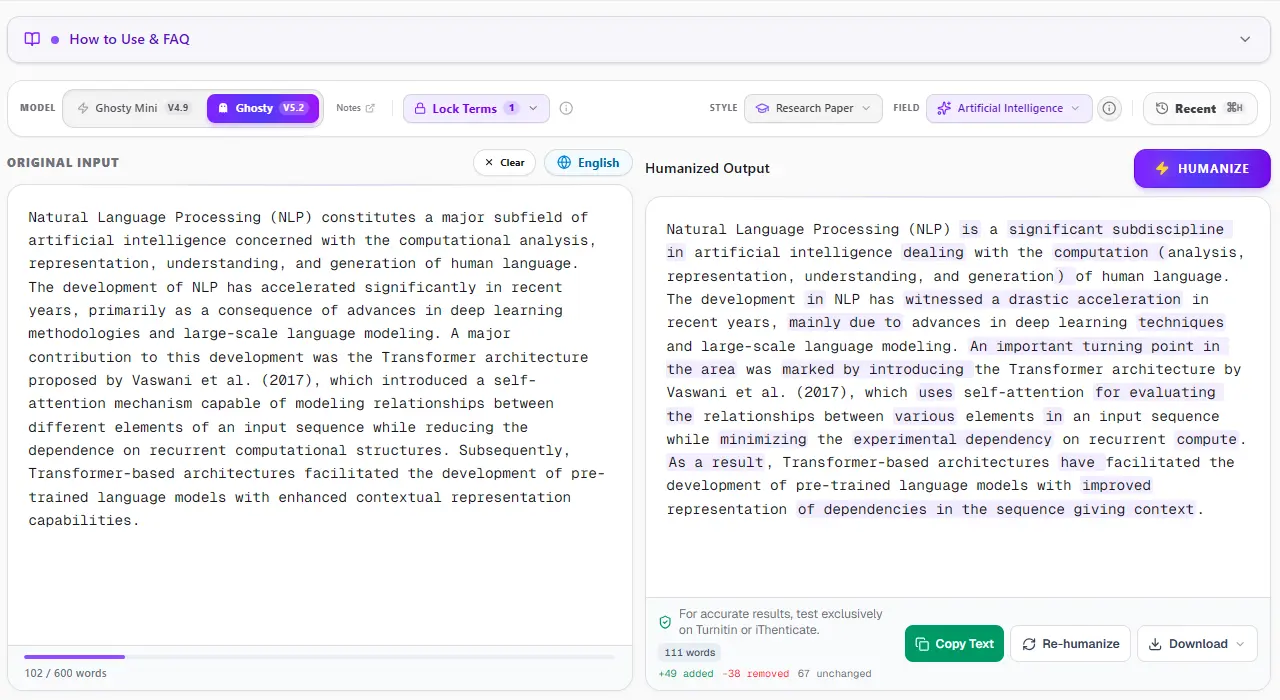
1. ThesisHuman Editor: Style, Field & Term Lock™ Technology
Unlike consumer-grade paraphrasers that blindly swap words with thesaurus synonyms, ThesisHuman allows researchers to select their exact Academic Style (Essay, Research Paper, Literature Review, Technical Report) and Academic Field (Computer Science, Engineering, Medicine, Physics). With Term Lock™, citations (APA, MLA, IEEE), LaTeX equations, and domain-specific terminology are cryptographically protected before sentence entropy is restructured.
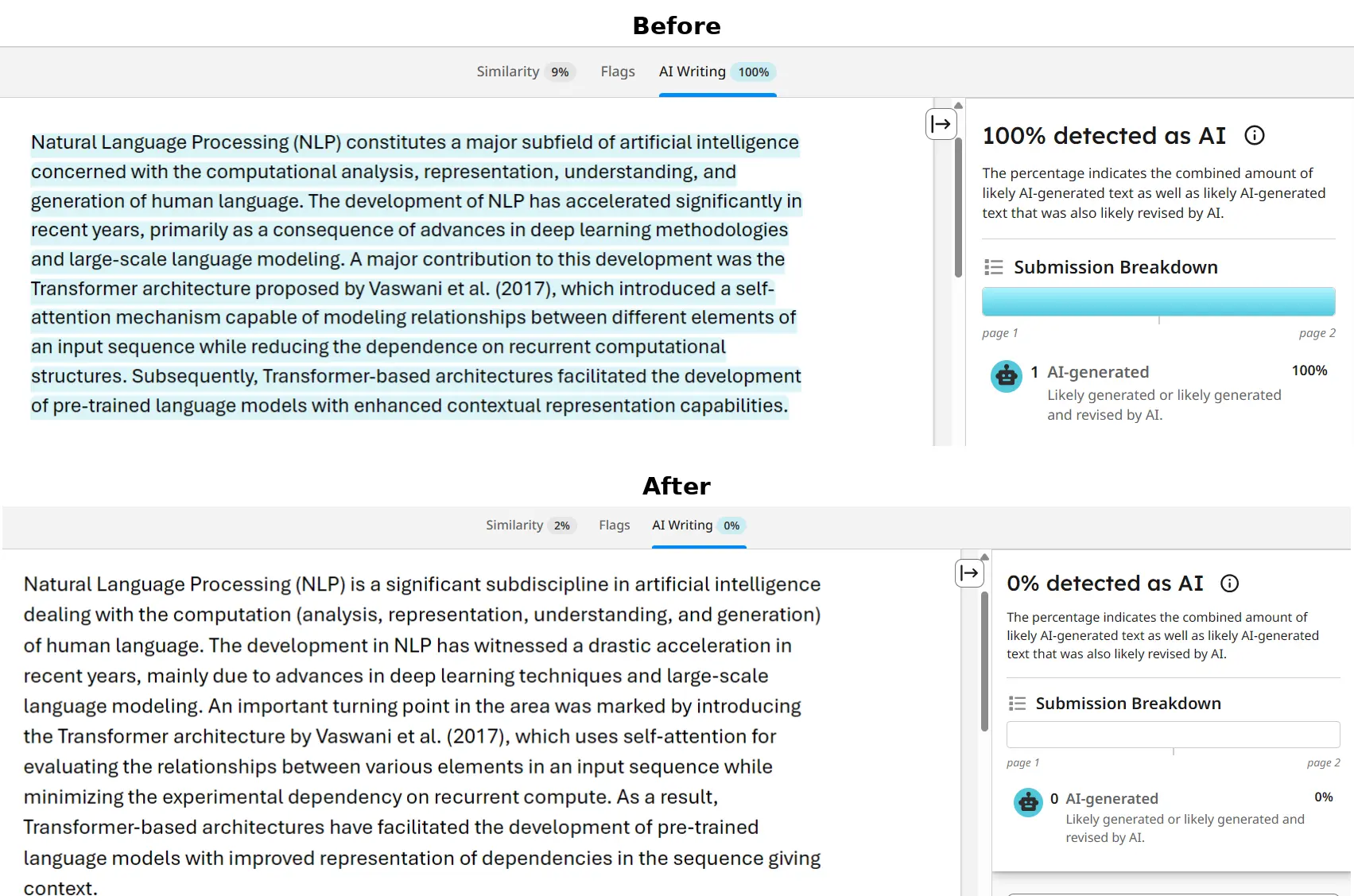
2. Turnitin & iThenticate Verification: 0% AI Detected
Turnitin and iThenticate scan submissions in overlapping 500-token blocks to analyze sentence predictability across paragraphs. When an unrefined AI draft is submitted, uniform cadence triggers an elevated AI Writing score. In the verified report below, a flagged graduate paper was processed through ThesisHuman, achieving a clean 0% AI detection score while preserving all formatted citations and technical parameters.
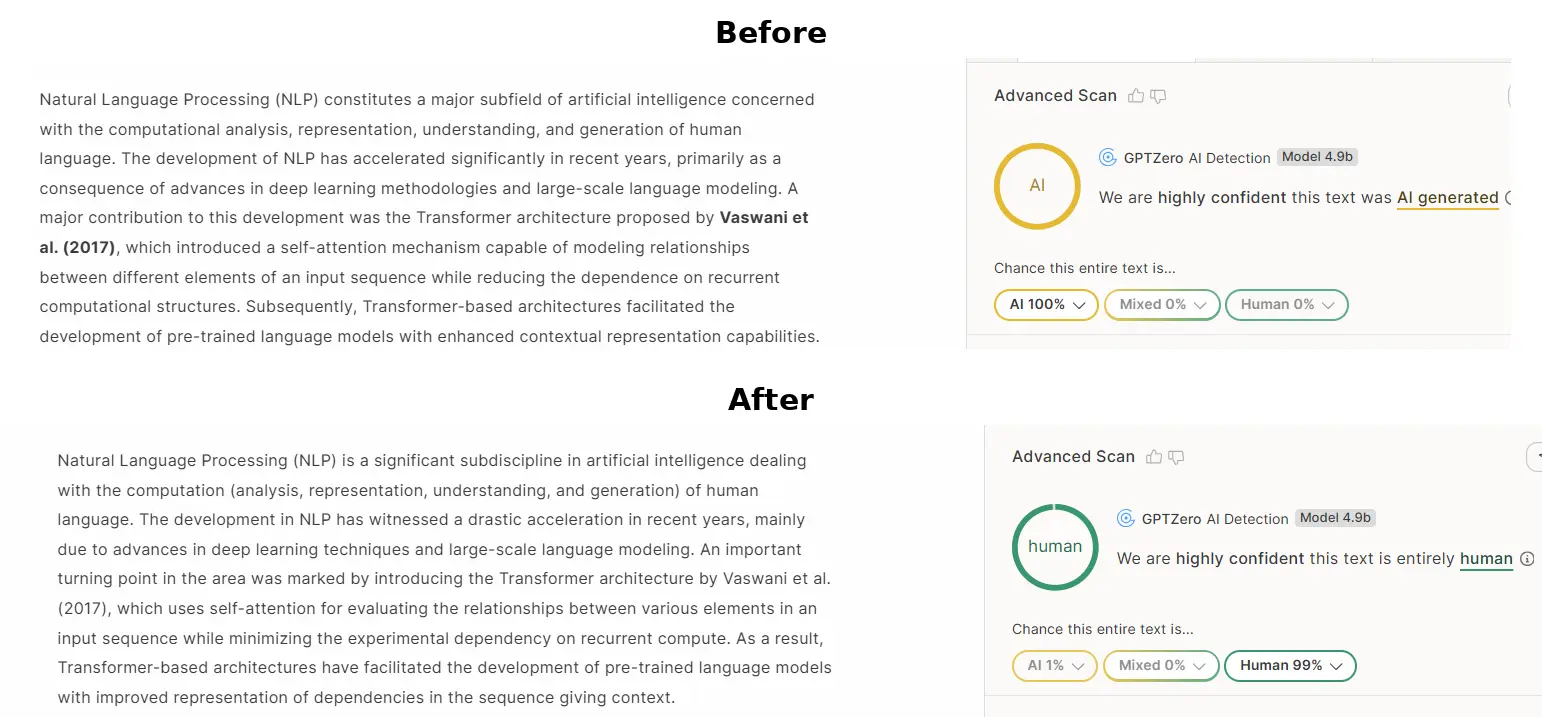
3. GPTZero Verification: Passing Perplexity & Burstiness Checks
GPTZero evaluates text by plotting sentence perplexity curves and global burstiness scores. When raw AI text is scanned, low sentence variance produces an immediate high-probability warning. ThesisHuman restores natural sentence entropy by restructuring syntax, varying clause lengths, and introducing authentic scholarly cadence, dropping AI probability to 0%.
4. Originality.ai Verification: 0% AI Confidence
Originality.ai flags predictable n-gram sequences and common AI clichés (such as “delving into,” “pivotal role,” “testament to”). ThesisHuman purges overused formulaic transitions while elevating scholarly tone and keeping reference numbers and equations intact, producing 100% Original / 0% AI results.