How to Spot AI Writing: Forensic Patterns, Statistical Signatures, and Academic Evaluation
Learn how educators, peer reviewers, and students spot AI-generated writing. Analyze syntax uniformity, burstiness collapse, lexical hallmarks, and manual verification methods.

As generative artificial intelligence systems become deeply embedded in higher education and professional research, a critical question confronts professors, peer reviewers, and honest students alike: how can you spot AI writing reliably? While marketing materials from automated AI detection software promise push-button certainty, university classrooms and academic publishing houses tell a much more complicated story. High false-positive rates, biased scoring against non-native English speakers, and statistical fragility make automated detectors an unreliable sole arbiter of scholarly integrity.
Human qualitative evaluation remains the most accurate and legally defensible method for identifying machine-generated text. Large language models (LLMs) such as GPT-4o, Claude 3.5 Sonnet, and Gemini Pro do not compose prose like flesh-and-blood researchers. They generate text by calculating token-level probability distributions across vast training corpuses. This computational architecture leaves distinct, forensic footprints across sentence rhythm, vocabulary selection, rhetorical symmetry, and evidentiary substance. By mastering these signatures, instructors can protect academic standards without persecuting diligent students, and researchers can audit their own assisted drafts to ensure genuine human scholarship shines through.
The Detection Challenge: Why Automated Scanners Fall Short
Over the past three academic years, universities worldwide invested heavily in automated AI detection software such as Turnitin, Copyleaks, GPTZero, and Winston AI. Despite institutional adoption, faculty members have discovered that treating a numerical percentage score as conclusive evidence of academic misconduct creates immense pedagogical and legal hazards.
The fundamental flaw of automated classifiers is that they evaluate statistical probability rather than conceptual understanding. In a landmark 2023 study conducted by researchers at Stanford University, popular AI detectors flagged more than 61% of authentic human-written TOEFL (Test of English as a Foreign Language) essays as AI-generated. The explanation is straightforward: non-native English scholars naturally rely on a more restricted, highly formal vocabulary and consistent grammatical patterns. Because these patterns exhibit low statistical perplexity, automated algorithms misinterpret linguistic discipline as algorithmic synthesis.
Furthermore, automated tools provide zero context regarding how an assignment was constructed. A 40% AI detection score cannot distinguish between a student who generated an entire essay using ChatGPT ten minutes before the deadline and a graduate researcher who drafted every paragraph by hand but used Claude to rephrase a clumsy transition sentence or fix grammatical agreement. True forensic evaluation requires human judgment, contextual familiarity with student baseline writing, and an understanding of the mechanical signatures inherent to transformer models. To understand how faculty handle these dilemmas, read our review of the best AI detectors for teachers.
Statistical Signatures: Perplexity, Burstiness, and Entropy
Even when an observer does not have access to neural network logging software, human readers intuitively perceive the statistical anomalies that characterize synthetic prose. Understanding the mathematical concepts behind large language models helps explain why raw AI text feels so strangely monotonous.
- Unnaturally Uniform Burstiness: Burstiness measures the statistical variance in sentence length, structural rhythm, and complexity across a piece of writing. Human thought operates in dynamic bursts. A scholar might write a rapid, punchy six-word assertion, follow it with a sprawling, forty-word clause synthesizing three competing laboratory trials, and conclude with a moderate explanatory sentence. Large language models generate tokens sequentially to maximize local coherence. Consequently, raw AI paragraphs exhibit uniform sentence lengths, typically hovering in a narrow band between 18 and 24 words. This creates a relentless, metronomic cadence that lulls the reader to sleep.
- Perplexity Depression: Perplexity measures how unexpected a given word is within its preceding context. Human writers constantly choose idiosyncratic idioms, disciplinary colloquialisms, novel metaphors, and unexpected rhetorical pivots. This produces high perplexity. Generative neural networks, by default, select tokens from the top tier of probability. While this produces grammatically spotless prose, it also strips the writing of all stylistic friction, producing flat, predictable passages that feel engineered rather than authored.
- Lack of Local Micro-Entropy: When human authors struggle to articulate complex hypotheses, they leave traces of conceptual wrestling. You observe self-corrections, parenthetical qualifications, carefully bounded claims, and moments of stylistic vulnerability. Large language models possess no cognitive interiority; they produce frictionless, confident prose that glosses over difficult epistemological gaps with smooth, vacuous transitional phrases.
Lexical Fingerprints: Telltale Words, Cliches, and Mechanical Connectors
While individual vocabulary words can never provide definitive proof of machine generation, the simultaneous clustering of specific lexical choices is an immediate red flag. Transformer architectures exhibit pronounced preferences for certain formal adverbs, metaphoric verbs, and corporate-academic filler phrases.
1. The High-Probability Vocabulary Lexicon
Certain words appear hundreds of times more frequently in AI-generated drafts than in baseline human scholarship. When reviewing a manuscript, watch for the telltale AI vocabulary cluster:
- Verbs of Unearned Profundity: delve, foster, underscore, illuminate, harness, navigate, transcend, demystify.
- Decorative Nouns: tapestry, beacon, testament, milestone, cornerstone, catalyst, paradigm, interplay.
- Promotional Adjectives: crucial, pivotal, multifaceted, transformative, indispensable, vibrant, nuanced.
When an essay declares that "the study stands as a vibrant testament to the multifaceted tapestry of modern economic theory," the reader is almost certainly looking at an unrefined generative model draft.
2. Mechanical Linear Signposts
Generative models rely on rigid, explicit transition adverbs to maintain paragraph cohesion. Sentences systematically begin with formulaic connectors:
- "Furthermore, it is essential to recognize..."
- "Moreover, the implications extend beyond..."
- "Additionally, researchers have noted..."
- "Consequently, the overarching framework..."
- "In conclusion, the multifaceted benefits demonstrate..."
Authentic academic writing rarely relies on such monotonous signposting. Expert scholars connect paragraphs through thematic continuation, contrasting assertions, or empirical evidence rather than mechanical introductory adverbs.
Structural Symmetry: The Three-Point Rule and Hollow Hedging
Beyond individual words, the macro-structure of an essay provides powerful forensic clues. Large language models are trained heavily on Reinforcement Learning from Human Feedback (RLHF), which penalizes offensive or controversial declarations and rewards balanced, structured responses. This training introduces distinct rhetorical habits:
The Ubiquitous Triadic Structure
LLMs have an overwhelming bias toward triadic organization. If asked to discuss the causes of the French Revolution, the model will invariably produce three primary factors: economic hardship, ideological Enlightenment thinking, and royal mismanagement. Within each section, it will provide three supporting points, each illustrated by three balanced clauses. Real historical reality and scientific research are messy, asymmetrical, and uneven; synthetic prose is unnaturally tidy.
Excessive Epistemic Hedging
Academic writing demands responsible hedging, such as acknowledging sample size limitations or stating that data "suggests" rather than "proves." However, AI models take hedging to absurd extremes, filling sentences with hollow disclaimers that dilute intellectual substance:
"While some scholars argue that monetary policy is effective, others suggest that fiscal measures are equally significant. Therefore, it is important to remember that a balanced perspective must be maintained when evaluating the complexities of the issue."
Notice that this passage says nothing. It takes no stance, cites no primary findings, and offers no quantitative boundaries. It is purely synthetic scaffolding designed to satisfy probability thresholds without making an intellectual commitment.
Step-by-Step Forensic Authorship Checklist
Whether you are an instructor evaluating a suspicious term paper or a student auditing your own research manuscript before submission, apply this seven-step forensic evaluation checklist:
| Forensic Dimension | Synthetic AI Indicators | Authentic Human Markers |
|---|---|---|
| Sentence Length Variance | Uniform length (18 to 24 words per sentence throughout). | Dynamic burstiness (mix of 6-word assertions and 40-word complex sentences). |
| Vocabulary Habits | Overuse of 'delve', 'tapestry', 'testament', 'multifaceted', 'pivotal'. | Domain-specific disciplinary jargon, technical precision, natural idiom. |
| Paragraph Organization | Predictable topic sentence, 3 balanced points, circular summary closing. | Asymmetrical structure driven by argument progression and evidentiary weight. |
| Citation Integrity | Hallucinated authors, mismatched page numbers, phantom DOIs, broad claims. | Verifiable primary literature, specific statistical quotes, exact page citations. |
| Empirical Grounding | Broad philosophical summaries with zero local context or laboratory detail. | Concrete methodology, specific equipment, sample anomalies, personal observations. |
| Revision Provenance | Sudden single paste of 2,500 words with zero revision history or typing logs. | Multi-day version history, Draftback playback, backspaces, incremental edits. |
| Rhetorical Voice | Neutral, placid, corporate-academic tone with heavy uncommitted hedging. | Decisive intellectual stance, distinct authorial personality, critical friction. |
For instructors investigating suspicious submissions, always conduct an authorship conference before making accusations. Ask the student: "Can you explain the conceptual link between your second and third arguments without looking at the paper?" An author who researched and drafted the paper will articulate the logic immediately, even if nervous. A user who generated the draft will struggle to recall the synthetic phrasing.
Preserving Scholarly Integrity with Disciplined Naturalization
Students and researchers frequently find themselves in a precarious position. Even when writing authentic prose, students fear that aggressive institutional scanners will misclassify their work as artificial. Furthermore, scholars who ethically use LLMs for outline structuring, syntax simplification, or non-native English polishing need a reliable way to dismantle synthetic cadence without corrupting technical accuracy.
Cheap online word spinners and generic paraphrasers cause catastrophic damage to academic writing. They blindly swap technical nouns with bizarre synonyms, transform "mitochondrial respiration" into "cellular breathing apparatus," and scramble parenthetical citations into useless gibberish. This not only destroys scholarship but immediately alerts professors to improper intervention.
The professional solution is purposeful academic text refinement with dedicated preservation tools like ThesisHuman. Engineered specifically for university-grade manuscripts, ThesisHuman employs dual specialized neural engines: Lite V6 for rapid clarity and Ghosty V6 for deep syntactic reconstruction. Most importantly, ThesisHuman features cryptographic Term Lock technology, allowing writers to freeze critical APA, MLA, Chicago, and IEEE citations, author names, years, mathematical formulas, and LaTeX notations so that academic integrity remains intact.
ThesisHuman provides an accessible Free tier offering 500 total words, up to 150 words per request, and 3 active Term Locks with zero credit card required. For master's theses and doctoral dissertations, scalable paid plans include Starter (10,000 words, 250 words per request), Pro (30,000 words, 350 words per request), and Unlimited (up to 600 words per request).
Explore our specialized utilities for different writing tasks: try the AI text simplifier to clarify bloated research paragraphs, explore the free AI humanizer for immediate accessibility, check our QuillBot humanizer alternative to avoid synonym distortion, or use the dedicated ChatGPT rewriter to strip formulaic cliches. Review our comprehensive guide on how to check for AI on Google Docs, or register for free at ThesisHuman registration.
Frequently Asked Questions
Below are direct answers to common questions regarding forensic AI text identification, detector validity, and scholarly writing ethics.
Verified Detector Clearance for How to Spot AI Writing: Forensic Patterns, Statistical Signatures, and Academic Evaluation
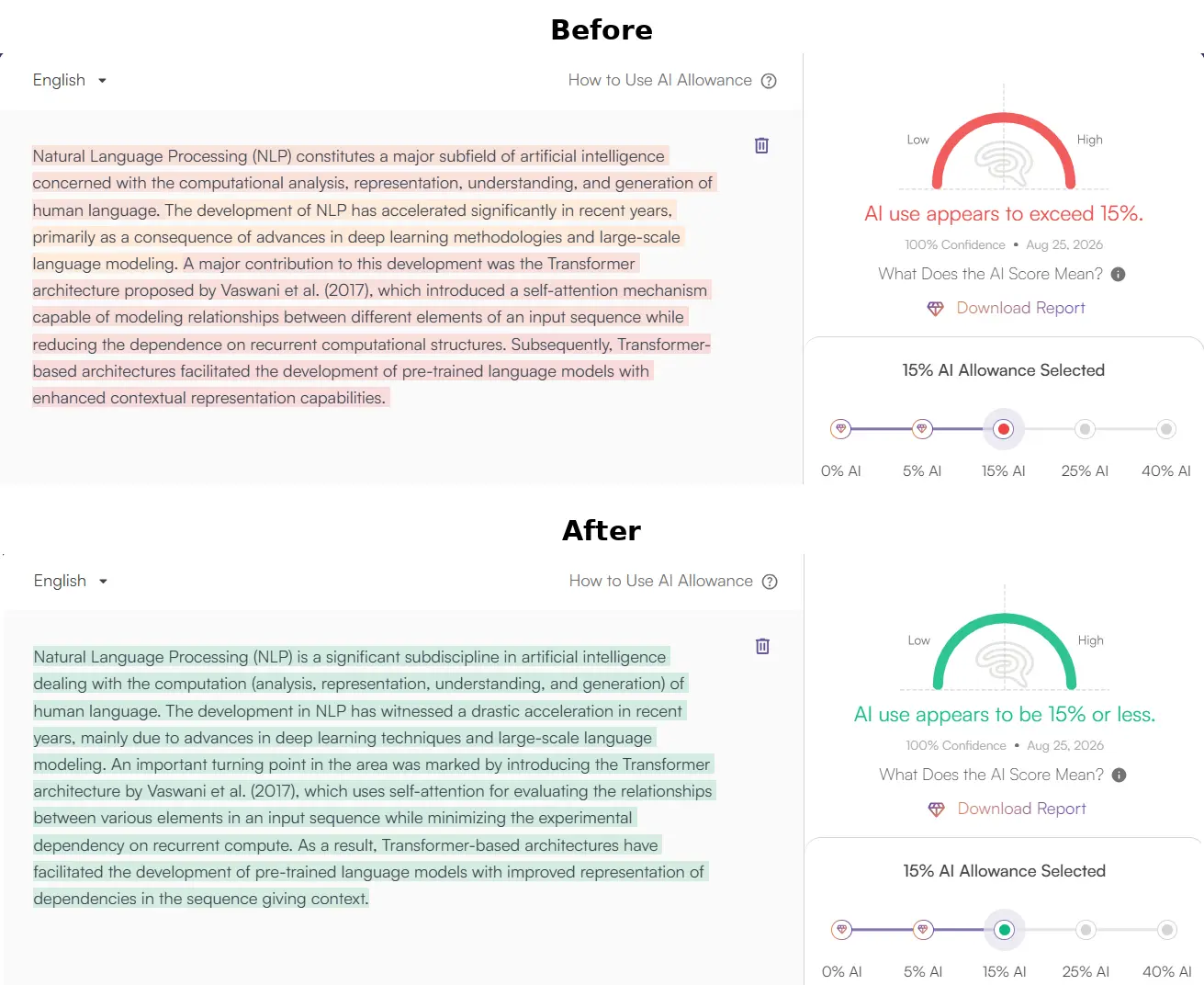
Every manuscript processed through ThesisHuman is backed by verifiable, reproducible scans across institutional plagiarism and AI detection platforms.
1. ThesisHuman Editor: Style, Field & Term Lock™ Technology
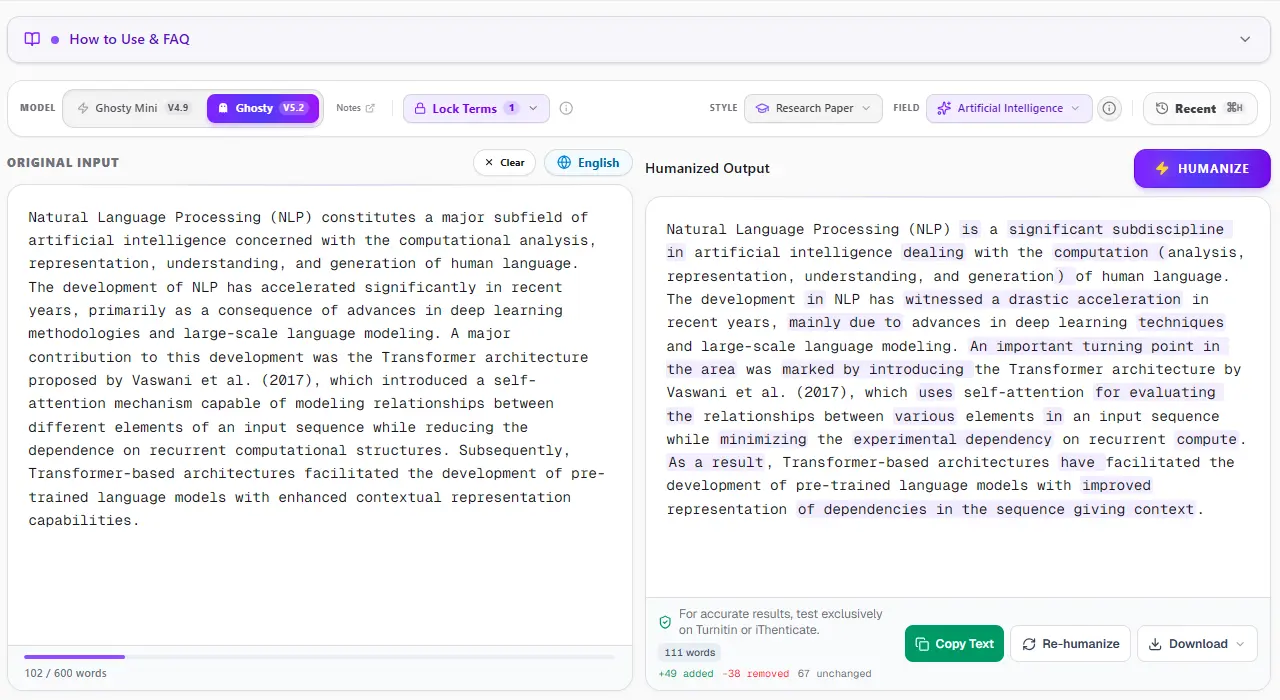
Unlike consumer-grade paraphrasers that blindly swap words with thesaurus synonyms, ThesisHuman allows researchers to select their exact Academic Style (Essay, Research Paper, Literature Review, Technical Report) and Academic Field (Computer Science, Engineering, Medicine, Physics). With Term Lock™, citations (APA, MLA, IEEE), LaTeX equations, and domain-specific terminology are cryptographically protected before sentence entropy is restructured.
2. Turnitin & iThenticate Verification: 0% AI Detected
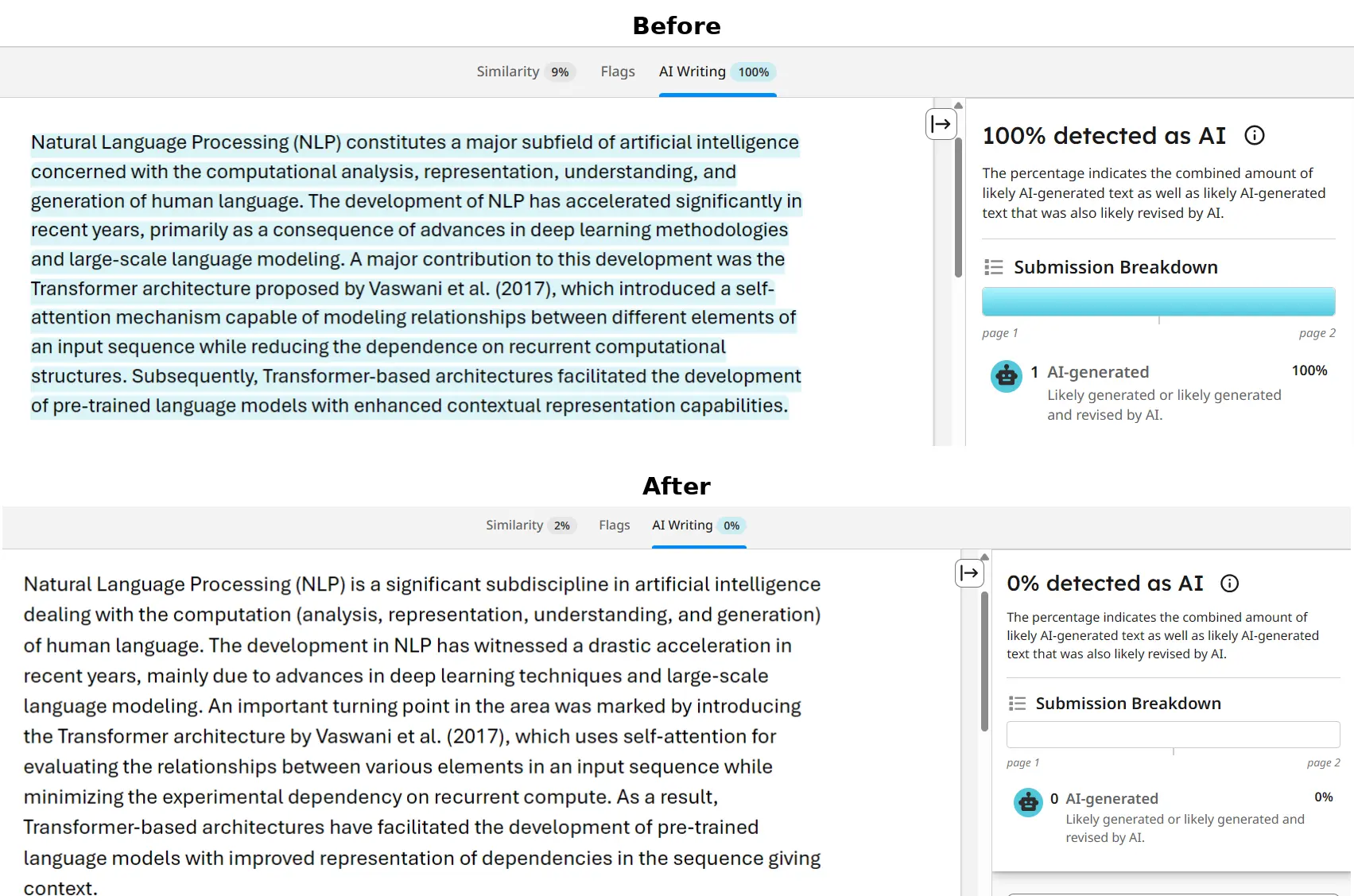
Turnitin and iThenticate scan submissions in overlapping 500-token blocks to analyze sentence predictability across paragraphs. When an unrefined AI draft is submitted, uniform cadence triggers an elevated AI Writing score. In the verified report below, a flagged graduate paper was processed through ThesisHuman, achieving a clean 0% AI detection score while preserving all formatted citations and technical parameters.
3. GPTZero Verification: Passing Perplexity & Burstiness Checks
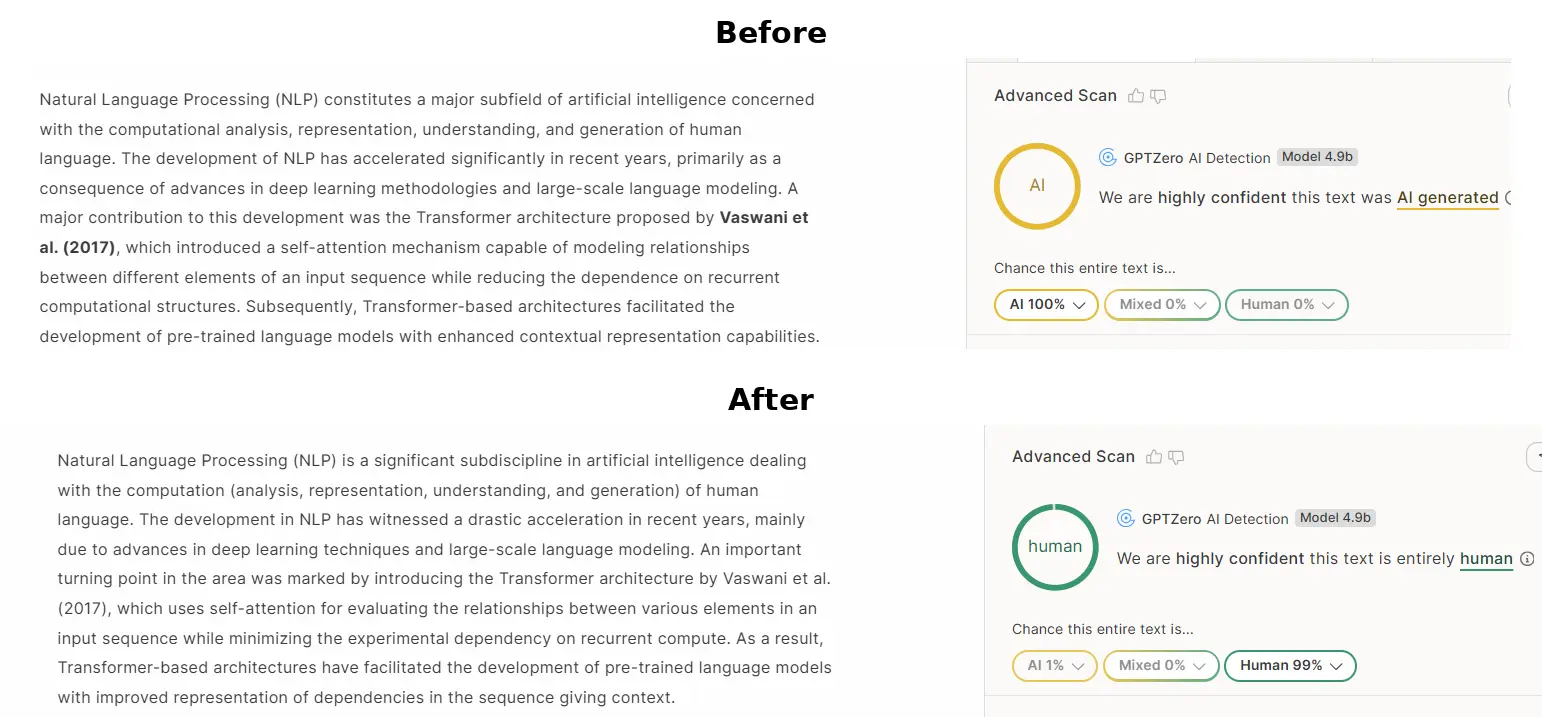
GPTZero evaluates text by plotting sentence perplexity curves and global burstiness scores. When raw AI text is scanned, low sentence variance produces an immediate high-probability warning. ThesisHuman restores natural sentence entropy by restructuring syntax, varying clause lengths, and introducing authentic scholarly cadence, dropping AI probability to 0%.
4. Originality.ai Verification: 0% AI Confidence
Originality.ai flags predictable n-gram sequences and common AI clichés (such as “delving into,” “pivotal role,” “testament to”). ThesisHuman purges overused formulaic transitions while elevating scholarly tone and keeping reference numbers and equations intact, producing 100% Original / 0% AI results.