How to Prompt AI to Write Like a Human: Academic Frameworks, Tone Tuning, and Statistical Limits
Master prompt engineering to eliminate robotic AI phrasing in academic drafts. Learn constraint frameworks, syntax variation methods, and the mathematical limits of prompting.

As generative artificial intelligence tools like ChatGPT, Claude, and Gemini become regular companions in research workflows, university writers frequently encounter a frustrating barrier: machine-generated prose sounds unmistakably synthetic. Instructors, peer reviewers, and journal editors can spot the telltale rhythm of unrefined model output within seconds, and institutional detection scanners flag the predictable statistical signatures left behind.
The immediate reaction of most scholars is to experiment with prompt engineering. Students and researchers scour internet forums seeking the elusive perfect prompt, typing instructions such as "write in a natural human style," "vary your sentence length," or "bypass AI detection." Yet despite increasingly elaborate prompt templates, the resulting text still carries an unmistakable robotic cadence. To understand why prompting often falls short, and how to harness prompt engineering constructively without falling into common traps, scholars must understand both the mechanics of language models and the mathematical boundaries of generative output.
The Prompting Paradox: Why Naive Instructions Fail
The fundamental limitation of naive prompting lies in the discrepancy between human perception of writing and the algorithmic reality of neural networks. When a user instructs a language model to "write like a human," the model interprets that command through its vast training distribution. To a transformer, "human writing" is not an organic cognitive experience; it is an abstraction represented by billions of internet texts, corporate marketing blogs, student essays, and open-access articles.
Consequently, when prompted broadly, the model defaults to an idealized, hyper-standardized average of formal prose. It avoids colloquialisms, corrects every minor syntactic asymmetry, and selects transition markers that maximize grammatical coherence across adjacent sentences. This well-intentioned optimization produces text that is grammatically flawless yet fundamentally lifeless. The resulting output suffers from the prompting paradox: the harder a user pushes an AI model to sound sophisticated and human through naive instructions, the more aggressively the model retreats to its most predictable, formulaic statistical averages.
Furthermore, naive instructions cannot override the autoregressive decoding algorithms that govern how large language models assemble sentences. Whether a model operates via greedy decoding, top-p nucleus sampling, or temperature adjustments, it sequentially predicts next tokens based on probability. A prompt can shift the semantic domain or adjust the lexical register, but it cannot dismantle the foundational mathematical predictability that institutional classifiers evaluate.
The Anatomy of Robotic AI Output
To construct prompts that genuinely improve writing quality, researchers must identify the specific linguistic markers that make raw AI text recognizable. Large language models exhibit consistent behavioral patterns across several key dimensions:
- Monotonous Sentence Cadence (Low Burstiness): Raw AI paragraphs exhibit an uncanny structural symmetry. Consecutive sentences routinely cluster within a narrow span of 18 to 24 words. A declarative subject-verb opening is followed by a dependent explanatory clause, followed in turn by a symmetrical coordinating conjunction. Authentic academic scholarship, by contrast, breathes with extreme variation, alternating between short, decisive assertions and complex, multi-clause evidentiary syntheses.
- Predictable Lexical Crutches: Models rely heavily on a recognizable constellation of stock academic and corporate phrases. Words such as "delve," "tapestry," "stands as a testament," "pivotal milestone," "crucial role," "beacon," and "underscores the necessity" appear with unnatural frequency across independent prompts.
- Mechanical Transitional Suffixes: Paragraphs produced by generative models almost universally rely on predictable transitional adverbs. Sentences systematically begin with "Furthermore," "Moreover," "Additionally," "Consequently," or "In conclusion," creating a rigid, linear conveyor-belt rhythm that weary faculty members immediately recognize.
- Excessive Epistemic Hedging: While academic writing requires cautious qualification, AI models overcompensate by inserting hollow hedging language into every paragraph. Phrases such as "It is important to remember that," "One must take into consideration," or "While perspectives may vary" dilute intellectual authority without adding empirical substance.
Understanding these flaws is the first step toward building rigorous prompt frameworks that systematically eliminate robotic patterns during initial drafting.
Actionable Academic Prompting Frameworks
Effective prompt engineering for scholarly research is not about discovering magic phrases. It requires providing precise contextual constraints, negative rules, structural boundaries, and evidentiary anchors. Below are four battle-tested frameworks tailored to university-level drafting:
1. Negative Constraint Engineering
Negative constraints tell the model what it is strictly forbidden to do. Because generative models default to high-probability corporate boilerplate when unconstrained, explicit prohibitions force the neural network to explore alternative, more varied phrasing paths.
Consider incorporating this negative constraint block into research drafting prompts:
"Draft the literature review section following these strict negative constraints:
- Do not use the words: delve, tapestry, testament, crucial, pivotal, multifaceted, beacon, or vibrant.
- Do not begin any sentence with: Furthermore, Moreover, Additionally, In conclusion, or It is important to note.
- Avoid opening paragraphs with broad philosophical generalizations.
- Do not summarize the main point in the final sentence of every paragraph.
- Eliminate all decorative metaphors and promotional adjectives."
2. Structural Asymmetry and Cadence Modulation
Rather than asking for "engaging" prose, specify explicit sentence length targets to dismantle the uniform clausal symmetry that triggers detection algorithms:
"Structure the argumentation using deliberate rhythm asymmetry:
- Ensure consecutive sentences vary drastically in word count.
- Pair short, direct declarative claims (under 10 words) with detailed, multi-clause analytical explanations (over 30 words).
- Never allow three consecutive sentences to share similar grammatical structures.
- Use active voice for methodological descriptions and reserve passive constructions strictly for standardized laboratory procedures."
3. Evidentiary Anchoring and Primary Data Feeding
The primary reason AI text sounds generic is that users provide vague prompts asking the model to synthesize broad concepts. When the model has no concrete data to anchor its reasoning, it fills the page with decorative generalizations. When you provide explicit empirical data, statistical findings, and specific methodological parameters, the model is compelled to construct sentences around concrete facts, dramatically raising lexical diversity and analytical depth.
"Synthesize the following experimental findings into an academic discussion paragraph:
- Primary outcome: Cohort A exhibited a 14.2% reduction in serum cortisol (p < 0.01).
- Secondary caveat: The effect decayed after 72 hours under sustained sleep deprivation.
- Competing view: Johnson et al. (2024) observed no significant variance across identical cohorts.
- Lead directly with the statistical finding without introductory throat-clearing."
4. Disciplinary Register Anchoring
Instruct the model to adopt the specific stylistic conventions of your disciplinary target rather than general academic English. A clinical epidemiology paper demands concise, hedged passive-voice documentation, whereas a humanities philosophy monograph requires nuanced intellectual progression and active conceptual dissection. Specify the intended journal, citation style, and methodological philosophy in your initial prompt setup.
The Mathematical Limits: Perplexity and Token Distributions
While sophisticated prompt engineering significantly improves the clarity and readability of rough drafts, scholars must recognize a hard technical truth: prompt engineering cannot guarantee that text will pass institutional AI detectors. The reason is rooted in computational linguistics.
Institutional screening tools like Turnitin, Copyleaks, and GPTZero do not grade essays based on vocabulary alone. They analyze mathematical probability distributions across sequences of text, evaluating two fundamental metrics:
- Perplexity: A measure of how surprised a language model is by a sequence of words. When a human writes, they select unexpected idioms, domain-specific colloquialisms, idiosyncratic sentence transitions, and irregular grammatical structures. This produces high perplexity. When an AI generates text, it naturally selects words from the upper tier of statistical probability, producing low perplexity. Even when prompted with negative constraints, the model continues to select from among the most probable valid tokens available within those boundaries.
- Burstiness: A measure of the statistical entropy and variance of sentence lengths and structural complexity across a whole document. Humans think in bursts, alternating between rapid declarations and lengthy analytical explorations. Because neural models generate tokens sequentially without holistic cognitive intention, their burstiness profiles remain mathematically uniform across multi-paragraph samples.
Because detectors evaluate statistical distributions rather than individual words, a draft can follow every prompt rule perfectly and still trip an automated detector. Relying solely on prompt engineering to bypass academic screening is a precarious strategy that frequently leads to false positives or disciplinary scrutiny. To explore how institutional scanners analyze these signals in real submissions, review our detailed guide on why AI detectors flag student writing.
The Professional Workflow: Prompting to Publication-Grade Prose
If prompt engineering is an incomplete solution on its own, what is the legitimate, defensible workflow for modern university researchers? The answer lies in a disciplined, multi-stage hybrid workflow that combines structured prompting, dedicated academic text naturalization, and rigorous human authorial oversight.
A defensible three-stage drafting pipeline consists of:
- Stage 1: Constrained AI Drafting: Use negative constraint prompts and primary empirical evidence to generate clear, structured initial paragraphs. Focus on organizing arguments, synthesizing dense background literature, and outlining methodological steps. Do not worry about detection scores at this stage; focus on logical rigor.
- Stage 2: Academic Naturalization and Term Locking: Once the rough text is assembled, process it through a purpose-built scholarly engine like ThesisHuman. Unlike generic consumer paraphrasers that blindly replace words with flawed synonyms, ThesisHuman utilizes specialized neural models (Ghosty V6 and Lite V6) calibrated specifically for peer-reviewed prose. Most critically, its Term Lock feature allows authors to designate immutable terms, freezing APA, MLA, Chicago, and IEEE in-text citations, author names, years, mathematical variables, and LaTeX notation so that evidence chains remain uncorrupted.
- Stage 3: Human Verification and Provenance Archival: Review the refined manuscript to verify factual accuracy, ensure personal authorial tone, and confirm that all citations map to legitimate primary literature. Save timestamped intermediate revisions in your cloud processor so that you possess an unbroken authorship trail.
ThesisHuman offers a transparent Free tier providing 500 total words, up to 150 words per single request, and 3 active term locks with zero credit card required. For extended research projects, scalable tiers include Starter (10,000 words, 250 words per request), Pro (30,000 words, 350 words per request), and Unlimited (up to 600 words per request for comprehensive dissertations).
Explore our specialized rewriting utilities for specific scholarly tasks, including the academic essay rewriter, the research paper paraphrasing tool, and our scholarly tone rewriter. You can register for free at ThesisHuman registration or explore our practical tips on how to make ChatGPT sound more human.
Frequently Asked Questions
Below are direct answers to common questions regarding academic prompt engineering, detection mechanics, and writing workflows.
Verified Detector Clearance for How to Prompt AI to Write Like a Human: Academic Frameworks, Tone Tuning, and Statistical Limits
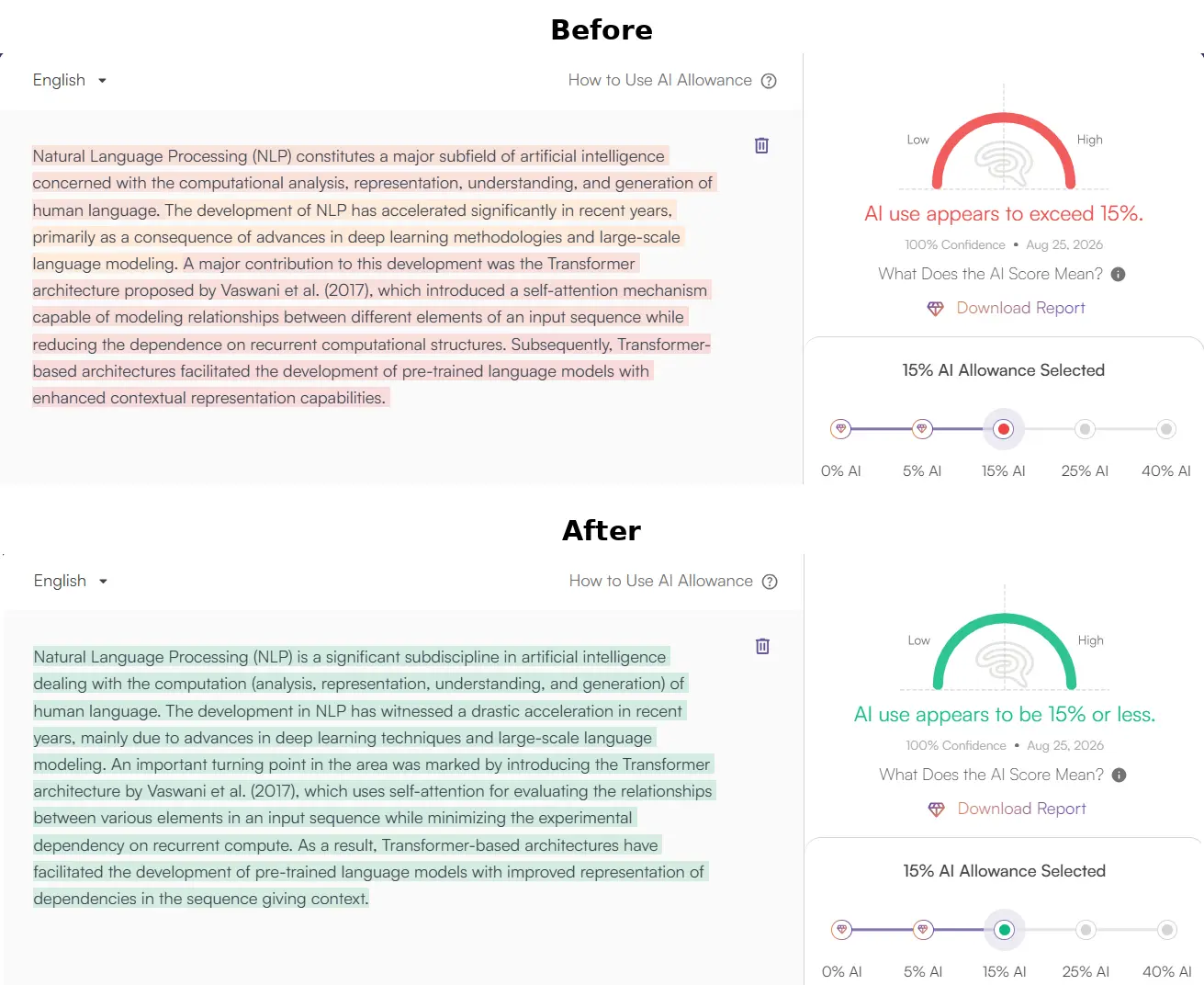
Every manuscript processed through ThesisHuman is backed by verifiable, reproducible scans across institutional plagiarism and AI detection platforms.
1. ThesisHuman Editor: Style, Field & Term Lock™ Technology
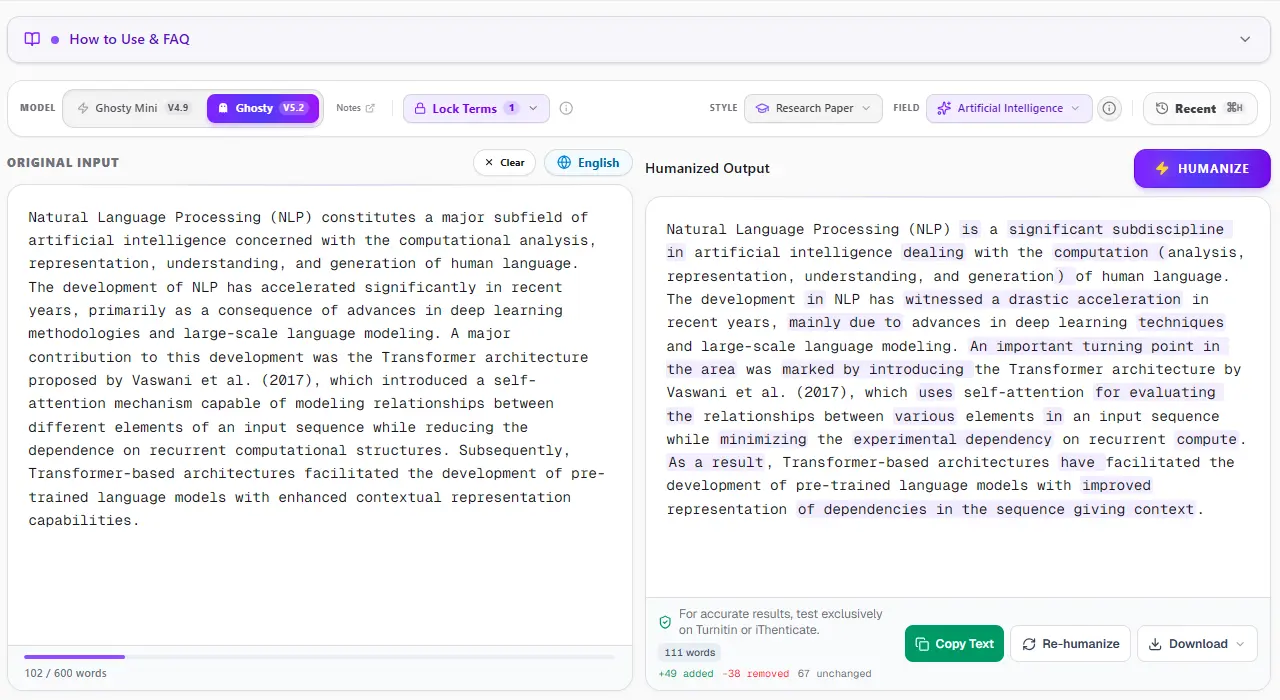
Unlike consumer-grade paraphrasers that blindly swap words with thesaurus synonyms, ThesisHuman allows researchers to select their exact Academic Style (Essay, Research Paper, Literature Review, Technical Report) and Academic Field (Computer Science, Engineering, Medicine, Physics). With Term Lock™, citations (APA, MLA, IEEE), LaTeX equations, and domain-specific terminology are cryptographically protected before sentence entropy is restructured.
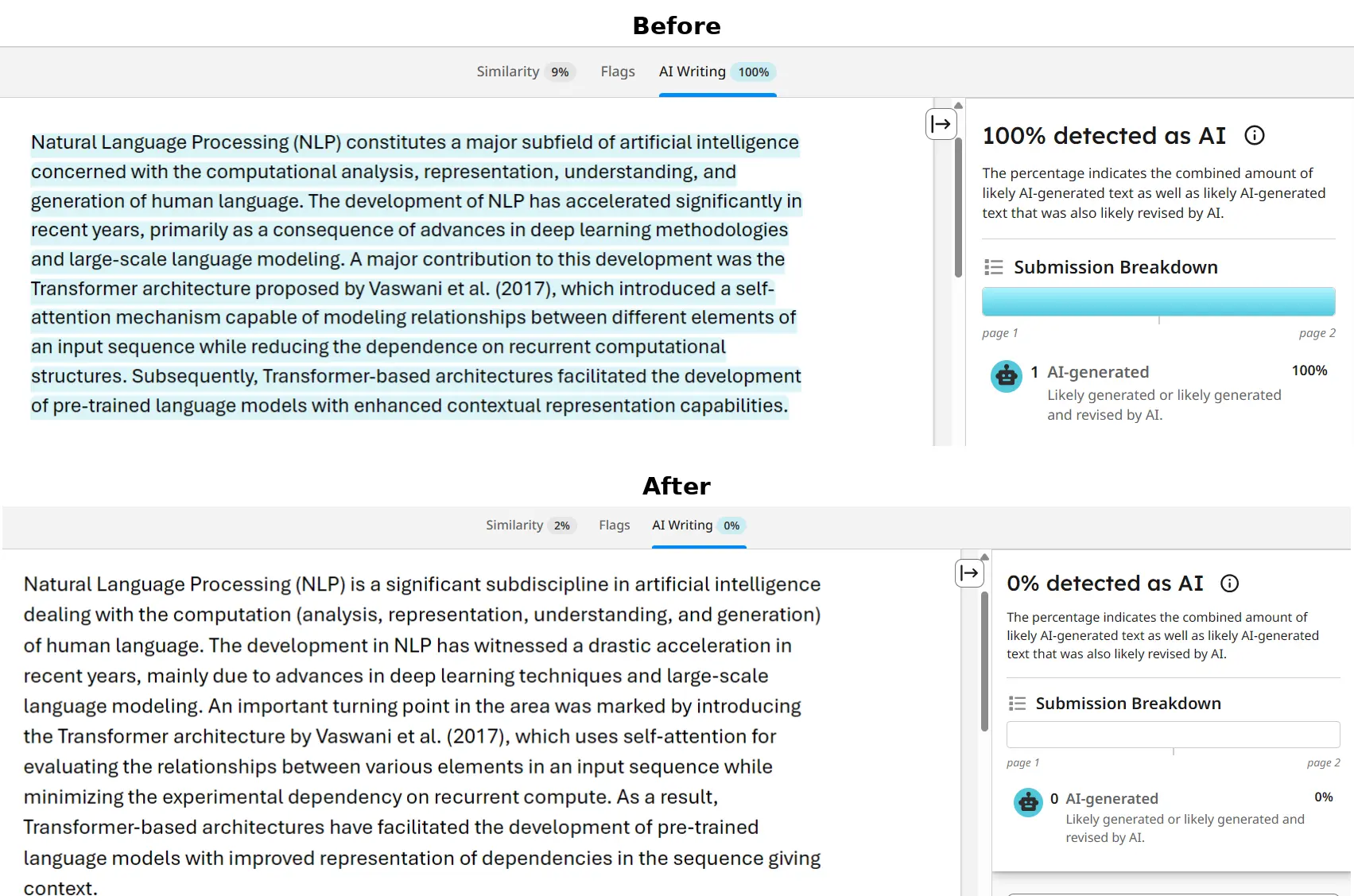
2. Turnitin & iThenticate Verification: 0% AI Detected
Turnitin and iThenticate scan submissions in overlapping 500-token blocks to analyze sentence predictability across paragraphs. When an unrefined AI draft is submitted, uniform cadence triggers an elevated AI Writing score. In the verified report below, a flagged graduate paper was processed through ThesisHuman, achieving a clean 0% AI detection score while preserving all formatted citations and technical parameters.
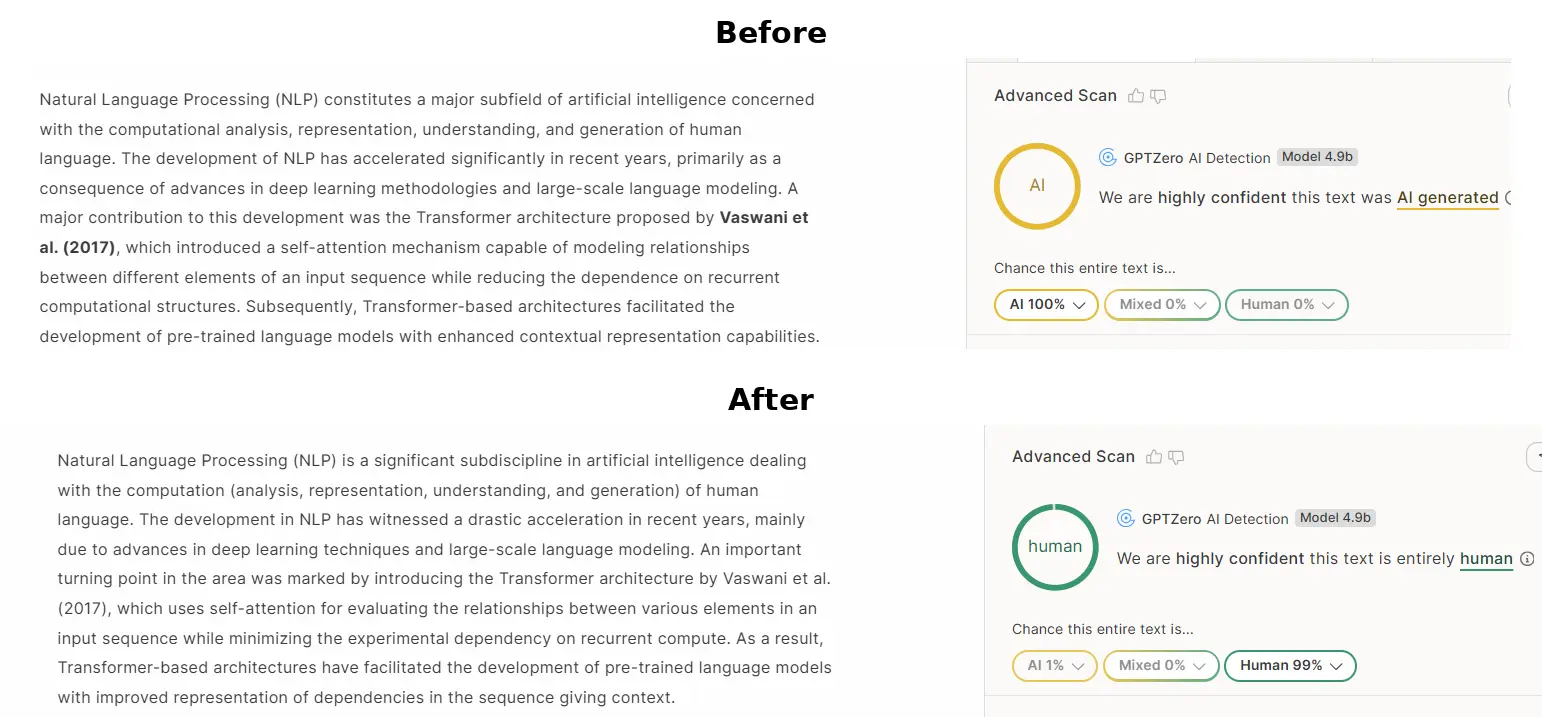
3. GPTZero Verification: Passing Perplexity & Burstiness Checks
GPTZero evaluates text by plotting sentence perplexity curves and global burstiness scores. When raw AI text is scanned, low sentence variance produces an immediate high-probability warning. ThesisHuman restores natural sentence entropy by restructuring syntax, varying clause lengths, and introducing authentic scholarly cadence, dropping AI probability to 0%.
4. Originality.ai Verification: 0% AI Confidence
Originality.ai flags predictable n-gram sequences and common AI clichés (such as “delving into,” “pivotal role,” “testament to”). ThesisHuman purges overused formulaic transitions while elevating scholarly tone and keeping reference numbers and equations intact, producing 100% Original / 0% AI results.