How to Write an Abstract for a Research Paper: Examples and Structure
Learn how to write a clear, concise abstract for your research paper. Explore structured vs. unstructured formats, disciplinary models, and a drafting checklist.

An abstract is the single most critical gateway to your research paper. Before peer reviewers accept your manuscript, before conference committees invite you to speak, and before researchers decide whether to download your full text, they read your abstract. In contemporary digital repositories, an abstract serves as both an intellectual summary and an indexing asset, determining how discovery engines categorize your findings and whether prospective readers engage with your work.
Despite its brevity, writing an academic abstract is often one of the most demanding stages of the scholarly publishing process. Condensing months or years of complex methodology, statistical data, and nuanced theoretical argumentation into 200 words requires precision, disciplined syntax, and strict adherence to disciplinary conventions. This comprehensive guide details the architecture of an effective research abstract, examines differences between structured and unstructured models across fields, presents fully annotated examples, highlights common writing traps, and provides a practical revision checklist.
1. What Is an Abstract?
An abstract is a standalone, concise synopsis of an entire academic manuscript, thesis, or dissertation. Its purpose is to communicate what was studied, why it matters, how the investigation was conducted, what was discovered, and what those discoveries mean for the broader scholarly field.
An effective abstract functions as a miniature representation of the complete document. A reader who inspects only the abstract should understand the core intellectual contribution of the paper without being forced to open the main document. Importantly, an abstract is not a teaser or marketing preview; it must reveal the primary results and conclusions rather than withholding them to create artificial suspense.
Core Principle: An academic abstract must be entirely self-contained. It should never refer to external bibliographic citations, cross-reference figures in the main text, or introduce undefined acronyms.
2. Abstract versus Introduction versus Executive Summary
Writers frequently confuse an abstract with an introduction or an executive summary. Although all three appear near the front of a document, their rhetorical purposes and internal structures differ significantly.
| Feature | Abstract | Introduction | Executive Summary |
|---|---|---|---|
| Audience | Scholars, peer reviewers, cataloging databases | Readers entering the full manuscript argument | Decision-makers, corporate managers, policy analysts |
| Typical Length | 150 to 300 words (single section) | 2 to 5 pages (10% to 15% of document) | 1 to 4 pages (stand-alone report) |
| Reveals Results? | Yes, states primary findings explicitly | Rarely; focuses on hypothesis and roadmap | Yes, emphasizes actionable takeaways |
| Citation Style | No citations or parenthetical references | Dense literature review citations | Selective citations and executive charts |
While an introduction opens the door by establishing theoretical context, defining problems, and offering a roadmap, it relies on the subsequent sections to unpack proof. An abstract, by contrast, condenses that entire sequence into a single micro-narrative. For a deeper breakdown of academic foundations, see our guide on what is academic writing.
3. Structured versus Unstructured Abstracts
Journals and conferences format abstracts according to two dominant organizational paradigms: structured and unstructured.
Structured Abstracts
Common in medicine, nursing, clinical psychology, public health, and certain computational sciences, structured abstracts use explicit, bold subheadings to delineate components. Frequent headers include Background, Objectives, Methods, Results, and Conclusions. Some medical journals mandate even finer divisions, such as Design, Setting, Participants, and Main Outcome Measures. Structured formats prioritize rapid scanning and standardized meta-analysis indexing, allowing researchers to evaluate methodological validity within seconds.
Unstructured Abstracts
Predominant in the humanities, social sciences, mathematics, theoretical physics, and traditional engineering, unstructured abstracts present the identical logical progression in a single continuous paragraph without bold headers. While an unstructured abstract lacks visual dividers, it must follow an equally disciplined logical trajectory: context, research question, approach, findings, and implications. If you are developing supporting body sections for your paper, reviewing our analysis of what is a body paragraph offers helpful structural alignment.
4. Disciplinary Differences and Publication Venues
Abstract expectations vary substantially across academic disciplines. Authors who submit an abstract built for a biochemical journal to a cultural studies journal will face immediate editorial friction.
- Empirical Sciences & Engineering: Emphasize explicit methodology, sample parameters, apparatus specifications, quantitative outcomes with confidence intervals or effect sizes, and operational significance. Follows the traditional IMRaD sequence (Introduction, Methods, Results, and Discussion).
- Social Sciences: Balance theoretical framing, qualitative or quantitative data sources (e.g., ethnographic field notes, longitudinal surveys), analytical framework, and policy or societal implications.
- Humanities & Cultural Theory: Focus on textual objects of study, historical moments, critical interventions into established scholarly debates, and interpretive theses. These rarely use IMRaD and instead frame a conceptual intervention.
- Mathematics & Theoretical Computer Science: State the problem class, theorem established, proof technique introduced, and asymptotic complexity or algorithmic bounds.
5. Five Core Components in Recommended Sequence
Regardless of discipline, almost every successful academic abstract answers five fundamental questions across five sequential stages:
1. Background and Context (1 to 2 sentences)
Why does this research area matter? Establish the broad scholarly domain and identify the specific unresolved problem, empirical gap, or theoretical tension the paper addresses.
2. Research Objective or Question (1 sentence)
What did this specific project set out to accomplish? State your hypothesis, central research inquiry, or primary objective with absolute clarity.
3. Methodology and Design (1 to 3 sentences)
How was the study conducted? Detail your study design, primary data sources, participant demographics, sample size, analytical framework, or computational models. Be specific enough that an expert recognizes your scholarly approach.
4. Key Findings and Results (2 to 4 sentences)
What did the data reveal? This is the core intellectual payload of the abstract. State your primary empirical findings, qualitative discoveries, or theoretical deductions plainly. Include central metrics or directionality where appropriate.
5. Conclusion and Broader Implications (1 to 2 sentences)
What do these findings mean for the discipline? Connect your results back to the original problem statement. Explain how your work shifts theoretical perspectives, guides professional practice, or opens new research pathways.
6. Calibrating Scholarly Claims Without Overpromising
A frequent reason abstracts get flagged by journal editors is epistemic overclaiming. Emerging researchers often feel pressured to claim that their work 'proves conclusively' or 'revolutionizes understanding.' In mature academic discourse, overstated conclusions trigger skepticism from experienced reviewers.
Ensure your abstract claims accurately mirror the limitations of your methodology. If you analyzed a sample of 40 rural clinic patients, do not claim your findings apply universally to global healthcare systems. Use disciplined academic hedging: terms such as 'suggests,' 'indicates,' 'provides preliminary evidence for,' and 'correlates with' demonstrate intellectual rigor and protect your work against peer critique.
7. Verb Tense and Academic Style Guidelines
Maintaining consistent, conventional verb tenses throughout an abstract preserves chronological clarity for reviewers and readers.
- Present Tense: Use for introducing the established problem state, stating the paper's overarching goal ('This paper investigates...'), and asserting broad, enduring conclusions ('These findings indicate that...').
- Past Tense: Use for describing completed experimental procedures, methodological steps, participant recruitment, and historical observations ('The authors surveyed 340 educators,' 'Enzymatic activity decreased by 18 percent').
- Voice: Modern scientific style favors active voice for conciseness ('We examined' or 'This study evaluated' rather than 'It was examined by the researchers'), though authors should follow target journal norms.
- Jargon and Abbreviations: Avoid obscure disciplinary abbreviations unless universally known across the field (such as DNA or fMRI). When an acronym is essential, define it upon first use within the abstract itself.
8. Word Count Rules and Academic Keyword Selection
Most academic publishers enforce hard word count boundaries on abstracts, generally between 150 and 250 words. Electronic submission portals frequently reject abstracts that exceed the limit by even a single word. Draft your abstract with tight syntactic economy, eliminating filler phrases and unnecessary meta-commentary.
Directly beneath the abstract, journals usually request four to six academic keywords. Keywords dictate how search engines, indexing platforms (like PubMed, Scopus, and IEEE Xplore), and library databases catalog your manuscript. Choose keywords that capture your specific research subfield, methodological framework, target population, and central conceptual variables. Avoid choosing words that already appear in your title; using complementary terms broadens the discoverability of your paper.
9. Common Abstract Mistakes to Avoid
Reviewers frequently notice recurring drafting errors that diminish an abstract's clarity and scholarly authority. Beware of these five common traps:
- The Background Trap: Devoting half the word count to extensive literature review while leaving only one or two rushed sentences for your actual findings.
- The Cliffhanger Trap: Writing vague conclusions such as 'The results will be discussed' or 'Implications are presented.' An abstract must explicitly reveal the primary findings.
- The Dangling Citation: Including formal parenthetical references (e.g., 'Smith, 2021'). Abstracts must remain self-contained.
- The Acronym Forest: Introducing multiple complex abbreviations that overwhelm readers and obscure the main argument.
- The Disconnected Promise: Reporting results or implications in the abstract that are not substantiated in the body text of the manuscript.
10. Illustrative Examples Across Research Fields
The following original, illustrative examples demonstrate how structured and unstructured abstracts operate in distinct academic settings. These studies are clearly labeled as fictional models created solely for instructional purposes.
Model 1: Illustrative Fictional Structured Abstract (Digital Health Informatics)
Fictional Instructional Study Model
Title: Algorithmic Triage Integration in Rural Ambulatory Settings: A Multi-Center Evaluation
Background: Rural outpatient clinics experience severe provider shortages, resulting in delayed diagnostic triage for chronic cardiac conditions.
Objective: To assess whether deploying an automated clinical decision-support triage tool improves diagnostic referral velocity without increasing false-positive specialist consultations.
Methods: A prospective, cluster-randomized trial was conducted across twelve rural clinics over nine months, monitoring 1,420 adult patient encounters. Six intervention clinics utilized the automated triage tool, while six control clinics followed conventional manual triage protocols.
Results: The intervention group demonstrated a 34 percent reduction in median time to specialist cardiology evaluation (4.2 days versus 6.4 days in the control group). Diagnostic concordance between primary referral and specialist evaluation reached 89 percent in the intervention arm compared to 82 percent in the control arm, with no statistically significant increase in inappropriate referrals.
Conclusions: Integrating automated decision-support in rural clinical workflows safely accelerates specialty referral timelines for cardiac monitoring. These findings support targeted policy investments in regional clinical informatics infrastructure.
Keywords: clinical decision support; diagnostic velocity; rural healthcare; cardiology triage; ambulatory care informatics.
Model 2: Illustrative Fictional Unstructured Abstract (Environmental Economics & Policy)
Fictional Instructional Study Model
Title: Municipal Groundwater Allocation Under Prolonged Drought: An Empirical Assessment of Tiered Pricing
Municipal water authorities in arid basins face escalating tension between groundwater aquifer conservation and residential economic welfare during prolonged drought cycles. While volumetric tiered-rate pricing structures are widely recommended to curb consumer overconsumption, their empirical impact on low-income households remains heavily contested. This study evaluates five years of utility billing records encompassing 82,000 residential accounts across three municipalities that enacted divergent rate structures following the 2021 drought declaration. Employing a difference-in-differences econometric framework with household-level fixed effects, the analysis demonstrates that progressive tiered pricing achieved an aggregate 16.4 percent reduction in summer residential consumption without inducing severe financial distress in baseline water quotas. However, water savings were predominantly concentrated among high-income single-family residences, whereas multi-family rental dwellings exhibited price-inelastic demand due to master-metering configurations. These findings reveal that consumption-based pricing mechanisms must be paired with sub-metering mandates and targeted utility rebates to avoid regressive economic outcomes during climate adaptation transitions.
Keywords: municipal water policy; drought adaptation; groundwater governance; tiered-rate utility pricing; environmental equity.
11. Weak versus Improved Abstract Transformation
Observing how an unrefined draft transforms into a publication-ready abstract clarifies common editorial revisions. Examine the differences in precision, structure, and academic register between these two versions of the same study:
Weak Abstract (Vague and Incomplete)
This paper talks about how remote learning affects university students. Lots of researchers say online classes are bad, but others think they are helpful. We wanted to look into this issue because college is very important. We gave a survey to a bunch of students at our school and asked them questions about their study habits and stress levels. We got back several hundred responses. The data showed that remote learning had a big impact on their grades and mental focus. Some students did well while others struggled a lot. In this paper, we discuss why this happens and give suggestions for universities to make things better in the future.
- Missing specific research question and hypothesis.
- Imprecise methodology ('gave a survey to a bunch of students').
- Fails to report concrete data or directional outcomes ('big impact').
- Cliffhanger conclusion ('give suggestions to make things better').
Improved Abstract (Precise and Scholarly)
While emergency transitions to remote post-secondary education expanded instructional accessibility, their long-term consequences on undergraduate cognitive engagement and academic retention remain under-theorized. This study investigates the relationship between asynchronous course delivery formats and self-regulated learning strategies among STEM undergraduates. Utilizing a validated multi-dimensional engagement survey administered across two consecutive academic terms, we evaluated self-reported study habits, executive function scores, and final course outcomes among 485 undergraduate engineering majors. Multiple regression modeling indicates that asynchronous video lectures correlated with a 14 percent decrease in deep cognitive engagement compared to synchronous discussions, an effect partially mediated by lower peer accountability scores. Conversely, students who utilized structured weekly self-assessment modules maintained academic performance comparable to in-person cohorts. These results suggest that asynchronous STEM instruction requires embedded metacognitive checkpoints to sustain independent analytical focus and preserve academic persistence.
- Clear theoretical context and defined target population.
- Precise methodological details and sample specification (N=485).
- Explicit quantitative outcomes and regression findings.
- Substantive pedagogical conclusion with actionable implications.
12. Practical Step-by-Step Drafting Checklist
Before submitting your manuscript or thesis deposit, review your abstract against this 10-point quality checklist:
- 1. Standalone Completeness: Does the abstract make total sense to a scholar without opening the main paper?
- 2. Word Count Compliance: Does the word count strictly satisfy the target journal's specific guidelines?
- 3. No External Citations: Are all parenthetical author citations and bibliographic notes omitted?
- 4. Defined Acronyms: Are all non-standard abbreviations spelled out upon first use?
- 5. Methodological Specifics: Does the abstract clearly state the sample size, design, and analytical approach?
- 6. Explicit Findings: Are central results and directional trends stated plainly rather than hinted at?
- 7. Hedging & Restraint: Are conclusions calibrated appropriately without unsubstantiated overclaiming?
- 8. Tense Consistency: Is past tense used for completed actions and present tense for overarching truths?
- 9. Strategic Keywords: Do the keywords complement rather than simply duplicate words in the title?
- 10. Factual Concordance: Does every single statement in the abstract match the verified contents of the paper?
13. Polishing Research Abstracts with ThesisHuman
Drafting an abstract requires extraordinary economy of language. Every word must carry scholarly weight, and transitions must link dense thoughts seamlessly. For authors who have drafted an initial abstract but want to refine sentence variety, eliminate formulaic phrasing, or test clausal cadence, ThesisHuman offers specialized academic tools designed for scholarly prose.
Using the research paper humanizer and the interactive ThesisHuman editor, researchers can workshop drafts while protecting scientific terminology, specialized variable names, and LaTeX formulas. Unlike consumer paraphrasers that swap in awkward colloquialisms, ThesisHuman remodels sentence structures to match formal peer-reviewed journal standards. For researchers developing complete manuscripts, our comprehensive guide on how to write a research paper and our analysis of paraphrasing definitions provide additional foundational guidance. Review our accessible pricing plans to choose an editing option suited to your scholarly workflow.
14. Frequently Asked Questions
What is the primary purpose of an abstract in a research paper?
An abstract is a self-contained synopsis of a scholarly manuscript that summarizes the study's background, research question, methodology, core findings, and primary conclusions, enabling readers and indexing databases to quickly assess the paper's relevance.
How long should an academic research abstract typically be?
Most academic journals, conference proceedings, and university thesis guidelines specify an abstract length between 150 and 300 words. Because institutional requirements vary widely, authors must always verify their target venue's author guidelines.
Should an abstract include citations and literature references?
No. An abstract should be completely self-contained and stand independently from the manuscript. Citations, bibliographic notes, and parenthetical references should be omitted unless a paper's entire premise directly responds to a single foundational study.
What is the difference between a structured and an unstructured abstract?
A structured abstract divides content into explicit labeled headings, such as Background, Objective, Methods, Results, and Conclusions, which is standard in medical and clinical fields. An unstructured abstract conveys the same logical progression in a single continuous narrative paragraph, which is typical in humanities, social sciences, and engineering.
Which verb tenses should be used when drafting an abstract?
Use the past tense when describing completed research actions, methodologies, and specific empirical findings (e.g., 'the study surveyed 250 participants'). Use the present tense when asserting general scientific truths, overarching theories, or broad manuscript implications (e.g., 'these findings indicate that...').
Verified Detector Clearance for How to Write an Abstract for a Research Paper: Examples and Structure
Every manuscript processed through ThesisHuman is backed by verifiable, reproducible scans across institutional plagiarism and AI detection platforms.
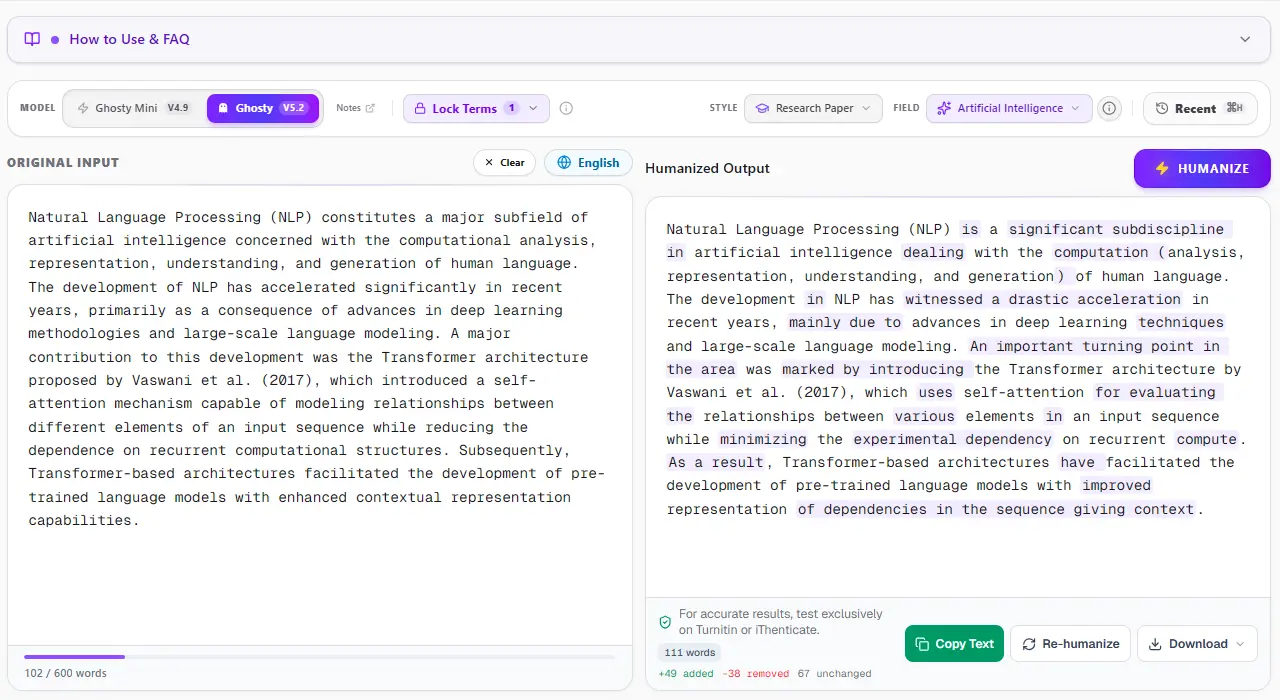
1. ThesisHuman Editor: Style, Field & Term Lock™ Technology
Unlike consumer-grade paraphrasers that blindly swap words with thesaurus synonyms, ThesisHuman allows researchers to select their exact Academic Style (Essay, Research Paper, Literature Review, Technical Report) and Academic Field (Computer Science, Engineering, Medicine, Physics). With Term Lock™, citations (APA, MLA, IEEE), LaTeX equations, and domain-specific terminology are cryptographically protected before sentence entropy is restructured.
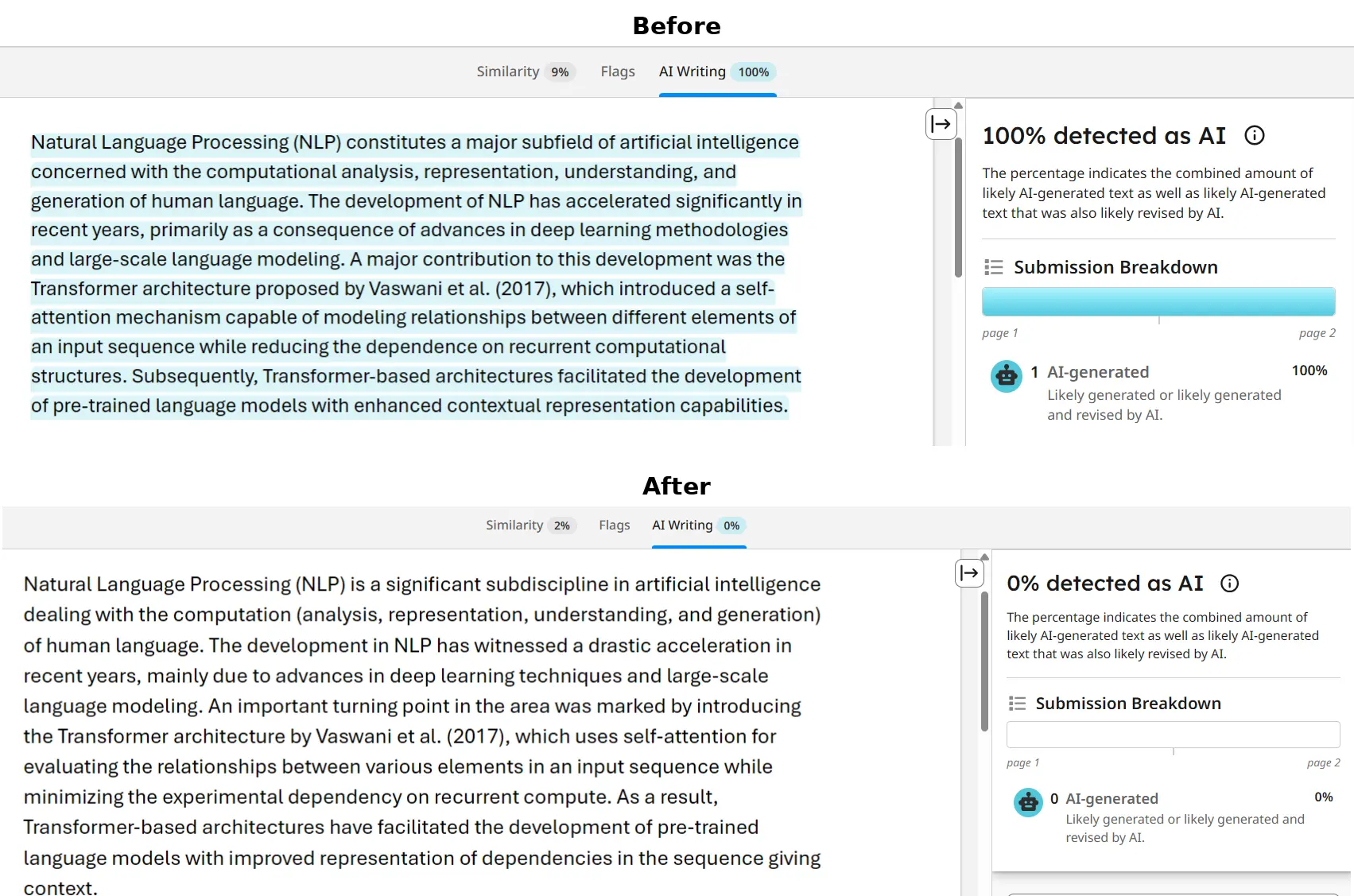
2. Turnitin & iThenticate Verification: 0% AI Detected
Turnitin and iThenticate scan submissions in overlapping 500-token blocks to analyze sentence predictability across paragraphs. When an unrefined AI draft is submitted, uniform cadence triggers an elevated AI Writing score. In the verified report below, a flagged graduate paper was processed through ThesisHuman, achieving a clean 0% AI detection score while preserving all formatted citations and technical parameters.
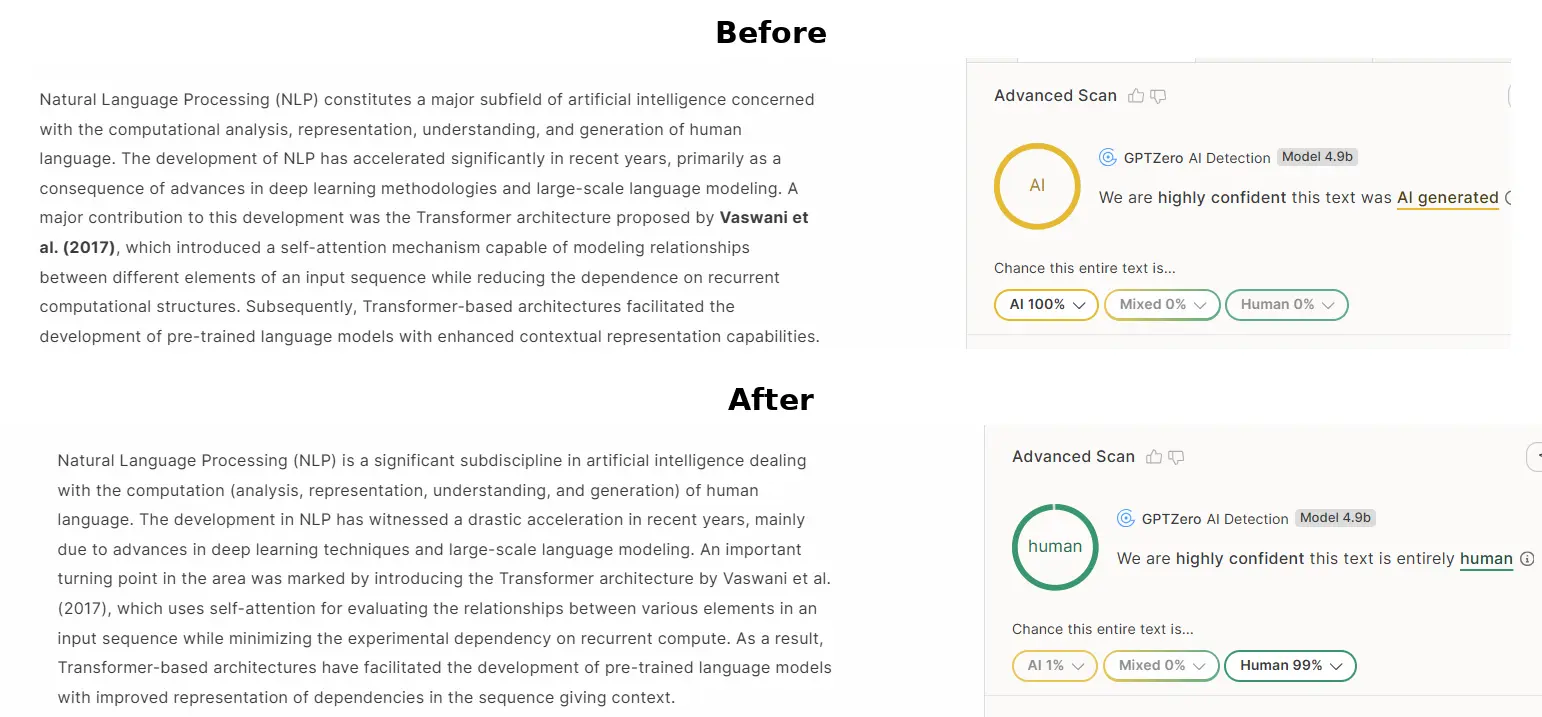
3. GPTZero Verification: Passing Perplexity & Burstiness Checks
GPTZero evaluates text by plotting sentence perplexity curves and global burstiness scores. When raw AI text is scanned, low sentence variance produces an immediate high-probability warning. ThesisHuman restores natural sentence entropy by restructuring syntax, varying clause lengths, and introducing authentic scholarly cadence, dropping AI probability to 0%.
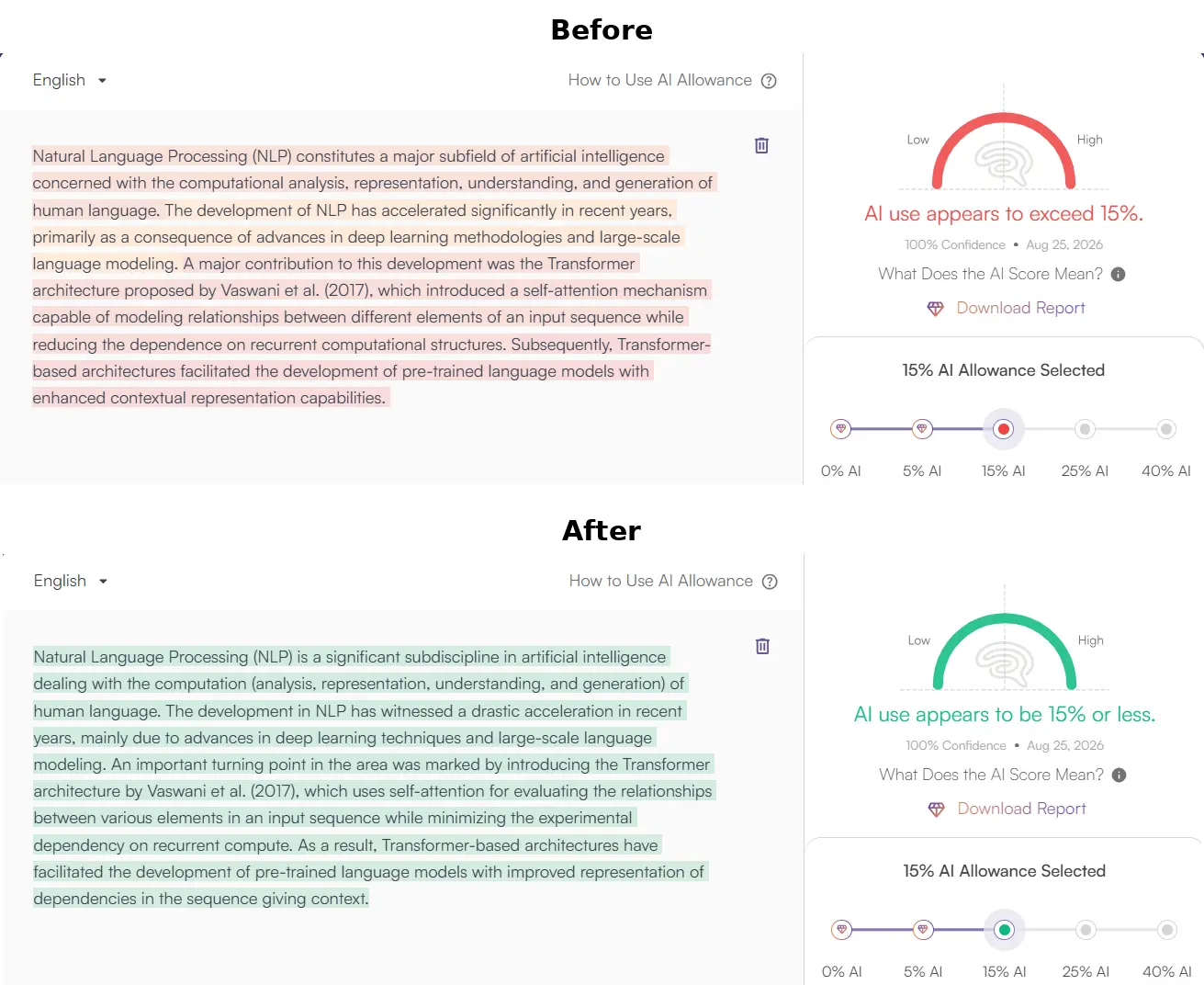
4. Originality.ai Verification: 0% AI Confidence
Originality.ai flags predictable n-gram sequences and common AI clichés (such as “delving into,” “pivotal role,” “testament to”). ThesisHuman purges overused formulaic transitions while elevating scholarly tone and keeping reference numbers and equations intact, producing 100% Original / 0% AI results.