How to Cite a Chapter in a Book in APA 7: Format and Examples
Master how to cite a chapter in a book under APA 7th edition rules. Learn the critical difference between edited collections and authored books with complete reference templates.

Citing a chapter in an academic book is one of the most misunderstood tasks in scholarly referencing. Many researchers assume that every book chapter follows an identical citation template. Under the American Psychological Association (APA 7th edition) guidelines, however, the correct citation method depends entirely on one fundamental question: Was the book written by one unified author group, or is it an edited collection of separately authored chapters?
Confusing these two publication structures leads to frequent reference errors, misplaced author attributions, and lost points on student essays and thesis submissions. This comprehensive guide details the precise mechanics of citing book chapters in APA 7th edition, complete with verified structural templates, annotated fictional models, ebook and DOI conventions, and practical self-test exercises.
1. Direct Answer: Edited Collections vs. Authored Books
Before creating an APA citation, inspect the book's title and copyright pages to identify the publication model:
- Scenario A: Chapter in an Edited Collection: Different authors wrote different chapters, and one or more editors assembled the book. Action: Create a standalone reference entry for the specific chapter, crediting the chapter author(s), book editor(s), book title, and chapter page range.
- Scenario B: Chapter in an Authored Book: The same author or author group wrote the entire book from start to finish. Action: Cite the entire book in your reference list. Indicate the specific chapter or page locator inside your in-text citation only.
Rule of Thumb: If the chapter table of contents lists a distinct author under the chapter title, cite the chapter. If the table of contents lists only chapter titles without individual author names, cite the whole book.
2. How to Identify Whether a Book Is Edited or Authored
To verify whether a volume is an edited collection or an authored book, examine these three physical or digital markers:
- The Cover and Title Page: Look for the phrase "Edited by" or "(Eds.)" next to the names on the cover. If the cover reads "Edited by Sarah Jenkins," you are holding an edited collection. If it reads "Sarah Jenkins" without editorial qualifiers, it is likely an authored book.
- The Table of Contents: In an edited collection, every chapter heading is accompanied by the specific author or authors who wrote that piece. In an authored book, only chapter numbers and titles appear.
- The Chapter Opener: Turn to page one of the chapter. If an author byline appears beneath the chapter title, credit that person as the chapter author.
3. APA 7th Edition Edited Book Chapter Template
When citing an independently authored chapter from an edited collection, follow this exact eight-part template:
Chapter Author Surname, Initial(s). (Publication Year). Title of chapter in sentence case. In Editor Initial(s). Surname (Ed. or Eds.), Title of book in italics and sentence case (pp. xx-xx). Publisher Name. DOI or URL
Notice these critical stylistic requirements:
- Chapter Title: Set in plain text (no italics, no quotation marks) using sentence case.
- Editor Names: Preceded by the word "In". Unlike author names, editor initials precede their surnames (e.g., In E. A. Vance (Ed.)).
- Book Title: Set in italics using sentence case.
- Page Range: Preceded by "pp." (or "p." for a single page) enclosed in parentheses immediately after the book title.
- Publisher Location: APA 7 no longer requires city or state of publication; list only the publisher name.
4. Complete Worked Example with Component Breakdown
Examine this complete, illustrative reference for a fictional chapter in an edited volume:
Hensley, R. K., & Patterson, L. M. (2024). Algorithmic diagnostic frameworks in clinical psychology. In M. T. Thorne & C. R. Alvarez (Eds.), Modern computational methods in mental healthcare (pp. 142-168). Academic Press. https://doi.org/10.1016/j.compcare.2024.01.004
1. Chapter Authors: Hensley, R. K., & Patterson, L. M. (Surnames followed by initials, separated by an ampersand).
2. Year of Publication: (2024). (Enclosed in parentheses, followed by a period).
3. Chapter Title: Algorithmic diagnostic frameworks in clinical psychology. (Sentence case, plain font, no quotation marks).
4. Editorial Attribution: In M. T. Thorne & C. R. Alvarez (Eds.), (Preceded by "In", initials precede surnames, "(Eds.)" indicates plural editors).
5. Book Title: Modern computational methods in mental healthcare (Italicized, sentence case).
6. Page Range: (pp. 142-168). (Preceded by "pp.", separated by an en dash or hyphen, inside parentheses, followed by a period).
7. Publisher: Academic Press. (Plain font, no geographic location).
8. DOI: https://doi.org/10.1016/j.compcare.2024.01.004 (Formatted as an active, standard HTTPS URL without a trailing period).
5. In-Text Citations: Parenthetical and Narrative Formats
When citing an edited chapter within the body of your paper, cite only the chapter authors, never the book editors. The in-text citation indicates who originated the idea you are discussing.
- Parenthetical Citation (Paraphrase): Place author surnames and year in parentheses at the end of the sentence.
(Hensley & Patterson, 2024)
- Narrative Citation (Paraphrase): Incorporate author surnames directly into your running sentence.
As Hensley and Patterson (2024) demonstrated, diagnostic algorithms improve screening accuracy.
- Direct Quotation (Page Locator Required): When quoting directly, always include the specific page number.
"Diagnostic algorithms reduce clinical intake latency by forty percent" (Hensley & Patterson, 2024, p. 155).
Notice that in parenthetical citations, authors are joined by an ampersand (&), whereas in narrative prose, the word "and" is spelled out.
6. Chapter Authors vs. Book Editors: Who Goes Where?
Writers frequently confuse the roles and placements of chapter authors and volume editors. Use this comparison table to maintain clarity:
| Dimension | Chapter Author | Book Editor |
|---|---|---|
| Intellectual Contribution | Researched and wrote the specific chapter. | Assembled, reviewed, and organized the entire book. |
| In-Text Citation Placement | Yes (Always cited here) | No (Never cited in-text unless citing whole book) |
| Reference List Position | First element (Surname, Initial). | Middle element following "In" (Initial. Surname, Ed.). |
| Name Order | Inverted: Surname first, then initials. | Normal: Initials first, then surname. |
7. Handling Multiple Chapter Authors (APA 7 Rules)
Under APA 7th edition rules, author counts determine formatting in both the reference list and in-text citations:
- One Chapter Author: (Miller, 2024) in-text; Miller, A. (2024) in references.
- Two Chapter Authors: (Miller & Davis, 2024) in-text; Miller, A., & Davis, B. (2024) in references.
- Three or More Chapter Authors: In APA 7, use the first author's surname followed by "et al." from the very first in-text citation (e.g., Miller et al., 2024). In the reference list, list up to 20 authors before using an ellipsis.
8. Handling Multiple Book Editors and Abbreviations
When a collection is edited by two or more scholars, incorporate all editor names in the "In" clause using normal name order (initials followed by surnames). Use the plural abbreviation "(Eds.)" with a capital E and a period inside parentheses.
Single Editor: In J. R. Miller (Ed.), Contemporary Urban Planning (pp. 50-72).
Multiple Editors: In J. R. Miller, C. K. Aris, & D. V. Lin (Eds.), Contemporary Urban Planning (pp. 50-72).
9. Chapters in Authored Books: Cite the Entire Book
This is the most critical distinction in book referencing. If a book was authored entirely by Dr. Elena Vance, and you quote chapter 4 ("Neural Networks and Sensor Arrays"), do not cite chapter 4 as a standalone reference entry.
Instead, create a reference entry for Vance's complete book. Then, specify chapter 4 inside your parenthetical in-text citation.
Correct Reference List Entry: Vance, E. (2023). Foundations of cognitive robotics. MIT Press.
Correct In-Text Citation (Chapter Mention): (Vance, 2023, Chapter 4)
Correct In-Text Citation (Direct Quote): (Vance, 2023, p. 88)
10. Citing Multiple Chapters from the Same Edited Book
If you cite two or more different chapters from the same edited anthology, you must create a separate reference list entry for each individual chapter. Do not combine them into one general reference entry.
In each entry, provide the specific chapter author, chapter title, and unique page range. Repeat the book editor and title details in full for each entry.
11. Electronic and Ebook Chapters: DOIs and URLs
Electronic book chapters follow the exact same structural template as print chapters, with the addition of a DOI or stable URL at the end of the entry. Keep these APA 7 electronic guidelines in mind:
- No Device Names: Do not include device or platform formats such as "Kindle edition" or "EPUB version."
- No Retrieval Dates: Do not include "Retrieved from" dates unless the book content is explicitly designed to update continuously (such as an open-access living encyclopedia).
- Active Links: DOIs should be formatted as live, clickable HTTPS URLs starting with "https://doi.org/".
12. DOI vs. URL Formatting Standards in APA 7
Whenever a Digital Object Identifier (DOI) is available, always prioritize it over a standard website URL. DOIs provide permanent, persistent links to academic publications that do not break over time.
- Correct DOI Format: https://doi.org/10.1000/182
- Incorrect DOI Format: doi:10.1000/182 or http://dx.doi.org/...
- Do not place a period at the very end of a DOI or URL, as this breaks the functional hyperlink.
13. How to Cite a Chapter Without a DOI
If a chapter does not have a DOI, your citation depends on where and how you accessed it:
- Print Book: Simply end the reference after the publisher's name. No URL is needed.
- Academic Subscription Database (EBSCO, ProQuest, JSTOR): Do not include the database URL. Because these databases require institutional logins, APA 7 treats database-sourced books without DOIs the same as print books, ending the entry after the publisher name.
- Open Web (Author Website or Open-Access Archive): Provide the direct URL to the book chapter at the end of the entry.
14. Chapters in Anthologies and Classic Reprints
When citing a classic literary work or historical article reprinted in a modern anthology, cite the author of the original work, but record the modern publication year and anthology details. At the very end of the entry, add the original publication year in parentheses:
In-text citation format for classic reprints: (Freud, 1917/2020).
15. Side-by-Side Comparison: Reference List vs. In-Text
Review this direct comparison showing how author and editor information is distributed across the two citation surfaces:
| Element | In-Text Citation | Reference List Entry |
|---|---|---|
| Chapter Author | Present (Hensley & Patterson, 2024) | Present (Hensley, R. K., & Patterson, L. M.) |
| Book Editor | Absent (Never named in-text) | Present (In M. T. Thorne (Ed.)) |
| Chapter Title | Optional in narrative, omitted in parenthetical | Mandatory (Sentence case, plain text) |
| Page Range | Specific page for quotes only (p. 155) | Full chapter span mandatory (pp. 142-168) |
| Book Title | Omitted in standard parenthetical citations | Mandatory (Italics, sentence case) |
16. Eight Common Citation Mistakes to Avoid
Watch out for these eight frequent pitfalls when preparing APA 7 book chapter references:
- Naming the Editor in In-Text Citations: Writing "(Thorne, 2024)" when referring to a finding written by Hensley. Always cite the chapter author.
- Putting Chapter Titles in Quotation Marks: APA 7 does not use quotation marks around chapter titles in reference lists.
- Italicizing the Chapter Title: Only the book title is italicized; the chapter title must remain in plain text.
- Omitting "pp." from the Page Span: Writing "(142-168)" instead of the required "(pp. 142-168)".
- Using Title Case for Chapter or Book Titles: Capitalizing every word in the reference list. Remember that APA references require sentence case for books and chapters.
- Citing an Authored Book Chapter Separately: Inventing a chapter reference for a book written by a single author instead of citing the entire book.
- Inverting Editor Initials: Writing "In Thorne, M. T. (Ed.)" instead of the correct "In M. T. Thorne (Ed.)".
- Including Publisher Location: Including "New York: Academic Press." Publisher location is obsolete in APA 7.
17. APA 7 Chapter Citation Quick Reference Table
Use this concise reference guide for rapid formatting verification:
| Publication Scenario | Reference List Format Model | In-Text Model |
|---|---|---|
| Single Author, Single Editor | Brooks, T. (2023). Title of chapter. In E. Vance (Ed.), Book title (pp. 10-30). Publisher. | (Brooks, 2023) |
| Multiple Authors, Multiple Editors | Lin, A., & Chen, S. (2024). Chapter title. In J. Day & R. Cox (Eds.), Book title (pp. 45-60). Publisher. | (Lin & Chen, 2024) |
| Authored Book (Same Author Entire Book) | Vance, E. (2023). Book title. Publisher. [Cite whole book] | (Vance, 2023, Chapter 4) |
| Chapter with DOI | Davis, K. (2024). Chapter title. In A. Bell (Ed.), Book title (pp. 1-25). Publisher. https://doi.org/10.xxxx | (Davis, 2024) |
| Reprinted Classic Chapter | James, W. (2021). The self. In M. Cole (Ed.), Classic psychology (pp. 12-28). Press. (Original work published 1890) | (James, 1890/2021) |
18. Practical Citation Exercises with Step-by-Step Solutions
Diagnose and resolve the errors in these five realistic citation scenarios.
Exercise 1: Misplaced Editor in In-Text Citation
Dr. Aris contributed a chapter to an edited volume assembled by Dr. Henderson. The student wrote in-text: "Urban traffic decreases during telecommuting expansions (Henderson, 2023)."
Correction: "Urban traffic decreases during telecommuting expansions (Aris, 2023)."
Explanation: In-text citations must credit the author of the specific chapter (Aris), not the editor of the book (Henderson).
Exercise 2: Quotation Marks in Reference Entry
Reference Entry: Thorne, B. (2024). "Cognitive plasticity in adults." In M. Vance (Ed.), Neural Biology (pp. 40-55). Academic Press.
Correction: Thorne, B. (2024). Cognitive plasticity in adults. In M. Vance (Ed.), Neural biology (pp. 40-55). Academic Press.
Explanation: Remove quotation marks around the chapter title, and ensure the book title uses sentence case.
Exercise 3: Missing Page Label
Reference Entry: Miller, K. (2023). Ethics in research. In D. Ortiz (Ed.), Applied Ethics (112-134). Oxford University Press.
Correction: Miller, K. (2023). Ethics in research. In D. Ortiz (Ed.), Applied ethics (pp. 112-134). Oxford University Press.
Explanation: Page numbers in APA edited book references must be preceded by "pp." (or "p." for single-page entries).
Exercise 4: Inverted Editor Name
Reference Entry: Lin, J. (2024). Quantum coherence. In Alvarez, C. R. (Ed.), Modern Physics (pp. 20-44). Springer.
Correction: Lin, J. (2024). Quantum coherence. In C. R. Alvarez (Ed.), Modern physics (pp. 20-44). Springer.
Explanation: Unlike author names, editor initials precede their surnames in the "In" clause.
Exercise 5: Citing an Authored Chapter
Dr. Sarah Clark wrote all twelve chapters of Principles of Macroeconomics. The student cited chapter 2 as: Clark, S. (2023). Inflation dynamics. In S. Clark (Ed.), Principles of Macroeconomics (pp. 25-45). Pearson.
Correction: In reference list: Clark, S. (2023). Principles of macroeconomics. Pearson. In-text: (Clark, 2023, Chapter 2).
Explanation: Because Clark wrote the entire book, cite the complete volume in the reference list and indicate the chapter locator in-text.
19. Frequently Asked Questions
Here are clear answers to essential questions regarding APA 7 chapter citations.
Do you cite the chapter author or the book editor in an APA in-text citation?
Always cite the author or authors of the specific chapter in your in-text citation, never the book editor. The editor's name appears only in the reference list entry to guide the reader to the larger volume. For general in-text citation rules, explore our tutorial on how to cite APA in text.
How do you cite a chapter in a book where the whole book was written by one author?
If one author or the same group of authors wrote the entire book, you do not create a separate reference list entry for the chapter. Instead, create a reference for the entire book. Then, specify the chapter number or page range in your in-text citation (e.g., Davis, 2023, Chapter 4). For guidance on formatting the book title itself, review how to write a book title in an essay.
Do you put quotation marks around chapter titles in an APA 7 reference list?
No. In APA 7th edition reference lists, chapter titles are written in sentence case without quotation marks and without italics. Quotation marks are only used if the chapter title already contains an embedded quote.
What abbreviation is used for multiple book editors in APA 7?
For multiple editors, use the abbreviation (Eds.) with a period inside the parentheses. For a single editor, use (Ed.). Note that editor initials precede their surnames in the 'In' portion of the reference entry.
How does ThesisHuman protect bibliographic citations during manuscript editing?
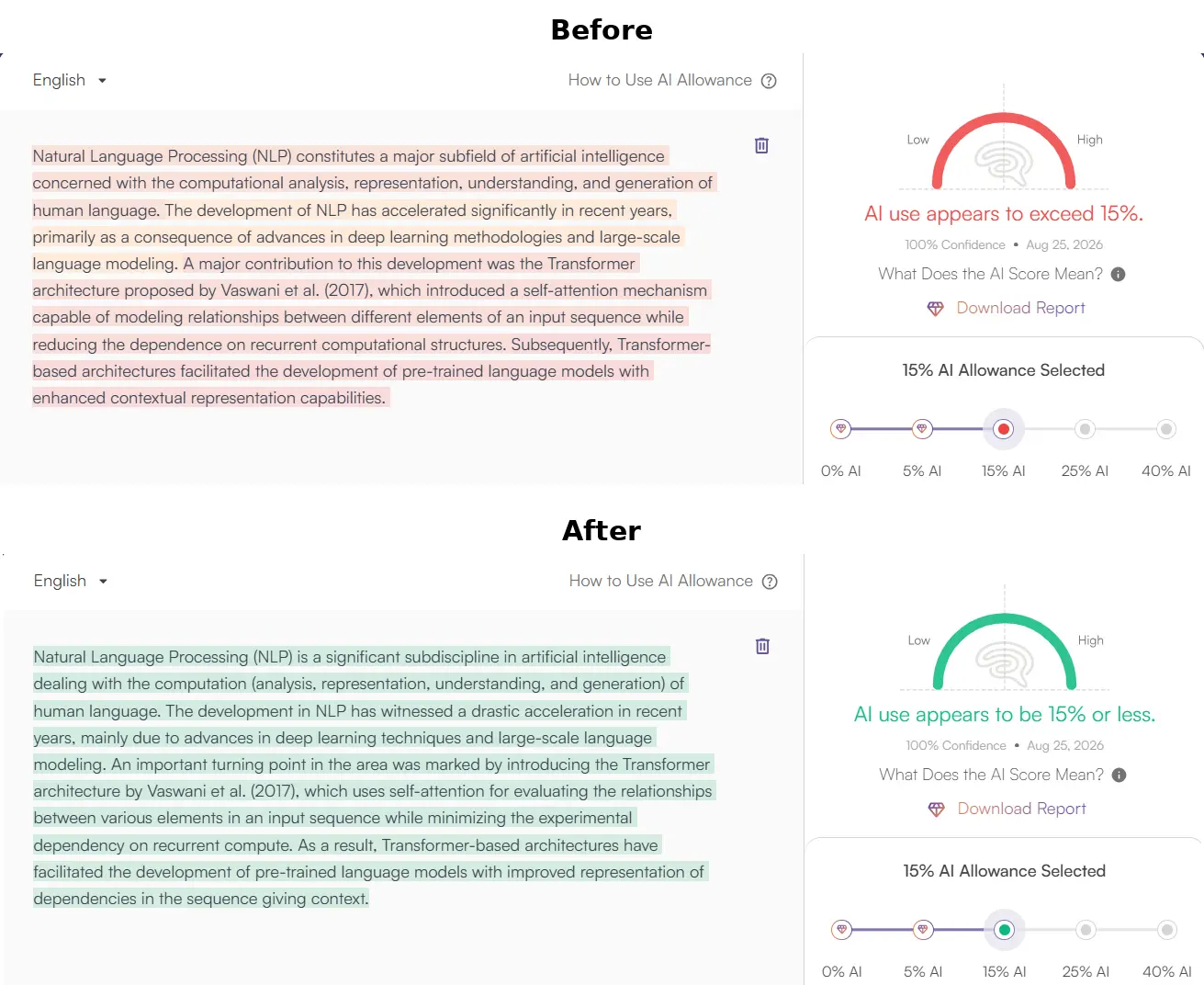
ThesisHuman incorporates Term Lock technology, allowing writers to freeze formatted in-text citations (such as author-date pairs and page numbers) so they remain untouched while surrounding prose is polished and naturalized. Experience precision academic revision with our sentence rewriter and academic paraphraser.
Verified Detector Clearance for How to Cite a Chapter in a Book in APA 7: Format and Examples
Every manuscript processed through ThesisHuman is backed by verifiable, reproducible scans across institutional plagiarism and AI detection platforms.
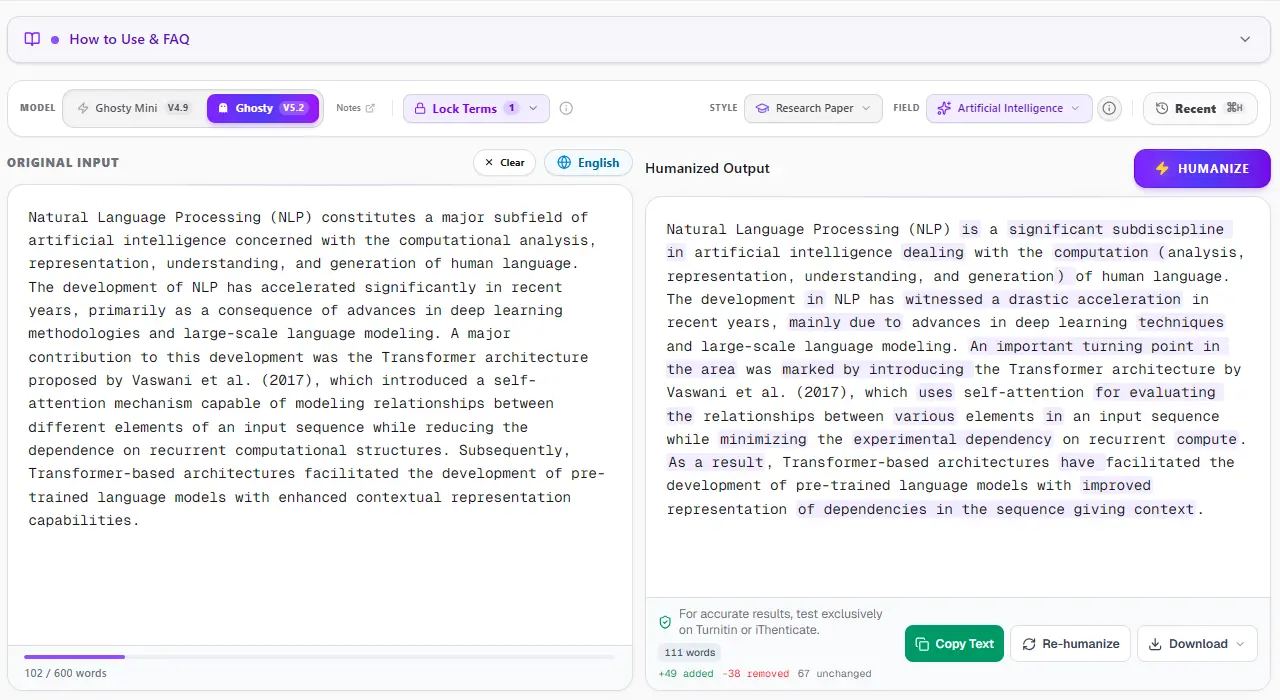
1. ThesisHuman Editor: Style, Field & Term Lock™ Technology
Unlike consumer-grade paraphrasers that blindly swap words with thesaurus synonyms, ThesisHuman allows researchers to select their exact Academic Style (Essay, Research Paper, Literature Review, Technical Report) and Academic Field (Computer Science, Engineering, Medicine, Physics). With Term Lock™, citations (APA, MLA, IEEE), LaTeX equations, and domain-specific terminology are cryptographically protected before sentence entropy is restructured.
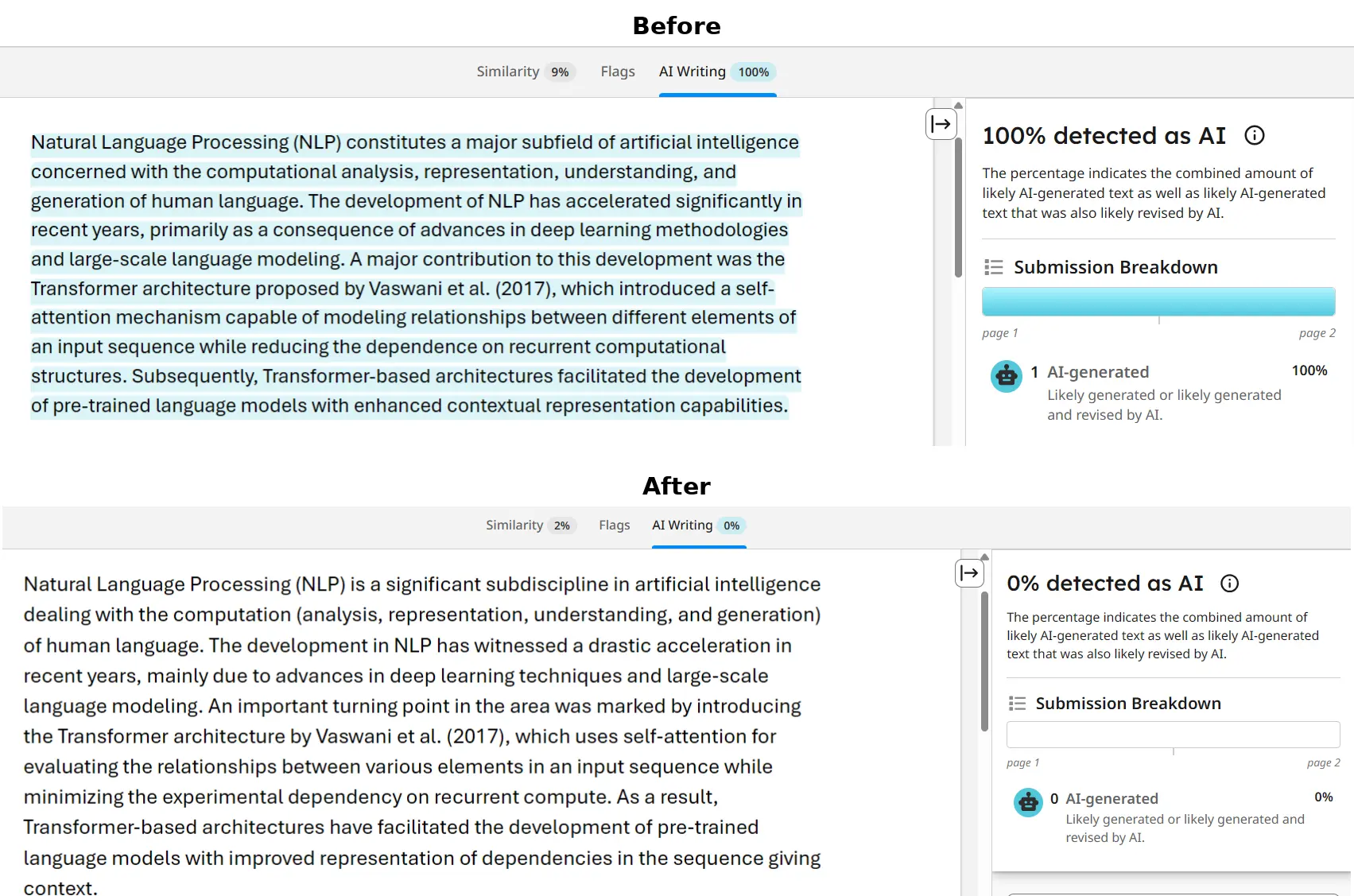
2. Turnitin & iThenticate Verification: 0% AI Detected
Turnitin and iThenticate scan submissions in overlapping 500-token blocks to analyze sentence predictability across paragraphs. When an unrefined AI draft is submitted, uniform cadence triggers an elevated AI Writing score. In the verified report below, a flagged graduate paper was processed through ThesisHuman, achieving a clean 0% AI detection score while preserving all formatted citations and technical parameters.
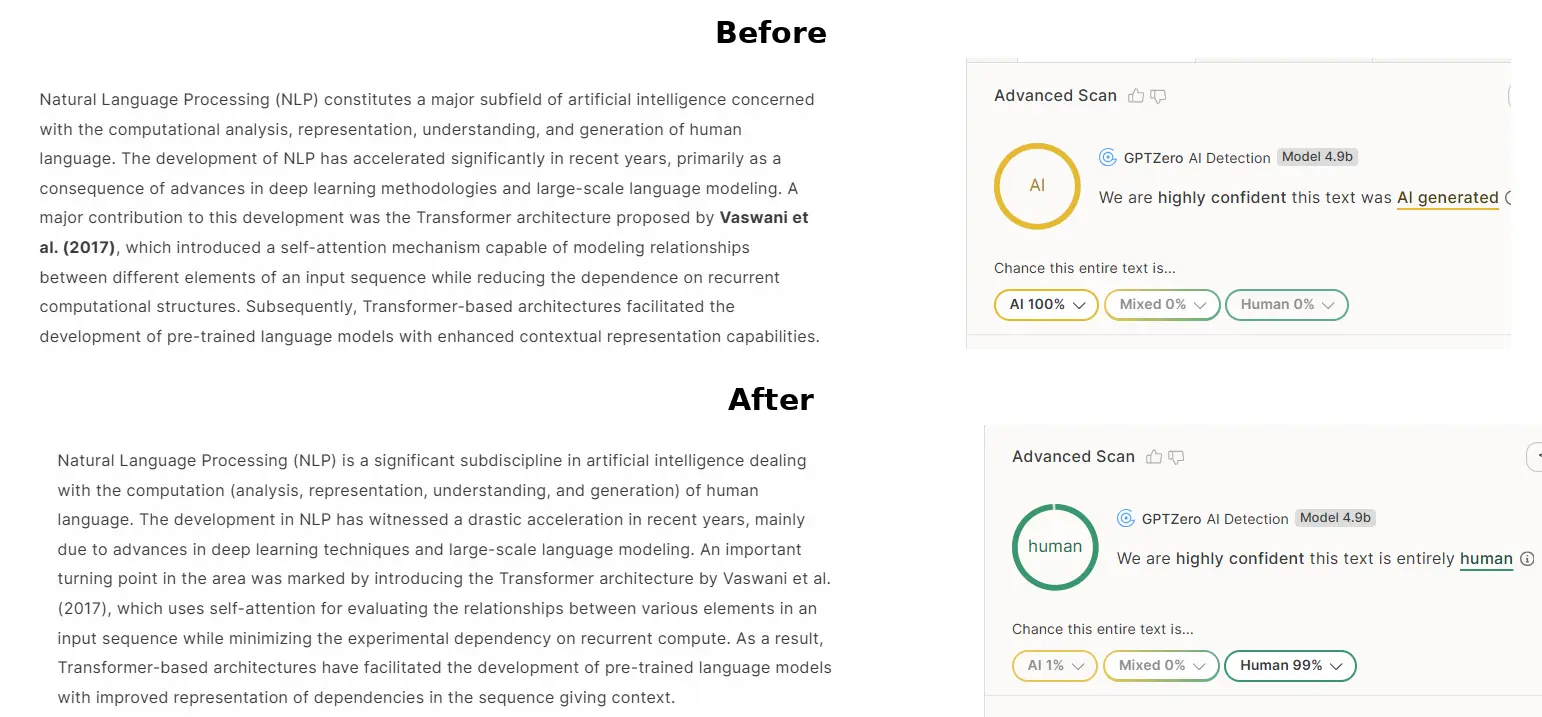
3. GPTZero Verification: Passing Perplexity & Burstiness Checks
GPTZero evaluates text by plotting sentence perplexity curves and global burstiness scores. When raw AI text is scanned, low sentence variance produces an immediate high-probability warning. ThesisHuman restores natural sentence entropy by restructuring syntax, varying clause lengths, and introducing authentic scholarly cadence, dropping AI probability to 0%.
4. Originality.ai Verification: 0% AI Confidence
Originality.ai flags predictable n-gram sequences and common AI clichés (such as “delving into,” “pivotal role,” “testament to”). ThesisHuman purges overused formulaic transitions while elevating scholarly tone and keeping reference numbers and equations intact, producing 100% Original / 0% AI results.