Best AI Detector for Teachers: Academic Accuracy, False Positives, and Faculty Guidelines
An objective evaluation of the best AI detectors for teachers. Compare Turnitin, Copyleaks, GPTZero, and Winston on accuracy, false positives, and policy ethics.
Educators across universities, community colleges, and secondary schools face an unprecedented pedagogical challenge: evaluating student authorship in an era where generative artificial intelligence can produce coherent essays in seconds. From freshman composition to graduate-level seminars, instructors are inundated with vendor marketing claims from software companies promising infallible, one-click solutions to detect AI-generated submissions.
However, responsible teachers know that adopting detection technology is not simply an IT decision; it is an academic integrity issue with severe ethical, legal, and educational consequences. A false accusation of academic misconduct can derail a student's academic standing, revoke scholarships, and destroy educator-student trust. This comprehensive evaluation provides an objective, empirical review of the best AI detectors for teachers, comparing enterprise institutional scanners with standalone commercial tools on accuracy, false-positive vulnerability, algorithmic bias, and ethical classroom implementation.
The Educator Dilemma: Accuracy vs Due Process
The central dilemma facing modern educators is that no AI detection tool on the market functions as an empirical truth engine. Large language models do not leave cryptographic signatures, digital serial numbers, or physical fingerprints in raw text. As a result, detection software must rely on statistical probability models that estimate whether a text sample exhibits patterns characteristic of machine generation.
Because detectors operate on probability rather than definitive proof, every tool inherently balances sensitivity against the risk of false positives. If a tool developer tunes an algorithm to be aggressively sensitive, catching subtle AI edits, the rate of false accusations against honest human writers increases dramatically. Conversely, if a tool lowers sensitivity to protect human students, unedited AI drafts slip through undetected. For faculty members, understanding this mathematical trade-off is essential: a detection score is a statistical hypothesis requiring human verification, never an automatic verdict of misconduct.
Detailed Review of Leading Educator Detectors
Teachers and academic departments evaluate several major AI detection platforms. Each tool utilizes distinct architectural methods and presents differing institutional trade-offs:
1. Turnitin AI Writing Indicator
Turnitin remains the dominant institutional solution in higher education due to its seamless integration into learning management systems such as Canvas, Blackboard, and D2L Brightspace. Rather than operating as an external website, Turnitin evaluates student submissions directly within the instructor grading interface.
- Architectural Method: Turnitin breaks submissions into overlapping chunks of roughly several hundred words, running each span through a specialized transformer classifier. The tool computes sentence-level probabilities and aggregates them into an overall document percentage.
- Instructor Advantages: Direct LMS gradebook integration, combined similarity matching against Turnitin's extensive proprietary student paper database, and highlighted span reports that allow teachers to inspect exactly which paragraphs raised suspicion.
- Key Educator Limitations: Turnitin has publicly acknowledged that its indicator carries false-positive risks, recommending that scores below 20% be disregarded. Furthermore, students cannot view the AI score prior to grading, creating transparency friction. For a detailed breakdown of how Turnitin functions within courseware, see our analysis on how Turnitin AI detection works and our companion guide on whether Canvas LMS detects AI writing.
2. Copyleaks
Copyleaks has earned widespread adoption among faculty who require high-granularity detection across multiple document formats. Unlike basic consumer checkers, Copyleaks separates plagiarism detection from AI probability analysis on the same review screen.
- Architectural Method: Uses deep learning language models trained across millions of human and synthetic texts, analyzing token predictability, character patterns, and multi-lingual transitions.
- Instructor Advantages: Robust LMS integrations, high sensitivity to subtle generative edits, support for code detection across computer science curricula, and clear side-by-side highlighting.
- Key Educator Limitations: High sensitivity leads to elevated false-positive flags on structured introductory sections, standard research literature summaries, and student essays written in formal, conservative English.
3. GPTZero
Originally developed specifically to protect academic integrity, GPTZero is widely utilized by individual educators who lack institutional Turnitin licenses. It offers web-based scanning, LMS integrations, and desktop extensions.
- Architectural Method: Evaluates text through two transparent linguistic dimensions: perplexity (word-level predictability) and burstiness (sentence-length entropy and variance across paragraphs).
- Instructor Advantages: Clear educational visualization displaying color-coded sentence-by-sentence perplexity graphs, enabling teachers to understand why a specific paragraph was flagged rather than relying on a blind black-box percentage.
- Key Educator Limitations: Can exhibit volatility across differing generative model releases. Sophisticated student revisions that disrupt surface-level burstiness can lower detection confidence while leaving core machine structures intact.
4. Winston AI
Winston AI has gained traction among secondary school teachers and college faculty who frequently process handwritten assignments, scanned physical essays, and digital PDF submissions.
- Architectural Method: Integrates optical character recognition (OCR) with proprietary linguistic classifiers tuned to differentiate generative text from human student writing.
- Instructor Advantages: Excellent handling of scanned documents and image-based PDFs, comprehensive plagiarism cross-referencing, and an intuitive grading dashboard.
- Key Educator Limitations: Limited LMS integration compared to enterprise solutions like Turnitin, requiring manual uploads for educators whose institutions do not maintain enterprise subscriptions.
The Core Pitfall: Algorithmic Bias and False-Positive Risks
Before any educator issues a disciplinary penalty based on an AI detector score, they must understand the structural algorithmic biases thoroughly documented in peer-reviewed academic literature. Two vulnerable student populations face disproportionate risks of false-positive flags:
1. Non-Native English (ESL) Students
In a landmark 2023 empirical study conducted by Stanford University researchers, leading commercial AI detectors evaluated essays written by non-native English speakers for the TOEFL examination alongside essays written by native US eighth-graders. While the native essays were classified accurately, over 60% of genuine, human-written ESL essays were falsely flagged as AI-generated.
Why does this bias occur? Non-native English writers naturally rely on safe, predictable grammatical structures, common transitional phrasing, and a constrained vocabulary. In computational linguistics, predictability equals low perplexity. To a machine classifier that equates low perplexity with generative AI, careful human writing looks statistically identical to a language model. Punishing an international student because their careful writing triggers a statistical detector constitutes profound educational injustice.
2. Technical, Methodological, and STEM Writing
In scientific laboratory reports, computer science documentation, and quantitative research papers, academic conventions demand standardized, formulaic language. A chemistry student describing a titration protocol or a biology student documenting a Western blot procedure must use exact, conventional vocabulary. This discipline-standard phrasing naturally generates low perplexity scores, causing detectors to misclassify rigorous scientific methods as synthetic output.
Educators must also be aware that learning management systems like Canvas do not possess native detection algorithms. For a complete technical walkthrough on LMS mechanics, review our guide on Canvas AI detection and instructor grading logs.
Best Practice Protocol for Faculty and Teaching Assistants
Given the severe limitations of automated detection software, leading university teaching centers and academic integrity committees advise faculty to adopt a multi-faceted pedagogical investigation protocol rather than issuing automatic sanctions:
- Never Sanction on a Software Score Alone: Treat an AI detection flag as a prompt for pedagogical dialogue, not as evidence of misconduct. Institutional policies increasingly prohibit using detector outputs as the sole evidentiary basis for academic discipline.
- Inspect Cloud Revision Histories: When a submission appears suspicious, request access to the student's version history in Google Docs or Microsoft Word for Web. A genuine human drafting record displays progressive editing over several hours, character-by-character typing, revision pauses, and deleted sentences. An unedited AI paste appears as an instantaneous, thousand-word block insertion. Review our step-by-step tutorial on how to check for AI on Google Docs and verify version history.
- Conduct an Authorship Conference: Invite the student for a supportive, low-stakes conversation. Ask open-ended questions about their research process: "What led you to select this case study?" or "Can you explain the conceptual connection between paragraphs three and four?" A student who authored the work will articulate their reasoning with confidence, whereas a student who submitted unread machine output will struggle to explain basic assertions.
- Evaluate Source Provenance: Check the bibliography. Generative models frequently hallucinate fake citations, attribute quotes to non-existent authors, or scramble publication years. An essay containing invented scholarly references offers concrete, verifiable evidence of academic negligence without needing statistical detector scores.
Cultivating Integrity: Syllabi Policies and Transparent Workflows
The most effective defense against uncritical AI reliance is clear, proactive syllabus policy. Rather than issuing blanket bans that students inevitably circumvent, forward-thinking instructors define acceptable versus unacceptable AI use clearly in their course guidelines:
- Permissible Assistive Roles: Clarify whether students may use artificial intelligence for brainstorming research topics, generating outline structures, practicing conversational foreign language dialogues, or checking grammar.
- Mandatory Disclosure Frameworks: Require students to include an AI disclosure statement in their submissions, detailing which tools were used and the specific nature of the assistance.
- Encourage Ethical Polish over Dishonest Evasion: When students use AI for language polish, caution them against predatory consumer paraphrasers that scramble citations and inject informal slang. Purpose-built academic writing platforms like ThesisHuman offer students ethical naturalization that preserves in-text citations, author names, and LaTeX formulas using Term Lock technology.
ThesisHuman provides transparent, accessible options for university writers, including a Free tier offering 500 total words, 150 words per request, and 3 term locks with no credit card required. Paid plans scale from Starter (10,000 words, 250 words per request) to Pro (30,000 words, 350 words per request) and Unlimited for graduate researchers.
Explore our dedicated resources for academic writing, including our undergraduate essay rewriter, the academic term paper rewriter, and our scholarly tone rewriter. Sign up for free at ThesisHuman signup to experience academic-grade writing tools designed with scholarly integrity at their core.
Frequently Asked Questions
Below are direct answers to common questions educators ask regarding AI detection accuracy, university policy, and classroom management.
Verified Detector Clearance for Best AI Detector for Teachers: Academic Accuracy, False Positives, and Faculty Guidelines
Every manuscript processed through ThesisHuman is backed by verifiable, reproducible scans across institutional plagiarism and AI detection platforms.
1. ThesisHuman Editor: Style, Field & Term Lock™ Technology
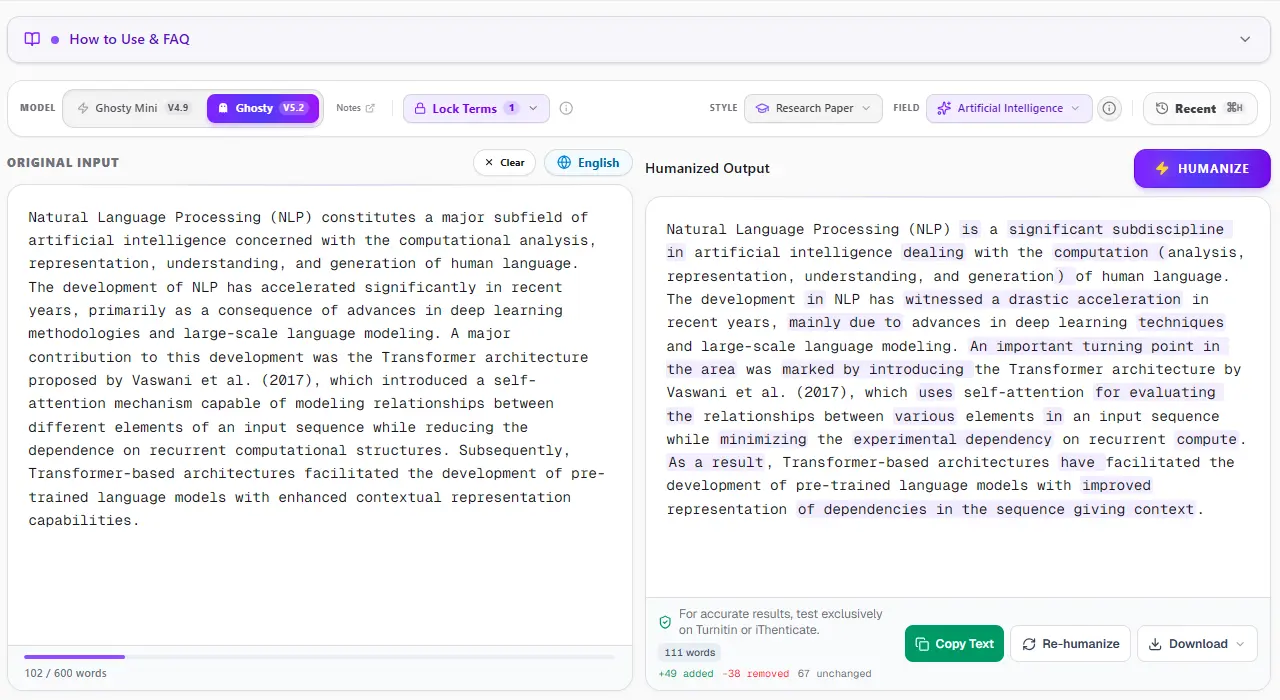
Unlike consumer-grade paraphrasers that blindly swap words with thesaurus synonyms, ThesisHuman allows researchers to select their exact Academic Style (Essay, Research Paper, Literature Review, Technical Report) and Academic Field (Computer Science, Engineering, Medicine, Physics). With Term Lock™, citations (APA, MLA, IEEE), LaTeX equations, and domain-specific terminology are cryptographically protected before sentence entropy is restructured.
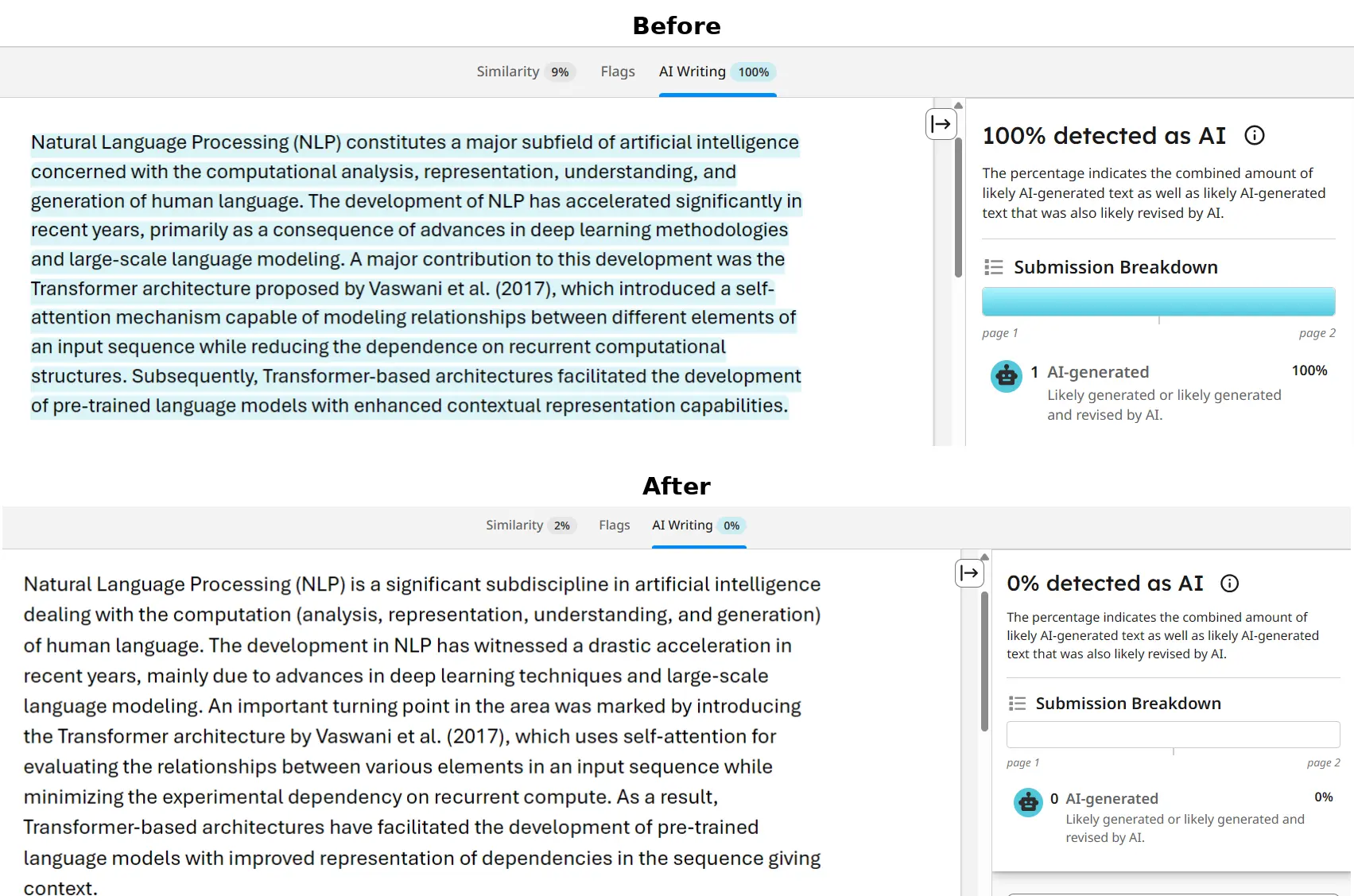
2. Turnitin & iThenticate Verification: 0% AI Detected
Turnitin and iThenticate scan submissions in overlapping 500-token blocks to analyze sentence predictability across paragraphs. When an unrefined AI draft is submitted, uniform cadence triggers an elevated AI Writing score. In the verified report below, a flagged graduate paper was processed through ThesisHuman, achieving a clean 0% AI detection score while preserving all formatted citations and technical parameters.
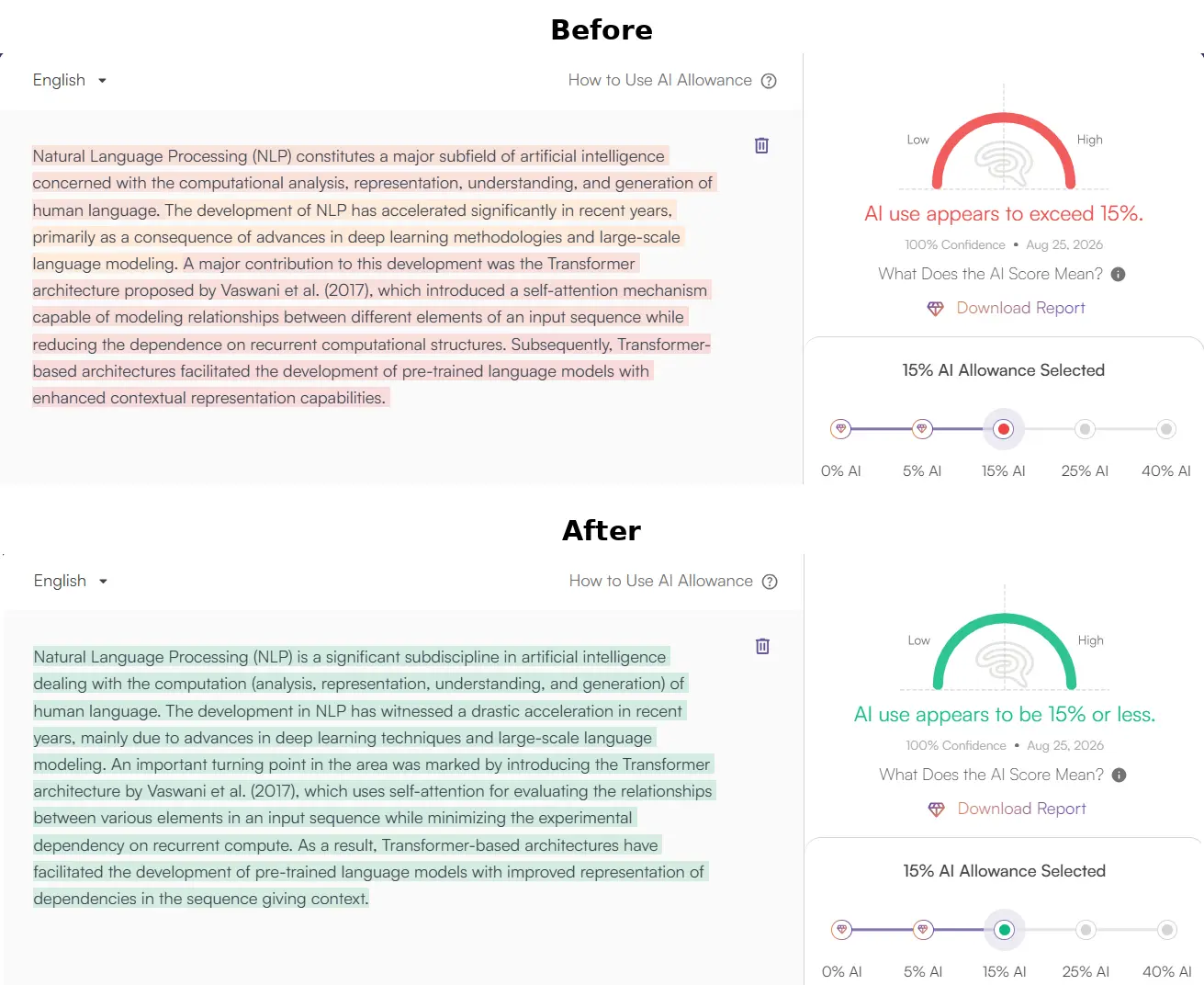
3. GPTZero Verification: Passing Perplexity & Burstiness Checks
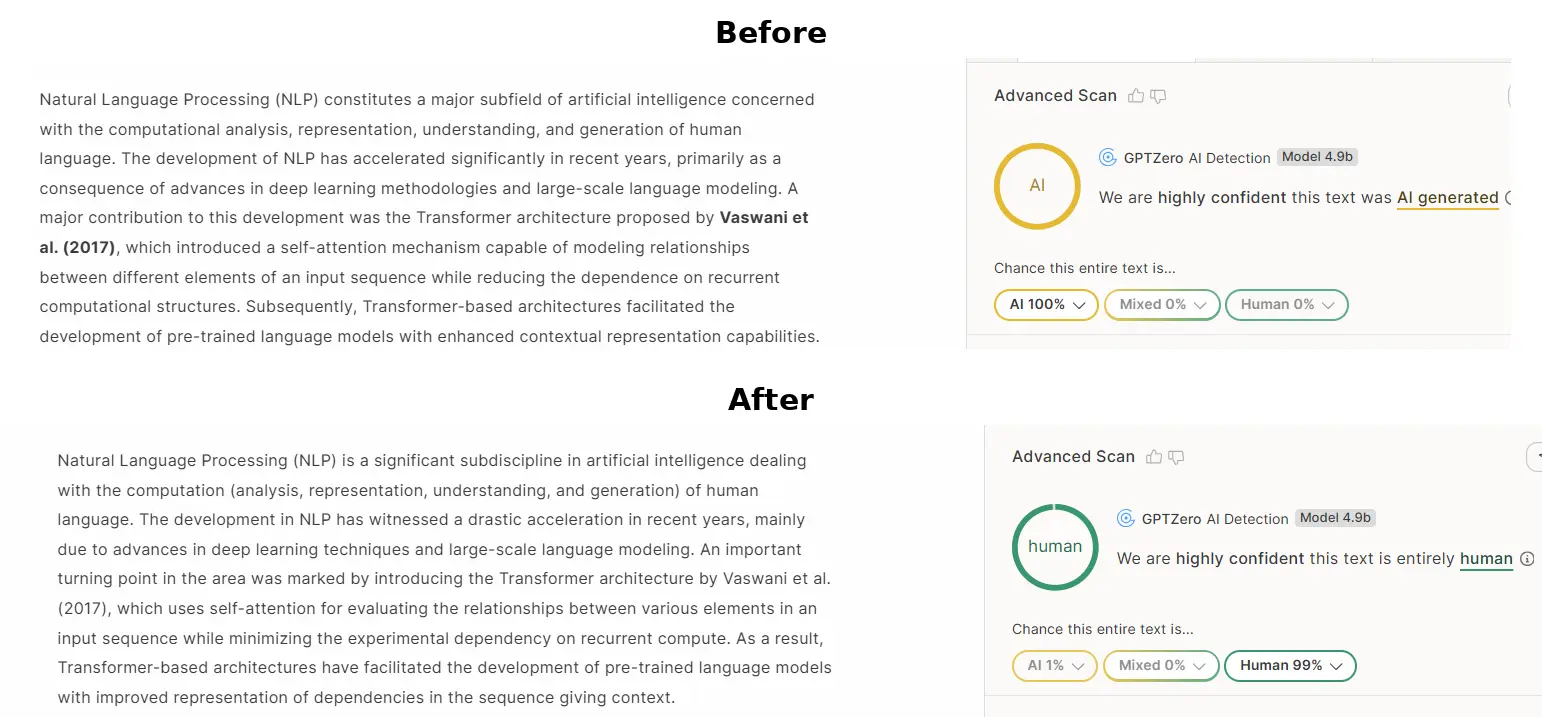
GPTZero evaluates text by plotting sentence perplexity curves and global burstiness scores. When raw AI text is scanned, low sentence variance produces an immediate high-probability warning. ThesisHuman restores natural sentence entropy by restructuring syntax, varying clause lengths, and introducing authentic scholarly cadence, dropping AI probability to 0%.
4. Originality.ai Verification: 0% AI Confidence
Originality.ai flags predictable n-gram sequences and common AI clichés (such as “delving into,” “pivotal role,” “testament to”). ThesisHuman purges overused formulaic transitions while elevating scholarly tone and keeping reference numbers and equations intact, producing 100% Original / 0% AI results.