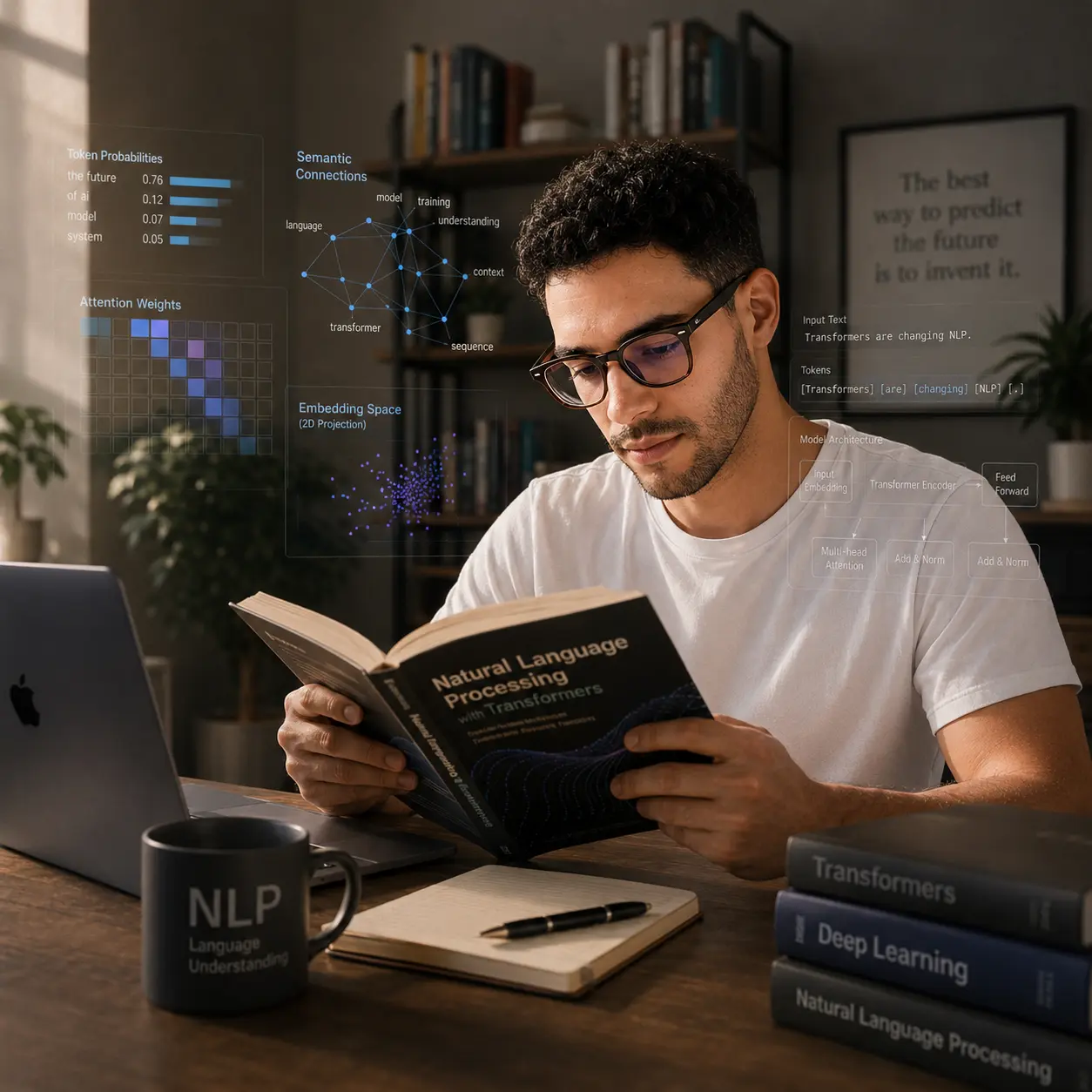
Is Undetectable AI Legit? An Academic Review of Features, Claims, and Integrity Risks
An in-depth academic review of Undetectable AI. Examine its paraphrasing mechanics, detector bypass claims, citation preservation flaws, and university integrity risks.
Across student forums, social media channels, and writing communities, Undetectable AI has emerged as one of the most visible names in the artificial intelligence rewriting space. Advertised as an all-in-one bypass utility capable of turning flagged machine drafts into human-grade prose, the tool promises to beat major detection filters with a single click. But for university undergraduates, postgraduate researchers, and academic authors, a fundamental question remains: is Undetectable AI legit, or does it introduce severe integrity risks to your scholarly work?
Evaluating software for academic writing requires a far higher standard than assessing consumer blog generators or marketing paraphrasers. A tool that produces acceptable copy for an affiliate website can cause catastrophic damage to an academic paper by scrambling cited literature, corrupting mathematical formulas, or altering disciplinary arguments. When high-stakes outcomes like degree conferral, course completion, or journal publication are on the line, blind faith in marketing claims is dangerous.
This critical review analyzes Undetectable AI from an academic integrity and technical perspective. We investigate how its transformation algorithms operate, evaluate the credibility of its bypass guarantees, expose its limitations with citations and technical terminology, and outline what responsible scholars should use instead.
What Is Undetectable AI and What Does It Promise?
Undetectable AI is a commercial web service designed to rewrite machine-generated text so that automated classifiers do not flag it as artificial. Launched in response to the rise of classifiers like Turnitin, GPTZero, Copyleaks, and Crossref iThenticate, the platform positions itself as a dual utility: an aggregate detector that queries multiple scanning APIs, paired with a paraphrasing rewriter that attempts to evade them.
The platform's marketing centers around bold assertions. It advertises the ability to create undetectable content across various readability levels, ranging from high school to doctorate. It claims to deliver human-quality output that slips past institutional oversight without triggering academic dishonesty inquiries. For stressed students facing tight deadlines and stringent institutional policies, these promises appear compelling.
However, a wide gap separates marketing claims from academic realities. Understanding whether the service is legitimate requires examining what happens beneath the graphical user interface when complex scholarly prose is submitted to its transformation engine.
Under the Hood: How Its Rewriting Engine Operates
Automated AI detectors identify machine authorship by evaluating two core statistical properties of language: perplexity (a measure of token predictability) and burstiness (the variation in sentence length and syntactic structure across a passage). Large language models like ChatGPT naturally generate prose with low perplexity and flat burstiness, clustering around predictable n-grams and uniform sentence lengths.
Undetectable AI attempts to disrupt this statistical fingerprint using secondary transformation passes. Rather than performing deep semantic restructuring, the engine relies primarily on aggressive lexical substitution and syntactic fragmentation:
- Unusual Synonym Swapping: The tool replaces high-probability vocabulary with low-frequency alternatives. In informal prose, this occasionally mimics human idiosyncrasy; in academic prose, it frequently replaces established disciplinary terms with nonsensical synonyms.
- Arbitrary Clause Splitting: The engine artificially inflates burstiness by chopping compound sentences into brief, staccato fragments, often introducing punctuation errors and comma splices.
- Syntactic Disordering: Passive and active voice constructions are flipped mechanically without regard to scholarly emphasis or disciplinary convention.
While these transformations can lower automated perplexity readings on superficial web scanners, they often degrade readability. The resulting prose frequently sounds unnatural to human readers, replacing recognizable machine smoothness with jarring grammatical awkwardness. For an analysis of similar consumer rewriter limitations, consult our review of Clever AI Humanizer performance and academic limitations.
Why Statistical Paraphrasing Fails Human Academic Review
The fundamental shortcoming of generic bypass engines is that they optimize solely against machine learning classifiers while ignoring human subject-matter experts. When an instructor, academic referee, or thesis committee member reads a submission, they evaluate logical coherence, epistemic depth, and conceptual precision. Aggressive automated rewriting introduces severe telltale markers that experienced faculty recognize immediately:
- Semantic Incoherence: Sentences that pass automated perplexity screens often make little sense upon close inspection. The algorithm may swap words to increase lexical entropy, but the resulting phrase obscures the author's scientific argument.
- Disciplinary Register Collapse: Academic writing adheres to strict genre expectations. When a consumer rewriter injects colloquial idioms or disjointed sentence fragments into a methodology section, the paper loses its authoritative tone.
- Viva and Defense Vulnerability: When students face oral examinations, thesis defenses, or academic integrity hearings, faculty frequently ask candidates to explain the exact meaning of convoluted sentences in their papers. If a student cannot articulate what an algorithmically generated clause means, the defense collapses regardless of automated detector scores.
- COPE Standards: Guidelines from the Committee on Publication Ethics emphasize author accountability. Submitting text transformed by black-box algorithms without substantive human review violates core scholarly responsibilities.
The Reality of Guaranteed Bypass Claims
Perhaps the most problematic aspect of Undetectable AI's promotional messaging is the implication of guaranteed or 100% detection bypass. In the field of natural language processing and machine learning, a guaranteed bypass claim is mathematically unfounded.
Modern institutional detection systems do not operate as static, deterministic firewalls. Consider how enterprise engines function in higher education:
- Sliding Probability Thresholds: Detectors like Turnitin calculate segment-level probabilities across 50-to-100-word windows. A document that passes one sensitivity threshold can trigger a flag if an institution configures a lower tolerance level.
- Continuous Model Retraining: Detection providers retrain their classifiers on newly emerging evasion techniques. What slips past a detector in March may trigger high-confidence alerts by October.
- Hybrid Human Review: Academic misconduct inquiries are never decided solely by software scores. When a professor notices convoluted sentences, bizarre word choices, or mangled citations, they initiate human review regardless of what an automated badge indicates.
Any service that promises unconditional, foolproof detection evasion misrepresents how academic integrity oversight works. Responsible scholars do not seek obfuscation; they seek authorial clarity and authentic stylistic refinement.
The Scholarly Hazard: Citation Mutilation and Technical Drift
The fatal flaw of Undetectable AI for research papers, theses, and dissertations is its complete lack of citation and formula awareness. The tool was developed for marketing copy, blog posts, and general business correspondence. It does not recognize the sacred invariants of scholarly literature.
When academic text is processed through Undetectable AI, several severe corruptions routinely occur:
- Scrambled In-Text Citations: An APA citation such as (Smith & Johnson, 2023, p. 45) is treated as raw prose. The algorithm frequently alters author surnames, separates dates from parenthetical enclosures, or converts bracketed references into meaningless descriptive text. Submitting scrambled citations constitutes academic negligence and can trigger immediate plagiarism investigations.
- Broken LaTeX and Mathematical Notation: Inline equations, Greek symbols, and bracketed matrix environments are treated as standard characters. Mathematical notation is garbled, destroying the empirical validity of STEM manuscripts.
- Technical Concept Distortion: Specialized scientific terms possess precise meanings that cannot be substituted. When an algorithm replaces "heteroskedasticity" with "variable variance" or converts "myocardial infarction" into "heart breakdown," the scholarly credibility of the paper collapses.
Scholarly writing requires immutable preservation of evidence chains. A tool that cannot freeze citations and technical nomenclature is fundamentally unfit for university submissions. For a deeper breakdown of competitor comparisons across marketing vs academic tools, see our guide on Writesonic AI humanizer versus academic writing requirements.
Pricing, Word Limits, and Credit Consumption
Another point of friction for student users is Undetectable AI's commercial structure. The platform operates on a prepaid credit model where users purchase word allowances. While introductory pricing appears modest, the practical cost escalates rapidly under real-world conditions:
- Credit Deductions on Every Generation: Because the initial rewrite frequently produces awkward phrasing or corrupted citations, users must regenerate text multiple times. Each iteration consumes credits from the user's balance.
- Aggressive Upgrades: The free trial is extremely restricted, functioning primarily as a demonstration teaser. Once a user attempts to process a substantial document, like a 5,000-word term paper or a 15,000-word thesis chapter, paid subscriptions become mandatory.
- Non-Refundable Usage: Credits consumed during failed, unusable, or garbled rewrites are rarely refundable, leading to user frustration on independent review platforms.
Responsible Academic Workflows and Defensible Alternatives
If aggressive consumer paraphrasers like Undetectable AI carry high integrity risks, what should university students and researchers do when refining AI-assisted drafts? The answer lies in adopting purpose-built academic tools combined with disciplined editorial oversight.
A defensible academic humanization workflow incorporates specific technical safeguards:
- Term Lock Capabilities: Academic-first platforms like ThesisHuman allow writers to designate immutable terms. In-text citations, author names, publication years, statistical symbols, and technical jargon remain completely frozen while the surrounding narrative cadence is naturalized.
- Dual Model Calibration: Utilizing refined neural models such as Ghosty V6 and Lite V6, scholarly text is restructured to balance perplexity and burstiness without injecting slang or broken syntax.
- Transparent Free Access: ThesisHuman provides a genuine free tier offering 500 total words, up to 150 words per single request, and 3 active term locks with zero credit card required. Paid plans scale transparently: Starter offers 10,000 words (250 per request), Pro provides 30,000 words (350 per request), and Unlimited supports intensive research workflows with up to 600 words per request.
- Explore Targeted Solutions: Examine our specialized solutions tailored to authentic academic tasks, including our undetectable AI humanizer guide, our benchmark of the best AI humanizer options, the undergraduate essay rewriter, academic term paper rewriter, and scholarly tone calibration engine. Get started directly via free account creation, or compare flexible options across our transparent pricing tiers.
Frequently Asked Questions
Below are direct answers to common questions regarding Undetectable AI legitimacy, detector accuracy, and academic safety.
Verified Detector Clearance for Is Undetectable AI Legit? An Academic Review of Features, Claims, and Integrity Risks
Every manuscript processed through ThesisHuman is backed by verifiable, reproducible scans across institutional plagiarism and AI detection platforms.
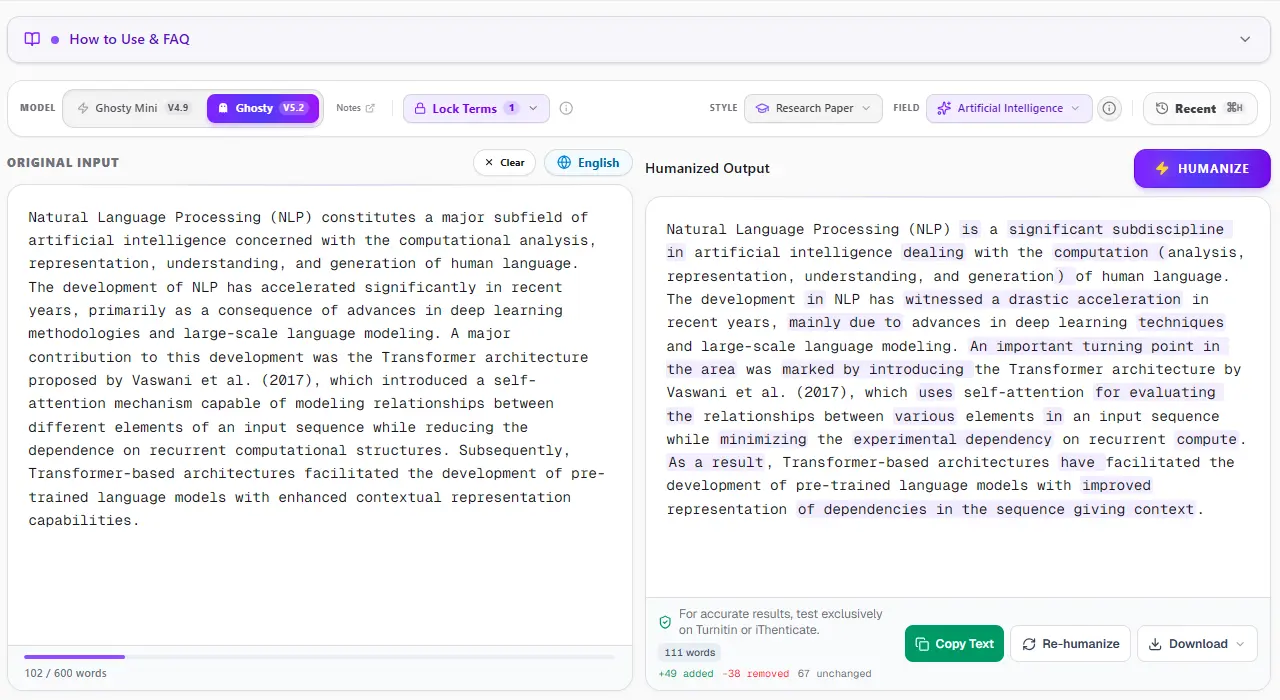
1. ThesisHuman Editor: Style, Field & Term Lock™ Technology
Unlike consumer-grade paraphrasers that blindly swap words with thesaurus synonyms, ThesisHuman allows researchers to select their exact Academic Style (Essay, Research Paper, Literature Review, Technical Report) and Academic Field (Computer Science, Engineering, Medicine, Physics). With Term Lock™, citations (APA, MLA, IEEE), LaTeX equations, and domain-specific terminology are cryptographically protected before sentence entropy is restructured.
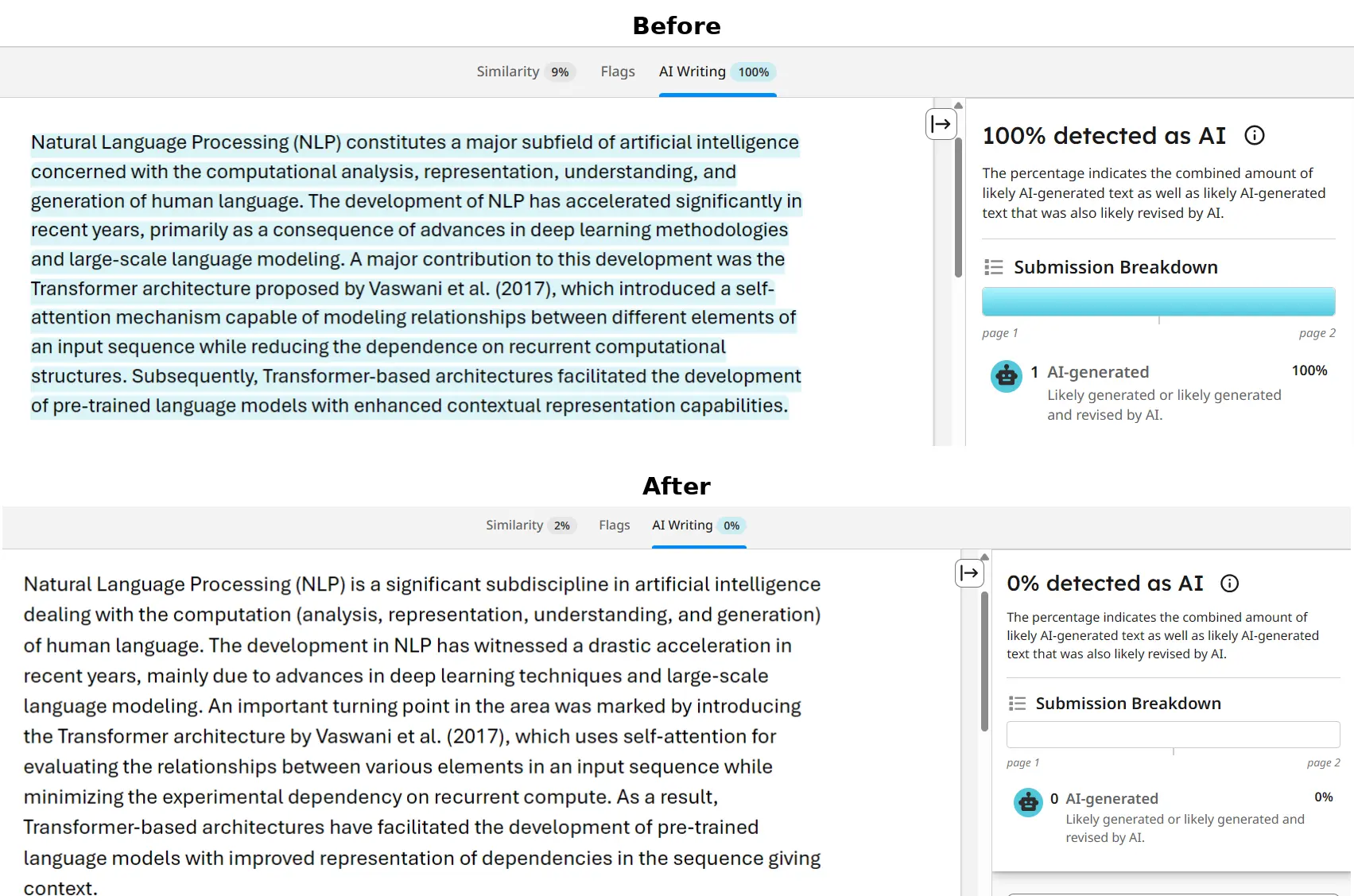
2. Turnitin & iThenticate Verification: 0% AI Detected
Turnitin and iThenticate scan submissions in overlapping 500-token blocks to analyze sentence predictability across paragraphs. When an unrefined AI draft is submitted, uniform cadence triggers an elevated AI Writing score. In the verified report below, a flagged graduate paper was processed through ThesisHuman, achieving a clean 0% AI detection score while preserving all formatted citations and technical parameters.
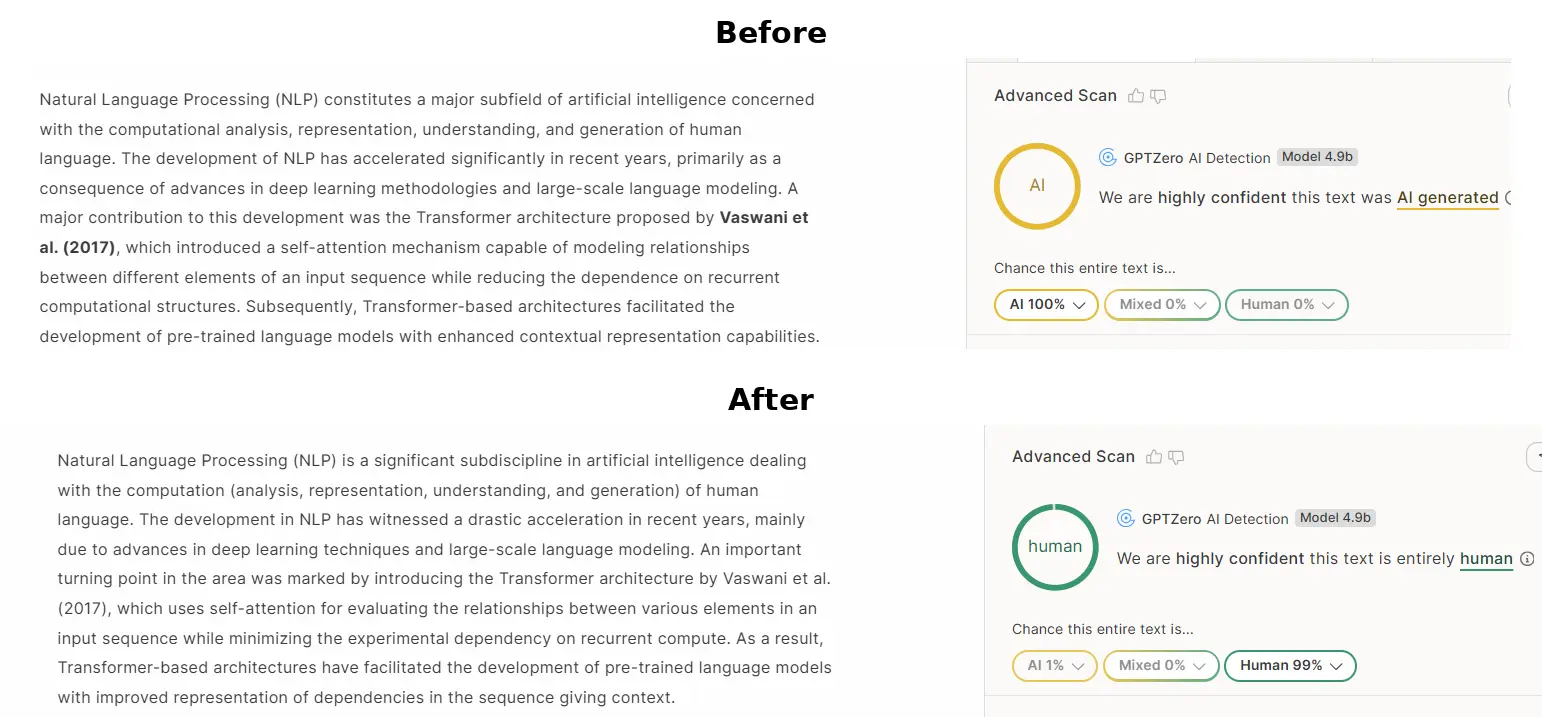
3. GPTZero Verification: Passing Perplexity & Burstiness Checks
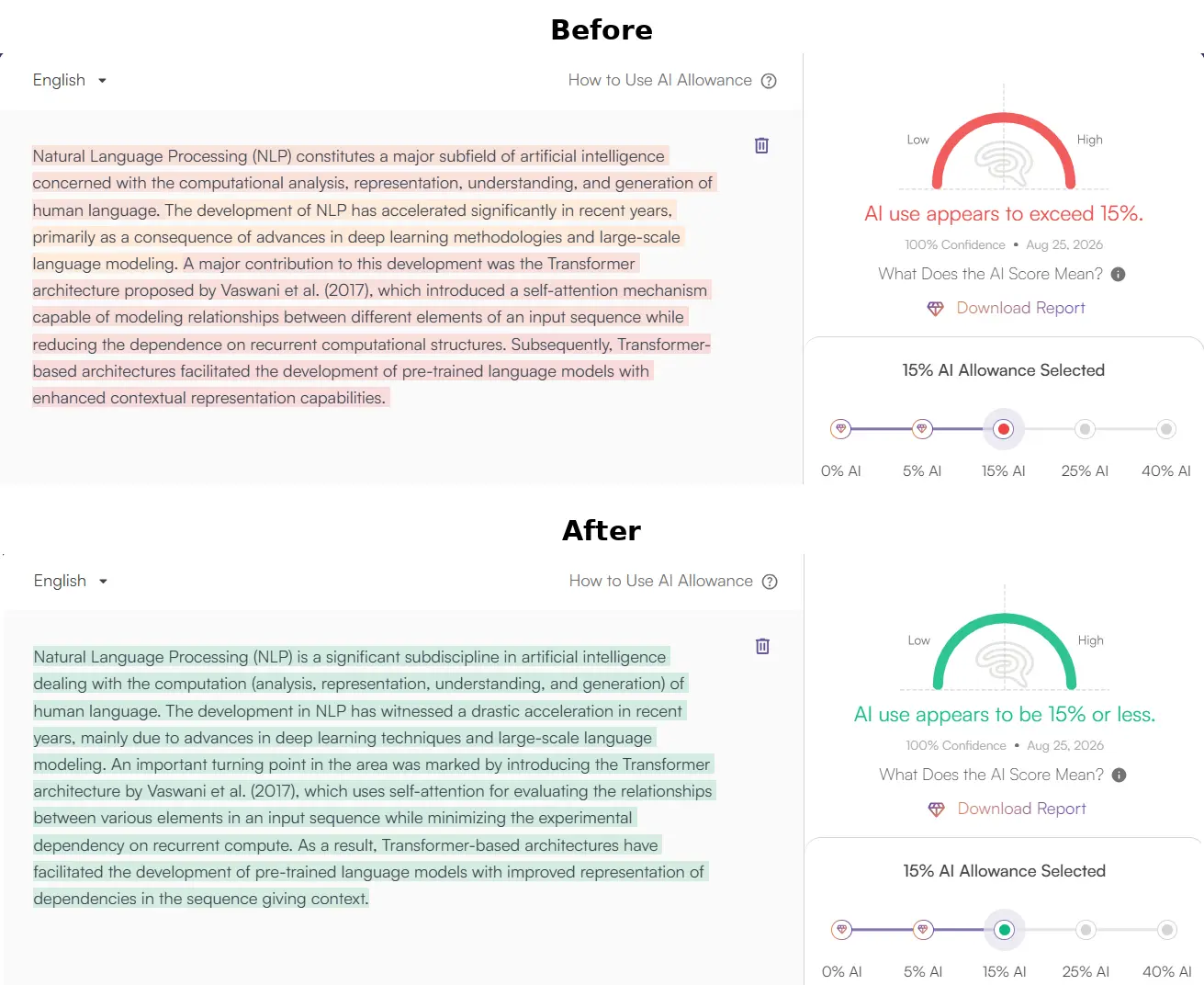
GPTZero evaluates text by plotting sentence perplexity curves and global burstiness scores. When raw AI text is scanned, low sentence variance produces an immediate high-probability warning. ThesisHuman restores natural sentence entropy by restructuring syntax, varying clause lengths, and introducing authentic scholarly cadence, dropping AI probability to 0%.
4. Originality.ai Verification: 0% AI Confidence
Originality.ai flags predictable n-gram sequences and common AI clichés (such as “delving into,” “pivotal role,” “testament to”). ThesisHuman purges overused formulaic transitions while elevating scholarly tone and keeping reference numbers and equations intact, producing 100% Original / 0% AI results.