Limitations of a Study: Examples, Types, and How to Write Them
Learn how to write a rigorous, defensible limitations section for research papers and dissertations. Discover core validity pillars, 12 field-specific examples, and structural formulas.

1. Direct Answer: What Are Research Limitations and Why Do They Matter?
In academic scholarship, research limitations are the structural, methodological, environmental, and practical boundaries inherent to a study that restrict the scope, generalizability, or certainty of its empirical findings.
Rather than indicating research weakness or analytical failure, a transparent, carefully articulated limitations section is one of the clearest hallmarks of scholarly maturity and scientific rigor. Peer reviewers and dissertation examiners do not expect an empirical study to be universally definitive; they expect the authors to possess complete awareness of their study's theoretical constraints, statistical power boundaries, and methodological trade-offs.
To write a strong limitations subsection in your Discussion chapter, adhere to three core principles:
- Identify the True Structural Constraints: Focus on unavoidable design boundaries (such as cross-sectional sampling, specialized regional demographics, or sensor sensitivity ceilings) rather than careless researcher mistakes or avoidable protocol oversights.
- Explain the Precise Epistemological Impact: Quantify how the limitation affects the interpretation of your data (for example, clarifying that an observed correlation indicates statistical association but cannot prove longitudinal causation).
- Propose Actionable Future Research Directions: Transform each limitation into a concrete hypothesis or methodological blueprint for future researchers in your field.
For foundational guidance on contrasting your overall investigative framework, see our guide on methods vs methodology in research, and review our structural guide on the difference between discussion and conclusion sections.
2. Limitations vs Delimitations: The Fundamental Distinction in Scholarly Inquiry
Graduate researchers frequently conflate limitations with delimitations, treating them as interchangeable terms in Chapter 1 and Chapter 5. In scholarly inquiry, they represent two opposing dimensions of methodological control:
- Limitations (Uncontrolled Boundaries): Factors outside the researcher's direct control that constrain the study's execution, data depth, or external validity. Examples include participant attrition during a multi-year trial, unexpected geopolitical disruptions to supply chains, regional healthcare policy shifts, baseline non-response bias in public surveys, or computational memory bottlenecks when training dense deep learning models.
- Delimitations (Intentional Boundaries): Intentional choices made by the researcher to narrow the operational scope of the investigation. Delimitations define what the study includes and explicitly excludes. Examples include restricting participant recruitment to accredited public universities in the Midwest, selecting only peer-reviewed English-language publications from 2015 to 2025, evaluating solely adult patients aged 18 to 65, or testing a deep neural model exclusively on image data while excluding multimodal audio.
In your thesis or dissertation, delimitations belong in Chapter 1 (Introduction) or the opening of Chapter 3 (Methodology) to establish project scope. Limitations belong in Chapter 5 (Discussion), where you critically evaluate how real-world constraints qualified your empirical results.
3. The Four Core Pillars of Research Limitations: Internal, External, Construct, and Statistical
Methodologists classify empirical study limitations into four primary validity domains:
1. Internal Validity Limitations
Internal validity assesses the degree to which an observed empirical effect can be confidently attributed to the independent variable rather than uncontrolled confounding factors. Internal validity limitations arise from:
- History Effects: External societal or economic events that occur during data collection and influence participant responses (such as an election or economic downturn).
- Maturation: Biological or psychological changes within human participants over the course of an extended study that occur independently of experimental interventions.
- Testing and Instrumentation Drift: Changes in calibration, observer scoring consistency, or participant familiarity with test instruments across repeated measurements.
2. External Validity (Generalizability) Limitations
External validity examines whether findings can be generalized beyond the specific sample, setting, and timeframe of the investigation:
- Population Representativeness: Constraints arising when samples fail to mirror the broader demographic, ethnic, or socioeconomic diversity of the global population.
- Ecological Validity: Discrepancies between controlled, sterile laboratory environments and real-world naturalistic operational conditions.
- Temporal Validity: Constraints regarding whether findings generated during a specific historical period remain applicable in subsequent years.
3. Construct Validity Limitations
Construct validity evaluates whether your operational instruments (questionnaires, biochemical markers, or algorithmic metrics) accurately measure the theoretical construct they claim to evaluate:
- Mono-Method Bias: Relying on a single self-report instrument to assess multifaceted psychological phenomena like burnout or intellectual engagement.
- Subject-Expectancy and Social Desirability: Participants altering behaviors or survey responses to align with perceived researcher expectations or socially endorsed norms.
4. Statistical Conclusion Validity Limitations
Statistical validity assesses whether the mathematical relationships observed between variables are mathematically sound:
- Low Statistical Power: Inadequate sample sizes that elevate the risk of Type II errors (failing to detect a genuine effect).
- Violated Statistical Assumptions: Performing parametric tests on non-normally distributed data or heteroscedastic residuals, which distorts p-values.
- Multiple Testing Artifacts: Inflated Type I error rates resulting from repeated comparisons without family-wise corrections (like Bonferroni or False Discovery Rate adjustments).
4. Methodological and Sampling Limitations: Navigating Representativeness and Power
Sampling constraints represent the most common category of research limitations in empirical literature. When framing sampling limitations, avoid generic self-deprecation like "our sample was too small." Instead, provide precise statistical and contextual parameters:
- Convenience Sampling Constraints: If participants were recruited from an introductory undergraduate psychology pool, state explicitly: "Because the sample comprised predominantly undergraduate students at a single private research university, behavioral responses may reflect unique generational and educational norms that restrict direct generalizability to broader workforce demographics."
- Response Rate and Self-Selection Bias: If your online survey achieved an 11% completion rate, document: "The voluntary nature of the electronic survey introduces potential self-selection bias, as individuals with extreme perspectives on remote work policies were more likely to participate than those with neutral experiences."
- Geographical and Cultural Boundary Limits: When conducting qualitative interviews within a single municipal hospital system, explain: "While this qualitative case study delivers rich phenomenological insight into nursing retention within urban public hospitals, the findings may not directly translate to private or rural healthcare facilities operating under distinct staffing ratios."
5. Data Collection, Measurement, and Instrumentation Constraints
Every measurement instrument possesses physical, temporal, or psychometric boundaries that introduce potential measurement noise into your dataset:
- Self-Report Retrospective Recall Bias: When relying on questionnaires asking participants to recall dietary habits or pain levels over the prior six months, acknowledge: "Retrospective dietary recall is inherently susceptible to memory distortion and social desirability bias, which may have led to an underreporting of caloric intake relative to objective metabolic monitoring."
- Physical Sensor Limits and Environmental Sensitivity: In field engineering or environmental sciences, document hardware boundaries: "Field measurements of atmospheric particulate matter (PM2.5) were collected using optical particle counters with an operational sensitivity threshold of 0.3 micrometers; nano-scale ultra-fine particulates below this threshold were not recorded."
- Cross-Sectional Measurement vs. Longitudinal Tracking: If your study measured burnout at a single point in time, clarify: "Owing to the cross-sectional design, temporal sequencing cannot be definitively established. Although perceived administrative burden correlated significantly with exhaustion, whether administrative burden precedes burnout or whether burned-out clinicians perceive administrative tasks as more burdensome requires longitudinal verification."
6. Computational, Machine Learning, and Modern AI Model Limitations
In data science, bioinformatics, and artificial intelligence research, reviewers place enormous emphasis on computational limitations. Machine learning papers must clearly state boundaries related to data distributions, compute ceilings, and model interpretability:
- Training Set Distribution Shifts (Out-of-Distribution Vulnerability): "Although the convolutional model achieved a 94.2% macro F1-score on the curated CheXpert validation set, performance degradation may occur when deployed on chest radiographs captured with portable X-ray equipment exhibiting differing contrast and artifact levels."
- Compute Constraints and Hyperparameter Search Ceilings: "Due to computational memory constraints across our GPU cluster, hyperparameter optimization was executed using random search across 50 iterations rather than exhaustive Bayesian grid search, leaving open the possibility of suboptimal parameter configurations."
- Black-Box Architecture and Epistemic Interpretability: "While attention weights and Grad-CAM heatmaps highlight input regions influencing algorithmic classification, these post-hoc interpretability mechanisms provide heuristic approximations rather than mathematically rigorous causal explanations for model decisions."
7. Comparative Analysis: Weak vs Rigorous Limitation Formulations
The following comparative table illustrates how to elevate superficial, defensive limitation statements into authoritative, academically rigorous disclosures:
| Research Domain | Weak / Apologetic Formulation | Rigorous / Constructive Academic Formulation |
|---|---|---|
| Sample Size (Clinical) | "A major limitation of our study is that we only recruited 42 patients, which is too small." | "Our cohort was bounded to 42 post-stroke patients due to strict exclusion criteria for prior neurological trauma. While an a priori power calculation confirmed 80% power to detect large effect sizes (Cohen d >= 0.8), statistical power was insufficient to evaluate subtle subgroup interactions across age brackets." |
| Self-Report Survey (Social Science) | "Our survey results might be inaccurate because people often lie on questionnaires." | "Data collection relied on subjective self-report instruments, which are susceptible to social desirability bias and recall distortion. To mitigate this effect, participant anonymity was guaranteed, and survey scales demonstrated strong internal consistency (Cronbach alpha = 0.89)." |
| Laboratory Assay (Biochemistry) | "We could not run mass spectrometry because the instrument was broken." | "Protein characterization was constrained to Western blot densitometry due to instrumentation availability during the testing window. Although antibody specificity was verified against known controls, subsequent investigations should incorporate LC-MS/MS to identify post-translational phosphorylation sites." |
| Machine Learning (Computer Science) | "Our model might not work on other datasets because we did not test them." | "The deep learning architecture was trained exclusively on high-resolution clinical mammograms from North American medical centers. Evaluating model transferability across diverse patient demographics and lower-resolution scanners from developing regions represents an essential target for subsequent research." |
| Case Study (Organizational Behavior) | "This study only looked at one tech company, so you cannot apply it to other businesses." | "As a single-site exploratory case study of a multinational enterprise during corporate restructuring, the findings provide deep contextualized insight into leadership communication rather than universal organizational axioms. Comparative cross-industry inquiries are recommended to test the boundaries of these mechanisms." |
8. Twelve Field-Specific Limitation Examples with Constructive Scholarly Framing
The following twelve examples demonstrate how to articulate limitations across diverse academic disciplines while preserving scholarly authority and scientific credibility:
Example 1: Clinical Pharmacology (Animal Model Translation)
"Although compound 12a demonstrated significant reduction in hippocampal amyloid plaque density in transgenic APP/PS1 murine models, pharmacokinetic and blood-brain barrier transport characteristics in rodents do not directly mirror human physiology. Future translational phases must assess toxicity and bioavailability in non-human primates before initiating human clinical trials."
Example 2: Molecular Biology (In Vitro vs. In Vivo Translation)
"Cellular assays were conducted exclusively within immortalized HeLa cell lines in monolayer cultures. Two-dimensional in vitro cultures lack the extracellular matrix architecture, immune interactions, and vascular microenvironments present in solid tumors in vivo, which may alter the observed apoptotic response."
Example 3: Clinical Psychology (Participant Dropout / Attrition)
"During the 12-week cognitive behavioral therapy trial, participant attrition reached 22% in the control arm and 18% in the intervention arm. Although intent-to-treat (ITT) analyses using multiple imputation yielded consistent conclusions, differential dropout rates introduce potential attrition bias if unobserved symptom severity influenced adherence."
Example 4: Educational Research (Hawthorne / Observer Effect)
"Because classroom observations were conducted in person by the lead researcher, teachers and students may have altered their routine instructional behaviors in response to being monitored (the Hawthorne effect). Conducting unobtrusive remote recording or integrating longer acclimation periods in future studies would help minimize observer reactivity."
Example 5: Public Health (Retrospective Cohort Design)
"This retrospective epidemiological analysis relied on secondary diagnostic coding from electronic health records (EHR). Inherent limitations include potential misclassification of billing ICD-10 codes, missing socioeconomic indicators, and an inability to account for over-the-counter medication usage."
Example 6: Environmental Science (Spatial Sensor Resolution)
"Ground-level ozone concentrations were interpolated from twelve regional monitoring stations across the river basin. While spatial kriging produced acceptable estimation variance, microclimatic variations within densely forested valleys may not have been fully captured by the existing spatial sensor network."
Example 7: Macroeconomics (Simultaneity and Endogeneity)
"Although instrumental variable regression was employed to examine the impact of foreign direct investment on regional wage growth, identifying entirely exogenous instruments remains challenging. Unobserved regional policy interventions enacted simultaneously could retain residual correlation with error terms."
Example 8: Human-Computer Interaction (Synthetic Evaluation Tasks)
"Usability testing occurred in a controlled laboratory setting where participants executed simulated data entry tasks under timed conditions. These synthetic scenarios may not replicate the cognitive interruptions, multitasking demands, and environmental distractions encountered in high-stress operational workspaces."
Example 9: Materials Science (Accelerated Aging Simulations)
"Thermal degradation of the polymer composite was evaluated under accelerated laboratory aging protocols at 85 degrees Celsius and 85% relative humidity for 1,000 hours. While Arrhenius kinetic modeling predicts a 20-year operational lifespan, accelerated aging cannot fully account for cyclical solar UV radiation and mechanical fatigue encountered in outdoor aerospace applications."
Example 10: Natural Language Processing (Synthetic Benchmark Bias)
"The fine-tuned language model was evaluated primarily on synthetic question-answering benchmarks (SQuAD 2.0). Performance metrics on these curated corpora may overestimate real-world diagnostic utility when processing informal, fragmented patient inquiries characterized by grammatical ambiguity and colloquial medical phrasing."
Example 11: Sociology (Retrospective Survivorship Bias)
"In evaluating entrepreneurial resilience among startup founders, participant recruitment captured only active founders whose enterprises survived beyond the five-year mark. Excluding failed ventures introduces survivorship bias, which may overemphasize the causal importance of founder optimism relative to baseline capitalization."
Example 12: Robotics (Sim-to-Real Transfer Gap)
"Reinforcement learning policies for autonomous navigation were developed inside the Isaac Sim physics simulator before real-world testing. Discrepancies between simulated friction dynamics and real-world surface irregularities produced an observable performance drop during physical obstacle traversal."
9. The Three-Part Formula for Writing Defensible Limitation Paragraphs
To craft authoritative limitation paragraphs that satisfy reviewers, follow this proven three-step rhetorical formula:
Step 1: Objective Identification (State the Boundary Clearly)
Begin the paragraph by identifying the specific methodological constraint without apologetic emotional language. Use neutral, precise technical descriptors:
- Weak Formulation: "Unfortunately, we made a mistake and did not collect data during the winter months."
- Defensible Formulation: "A temporal limitation of this investigation is that ecological sampling was restricted to the spring and summer breeding seasons."
Step 2: Contextual Impact Assessment (Define the Consequence)
Explain exactly how this operational constraint qualifies your findings. Emphasize what the study can and cannot claim:
- Defensible Formulation: "Consequently, the observed migratory feeding patterns reflect peak resource availability but cannot be extrapolated to overwintering energetic trade-offs when caloric density declines sharply."
Step 3: Mitigating Actions and Forward-Looking Trajectory (The Antidote)
Conclude the paragraph by articulating how your study minimized the limitation and presenting a concrete roadmap for future research:
- Defensible Formulation: "To mitigate seasonal distortion, physiological baseline metrics were cross-referenced against historical multi-year wildlife registries. Future longitudinal investigations should deploy continuous satellite telemetry tags across a complete 12-month annual cycle."
By following this three-part progression (Identification, Impact, Antidote), you transform potential vulnerabilities into constructive scholarly contributions.
10. What Never to Write in Your Limitations Section: Five Fatal Pitfalls
Avoid these five self-destructive habits when drafting your study limitations:
- Confessing Avoidable Carelessness: Never cite obvious researcher negligence as a study limitation. Writing "we did not calibrate the pH meter daily" or "we forgot to record participant ages" is not a limitation; it is academic incompetence that warrants manuscript rejection.
- Undermining Your Central Conclusion: Do not write limitations so catastrophic that they invalidate your primary research question: Because our assay was unvalidated, our findings cannot be trusted. If your findings cannot be trusted, the study should not be published. Defend what your data successfully proves within its stated boundaries.
- The Single-Sentence Afterthought: Dismissing limitations with a superficial single sentence (Future research with bigger samples is needed) signals to reviewers that you did not critically evaluate your research design.
- Blaming External Parties: Avoid complaining about institutional bureaucracy, lack of funding, or difficult participants. Frame constraints objectively through standard methodological terminology (e.g., resource-bounded convenience sampling, regulatory timeline constraints).
- Over-Apologizing with Weak Prose: Eliminate words like flawed, failed, regrettably, or inadequately. Academic discourse demands dispassionate, analytical evaluation of empirical parameters.
11. Practical 10-Point Pre-Submission Checklist for Study Limitations
Before submitting your thesis or research article, verify your limitations subsection against this 10-point quality checklist:
- Core Validity Pillars: Have you examined internal, external, construct, and statistical validity constraints?
- Clear Boundary Distinction: Are delimitations (intentional scope choices) separated from limitations (uncontrolled methodological constraints)?
- Absence of Apologetic Language: Have you eliminated defensive emotional phrasing in favor of objective scientific evaluation?
- Precise Impact Articulation: Does each limitation explain how data interpretation is qualified rather than leaving consequences vague?
- Constructive Future Blueprints: Does each identified constraint conclude with a clear, actionable direction for future investigations?
- Integrity of Main Findings: Do your core research claims remain defensible and supported within the stated operational parameters?
- Transparent Sampling Disclosures: Are sample demographics, recruitment criteria, attrition rates, and response rates candidly reported?
- Instrumentation Boundaries: Have physical sensor thresholds, psychometric scale limits, and assay constraints been documented?
- Computational and Model Disclosures: In AI and computational papers, are benchmark biases, GPU ceilings, and distribution shifts declared?
- Scholarly Syntax Polish: Is your limitations section written with crisp clausal rhythm and calibrated epistemic modesty? To refine scholarly voice, consult our academic clarity principles and thesis naturalization suite.
12. Five Frequently Asked Questions About Study Limitations
Where should the limitations section be placed in a research paper?
In a standard IMRaD research article, the limitations section is placed near the end of the Discussion section, immediately before the concluding paragraph. In a multi-chapter doctoral dissertation, limitations are detailed extensively in Chapter 5 (Discussion and Recommendations), with foundational scope delimitations outlined in Chapter 1.
How many limitations should I include in a research paper?
Most empirical journal articles discuss between three and five primary limitations. Listing fewer than two suggests a lack of critical reflection, while listing more than seven can overwhelm reviewers and make the study appear structurally compromised. Focus deeply on the most substantive methodological constraints rather than cataloging minor trivialities.
Will peer reviewers reject my paper if I list too many limitations?
Reviewers do not reject papers for honestly acknowledging legitimate, unavoidable scientific boundaries; they reject papers when authors conceal limitations, overstate conclusions, or display ignorance of methodological weaknesses. Transparent, constructive limitation analysis builds intellectual trust with editors and reviewers.
How do limitations differ between quantitative and qualitative research?
Quantitative limitations focus on sample size, statistical power, sampling representativeness, confounding variables, measurement error, and instrument calibration. Qualitative limitations address researcher reflexivity, transferability across cultural contexts, participant trust, interview depth, and procedural boundaries of thematic coding.
How does ThesisHuman help researchers write and polish limitations sections?
ThesisHuman helps academic researchers articulate study limitations with balanced epistemic hedging, academic authority, and syntactic precision. Using our document-specific naturalizer and academic research paper humanizer, scholars can transform defensive or awkward limitation statements into authoritative, publication-ready prose while keeping citations and technical terminology locked with Term Lock.
Verified Detector Clearance for Limitations of a Study: Examples, Types, and How to Write Them
Every manuscript processed through ThesisHuman is backed by verifiable, reproducible scans across institutional plagiarism and AI detection platforms.
1. ThesisHuman Editor: Style, Field & Term Lock™ Technology
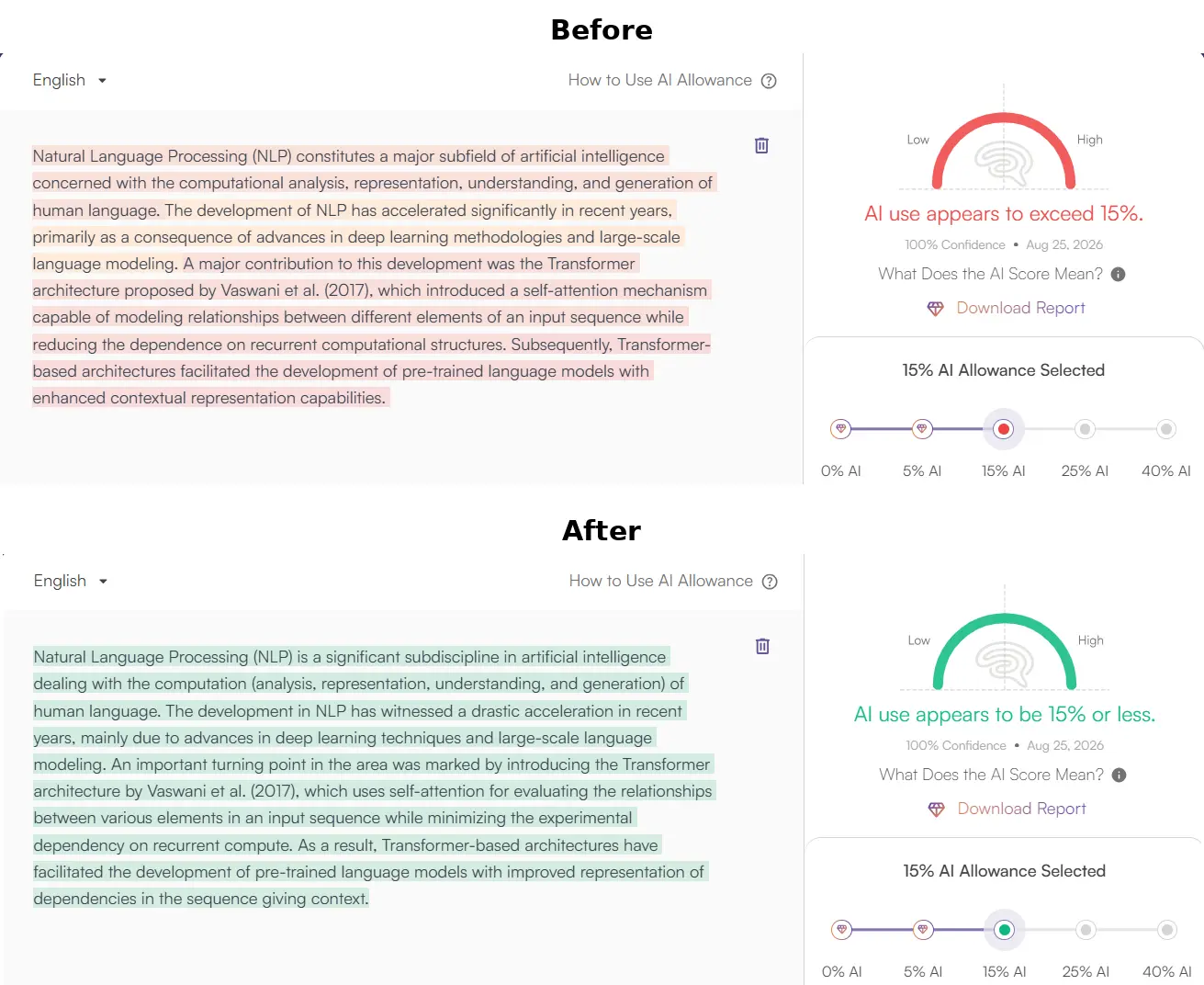
Unlike consumer-grade paraphrasers that blindly swap words with thesaurus synonyms, ThesisHuman allows researchers to select their exact Academic Style (Essay, Research Paper, Literature Review, Technical Report) and Academic Field (Computer Science, Engineering, Medicine, Physics). With Term Lock™, citations (APA, MLA, IEEE), LaTeX equations, and domain-specific terminology are cryptographically protected before sentence entropy is restructured.
2. Turnitin & iThenticate Verification: 0% AI Detected
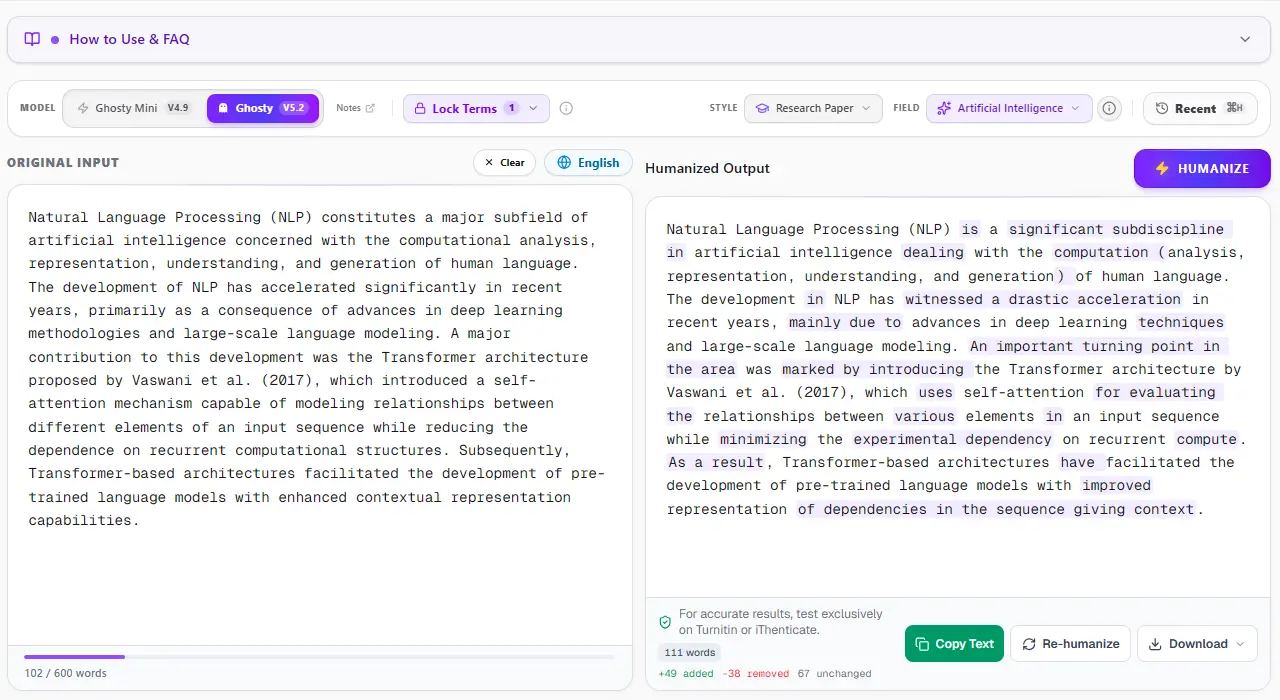
Turnitin and iThenticate scan submissions in overlapping 500-token blocks to analyze sentence predictability across paragraphs. When an unrefined AI draft is submitted, uniform cadence triggers an elevated AI Writing score. In the verified report below, a flagged graduate paper was processed through ThesisHuman, achieving a clean 0% AI detection score while preserving all formatted citations and technical parameters.
3. GPTZero Verification: Passing Perplexity & Burstiness Checks
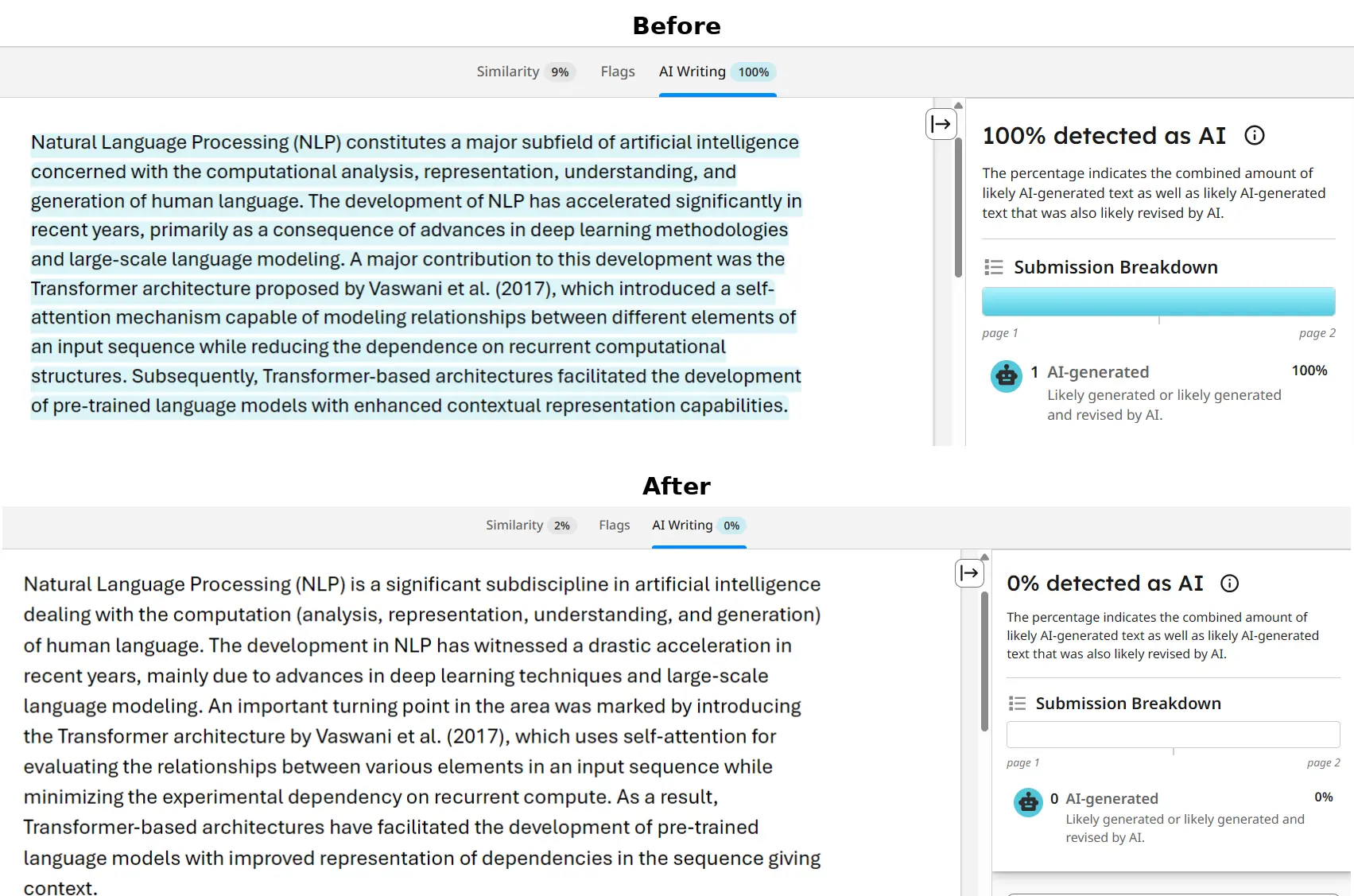
GPTZero evaluates text by plotting sentence perplexity curves and global burstiness scores. When raw AI text is scanned, low sentence variance produces an immediate high-probability warning. ThesisHuman restores natural sentence entropy by restructuring syntax, varying clause lengths, and introducing authentic scholarly cadence, dropping AI probability to 0%.
4. Originality.ai Verification: 0% AI Confidence
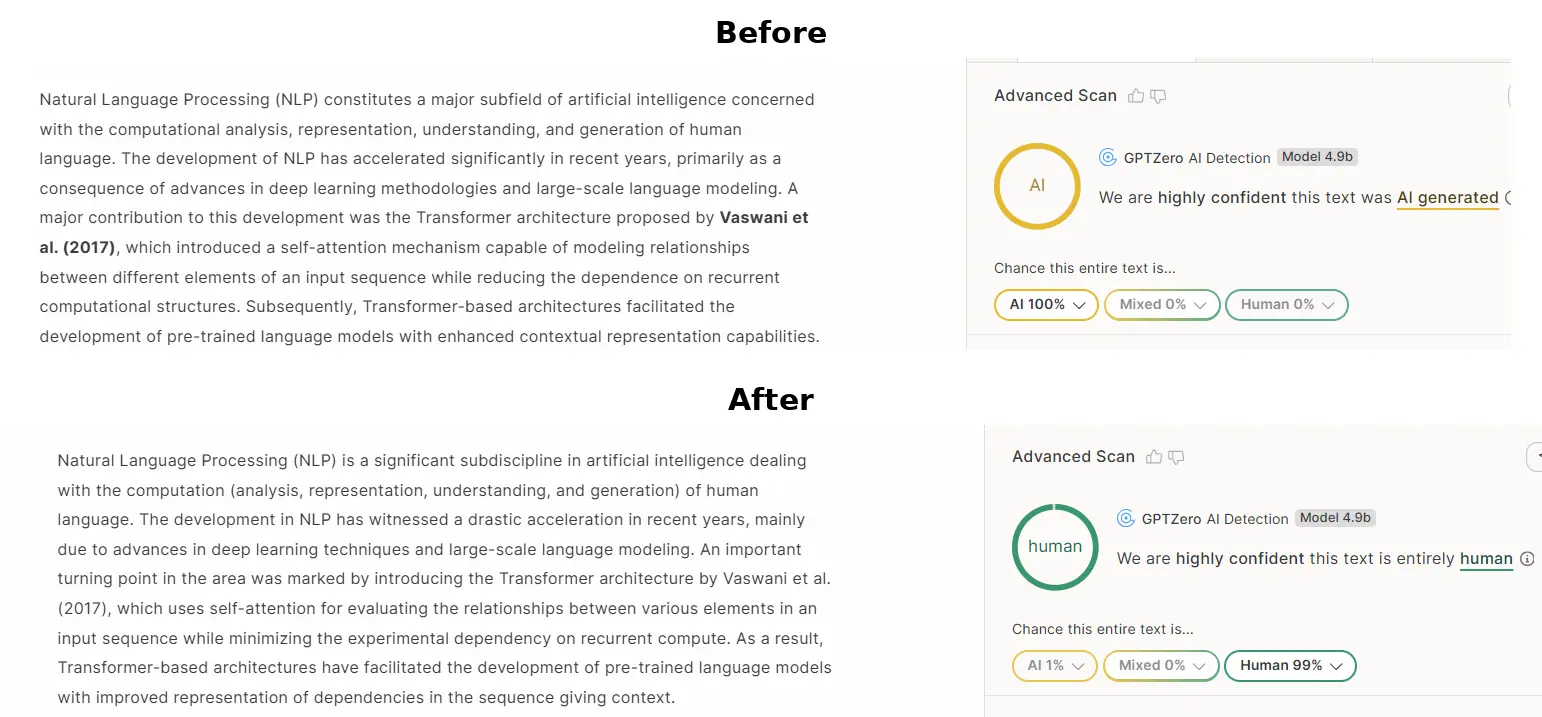
Originality.ai flags predictable n-gram sequences and common AI clichés (such as “delving into,” “pivotal role,” “testament to”). ThesisHuman purges overused formulaic transitions while elevating scholarly tone and keeping reference numbers and equations intact, producing 100% Original / 0% AI results.