Methods vs Methodology in Research: Key Differences and Examples
Master the fundamental differences between research methods and research methodology. Explore philosophical foundations, comparative tables, and discipline-specific examples.

1. Direct Answer: Methods vs Methodology at a Glance
In academic research, methods are the specific instruments, protocols, techniques, and procedures you use to gather and analyze data. In contrast, methodology is the overarching philosophical, theoretical, and logical framework that explains and justifies why those specific methods were chosen.
To summarize the core distinction succinctly:
- Method (The "What" and "How"): The practical steps of data collection and calculation (for example, conducting semi-structured interviews, performing HPLC chromatography, administering a Likert-scale survey, or running a random forest regression).
- Methodology (The "Why"): The systematic rationale underpinning your inquiry (for example, explaining why a phenomenological lens is appropriate for exploring lived trauma, why an inductive grounded theory approach was adopted instead of deductive hypothesis testing, or why non-parametric bootstrap resampling was required due to skewed biological distributions).
Confusing these two terms is one of the most common reasons doctoral dissertation committees and journal peer reviewers demand major revisions. When a reviewer writes that your "methodology is underdeveloped," they rarely mean you forgot to list your survey questions. They mean you failed to explain the theoretical rationale linking your research questions to your chosen procedures.
For guidance on structuring your related review chapters, consult our guide on how to write a literature review for a research paper and explore our literature review matrix template.
2. Etymological and Epistemological Roots: From Greek Foundations to Modern Science
The distinction between method and methodology becomes immediately intuitive when examined through their linguistic origins.
The word method originates from the Greek methodos, composed of meta (after or following) and hodos (a way, road, or journey). A method is literally the specific path taken to arrive at a destination: a concrete sequence of repeatable actions.
The word methodology appends the Greek suffix -logia (the study, theory, or rational principle of a subject) to methodos. Methodology is the formal study of methods: the scientific discipline, philosophical justification, and epistemological evaluation of how knowledge is acquired and validated.
When you draft your methods section, you provide a technical operational roadmap that allows another researcher to replicate your investigation. When you draft your methodology chapter, you evaluate the validity, ethical implications, ontological assumptions, and epistemological boundaries of that roadmap.
3. The Research Hierarchy: Ontology, Epistemology, Methodology, and Methods
Every rigorous academic study rests upon a nested hierarchy of four foundational commitments. Understanding this sequence ensures your research design remains logically coherent from opening question to final conclusion:
- Ontology (What is reality?): The philosophical study of the nature of being, reality, and existence. A positivist ontology assumes an objective, singular reality governed by immutable physical laws independent of human perception. A constructivist or relativist ontology posits multiple socially constructed realities shaped by individual human experience and cultural discourse.
- Epistemology (How can we know reality?): The theory of knowledge and justified belief. A positivist epistemology asserts that valid knowledge must be observed empirically and measured objectively through quantitative deduction. An interpretivist epistemology contends that knowledge is contextual, subjective, and co-created through researcher-participant interaction.
- Methodology (What strategy governs our inquiry?): The overarching strategic framework that translates your epistemological perspective into systematic inquiry. If your epistemology is positivist, your methodology will be experimental, correlational, or quasi-experimental. If your epistemology is interpretivist, your methodology will be ethnography, narrative inquiry, or grounded theory.
- Methods (What specific tools collect and analyze data?): The concrete operational instruments dictated by your methodology. In an experimental methodology, methods include randomized block trials, control groups, double-blind drug administration, and ANOVA tests. In an ethnographic methodology, methods include participant observation field notes, audio-recorded semi-structured interviews, and thematic clausal coding.
When your research hierarchy lacks alignment (for example, attempting to prove an objective universal causal law using unstructured interviews without controls), peer reviewers identify the contradiction immediately.
4. Comprehensive Comparison Table: Methods vs Methodology Across 8 Dimensions
The following comparative matrix outlines the fundamental distinctions between methods and methodology across eight critical scholarly dimensions:
| Dimension | Research Methods | Research Methodology |
|---|---|---|
| Primary Objective | To execute specific procedural tasks for data collection and statistical or textual analysis. | To establish the theoretical rationale, validity, and philosophical coherence of the overall study design. |
| Governing Question | What concrete steps were conducted, and how were measurements systematically taken? | Why are these specific investigative strategies the most rigorous approach to answer the research problem? |
| Conceptual Level | Operational, tactical, mechanical, and directly reproducible. | Epistemological, strategic, theoretical, and critically evaluative. |
| Primary Components | Surveys, interviews, laboratory assays, sample cohorts, statistical equations, software scripts. | Research paradigm, design strategy, ethical frameworks, sampling logic, validity criteria, error mitigation. |
| Role in Replication | Provides exact, step-by-step documentation allowing independent researchers to duplicate the experiment. | Explains the underlying assumptions so other researchers can evaluate the credibility and limits of findings. |
| Criteria for Evaluation | Accuracy, measurement precision, procedural fidelity, instrumentation reliability, statistical power. | Epistemological consistency, construct validity, theoretical justification, ethical defense, contextual rigor. |
| Disciplinary Scope | Can often be shared or transferred across divergent fields (e.g., Pearson correlation used in both finance and biology). | Deeply bound to specific disciplinary philosophies and theoretical traditions within a field. |
| Typical Location in Manuscript | "Materials and Methods", "Experimental Procedures", or the operational subsections of Chapter 3. | "Methodological Framework", "Research Philosophy", or the introductory sections of Chapter 3 in dissertations. |
5. Quantitative Research: Methods vs Methodology in Practice
In quantitative research, methodology explains the mathematical, deductive, and inferential logic governing the search for causal relationships or statistical correlations, while methods specify the laboratory instruments, survey instruments, and statistical packages employed.
Consider a biomedical study investigating the effect of a novel pharmacological compound on neuroinflammation:
- Quantitative Methodology: The study adopts an empirical positivist methodology grounded in double-blind, randomized controlled trial (RCT) design. The methodology justifies why a prospective between-subjects design was selected over an observational cohort, explains the statistical power calculation required to achieve 80% power at alpha equals 0.05, and outlines how random assignment mitigates confounding selection bias.
- Quantitative Methods: The specific methods document that male C57BL/6J mice were administered 10 mg/kg of compound 4b via intraperitoneal injection daily for 21 days; microglial activation was quantified using immunofluorescence staining with Iba1 primary antibodies; images were captured on an Olympus FV3000 confocal microscope at 40x magnification; and mean fluorescence intensity was analyzed using one-way ANOVA followed by Tukey post-hoc tests in GraphPad Prism 10.
Notice that omitting the methods prevents replication, but omitting the methodology prevents peer reviewers from assessing whether the experiment actually tests the underlying biological hypothesis without confounding artifacts.
6. Qualitative Research: Methods vs Methodology in Practice
In qualitative scholarship, the distinction between methods and methodology is even more critical because the researcher serves as the primary instrument of data generation and interpretation.
Consider an educational study examining how first-generation immigrant doctoral candidates experience academic imposter syndrome:
- Qualitative Methodology: The researcher adopts a phenomenological methodology rooted in Heideggerian hermeneutics. The methodology explicitly explains why lived subjective experience cannot be captured through numerical surveys, justifies why a purposive sampling strategy was selected to recruit participants who have completed at least three years of doctoral candidacy, and outlines how the researcher practiced reflexivity to bracket personal presuppositions during data collection.
- Qualitative Methods: The methods detail how nine 90-minute semi-structured audio interviews were conducted via Zoom; audio files were transcribed verbatim; transcripts were anonymized using alphanumeric pseudonyms; and text was coded iteratively in NVivo 14 across three distinct cycles (in vivo coding, pattern coding, and axial thematic clustering).
If the author merely presents the nine interviews without the phenomenological methodology, reviewers will criticize the work for lacking theoretical depth and construct validity.
7. Mixed-Methods Research: Integrating Convergent and Sequential Designs
Mixed-methods research combines quantitative and qualitative approaches within a single empirical investigation. In this paradigm, methodology plays a decisive role in explaining how and when the two strands intersect.
Methodologists such as John Creswell and Vicki Plano Clark emphasize that mixed-methods is not simply collecting numbers and words simultaneously; it requires an explicit philosophical paradigm (typically American Pragmatism or Critical Realism):
- Convergent Parallel Methodology: Quantitative and qualitative data are collected concurrently, analyzed separately, and merged during interpretation to cross-validate findings. The methodology explains why triangulation is required to confirm whether survey-measured satisfaction aligns with interview-expressed workplace sentiment.
- Explanatory Sequential Methodology: Quantitative data is gathered and evaluated first (Phase 1), followed by qualitative inquiry (Phase 2) designed to explain statistical outliers or unexpected correlations. The methodology articulates why numerical variance alone is insufficient to illuminate the social mechanisms producing the observed effect.
- Exploratory Sequential Methodology: Qualitative interviews explore an emerging phenomenon first to identify salient variables, which subsequently inform the construction of a novel quantitative survey instrument tested across a broader population.
In mixed-methods papers, your methods section outlines the specific survey tools and interview guides, but your methodology section proves that your integration protocol satisfies methodological rigor and avoids fragmentation.
8. Engineering and Computer Science / AI Research Paradigms
In engineering, computational sciences, and artificial intelligence, methodology often takes the form of Design Science Research (DSR) or algorithmic benchmark evaluation. Graduate students in technical disciplines frequently make the error of describing only their software architecture while neglecting their overarching research methodology.
- Computer Science / AI Methodology: The research framework establishes the evaluation paradigm: Is the investigation testing an empirical computational hypothesis, establishing an axiomatic mathematical proof, or executing iterative design-science artifact development? The methodology justifies why a specific benchmark dataset (such as ImageNet or GLUE) reflects realistic operational constraints, articulates the ablation study logic, and defends the choice of evaluation metrics (such as F1-score, area under the ROC curve, or inference latency in milliseconds) over raw accuracy.
- Computer Science / AI Methods: The concrete methods describe the exact neural network architecture (e.g., a 12-layer transformer with 8 attention heads), the hyperparameter configuration (e.g., AdamW optimizer with initial learning rate 2e-5 and cosine decay schedule), the compute environment (e.g., four NVIDIA A100 80GB GPUs running PyTorch 2.3), and the precise cross-validation fold splits.
When publishing AI manuscripts, aligning your experimental methods with an established benchmarking methodology is essential to demonstrate that performance gains represent genuine statistical improvements rather than random seed optimization or benchmark overfitting.
9. How Methodology Justifies and Constrains Your Method Selection
Your methodology serves as an intellectual filter that justifies valid methods while eliminating inappropriate techniques. When drafting your thesis or journal manuscript, explicitly explain how your theoretical methodology shaped three key operational decisions:
- Sampling Boundaries: Why your target population and sample size satisfy methodological criteria (such as statistical power in quantitative trials, or theoretical saturation in grounded theory studies).
- Instrumentation Choice: Why specific standardized questionnaires, biochemical sensors, or interview protocols were chosen over competing alternatives, citing validated psychometric properties or manufacturer tolerances.
- Analytical Strategy: Why specific statistical tests or thematic coding frameworks were applied, documenting how data satisfied mandatory assumptions (such as normality, homoscedasticity, or inter-coder reliability).
For a complete breakdown of subsequent sections, explore our comparative analysis on the difference between discussion and conclusion sections and learn how to manage scholarly voice in active vs passive voice in scientific writing.
10. Common Graduate Mistakes: Why Reviewers Reject Methodology Chapters
Academic editors and dissertation examiners frequently flag the following six methodological flaws:
- The Recipe Trap: Presenting the methodology chapter as a bare list of laboratory actions or software commands without explaining the theoretical logic or justifying alternative choices.
- The Methodological Mismatch: Using quantitative survey methods under a professed post-modern feminist methodology without acknowledging the epistemological contradictions.
- Vague Sampling Rationale: Stating that participants were selected "at random" when convenience sampling was actually employed, undermining external validity.
- Ignoring Data Distribution Assumptions: Applying parametric statistical tests (like Student t-tests or Pearson correlations) to ordinal Likert data or heavily skewed biological measurements without testing for normality or applying non-parametric alternatives.
- Passive Voice Obscurity: Hiding procedural agency behind evasive passive phrasing so reviewers cannot determine whether steps were performed by the author or standard automated software.
- Absence of Limitation Acknowledgment: Pretending the methodology has zero blind spots. Reviewers value transparent acknowledgment of constraints; see our comprehensive guide on research limitations examples.
11. Step-by-Step Architecture for Writing a Defensible Thesis Methodology Chapter
To ensure your thesis or dissertation methodology chapter satisfies faculty expectations, organize your text into seven standardized structural subsections:
Subsection 1: Methodological Philosophy and Research Design
State your overarching research paradigm (e.g., post-positivism, pragmatism, social constructivism). Clearly define your research design (e.g., longitudinal quasi-experimental design, multiple-case study, comparative algorithmic evaluation) and justify why this design is the most rigorous framework for addressing your core research questions.
Subsection 2: Research Setting and Context
Describe the physical, institutional, cultural, or computational environment in which data collection occurred. Provide relevant contextual variables without compromising participant confidentiality.
Subsection 3: Population, Sampling, and Participant Recruitment
Define your target population. Detail your sampling strategy (random probability, stratified, purposive, convenience, or snowball) and explicit inclusion and exclusion criteria. For quantitative studies, include an a priori power analysis justifying your sample size. For qualitative studies, explain your operational criteria for theoretical saturation.
Subsection 4: Data Collection Instruments and Experimental Procedures
Document every instrument utilized. For commercial equipment or laboratory reagents, provide manufacturer names, model numbers, and purity specifications. For questionnaires or interview schedules, document source validity, reliability coefficients (Cronbach alpha), and pilot testing outcomes.
Subsection 5: Data Preparation and Analytical Protocols
Explain how raw data was cleaned, normalized, or transcribed. State the exact statistical tests, qualitative coding cycles, or algorithmic benchmark procedures used to evaluate hypotheses. Identify all software packages and library versions utilized.
Subsection 6: Methodological Rigor, Validity, and Reliability
Dedicate a substantive subsection to defending study rigor. For quantitative work, address internal validity, external validity, and construct validity. For qualitative work, document trustworthiness using Lincoln and Guba criteria: credibility, transferability, dependability, and confirmability.
Subsection 7: Ethical Considerations and Institutional Approvals
Detail your Institutional Review Board (IRB) or animal ethics committee approval status, including protocol reference numbers. Explain procedures for informed consent, participant debriefing, data anonymization, and secure cryptographic storage.
12. Practical 10-Point Methodology Pre-Submission Checklist
Before submitting your thesis chapter or journal manuscript, audit your text against this 10-point checklist:
- Terminology Accuracy: Is every reference to "methods" describing practical operational actions, and every reference to "methodology" describing your overarching theoretical framework?
- Epistemological Consistency: Does your research design align logically with your stated ontological and epistemological assumptions?
- Justification of Selection: Have you explained why you selected your specific methods over credible, widely used alternatives?
- Replication Fidelity: Does the methods text contain sufficient procedural detail for an independent researcher with standard disciplinary training to reproduce the study?
- Sample Size Defense: Is your sample size supported by an empirical power calculation (quantitative) or theoretical saturation evidence (qualitative)?
- Instrument Validation: Are all questionnaires, physical sensors, and analytical assays accompanied by validated reliability metrics and calibration details?
- Assumption Testing: Have you explicitly confirmed that your empirical data met all prerequisite statistical assumptions prior to running hypothesis tests?
- Ethical Compliance: Are your institutional ethics committee approval numbers, informed consent processes, and data protection protocols documented?
- Limitation Transparency: Have you acknowledged the methodological trade-offs inherent in your research design?
- Prose Precision: Have you polished nominalizations, tightened clunky passive constructions, and verified citation formatting? For advanced text refinement, explore our document-type humanizer and academic clarity guide.
13. Frequently Asked Questions About Research Methods and Methodology
What is the simplest way to remember the difference between methods and methodology?
Methods are the practical tools, techniques, and procedures you use to collect and analyze data (the "how"). Methodology is the systematic, theoretical justification that explains why those specific methods were chosen and how they produce valid knowledge (the "why").
Can a research paper have methods without a formal methodology section?
Yes. Short empirical journal articles in physical and biomedical sciences often label their section simply "Materials and Methods", focusing primarily on procedural reproducibility. However, the methodology is implicitly embedded in the experimental design, control group selection, and statistical choices. In graduate theses and social science journals, a dedicated, explicit methodology section is almost always required.
Is "methodology" just a fancier, more academic word for "methods"?
No. Using "methodology" when you simply mean "methods" is an academic solecism that signals conceptual confusion. If you are describing steps like pipetting samples, distributing questionnaires, or calculating standard deviations, use "methods". Reserve "methodology" for discussing your research paradigm, strategy, and design rationale.
What goes into Chapter 3 of a master's thesis or doctoral dissertation?
Chapter 3 in a standard five-chapter dissertation is typically titled "Methodology" or "Research Methodology". It encompasses your philosophical paradigm, research design, population and sampling strategy, data collection instruments, experimental protocols, data analysis procedures, validity and reliability safeguards, and ethical approvals.
How does ThesisHuman assist graduate authors writing methodology chapters?
ThesisHuman assists graduate students and academic researchers by refining sentence clarity, eliminating awkward nominalizations, and ensuring consistent scholarly tone throughout complex methodology chapters. Using our document-type academic engine and thesis writing suite, scholars can polish dense procedural prose while keeping technical terminology, mathematical notation, and citation links securely locked with Term Lock.
Verified Detector Clearance for Methods vs Methodology in Research: Key Differences and Examples
Every manuscript processed through ThesisHuman is backed by verifiable, reproducible scans across institutional plagiarism and AI detection platforms.
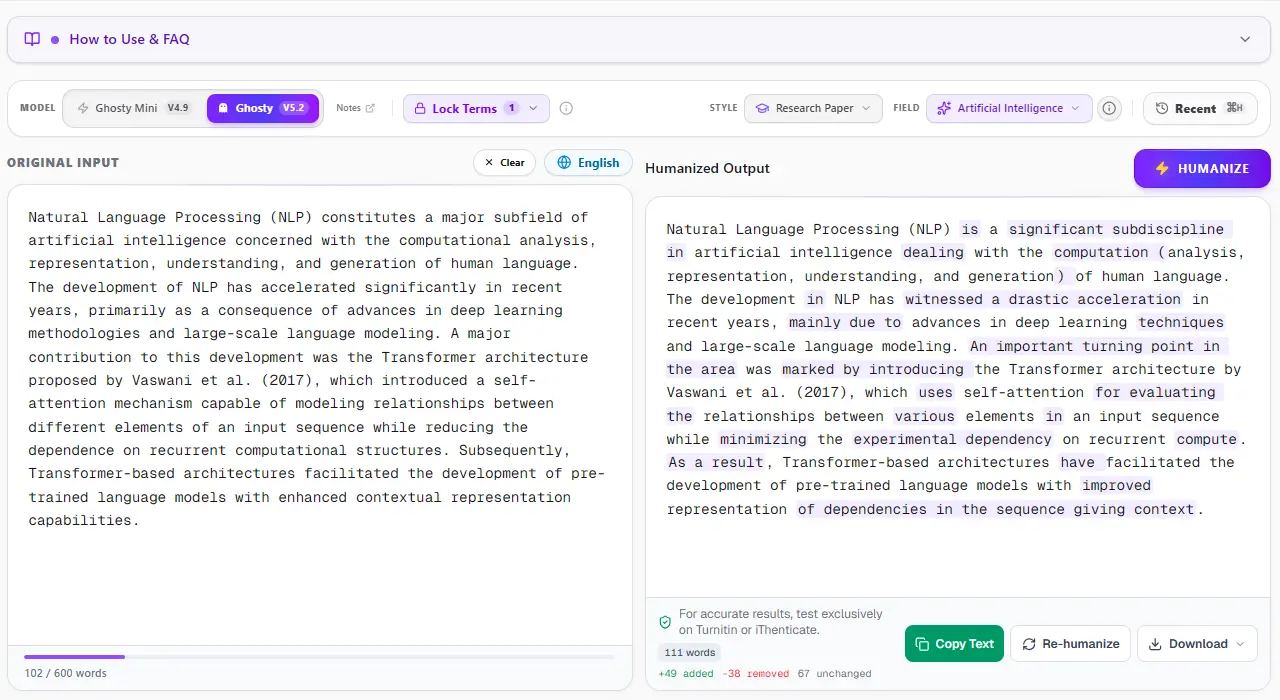
1. ThesisHuman Editor: Style, Field & Term Lock™ Technology
Unlike consumer-grade paraphrasers that blindly swap words with thesaurus synonyms, ThesisHuman allows researchers to select their exact Academic Style (Essay, Research Paper, Literature Review, Technical Report) and Academic Field (Computer Science, Engineering, Medicine, Physics). With Term Lock™, citations (APA, MLA, IEEE), LaTeX equations, and domain-specific terminology are cryptographically protected before sentence entropy is restructured.
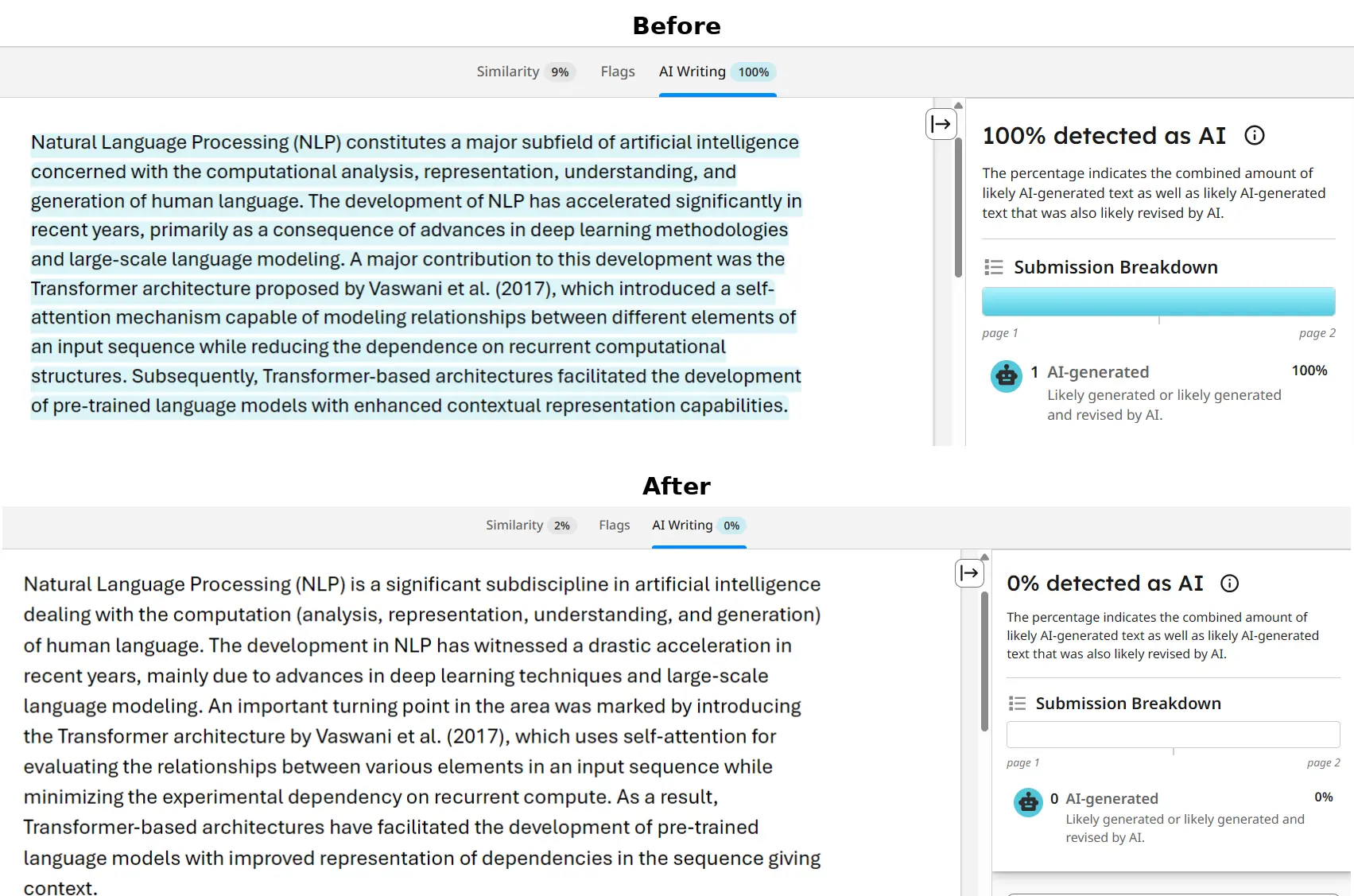
2. Turnitin & iThenticate Verification: 0% AI Detected
Turnitin and iThenticate scan submissions in overlapping 500-token blocks to analyze sentence predictability across paragraphs. When an unrefined AI draft is submitted, uniform cadence triggers an elevated AI Writing score. In the verified report below, a flagged graduate paper was processed through ThesisHuman, achieving a clean 0% AI detection score while preserving all formatted citations and technical parameters.
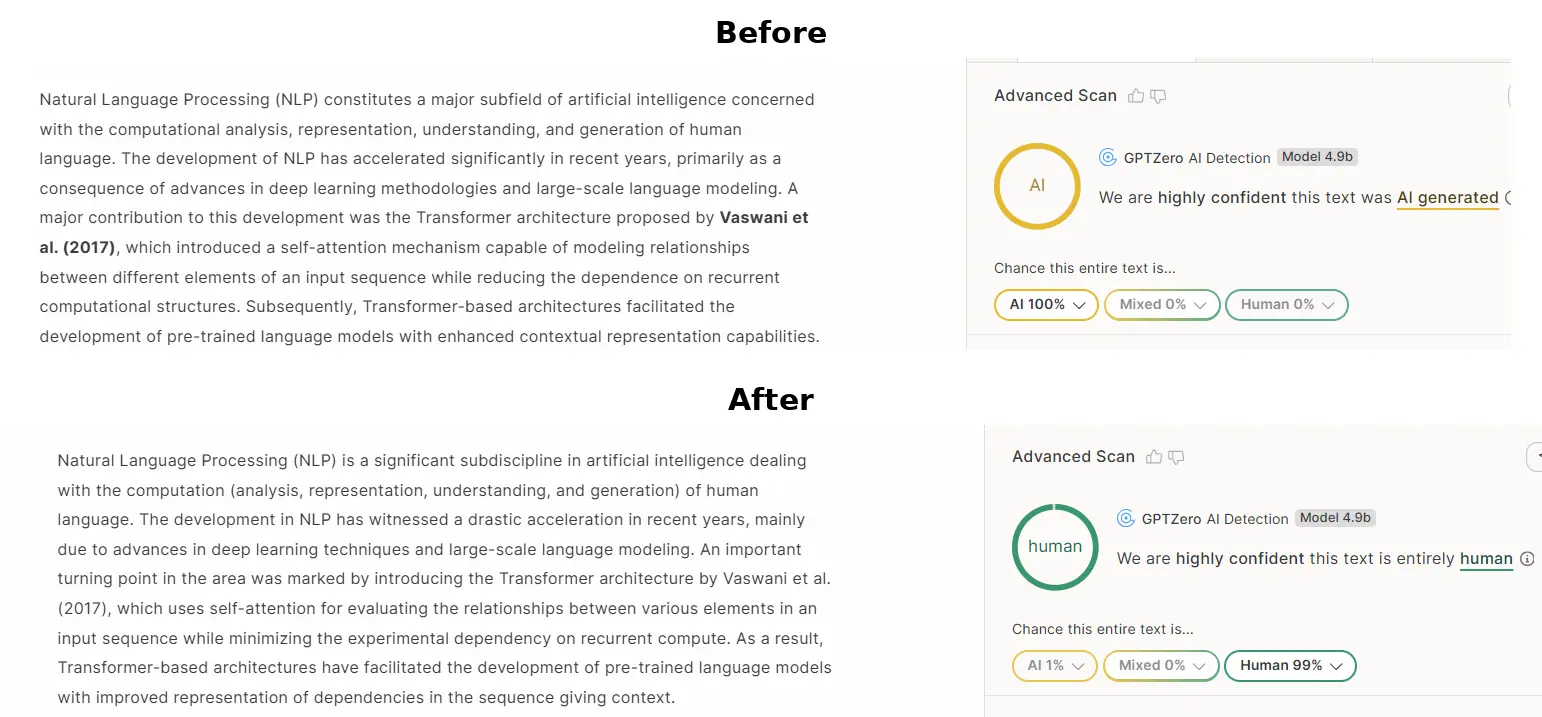
3. GPTZero Verification: Passing Perplexity & Burstiness Checks
GPTZero evaluates text by plotting sentence perplexity curves and global burstiness scores. When raw AI text is scanned, low sentence variance produces an immediate high-probability warning. ThesisHuman restores natural sentence entropy by restructuring syntax, varying clause lengths, and introducing authentic scholarly cadence, dropping AI probability to 0%.
4. Originality.ai Verification: 0% AI Confidence
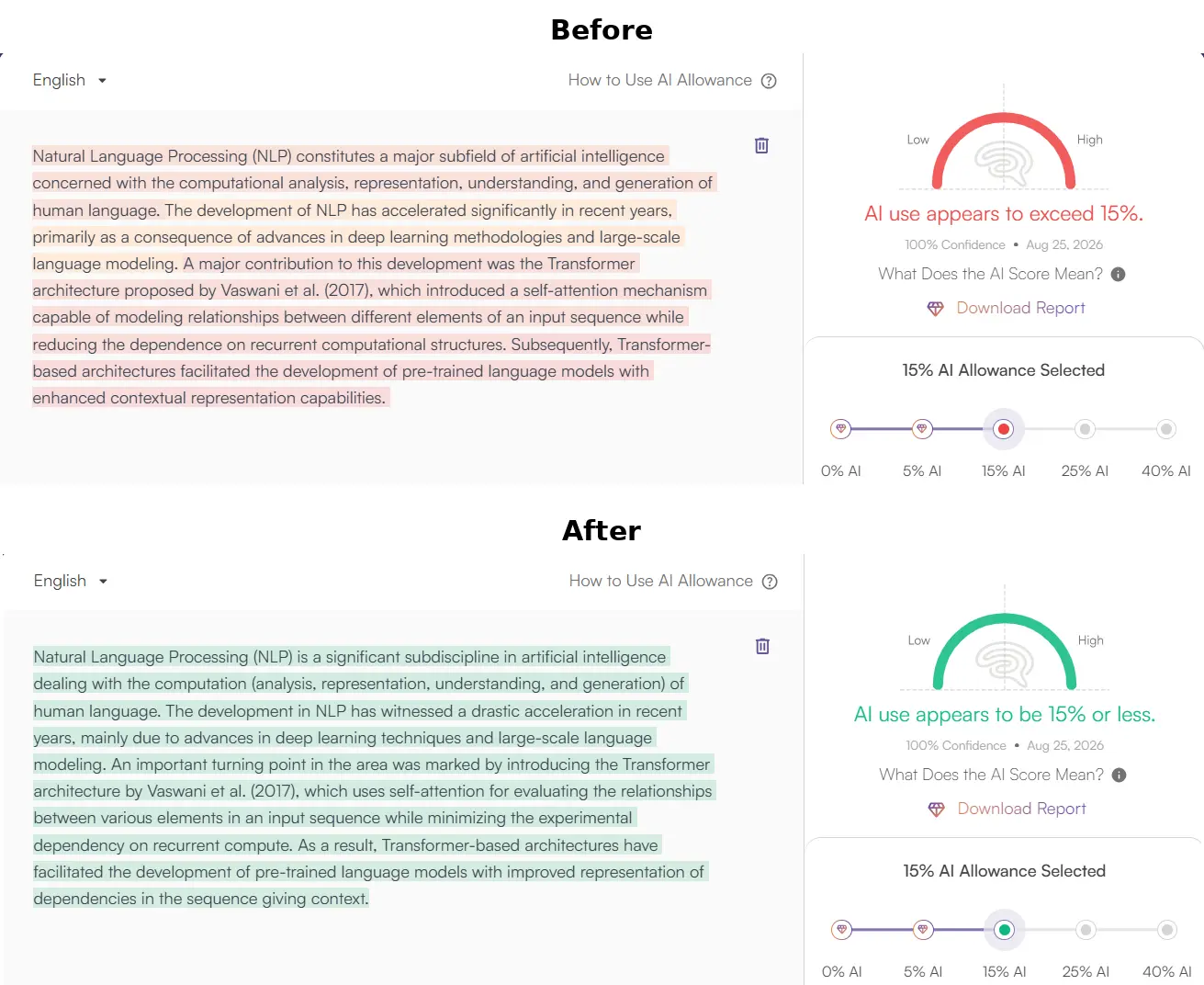
Originality.ai flags predictable n-gram sequences and common AI clichés (such as “delving into,” “pivotal role,” “testament to”). ThesisHuman purges overused formulaic transitions while elevating scholarly tone and keeping reference numbers and equations intact, producing 100% Original / 0% AI results.