Academic Words to Use in Essays: Examples, Meaning, and Proper Usage
Enhance your scholarly essay with precise academic vocabulary. Learn appropriate register, contextual usage, semantic precision, and words to avoid.

Developing an authoritative scholarly voice does not mean replacing every familiar word with an obscure synonym found in a thesaurus. True academic writing is characterized by conceptual precision, analytical economy, and disciplined register. When writers artificially inflate their prose with ornate vocabulary, arguments become convoluted, meaning is obscured, and instructors or peer reviewers quickly detect the lack of substantive reasoning beneath the decorative surface.
This comprehensive guide provides university students, graduate researchers, and academic writers with a curated collection of precise academic words, phrases, and analytical verbs. Rather than presenting a generic list of high-sounding terms, we unpack the exact meaning, disciplinary context, rhetorical function, and epistemic boundaries of core academic vocabulary. We explore distinctions between certainty and hedging, analyze words frequently misused in student manuscripts, showcase before-and-after sentence transformations, and provide a comprehensive reference table for immediate revision.
1. What Makes Vocabulary Truly Academic?
Scholarly vocabulary is defined not by its syllable count, but by its capacity to convey complex intellectual relationships with minimal ambiguity. A word is genuinely academic when it accomplishes one of three communicative goals:
- It names a precise theoretical or methodological construct: Terms such as operationalize, paradigm, stratification, or epistemology describe specific concepts that would otherwise require multi-sentence explanations.
- It calibrates authorial stance and evidential strength: Verbs such as posits, corroborates, suggests, or contends signal exactly how much certainty the researcher attributes to a particular claim.
- It establishes logical relationships between ideas: Connective and qualifying terms such as consequently, conversely, predicated upon, or notwithstanding organize complex analytical chains.
Core Rule: In academic writing, clarity always takes precedence over ornamentation. If a simple word expresses your meaning without ambiguity, never substitute a complex word merely to sound scholarly.
2. Precision versus Needless Complexity
Many emerging writers operate under the mistaken belief that good scholarship requires dense, impenetrable prose. In reality, academic editors and journal reviewers actively weed out pompous phrasing. Consider the difference between precision and complexity in the following examples:
Needless Complexity (Inflated)
'The pedagogical practitioners utilized an advantageous methodology to facilitate an amelioration in pupil retention metrics.'
Diagnosis: Burdened by bureaucratic jargon ('pedagogical practitioners,' 'utilized,' 'amelioration') that slows comprehension.
Academic Precision (Clear & Direct)
'Teachers adopted structured peer tutoring to improve student retention rates.'
Diagnosis: Replaces vague nominalizations with concrete subjects, precise action verbs, and direct terminology.
Notice that the second sentence is shorter, more direct, and immediately understandable, yet remains entirely appropriate for an educational research journal. To explore how sentence structures combine into cohesive sections, see our guide on sentence starters for essays.
3. Epistemic Accuracy and the Art of Scholarly Hedging
The most critical intellectual skill in academic vocabulary selection is maintaining epistemic accuracy: matching your choice of words to the exact strength of your evidence. When scholars overstate what their data supports, they commit fatal argumentative errors.
Key Semantic Distinctions
- Demonstrates vs. Suggests: To say that data demonstrates a conclusion means the evidence is definitive and directly proves the outcome. If data shows a strong correlation or plausible mechanism without eliminating all alternative explanations, the appropriate academic term is suggests, indicates, or points toward.
- Correlates vs. Causes: A correlation indicates that two variables fluctuate together; it never proves causation. Using causal verbs like triggers, determines, or causes when reporting observational survey data misleads readers and undermines your credibility. Instead, use associates with, correlates with, or co-occurs with.
- Significant vs. Important: In empirical research, significant has a strict mathematical definition: a result that achieves statistical significance (e.g., p < .05). Never use 'significant' in an empirical essay as a casual synonym for 'large,' 'important,' or 'meaningful.' Use substantial, noteworthy, or pronounced instead.
- Confirms vs. Supports: A single empirical study rarely confirms an overarching theoretical hypothesis; rather, it supports or lends empirical weight to the hypothesis within a bounded context.
4. Academic Words for Introducing Claims and Theories
When framing theoretical perspectives or establishing your central argument, avoid passive or repetitive formulas like 'The author says' or 'I think.' Utilize verbs that characterize the rhetorical nature of the scholarly claim:
| Word / Term | Rhetorical Meaning | Contextual Usage Example |
|---|---|---|
| Posit | To put forward a foundational premise as the basis for an argument | Institutional theorists posit that organizational structures reflect cultural expectations rather than purely technical demands. |
| Contend | To assert a position firmly against competing viewpoints | Critical geographers contend that gentrification processes are systematically accelerated by municipal tax zoning incentives. |
| Delineate | To describe, outline, or define boundaries with precision | The study delineates four distinct developmental phases observed across adolescent peer networks. |
| Articulate | To express a coherent, well-reasoned argument or conceptual framework | Habermas articulates a communicative framework grounded in ideal speech situations. |
| Premise | To base an argument or policy on a specific presupposition | The legislative reform is premised on the assumption that market competition naturally reduces healthcare delivery costs. |
For strategies on initiating body paragraphs effectively, consult our dedicated guide on topic sentence starters.
5. Terms for Analyzing Evidence and Interpreting Data
Presenting evidence without rigorous analytical commentary produces weak essays. Use these terms to explain how empirical findings or textual quotes substantiate your central claims:
- Corroborate: To confirm, support, or give additional credibility to a finding using independent evidence. 'The interview transcripts corroborate the survey findings, indicating widespread administrative burnout.'
- Substantiate: To establish or validate a claim with concrete proof or documentation. 'Historical ledger records substantiate the author's claim that maritime trade volumes surged after 1740.'
- Exemplify: To serve as a typical, illustrative instance of a broader trend or phenomenon. 'This policy failure exemplifies the systemic coordination breakdown between federal agencies.'
- Elucidate: To make something complex clear, lucid, or comprehensible through explanation. 'Semi-structured qualitative interviews elucidate the psychological coping strategies employed by frontline nurses.'
- Crystallize: To cause an ambiguous trend or theoretical tension to become clear and definitive. 'The 2008 liquidity crisis crystallized structural flaws inherent in subprime credit rating models.'
For focused guidance on framing quantitative and qualitative data, explore our companion resource on evidence sentence starters.
6. Vocabulary for Comparison, Analogy, and Synthesis
When synthesizing multiple scholarly perspectives or comparing disparate empirical datasets, replace monotonous phrases like 'is similar to' with nuanced comparative vocabulary:
| Term | Comparative Nuance | Example in Context |
|---|---|---|
| Converge | To arrive at the same conclusion from different methodological directions | Both behavioral economics and cognitive neuroscience converge on the finding that emotion heavily modulates financial risk tolerance. |
| Parallel | To exhibit an analogous developmental trajectory or structural correspondence | The evolution of social media recommendation algorithms closely parallels early broadcasting regulatory battles. |
| Harmonize | To bring divergent theories or empirical observations into consistent agreement | The revised behavioral framework harmonizes microeconomic utility models with sociological field observations. |
| Echo | To reflect or resemble earlier scholarly themes or historical findings | Contemporary debates surrounding algorithmic surveillance echo early twentieth-century critiques of industrial Taylorism. |
7. Words for Contrast, Nuance, and Qualification
Sophisticated academic argumentation rarely involves binary right-versus-wrong assessments. Instead, scholars qualify existing knowledge by highlighting boundary conditions, counter-evidence, and nuances:
- Diverge: To move in distinct analytical or empirical directions from an established consensus. 'While classical macroeconomics anticipates rising employment during credit expansions, empirical wage data diverges noticeably after 2010.'
- Complicate: To demonstrate that an existing model or assumption is more multifaceted and less straightforward than previously recognized. 'These regional ethnographic accounts complicate the narrative of unmitigated global homogenization.'
- Qualify: To limit, restrict, or specify the scope within which a general statement holds true. 'The authors qualify their policy recommendations, noting that fiscal subsidies are effective only in urban municipalities with robust public transit.'
- Demarcate: To set clear boundaries between adjacent concepts or categorical domains. 'The legal statute fails to demarcate permissible research fair use from civil copyright infringement.'
To master moving smoothly between contrasting ideas in your essays, review our comprehensive analysis of transition sentences.
8. Cause, Effect, and Logical Progression Terms
Avoid relying exclusively on 'because,' 'leads to,' or 'results in.' Express complex causality and sequential development using precise explanatory terms:
| Verb / Phrase | Causal Function | Example in Context |
|---|---|---|
| Precipitate | To trigger a rapid, unexpected, or major event or transition | The unexpected devaluation of the currency precipitated an immediate banking liquidity crisis. |
| Engender | To produce, cultivate, or give rise to a feeling, state, or climate | Inconsistent administrative grading policies engender deep cynicism among university undergraduates. |
| Emanate from | To originate from or be traced back to a specific source | Much of the resistance to algorithmic auditing emanates from proprietary commercial secrecy concerns. |
| Culminate in | To reach a final, decisive stage or climax after sustained progression | Decades of neglected civil infrastructure investment culminated in the catastrophic failure of the municipal floodway. |
| Entail | To involve or require something as an inevitable logical consequence | Decentralizing power grid management entails substantial capital investment in automated telemetry sensors. |
9. Vocabulary for Evaluating Study Limitations and Scope
Acknowledging limitations is a hallmark of mature scholarly writing. Far from weakening your paper, clearly defining the boundaries of your work demonstrates academic integrity and analytical rigor:
- Circumscribe: To set boundaries or restrict the applicability of a conclusion. 'The reliance on voluntary self-reporting circumscribes the generalizability of our behavioral metrics.'
- Warrant caution: To advise careful interpretation due to methodological constraints. 'The small sample size warrants caution when extrapolating these clinical findings to adult populations.'
- Provisional: Open to revision or tentative pending further empirical verification. 'These initial revenue projections remain provisional until fiscal year audits conclude.'
- Bounded by: Confined within specific experimental, geographic, or temporal parameters. 'The validity of this economic model is strictly bounded by the assumption of frictionless capital mobility.'
10. Strong Disciplinary Verbs versus Weak Vague Verbs
One of the fastest ways to elevate essay prose is replacing generic conversational verbs with dynamic, disciplinarily specific alternatives. Study this replacement reference:
| Weak / Vague Verb | Strong Academic Alternatives | Example Replacement |
|---|---|---|
| talks about | examines, analyzes, articulates, interrogates | The author interrogates the political assumptions underlying welfare state reform. |
| looks at | investigates, evaluates, explores, scrutinizes | This paper scrutinizes the statistical sampling protocols of previous clinical trials. |
| shows | reveals, substantiates, illustrates, elucidates | The regression model elucidates the non-linear relationship between income inequality and public trust. |
| makes better | enhances, refines, optimizes, bolsters | Incorporating distributed caching optimizes database retrieval latency under high concurrent load. |
| gives | furnishes, provides, yields, confers | The spectroscopic analysis yields unequivocal evidence of chemical decomposition. |
11. Discipline-Specific Vocabulary Across Major Fields
Different academic disciplines value distinct analytical vocabularies. Align your word choices with your target field's conventions:
- Social Sciences (Sociology, Political Science): hegemony, structural violence, discursive, social stratification, intersectionality, agency, normative framework.
- Education & Pedagogy: scaffolding, metacognition, formative assessment, affective filter, differentiated instruction, praxis.
- Computer Science & Systems Engineering: deterministic, asymptotic complexity, fault-tolerant, telemetry, idempotent, heuristic optimization.
- Health Sciences & Epidemiology: etiology, comorbidity, longitudinal cohort, confounding variable, prophylactic, pathophysiology.
- Humanities & Literary Studies: diegesis, subtext, hermeneutics, trope, juxtaposition, allegory, aesthetic distance.
12. Words Frequently Misused in Student Essays
Instructors and graders repeatedly encounter certain words that students use incorrectly in attempts to sound impressive. Review these six common traps:
- Methodology vs. Method: A method is the specific tool or technique used to collect data (e.g., surveys, interviews). Methodology refers to the philosophical, theoretical study of methods. Do not write 'our methodology was a 10-question survey'; write 'our data collection method was a 10-question survey.'
- Utilize vs. Use: Utilize means to repurpose something for a task it was not originally designed for (e.g., 'he utilized a butter knife as a screwdriver'). In almost all other cases, use use, apply, or employ.
- Impactful: Impactful is corporate marketing jargon, not formal academic English. Use influential, consequential, effective, or substantive instead.
- Plethora: Originating from a medical term meaning a morbid excess of blood, plethora denotes a negative or overwhelming surplus. Writing 'a plethora of useful studies' is semantically contradictory. Use an abundance, a wide range, or numerous.
- Literally: Frequently misapplied as hyperbolic emphasis ('the policy literally destroyed the economy'). Avoid this colloquial filler entirely in academic essays.
- Factor: Overused as a vague catch-all. Replace 'this was a big factor' with precise nouns like catalyst, variable, determinant, or contributing cause.
13. Before-and-After Sentence Transformations
Examine these four side-by-side sentence transformations to see how applying precise academic vocabulary eliminates wordiness, strengthens logic, and restores authoritative scholarly tone:
Before (Informal & Cluttered)
'There are a lot of different factors that make students feel really stressed out during final exams week.'
After (Academic Precision)
'Multiple compounding stressors, notably sleep deprivation and academic evaluation anxiety, precipitate acute psychological distress during examination periods.'
Before (Informal & Cluttered)
'The author talks a lot about how social media is bad for democracy because of fake news.'
After (Academic Precision)
'The author contends that algorithmic amplification of disinformation systematically erodes democratic civic engagement.'
Before (Informal & Cluttered)
'This shows for sure that the new drug totally works way better than the old medicine.'
After (Academic Precision)
'These randomized clinical findings indicate that the experimental compound demonstrates superior therapeutic efficacy compared to standard pharmacological regimens.'
14. Comprehensive Academic Usage Reference Table
Keep this quick-reference table accessible when revising essay drafts, dissertations, and research papers:
| Word | Part of Speech | Meaning / Function | Usage Caution |
|---|---|---|---|
| Salient | Adjective | Most noticeable, prominent, or important | Do not overuse; reserve for features that genuinely stand out analytically. |
| Exacerbate | Verb | To make a bad situation, problem, or symptom worse | Apply only to negative phenomena; never write 'exacerbated the benefits.' |
| Mitigate | Verb | To make less severe, harmful, or painful | Do not confuse with 'militate' (which is used in 'militate against'). |
| Anomalous | Adjective | Deviating from what is standard, normal, or expected | Must be substantiated by baseline expectations or statistical norms. |
| Juxtapose | Verb | To place close together for contrasting effect | Requires two explicit subjects or themes being contrasted side by side. |
| Inherent | Adjective | Existing in something as a permanent, essential, or characteristic attribute | Do not use for temporary, circumstantial, or external factors. |
| Synthesize | Verb | To combine disparate ideas into a coherent, novel whole | Distinct from merely summarizing; requires integrating connections between sources. |
15. Practical Vocabulary Revision Checklist
Before finalizing any university essay, thesis chapter, or research manuscript, run through this vocabulary audit checklist:
- 1. Eliminate Artificial Synonyms: Did you replace simple, functional words with awkward thesaurus terms? Revert them to direct expressions.
- 2. Audit 'Significant': If you wrote 'significant,' is it in a statistical context? If not, change it to 'substantial,' 'noteworthy,' or 'pronounced.'
- 3. Check Causality: Did you claim 'X causes Y' where data only proves an association? Change to 'correlates with' or 'associates with.'
- 4. Replace Vague Verbs: Search your draft for 'talks about,' 'shows,' 'looks at,' and 'makes.' Substitute precise analytical verbs.
- 5. Prune Nominalizations: Search for abstract nouns ending in '-tion' or '-ment' (e.g., 'facilitate an examination of'). Convert them to active verbs ('examine').
- 6. Verify Academic Hedging: Are your conclusions balanced by appropriate qualifiers ('suggests,' 'tends to,' 'provisional') without overpromising?
- 7. Check Technical Jargon: Are specialized disciplinary constructs spelled out or defined clearly for your audience?
16. Refining Essay Vocabulary with ThesisHuman
Achieving the right balance between scholarly authority and readability can be challenging, especially when polishing complex dissertation chapters or revising papers under tight deadlines. Writers who draft with AI assistance often encounter flattened, repetitive vocabulary that trips automated classifiers and sounds robotic to human evaluators.
ThesisHuman provides purpose-built tools for scholarly writing. With our specialized essay rewriter and the interactive ThesisHuman editor, you can test alternative academic phrasings, introduce natural sentence burstiness, and eliminate monotonous clausal patterns without losing your technical terminology or parenthetical citations. For comprehensive guidance on structural essay mechanics, explore our companion roadmap on how to write a research paper and our guide to what is a body paragraph. Check out our transparent pricing plans to choose an editing tier that matches your academic workflow.
17. Frequently Asked Questions
What is the difference between academic vocabulary and inflated language?
Genuine academic vocabulary emphasizes precision, concise meaning, and disciplinary accuracy, whereas inflated language relies on obscure thesaurus synonyms and needlessly ornate phrasing that obscures the author's argument without adding analytical depth.
Why is the distinction between 'demonstrates' and 'suggests' crucial in academic essays?
'Demonstrates' conveys high empirical certainty where evidence directly substantiates a claim, whereas 'suggests' functions as an epistemic hedge indicating a plausible interpretation or tentative trend that warrants further investigation.
Is it considered acceptable to use simple words in university-level essays?
Yes. Clear, straightforward prose is always preferred over convoluted vocabulary. Scholars value economy of expression; words like 'use,' 'explain,' and 'find' are frequently superior to forced terms like 'utilize,' 'explicate,' and 'ascertain.'
How does academic hedging protect an author's scholarly credibility?
Hedging terms like 'tends to,' 'plausibly,' 'provisional,' and 'indicates' calibrate claims to the actual strength and limitations of the evidence, preventing unwarranted overgeneralizations that invite immediate skepticism from peer reviewers.
Does using academic words make text look like AI-generated output?
No. Legitimate scholarly terms do not trigger AI flags when integrated naturally into bursty, varied sentence structures. Automated classifiers flag uniform token predictability and formulaic transitional filler, not precise discipline-specific vocabulary.
Verified Detector Clearance for Academic Words to Use in Essays: Examples, Meaning, and Proper Usage
Every manuscript processed through ThesisHuman is backed by verifiable, reproducible scans across institutional plagiarism and AI detection platforms.
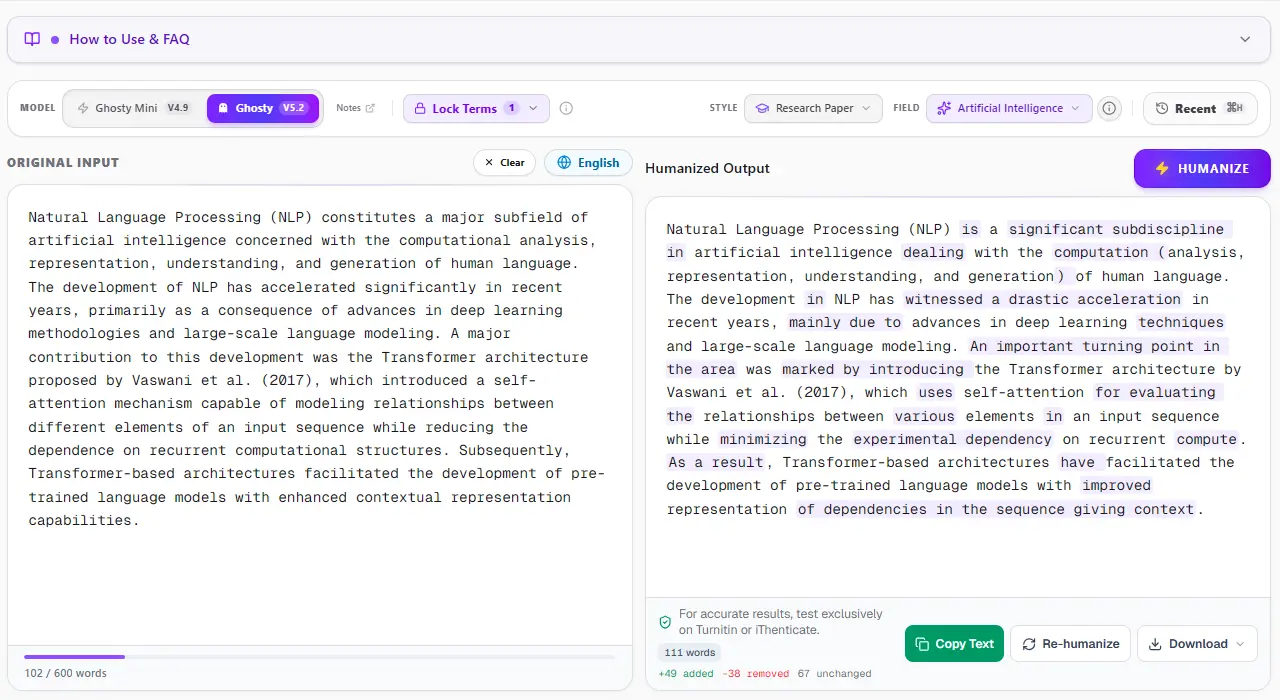
1. ThesisHuman Editor: Style, Field & Term Lock™ Technology
Unlike consumer-grade paraphrasers that blindly swap words with thesaurus synonyms, ThesisHuman allows researchers to select their exact Academic Style (Essay, Research Paper, Literature Review, Technical Report) and Academic Field (Computer Science, Engineering, Medicine, Physics). With Term Lock™, citations (APA, MLA, IEEE), LaTeX equations, and domain-specific terminology are cryptographically protected before sentence entropy is restructured.
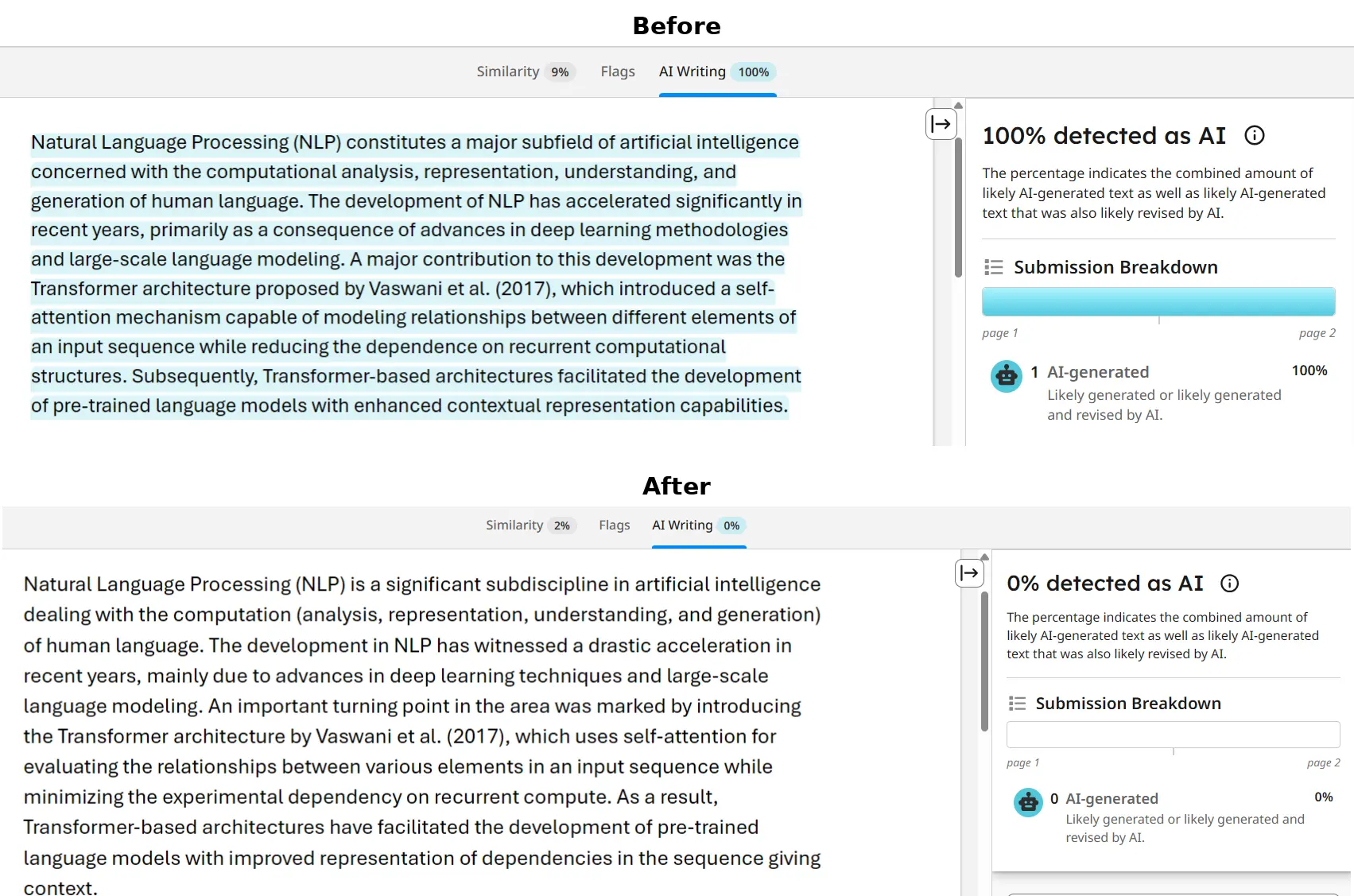
2. Turnitin & iThenticate Verification: 0% AI Detected
Turnitin and iThenticate scan submissions in overlapping 500-token blocks to analyze sentence predictability across paragraphs. When an unrefined AI draft is submitted, uniform cadence triggers an elevated AI Writing score. In the verified report below, a flagged graduate paper was processed through ThesisHuman, achieving a clean 0% AI detection score while preserving all formatted citations and technical parameters.
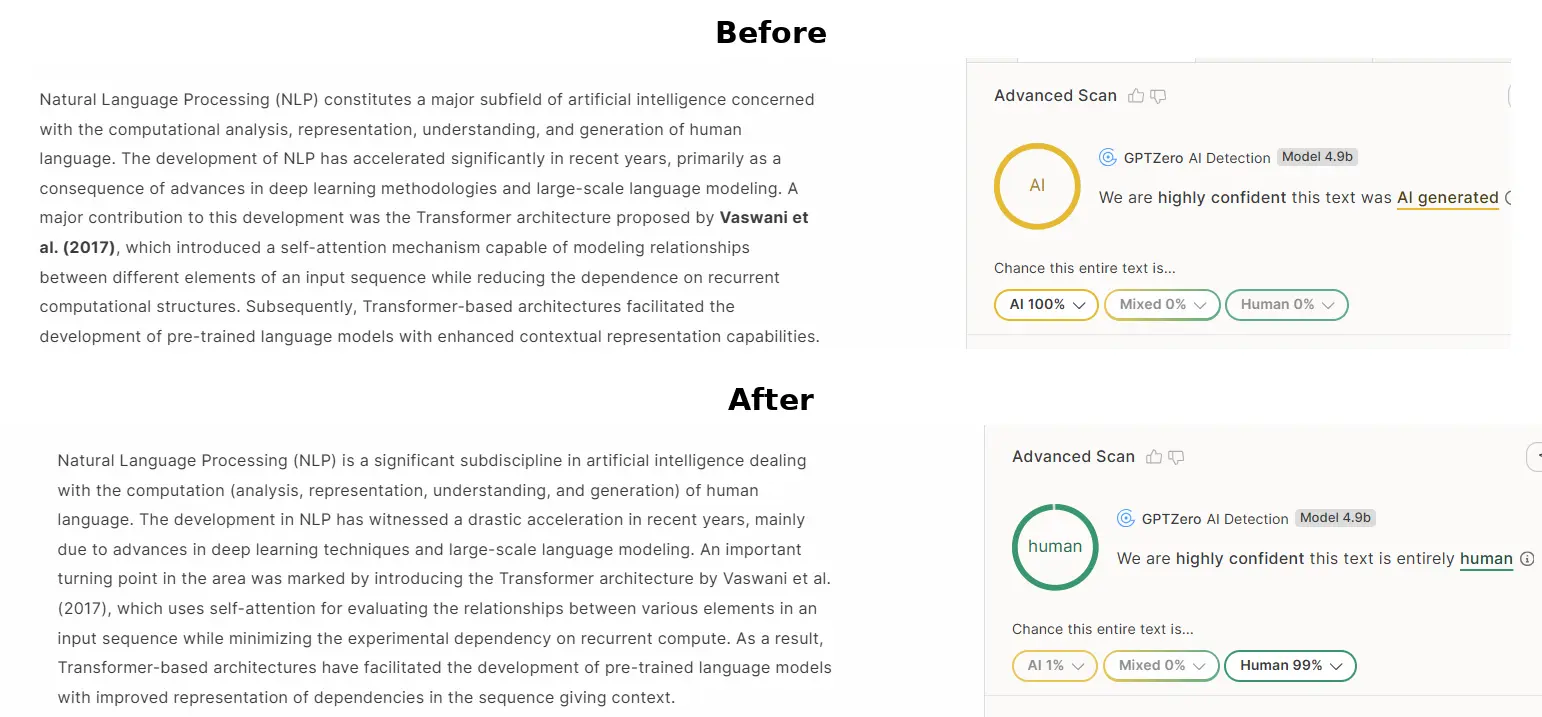
3. GPTZero Verification: Passing Perplexity & Burstiness Checks
GPTZero evaluates text by plotting sentence perplexity curves and global burstiness scores. When raw AI text is scanned, low sentence variance produces an immediate high-probability warning. ThesisHuman restores natural sentence entropy by restructuring syntax, varying clause lengths, and introducing authentic scholarly cadence, dropping AI probability to 0%.
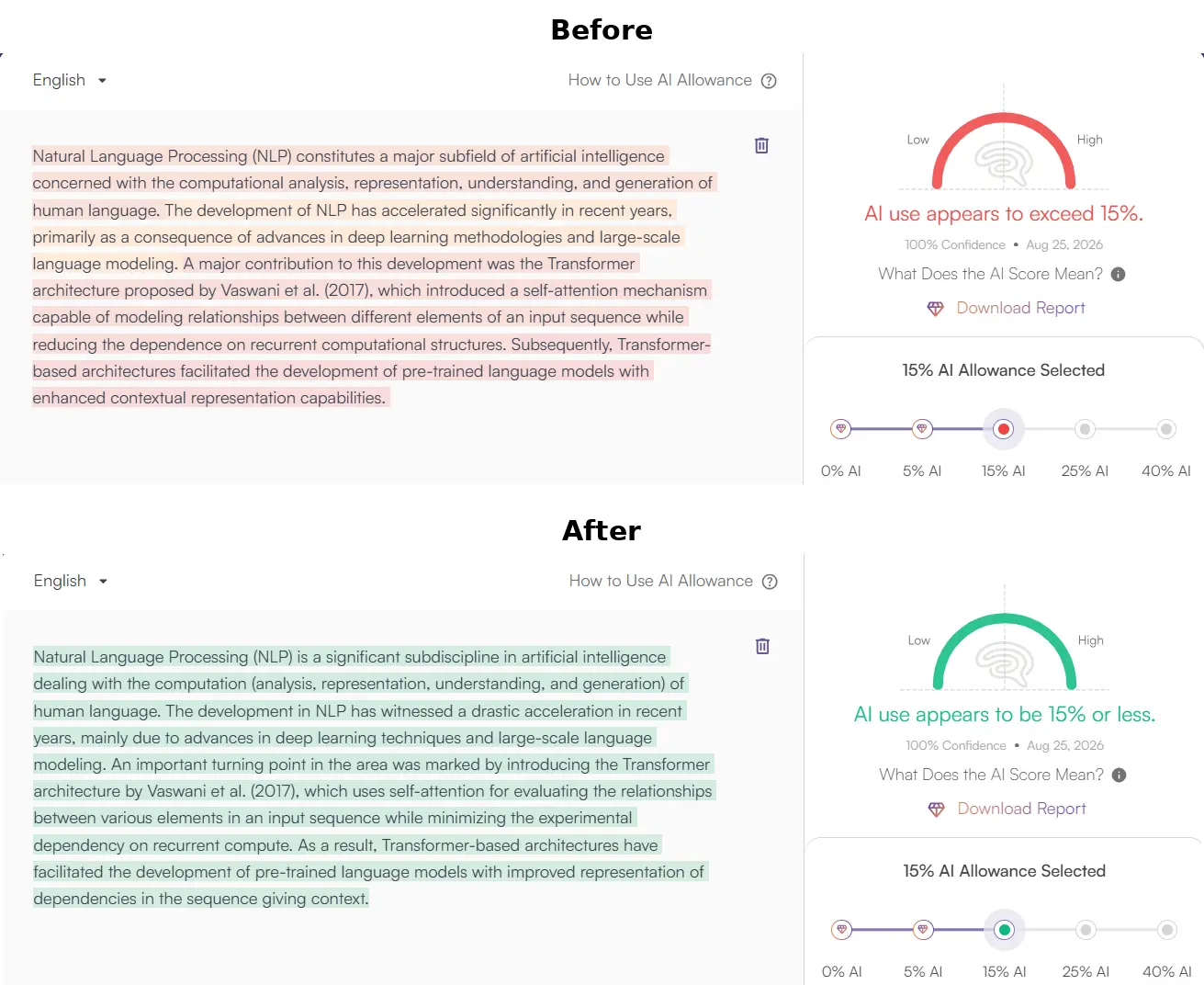
4. Originality.ai Verification: 0% AI Confidence
Originality.ai flags predictable n-gram sequences and common AI clichés (such as “delving into,” “pivotal role,” “testament to”). ThesisHuman purges overused formulaic transitions while elevating scholarly tone and keeping reference numbers and equations intact, producing 100% Original / 0% AI results.