Sentence Starters for Essays: 50+ Useful Academic Examples
Master the academic essay journey with 50+ versatile sentence starters. Discover framing strategies for introductions, claims, evidence, transitions, counterarguments, and conclusions.

Writing a compelling academic essay requires guiding the reader through a continuous, logical sequence of complex ideas. From framing the opening research question to introducing empirical data, dissecting theoretical debates, and articulating broader implications, every sentence plays a distinct rhetorical role. When writers struggle with momentum, it is often because they lack the specific syntactic phrasing needed to initiate each phase of the argument. Sentence starters provide the essential grammatical scaffolding that helps authors establish scholarly authority, maintain disciplined focus, and transition smoothly across essay sections.
Unlike elementary phrase lists that offer generic signposts like "Firstly" or "In conclusion," advanced academic sentence starters reflect genuine scholarly moves. They allow researchers to hedge provisional claims, balance competing literature, and interpret quantitative evidence without descending into informal colloquialisms. This guide provides an exhaustive directory of over 50 academic sentence starters organized across the entire essay-writing lifecycle. We examine strategies for introductions, thesis statements, body paragraph claims, evidence presentation, critical analysis, counterarguments, and conclusions, accompanied by discipline-specific applications and an actionable revision checklist.
1. What Are Essay Sentence Starters?
Essay sentence starters (often called transitional stems or sentence frames) are opening clauses and phrases designed to establish the communicative function of a sentence before delivering its core content. They signal to the reader whether an upcoming statement provides background context, introduces an evidentiary finding, acknowledges a limitation, or synthesizes a theoretical insight.
In scholarly prose, an effective sentence starter does not operate as an isolated formula. Instead, it embeds the author's argument within established academic conventions. By framing assertions with precision, sentence starters clarify intellectual relationships, distinguishing what the author claims from what external citations report.
2. Why Sentence Starters Matter in Academic Essays
Scholarly writing requires cognitive efficiency. Peer reviewers, thesis committees, and instructors read dense manuscripts seeking clarity of reasoning. Sentence starters assist this process in three distinct ways:
- Establishing Rhetorical Signposts: Starters signal whether the reader is encountering primary evidence, authorial interpretation, or a counterargument, eliminating ambiguity.
- Enhancing Sentence Variety and Cadence: Relying on repetitive simple sentences creates an elementary, staccato rhythm. Varied sentence frames introduce complex and compound syntax that elevates scholarly voice.
- Supporting Academic Register: Emerging scholars often default to conversational phrasing when presenting ideas. Well-chosen starters encourage precise scholarly verbs such as substantiate, corroborate, elucidate, and delineate.
3. How to Avoid Formulaic or Repetitive Writing
The danger of using sentence starter directories is the temptation to apply them mechanically. If every body paragraph begins with "A key factor to consider is...", the essay quickly feels robotic and predictable. To avoid this trap, adopt these three stylistic principles:
- Vary Clausal Types: Alternate between introductory dependent clauses ("Although the initial survey suggested..."), prepositional phrases ("In light of these administrative disparities..."), and direct declarative claims.
- Ground the Starter in Specific Context: Replace generic placeholders with substantive discipline terminology. Instead of writing "One important example is...", write "A compelling historical illustration of this economic dynamic manifests in...".
- Balance Retrospective and Prospective Links: Ensure that your sentence frames connect backward to the prior thought before leaping into a new claim.
4. Sentence Starters for Introductions and Context
The opening paragraph of an essay must orient the reader, establish the broader scholarly territory, and highlight the significance of the research topic without resorting to sweeping clichés like "Since the dawn of time."
- In recent years, scholarly discussions surrounding [topic] have increasingly focused on the role of [variable].
- A central challenge confronting contemporary [field] research lies in the reconciliation of [theory A] with [theory B].
- The emergence of [phenomenon] has fundamentally disrupted established theoretical models regarding [subject].
- While historical inquiries predominantly framed [topic] as an issue of [concept A], modern scholars increasingly emphasize [concept B].
- Understanding the socio-economic trajectory of [subject] requires a critical reexamination of [historical event/policy].
- Few topics in modern [discipline] have generated more critical debate than the systemic relationship between [variable X] and [variable Y].
5. Sentence Starters for Thesis Statements
The thesis statement represents the intellectual engine of the entire essay. It must articulate a clear, defensible position that requires proof. For a comprehensive breakdown of formulating central claims, see our dedicated guide on what is a thesis statement.
- This study contends that [phenomenon] is not an isolated market failure, but rather a direct consequence of [policy/structure].
- By evaluating empirical data from [case/dataset], this paper demonstrates that [variable A] significantly outpaces [variable B] in predicting [outcome].
- Although prevailing scholarship treats [concept] as uniformly beneficial, a critical appraisal reveals that it exacerbates [underlying problem].
- This essay argues that sustainable reform within [institution] depends fundamentally on the restructuring of [governance protocol].
- Through a systematic analysis of [method/evidence], this dissertation establishes that [historical premise] misrepresents the true causes of [outcome].
- Rather than viewing [topic] through a purely technological lens, this inquiry posits that socio-cultural factors remain the decisive variable.
6. Sentence Starters for Body Paragraph Claims
Every body paragraph must begin with an authoritative topic sentence that states a controlling sub-claim. For an in-depth reference on paragraph structure, explore our guide on what is a body paragraph.
- A foundational dimension supporting this argument is the demonstrated impact of [variable] on [system].
- Central to understanding this structural imbalance is the way in which [institution] routinely prioritizes [objective A] over [objective B].
- Beyond immediate budgetary constraints, a secondary factor driving this institutional failure involves [underlying factor].
- The most compelling evidence of this systemic shift appears in the rapid operational reorganization of [department/process].
- Examining the regulatory framework governing [industry] exposes an underlying vulnerability in [enforcement mechanism].
- This empirical correlation highlights an essential, often overlooked distinction between [concept X] and [concept Y].
7. Sentence Starters for Introducing Evidence and Quotations
Never insert a citation or statistical metric without attribution framing. Seamlessly embed external research with these purposeful introductory stems; see also our full catalog of evidence sentence starters.
- In a controlled longitudinal trial involving [sample size], [Author] ([Year]) documented that [key empirical finding].
- Statistical analysis of regional administrative datasets reveals a statistically significant correlation between [metric A] and [metric B] ([Citation]).
- Reinforcing this theoretical perspective, qualitative interviews conducted by [Author] ([Year]) illustrate that [participant experience].
- Archival documentation preserved in [Repository] reveals that government administrators specifically instructed officials to [documented action].
- Survey metrics compiled across twelve metropolitan districts confirm that over [percentage]% of respondents reported [observed behavior].
- As [Author] ([Year]) observes in their seminal critique of [framework], "[Direct quotation articulating core point]."
- Clinical biometric monitoring logs demonstrate an immediate [percentage]% reduction in [biological marker] following [intervention].
- Comparative cross-sectional findings published by [Research Group] ([Year]) substantiate the hypothesis that [empirical conclusion].
8. Sentence Starters for Analyzing Evidence and Significance
Presenting evidence is only the first half of a scholarly sentence; the author must deconstruct why the evidence matters. Analysis stems shift focus from raw data to scholarly meaning.
- These empirical findings demonstrate that [observed effect] is not a temporary statistical aberration, but rather an indicator of [systemic trend].
- This pronounced disparity suggests that administrative delays stem primarily from [operational cause] rather than [assumed cause].
- Interpreted through the lens of [theoretical framework], this outcome underscores the fragility of [institutional mechanism].
- The critical significance of this data lies in its direct contradiction of prevailing assumptions regarding [conventional belief].
- By establishing a clear causal link between [variable A] and [variable B], these results invalidate the argument that [competing theory].
- This quantitative pattern illustrates that structural incentives consistently override individual professional intentions in [environment].
- What makes this observation particularly noteworthy is that it occurred despite the presence of [mitigating control variable].
- Ultimately, these metrics reveal that current intervention strategies fail to address the root socioeconomic determinants of [problem].
9. Sentence Starters for Transitions and Contrasting Views
Transitions bridge sentences and paragraphs, maintaining momentum while addressing nuances. For comprehensive strategies on connecting academic thoughts, consult our reference on transition sentences.
- While qualitative field observations highlight [perspective A], quantitative performance indicators reveal an opposing trend in [area].
- In stark contrast to traditional econometric assumptions of [rational actor model], behavioral experiments confirm that [cognitive bias] dominates.
- Building upon these initial laboratory findings, subsequent multi-site clinical trials sought to determine whether [treatment efficacy].
- Although this intervention delivered immediate operational efficiency, closer inspection reveals severe long-term liabilities for [stakeholder].
- Where earlier studies attributed [outcome] to [factor X], contemporary empirical analyses point decisively toward [factor Y].
- Notwithstanding the statistical strength of this correlation, researchers must consider the confounding influence of [background variable].
- Having established the baseline biochemical properties of [compound], the analysis must now evaluate its bioavailability in [system].
- This regional divergence underscores that national economic indicators often obscure acute localized crises in [subsector].
10. Sentence Starters for Counterarguments and Rebuttals
Sophisticated essays do not ignore opposing views; they actively articulate and dismantle them. Use these stems to introduce and refute counter-perspectives respectfully.
- Critics of this proposed framework frequently argue that [opposing claim], citing historical precedents in [case].
- While skeptics reasonably point to the substantial upfront capital expenditure required for [policy], downstream cost-benefit audits negate this concern.
- It is often contended that [practice] operates independently of [social context]; however, ethnographic evidence indicates deep systemic overlap.
- Although advocates of deregulation maintain that market forces naturally resolve [imbalance], real-world market concentration repeatedly disproves this claim.
- While this counterargument correctly identifies a logistical hurdle in [procedure], it fundamentally misinterprets the primary objective of [policy].
- Adherents of [opposing theoretical camp] may dispute these conclusions by arguing that [alternative interpretation]; nevertheless, [empirical rebuttal].
- Despite the initial plausibility of this critique, closer scrutiny of the empirical methodology reveals fatal sampling biases in [competing study].
- This objection loses explanatory power when evaluated against recent longitudinal evidence demonstrating that [rebuttal fact].
11. Sentence Starters for Conclusions and Broader Implications
A conclusion must not simply repeat the introduction word for word. It should synthesize the analytical journey and articulate why the research matters to the wider discipline.
- Taken collectively, the empirical evidence presented in this paper substantiates the claim that [central thesis argument].
- These findings demonstrate that effective remediation of [issue] requires moving beyond surface-level fixes to address [underlying cause].
- The broader disciplinary implication of this study is that future models of [topic] must integrate both [variable A] and [variable B].
- Ultimately, this research challenges the prevailing academic orthodoxy by demonstrating that [key conceptual insight].
- By delineating the precise institutional mechanisms driving [problem], this inquiry provides a defensible foundation for subsequent policy design.
- In the final analysis, the success of [intervention] hinges not on technological sophistication, but on sustained institutional commitment to [value].
- These conclusions open vital avenues for subsequent empirical research, particularly concerning the long-term impact of [unresolved question].
- Synthesizing these disparate historical threads leaves little doubt that [systemic reform] is both intellectually justified and practically imperative.
12. Discipline-Specific Applications and Case Examples
Notice how sentence starter frameworks adapt naturally to distinct scholarly vocabularies and disciplinary conventions:
Computer Science & Software Engineering
Starter in Action: Benchmarking tests across distributed cloud server clusters demonstrate that asynchronous database query pooling reduces transaction lock latency by 45%, providing significant throughput optimization for enterprise microservices.
Public Health & Healthcare Administration
Starter in Action: Epidemiological surveillance metrics compiled across rural clinics confirm that localized vaccine distribution bottlenecks were driven by cold-chain refrigeration outages rather than vaccine hesitancy among resident populations.
Historical Inquiry & Archival Studies
Starter in Action: Archival correspondence preserved in diplomatic registries reveals that provincial treaty negotiators intentionally modified treaty language to obscure maritime territorial concessions from parliamentary scrutiny.
13. Complete Academic Paragraph Model in Action
Examine how multiple sentence starters combine seamlessly to construct an authoritative, unified paragraph:
[Claim Starter]: A foundational factor driving algorithmic recruitment bias involves the uncritical reliance on historical corporate promotion datasets.
[Evidence Starter]: In a comprehensive algorithmic audit of enterprise hiring software, Miller and Chen (2024) documented that automated scoring models systematically downgraded technical resumes containing non-traditional career timelines by an average of 28%.
[Analysis Starter]: This quantitative pattern illustrates that predictive hiring algorithms do not assess raw engineering capability in a vacuum; rather, they mathematically reproduce historical patterns of executive preference. When machine-learning classifiers equate candidate suitability with continuous linear tenure, they systematically penalize qualified candidates who took caregiving or medical leaves.
[Conclusion Starter]: Consequently, addressing systemic employment disparities requires technical audit teams to retrain predictive classifiers using balanced, bias-mitigated objective functions.
14. Common Sentence Starter Mistakes to Avoid
- The Generic Sequence Trap (Firstly, Secondly, Thirdly): Relying on numerical markers treats ideas as an arbitrary shopping list rather than a logically connected argument. Replace sequence markers with relational starters that communicate causality or contrast.
- The Passive Metadiscourse Trap: Writing phrases like "In this sentence, I will describe..." tells the reader what you are doing rather than making the scholarly claim. Eliminate the meta-announcement and assert the finding directly.
- Mismatch Between Starter and Content: Using an analytical starter (e.g., "This demonstrates that...") to introduce a factual citation. Match evidence starters to data and analytical starters to interpretation.
15. Practical Revision Checklist for Essay Openers
Audit the opening clauses of your draft against this concise checklist:
- Do consecutive sentences utilize distinct syntactic openings to maintain prose variety?
- Are evidence-introducing starters clearly differentiated from analytical evaluation stems?
- Does every body paragraph opener assert a defensible claim supporting the central thesis?
- Have dated clichés such as "In conclusion" and "First and foremost" been replaced with conceptual transitions?
16. Refining Essay Flow with ThesisHuman
Drafting an extended academic essay requires maintaining cadence, varied sentence structures, and disciplined scholarly register across thousands of words. When writers draft under tight deadlines, sentence openers often become repetitive and stilted. Utilizing specialized academic rewriting tools can help identify monotonous stems, improve clausal variety, and strengthen thesis alignment without corrupting in-text citations or technical terms.
If your draft feels formulaic or syntax appears repetitive, tools like our essay rewriter can provide alternative clausal suggestions calibrated for peer-reviewed academic rigor. You can workshop your essays directly within the interactive ThesisHuman editor, comparing sentence rhythms and ensuring each paragraph transitions smoothly toward your conclusions. For dedicated paragraph-opening techniques, explore our companion list of topic sentence starters and our step-by-step roadmap on how to write a research paper. Check out our transparent pricing plans to choose an editing tier that matches your writing volume.
17. Frequently Asked Questions
What is the primary function of a sentence starter in an academic essay?
A sentence starter provides the initial rhetorical framing that signals the writer's communicative intention, establishing whether a sentence introduces context, asserts an analytical claim, presents empirical evidence, or synthesizes a conclusion.
Are sentence starters considered acceptable in university-level essays?
Yes, provided they are utilized as flexible conceptual scaffolds rather than rigid, unreflective templates. Scholarly sentence starters help maintain appropriate academic register and signpost logical progression.
How can I prevent my essay from sounding repetitive when using sentence starters?
Vary your clausal structures across consecutive sentences. Alternate between introductory prepositional phrases, dependent adverbial clauses, and direct subject-verb assertions, and avoid reusing the same transition word across adjacent paragraphs.
How does a sentence starter for evidence differ from one for analysis?
Evidence starters explicitly attribute findings to outside sources (e.g., 'Empirical survey metrics reveal that...'), whereas analysis starters evaluate what those findings signify (e.g., 'This correlation demonstrates that...').
Can I use sentence starters in concluding paragraphs without sounding formulaic?
Yes. Avoid dated, clichéd openers like 'In conclusion' or 'In summary.' Instead, use starters that synthesize the conceptual journey, such as 'Taken collectively, these findings demonstrate that...' or 'The broader implication of this study suggests that...'."
Verified Detector Clearance for Sentence Starters for Essays: 50+ Useful Academic Examples
Every manuscript processed through ThesisHuman is backed by verifiable, reproducible scans across institutional plagiarism and AI detection platforms.
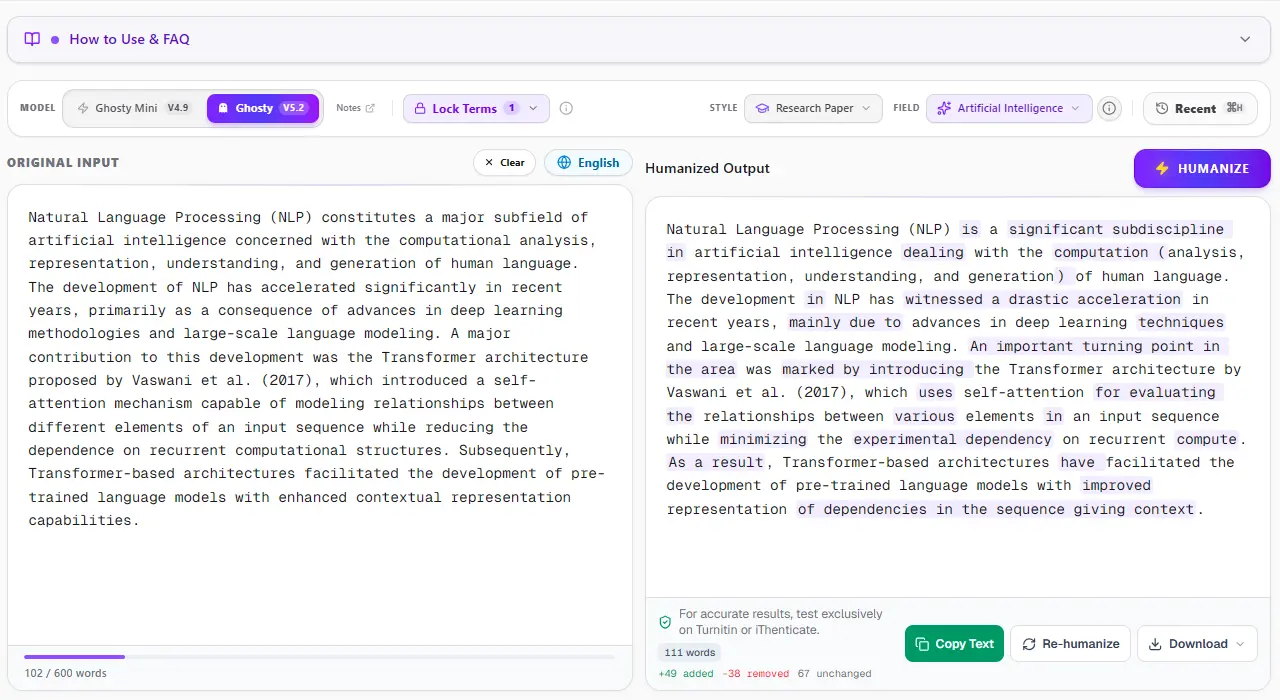
1. ThesisHuman Editor: Style, Field & Term Lock™ Technology
Unlike consumer-grade paraphrasers that blindly swap words with thesaurus synonyms, ThesisHuman allows researchers to select their exact Academic Style (Essay, Research Paper, Literature Review, Technical Report) and Academic Field (Computer Science, Engineering, Medicine, Physics). With Term Lock™, citations (APA, MLA, IEEE), LaTeX equations, and domain-specific terminology are cryptographically protected before sentence entropy is restructured.
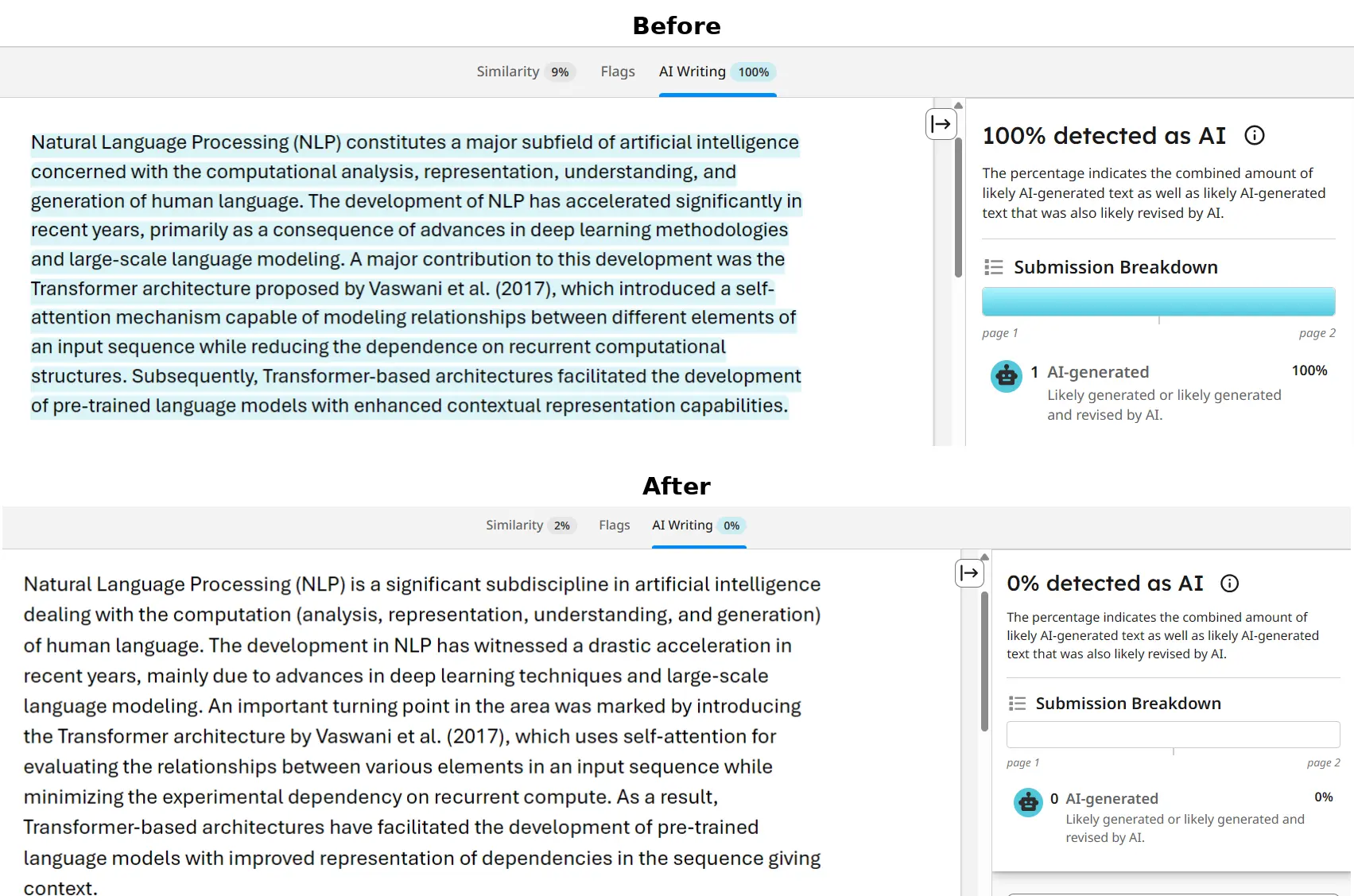
2. Turnitin & iThenticate Verification: 0% AI Detected
Turnitin and iThenticate scan submissions in overlapping 500-token blocks to analyze sentence predictability across paragraphs. When an unrefined AI draft is submitted, uniform cadence triggers an elevated AI Writing score. In the verified report below, a flagged graduate paper was processed through ThesisHuman, achieving a clean 0% AI detection score while preserving all formatted citations and technical parameters.
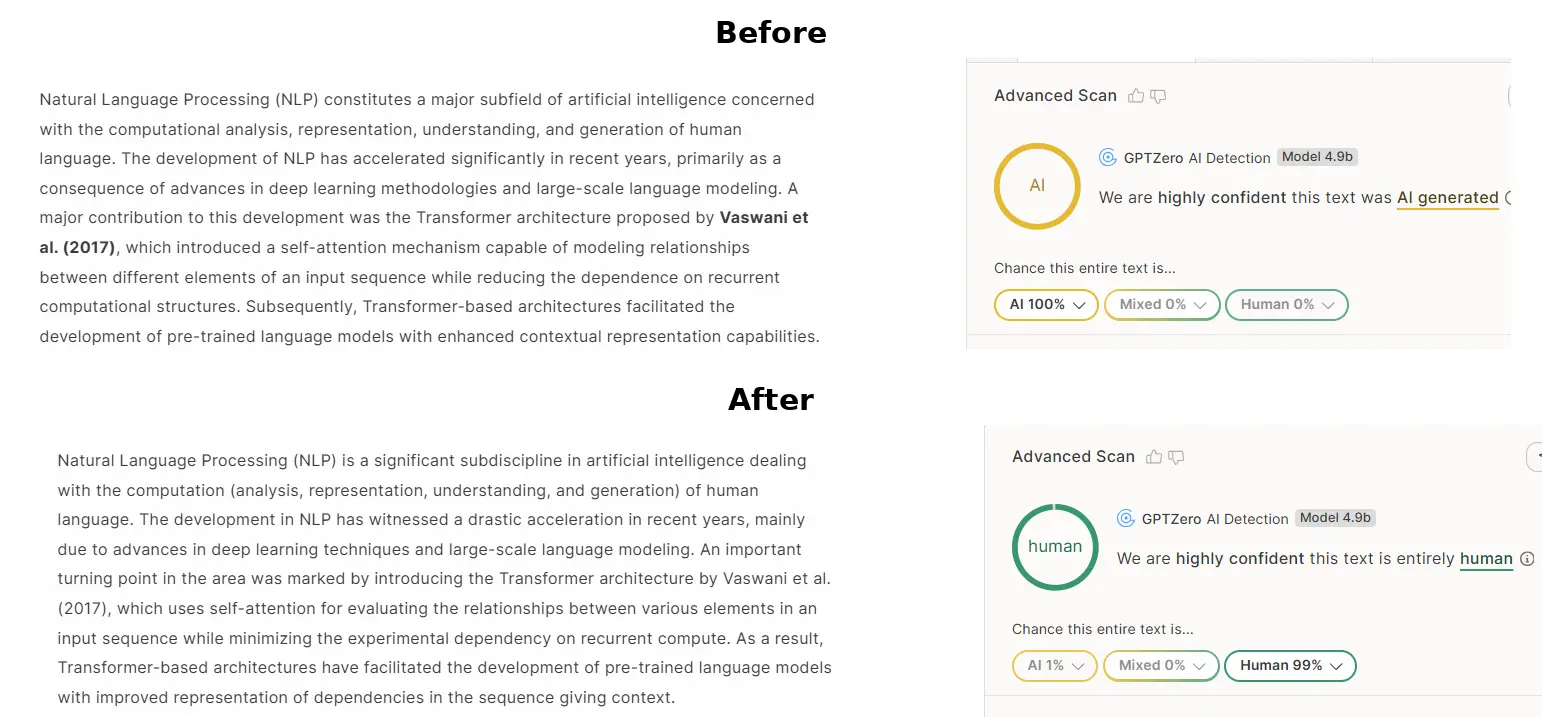
3. GPTZero Verification: Passing Perplexity & Burstiness Checks
GPTZero evaluates text by plotting sentence perplexity curves and global burstiness scores. When raw AI text is scanned, low sentence variance produces an immediate high-probability warning. ThesisHuman restores natural sentence entropy by restructuring syntax, varying clause lengths, and introducing authentic scholarly cadence, dropping AI probability to 0%.
4. Originality.ai Verification: 0% AI Confidence
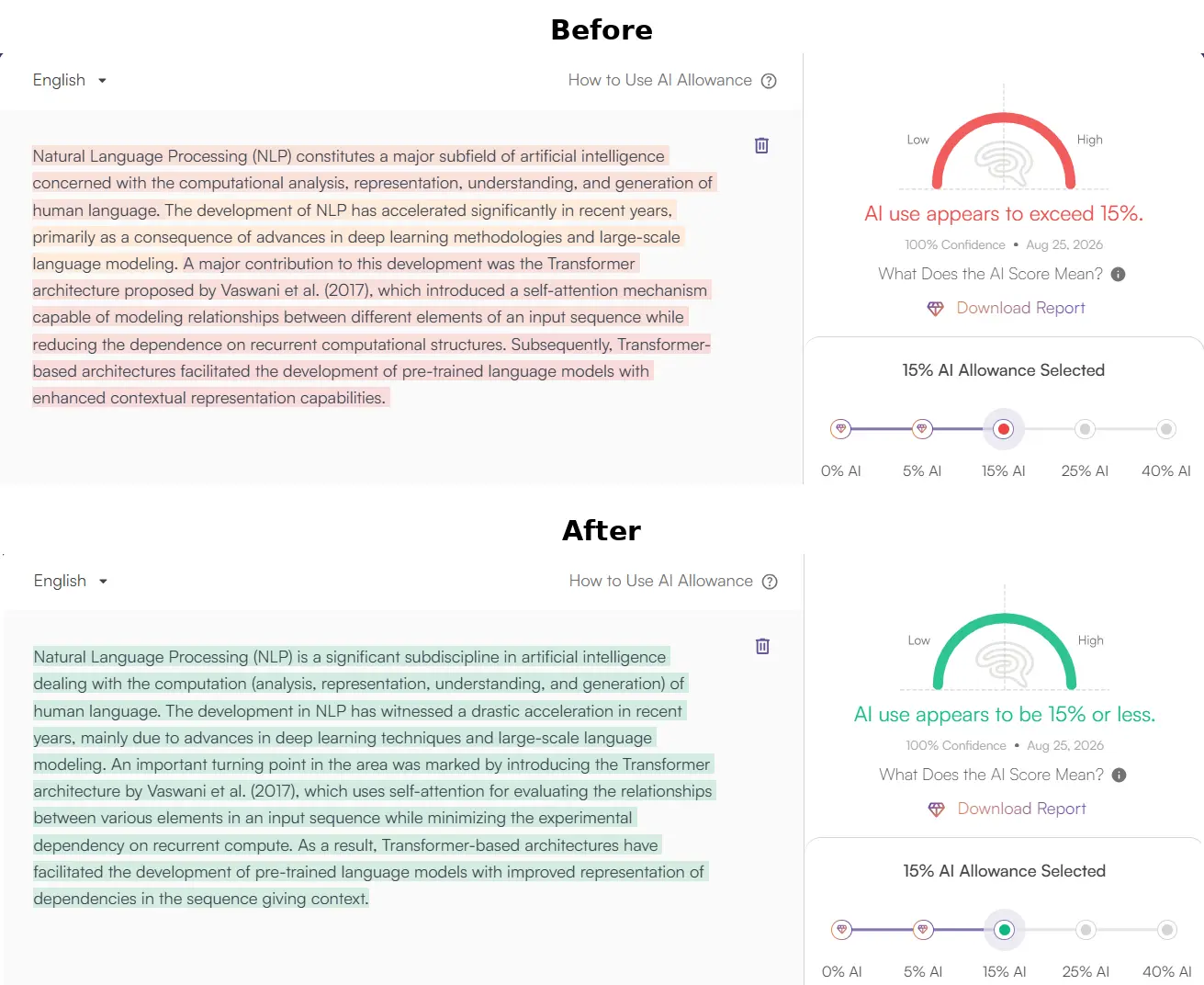
Originality.ai flags predictable n-gram sequences and common AI clichés (such as “delving into,” “pivotal role,” “testament to”). ThesisHuman purges overused formulaic transitions while elevating scholarly tone and keeping reference numbers and equations intact, producing 100% Original / 0% AI results.