AI Detection Tools in Higher Education: A Comprehensive Guide for Students and Researchers
An in-depth analysis of how university AI detection tools work, why they produce false positive flags on non-native and technical writing, and how to protect your academic work with a documented drafting audit trail.

Over the past three academic years, the deployment of automated AI detection software across colleges and research universities has transformed the relationship between students, researchers, and institutional evaluators. What began as experimental pilot programs in writing centers has matured into widespread institutional integration: learning management systems like Canvas and Blackboard now automatically pipe student submissions into background classifiers before teaching assistants even open an essay.
Yet beneath this veneer of automated vigilance lies an uncomfortable reality: statistical AI classifiers do not possess forensic insight into authorship. They do not know who sat at the keyboard, how many hours were spent in university archives, or whether a passage was drafted through painstaking human revision or generated in three seconds by a large language model. Instead, every AI detection tool functions as an inference engine, calculating the mathematical probability that a sequence of words resembles the default output distributions of contemporary autoregressive transformers.
For graduate students submitting electronic theses, undergraduate researchers composing capstone projects, and postdocs drafting journal manuscripts, navigating this landscape requires an unvarnished understanding of detector mechanics. Understanding how detection tools work, where their structural blind spots lie, and how to construct an ironclad audit trail of your writing process is essential for defending your academic reputation against automated false positives.
The Rapid Rise of AI Detection Tools in Higher Education
When commercial large language models became widely accessible in late 2022, university administrations faced an unprecedented challenge. Traditional plagiarism detection infrastructure, exemplified by string-matching tools like Turnitin and Crossref Similarity Check, depended on direct database matching. If a student lifted a paragraph from a published journal or another student's dissertation, the software highlighted the exact duplicated n-grams and provided a direct hyperlink to the source URL.
Generative artificial intelligence shattered that paradigm. Large language models generate novel sequences of tokens on the fly based on probabilistic next-token predictions. A student could prompt a model to synthesize a literature review on organizational behavior, and the resulting prose would return a spotless zero percent traditional plagiarism score while being completely synthetic in origin. In response, academic vendors rushed to build classifiers capable of analyzing the linguistic texture of the prose itself rather than its database overlap.
Today, commercial AI detection tools are embedded throughout global higher education. Turnitin AI Writing Indicator evaluates millions of student assignments each semester. Institutional licenses for Copyleaks, GPTZero, and Originality.ai are routinely purchased by departmental faculties. Even publisher portals like Elsevier and Springer Nature utilize iThenticate's integrated AI indicators to screen incoming journal submissions before assigning peer reviewers. However, the speed of this institutional rollout has far outpaced independent scientific validation, creating severe frictions between students and academic integrity committees.
How Modern AI Detection Tools Actually Work
To understand why an AI detection tool flags certain passages while ignoring others, you must look past marketing promises and examine the underlying statistical classifiers. AI detectors do not detect ideas, intent, or truth; they evaluate two mathematical properties of written text: perplexity and burstiness.
Perplexity: Measuring Predictability at the Token Level
Perplexity is a measurement of how likely or predictable a given word is within its preceding context. When a large language model generates text, it calculates a probability distribution across its entire vocabulary for the next token. Unless directed to use extreme temperature sampling, models systematically select tokens with high mathematical probability. The result is prose that follows the path of least linguistic resistance.
An AI detection tool reverses this calculation. As the classifier reads your essay, it feeds each sentence through an internal evaluator and asks: "Given these first ten words, what was the mathematical probability of word eleven?" If every consecutive word choice matches the highest-probability distribution of standard transformer models, the text exhibits low perplexity. To an automated detector, low perplexity is the primary fingerprint of machine generation.
Human writers, by contrast, naturally exhibit higher perplexity. We select uncommon metaphors, insert discipline-specific jargon, alter grammatical registers mid-paragraph, and construct idiosyncratic rhetorical flourishes. When a detector encounters these unpredictable lexical choices, perplexity spikes, signaling to the classifier that human cognition guided the prose.
Burstiness: Measuring Syntactic and Clausal Variation
While perplexity operates at the word level, burstiness evaluates the rhythmic structure of sentences across paragraphs. Human speech and writing are fundamentally bursty: we naturally vary our sentence lengths and clausal architectures. A human scholar might compose a dense, forty-word compound-complex sentence establishing a theoretical framework, immediately followed by a crisp five-word assertion. Paragraphs written by humans breathe with dynamic syntactic rhythm.
Generative models struggle with authentic burstiness. Because transformer architectures optimize for continuous coherence across context windows, their default output tends toward uniform sentence lengths, typically clustering between eighteen and twenty-four words. Every sentence opens with a similar transitional prepositional phrase, proceeds through a predictable subject-verb-object arrangement, and concludes with a polite qualifying clause. AI detection tools calculate the statistical variance in sentence lengths across a document; when variance falls below an empirical baseline, the detector flags the passage as synthetic.
Classifier Thresholds and Institutional Scoring
Once a detector calculates perplexity and burstiness metrics across a submission, it maps those values against a machine-learning classification model trained on millions of labeled human and machine-generated texts. The software outputs a percentage score representing the classifier's statistical confidence that the document contains synthetic writing.
Crucially, this score is not an objective percentage of copied words. A Turnitin score of 42% does not mean that exactly 42% of the sentences were copied from ChatGPT; it means the classifier is confident that 42% of the text displays statistical traits characteristic of machine generation. When professors misinterpret this probability score as a deterministic measure of misconduct, serious institutional miscarriages occur.
Why AI Detection Tools Frequently Produce False Positives
The fundamental flaw in modern AI detection tools is that the statistical properties associated with machine writing are also characteristic of certain types of legitimate, rigorous human scholarship. Detectors evaluate form rather than substance, leading to predictable systemic false positives.
The Documented Bias Against Non-Native English Scholars
Multiple peer-reviewed studies, including landmark evaluations conducted by Stanford University researchers, have revealed a severe structural bias in commercial AI detection tools: they systematically misclassify text written by non-native English speakers as artificial intelligence. International students and English as a Second Language (ESL) researchers frequently rely on standardized sentence templates, cautious vocabulary, and precise grammatical constructions learned from formal English composition textbooks.
Because these scholars avoid obscure colloquialisms and maintain consistent syntactic patterns to ensure clarity, their writing exhibits low perplexity and low burstiness. To an automated detector like Copyleaks or Turnitin, this careful, disciplined human prose looks indistinguishable from an unedited model output. Flagging an international student for academic dishonesty simply because their English adheres to textbook grammar represents an unacceptable failure of institutional technology.
Technical Nomenclature and Formulaic Methods Sections
A second major category of false positives occurs within scientific, technical, engineering, and mathematics (STEM) writing. Scientific publication demands standardized vocabulary and rigid clausal structures. When describing a polymerase chain reaction protocol, an organic synthesis procedure, or an econometric regression model, researchers are expected to use established disciplinary phrasing.
If a graduate student writes: "Data were collected across three experimental trials and analyzed using an ordinary least squares regression model with robust standard errors," the sentence has exceptionally low perplexity. Every statistician would predict that sequence of words. When an AI detector evaluates such a methodology section, it frequently highlights multiple paragraphs in red, falsely claiming the researcher pasted the text from a generative chatbot.
University AI Policies: What Syllabus Clauses Actually Mean
To protect your academic standing, you must carefully decode the AI policy statements present in your course syllabi and university honor codes. Across global higher education, institutional policies generally fall into three distinct categories:
- Complete Prohibition (Strict Prohibitionist): Some humanities seminars and introductory composition courses explicitly forbid any interaction with generative language models. In these classrooms, even using AI for brainstorming or grammar checking is classified as an honor code violation. Submitting an assignment that trips an AI detector in such a course will immediately trigger an integrity review.
- Permitted for Ideation with Mandatory Disclosure: An increasing majority of university faculties recognize that AI tools are ubiquitous professional assets. These policies allow students to consult models for preliminary literature discovery, coding assistance, or outline structuring, provided that the student discloses the prompt history and explicitly attributes machine contributions in an appendix or methodology footnote.
- Full Editorial Integration with Author Responsibility: Advanced research programs, graduate departments, and leading academic publishers (including Elsevier, IEEE, and Nature) permit authors to use generative tools to polish prose and refine language, provided that the human author assumes complete intellectual responsibility for factual accuracy, citation integrity, and conceptual originality.
Never assume that a policy in your biology lab applies to your sociology seminar. Always check the exact wording of each syllabus, and when in doubt, request written clarification from your instructor regarding permitted language-editing tools.
Building a Defensible Drafting Audit Trail
If you are ever confronted with an unexpected AI detection flag, your strongest asset is not emotional protestation; it is forensic documentation of your labor. AI detectors offer probabilistic guesses; a documented audit trail offers undeniable historical fact. Implement the following habits on every major academic assignment:
- Enable Detailed Cloud Version History: Always draft your papers in cloud-enabled editors such as Google Docs or Microsoft 365 Word with continuous auto-save activated. These platforms record granular keystroke histories, showing how paragraphs were drafted, deleted, reorganized, and refined over days or weeks. An instantaneous paste of two thousand words looks suspicious; a four-week revision log with seventy intermediate versions proves genuine authorship.
- Preserve Outlines and Annotated Bibliographies: Save your preliminary concept maps, handwritten thesis outlines, and notes from original PDF source readings. When you can show an instructor the highlighted journal article from which a specific argument was derived, accusations of generative hallucination dissolve.
- Maintain Reference Management Archives: Use dedicated bibliographic tools like Zotero, Mendeley, or EndNote. These applications maintain timestamped database records of when source citations were imported and formatted, corroborating the authenticity of your literature citations.
Ethical Revision: Refining AI-Assisted Prose into Authentic Scholarly Writing
When using computational assistance to polish your academic prose, avoiding false-positive detector flags requires deliberate editorial intervention rather than superficial tricks. Naive internet gimmicks like inserting zero-width spaces, swapping Latin letters for Cyrillic homoglyphs, or running text through crude synonym spinners do not work. Modern detectors strip hidden characters during pre-processing, and institutional scanners flag intentional obfuscation as deliberate tampering.
Instead, authentic humanization requires structural syntactic revision that elevates perplexity and restores natural clausal burstiness while safeguarding your scholarship:
- Deconstruct Uniform Sentence Cadence: Break monotonous compound sentences into varied rhetorical units. Pair detailed thirty-word technical explanations with direct, declarative claims.
- Purge Generative Vocabulary Clichés: Large language models overuse predictable transitional markers. Systematically eliminate empty flourishes such as "it is crucial to delve into," "a testament to," "multifaceted tapestry," and "furthermore." Replace them with precise, disciplinary verbs.
- Lock Citations and Formula Syntax: When revising, never permit automated tools to rewrite author-date parenthetical citations (e.g., APA, Harvard) or bracketed numerical references (IEEE). If a tool rewords "(Smith & Roberts, 2024)" or modifies a LaTeX variable, your academic integrity is instantly compromised.
For researchers requiring automated assistance calibrated specifically for university standards, the ThesisHuman editor offers an academic-first synthesis environment. Unlike general commercial alternatives like Clever AI Humanizer, ThesisHuman incorporates Term Lock technology to freeze citations and LaTeX math while restructuring sentence syntax into genuine scholarly prose. You can also explore our free AI humanizer to test short drafts with zero credit card required.
For deeper investigations into specific detector architectures, consult our comprehensive Turnitin AI detection guide, review our empirical AI humanizer detector investigation, or study our tactical tutorial on how to make AI undetectable through legitimate linguistic revision.
Frequently Asked Questions
Verified Detector Clearance for AI Detection Tools in Higher Education: A Comprehensive Guide for Students and Researchers
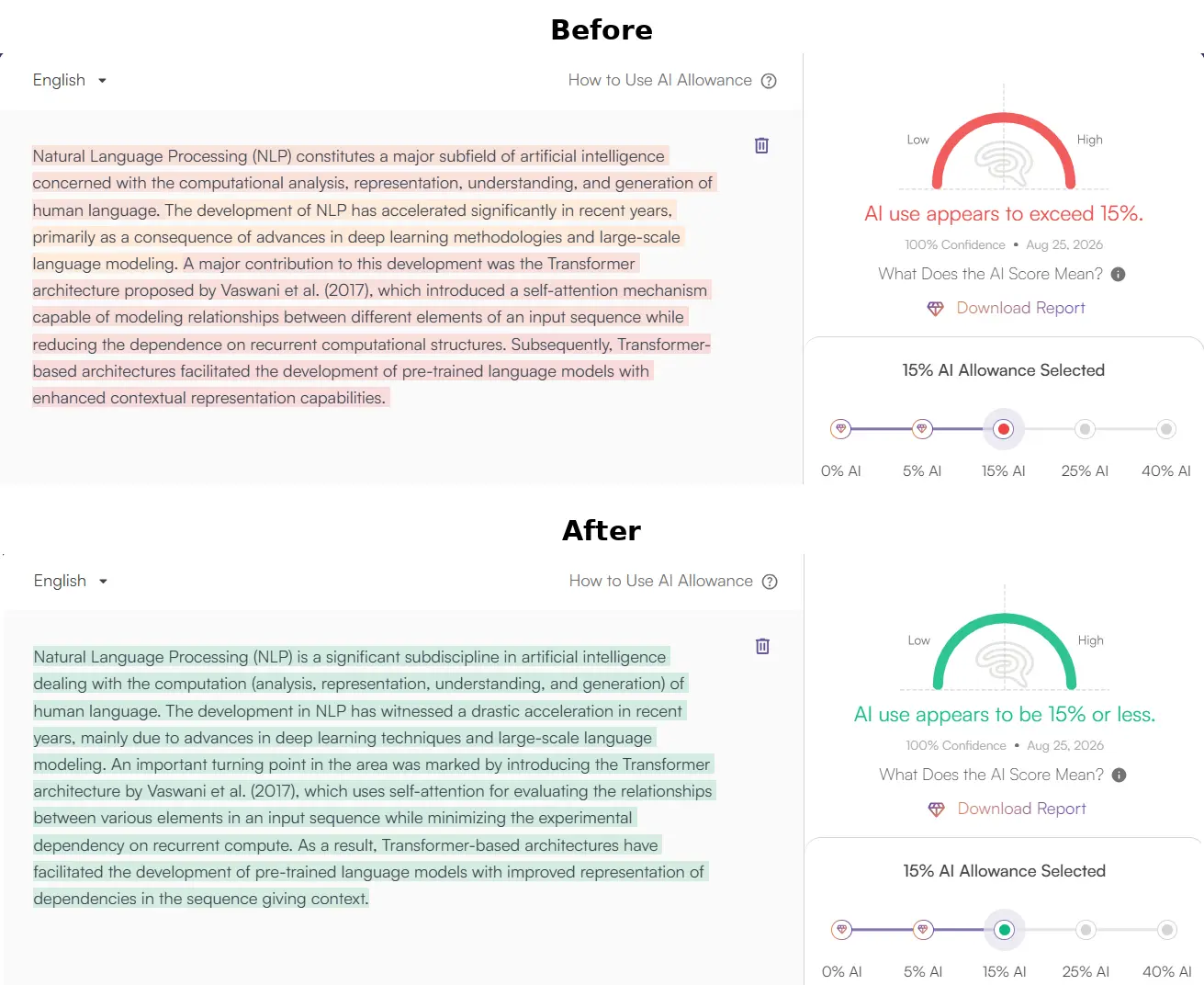
Every manuscript processed through ThesisHuman is backed by verifiable, reproducible scans across institutional plagiarism and AI detection platforms.
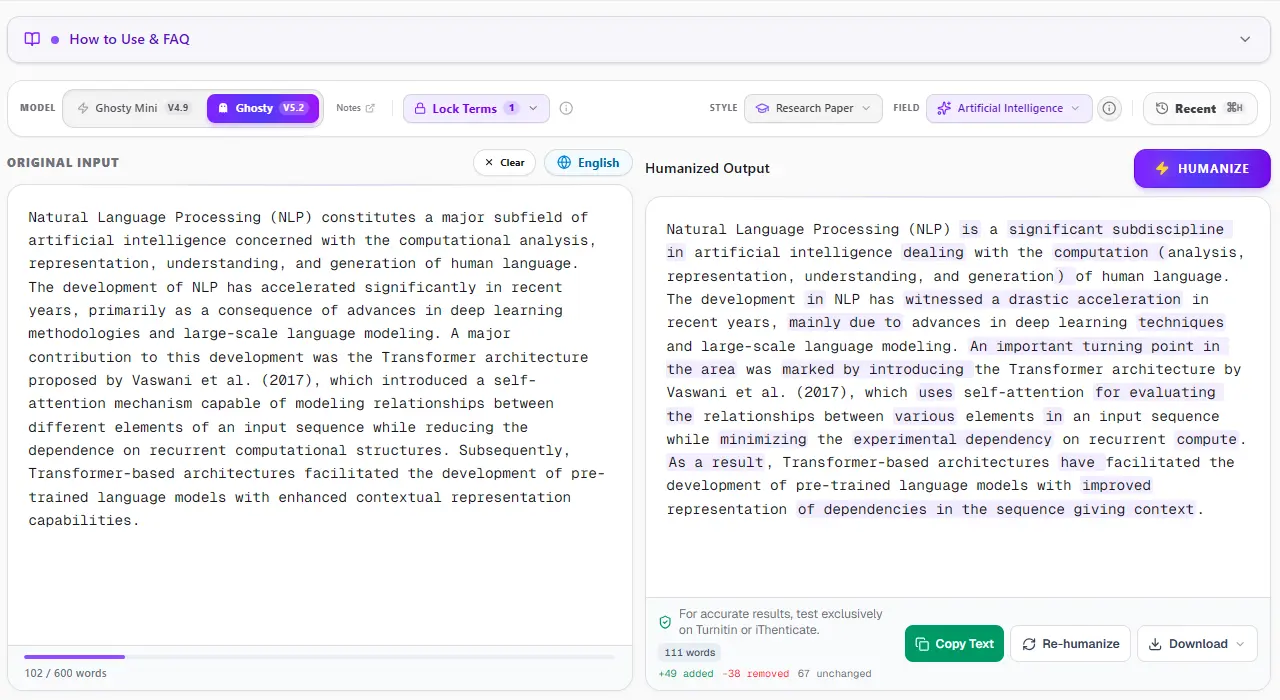
1. ThesisHuman Editor: Style, Field & Term Lock™ Technology
Unlike consumer-grade paraphrasers that blindly swap words with thesaurus synonyms, ThesisHuman allows researchers to select their exact Academic Style (Essay, Research Paper, Literature Review, Technical Report) and Academic Field (Computer Science, Engineering, Medicine, Physics). With Term Lock™, citations (APA, MLA, IEEE), LaTeX equations, and domain-specific terminology are cryptographically protected before sentence entropy is restructured.
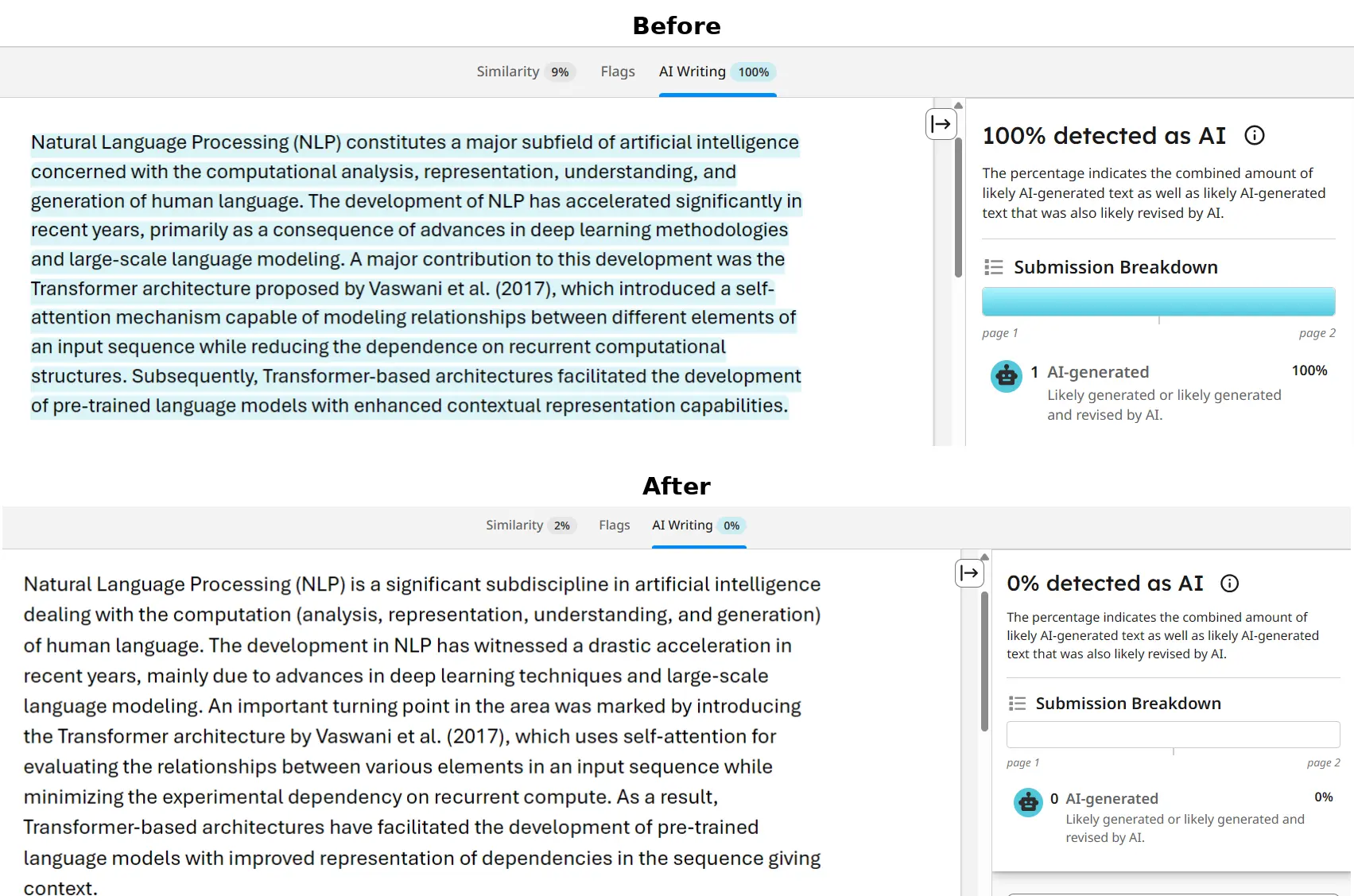
2. Turnitin & iThenticate Verification: 0% AI Detected
Turnitin and iThenticate scan submissions in overlapping 500-token blocks to analyze sentence predictability across paragraphs. When an unrefined AI draft is submitted, uniform cadence triggers an elevated AI Writing score. In the verified report below, a flagged graduate paper was processed through ThesisHuman, achieving a clean 0% AI detection score while preserving all formatted citations and technical parameters.
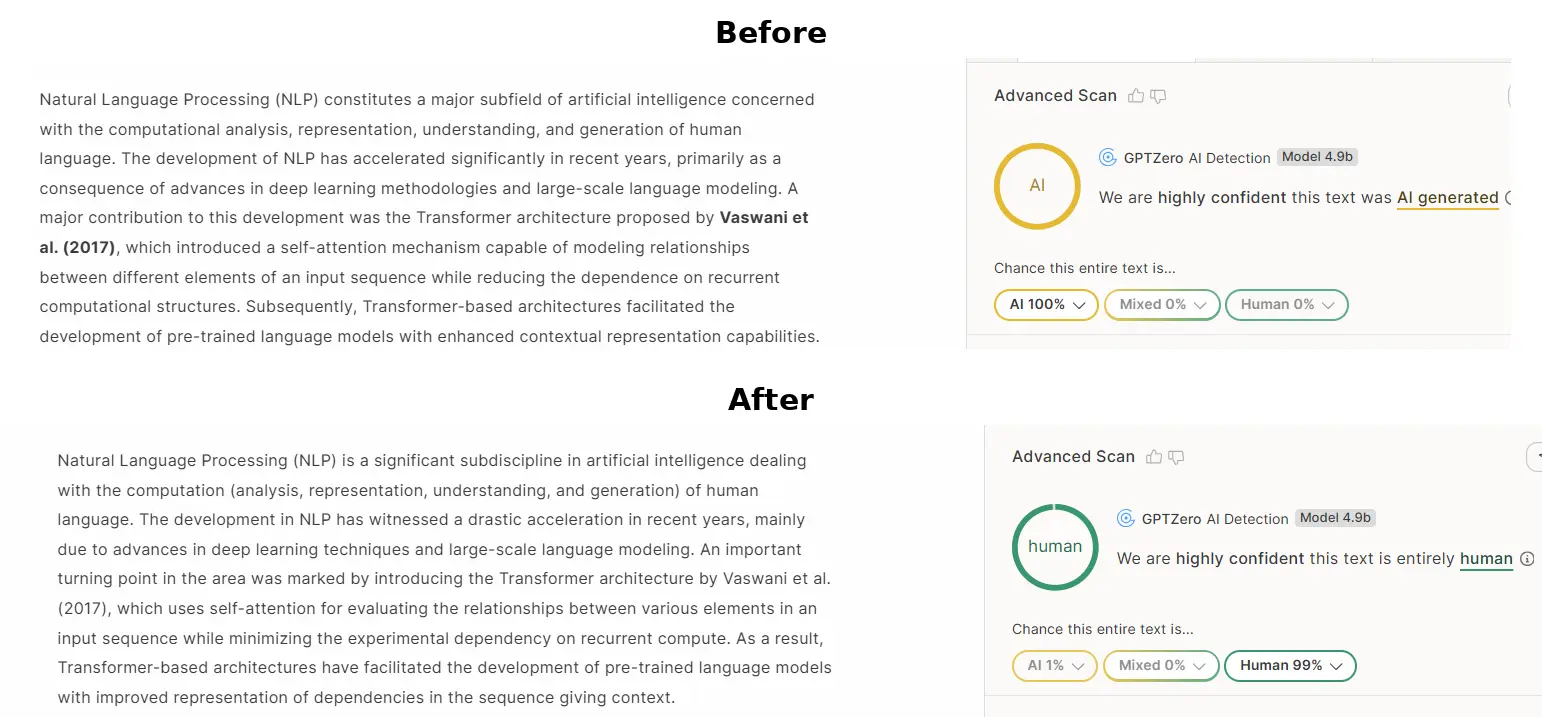
3. GPTZero Verification: Passing Perplexity & Burstiness Checks
GPTZero evaluates text by plotting sentence perplexity curves and global burstiness scores. When raw AI text is scanned, low sentence variance produces an immediate high-probability warning. ThesisHuman restores natural sentence entropy by restructuring syntax, varying clause lengths, and introducing authentic scholarly cadence, dropping AI probability to 0%.
4. Originality.ai Verification: 0% AI Confidence
Originality.ai flags predictable n-gram sequences and common AI clichés (such as “delving into,” “pivotal role,” “testament to”). ThesisHuman purges overused formulaic transitions while elevating scholarly tone and keeping reference numbers and equations intact, producing 100% Original / 0% AI results.