Turnitin AI Detection: How It Works and How to Pass It Safely
A researcher's complete guide to Turnitin's AI writing indicator: how the score works, why it misfires, and a safe workflow to humanize AI-assisted drafts.

If you are a graduate student or working researcher in 2026, Turnitin's AI writing indicator is probably the single most consequential number attached to anything you submit. It sits next to the familiar similarity score in your instructor's or editor's dashboard, it reports a percentage from 0 to 100, and unlike the similarity index it does not point to a source you can check, dispute, or cite. It points at the statistical texture of your own prose and renders a verdict: this looks machine-generated. For anyone who uses AI as a drafting aid, and for many who never touch AI at all, that verdict arrives with almost no context and almost no appeal.
This is the hub guide to that system. We will separate Turnitin's AI detection from its classic plagiarism check, walk through how the 0 to 100 indicator and the per-segment highlighting are actually computed, explain the documented false-positive risk for non-native English writers and highly formulaic technical prose, lay out what a flag really means inside a university or a journal, and finish with a concrete, defensible workflow for humanizing AI-assisted drafting so it reads like your own voice and clears the detector. This is a blog surface for researchers, so we discuss passing Turnitin frankly rather than pretending the problem does not exist.
AI Detection Is Not the Similarity Score
The first thing to understand is that Turnitin's AI writing indicator and the classic similarity index are two entirely different machines that happen to live in the same report. Conflating them is the most common and most damaging mistake researchers make, because the two scores behave nothing alike.
The similarity index is a matching problem. Turnitin compares your text against its content database of student papers, web pages, and published works, and it reports the proportion of your document that overlaps with existing sources. Every percentage point is traceable. You can click a highlighted passage, see exactly which source it matched, and decide whether it is a properly quoted citation, common technical phrasing, or genuine overlap that needs fixing. It is deterministic and auditable. The same paper produces the same matches.
The AI writing indicator is a classification problem, and it is fundamentally different in character. Nothing in your document is being matched against anything. Instead, a machine learning model reads your prose and estimates the probability that each segment was produced by a large language model rather than a human. The output percentage is not "this fraction of your text was copied." It is closer to "this fraction of your text carries the statistical fingerprint our model associates with AI generation." There is no source to click through to, no external document to compare against, and no deterministic guarantee that the same passage scores the same way across model updates. Turnitin documents this distinction directly on its AI writing resource hub, and it matters enormously for how you should respond to each number.
The practical consequence is this: a low similarity score tells you nothing about your AI indicator, and a clean AI indicator tells you nothing about similarity. You can write every word yourself, cite everything correctly, score low on similarity, and still light up the AI detector because your sentences happen to be smooth, even, and predictable. The two systems answer two unrelated questions, and you have to satisfy both.
How the 0 to 100 Indicator Actually Works
To pass a detector, you need a real mechanical model of what it measures, not folklore. Turnitin does not publish the internals of its classifier, and you should distrust anyone who claims to know the exact weights. But the architecture of statistical AI detection is well understood across the field, and Turnitin's public descriptions are consistent with the same core signals that GPTZero, Originality.ai, and Copyleaks rely on. Two of those signals do most of the work: perplexity and burstiness.
Perplexity: how predictable your next word is
Perplexity is a measure of surprise. A language model reads your text token by token and, at each position, asks how predictable that token was given everything before it. When a sentence unfolds exactly the way a model would have continued it, perplexity is low. When word choices are unexpected, idiosyncratic, or specific to one author's habits, perplexity rises. This is the crux of the problem for AI-assisted writing: a large language model generates text by selecting high-probability continuations, so its output is, almost by definition, low-perplexity. It writes the words the model expected to write. Human prose, shaped by an individual's reading history, discipline, native language, and momentary intent, tends to be lumpier and less predictable.
Burstiness: how much your rhythm varies
Burstiness captures variation across the document. Humans write in uneven bursts. We produce a long, subordinate-clause-heavy sentence, then a short one. Then a fragment. We mix a dense methodological passage with a plain transitional aside. AI output, by contrast, tends toward uniformity: sentences cluster around a similar length, paragraphs share a similar shape, and the perplexity curve stays flat from start to finish. A detector measures this variance directly. Low burstiness, a smooth and even statistical surface, reads as machine-generated. High burstiness, with genuine swings in sentence length and complexity, reads as human.
From token signals to a percentage
Turnitin's pipeline does not score your document as a single blob. It segments the submission into overlapping windows, typically a few hundred words at a time, and runs the classifier across each window using a sliding approach. Each segment receives an internal probability that it was AI-generated. Segments above the model's confidence threshold are marked, and the headline 0 to 100 percentage you see is essentially the proportion of qualifying text the system believes was machine-written. This is why the score and the highlighting are linked: the percentage is an aggregate of the per-segment decisions, not an independent judgment. Turnitin has also publicly described tuning its system conservatively to limit false positives, which has a real and underappreciated side effect: short documents and short isolated passages are often left unscored entirely, because the model lacks enough contiguous text to reach confidence.
The AI indicator does not detect cheating. It detects a statistical texture: low perplexity and low burstiness across contiguous segments. Human writing can have that texture. Machine writing can lack it. The number is a probability, not a fact.
Reading the Per-Segment Highlighting
The colored highlighting in a Turnitin AI report is the most useful and the most misread part of the whole interface. Used correctly, it is a diagnostic map that tells you precisely which passages carry the AI fingerprint. Used carelessly, it produces panic and bad decisions.
Each highlighted run corresponds to one of the segments the classifier flagged with sufficient confidence. The pattern of highlighting is genuinely informative. If your flagged passages cluster in exactly the sections you drafted with AI assistance, that is a signal the detector is tracking the real statistical seam between your voice and the model's. If, instead, highlighting lands on passages you wrote entirely yourself, that is a warning that your natural style is producing low-perplexity, low-burstiness text, which happens constantly with formulaic technical writing.
Two structural facts about the highlighting deserve emphasis. First, unhighlighted does not mean verified human. It often means the segment was too short or too uncertain for the model to commit. Second, the percentage can shift between submissions of the same document, because Turnitin periodically updates the underlying model. A chapter that scored a modest figure one term can score differently the next with no edits at all. Treat any single number as a snapshot of one model version, not a permanent property of your text. For a structured comparison of how Turnitin's highlighting behaves against other tools, see our breakdown of AI detectors for academic writing compared across Turnitin, iThenticate, GPTZero, Copyleaks and Originality.ai.
The Documented False-Positive Risk
This is the part of the conversation that institutions consistently underplay, and it is the part that should worry careful researchers most. Statistical AI detection has a structural false-positive problem, and the people most exposed are not the people gaming the system. They are honest writers whose natural prose happens to be low-perplexity. For what to do if you are wrongly flagged, including how to assemble a documented defense, see our guide to passing originality checks ethically.
Non-native English writers
If you write academic English as a second or third language, you are at elevated risk, and the mechanism is not mysterious. Researchers working in a non-native language tend to draw on a more constrained, higher-frequency vocabulary, lean on standard sentence templates learned from textbooks, and avoid the irregular flourishes that native speakers produce without thinking. To a perplexity-based classifier, that careful, conventional, template-aligned prose looks exactly like a language model selecting high-probability continuations. The result is a documented pattern where competent non-native writing is disproportionately flagged. This is not a fringe concern: it has been raised repeatedly in the academic-integrity literature and acknowledged in discussions led by bodies like the Committee on Publication Ethics (COPE), which has urged caution about treating detector output as proof of misconduct. If this is your situation, our guide to Turnitin AI false positives goes deeper into protective habits.
Highly formulaic technical writing
The second high-risk category is rigorous, conventional STEM prose. A methods section is supposed to be uniform. You describe reagents, instruments, parameters, and procedures in standardized, low-variance language because the discipline demands precision and reproducibility, not stylistic flair. A well-written results paragraph reporting test statistics is similarly regular. Both produce exactly the flat, low-burstiness, low-perplexity surface that classifiers associate with machine generation. The cruel irony is that the better you follow your field's writing conventions, the more machine-like your honest prose can look. We address how to navigate this section by section in our guide on how to humanize AI text by document type across abstracts, literature reviews, methodology, discussion and proposals.
What about Grammarly and standard editing tools?
A constant source of anxiety is whether ordinary editing assistance contaminates your AI score. The honest answer is nuanced. Light grammar and spelling correction does not generate text and is unlikely on its own to flip a passage to "AI." But aggressive generative rewriting, the kind that restructures whole sentences or proposes full paragraphs, pushes your prose toward the same low-perplexity profile the detector punishes. The boundary is whether the tool is correcting your words or producing new ones. We unpack the specifics in our analysis of whether Grammarly triggers Turnitin.
What a Flag Really Means Institutionally
It is worth being clear-eyed about stakes, because the gap between what the detector technically claims and what an institution does with that claim is where careers are damaged. Turnitin itself frames the AI indicator as a signal for human review, not a verdict. In practice, the number is frequently treated as evidence, and the burden of disproving it lands on the writer.
At the university level, a meaningful AI flag on a thesis chapter or coursework can trigger an academic-integrity process. Depending on the institution, that can mean a hold on progression, a hearing, and a notation that persists even if you are eventually cleared. The process itself, assembling drafts, version histories, and outline notes to demonstrate authorship, can consume months and strain your relationship with your supervisor regardless of outcome.
At the journal level, the screening is increasingly automated upstream. Manuscripts run through detectors before or during review, and a flag can produce desk rejection or a request for explanation. Publishers including Elsevier and IEEE have published author-facing policies on disclosed AI use, and the existence of those policies means an undisclosed flag is read against a formal expectation. The reputational cost of a post-publication integrity question is real and durable. None of this means you should never use AI assistance. It means the margin for a careless, machine-textured submission is thin, and the case for getting your prose genuinely human before it is screened is strong.
Why the Common Shortcuts Fail
Before the constructive workflow, it is worth dismantling the three shortcuts researchers reach for first, because each one tends to make the statistical problem worse, not better.
The first is manual word-swapping. You read the AI draft and replace scattered words with synonyms, hoping to break the pattern. This almost never works, because perplexity and burstiness are properties of structure, not vocabulary. You can change fifty words and leave the underlying sentence rhythm, and therefore the statistical signature, completely intact. The detector is not reading your synonyms. It is reading your variance.
The second is generic spinning tools. Consumer paraphrasers apply uniform transformations, predictable synonym substitution, mechanical voice-flipping, in patterns that detectors have themselves been trained against. The output frequently looks like AI text that was post-processed, which can read as more suspicious than the original. Worse, these tools routinely mangle citations, equations, and discipline-specific terminology, introducing accuracy errors on top of the detection problem. If you are weighing options here, our comparison of the best AI humanizer for Turnitin explains what actually separates an academic-grade engine from a blog-content spinner.
The third is raising the temperature and praying. Some writers ask the model to be "more creative" and assume randomness will defeat the classifier. It helps marginally and unpredictably, but unconstrained randomness degrades scholarly precision, and the gains are fragile across model updates. The reliable lever is not raw randomness. It is targeted reconstruction of burstiness while preserving meaning, which is exactly what a purpose-built academic humanizer does and a temperature slider does not. If you want the realistic mechanics rather than the hype, our walkthrough of making ChatGPT undetectable by Turnitin shows where these shortcuts break down in practice.
A Safe Workflow to Humanize and Pass Turnitin
Here is the workflow we recommend to researchers who use AI assistance and need to clear Turnitin without compromising their work or their integrity. The principle behind all of it is simple: keep the intellectual contribution unambiguously yours, and treat humanization as the step that aligns honest AI-assisted prose with the statistical texture of human academic writing.
- Own the ideas first. Write your research question, your argument, your methodology decisions, and your conclusions in your own words before any model touches the page. AI should refine and accelerate your prose, never originate your claims. This is both the ethical line and your strongest defense if you are ever asked to demonstrate authorship.
- Draft, then deliberately disrupt uniformity. Once you have AI-assisted text, the editing target is variance. Break the smooth rhythm: collapse two even sentences into one long clause, then cut the next to a blunt five words. Reorder so the paragraph does not march in lockstep. You are manufacturing burstiness by hand, which raises the signal the detector reads as human.
- Reintroduce real authorial habits. Add the qualified hedging, the comparative framing, and the specific connective tissue that reflect how a researcher actually argues. Low-perplexity text reads as generic; your discipline-specific phrasing and your considered caveats raise perplexity in the way honest expert writing naturally does.
- Protect everything technical. Lock your in-text citations, statistical notation, LaTeX, chemical formulas, gene names, and framework names so nothing gets paraphrased into error. A humanizer that rewrites "p < 0.05" or corrupts a citation key has traded a detection problem for an accuracy problem.
- Use an academic-grade humanizer for scale. Doing all of the above by hand across a dissertation is impractical, and manual editing introduces its own repetitive fingerprints. A tool calibrated on published journal prose, such as the ThesisHuman editor, restructures burstiness and perplexity at the level the classifier actually measures while preserving your locked terms.
- Verify, then read it aloud. Re-check the result, and crucially, read it out loud. If it sounds like you and survives your own ear, it will carry the irregular cadence detectors associate with human authorship. If it sounds robotic to you, it will to the model too.
For document-length work, the same logic scales up but the stakes rise. Our dedicated guide on passing Turnitin on a PhD dissertation covers chapter-by-chapter strategy, and the broader playbook for avoiding AI detection on a thesis walks through how to sequence humanization across a multi-chapter manuscript without losing coherence. For dissertation-scale cleanup specifically, the guide on removing AI detection from a dissertation sequences the work so coherence survives across every chapter.
Workflow at a glance
| Stage | What you do | Detector signal it improves |
|---|---|---|
| Originate | Write claims, method, and conclusions yourself | Authorship defensibility, authentic perplexity |
| Disrupt | Vary sentence length and paragraph shape | Burstiness |
| Voice | Add hedging, comparison, discipline-specific phrasing | Perplexity |
| Protect | Lock citations, notation, formulas, terms | Accuracy, not detection |
| Humanize | Run an academic-calibrated engine at scale | Burstiness and perplexity together |
| Verify | Re-check and read aloud | Human cadence confirmation |
Two adjacent questions come up constantly, and both have their own guides. If you want to understand why raw model output gets flagged and how to coach a model toward scholarly prose in the first place, read how to make ChatGPT write like a PhD student. If you are choosing tools rather than techniques, our roundups of AI that passes Turnitin, the best undetectable AI for researchers, and undetectable AI for academic writing compare the realistic options.
Choosing Tools and Going Deeper
No single tool is a permanent guarantee, because detectors evolve and so must your approach. What you can do is choose tooling built for the actual problem, scholarly prose with locked technical content, rather than generic content spinning. The distinction is the difference between text that merely passes once and text that reads as authentically yours under any model version.
For task-specific deep dives, we maintain focused guides on the realistic mechanics of how to bypass Turnitin, the landscape of AI writers that pass Turnitin, and the best AI for academic essays. If your work is essay-length rather than dissertation-length, see our practical notes on avoiding AI detection in essays and the step-by-step on rewriting ChatGPT output for university.
Finally, Turnitin is not the only detector you will face. Journals and publishers frequently route manuscripts through iThenticate, which shares Crossref's Similarity Check infrastructure and has its own AI-screening behavior. If you are publishing rather than submitting coursework, read our complete iThenticate AI detection guide for researchers and PhD candidates alongside this one, since the two detectors weight signals differently and a draft tuned for one is not automatically safe against the other.
The Bottom Line for Researchers
Turnitin's AI writing indicator is a probabilistic classifier reading the statistical texture of your prose, not a copy-matching engine and not a verdict on your honesty. It measures perplexity and burstiness across sliding segments, aggregates per-segment decisions into the headline percentage, and highlights the passages that tripped its confidence threshold. It misfires most on exactly the writers who least deserve it: careful non-native English speakers and rigorous technical authors whose conventional prose is naturally low-variance.
The defensible response is not to game the number with synonyms or spinners. It is to keep your ideas unambiguously your own, then deliberately restore the burstiness and perplexity that genuine human academic writing carries, protecting every citation and formula along the way. Do that by hand where you can, and lean on an academic-calibrated humanizer like the ThesisHuman editor where scale demands it. Get the statistical texture right and the detector stops being a threat, because your AI-assisted draft will finally read the way honest expert writing actually reads. That is the whole game, and it is winnable.
Verified Detector Clearance for Turnitin AI Detection: How It Works and How to Pass It Safely
Every manuscript processed through ThesisHuman is backed by verifiable, reproducible scans across institutional plagiarism and AI detection platforms.
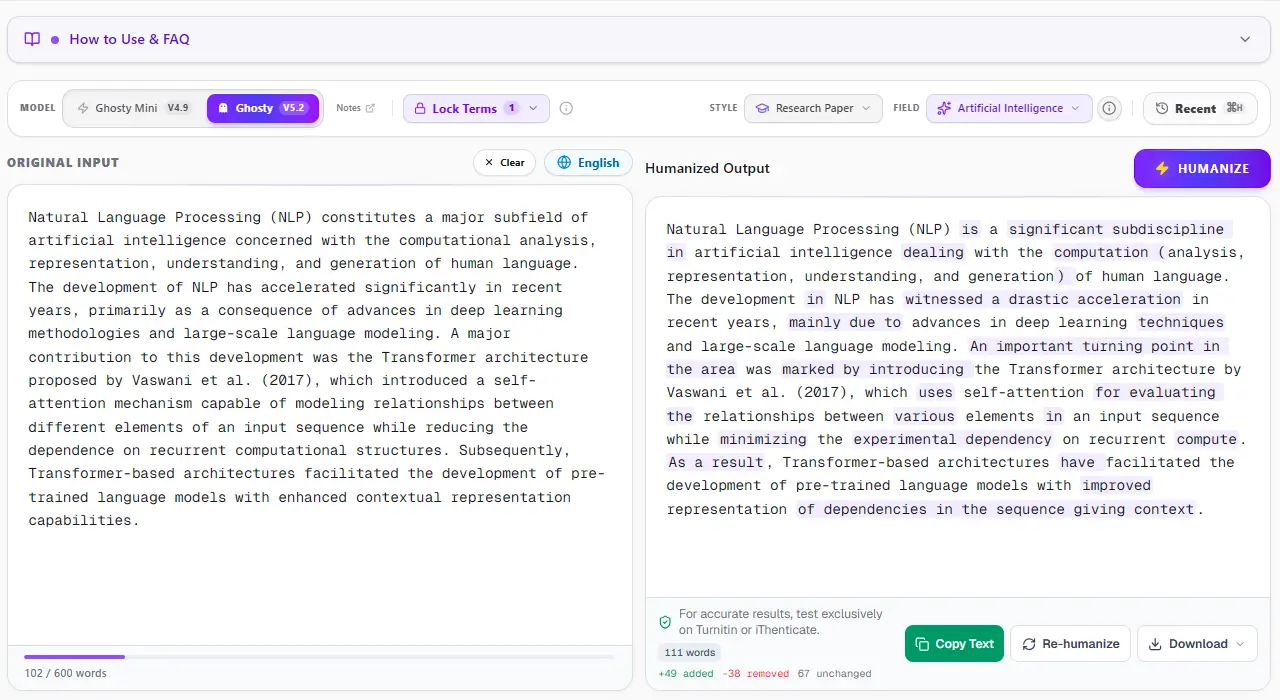
1. ThesisHuman Editor: Style, Field & Term Lock™ Technology
Unlike consumer-grade paraphrasers that blindly swap words with thesaurus synonyms, ThesisHuman allows researchers to select their exact Academic Style (Essay, Research Paper, Literature Review, Technical Report) and Academic Field (Computer Science, Engineering, Medicine, Physics). With Term Lock™, citations (APA, MLA, IEEE), LaTeX equations, and domain-specific terminology are cryptographically protected before sentence entropy is restructured.
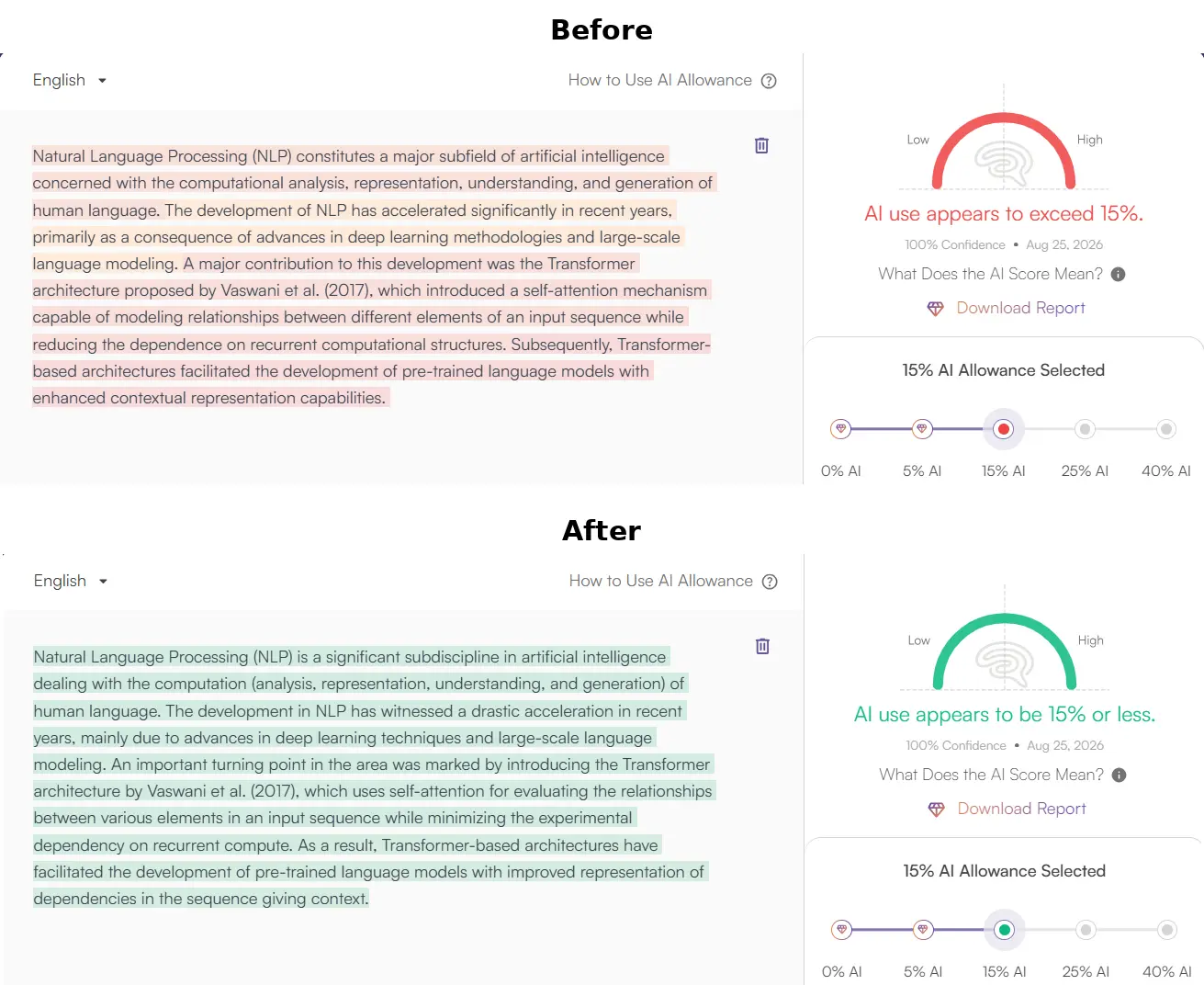
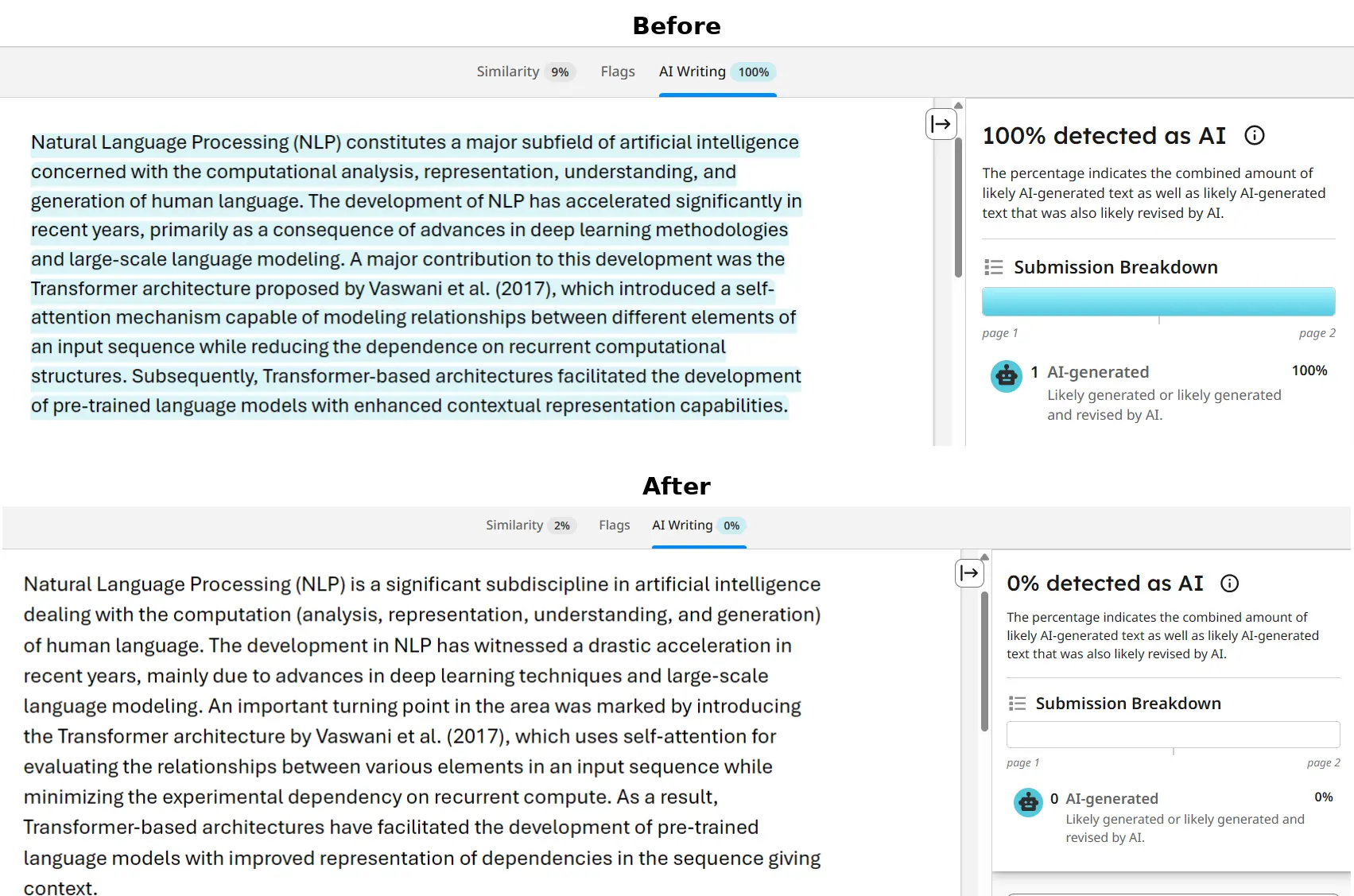
2. Turnitin & iThenticate Verification: 0% AI Detected
Turnitin and iThenticate scan submissions in overlapping 500-token blocks to analyze sentence predictability across paragraphs. When an unrefined AI draft is submitted, uniform cadence triggers an elevated AI Writing score. In the verified report below, a flagged graduate paper was processed through ThesisHuman, achieving a clean 0% AI detection score while preserving all formatted citations and technical parameters.
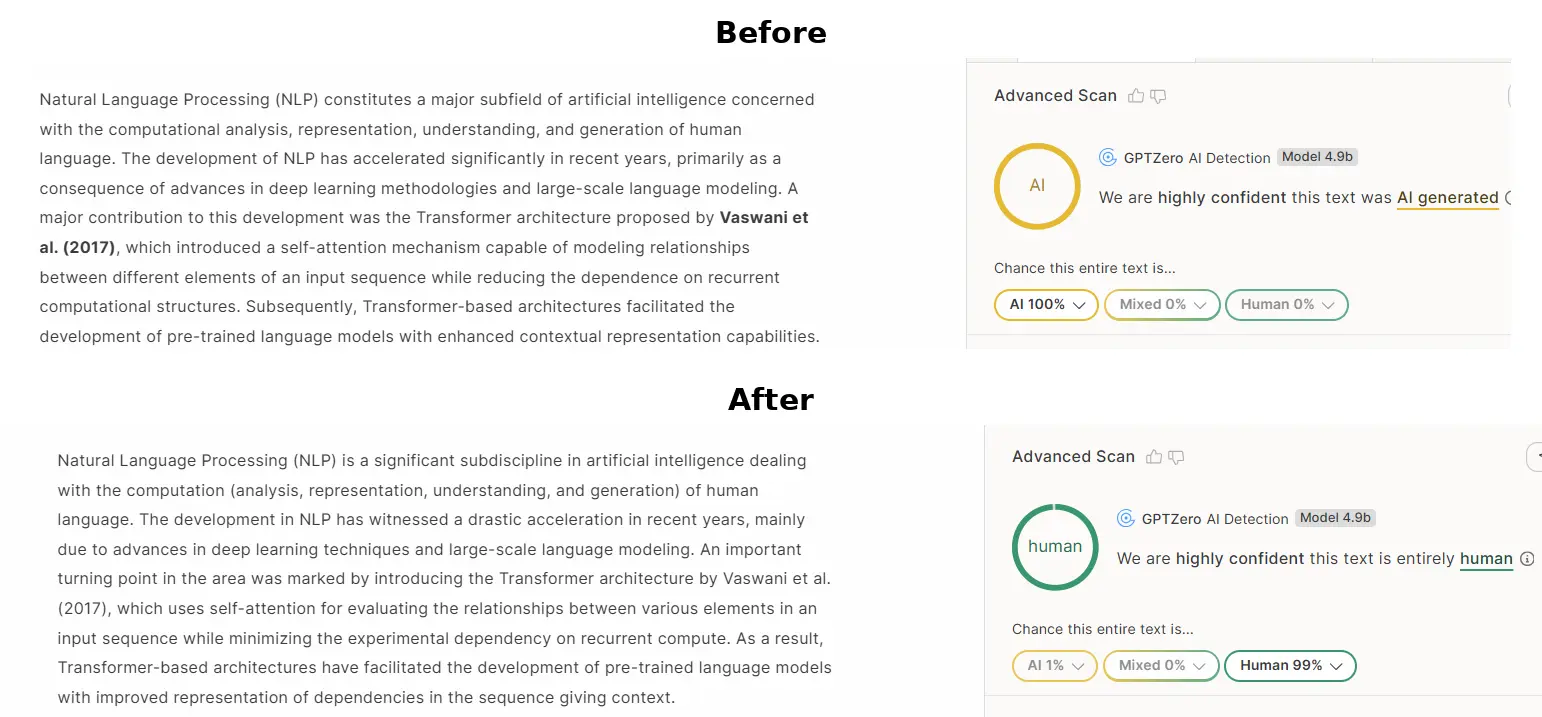
3. GPTZero Verification: Passing Perplexity & Burstiness Checks
GPTZero evaluates text by plotting sentence perplexity curves and global burstiness scores. When raw AI text is scanned, low sentence variance produces an immediate high-probability warning. ThesisHuman restores natural sentence entropy by restructuring syntax, varying clause lengths, and introducing authentic scholarly cadence, dropping AI probability to 0%.
4. Originality.ai Verification: 0% AI Confidence
Originality.ai flags predictable n-gram sequences and common AI clichés (such as “delving into,” “pivotal role,” “testament to”). ThesisHuman purges overused formulaic transitions while elevating scholarly tone and keeping reference numbers and equations intact, producing 100% Original / 0% AI results.