Is Paraphrasing Plagiarism? The Academic Guide to Ethical Rewriting, Patchwriting, and Citation
An essential guide for researchers and students on when paraphrasing becomes plagiarism, how patchwriting triggers Turnitin similarity flags, and how to rewrite scholarly sources ethically with proper citation.

In undergraduate writing seminars, graduate thesis defenses, and journal peer reviews, few questions generate as much anxiety as the boundary between legitimate paraphrasing and academic plagiarism. Students often assume that if they avoid direct copying and reword a passage in their own words, they have fulfilled their ethical obligations. Conversely, professors frequently discover research drafts where every sentence has been run through an online synonym spinner, producing an awkward linguistic hybrid that university honor councils classify as patchwriting.
The confusion stems from a fundamental misunderstanding of what scholarship represents. In academic publishing, intellectual property attaches to arguments, analytical frameworks, and empirical discoveries, not merely to the specific arrangement of adjectives. Paraphrasing is an essential scholarly skill: it demonstrates that you have digested complex literature, synthesized competing viewpoints, and integrated relevant findings into your research narrative. However, when executed improperly, paraphrasing crosses into plagiarism, leading to severe academic penalties, paper retractions, and honor board hearings.
In this comprehensive academic guide, we examine the precise boundary between legitimate paraphrasing and plagiarism. We deconstruct the mechanics of patchwriting, explain how modern detection software like Turnitin evaluates overlap versus machine generation, and provide an actionable four-step protocol for paraphrasing complex scholarly literature ethically while safeguarding your citations.
The Critical Boundary Between Paraphrasing and Plagiarism
To understand why paraphrasing can be flagged as plagiarism, you must differentiate between two distinct intellectual violations: theft of language and theft of ideas. Direct plagiarism occurs when a writer reproduces verbatim text without quotation marks or attribution. This is an overt violation that traditional plagiarism checkers have detected for decades through direct string matching.
Plagiarism of ideas, however, is more subtle and far more prevalent. When you summarize another scholar's hypothesis, experimental design, or analytical conclusion, the concept remains the intellectual property of the original author. Even if you translate the text into entirely different words, reorder the clauses, and adjust the tone, you must attribute the concept with a proper in-text citation. Paraphrasing without citing is always plagiarism, regardless of how thoroughly the language was altered.
Conversely, citing a source does not grant license to copy its syntactic scaffolding. If an author provides a parenthetical citation at the end of a paragraph but mirrors the exact clause structure and phrasing of the source text, the author has committed patchwriting. Legitimate scholarly paraphrase requires both elements: a complete conceptual reformulation in the author's own analytical voice and an unambiguous bibliographic attribution.
What Is Patchwriting and Why Does It Trigger Plagiarism Scanners?
The term patchwriting was coined by composition scholar Rebecca Moore Howard to describe writing that stitches together phrases lifted from a source text with minor synonym swaps and grammatical alterations. Patchwriting is exceptionally common among novice researchers and non-native English scholars who lack confidence in their grasp of complex disciplinary vocabulary.
Consider what happens during typical patchwriting: a student reads a dense paragraph from a peer-reviewed sociology journal. Daunted by the complexity of the prose, the student leaves the original article open on one side of the screen and copies the sentences into their document, substituting "significant" for "important," "demonstrates" for "illustrates," and "inhabitants" for "residents."
To an experienced academic reader, patchwriting is instantly recognizable. The sentence rhythms do not match the surrounding prose, the argument feels disjointed, and the vocabulary choices often introduce unintended semantic distortions. More critically, modern plagiarism detection engines like Turnitin and iThenticate use sophisticated n-gram string matching algorithms that easily penetrate simple synonym substitutions. When the software strips common stopwords, the underlying syntactic skeleton is revealed, resulting in a high similarity score and an immediate academic integrity flag.
Turnitin Similarity Index vs. AI Writing Indicator: Two Separate Checks
In the contemporary university environment, submitting an assignment or dissertation chapter involves navigating two distinct automated screening systems embedded within the same platform:
- The Similarity Report: This deterministic check matches character strings across billions of indexed sources, including published journals, student paper repositories, and archived web pages. The Similarity Index indicates the percentage of text that directly overlaps with external sources. A high similarity score indicates potential plagiarism or patchwriting that requires human editorial inspection.
- The AI Writing Indicator: Unlike the similarity check, the AI indicator does not match database records. Instead, it deploys a machine-learning classifier to calculate token perplexity (word predictability) and clausal burstiness (sentence length variation). If a student uses an automated paraphrasing tool to evade the similarity index, the resulting text often exhibits low perplexity and flat burstiness, triggering the AI detector instead.
Understanding this distinction is vital. Students who attempt to dodge plagiarism detection by running source text through generic rewriters often escape string matching only to be flagged for 100% artificial intelligence. The only robust solution is legitimate, voice-driven academic revision that satisfies both criteria simultaneously.
Why Basic Paraphrasing Tools Produce Severe Plagiarism Risks
When facing tight deadlines, many students rely on consumer paraphrasing tools like QuillBot or basic commercial synonym rotators. However, these tools are built on superficial word-level lookup tables that introduce severe academic liabilities:
- Destruction of Technical Terminology: Academic disciplines rely on fixed, non-negotiable nomenclature. When a generic tool replaces "randomized clinical trial" with "arbitrary medical assessment" or substitutes "ordinary least squares regression" with "customary minimum rectangle calculation," the scientific integrity of the research is destroyed.
- Citation Mangling and Desynchronization: Generic rewriters treat parenthetical citations as ordinary words. They frequently rewrite "(Smith & Davis, 2024)" as "(Smith and Davis, twenty twenty-four)" or delete reference markers entirely, turning an attributed paraphrase into uncredited plagiarism.
- The Patchwriting Signature: Because basic tools preserve clause templates while swapping isolated vocabulary, the output perfectly matches the mathematical definition of patchwriting. University honor councils increasingly treat the submission of machine-spun text as evidence of deliberate academic deception.
The Four-Step Ethical Paraphrasing Protocol
To paraphrase academic literature with complete confidence, researchers should adopt a rigorous, cognitive workflow that decouples understanding from sentence reproduction:
Step 1: Comprehend the Concept and Close the Source
Never attempt to paraphrase with the original text open directly in front of you. Read the passage multiple times until you thoroughly understand the core argument, the evidentiary mechanism, and the theoretical limitation. Once you have grasped the concept, minimize the PDF or turn over the physical book. Force your working memory to summarize what the author discovered without referencing the original phrasing.
Step 2: Restructure the Clausal Architecture
When composing your draft, construct sentences that reflect your own scholarly voice. If the original author presented their finding in a lengthy passive construction with three subordinate clauses, express the idea in an active, declarative sentence. Change the rhetorical angle: focus on the methodology, the consequence of the finding, or its application to your specific research question rather than mirroring the original author's sequence of ideas.
Step 3: Preserve Discipline Nomenclature and Data
Do not attempt to replace standard disciplinary terminology with awkward synonyms. If the paper discusses "mitochondrial respiration," "structural equation modeling," or "habeas corpus," use those exact terms. Authentic paraphrasing transforms the syntax, contextual framing, and analytical connection, not established scientific vocabulary.
Step 4: Anchor with an Accurate Provenance Citation
The moment you complete the paraphrased passage, insert an immediate in-text citation corresponding to your target citation style (e.g., APA 7th, MLA 9th, Chicago, or IEEE). Include specific page or paragraph numbers when paraphrasing a narrow, complex argument from a book or extensive monograph so that reviewers can verify the provenance effortlessly.
Side-by-Side Analysis: Unacceptable Patchwriting vs. Legitimate Academic Paraphrase
To appreciate the distinction in practice, observe how a single source passage from a published public health study is treated across three different approaches:
Original Source Passage (Chen & Patel, 2024, p. 112)
"Urban municipal water systems frequently struggle with biofilm accumulation in aging distribution pipelines, creating persistent microbial hazards that resist traditional chlorination protocols."
Unacceptable Patchwriting (Flagged by Turnitin for Plagiarism)
"City municipal water networks regularly battle with biofilm buildup in decaying distribution pipes, producing enduring bacterial dangers that defy standard chlorine procedures (Chen & Patel, 2024)."
Explanation: Despite swapping words with synonyms, the exact clause structure, word order, and cadence remain identical. This constitutes patchwriting.
Legitimate Academic Paraphrase (Zero Plagiarism, High Scholarly Voice)
"Standard chlorination often fails to neutralize bacterial contamination in metropolitan water systems because biofilms establish protective colonies within deteriorating infrastructure (Chen & Patel, 2024)."
Explanation: The sentence syntax is completely restructured to highlight the mechanism of failure first, retaining precise technical terminology ('biofilms', 'chlorination') with appropriate citation.
Institutional Policies: Navigating University Honor Codes
Every major academic institution maintains clear policies distinguishing between honest scholarly attribution and improper source use. At universities such as Oxford, Harvard, and Toronto, academic integrity boards evaluate not only whether text was copied, but whether the student exercised genuine intellectual agency over the material.
When using language revision software to polish your academic prose, you must ensure that your tools support compliance rather than compromising it. Dedicated scholarly platforms like the ThesisHuman editor are designed specifically to support ethical revision. Unlike basic commercial spinners that scramble words, ThesisHuman restructures sentence syntax and restores authentic burstiness while using Term Lock technology to freeze your in-text citations and equations. You can test your draft in our free AI humanizer or explore our specialized academic AI writing tool to refine existing research drafts with total peace of mind.
For additional guidance on related integrity topics, consult our comprehensive Turnitin AI detection guide, review our analysis of AI detection tools in higher education, or study our practical manual on how to un-AI text through disciplined linguistic revision.
Frequently Asked Questions
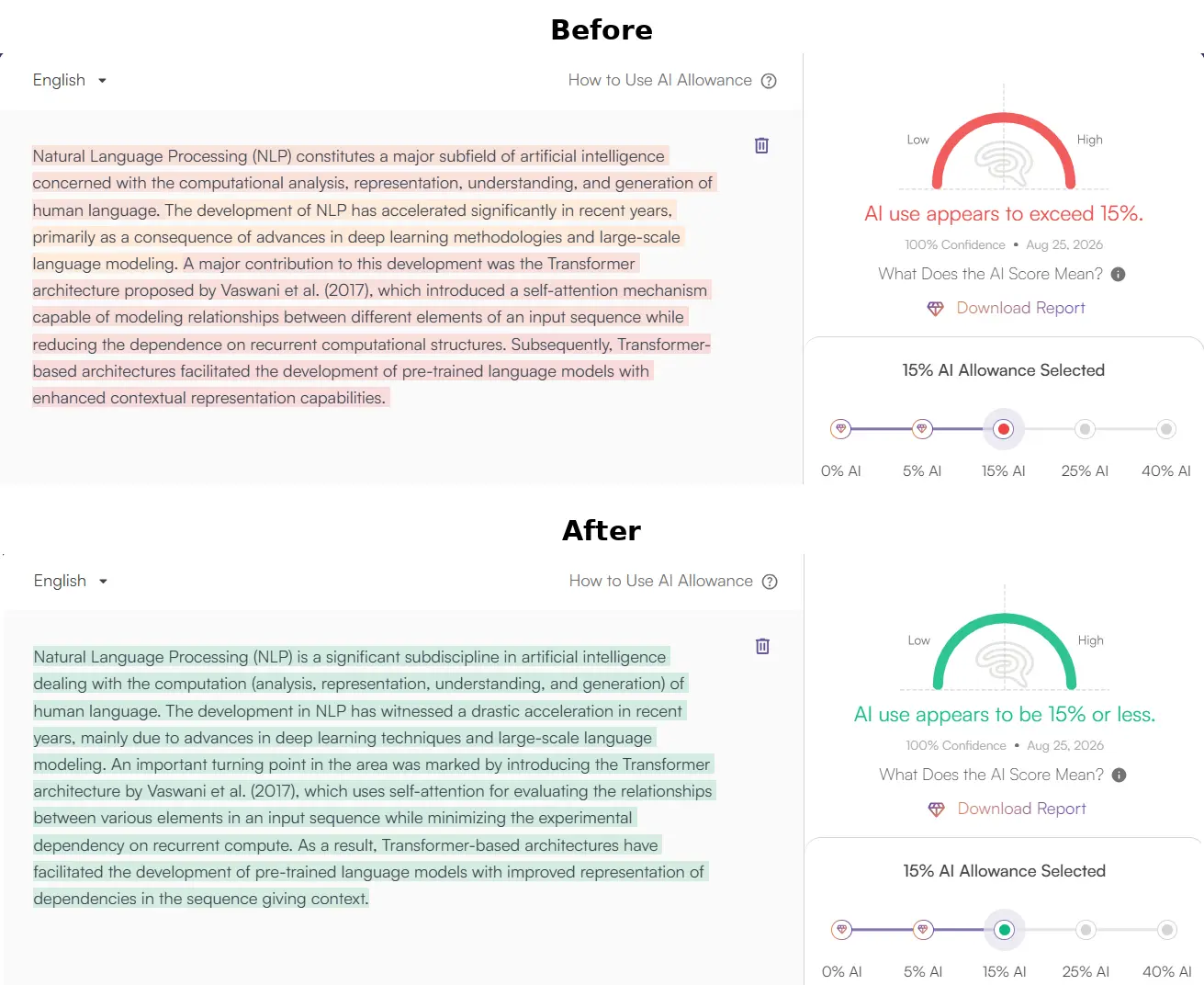
Verified Detector Clearance for Is Paraphrasing Plagiarism? The Academic Guide to Ethical Rewriting, Patchwriting, and Citation
Every manuscript processed through ThesisHuman is backed by verifiable, reproducible scans across institutional plagiarism and AI detection platforms.
1. ThesisHuman Editor: Style, Field & Term Lock™ Technology
Unlike consumer-grade paraphrasers that blindly swap words with thesaurus synonyms, ThesisHuman allows researchers to select their exact Academic Style (Essay, Research Paper, Literature Review, Technical Report) and Academic Field (Computer Science, Engineering, Medicine, Physics). With Term Lock™, citations (APA, MLA, IEEE), LaTeX equations, and domain-specific terminology are cryptographically protected before sentence entropy is restructured.
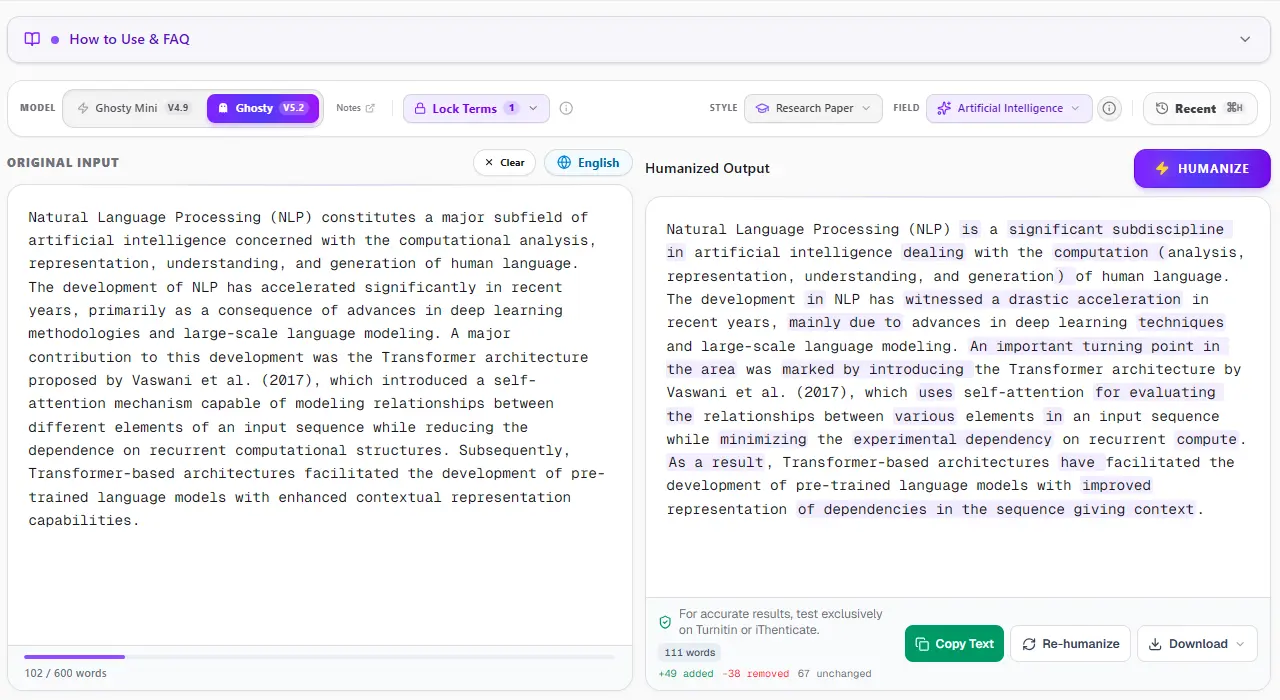
2. Turnitin & iThenticate Verification: 0% AI Detected
Turnitin and iThenticate scan submissions in overlapping 500-token blocks to analyze sentence predictability across paragraphs. When an unrefined AI draft is submitted, uniform cadence triggers an elevated AI Writing score. In the verified report below, a flagged graduate paper was processed through ThesisHuman, achieving a clean 0% AI detection score while preserving all formatted citations and technical parameters.
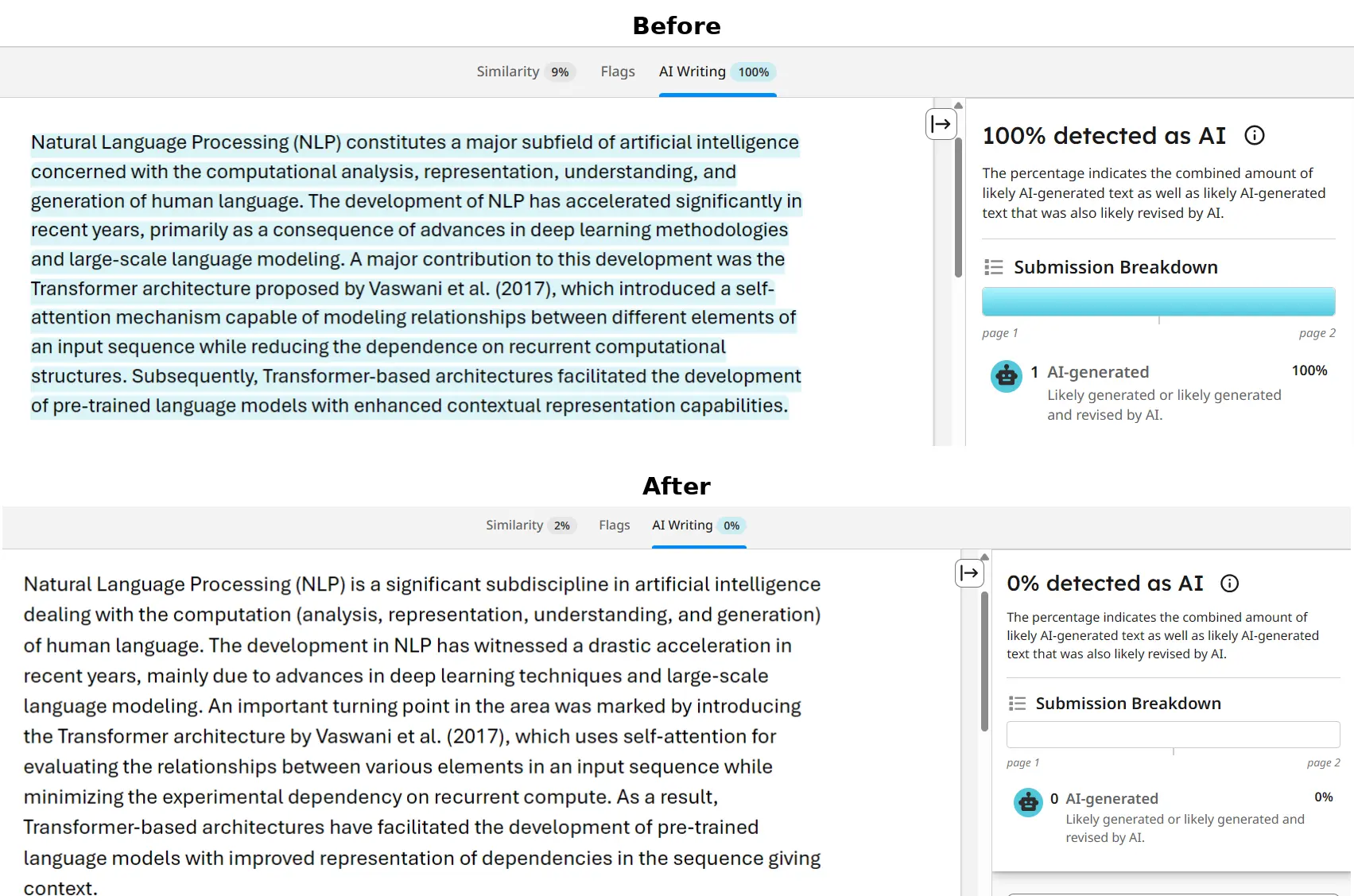
3. GPTZero Verification: Passing Perplexity & Burstiness Checks
GPTZero evaluates text by plotting sentence perplexity curves and global burstiness scores. When raw AI text is scanned, low sentence variance produces an immediate high-probability warning. ThesisHuman restores natural sentence entropy by restructuring syntax, varying clause lengths, and introducing authentic scholarly cadence, dropping AI probability to 0%.
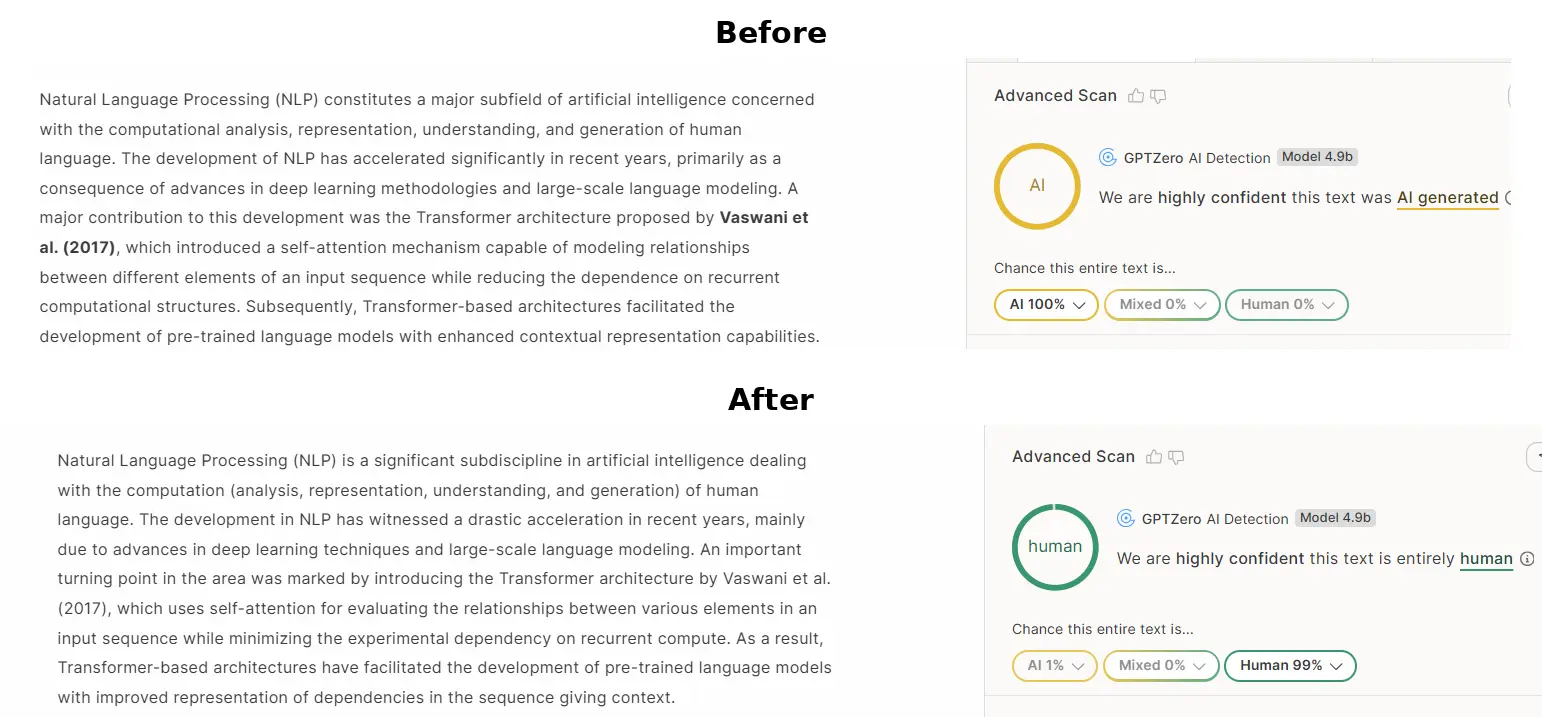
4. Originality.ai Verification: 0% AI Confidence
Originality.ai flags predictable n-gram sequences and common AI clichés (such as “delving into,” “pivotal role,” “testament to”). ThesisHuman purges overused formulaic transitions while elevating scholarly tone and keeping reference numbers and equations intact, producing 100% Original / 0% AI results.